Heavy Metals and Nitrate in Microgreens: What Has Actually Been Measured
Cal HewittPublished Checked
- health
- safety
- nutrition
- evidence
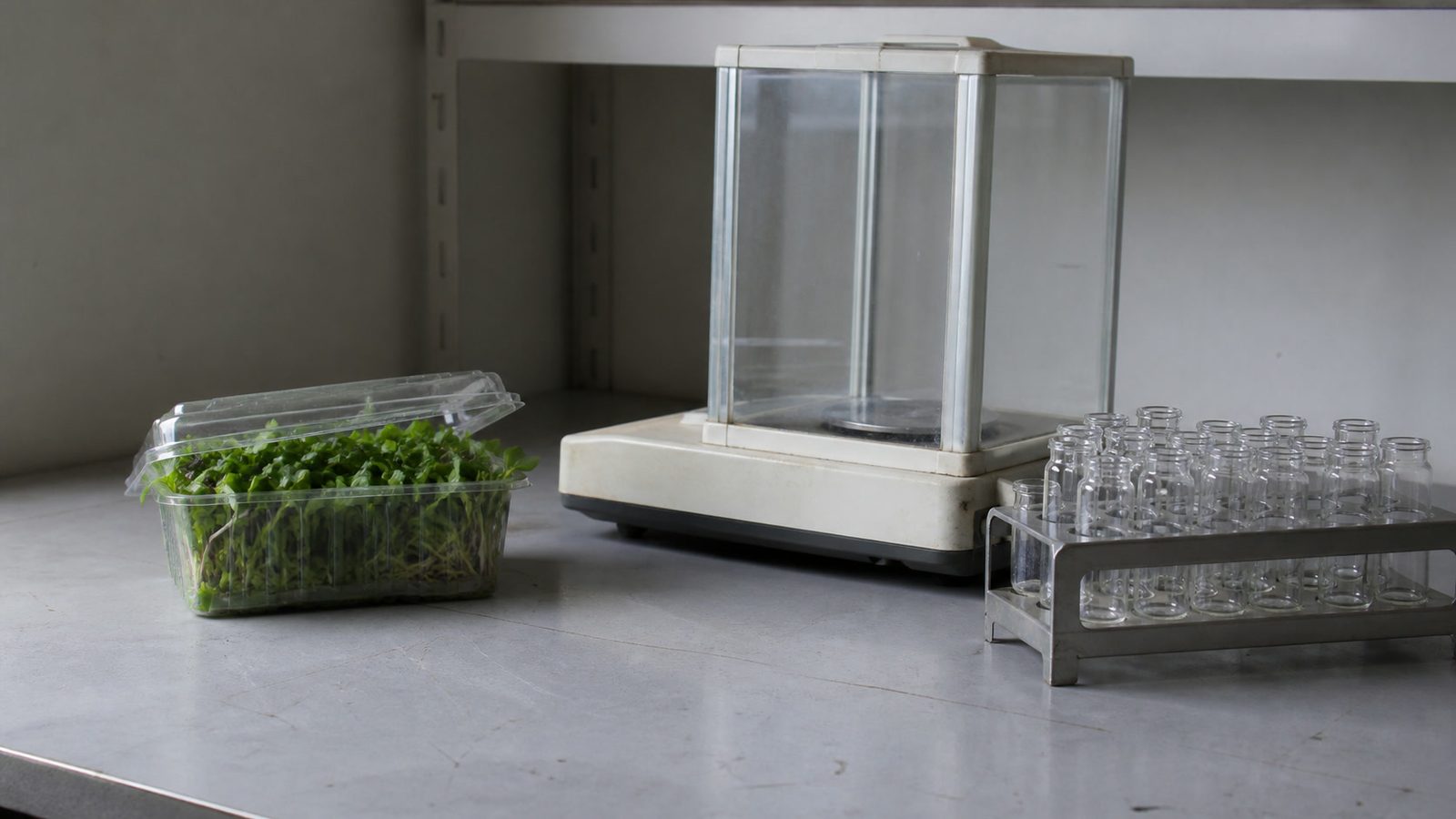
No one has tested microgreens you can buy for heavy metals or nitrate. Three uncommon species grown in one greenhouse have been assayed for toxic metals, and all came in at low concentrations. Nitrate has been measured in a handful of crops, but in a unit that has to be converted before it can be held against a legal limit.
That conversion changes the answer more than anything else here, so it comes first.
Nitrate results are dry weight, and the limits are fresh weight
A 2024 assay measured nitrate in the young shoots of three crops and reported 2,712 to 11,985 mg per 100 g of DRY weight. The European Union's maximum levels for nitrate in leafy vegetables are set on FRESH weight: 3,500 mg/kg for fresh spinach, 2,000 to 5,000 for lettuce depending on type and season, and 6,000 to 7,000 for rucola.
Those two sets of numbers look like they belong on the same axis. They do not. A microgreen is mostly water, so converting between them means dividing by the crop's dry matter, and the dry matter is not the same for any two crops.
Hover or tap a row to highlight it.
| Dry matter assumed | Which crop it came from | The same result, as mg/kg fresh weight |
|---|---|---|
| 3.85 percent | Broccoli, the lowest of 17 species measured | 1,045 to 4,620 |
| 5.69 percent | The average across those 17 species | 1,543 to 6,819 |
| 9.43 percent | Sunflower, the highest of the 17 | 2,559 to 11,307 |
The bottom of that table is eleven times the top. One published measurement, three defensible assumptions, and an answer that lands below every EU limit or above all of them depending on which one you pick.
This is arithmetic on two published figures rather than anything anybody measured, and it shows why the conversion should not be attempted without the crop's own dry matter. The dry-matter range is from a separate 17-species study and the nitrate figures are from three species that were not among them.
So, there is no figure yet to hold against a limit. Nobody has published nitrate in a commonly sold microgreen on a fresh-weight basis against a limit that applies to it, and microgreens are not listed as a category in the EU nitrate regulation at all.
One paper contradicts itself on exactly this point. A 2022 study of red cabbage, broccoli, mizuna, green mustard and pak choi tabulates nitrate at 85.8 to 198 mg/kg fresh weight, and its own prose calls the same 165 figure "mg per 100 g", which is a tenfold difference in the same document. Its table also carries an unexplained "allowed residue" of 300 that matches no regulation quoted here. That is a discrepancy inside the source, so neither of its figures should be quoted without saying so.
The metals: three species, one greenhouse, one run
The only microgreen assay with published toxic-element numbers covered nigella, safflower and camelina, grown in a greenhouse and harvested at two stages.
Hover or tap a row to highlight it.
| Element | Range measured | Highest in |
|---|---|---|
| Cadmium | 0.011 to 0.119 | Safflower, second harvest |
| Lead | 0.006 to 0.083 | Nigella |
| Arsenic | 0.004 to 0.018 | Nigella |
| Chromium | 0.011 to 0.041 | Nigella, second harvest |
Three species is three species. These are crop and harvest differences inside one greenhouse run, not a ranking of microgreens and not a market survey. None of the three is among the crops most people grow.
Two other studies report non-detects and neither can be read as a zero. A 2016 paper analyzed cadmium and lead across 30 Brassicaceae varieties and detected neither, but the accessible abstract publishes no concentration and no detection limit, so there is no number to use. A 2025 hemp study reports lead, mercury, chromium and arsenic below detection at limits of 0.5, 0.1, 1 and 0.1 mg/kg dry weight respectively. Below a detection limit means below that limit, which is a different statement from absent.
And the comparison people actually want does not exist. No study has grown the same crop to microgreen and to maturity under matched conditions and assayed both for cadmium, lead, arsenic and mercury. The stage comparisons that exist are for nutritional minerals like copper, iron and manganese, and they show no uniform direction.
Where it could come from, and what has been ruled in
Nothing has been ruled out, and only one route has been demonstrated experimentally.
The growing medium is a documented route under deliberate loading. A coco coir bioassay amended coir with cadmium and lead at 0 to 60 mg/kg and with arsenic, cadmium and lead at 0 to 5 mg/kg, then grew hemp, mustard and kale seedlings. Cadmium was taken up most readily, and mustard accumulated more arsenic and cadmium than kale or hemp. That study was designed because metals have been found in greenhouse substrates.
Read it precisely. It shows that a contaminated medium transfers to the crop, in a dose-responsive way, with a real difference between crops. It does not show that ordinary coir contains those metals. No representative assay of commercial coir, peat, hemp mats or fabric mats has ever been published with figures against a food-relevant limit. "Coir is contaminated" is an overstatement. "Coir belongs in any trace-back assay" is supported.
Seed, water and fertilizer are all plausible and none is established. The 2024 assay documented its input water at cadmium and chromium below 0.001 mg per cubic decimeter and nitrate at 16.3, and its fertilizer recipe, but it did not assay the seed and did not attribute any shoot metal to any input. Apportioning would take a mass balance across seed lot, unused substrate, irrigation water, nutrient solution and harvested shoot, and nobody has run one.
Pesticide residue is a complete blank. No multi-residue assay of retail or experimental microgreens was found. Extension guidance says to use only products approved for the crop and follow the label, which is advice rather than a measurement.
What raises and lowers nitrate, where it has been tested on this crop
Two things have real microgreen-specific evidence behind them.
Nitrogen form and supply. A 2020 study manipulated the ammonium to nitrate ratio and the nutrient solution strength in broccoli, broccoli raab and cauliflower microgreens and found effects on nitrate that depended on the genotype.
Light. Greater light intensity produced larger leaf area and lower nitrate in kohlrabi, mustard, red pak choi and tatsoi.
Harvest timing does not have a direction. In the 2024 assay a later harvest LOWERED nitrate in nigella, from 5,159 to 2,712 mg per 100 g dry weight, and RAISED it in both safflower and camelina. So, there is no reason to move your harvest day earlier or later to manage nitrate: the one study that tested it found opposite effects in different crops.
The rest of the list is borrowed. Insufficient sunlight, acidic pH, low moisture, magnesium or molybdenum shortage and herbicide use are all associated with higher nitrate in the broad plant literature. They have not been tested crop by crop in microgreens, and they should be read as mature-crop inference until they are.
What this means if you eat them
Nitrate is not simply a contaminant. EFSA publishes an acceptable daily intake of 3.7 mg of nitrate per kilogram of body weight per day. Nitrate is regulated in some leafy vegetables because exposure depends on concentration and on the whole diet, not because a nitrate measurement is itself a harm finding. Dietary nitrate from vegetables is also the subject of a substantial literature on blood pressure, which cuts the other way.
And concentration is not dose. There is no authoritative microgreen serving size. A published biofortification study used a 10 gram fresh portion; a seller suggests 20 to 40 grams of broccoli microgreens. Those are an illustrative portion and a retail claim, not a consumption survey.
In short: three species have been assayed for toxic metals, all at low concentrations, in one greenhouse run. Nitrate has been measured in a handful of crops in a unit that cannot be compared to the applicable limits, and microgreens are not in those limits anyway. A contaminated medium is a demonstrated route in an experiment that deliberately contaminated the medium. Nobody has surveyed anything you can buy.
What nobody has measured
- Any toxic-metal survey of microgreens sold at retail, anywhere, at any scale.
- Nitrate on a fresh-weight basis in the crops people actually grow, against a limit that applies to them.
- A microgreen against its own mature plant for cadmium, lead, arsenic or mercury under matched conditions.
- The metal content of ordinary commercial growing media, which is the one route shown to work experimentally.
- A pesticide residue assay of any kind.
- A source apportionment, so no one can say whether any measured metal came from the seed, the medium, the water or the feed.
Terms on this page
Tap a term to see what it means.
Dry weight. The mass of a sample after its water has been removed. Most laboratory chemistry is reported this way.
Sources
Opened 2026-08-12. The dry-weight to fresh-weight conversion table is arithmetic performed for this page on published figures from two separate studies, and is labeled as such above.
- Kapusta-Duch and colleagues, elemental and nitrate composition of nigella, safflower and camelina young shoots, 2024 (PDF) - the cadmium, lead, arsenic and chromium ranges, the nitrate range of 2,712 to 11,985 mg per 100 g dry weight with nitrite not detected, the reversal of the harvest-timing direction between nigella and the other two, the input water analysis, the fertilizer recipe, and the statement that the analyses were performed on freeze-dried material.
- Commission Regulation (EU) 2023/915, maximum levels for certain contaminants - the fresh-weight nitrate maxima of 3,500 mg/kg for fresh spinach, 2,000 to 5,000 for lettuce and 6,000 to 7,000 for rucola, and the absence of any microgreen category from the table.
- EFSA on nitrate - the acceptable daily intake of 3.7 mg of nitrate per kilogram of body weight per day.
- Di Gioia and colleagues, 17 microgreen species, 2023 - the dry matter range of 38.55 g/kg fresh weight in broccoli to 94.34 in sunflower with an average of 56.90, used here only as the divisor in the conversion table and explicitly not as a measurement of the three assayed species.
- Vietnam Journal of Biotechnology, nitrate in five microgreen crops on four substrates, 2022 (PDF) - the tabulated 85.8 to 198 mg/kg fresh weight, the internal contradiction where the prose calls the same 165 figure mg per 100 g, and the unexplained allowed residue of 300.
- Coco coir heavy metal bioassay, record and abstract - coir amended with 0 to 60 mg/kg cadmium and lead and 0 to 5 mg/kg arsenic, cadmium and lead, hemp, mustard and kale seedlings, cadmium taken up most readily, and mustard accumulating more arsenic and cadmium than kale or hemp. The medicinal-cannabis thresholds it compares against are 0.2 mg/kg for arsenic and cadmium and 0.5 for lead, and are not a microgreen food limit.
- Microgreens review, 2022 (PDF) - the light intensity result lowering nitrate in kohlrabi, mustard, red pak choi and tatsoi, the account of the microgreen against mature-plant comparisons for copper, iron and manganese showing no uniform trend, and the 10 gram fresh portion used in a selenium biofortification study.
- Brassica microgreen nutrient solution study, 2020 - the ammonium to nitrate ratio and solution strength experiment in broccoli, broccoli raab and cauliflower, with genotype-dependent effects on nitrate. The page returned a CAPTCHA on direct open, so no figures beyond the design are taken from it.
- University of Nevada Extension, microgreens (PDF) - the guidance to use only pesticides approved for the crop and follow the label, which is the closest thing to residue guidance that exists.
- Microgreens of Brassicaceae, mineral composition of 30 varieties, 2016 - cadmium and lead analyzed across 30 varieties and neither detected. The full text was blocked, and the accessible abstract gives neither a concentration nor a detection limit, so it is reported here as a non-detect without a number.
- Hemp microgreen study, 2025 - lead, mercury, chromium and arsenic below detection limits of 0.5, 0.1, 1 and 0.1 mg/kg dry weight. The full text was blocked and the detection limits are what the accessible record supplies.
- Piedmont Microgreens, broccoli retail - practice only, the 20 to 40 gram suggested portion.
Keep reading
The journal
Are Microgreens Anti-Inflammatory? What the Research Really Says
Nobody has fed a person microgreens and measured their inflammation. And when researchers pooled ten broccoli sprout trials, the combined result came out at something that could be zero.
Read Are Microgreens Anti-Inflammatory? What the Research Really SaysThe journal
Best Microgreens for Kidney Health: Potassium by the Serving
See measured potassium and phosphorus for the best microgreens for kidney health, from lowest to highest, plus what your renal dietitian needs to know.
Read Best Microgreens for Kidney Health: Potassium by the ServingThe journal
Do Microgreens Help You Lose Weight? Two Claims, One Answer
One of these claims is probably true and has nothing to do with microgreens. The other was tested by injecting a compound into mice. Here is which is which.
Read Do Microgreens Help You Lose Weight? Two Claims, One AnswerThe journal
Do Microgreens Really Have 40 Times the Nutrients?
The number is real. It belongs to one nutrient in one crop. Used for microgreens as a category it is wrong in both directions, because some pairs run far above 40 and for at least one compound the mature plant is the more concentrated of the two.
Read Do Microgreens Really Have 40 Times the Nutrients?