At a glance
Nothing about it is demanding except the seed, which is fine enough that uneven distribution and surface water make it clump and wash, and the blackout habit every other crop teaches you is actively wrong here.
- Botanical name
- Lactuca sativa
- Also sold as
- Lettuce microgreens seeds, Salad Bowl Green, Red Sails, Little Gem, Grand Rapids, Waldmann's Green
- Family
- aster
- Difficulty
- Moderate
- Days to harvest
- 8 to 16 days
- Harvest window
- 4 to 7 days
- Seed per 1020 tray
- No published figure
- Soak
- None
- Blackout
- 0 to 1 days
- Germination temperature
- 50 to 80 °F
- Yield per 1020 tray
- No published figure
- Regrows after cutting
- No published figure
- Mold risk
- Medium
- Hull shedding
- Not applicable
- Shelf life
- 4 to 6 days
- Eaten as
- raw
- Seed cost per tray
- No published figure
Any field name above ranks every variety by it. No published figure means we researched it and nobody has established one, which is different from not yet researched. Every figure here is sourced at the bottom of the page. Compare every variety side by side.
Almost every microgreen wants the tray covered and kept dark for a few days. Lettuce is the crop where that instruction is wrong, and it is the one thing a competent grower of everything else will get wrong.
Lettuce seed is light-responsive, so the crop-specific guidance is a clear humidity lid and indirect light, and if you use a dark cover at all, twelve to twenty-four hours against the two to eight dark days a brassica wants. Treating lettuce like a stacked, blacked-out brassica does not merely slow it down: the crop-specific source reports it reduces or blocks germination, and cold plus darkness together is the worst combination.
It is not the only crop like this. Mint and purslane are light-responsive too, and mint is the strictest of the three. Sorrel also takes no blackout, though for a different reason: its supplier simply lists none, and nothing says its seed needs light. Lettuce tolerates twelve to twenty-four hours under a dark cover and purslane will take about the same; mint’s crop guide reports minimal or no germination when the seed is covered at all. Three unrelated families, Asteraceae, Lamiaceae and Portulacaceae, arriving at the same requirement, which is a stronger pattern than any one of them.
What growers are saying right now
Sampled from public posts and videos, 10 July to 9 August 2026. Every line links what it is quoting. How often something is repeated is not evidence that it is true, so every line also says what the sources actually establish.
Broccoli and bok choy and lettuce microgreens do not have all that much flavor
Circulating Said here at 46,767 views, in a beginner crop-picking video, with lettuce named explicitly as one to skip
Correct, and this page agrees with it. Lettuce is close to neutral by design and nothing in the tray changes that. What the criticism misses is that mildness is a job: it is a salad BASE rather than a flavor, and it is the reason this crop has an unusually forgiving harvest window. Nothing sharpens as it sits, so nothing punishes you for cutting late. Why the window is four to seven days
A German supermarket is growing 900,000 bags of salad on its roof and selling it downstairs
Circulating This reel at 47,268 views and 4,776 likes
The best illustration of what lettuce is actually for, and of the problem with growing it in a 1020. Lettuce is a VOLUME crop, and the world is extremely good at supplying it: nobody has a lettuce shortage, and 900,000 bags off one roof is the scale you are competing with. A tray of lettuce microgreens has to be sold on tenderness and on being cut minutes ago, never on filling a bowl. Is it worth growing
If your lettuce pulls a Usain Bolt on you, here is what to do
Circulating A bolting explainer at 8,266 views, one of eight clusters in this sweep and all eight about GARDEN lettuce
Bolting is the garden lettuce failure, and it is one thing a tray cannot do, because the crop is cut a fortnight before it could think about it. It also shows the shape of the record for this crop: nobody at all is discussing lettuce as a microgreen, so expect to work from the supplier guidance rather than from a community.
What it is, and how to tell you grew it right
Lettuce microgreens are seedlings of Lactuca sativa, an Asteraceae, the same family as endive and fennel and nothing like a brassica. Six named cultivars are sold for the microgreen stage, and they are real types rather than relabels: Salad Bowl Green is a frilled loose-leaf, Little Gem is a miniature romaine, Red Sails brings a red tinge, Grand Rapids and Waldmann's Green are green and uniform.
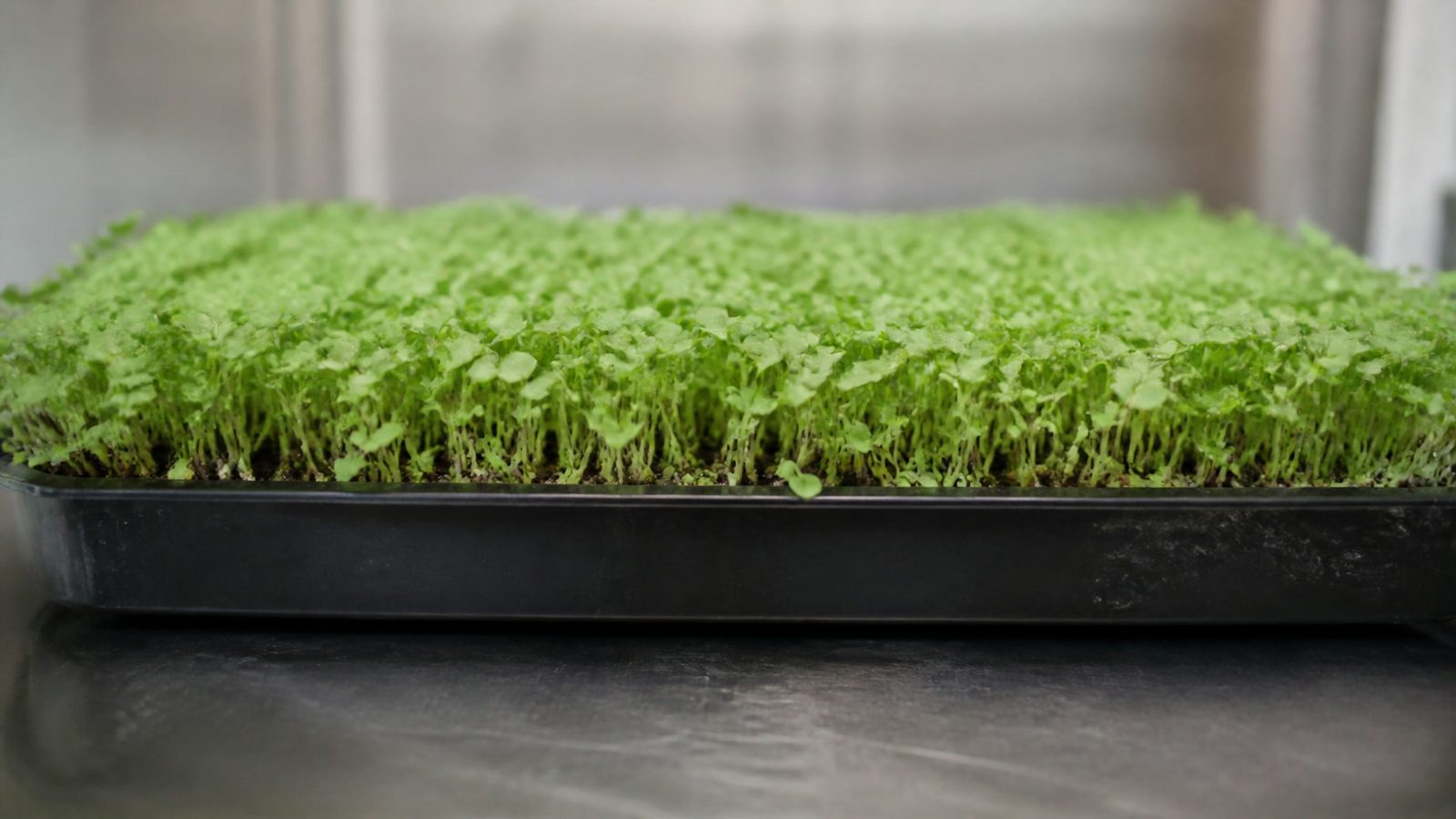
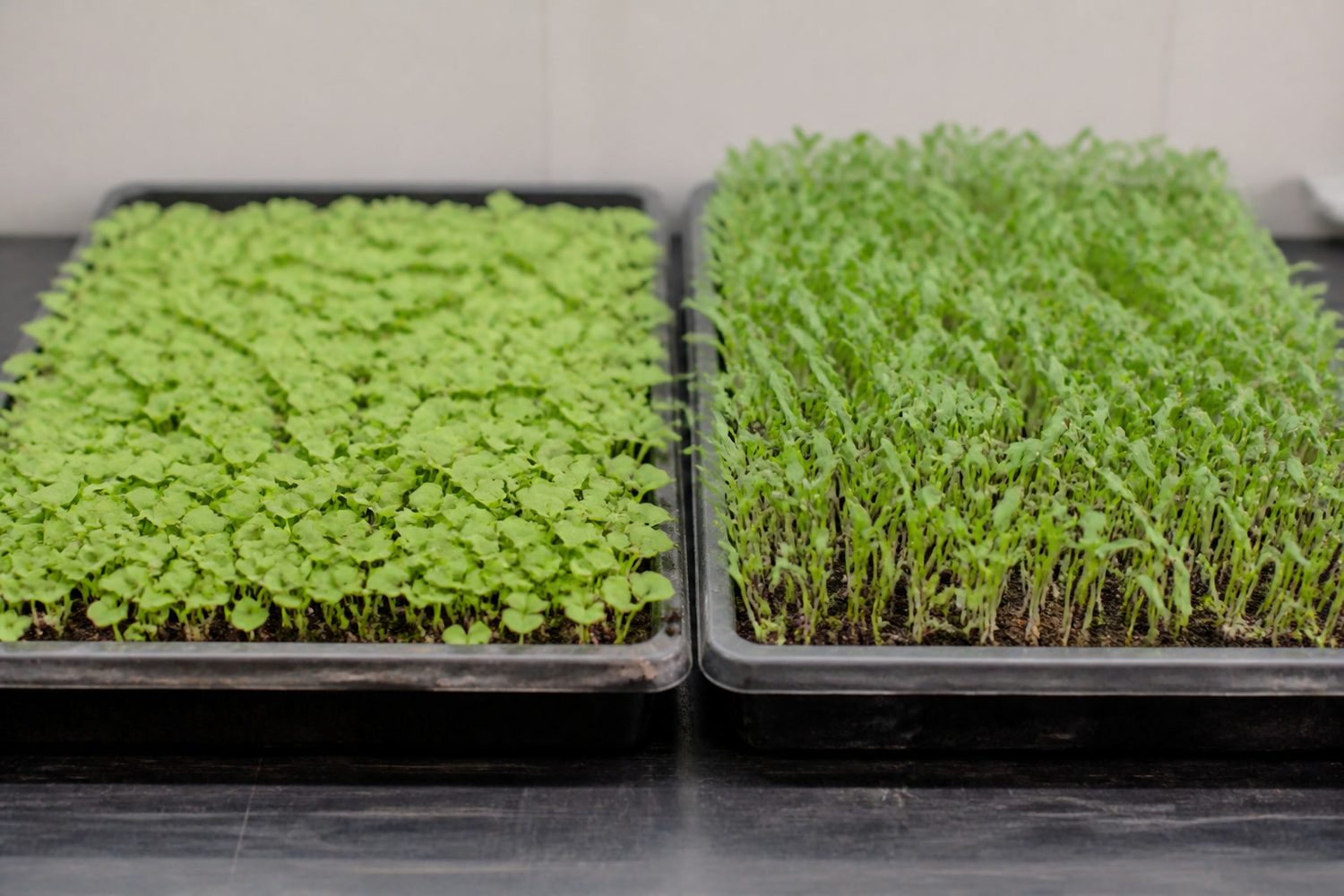
A correct tray is a soft, even carpet of pale green, delicate, recognizably lettuce-shaped leaves on fine short stems. It reads softer and less upright than any brassica stand.
Identification is by flavor, not by sight. At cotyledon stage lettuce is easily confused with arugula and the fine-seeded brassicas, and the reliable tell is the absence of brassica character: no pepper, no mustard, nothing sharp. If it bites, it is not lettuce. No source opened here offers a universal visual key, so taste a stem rather than squinting at a photograph.
What it tastes like, and what to do with it
Mild, softly sweet, and close to neutral, with very little aroma. It is a tender salad base rather than a flavor, and the beginner video quoted above is right that it has less character than most of this directory.
That makes it the crop you use for texture and volume in a raw dish: a salad base, a sandwich or toast layer, a filling in a taco or a roll, a cold garnish, or alongside eggs or fish. It wilts and slips on contact with heat, so it goes on last or not at all.
The flavor only changes in one direction and only if you wait: past the ideal cut it becomes denser, coarser and can pick up a faint mature-lettuce bitterness. Cut earlier if you or your customers are sensitive to that.
Who will not like it: anyone wanting mustard heat, radish bite, or an aromatic garnish that announces itself, and anyone expecting the crunch of a mature lettuce heart. This is soft, and softness is the product.
Growing it: only what differs from the standard method
Everything general about trays, medium, light and watering is on the standard tray method for growing microgreens. Lettuce has one delta that matters enormously and two that are ordinary.
Do not black it out. Use a clear lid or film and indirect light. If you use a dark cover at all, cap it at twelve to twenty-four hours, and take it off when most of the seed has germinated. This is the crop's defining instruction and it is the exact opposite of what almost every other crop wants. The mechanism is that lettuce seed is light-responsive, and the reported consequence of getting it wrong is reduced or blocked germination rather than a merely leggy tray.
Sow the fine seed evenly on a leveled surface and do not soak it. Lettuce seed is very small, and the failure mode is clumping and washing rather than anything dramatic: too much surface water sticks seeds together and gives you an uneven stand with an airless canopy.
Keep it cool. 61 to 72°F is the crop-specific microgreen optimum. Above about 79°F the seedlings go soft and watery, and above 80°F lettuce seed goes dormant rather than merely slowing. That is the same behavior endive shows above 77°F, and those two are the only microgreens with a documented temperature at which the seed simply declines to start. Both are Asteraceae, which is unlikely to be a coincidence.
Then bottom water and give it airflow, as usual. Nothing establishes a lettuce-specific light or water requirement beyond the germination point.
A lettuce tray, day by day
- 1
Day 0, sow dry
Fine seed spread evenly on a leveled, pre-moistened bed. No soak. Do not bury it.
- 2
Days 0 to 1, CLEAR lid
A humidity cover and indirect light, not a blackout. If you use a dark cover at all, 12 to 24 hours maximum. This is the step that goes the other way round on almost every other crop.
- 3
Days 2 to 5, germination
Uncover once most seed is up. Hold 61 to 72°F and stay under 80, where the seed goes dormant rather than slow.
- 4
Days 5 onward, light
Bottom water. The canopy is low and soft, so airflow matters more than light does.
- 5
Days 7 to 10, early or optimal
The tender cut.
- 6
Days 10 to 14, acceptable
Bigger and denser. Still the product.
- 7
Days 14 to 18, overripe
Coarser stems and a faint bitterness. You had four to seven days to decide, which is longer than almost any crop gives you.
What goes wrong with lettuce specifically
The blackout mistake, and it is the one that matters. Treating lettuce like a stacked brassica reduces or blocks germination, and low temperature plus darkness together is the worst case. If a lettuce tray simply fails to come up, check what you covered it with before you blame the seed.
Clumped, uneven sowing. From too much water on a very fine seed. It sticks together, washes into low spots, and produces bare zones beside dense ones with no air moving through them.
Damping-off. Pythium and Rhizoctonia under wet conditions, on a dense low canopy. Warm, unventilated trays are reported to give stuck stems and mold quickly. Root hairs sit on individual roots at the medium and do not bridge; growth that webs across stems and medium with soft collapsing tissue is the disease.
And late cutting, which on this crop is unusually forgiving. Enlarged leaves, coarser stems, a possible faint bitterness. You can see expanding true leaves before you cut. If baby leaf was what you wanted, it is not a failure at all; the same tray at 21 days is sold as baby green.
Nutrition, and what is actually established
The claim that microgreens concentrate nutrition falls apart on a lot of crops. Chia: germination spends the seed's fat. Celery: several minerals came out higher in the mature leaf. Flax: both directions at once. Lentil: the answer moves with genotype and location.
On lettuce it holds up, and that is worth knowing too.
A peer-reviewed comparison of eleven lettuce varieties, six Valencian landraces and five commercial, measured them at microgreen, baby and adult stages and found phenolics roughly five times higher in the seedlings than in adult lettuce across varieties, and vitamin C about 41 percent higher at seedling stages. It also emphasized strong cultivar and stage effects, which is the same caveat lentil's study carried.
A separate study grew Lactuca sativa 'Parris Island Cos' on vermicompost and hydroponic pads for seven days and reported mineral content on a dry-weight basis, for example phosphorus at 13.34 mg/g and potassium at 13.92 mg/g on the hydroponic pads.
There is still no USDA record for lettuce microgreens, and mature lettuce values are not a substitute. What there is, on this crop, is a properly designed stage comparison that points the way the marketing says it should. The answer depends on the crop and on the compound, and on lettuce the seedling genuinely wins on the things that were measured.
Storage is a small bonus in the same direction: a seven-microgreen storage experiment found quality declined over eight days and lettuce retained its nutrients best of the group.
Which seed to buy
Six cultivars are sold for microgreen use and none has a measured yield or stem-length comparison behind it, so choose on leaf shape and color: Salad Bowl Green for frilled loose leaf, Red Sails for a red tinge, Little Gem for miniature romaine, Grand Rapids or Waldmann's Green for uniform green.
Specify untreated seed sold for microgreens or food use, with lot and germination information, and refuse treated field seed.
The shelf is well supplied. Lettuce microgreen seed on Amazon checked on 2026-08-09 returns 45 lettuce listings on the first page with 18 mentioning microgreens, including a 1 lb bag at $29.76 holding about 400,000 seeds and named cultivars sold in ounce quantities. True Leaf lists generic lettuce microgreen seed at $26.30 a pound. Either way this seed is inexpensive per pound, and lettuce seed is small enough that a pound is a great many trays.
What nobody sells you is a seeding rate, which is covered below.
Two mild traps, both from the word rather than the plant. "Lettuce Leaf" is a basil cultivar and it appears on this search as basil seed. And several salad-mix and mizuna listings carry "lettuce" in the title as marketing rather than as content. Neither is dangerous; both waste an order.
Is it worth growing?
For a home grower, yes, and it is genuinely forgiving once you know not to black it out: cheap seed, a soft crop children will eat, and a wider margin for error than almost anything else.
For a market grower, be careful, and the German supermarket in the pulse block above is the reason. Lettuce is the one crop whose adult version is a globally optimized commodity. Nobody is short of lettuce, it is cheap, and it comes in a bag. A tray cannot compete on volume or price, so the only things it can sell are tenderness, the specific look of a frilled or red-tinged micro leaf, and having been cut minutes ago.
The honest additional problem is that this crop has no numbers at all. No seed rate, no yield, no cost per tray, and no place in the ranked comparison below. You cannot plan a business on it from published data; you would have to generate the data yourself.
Grow it when the dish needs soft volume without a flavor, and grow something sharper when it does not.
A note on the numbers above
Hover or tap a row to highlight it.
| Figure | Value | Source | What kind of number it is |
|---|---|---|---|
| Seed per 1020 | No published figure | Nobody | Lettuce is absent from the 29-variety trial and no source gives a rate |
| Yield per 1020 | No published figure | Nobody | Same. Nothing to borrow and nothing to convert |
| Days to harvest | 8 to 14 | True Leaf, generic listing | No temperature, no stage |
| Days to harvest | 14 to 16, 21 as baby green | Five named cultivar listings | No temperature, no stage |
| Harvest window | About 4 to 7 days | Grow card | 7 to 10 optimal, 10 to 14 acceptable, 14 to 18 overripe |
| Blackout | 0, or 12 to 24 hours max | Grow card | A CLEAR lid and indirect light. The crop's defining instruction |
| Germination temperature | 50 to 80°F | General lettuce seed guidance | Spotty below 50, DORMANT above 80 |
| Germination temperature | 61 to 72°F | Grow card | The microgreen optimum. Soft watery seedlings above 79°F |
| Phenolics | About 5x higher than adult lettuce | 11-variety, 3-stage study | Measured, across landraces and commercial varieties |
| Vitamin C | About 41 percent higher at seedling stage | Same study | Measured, with strong cultivar and stage effects |
| Minerals | P 13.34 mg/g, K 13.92 mg/g dry weight | Weber, hydroponic pads, 7 days | 'Parris Island Cos', n=4, dry-weight basis |
| Storage | Best nutrient retention of 7 microgreens over 8 days | Storage experiment | A comparison, not a sell-by date |
| Shelf life | 4 to 6 days at 39 to 43°F | Grow card | Lidded, one dry paper towel, do not wash until serving |
| Seed price | $26.30 to $29.76 per lb | True Leaf and Amazon, 2026-08 | About 400,000 seeds per pound |
| USDA record | None for the microgreen | FoodData Central | Mature lettuce is a different food |
This is the emptiest economics on the site and the reason is worth stating precisely. The research for this crop looked for a seeding rate and refused to publish one, because there is no trial figure, no extension figure and no supplier figure. A competitor site publishes 10 g, which is a number rather than evidence. So, this page has no cost per tray, no yield and no place in the ranking, and inventing any of the three would have been easy and wrong.
What a grower can do instead. Seed is about $26.30 to $29.76 a pound, which is roughly 5.8 to 6.6 cents a gram. Weigh whatever rate your own trial settles on and multiply. At any rate between 8 and 15 grams that is somewhere between 46 cents and a dollar, but the range is arithmetic on an unknown, not a finding.
Lettuce breaks the pattern the other published harvest windows set. Radish, endive and fenugreek all sit at about one to three days, and on all three the cost of overrunning is a flavor that sharpens: hotter, more bitter, more bitter again. Lettuce sits at four to seven, and the reason is visible in the same sentence: lettuce has almost no flavor to sharpen. The three sold on taste give you a narrow window; the one sold on mildness gives you a wide one. That is now a pattern with a mechanism rather than a coincidence, and it predicts that the remaining flavor crops in this directory, mizuna, mint, oregano, shiso, sorrel and thyme, will be narrow. Three of those six were researched on 2026-08-09 and not one of them could test it: nobody has measured how long a mizuna, mint or oregano tray holds, so the flavor half of the prediction is still standing and still untested, with shiso, sorrel and thyme left to try it.
The mild half did get tested, from the other direction. Quinoa, researched the same day, is the first crop since this one to publish a harvest window at all: three to five days, on a crop its own supplier rates 2.5 out of 10 for flavor intensity. A mild crop landing near the wide end is what the mechanism predicts, so it counts in favor. It is one supplier's assertion rather than a trial, and what closes quinoa's window is a woody stem before it is a taste, which is arguably a third clock rather than either of these two.
FINAL RESULT, 2026-08-09: all six named crops are written and the prediction was never testable. Mizuna, mint, oregano, shiso, sorrel and thyme all have the mechanism, described by their own suppliers: shiso turns spicier and more basil-minty, sorrel goes from lemony-tart to tough and bitter, and so on down the list. Not one of the six has a measured hold time. Six for six.
That is a structural answer rather than a shrug, and it is worth stating as the conclusion of this thread. Hold time gets measured where holding costs somebody something countable. On radish, endive and fenugreek, a commercial grower was tracking a saleable crop day by day and the number fell out of that. On six aromatic herbs sold by the pinch, nobody has ever needed it badly enough to weigh anything. The flavor clock may well be real. It is unfalsifiable on the evidence that exists, and the way to settle it is a daily staggered cut on any one of these six, which is an afternoon of work nobody has done.
Hover or tap a row to highlight it.
| Crop | Seed per 1020 | Yield | Days | Cost per tray | Oz per $1 | Oz per tray-day |
|---|---|---|---|---|---|---|
| Sunflower | 48 to 167 g | 18.77 oz | 9 to 12 | $1.35 | 13.9 | 1.79 |
| Endive | 15 to 28 g | No published figure | 8 to 15 | $0.83 to $1.55 bulk, $20.86 retail | cannot be calculated | cannot be calculated |
| Lettuce | No published figure | No published figure | 8 to 16 | no rate to price | cannot be calculated | cannot be calculated |
A blank means nobody has published that figure, so the cell is left empty rather than filled with an estimate. How the numbers work
All 62 crops, sortable, on the microgreen comparison.
Lettuce has no published rate and no published yield, which puts it with cucumber, cauliflower, mint, oregano, purslane and quinoa, and it is the most surprising of them. Cucumber and cauliflower are odd choices for a tray, and mint and quinoa are the two cases where a rate does exist and this site declined to publish it. Lettuce is the most-grown salad plant on earth, sold as microgreen seed by every supplier, in six named cultivars, and nobody has published how much of it to sow or what comes back.
Terms on this page
Tap a term to see what it means.
*Lactuca sativa*. Garden lettuce, and the crop on this page. Loose-leaf, romaine and butterhead types are all this species.
Sources
- UAOrganic, lettuce microgreens grow card - the crop-specific guidance behind nearly everything on this page: the clear lid and 12 to 24 hour maximum dark period, the light-responsive germination and the blocked-germination consequence of a full blackout, the 61 to 72°C microgreen optimum, the 7-10 / 10-14 / 14-18 day quality bands, the mild neutral flavor and late bitterness, the clumping failure, and 4 to 6 days at 4 to 6°C lidded with a dry paper towel.
- Martinez-Ispizua et al., lettuce at microgreen, baby and adult stages - eleven varieties, six Valencian landraces and five commercial, with phenolics about five-fold higher in seedlings than adults and vitamin C about 41 percent higher at seedling stages, alongside strong cultivar and stage effects.
- Weber, nutrient content of cabbage and lettuce microgreens (PDF) - 'Parris Island Cos' at 42 g per insert tray over seven days on vermicompost and hydroponic pads, with mineral content on a dry-weight basis, n=4.
- PSTU, storage temperature and packaging for microgreens - quality declining over eight days across seven microgreens, with lettuce retaining nutrients best.
- True Leaf Market, lettuce microgreens seeds - the generic listing at 8 to 14 days and $26.30 per lb, plus the five named cultivar listings at 14 to 16 days with 21 days called baby green.
- Johnny's microgreens yield trial, method and discussion - the absence of lettuce from the 29 varieties tested, the first-true-leaf harvest standard, and the warning that one grower's yields do not transfer.
- On The Grow, will microgreens regrow after harvesting - lettuce sometimes giving two or three cuts with declining quality, and the commercial recommendation to start a fresh tray.
- Gardener's Path, planting salad greens early - lettuce seed germinating best at 50 to 80°F, spotty below 50 and dormant above 80.
- Virginia Tech Extension SPES-756 (PDF) - Asteraceae and Brassicaceae as separate microgreen families, soaking as a crop-specific question rather than a default, and uncovering when most seedlings have germinated.
- UC IPM, damping-off - Pythium and Rhizoctonia associated with wet conditions.
- USDA FoodData Central - no lettuce microgreen record.
Keep reading
The variety directory
Endive microgreens
You have about one to three days to cut it, one of only two microgreens with a published harvest window. Endive's clock runs on bitterness rather than weight, and no measured yield for it exists anywhere.
Read Endive microgreensThe variety directory
Sunflower microgreens
The heaviest tray you can grow, at about 18.8 oz, and the only one that needs a soak, a weight and daily hull-brushing. Published seed rates run from 48 g to 250 g a tray, more than five times apart.
Read Sunflower microgreensThe variety directory
Amaranth microgreens
Red Garnet amaranth is the magenta garnish crop, and the trial numbers explain why it is a chef's crop rather than a grower's: 7.5 g of seed makes 6.5 oz in 17 days, against radish's 11 oz in nine.
Read Amaranth microgreensThe variety directory
Bull's Blood beet microgreens
Crimson stems under green cotyledons, 23 g of seed for 7.5 oz in 17 days, and one seed that is not one seed: beet is multigerm, which is why the tray behaves the way it does.
Read Bull's Blood beet microgreens