At a glance
Fine seed and a twenty-to-thirty-five-day cycle, which means a densely sown tray stays moist for three to five times as long as a brassica. Nothing about the method is hard; the exposure is.
- Botanical name
- Thymus vulgaris
- Also sold as
- Thyme, Microgreen Thyme Common, Thyme, Microgreens seeds
- Family
- mint
- Difficulty
- Difficult
- Days to harvest
- 20 to 35 days
- Harvest window
- No published figure
- Soak
- No published figure
- Blackout
- No published figure
- Germination temperature
- 72 to 82 °F
- Yield per 1020 tray
- 3.3 oz
- Regrows after cutting
- No published figure
- Mold risk
- High
- Hull shedding
- No published figure
- Shelf life
- No published figure
- Eaten as
- raw
- Seed cost per tray
- No published figure
Any field name above ranks every variety by it. No published figure means we researched it and nobody has established one, which is different from not yet researched. Every figure here is sourced at the bottom of the page. Compare every variety side by side.
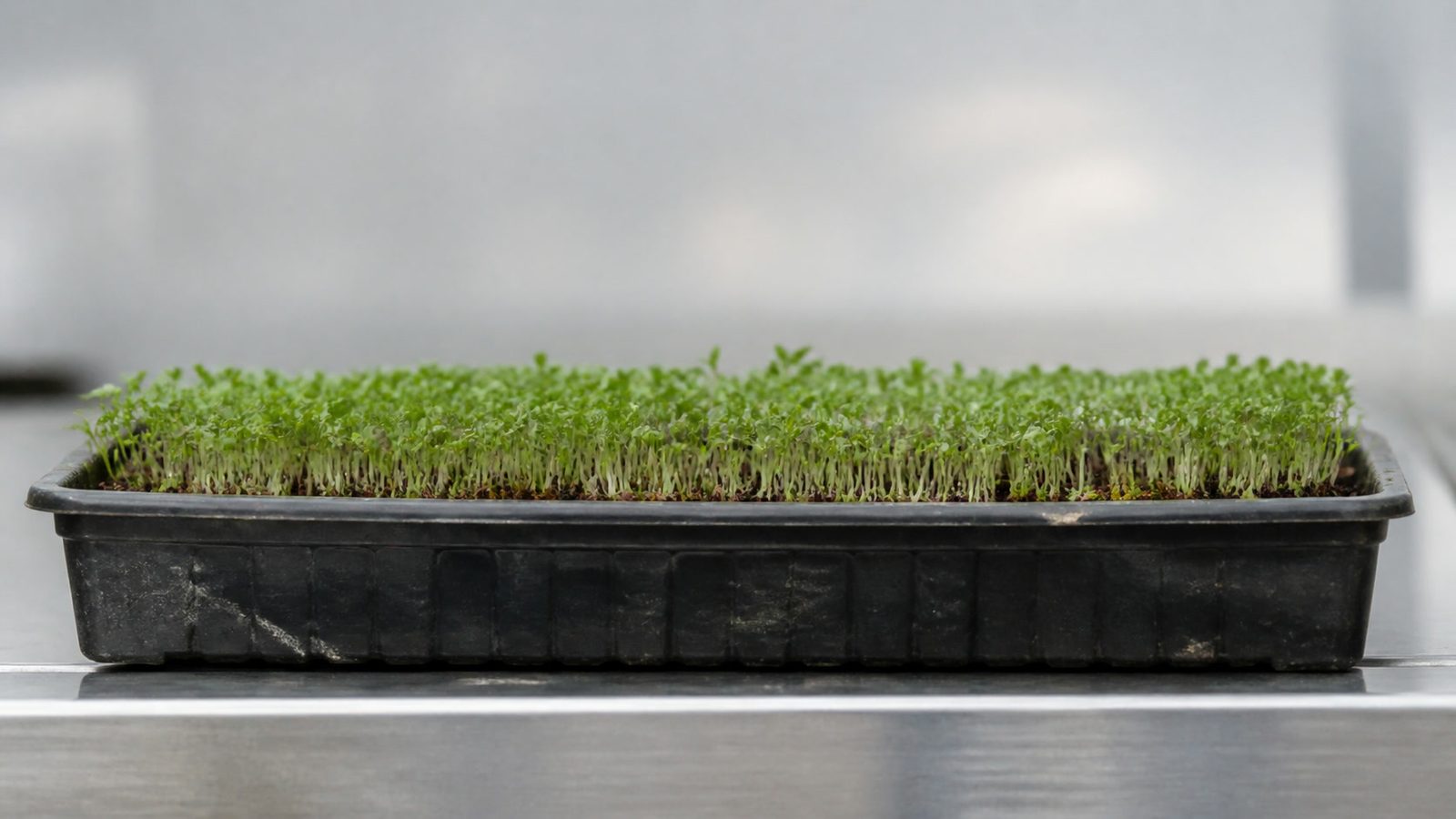
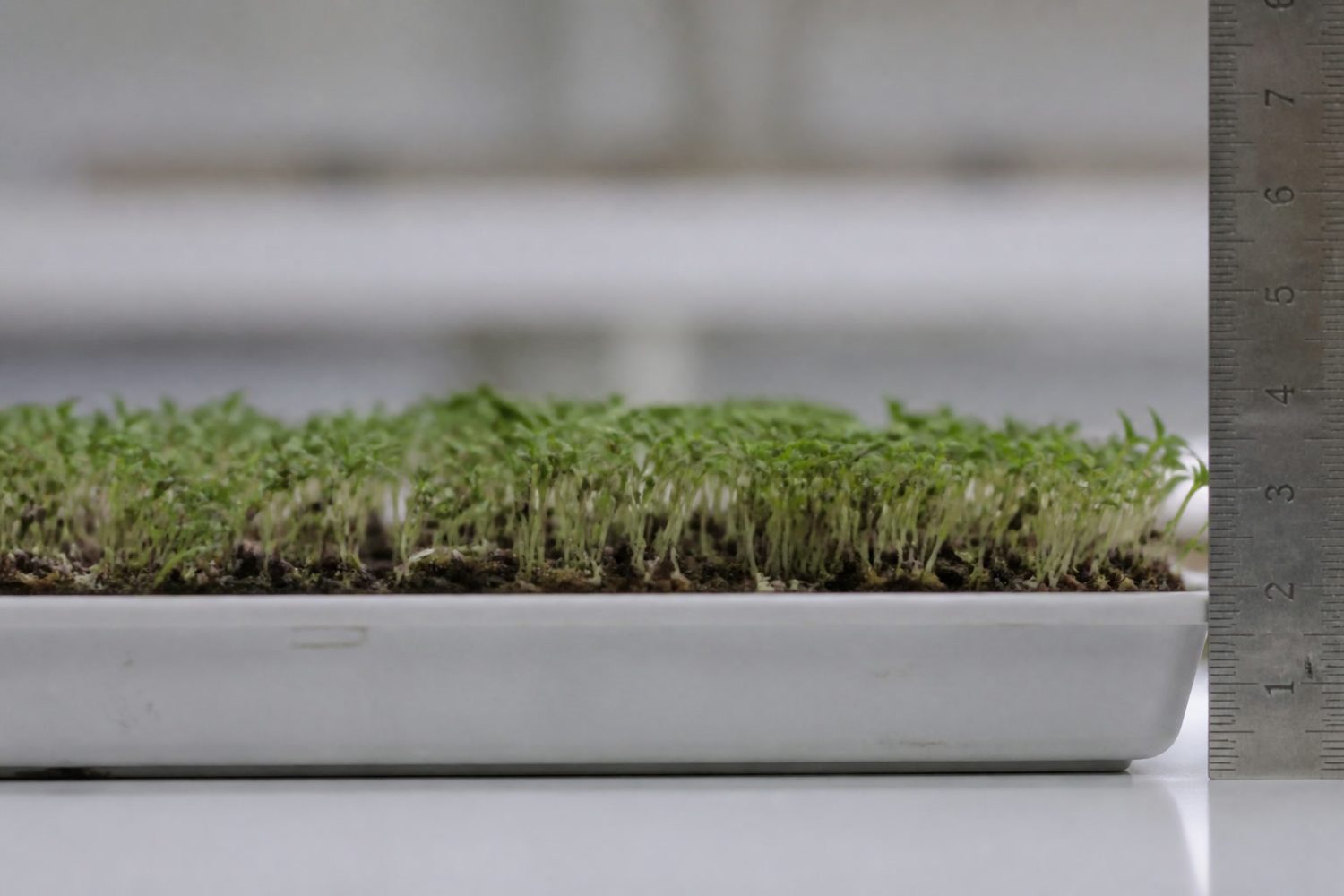
Thyme is three weeks of bench for about three ounces, and the tray never gets taller than an inch and a half. That is not a failure. The one controlled study measured the shoots at 3.5 to 4.6 cm at harvest, so if you are waiting for something that looks like a brassica canopy, you will wait right past the crop.
What you get for the wait is intense thyme, with pine and mint behind it, concentrated into a leaf a few millimeters across. It is a herb you use by the pinch rather than a green you eat, and it only makes sense if you already know where it is going.
Two things to settle before you start. The cycle runs twenty to thirty-five days, which keeps a fine-seeded tray damp three to five times as long as a brassica tray, so mold is what will beat you rather than anything about the plant. And nobody sells this seed at tray scale: the largest pack that states a weight is half a gram, and one tray takes thirty-one.
What growers are saying right now
Sampled from public posts and videos, 10 July to 9 August 2026. Every line links what it is quoting. How often something is repeated is not evidence that it is true, so every line also says what the sources actually establish.
Grow unlimited thyme from cuttings
Circulating The most-watched thyme video going, at 218,201 views and 314 comments
The top result for a thyme microgreen search is a guide to never buying thyme seed at all, and that tells you what you are really competing with. Like mint, thyme is a herb the world propagates from cuttings: a rooted one is free, it cuts repeatedly, and it will out-economize a three-week tray every time. Be sure you want the microgreen specifically before you commit the bench.
Grow Thyme Hydroponics
Circulating A shop introduction at 1,315 views
A pun rather than a crop, and worth knowing about because the word makes this one hard to search. A business called Grow Thyme outranks most actual thyme growing content, so add "microgreen" and "Thymus vulgaris" to anything you look up.
Nothing at all from growers
Circulating Not one thread in [r/microgreens](https://www.reddit.com/r/microgreens/) is about thyme, and everything that does rank is either the mature garden plant or that shop
A slow, low-yield herb sold by the pinch does not generate a grower conversation. So, expect no accumulated troubleshooting on this crop and keep your own notes from the first tray.
What it is, and how to tell you grew it right
Thyme microgreens are seedlings of Thymus vulgaris, common thyme, in the Lamiaceae, the mint family, alongside basil, chia, mint, oregano and shiso.
This is common thyme specifically, not a catch-all. Lemon thyme, creeping thyme and wild thyme are different plants, and no supplier opened here sells a distinct thyme microgreen cultivar. The three product names found are all the same crop.
A correct tray is very short. The controlled study measured shoots at 3.5 to 4.6 cm at the two-true-leaf harvest, which is roughly an inch and a half to under two inches. If you are waiting for something that looks like a brassica canopy, you will wait past the crop.
That study is the only measured description anyone has published, and it says nothing about stem color or stand density. No confirmed harvest photograph exists either, so photograph your own first tray at the cut and use that as your reference.
What it tastes like, and what to do with it
Intense thyme, with pine and mint behind it, concentrated into a leaf a few millimeters across.
This is a herb, not a green. It goes into soups, sauces, stocks and marinades, onto eggs, meat and seafood, and into a salad as an accent rather than a component. Use it raw or add it at the very end of cooking, because heat is what the aromatic oils are most easily lost to.
Nobody has tested whether the flavor sharpens with age, so taste a few leaves at the cut and again two days later before you decide when to harvest the next one.
Growing it: only what differs from the standard method
The published guidance conflicts on almost every point, so here is the conflict rather than a false consensus.
Soaking: both answers are unsupported. One supplier says no presoak is required. The study soaked its seed overnight, but never compared soaked against unsoaked, never gave a water temperature and never stated the hours. So, there is no evidence soaking helps and none that it hurts.
Blackout: three sources, three answers. One supplier says five days of blackout. A crop guide says a ventilated humidity dome for five to seven days and explicitly no weight. A university extension lists thyme among the seeds that need no cover at all. Nobody publishes a weight. Use a cover only to hold surface moisture, take it off when most seedlings are up, and do not stack this crop until you have tried it in your own room.
Rate: about 31 grams, converted from a real measurement. The study weighed 30 g into a 50 by 25 cm tray. That tray is 1,250 square centimeters against a 1020's 1,290, so the conversion is a 3 percent stretch, which is close enough to treat as a real rate rather than an estimate. Sow less if you intend to hold the crop longer.
Then the only thing that really matters: three weeks of restraint. The cycle is twenty to thirty-five days, which keeps a fine-seeded tray damp for three to five times as long as a brassica tray. Bottom-water, ventilate, and do not respond to slow progress with more water.
What goes wrong with thyme specifically
Mold, and the reason is arithmetic rather than biology. The risk is high here because of exposure, not because thyme is unusually susceptible to anything. A dense fine-seeded tray held moist for three weeks simply gives Pythium and Rhizoctonia far more opportunity than a nine-day crop does. Commercial thyme guidance warns about waterlogging repeatedly, and the failure looks the same as it does everywhere: rot at or below the medium line, and collapse.
Weak, uneven emergence read as failure. On a crop this slow the tray looks wrong for a long time before it looks right. Adding water is the instinct and it is the wrong one.
Cutting it looking for volume. Three and a half centimeters and three ounces is what this crop is. A grower who holds the tray waiting for more will get a longer exposure to the first problem and, as far as anyone has measured, no useful extra weight.
Nutrition, and one real study
USDA FoodData Central has no thyme microgreen record. Mature thyme entries are not a substitute.
One study did measure this crop properly. A 2025 six-species experiment grew T. vulgaris in desert sand against rockwool, twenty sampled plants across three replicates per treatment, and reported fresh yield, morphology, chlorophyll, carotenoids, phenols, antioxidant activity, protein, ascorbic acid and minerals.
At the two-true-leaf harvest it found ascorbic acid at 70.12 mg/100 g fresh weight in sand and 66.53 in rockwool, and total phenols at 25.00 and 21.63 mg GAE/100 g.
Those are numbers from one indoor experiment in one location under two named substrates, and the substrate moved them. They are not a label.
The claim to reject is the common one: that thyme microgreens carry "many times" the nutrients of mature thyme, or that their thymol is somehow more active because the plant is young. Nothing opened here supports either, and the study that measured the crop makes no such comparison.
Which seed to buy
One crop, three retail names, no meaningful cultivar choice. Specify Thymus vulgaris, untreated, sold for microgreen or food use, with a lot number and germination date.
And here is where this crop is genuinely awkward: there is no usable price. Not one supplier page publishes a per-pound figure tied to a package you can actually buy. One shows $4.75 against several unspecified size options, which cannot honestly become a cost per tray.
The marketplace explains why, and it is not a research gap. Thyme seed on Amazon returned 39 thyme listings out of 60 tiles on 9 August 2026, and only five of them state a weight at all. The largest is half a gram. A 0.5 g pack of about 1,350 seeds sells for $4.99, which is $9.98 a gram, or about $4,527 a pound.
At the study's 31 grams, one tray of thyme is 62 of those packets and roughly $309 of seed. A 500 mg French thyme pack at $5.15 works out to about $319. That is not a price this page can put in a table, and it is not a price anybody would pay.
So, thyme is the odd case with a measured rate, a measured yield and no price to multiply them by. Usually when a crop cannot be costed it is the rate that is missing. Here the rate is solid and the seed market is the problem: nobody sells it at tray scale, because nobody grows it at tray scale.
Two traps on that same page, and they are the only listings with big seed counts. "Red Creeping Thyme, Thymus praecox" at 30,000 seeds and "Blue Creeping Thyme, Thymus serpyllum" at 32,000 are lawn and walkway ground covers, not culinary thyme. A grower searching for bulk will find them first and they are the wrong plant. Multi-herb variety packs are the other shape and give you a pinch of thyme in a box of eighteen.
If you want to grow this crop, you are buying garden packets and accepting the arithmetic, or you are sourcing culinary T. vulgaris seed by weight from a wholesale herb supplier, which is outside anything this page could verify.
Is it worth growing?
Only if you cook with thyme, and only if you have somewhere for it to go.
Three weeks of bench space for about three ounces is the trade, and the study that produced that figure gave thyme the lowest fresh yield of the six species it grew. As a weight proposition it is close to indefensible. As a garnish that a chef will pay for by the gram, it can work.
For a beginner it is a bad first crop for the simplest reason: three weeks is a long time to find out you watered it too much.
Against any other tray you could run, thyme wins on exactly one axis, which is that it tastes like thyme. That is a narrower claim than most crops can make, and it is also, for the right buyer, the entire product.
A note on the numbers above
Hover or tap a row to highlight it.
| Figure | Value | Source | What kind of number it is |
|---|---|---|---|
| Seed per tray | 30 g per 50x25 cm | A 2025 six-species experiment | Measured. Converts to 31 g per 1020, a 3 percent area stretch |
| Yield | 91.00 +/- 11.53 g fresh, desert sand | The same experiment | Measured at two true leaves. Converts to 3.3 oz per 1020 |
| Yield | 68.67 +/- 11.02 g fresh, rockwool | The same experiment | The same crop in the other substrate. Converts to 2.5 oz |
| Days to harvest | 21.33 +/- 0.58 in sand, 19.67 +/- 0.58 in rockwool | The same experiment | Measured to two true leaves at 22 to 28C |
| Days to harvest | 21 to 35 | A supplier | Stated flat, no harvest stage and no temperature |
| Shoot height | 3.50 to 4.60 cm | The same experiment | Measured. The single most useful expectation-setter here |
| Ascorbic acid | 70.12 mg/100 g in sand, 66.53 in rockwool | The same experiment | Measured, and the substrate moved it |
| Total phenols | 25.00 and 21.63 mg GAE/100 g | The same experiment | Measured, same caveat |
| Blackout | 5 days / 5 to 7 days domed, no weight / no cover needed | Three sources | Three answers. Nobody publishes a weight |
| Soak | Not required / soaked overnight, untested | Two sources | Neither direction is supported by a comparison |
| Seed price | No usable figure | Every supplier page opened | No per-pound price tied to an available package |
| Harvest window | No figure exists | Every source opened | The sixth and last of lettuce's six test crops to come back blank |
| Fresh-weight panel | No FDC record | USDA FoodData Central | Mature thyme is not a substitute |
Nobody has measured how long a thyme tray holds, and there is a reason worth knowing. Hold time gets measured where holding costs somebody something countable. On radish, endive and fenugreek a grower was tracking a saleable crop day by day, and those windows come out at one to three days because the flavor sharpens. Lettuce holds four to seven, having nothing much to sharpen. On aromatic herbs sold by the pinch, the question never comes up: not thyme, not mizuna, mint, oregano, shiso or sorrel. So, on any herb, expect to find your own window by cutting one tray early and the next one late.
The seed rate here is a conversion you can actually trust, which is unusual. The study weighed 30 g into a tray that is 97 percent of a 1020's area, so scaling it up is a 3 percent stretch. Compare that with purslane and quinoa, where the only rates available are recommendations for trays a sixth the size. When you meet a converted figure anywhere, the question to ask is how far it was stretched and whether the original was a measurement or a suggestion.
Most of the fields on this page are blank, and the missing one is unusual. Thyme has a measured rate and a measured yield and no price, where normally a crop that cannot be costed is missing the rate. Everything else, the soak, the blackout, the hold time, the shelf life, simply has not been tested by anybody. Cucumber, cauliflower and sesame are in much the same position, so expect to trial any of them rather than plan them.
Hover or tap a row to highlight it.
| Crop | Seed per 1020 | Yield | Days | Cost per tray | Oz per $1 | Oz per tray-day |
|---|---|---|---|---|---|---|
| Shiso, Britton | 11.5 g | 6.5 oz | 16 | $3.94 | 1.65 | 0.41 |
| Basil | 5 to 6.5 g | 5.5 to 7.5 oz | 12 to 26 | $0.83 | 7.8 | 0.34 |
| Thyme | 31 g, area-converted | 3.3 oz, area-converted | 20 to 35 | no price to multiply | cannot be calculated | 0.15 at 21.3 days |
| Chia | 26.3 to 28.35 g | No published figure | 6 to 12 | $0.78 | cannot be calculated | cannot be calculated |
| Mint | No published figure | No published figure | 10 to 18 | no rate to price | cannot be calculated | cannot be calculated |
A blank means nobody has published that figure, so the cell is left empty rather than filled with an estimate. How the numbers work
All 62 crops, sortable, on the microgreen comparison.
Terms on this page
Tap a term to see what it means.
*Thymus vulgaris*. Common thyme, the crop here. Lemon, creeping and wild thyme are different plants sold under the same word.
Sources
- Nishanth et al., 2025, six microgreen species in desert sand against rockwool - study PDF. The only controlled thyme-microgreen source: 30 g in a 50x25 cm tray, 22 to 28C, harvest at two true leaves, 19.67 to 21.33 days, 68.67 to 91.00 g fresh, 3.50 to 4.60 cm shoots, and the full nutrient set. Thyme had the lowest fresh yield of its six crops.
- Thyme microgreens seeds, MP Seeds - T. vulgaris identity, 21 to 35 days, 5 days blackout, no presoak required, the pine and mint flavor description, and the cold-germination warning without a threshold.
- Microgreen Thyme Common, Thrive Heirloom Seed Emporium - a retail listing whose price could not be tied to a stated package size.
- Thyme, Mumm's Sprouting Seeds - the general small-seed rate guidance, with its own advice to sow less for two-to-three-week crops.
- Thyme microgreens, UAOrganic - the ventilated dome for 5 to 7 days with no weight, and the waterlogging warnings.
- Microgreens, UF/IFAS Gardening Solutions - thyme listed among seeds needing no cover, the general second-harvest note, and 5 to 6 days in a vented container.
- Johnny's microgreen yield trial and the trial tech sheet - 29 varieties, none of them thyme, and the caveat that yields do not transfer between systems.
- USDA FoodData Central - no thyme microgreen record.
- Damping-off, UC IPM - the pathogens behind the long-cycle risk.
- Growing microgreens at home, SDSU Extension and Microgreens production, Virginia Cooperative Extension - the general storage guidance, neither used as a thyme figure.
Keep reading
The variety directory
Mint microgreens
Mint must not be blacked out, and its seed costs $1,394.50 a pound. The one published seed rate would put 154,000 seeds in a 1020 tray, ten times the densest sowing anyone has measured.
Read Mint microgreensThe variety directory
Oregano microgreens
Concentrated resinous oregano as a fresh garnish, on a sixteen to twenty-five day tray. The seed is expensive and no sowing rate is published, so weigh a test patch before you scale.
Read Oregano microgreensThe variety directory
Chia microgreens
A small bitter minty garnish in about a week. Chia seed is about 30 percent fat and the microgreen is not, so if you want the omega-3, eat the seed.
Read Chia microgreensThe variety directory
Carrot microgreens
Carrot is one of the cheapest trays of seed you can sow at 44 to 66 cents, and one of the poorest uses of a bench: about 2 oz after 20 days, a twelfth of radish's daily turnover.
Read Carrot microgreens