Purslane microgreens
Cal HewittPublished Checked
- succulent
- moderate
- garnish
- purslane
- no soak
- cut and come again
- mold prone
At a glance
Nothing about it is delicate once it is up, but the seed is light-responsive and there are nearly a million of them to a pound, so the standard dark stack and a heavy hand with water both fail it before it starts.
- Botanical name
- Portulaca oleracea
- Also sold as
- Purslane, Red Gruner, Verdolaga, Common purslane
- Family
- purslane
- Difficulty
- Moderate
- Days to harvest
- 8 to 25 days
- Harvest window
- No published figure
- Seed per 1020 tray
- No published figure
- Soak
- None
- Blackout
- 0 to 1 days
- Germination temperature
- 60 to 75 °F
- Yield per 1020 tray
- No published figure
- Regrows after cutting
- partial
- Mold risk
- High
- Hull shedding
- No published figure
- Shelf life
- No published figure
- Eaten as
- raw
- Seed cost per tray
- No published figure
Any field name above ranks every variety by it. No published figure means we researched it and nobody has established one, which is different from not yet researched. Every figure here is sourced at the bottom of the page. Compare every variety side by side.
Purslane is famous for one thing. It is the richest green leafy source of omega-3 fatty acids there is, and that is not marketing: it goes back to work by Simopoulos and colleagues in the 1980s showing purslane leaves carry more alpha-linolenic acid than spinach.
Nobody has measured it in the microgreen.
The one controlled study of Portulaca oleracea at microgreen stage measured vitamin C and proline. Not fatty acids. USDA FoodData Central has no purslane microgreen record at all. So, the thing purslane is famous for has not been checked in the crop you would actually be growing. The seedling may well carry it, and it may not. Nobody has looked.
That is worth knowing before you grow a tray of it, and it is not a reason not to.
What growers are saying right now
Sampled from public posts and videos, 10 July to 9 August 2026. Every line links what it is quoting. How often something is repeated is not evidence that it is true, so every line also says what the sources actually establish.
Most of America poisons this plant, most of the world eats it, and it has more omega-3 than any leafy green on earth
Circulating The biggest purslane item in the window at 19,554 views and 1,074 likes, posted 31 July
The first two clauses are true and the third is true of the plant rather than the tray. Purslane is genuinely a garden weed across North America and genuinely a vegetable elsewhere, sold as verdolaga. And the omega-3 standing is real: Simopoulos et al. 1986 and 1992 established purslane leaves as richer in alpha-linolenic acid than spinach, and the literature since calls it the richest leafy vegetable source. What no source has done is measure it in a 14-to-25-day microgreen. What is actually measured
Purslane, the omega-3 weed you can plant once and harvest for seasons
Circulating A forgotten-crops video, one of several treating it as a perennial-ish garden staple
The competition. Purslane grows itself in most of the United States, for free, in a crack in a driveway, and it regrows after cutting in the ground. A tray of it is competing with a plant people are actively trying to kill. Is it worth growing
Most people pull it out of their garden without a second thought
Circulating A farm's foraging clip at 433 views, alongside a Spanish-language *verdolaga* explainer at 1,325 and a pickled-purslane post
The whole conversation is about the wild plant and eating it, not about growing it in a tray. Nothing in the sweep is about purslane as a microgreen, and the published record matches: no trial entry, no 1020 rate, no 1020 yield, no shelf-life study.
Introduce ornamental purslane to your Florida garden
Circulating A container-gardening post at 794 views
Worth flagging as a buying trap rather than as advice. **Ornamental purslane and Portulaca grandiflora moss rose are sold in the same aisle as the edible species** and are grown for flowers. Buy seed sold as food, by botanical name. Which seed to buy
What it is, and how to tell you grew it right
Purslane microgreens are seedlings of Portulaca oleracea, in the Portulacaceae. That makes it the only member of its family in this directory, and it behaves like nothing else here: a warm-season succulent that stores water in its leaves.
Red Gruner is the one cultivar verified as a microgreen product, open-pollinated, listed at 16 to 25 days. A secondary guide names a "Goldberg" as well and no supplier page confirmed it.
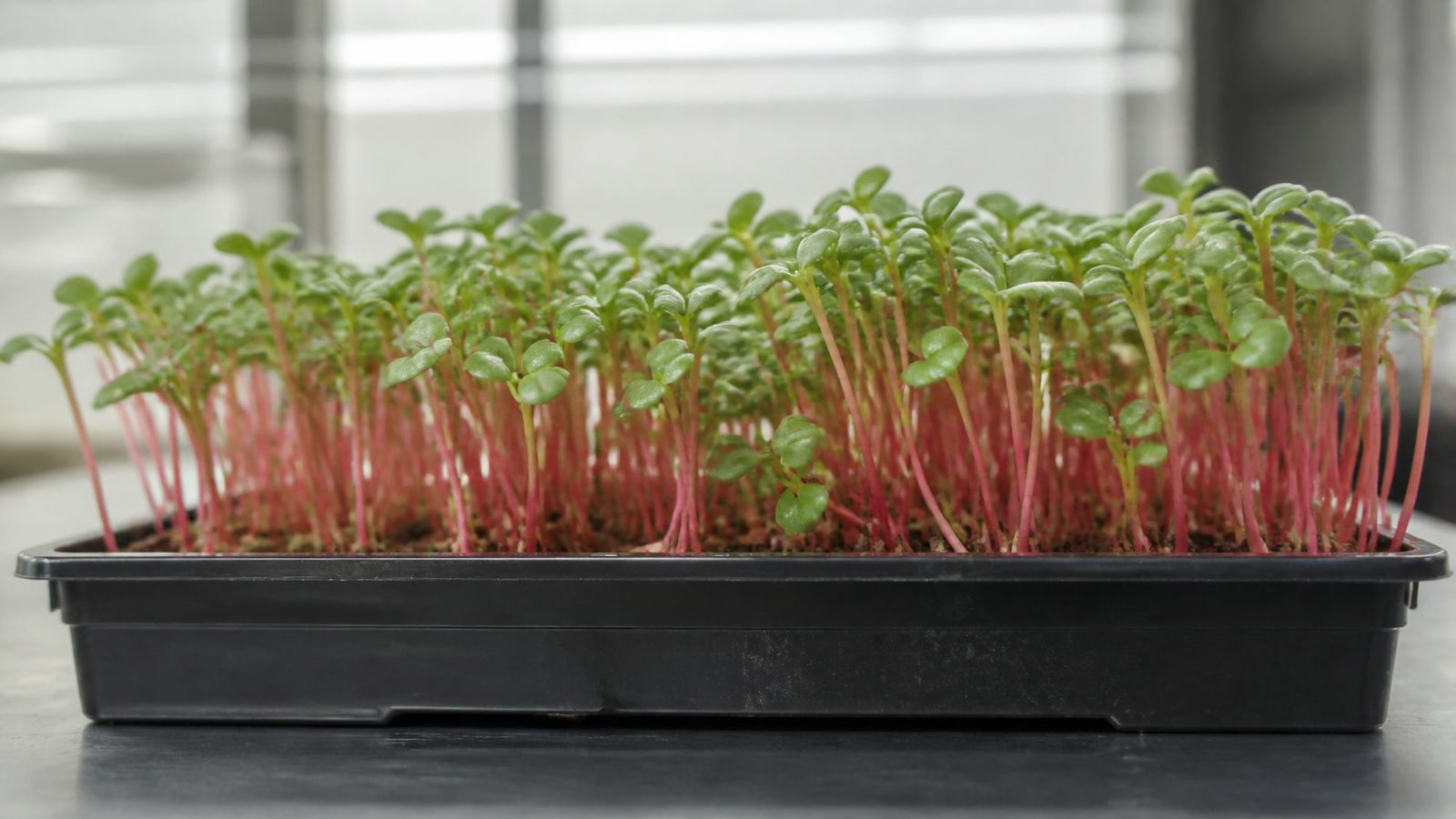
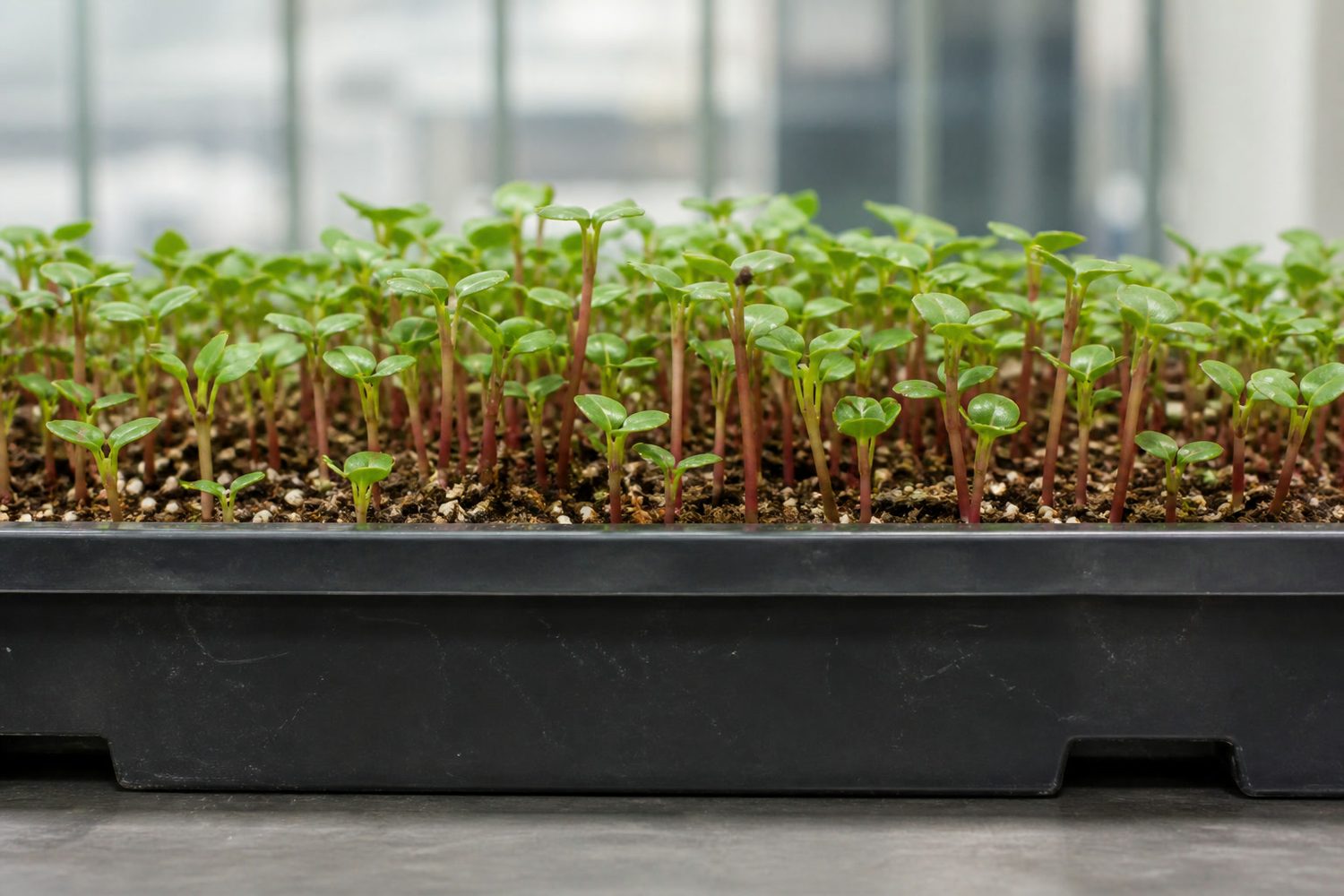
A correct tray is a dense but open, upright stand: thin pink to white-pink stems rising to paired, thick, smooth, fleshy green leaves. It does not form the flat closed canopy a brassica does, and the leaves look succulent rather than papery. Johnny's own description is succulent green leaves and pink stems. Harvest height is not published by the supplier; a secondary guide cuts at 1.2 to 2 inches at fully opened cotyledons.
Identification needs care here. No authoritative source validates a single-feature test that separates purslane from anything else at seedling stage, so nothing here should be used to decide whether a plant you found is edible. Purslane has a well-known toxic lookalike in the wild, spurge, and the distinction people rely on outdoors is that spurge leaks white latex when broken while purslane does not. That is foraging knowledge and this is a tray page: if you sowed Red Gruner from a labeled packet, what comes up is purslane, and if you are looking at something that appeared on its own, this is the wrong page to identify it from.
What it tastes like, and what to do with it
Mild and spinach-like with a crisp, watery, succulent bite and a faint sourness. There is no pepper and no brassica edge at all; the texture is the point.
That puts it where a plate wants moisture and crunch without flavor competition: folded through a tomato and feta salad, on an open sandwich, or as a small pink-stemmed tuft on a composed plate. The pink stem does real work visually.
It is the wrong choice when the dish wants a mustard or radish bite, a sturdy cooked green, or a dry leaf that will not wet the bread.
Anyone who reads "microgreen" as "concentrated flavor" will be disappointed by it, which the supplier's own description makes fairly clear: mild, spinach-like, sold on succulence.
Growing it: only what differs from the standard method
The standard tray method blacks out for a few days and then goes to light. Purslane is the third crop in this directory where that is wrong, after lettuce and mint, and the three arrive at it from three unrelated families.
Do not run a multi-day blackout. Purslane seed is light-responsive: a published experiment found light stimulated germination during the twelve hours before the radicle emerged. A secondary protocol permits 12 to 24 hours of darkness purely to even out moisture and contact, and says not to press the seed. A three-to-five-day dark stack is the characteristic way to fail this crop.
Sow on the surface of level, pre-moistened medium and press only for contact. There are about 977,400 seeds to the pound, so distribution is decisive and clumps become wet, airless disease pockets. Do not bury it.
Warm to germinate, then cool: 75°F at the medium, then toward 60°F. That is Johnny's guidance for this product. The species ecology explains why cold rooms are risky: freshly collected purslane seed germinated 13 percent at 86/59°F against 94 percent at 95/68°F in light. That is seed ecology and not a thermostat setting, and above 75°F Johnny's warns disease pressure rises.
Then water it less than instinct says. This is a succulent. It holds water in its leaves, it does not want a wet surface, and the two failure modes below both come from treating it like a thirsty leafy tray. Bottom water once seedlings are up, and never top water before then: the seed is small enough that a watering can rearranges the crop into rings and piles.
What goes wrong with purslane specifically
No emergence, or patchy emergence, in the first week. Too much darkness, cool medium, or seed washed off the moist surface. The tell is bare zones rather than delayed seedlings. Before the seed rots it can sometimes be rescued by moving the tray into warm light and stabilising the surface moisture. After that it cannot.
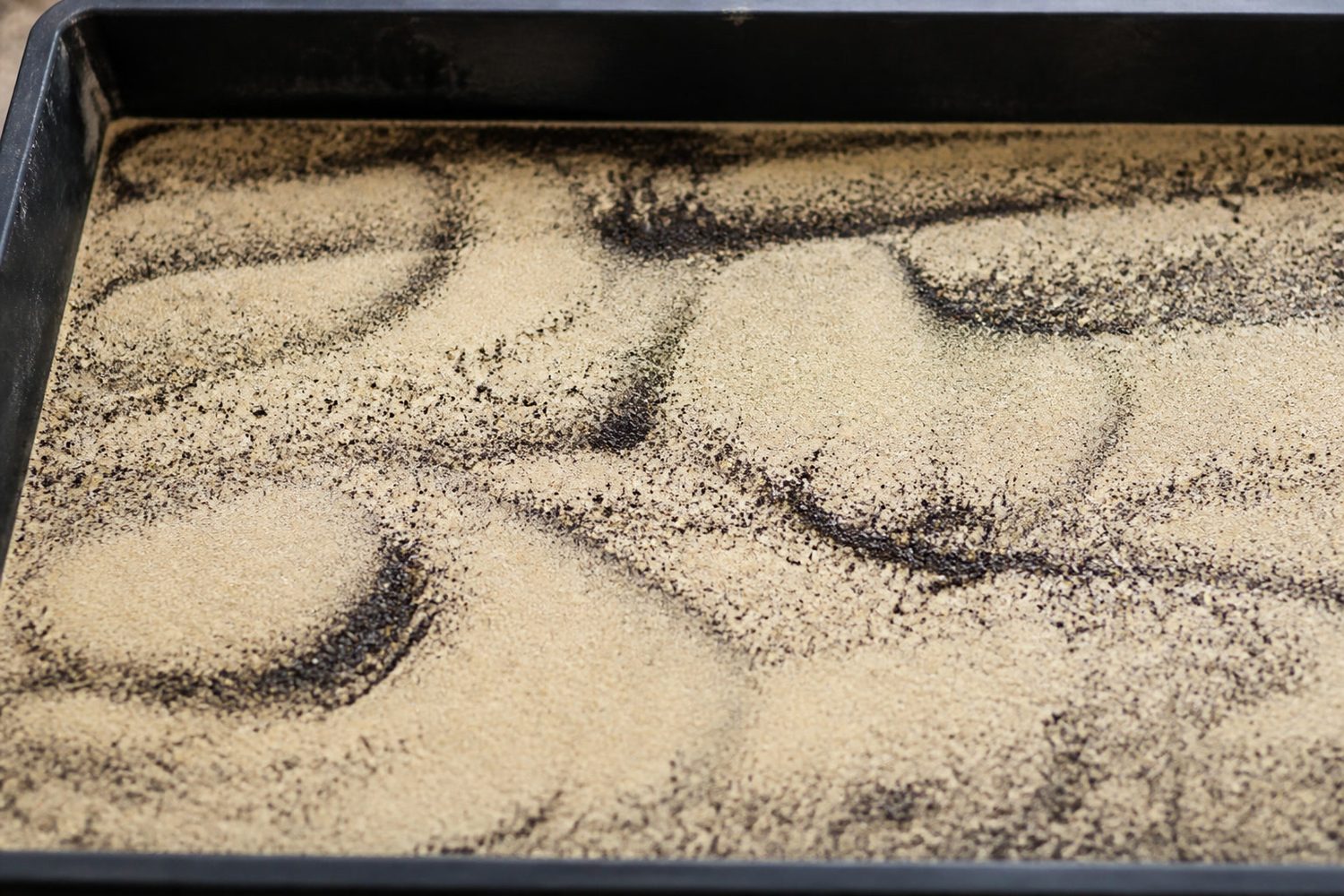
Washed and clumped seed, at sowing. Top watering displaces seed this small into rings and piles. You see it before emergence. It is not recoverable; a thin or bare tray gets resown.
Damping-off and root rot after emergence. Dense sowing plus persistently wet, warm, poorly ventilated medium. The early sign is a pinched, wet-looking stem at the medium line and seedlings collapsing in expanding patches, Pythium and Rhizoctonia the usual organisms. Discard rather than harvest around a spreading collapse.
On root hair against mold, the location test: root hairs are a short uniform fuzz confined to individual roots that visibly changes when the root zone is wetted, and they do not bridge between stems or spread across the medium. Cottony growth that spreads, with wet collapse or discolored pinched stems, is the other thing. No purslane-specific comparison exists, so treat spread plus seedling condition as the decision rather than appearance alone.
Pale, stretched, watery growth from too little light. Partly correctable if caught early; a floppy tray will not become a premium one. If it keeps happening, the problem is usually the light level at the tray rather than the fixture's wattage, which is the subject of the grow lights review.
Cut late and it stops being the product. The paired leaves outgrow the compact presentation and the stems begin to elongate and branch. Nobody has measured what that costs, and the two published day ranges disagree by a factor of two, so use the tray's appearance rather than the calendar.
Nutrition, and the question nobody has answered
What is established, and it is genuinely impressive, is about the mature plant. Simopoulos and colleagues published purslane as a terrestrial source of omega-3 fatty acids in 1986 and characterised it further in 1992, finding purslane leaves richer in alpha-linolenic acid than spinach, with chamber-grown plants highest. The literature since describes it as the richest green leafy vegetable source of ALA, and the same work found purslane richer than spinach in alpha-tocopherol, ascorbic acid and glutathione.
What is established about the microgreen is vitamin C and proline. Plocek and colleagues grew P. oleracea microgreens for 14 days on four-inch pads under red and blue LEDs and measured 29.8 mg total ascorbic acid per 100 g fresh mass and 6.44 µmol proline per gram dry weight in the controls, and found that salinity treatments up to 1.5 dS/m did not significantly change either.
Between those two facts is the gap that defines this crop. Nobody has measured alpha-linolenic acid in purslane at microgreen stage. Not higher, not lower, not the same: unmeasured. And it is not a safe assumption in either direction, because this directory has now watched the same question go both ways repeatedly. Chia is the cautionary case and it is closely relevant here: mature chia seed is roughly a third fat, the microgreen measures near 6.9 percent, and germination spends the seed's fat rather than concentrating it. Anyone buying purslane microgreens for omega-3 is making exactly the assumption chia disproved on a different crop.
So, the honest position: grow purslane microgreens for the texture, the pink stem and the mild flavor, all of which are real and verifiable on your own plate. If you want the omega-3, the evidence is about the mature leaf, and mature purslane grows itself for free in most of North America.
Which seed to buy
Buy by botanical name and buy food-use seed. Portulaca oleracea, untreated, with a lot and a germination figure if the supplier gives one. Penn State is explicit that seed treatments can end up in the young shoots people eat.
The buying trap on this crop is ornamental. Portulaca grandiflora, moss rose, and various ornamental portulacas are sold widely as bedding flowers, and the word purslane appears on both shelves. A packet sold for its flowers has not been handled as a food crop and may be treated. Read the species.
Red Gruner is the verified microgreen product, and its price is high and its availability is not guaranteed: Johnny's lists 1 oz $10.40, 1/4 lb $22.15, 1 lb $72.00, 5 lb $325.95 and 25 lb $1,506.00, with everything from a pound upward backordered until 30 October 2026 as checked on 2026-08-09. At $72 a pound that is about 16 cents a gram, which is not cheap for a crop with no published rate to multiply it by.
A bad lot looks like a watering failure on this crop, which is worth knowing before you change five things at once. Patchy emergence under controlled warmth, light and moisture points at the seed. Ask for the actual lot germination result rather than a catalogue figure, because no supplier germination standard for purslane microgreens is published anywhere.
Purslane seed on Amazon is where a home grower will find a packet-sized quantity, which suits a crop with no established rate. Check the listing says Portulaca oleracea and is sold for eating rather than for bedding.
Is it worth growing?
For a chef or a keen home cook, occasionally. For a bench, this is a hard sell and the reason is unusual.
The numbers do not exist. No published seed rate for a 1020, no published yield, no shelf life, no harvest window. Six fields on this page are blank, which is fourth in the directory behind cucumber's ten, cauliflower's eight and oregano's seven, counted across all 52 entries on 2026-08-09. You cannot cost it, cannot plan a rotation around it, and cannot compare it with anything on the table.
What it offers is a texture nothing else in this directory has. A crisp, watery, succulent leaf on a pink stem is a genuinely distinctive garnish, and a restaurant that wants it has nowhere else to go.
But the competitor is brutal and it is free. Purslane is a weed across most of the United States. It grows in driveway cracks without help, it regrows after cutting in the ground, and the sweep above is full of people explaining that the thing you are pulling up is food. A tray of purslane is competing with a plant most people are actively trying to kill, which is a harder position than mint faced with its perennial pot or leek faced with its slow garden version.
Grow it if the pink stems and the succulence are the point, if you are in a season or a climate where the weed is not available, and if you accept that you are the one running the trial.
A note on the numbers above
Hover or tap a row to highlight it.
| Figure | Value | Source | What kind of number it is |
|---|---|---|---|
| Days to harvest | 16 to 25 | Johnny's, Red Gruner | Supplier range, no stage or temperature |
| Days to harvest | 8 to 12 | Secondary crop guide | At 72 to 79°F, cut at 1.2 to 2 inches. A different, earlier cut |
| Seeds per pound | 977,400 | Johnny's | Which is why distribution decides the tray |
| Seed per tray | 1.5 to 2.5 g in 11 x 19 cm | Secondary crop guide | 209 cm². Area-scales to 9.3 to 15.4 g per 1020 |
| Seed per 1020 | No published figure | Nobody | The scaling above is a converted RECOMMENDATION, not a measurement |
| Yield, lab pad | 1.93 to 3.57 g fresh, 4 x 4 in pads | Plocek et al. 2023 | Measured, at 14 days from 0.75 g. Not a tray |
| Yield per 1020 | No published figure | Nobody | And converting a laboratory pad would invent one |
| Blackout | 0, or 12 to 24 h at most | Light-response study, secondary guide | The seed is light-responsive; a multi-day stack suppresses it |
| Germination temperature | 75°F then 60°F | Johnny's | Crop guidance for this product |
| Germination, seed ecology | 13% at 86/59°F, 94% at 95/68°F | Baskin and Baskin 1988 | Measured on fresh seed. Ecology, not a thermostat |
| Total ascorbic acid | 29.8 mg/100 g fresh | Plocek et al. 2023 | Measured, on the microgreen |
| Proline | 6.44 µmol/g dry weight | Plocek et al. 2023 | Measured, on the microgreen |
| Omega-3 (ALA) | Richest leafy vegetable source | Simopoulos et al., MATURE plant | Established, and never measured at microgreen stage |
| Seed price | $72.00/lb, backordered | Johnny's, checked 2026-08-09 | About $0.159 a gram. 1 lb and up unavailable until 30 Oct 2026 |
| Shelf life | No published figure | Nobody | No purslane postharvest trial |
| Harvest window | No published figure | Nobody | And the two day ranges differ by a factor of two |
Six blank fields, and the pattern is different from the other thin crops above it. Cucumber and cauliflower are blank because nobody has looked. Purslane has two peer-reviewed papers and a named commercial cultivar and is still blank on every production number, because the research that exists asked ecological and physiological questions rather than commercial ones. A light-response experiment from 1975, a germination-ecology study from 1988 and a salinity trial from 2023 tell you a great deal about the plant and nothing about what a tray returns.
This page declines to publish an area-converted seed rate, and the distinction from onion is deliberate. Onion's 4.8 g is an area conversion of a measurement: somebody sowed 1.0 g in a 270 cm² tray and harvested it. Purslane's 9.3 to 15.4 g would be an area conversion of a recommendation in a secondary guide. Pak choi showed the conversion arithmetic survives contact with a real tray, to within 4 to 13 percent, but that finding is about converting measurements. Scaling somebody's advice by area produces a number with no measurement anywhere underneath it.
The omega-3 question would be cheap to settle. Most missing figures here need a grower to run a weighed trial. This one needs a lab that already has a GC column to run a fatty-acid panel on a tray of a crop whose mature form is one of the most-studied leafy vegetables in the literature. Until somebody does, the single most repeated claim about purslane is unverified at the stage anyone selling microgreens is actually selling.
The harvest window is blank, which as of 2026-08-09 covers 48 of the 52 entries written.
| Crop | Seed per 1020 | Yield | Days | Cost per tray | Oz per $1 | Oz per tray-day |
|---|---|---|---|---|---|---|
| Purslane, Red Gruner | No published figure | No published figure | 8 to 25 | no rate to price | cannot be calculated | cannot be calculated |
A blank means nobody has published that figure, so the cell is left empty rather than filled with an estimate. How the numbers work
All 62 crops, sortable, on the microgreen comparison.
Purslane has neither a published seed rate nor a yield, which it shares with lettuce, mint, oregano, cucumber and cauliflower. It is the only one of those with two peer-reviewed papers behind it, which is the whole oddity of this entry: the plant is well studied and the tray is not.
Terms on this page
Tap a term to see what it means.
*Portulaca oleracea*. Common purslane, the crop here, also sold as verdolaga. The only Portulacaceae in this directory.
Sources
- Johnny's Red Gruner purslane microgreen seed - Portulaca oleracea, the verdolaga name, 16 to 25 days, 977,400 seeds per pound, succulent green leaves with pink stems, mild spinach-like flavor, 75°F to germination then 60°F, and the price ladder verified 2026-08-09 at 1 oz $10.40 through 25 lb $1,506.00 with 1 lb and above backordered until 30 October 2026.
- Reger, Egley and Swanson, 1975, light response in Portulaca oleracea germination - light stimulating germination during the twelve hours before radicle protrusion, which is why this crop does not take a blackout.
- Baskin and Baskin, 1988, temperature and germination timing in Portulaca oleracea - 13 percent germination at 86/59°F against 94 percent at 95/68°F on fresh seed, cited here as seed ecology rather than a production setting.
- Plocek et al., 2023, salinity effects on purslane and other microgreens (PDF) - the only controlled study of this crop at microgreen stage: 14 days on 4 by 4 inch pads at 0.75 g, 29.8 mg total ascorbic acid per 100 g fresh mass, 6.44 µmol proline per gram dry weight, fresh weights of 1.93 to 3.57 g per pad, and no significant salinity effect on either measure.
- Simopoulos et al., 1986, purslane as a terrestrial source of omega-3 fatty acids and 1992, common purslane as a source of omega-3 fatty acids and antioxidants - the mature-plant work behind the crop's reputation: purslane leaves richer in alpha-linolenic acid than spinach, and richer in alpha-tocopherol, ascorbic acid and glutathione.
- UA Organic purslane microgreens guide - the secondary protocol: 8 to 12 day cycle, 12 to 24 hours maximum darkness with no pressing, 72 to 79°F at germination, cutting at 1.2 to 2 inches, 1.5 to 2.5 g in an 11 by 19 cm tray, regrowth from roots left in the substrate at lower quality, and the mold and root-rot warnings.
- Penn State Extension, growing microgreens at home - the default blackout-then-light method this crop departs from, bottom watering, untreated seed, and that washing before storage substantially shortens shelf life.
- Virginia Tech Extension SPES-756 (PDF) - dark storage at 41°F as the general microgreen recommendation, cited to mark that it is not purslane-specific.
- Johnny's yield trial, method and discussion - purslane is absent from the 29 varieties, and the warning that one system's yields do not transfer.
- UC IPM, damping-off - Pythium and Rhizoctonia, and rot at or below the medium line as the diagnostic anchor.
- USDA FoodData Central - searched 2026-08-09, zero results for purslane microgreens across Foundation, SR Legacy, Survey and Experimental.
Keep reading
The variety directory
Nasturtium microgreens
A three-week tray that returns 5.64 oz and costs $5.74 of seed, so it earns its keep as a garnish and not by weight. Also the crop whose own name belongs to a different plant: search nasturtium in USDA's database and you get watercress.
Read Nasturtium microgreensThe variety directory
Celery microgreens
Three to four weeks of bench for a seasoning green, with an unusually complete measured nutrient panel behind it: 45.8 mg of vitamin C per 100 g, and four minerals that are higher in the mature leaf.
Read Celery microgreensThe variety directory
Amaranth microgreens
Red Garnet amaranth is the magenta garnish crop, and the trial numbers explain why it is a chef's crop rather than a grower's: 7.5 g of seed makes 6.5 oz in 17 days, against radish's 11 oz in nine.
Read Amaranth microgreensThe variety directory
Chia microgreens
A small bitter minty garnish in about a week. Chia seed is about 30 percent fat and the microgreen is not, so if you want the omega-3, eat the seed.
Read Chia microgreens