At a glance
Nothing about the method is hard, but a slow allium that fills a canopy over two to three weeks gives every moisture and density error far longer to turn into a problem than a brassica does.
- Botanical name
- Allium cepa
- Also sold as
- Onion microgreen seed, Crystal White Wax, Utah Yellow Sweet Spanish, Onion sprouting seed
- Family
- allium
- Difficulty
- Moderate
- Days to harvest
- 10 to 21 days
- Harvest window
- No published figure
- Seed per 1020 tray
- 4.8 g
- Soak
- No published figure
- Blackout
- 2 to 3 days
- Germination temperature
- 60 to 70 °F
- Yield per 1020 tray
- 1.29 oz
- Regrows after cutting
- No published figure
- Mold risk
- Medium
- Hull shedding
- some
- Shelf life
- No published figure
- Eaten as
- raw
- Seed cost per tray
- $1.20
4.8 g at $113.30/lb, True Leaf Market Crystal White Wax onion microgreen seed at the 1 lb size, listed 2026-08-09. That is among the dearest microgreen seed you can buy by the pound, and it still works out at a $1.20 tray because the rate is only 4.8 g. The ladder runs 1 oz $14.85, 4 oz $37.63, 1 lb $113.30, 5 lb $440.63. A generic onion sprouting and microgreen seed sells for about half that per pound and does not name a species, which on this crop is the one thing worth knowing. Seed only, excludes medium, tray, labor, light and loss.
Any field name above ranks every variety by it. No published figure means we researched it and nobody has established one, which is different from not yet researched. Every figure here is sourced at the bottom of the page. Compare every variety side by side.
An onion tray occupies a bench for ten to twenty-one days and comes off weighing about 1.29 ounces, which is roughly a tenth of what a sunflower tray returns in less time. What you get for it is fresh onion in thread form, concentrated enough that a few strands season a plate. Grow this one because you cook with it, not for what it weighs.
Before you buy seed, know that the shelf sells three different species under the single word "onion", and nothing in the tray tells them apart. Allium cepa is the bulb onion this page is about. Allium fistulosum, bunching or Welsh onion, is sold for microgreens as "Tokyo Long White". Allium tuberosum, garlic chives, turns up with the word "Onion" in its own product title. All three come up as a black seed, a looped first leaf and a thin green blade, so the botanical name printed on the bag is the only defense you have.
What growers are saying right now
Sampled from public posts and videos, 10 July to 9 August 2026. Every line links what it is quoting. How often something is repeated is not evidence that it is true, so every line also says what the sources actually establish.
Nobody is discussing onion as a microgreen
Circulating r/microgreens threads do not mention onion or allium at all, YouTube has nothing, and the onion talk on TikTok is all garden beds: planting green onions in August at 3,459 views and an onion harvest day at 427
The published record matches the silence exactly: no trial entry, no 1020 measurement, no shelf-life study, no harvest window. Both figures on this page come from one growing-media experiment run on a tray a fifth the size of a 1020, so treat them as a starting point and weigh your own first tray. Where the numbers stop
Green onions are harder than people think, and the mistake happens right after planting
Circulating Said here at 450 views, about shallow roots on young garden green onions
A garden problem, and worth knowing it does not transfer. A tray is cut at two to three weeks, long before roots matter, and the failure mode indoors is a slow wet canopy rather than anything about establishment. The whole onion conversation is like this: real, active, and about a different crop.
I have planted too many onions and shallots, said nobody ever
Circulating A garden clip at 2,466 views and 121 likes, the highest-engagement onion item in the window
The garden version of this plant is a staple that everyone grows and nobody photographs indoors, and leek behaves the same way. The comparison worth making is time: a bulb onion is most of a season, and this tray is two to three weeks. Is it worth growing
What it is, and how to tell you grew it right
Onion microgreens are seedlings of Allium cepa, the bulb onion, in the Amaryllidaceae.
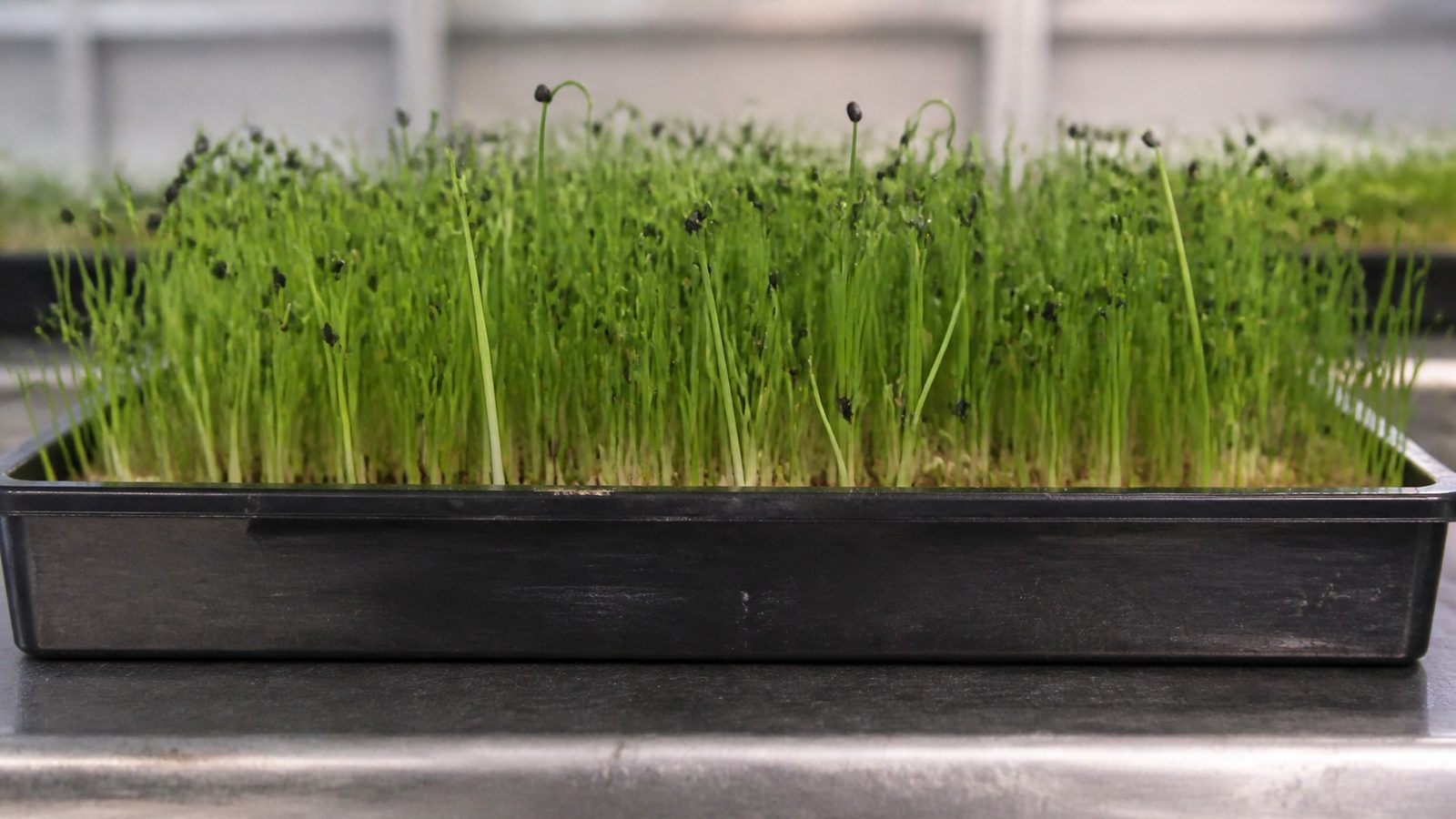
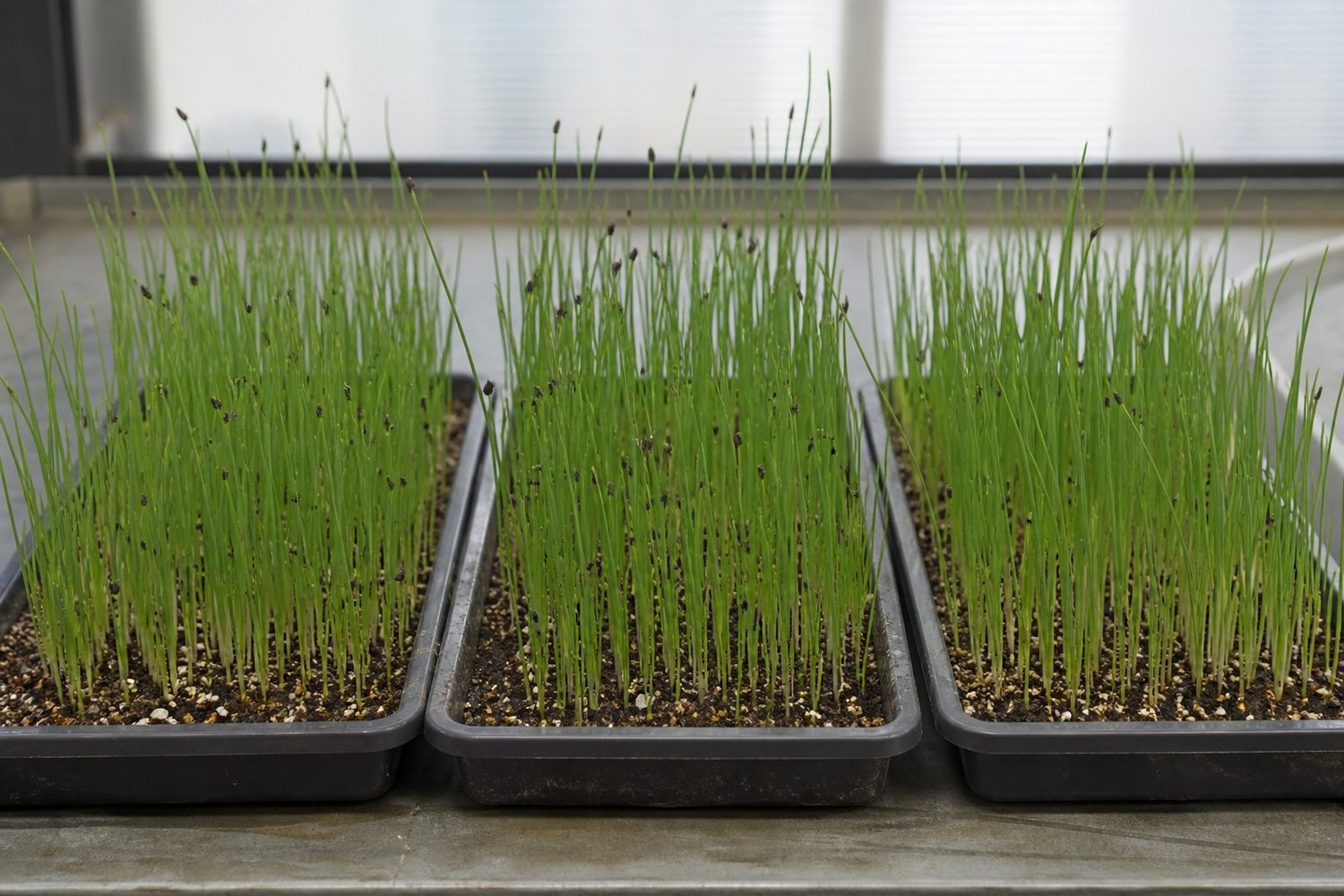
It is a monocot, and that changes what the tray looks like. There are no paired broad cotyledons here. Each plant sends up one narrow, grass-like leaf, initially bent into a loop with the tip still in the medium, which straightens as it grows. A correct stand is thin green blades with pale white bases, a mix of straightened leaves and still-looped tips, and minimal visible medium without a matted wet surface. The one nutrition study that measured them found 6 to 7 cm, about 2.4 to 2.8 inches, at two weeks.
Small black papery seed coats perch on the leaf tips, and they show in every supplier photograph of this crop. They are cosmetic rather than dangerous, and nobody publishes a shedding rate or a validated way to remove them, so budget a little cleaning rather than a number.
There is no way to identify this crop by looking at it. Onion, chives, bunching onion and garlic chives all present as a black hull, a looped leaf and a green blade at this stage, and no source offers a visual separator. The same is true of the Brassica rapa group around komatsuna. The seed label is the only identification you have, which is why the species confusion above matters so much: once it is in the tray, you cannot check.
What it tastes like, and what to do with it
Concentrated fresh onion, closer to scallion than to a cooked bulb, and strong. The one study that described the eating quality calls the greens soft, slightly crunchy and grass-like with onion flavor, and the supplier tells you to taste a few before you use a handful.
That makes it a seasoning rather than a green. A few strands go on deviled eggs, a baked potato, ramen or soup at service, tacos, burgers, steak, cream cheese, or a composed salad. It does the job of sliced scallion in a fraction of the volume, which is the entire argument for it.
It is the wrong choice for salad bulk, for anything cooked, and for a delicate dish it will simply take over. The intensity that makes a few strands useful is the same intensity that ruins a small sandwich.
People who dislike raw onion will dislike this, and there is nothing in the growing to soften it.
Growing it: only what differs from the standard method
Everything general is on the standard tray method for growing microgreens. Onion's documented deltas are short, and two of the usual fields are honestly blank.
Thin cover of media over the seed, not bare and not buried. The one controlled protocol covers the seed lightly, then holds the tray dark for 2 to 3 days, then uncovers. Level the medium first so the fine seed gets even contact, and do not compact it.
Uncover on the crop, not on the calendar. Take the cover off when most seedlings have germinated and are pushing it up. This is the crop's main trap: allium emergence looks slow and thin, and the instinct is to leave it sealed and damp for longer, which is precisely the condition that produces damping-off.
No soak, and no weight, and both of those are absences rather than instructions. No source specifies a soak for onion microgreens in either direction, and the one working protocol sowed dry, so sow dry. No source reports a top weight either. If you want either number for your own setup, run a tray each way and write down what happened, because nobody has published it.
Hold it at 60 to 70°F after emergence, the general microgreen range. The onion-specific temperature data that exists is about soil temperature for field germination, 50 to 95°F with 75°F optimum, and those are seed data rather than a microgreen trial. Keeping them apart matters, because a 75°F tray is warmer than most microgreen guidance recommends for anything.
Then wait longer than feels right. Ten to twenty-one days, against a brassica's twelve. Everything about this crop's risk profile follows from the length of time a damp tray sits there.
What goes wrong with onion specifically
Before emergence: seed rot and gaps. Low-vigor seed, a wet medium, or both. What you see is bare patches and soft seed rather than firm seed with a root. There is no recovery, and reseeding into a running tray does not produce an even stand.
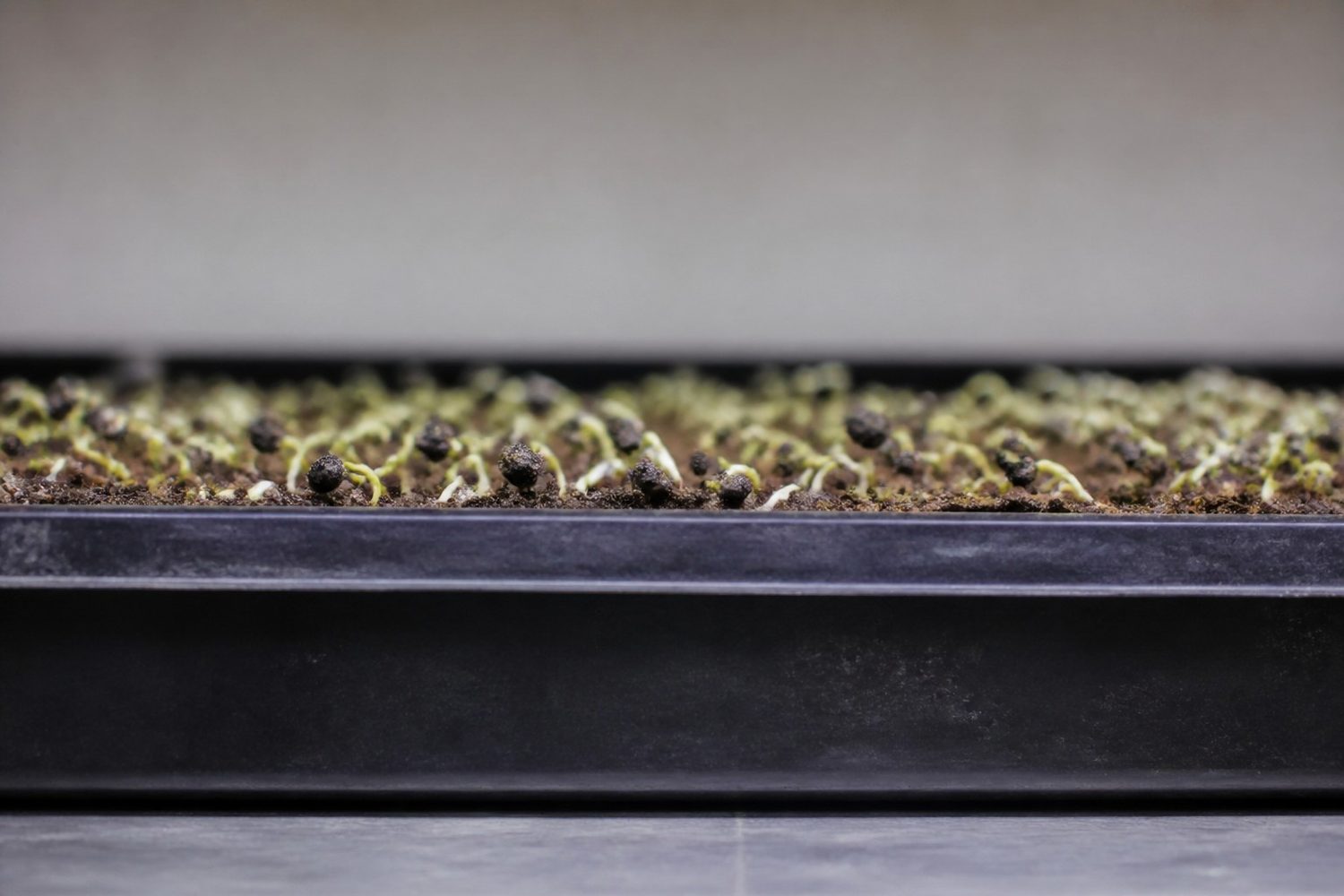
At emergence: damping-off. Water-soaked, pinched, collapsing seedlings at or below the medium line, with Pythium often starting at the root tips and Rhizoctonia also implicated. Stop the wet condition immediately; the collapsed seedlings are lost.
Root hair against mold, and how to call it. Root hairs are a fine white even fuzz anchored to living roots, and they look less conspicuous after watering because they collapse when wet. Suspect mold when growth bridges from the medium onto stems or hulls, spreads as a web, persists after watering, or comes with soft pinched seedlings. The decisive cue is tissue condition at the soil line, not the color of anything.
After uncovering: the patchy stand. Uneven germination shows as mismatched heights and bare areas. It is recoverable only as a lower-yield tray, and on a crop with a 1.29 oz yield to begin with, that is most of the margin.
Near the cut: coarse, lodged, tangled leaves. Held too long the blades lengthen and tangle, the hulls become more conspicuous in the pack, and the onion intensity gets harder to dose. No source gives a threshold, so set a house cut point by tasting and packing rather than by day count.
Nutrition, and what is actually established
Almost nothing, and what exists is one sentence.
There is no USDA FoodData Central record for onion microgreens, searched 2026-08-09, and mature onion values are not a substitute.
The one crop-specific study is Nair and Lekshmi (2019), which grew ten locally available microgreens for two weeks, recorded over 80 percent germination and 6 to 7 cm heights, and reported ***Allium cepa as high in niacin among the crops tested. That is a comparative statement within one small study, not a nutrient panel, and the accessible text carries no onion-specific table. There is no per-serving figure to be had*, so do not put one on a label or a market sign.
So, the "nutrient dense" and "superfood" language on supplier pages has nothing quantitative behind it for this crop, and the specific claim that onion microgreens carry the same nutrition as mature onion has nothing behind it at all. One thing you will see repeated, that they never make you cry, is true and is not a nutrition claim.
Which seed to buy
Buy on the botanical name, and this is the crop where that sentence does real work. Specify Allium cepa, a named cultivar, a lot number and a germination test date, and untreated seed intended for food use. Two A. cepa cultivars are sold for microgreens by name: Crystal White Wax and Utah Yellow Sweet Spanish, both listed at 14 to 21 days, with no comparative trial between them on length, tenderness, color or yield.
What you must not do is treat a bunching-onion result as an onion result. Tokyo Long White and Evergreen are sold for microgreens and are Allium fistulosum, a different species. Their days and yields are not this crop's. And the same searches return Allium tuberosum, garlic chives, under the word "Onion" in the product title. Garlic chives is the mislabel to watch for, because it shows up under onion, under chives and under leek listings alike. Read the Latin name, not the headline.
The marketplace is the cheaper route on this crop, which is the reverse of the usual. The Amazon search returns 294 results with nine genuine onion microgreen listings on the first page, and a full ladder from one brand: 8 oz $25.03, 1 lb $48.10, 2 lb $84.05, 3.5 lb $138.17. At $48.10 a pound that is less than half the seed house's $113.30 for the named cultivar, and it works the tray out at about 51 cents instead of $1.20.
The catch is exactly the thing this page is about. The cheaper bag is labeled "Onion Sprouting & Microgreens Seeds" and names no species and no cultivar. On a crop where three Allium species share a shelf and nothing tells them apart in the tray, paying double for a bag that says Allium cepa Crystal White Wax is buying information rather than seed. Which of those two trades is right depends on whether you need to know what you grew.
Onion microgreen seed on Amazon is where the cheaper ladder is. Read the title for a species before you buy, and if it does not name one, know that you are buying an allium rather than an onion.
Is it worth growing?
For a cook, yes, on flavor. For a bench you are trying to make pay, no, and the numbers say so plainly.
A tray occupies ten to twenty-one days and returns about 1.29 ounces. Only fennel yields less, and sunflower returns ten times as much. At $1.20 of seed that is 1.08 ounces per dollar and about 0.12 ounces per tray-day, both near the bottom of anything you could grow in the same space. Nothing about that improves with scale, because the constraint is the plant.
What it gives back is a genuinely useful kitchen ingredient. Fresh onion in thread form, cut minutes ago, that seasons a plate without the water and volume of sliced scallion. For a home grower who cooks daily, one tray of this earns its shelf on use rather than on weight.
The comparison that actually matters is with the other alliums. Chives is the best-measured of the three, with a real density trial behind it, and it competes with a perennial pot you buy once. Leek turns a bench faster than chives at 0.56 against 0.25, and it beats its own garden version by most of a season. Onion sits below both of them on every economic column and above both on flavor intensity. If you want an allium tray and you want numbers, grow leek. If you want onion on your eggs, grow onion.
If you keep animals, this is the tray to keep away from them
Onion is the allium that gets named directly. Colorado State Extension's poultry guidance lists onions among the things not to feed a flock, and Merck's toxicology chapter describes the sulfur-containing compounds in onion, garlic, chives and leek causing oxidative red-cell damage, Heinz bodies and delayed hemolysis in food-producing animals. Merck's numerical doses are for cats and dogs and do not transfer to a bird, and nothing has been tested at microgreen stage in any animal, so there is no threshold to work to.
That is an argument for keeping the tray out of reach, not for growing something else: onion microgreens are ordinary food for people. It also does not extend everywhere. The veterinary sources name dogs, cats and horses, and the reptile question is not established in either direction. The poultry reasoning, and the treat ceiling that governs it, is on the feeding microgreens to chickens guide.
A note on the numbers above
Hover or tap a row to highlight it.
| Figure | Value | Source | What kind of number it is |
|---|---|---|---|
| Seed per tray | 1.0 g in 18 x 15 cm | Growing-media study | Measured treatment, on a 270 cm2 tray |
| Seed per 1020 | 4.8 g | The same, area-converted | Extrapolation, not a production rate |
| Yield per tray | 7.68 g on cocopeat | Growing-media study | Measured, on the same 270 cm2 tray |
| Yield per 1020 | 36.7 g, 1.29 oz | The same, area-converted | Extrapolation, not a measured 1020 |
| Days to harvest | 10 to 12 | Growing-media study | After 2 to 3 covered days, no temperature or stage |
| Days to harvest | 14 to 21 | Supplier, three products | No temperature or stage |
| Blackout | 2 to 3 days | Growing-media study | Thin media cover, no weight reported |
| Height at 2 weeks | 6 to 7 cm | Nair and Lekshmi, 2019 | Measured |
| Niacin | High among ten crops tested | Nair and Lekshmi, 2019 | Comparative, not a nutrient panel |
| Soil temperature | 50 to 95°F, optimum 75°F | Penn State | ONION SEED data, not a microgreen trial |
| Seed price | $113.30/lb named cultivar | True Leaf, 2026-08-09 | Among the dearest microgreen seed sold |
| Seed price | $48.10/lb unnamed species | Amazon, 2026-08-09 | Less than half, and it names no species |
| Shelf life | No published figure | Nobody | No onion-specific trial |
| Harvest window | No published figure | Nobody | Nobody has established it |
Both of onion's money numbers are area conversions from a single study, so hold them loosely. The experiment sowed 1.0 g in an 18 by 15 cm tray, 270 square centimeters, and harvested 7.68 g of crop. A 1020 is 1,290 square centimeters, about 4.8 times the area, so the figures scale to 4.8 g of seed and 36.7 g, or 1.29 oz, of crop. That arithmetic assumes yield scales linearly with area, which is reasonable and unproven. Weigh your first full tray and work from that number afterwards, because it will be a measurement rather than a conversion.
The seed prices high per pound and the tray still comes out cheap, which is the reverse of the usual trap. Crystal White Wax at $113.30 a pound is among the dearest microgreen seed sold, behind mint at $1,394.50 and oregano at $242.36, and ahead of basil Red Rubin at $93.40 and mustard at $88.30. The tray still costs $1.20, because it takes 4.8 grams. Wheatgrass makes the point from the other end, at $3.12 a pound and 450 grams a tray. Seed price per pound tells you almost nothing about what a tray costs, so do the multiplication before you judge a bag on its sticker.
Onion sits near the bottom on both economic columns. It returns 1.08 oz per dollar, against fennel's 0.42, nasturtium's 0.98 and chives' 1.7, and about 0.12 oz per tray-day against fennel's 0.04 and carrot's 0.10. Those pair the study's own 11-day cycle with the study's own yield. On the supplier's 14 to 21 days it would be worse still, so build the rotation around something faster and fit onion in beside it.
Three numbers are missing on this crop, and each one has its own workaround. Nobody has tested a soak in either direction, so sow dry, which is what the one working protocol did. No onion-specific storage trial exists, so hold it dark at 41°F like any other microgreen and find your own limit by tasting. And nobody has measured how long a ready tray holds, so cut at the straightened leaf, write down the date, and let the second tray tell you the window.
Hover or tap a row to highlight it.
| Crop | Seed per 1020 | Yield | Days | Cost per tray | Oz per $1 | Oz per tray-day |
|---|---|---|---|---|---|---|
| Leek, American Flag | 23 g | 5.64 oz | 10 to 25 | $2.21 | 2.6 | 0.56 at 10 days |
| Chives | 19.4 to 38.7 g | 3.8 to 5.6 oz | 19 | $1.89 to $3.77 | 1.7 | 0.25 |
| Onion, Crystal White Wax | 4.8 g, area-converted | 1.29 oz, area-converted | 10 to 21 | $1.20 | 1.08 | 0.12 at 11 days |
All 62 crops, sortable, on the microgreen comparison.
Onion's seed rate and yield are both conversions rather than measurements, and so are fennel's, komatsuna's and lentil's. Those are the rows to check against your own scale before you plan anything around them.
Terms on this page
Tap a term to see what it means.
*Allium cepa*. The bulb onion, and the crop on this page. What you want on the bag.
Sources
- Growing-media trial for onion microgreens (PDF) - the only controlled onion microgreen protocol opened: 1.0 g sown in an 18 by 15 cm tray, 2 to 3 days covered under a thin media layer, a 10 to 12 day cycle, 7.68 g harvested on cocopeat, and the description of the greens as soft, slightly crunchy and grass-like with onion flavor.
- True Leaf Market, Crystal White Wax onion microgreen seed - the named A. cepa cultivar and the price ladder verified 2026-08-09 at 1 oz $14.85, 4 oz $37.63, 1 lb $113.30 and 5 lb $440.63.
- True Leaf Market, Utah Yellow Sweet Spanish onion microgreen seed - the second named A. cepa cultivar, 14 to 21 days, and the product photography showing black seed coats held at the leaf tips.
- True Leaf Market, organic onion microgreen seed - 14 to 21 days with no named cultivar, and the advice to taste a few first because the flavor is strong.
- True Leaf Market, Tokyo Long White bunching onion - sold as an onion microgreen and identified by the supplier as Allium fistulosum, which is the species confusion this page opens on.
- NCBI Taxonomy, Allium cepa - taxonomy ID 4679 and the Amaryllidaceae placement.
- Nair and Lekshmi, 2019, nutritional evaluation of selected microgreens - ten crops over two weeks, over 80 percent germination, 6 to 7 cm heights, and A. cepa reported high in niacin among those tested.
- Penn State Extension, seed and seedling biology - onion seed germination at 50 to 95°F with a 75°F optimum, a 35°F minimum and a 95°F maximum, which are soil-temperature data rather than microgreen conditions.
- Virginia Tech Extension SPES-756 (PDF) - the general 60 to 70°F and 50 to 70% RH production environment, uncovering when a majority has germinated, dark storage at 41°F, and the statement that species-specific storage optima remain under evaluation.
- Penn State Extension, growing microgreens at home - the default shallow-tray method this crop is compared against.
- UC IPM, damping-off - Pythium and Rhizoctonia, root-tip onset, and rot at or below the medium line as the diagnostic anchor.
- USDA FoodData Central - searched 2026-08-09, no onion microgreen record.
Keep reading
The variety directory
Chive microgreens
One of the few crops where somebody actually ran a density trial, and poor value per dollar of seed. It also competes with a perennial you buy once.
Read Chive microgreensThe variety directory
Leek microgreens
A crop where the garden version is far slower than the tray: a leek takes most of a season in the ground and ten days in a 1020, and it turns a bench more than twice as fast as chives.
Read Leek microgreensThe variety directory
Amaranth microgreens
Red Garnet amaranth is the magenta garnish crop, and the trial numbers explain why it is a chef's crop rather than a grower's: 7.5 g of seed makes 6.5 oz in 17 days, against radish's 11 oz in nine.
Read Amaranth microgreensThe variety directory
Beet microgreens
Generic red beet, the cheaper and less uniform sibling of Bull's Blood. Its seed is a multi-seed cluster, several shoots from one point are normal, and it has no measured yield of its own.
Read Beet microgreens