At a glance
Fast high germination with no soak, 2 to 3 days to emerge, and a short cycle; it only becomes unforgiving if the small seed is sown unevenly or the canopy is held wet after it closes.
- Botanical name
- Brassica rapa var. perviridis
- Also sold as
- Komatsuna Green, Komatsuna Red, Japanese mustard spinach, Tendergreen
- Family
- brassica
- Difficulty
- Beginner
- Days to harvest
- 8 to 12 days
- Harvest window
- No published figure
- Seed per 1020 tray
- 10 to 24 g
- Soak
- None
- Blackout
- 2 to 4 days
- Germination temperature
- 64 to 75 °F
- Yield per 1020 tray
- 10.6 to 13.4 oz
- Regrows after cutting
- No published figure
- Mold risk
- Medium
- Hull shedding
- No published figure
- Shelf life
- No published figure
- Eaten as
- raw
- Seed cost per tray
- $1.06
22.6 g at $21.24/lb, Mountain Valley Seed Co Tendergreen komatsuna, 1 lb, sold for microgreens, listed 2026-08-09. That rate is the controlled study's density, which is what the published yield was measured at. At the lower 10 g supplier rate the same seed is $0.47. THE PACKET PRICE IS A DIFFERENT WORLD: 1 g garden packets of named hybrids run about $183 an ounce, roughly 138 times the bulk rate. Seed only, excludes medium, tray, labor, light and loss.
Any field name above ranks every variety by it. No published figure means we researched it and nobody has established one, which is different from not yet researched. Every figure here is sourced at the bottom of the page. Compare every variety side by side.
Komatsuna is a fast, mild Japanese mustard green: no soak, two to three days to emerge, a short cover, and a cut inside a fortnight.
It is also one of the few crops where somebody has measured what holding the tray longer actually buys. A controlled study weighed the same trays at first true leaf and again at second true leaf and got 2.34 kg per square meter against 2.95, which is 26 percent more fresh weight for one more leaf stage, from the same seed under the same lights.
Set against that, the crop's own suppliers say the flavor intensifies as the leaves darken and the tray moves toward baby leaf. So, the trade is legible for once: about a quarter more weight, for a product that tastes more strongly of mustard and is further from the tender thing that was ordered. Which side of that you want depends on whether you are selling by weight or by tenderness, and this is the only page here that can put a number on the first half.
What growers are saying right now
Sampled from public posts and videos, 10 July to 9 August 2026. Every line links what it is quoting. How often something is repeated is not evidence that it is true, so every line also says what the sources actually establish.
The single mention of komatsuna in thirty days is somebody feeding it to an animal
Circulating This post describes a female finishing laying and incubating her eggs, and says her first meal afterwards was komatsuna
Not a microgreen use, and not a mistake either. Komatsuna is an everyday cooking green in Japan and a common feed green for pet birds and tortoises, so the plant has a large audience that has nothing to do with trays. If that is your interest, the microgreens for animals pillar is the right part of this site rather than this page.
Start with microgreens, they take almost no space and most are ready in seven to fourteen days
Circulating Said here, one of several beginner pitches that surfaced instead of anything komatsuna-specific
True of this crop, and komatsuna is a fair answer to that pitch: no soak, two to three days to emerge, a short cover, and a cut inside two weeks. The catch is not difficulty, it is that you cannot buy it in a beginner's quantity without paying a garden-packet price. Which seed to buy
What it is, and how to tell you grew it right
Komatsuna is Brassica rapa var. perviridis, sold in English as Japanese mustard spinach and often as Tendergreen. It is the same species as turnip, pak choi, mizuna and tatsoi, and a different variety of it, which is why it looks and behaves like all of them in a tray.
Two forms are genuinely sold: Komatsuna Green, with green-white stems and green leaves, and Komatsuna Red, with green leaves carrying red and purple highlights, usually in the leaves and veins rather than as a solid red stem. That is a real pigment distinction and not relabeling.
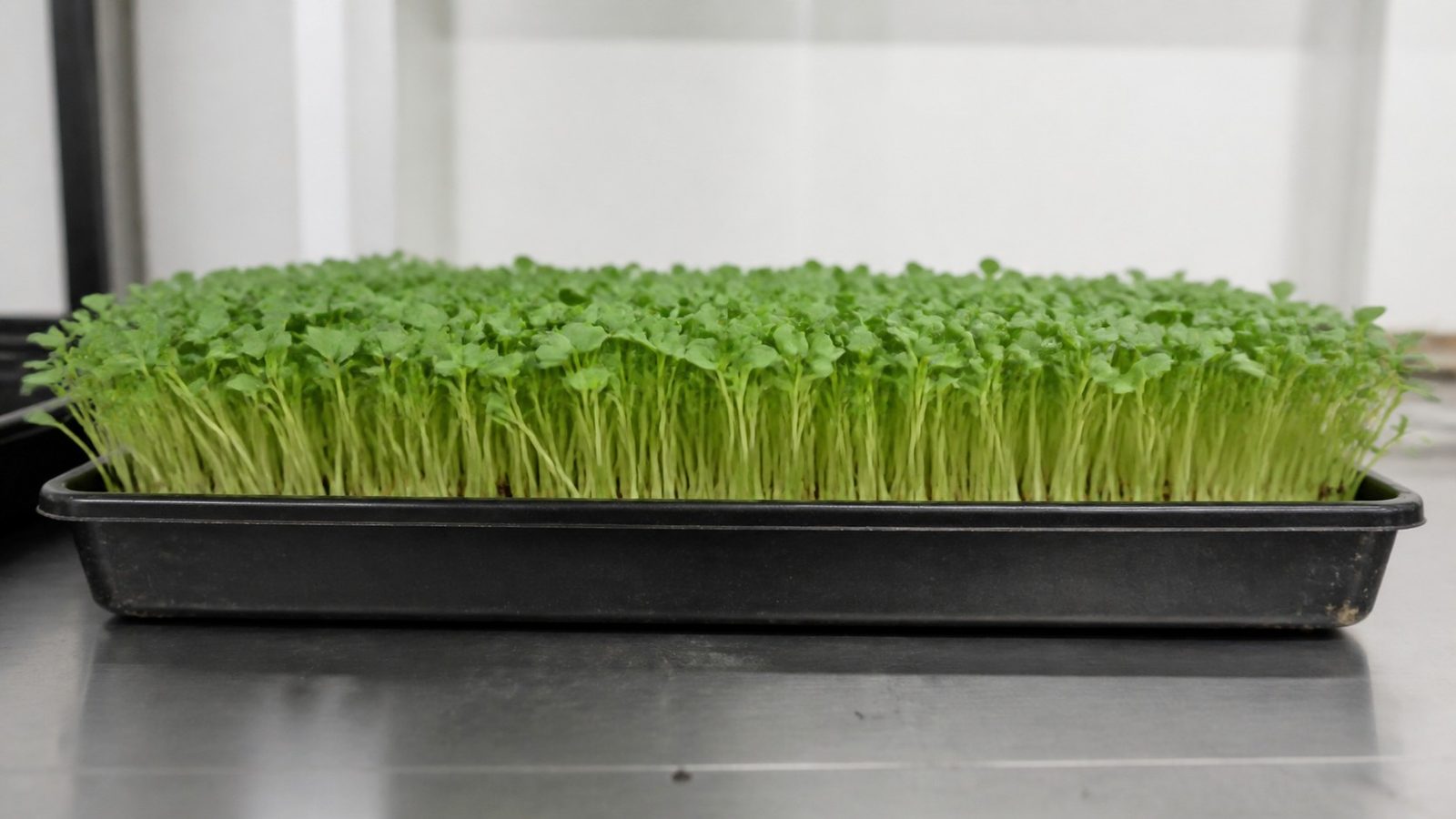
A correct tray is an even carpet of slender pale green to white stems with paired broad cotyledons, around two to three inches, over a fine white root mat at the medium. Growth climbing the stems is not part of it.
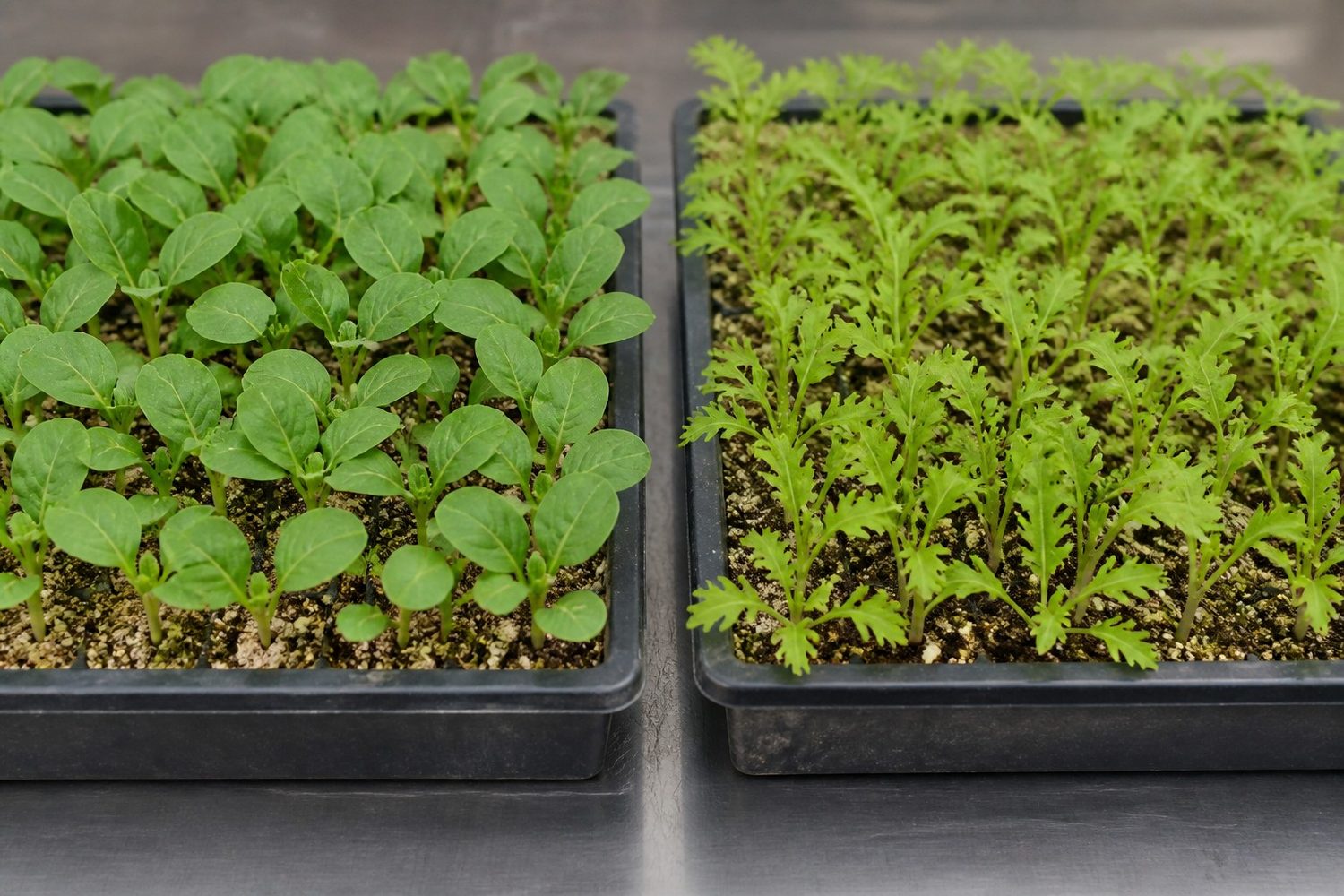
Identification at cotyledon stage is not possible. Komatsuna, pak choi, mizuna, tatsoi and generic mustard are all confusable, and no source opened here establishes a visual tell between them at that stage. The useful difference arrives at true leaf: komatsuna's is broad and spoon-shaped or oval, where mizuna develops conspicuously divided and fringed leaves. Before that, the seed label is the identification.
What it tastes like, and what to do with it
Mild, slightly sweet mustard-spinach with a gentle peppery bite. It is not hot the way a sharp mustard is, and a Red komatsuna supplier positions it specifically as suiting palates that find mustard too strong.
Its flavor is not fixed, and that is unusual enough to plan around. Suppliers report it intensifies as the leaves darken and develop, which is the same clock the yield section above is measuring from the other end. A day-10 cut and a day-14 cut are meaningfully different products, and neither is wrong.
Use it where soft leaf volume and a restrained brassica bite help: a rice or noodle bowl with soy, sesame and ginger, egg on toast, an avocado and cucumber sandwich, or a handful dropped onto soup at the end. It is a poor choice when the plate wants real heat, where radish or arugula belongs, or when it wants the crunch of pea shoots.
Who will not like it: people who dislike mustard-family bitterness or a sulfurous brassica aroma, and that dislike gets stronger the longer the tray is held.
Growing it: only what differs from the standard method
Everything general about trays, medium, light and watering is on the standard tray method for growing microgreens. Komatsuna's deltas are genuinely few, and saying so is more useful than inventing some.
Do not soak. Two crop-specific suppliers say so outright. At roughly 400 seeds per gram this seed is small but not dust, and wet seed clumps rather than spreading.
Sow evenly on a level bed and press for contact, do not bury. Level distribution matters more than depth here. A lumpy sow becomes a lumpy stand, and the crop is short enough that it never grows out of it.
Cover for two to four days, three being the target. This is a short blackout by the standards of this directory, where several brassicas take four to seven. Use only enough weight to keep seed and medium in contact; no komatsuna-specific weight has ever been published. Uncover when most seedlings have emerged and are pushing the cover, before the stems elongate and start trapping moisture.
Then bottom water and give it air. Nothing establishes that komatsuna wants more or less light, water, airflow or blackout than a default brassica tray. The general daily light integral target of 9 to 16 is a baseline, not a komatsuna prescription.
Hold it at 64 to 75°F. A supplier reports poor germination below about 54°F and heat stress above about 77°F. Those are supplier thresholds rather than an experiment, but the shape is the usual cool-season brassica one.
A komatsuna tray, day by day
- 1
Day 0, sow dry
10 to 24 g depending on whose rate you follow, spread evenly on a level bed and pressed for contact. No soak.
- 2
Days 2 to 3, emergence
Fast and high. Bare zones showing now are a distribution or contact failure and will not fill in later.
- 3
Days 2 to 4, uncover
When most seedlings are pushing the cover. Short by this directory's standards, and overstaying it is what produces pale bent stems.
- 4
Days 4 onward, light
Bottom water, keep air moving across a canopy that closes quickly.
- 5
Day 10 or so, first true leaf
The usual target, and the stage the study's 10.6 oz was measured at.
- 6
Day 12 to 14, second true leaf
About 26 percent more weight, a darker leaf and a stronger flavor. A different product, not a better one.
What goes wrong with komatsuna specifically
First, patchy emergence, in the first two to three days. Bare zones from uneven contact or a surface that dried. On a crop this fast there is no recovery to an even market tray: the gaps are still gaps at harvest. Fix the sowing, not the tray.
Then, elongated pale stems. The cover stayed on too long. Get it into light immediately, and it will green up, but severe lodging does not straighten.
Then, damping-off. Water-soaked or pinched stems at or below the medium line with seedlings collapsing. Pythium can begin at the root tips and Rhizoctonia rots at the line. Discard rather than harvest.
And the root-hair confusion, which on this crop has the ordinary answer. Normal root hairs are bright white, confined to the roots at the medium, and become less conspicuous with moisture. Mold spreads as a web across medium and tissue, persists, smells off, and travels with collapse. Unlike the mucilaginous crops in this directory, komatsuna adds nothing that muddies that test, so use it.
Late, a different crop rather than a spoiled one. Darker, more developed leaves and stronger flavor, moving toward baby leaf. The signal is true leaves expanding past whichever stage you were aiming at. That is a decision rather than a failure, and the numbers section below is the place it gets priced.
Nutrition, and what is actually established
There is no USDA record for komatsuna microgreens, and mature komatsuna values are a different food.
One controlled study has measured this crop properly, and it is unusually thorough: fresh and dry yield, dry matter, color, eleven minerals, carotenoids, volatiles, anthocyanins and polyphenols, chlorophyll, ascorbate and antioxidant capacity, all at both first and second true leaf. Komatsuna came out highest along with pak choi for phosphorus and potassium in that comparison. It used a red-pigmented genotype in controlled chambers, so it describes those plants under those conditions rather than a retail nutrition label.
What is not supported is the marketing you will meet: that komatsuna microgreens are packed with vitamins A, C and K, that they prevent cancer or diabetes, or that they carry some quantified high calcium value. No USDA entry and no crop-specific human study backs any of it. The study above measured composition and in-vitro antioxidant capacity, which is a statement about chemistry and not about people.
Which seed to buy
Two forms are verified, Komatsuna Green and Komatsuna Red, and no controlled comparison establishes a difference between them in stem length, tenderness, days or yield. Choose on appearance. Ask for seed sold expressly for microgreens or sprouting, untreated and food-use, with lot and germination information; one supplier publishes an 80 percent minimum germination, which is the shape of answer to expect.
The buying problem on this crop is quantity, and the spread is the widest this directory has recorded. Komatsuna seed on Amazon checked on 2026-08-09 returns 136 results with 11 komatsuna listings on the first page, and they fall into two completely separate markets:
Hover or tap a row to highlight it.
| Listing | Size | Price | Per pound | Trays it sows |
|---|---|---|---|---|
| Mountain Valley Tendergreen komatsuna, sold for microgreens | 1 lb | $21.24 | $21.24 | About 20 to 45 |
| Kitazawa Japanese Komatsuna | 1 oz | $11.99 | $191.84 | About 1 to 3 |
| Kitazawa Japanese Komatsuna | 3 g | $13.15 | $1,989 | Under one |
| Kitazawa Green Boy F1 | 1 g | $6.48 | $2,937 | A twentieth of one |
| Kitazawa Summer Fest F1 | 1 g | $6.48 | $2,937 | A twentieth of one |
| Heirloom garden packets | 1 to 2 g | $4.79 to $9.99 | $1,000 plus | Under one |
That is roughly 138 times the bulk price, and it beats endive's 85x for the widest gap on this site. The mechanism is the same one endive found: the garden shelf sells this species in packets counted for a vegetable patch, and a microgreen tray eats a packet at a time.
The difference, and it is good news, is that on komatsuna the bulk bag actually exists. Endive had no five-pound option a home grower could reach. Here there is a one-pound bag at $21.24, explicitly sold for microgreens, which sows somewhere between twenty and forty-five trays depending on whose rate you follow. Buy the pound. The named F1 hybrids in the gram packets, Green Boy and Summer Fest, are bred for field and greenhouse leaf production, and nothing establishes that either does anything different in a tray.
A bad lot shows as slow patchy emergence or weak seedlings, and on an eight to twelve day crop those gaps cannot fill before harvest. The loss is the whole tray's media, labor and rack time rather than the seed, which at bulk is under a dollar.
Is it worth growing?
Yes for a beginner, and yes for a home grower who wants something with more character than broccoli and less heat than radish. It is fast, it needs no soak, the blackout is short, and at bulk prices the seed is cheap.
For a market grower the honest answer is: trial it yourself first. Komatsuna is absent from the trade's 29-variety yield trial, so there is no 1020 benchmark measured the way broccoli's and kale's were, and the figures on this page come from a controlled study in trays a fifth the size of yours. That is better than nothing and it is not the same thing.
Its competition is the rest of the Asian brassica bench, pak choi, mizuna and tatsoi, all of them the same species, all similar in a tray. Pak choi wins on being better known to buyers, mizuna wins when the plate wants that fringed leaf, radish and arugula win when heat is the point. Komatsuna wins on broad tender leaf volume with a bite that stays polite, and it is the one to reach for when a customer likes the idea of mustard greens more than they like actual mustard.
A note on the numbers above
Hover or tap a row to highlight it.
| Figure | Value | Source | What kind of number it is |
|---|---|---|---|
| Fresh yield, first true leaf | 2.34 ± 0.05 kg/m2 | Controlled study, n=3 | Measured, 14x19 cm peat trays, 70,000 seeds/m2 |
| Fresh yield, second true leaf | 2.95 ± 0.09 kg/m2 | Same study | Measured. 26 percent more for one leaf stage |
| Yield per 1020 | 10.6 oz and 13.4 oz | Area conversion of the above | 0.129 m2. The study's trays are a FIFTH of a 1020 |
| Seed density | 70,000 seeds/m2 | Same study | Converts at about 400 seeds/g to roughly 22.6 g per 1020 |
| Seed per 1020 | 10 to 15 g | Bootstrap Farmer | Supplier guidance, no stage stated |
| Seed per 1020 | 24 g | MP Seeds, Red komatsuna | Supplier guidance. Lands with the study's density |
| Seed per 1020 | No trial figure | Johnny's | Komatsuna is absent from the 29-variety trial |
| Days to harvest | 8 to 12, ideal 10 | Bootstrap Farmer | No temperature, no leaf stage |
| Days to harvest | 10 to 12 after 2 to 4 dark days | Golinucci | No leaf stage |
| Days to STAGE | Not stated | The controlled study | Which is why tray-day cannot be calculated |
| Germination temperature | 64 to 75°F ideal | Micropod | Poor below 54°F, heat stress above 77°F. Supplier thresholds |
| Minerals | Highest with pak choi for P and K | The controlled study | A comparison within its set, not a label value |
| Seed price | $21.24/lb bulk, about $2,937/lb in 1 g packets | Amazon, checked 2026-08-09 | About 138x, the widest spread on this site |
| Germination spec | 80 percent minimum | Golinucci | A published supplier standard |
| Shelf life | No published figure | Nobody | No komatsuna-specific refrigerated life exists |
| Harvest window | No published figure | Nobody | How long a READY tray holds is unmeasured |
| USDA record | None for the microgreen | FoodData Central | Mature komatsuna is a different food |
Komatsuna is the first crop in this table whose tray-day is blank for a NEW reason. Every other blank in that column is a missing yield. Here the yield exists and is measured; what is missing is the day count that goes with it. The study weighed the crop at leaf STAGES and never published days-to-stage, and the suppliers who publish days never state a stage. Pairing a supplier's day 10 with the study's first-true-leaf weight would look like a calculation and would actually be an assumption, so the column stays empty and says why.
The yield is an area conversion and the trays were small. 14 by 19 centimeters is about a fifth of a 1020, and small trays are more affected by edge effects than large ones. This is the same treatment fennel and spinach get and it carries the same warning: it is the only measurement in existence for this crop, and it is not a weighed 1020.
The seed rate is the interesting corroboration. The study's 70,000 seeds per square meter converts to about 22.6 g per 1020, which is close to MP Seeds' 24 g and roughly double Bootstrap Farmer's 10 to 15. A controlled study and a supplier arriving independently at the same density is worth more than either alone, and it means the twofold disagreement in the spec block is not a coin toss: the high end has support the low end does not.
And the cost figure is new work rather than dossier work. The research for this crop could not price it, because the one supplier it opened showed a price that was not tied to any of its three pack sizes. Checking the seed shelf directly turned up a named 1 lb bag at $21.24 sold for microgreens, which is what makes the value-per-dollar column possible at all.
Hover or tap a row to highlight it.
| Crop | Seed per 1020 | Yield | Days | Cost per tray | Oz per $1 | Oz per tray-day |
|---|---|---|---|---|---|---|
| Watercress | No published figure | No published figure | 7 to 25 | no rate to price | cannot be calculated | cannot be calculated |
| Turnip, Purple Top White Globe | 10 g | No published figure | 7 to 12 | $0.31 | cannot be calculated | cannot be calculated |
| Komatsuna | 10 to 24 g | 10.6 oz at 1st true leaf, 13.4 at 2nd, area-converted | 8 to 12 | $0.47 to $1.12 | 10.0 | no day count for the measured stage |
| Collard | 28.35 g | No published figure | 7 to 15 | $0.90 | cannot be calculated | cannot be calculated |
| Cabbage, Green | No published figure | No published figure | 8 to 12 | no rate to price | cannot be calculated | cannot be calculated |
A blank means nobody has published that figure, so the cell is left empty rather than filled with an estimate. How the numbers work
All 62 crops, sortable, on the microgreen comparison.
Komatsuna sits between the two halves of that table on purpose. It has more figures than anything below it and one fewer than everything above it, and the missing one is a day count rather than a weight. If somebody publishes days-to-first-true-leaf for this crop, it moves up into the ranked half at roughly 1.0 ounce per tray-day on a ten-day cut, which would put it near the top. That is a real number waiting on one small piece of reporting.
Terms on this page
Tap a term to see what it means.
*Brassica rapa* var. *perviridis*. Komatsuna. The same species as turnip, pak choi, mizuna and tatsoi, and a different variety of it.
Sources
- Shared source note, added 2026-08-09: this same study supplies the pak choi entry's research figures. The two pages are not independent of each other, and pak choi's numbers are corroborated by Johnny's separate trial rather than by this page. On pak choi the study's area-converted yield lands within 4 to 13 percent of two measured 1020s, which is the only check this directory has on the conversion it uses here.
- Comparative study of Brassica microgreens at two harvest stages (PDF) - the controlled study behind this page's yield: 2.34 ± 0.05 kg/m2 at first true leaf and 2.95 ± 0.09 at second, n=3, 70,000 seeds/m2 in 14 by 19 cm peat trays, 24°C dark germination then 24/18°C, plus the mineral, carotenoid, volatile, chlorophyll, ascorbate and antioxidant measurements and the phosphorus and potassium finding.
- Bootstrap Farmer, microgreen cheat sheet - 8 to 12 days with an ideal of day 10, 10 to 15 g per 1020, and 3 to 5 blackout days.
- Golinucci, Komatsuna Green microgreens - Brassica rapa var. perviridis, about 400 seeds per gram, no presoak, 2 to 4 dark days, 10 to 12 days total, the green versus red distinction, and an 80 percent minimum germination spec.
- MP Seeds, Komatsuna Red microgreens - 24 g per 10 by 20 tray, 10 to 12 days, light green stems with green to purple leaves, and the positioning for palates that find mustard too strong.
- Mumm's Sprouting Seeds, komatsuna - no presoak, the mild slightly sweet mustard-spinach description, flavor intensifying as leaves darken, and the instruction to harvest dry and dry before sealing.
- Micropod, komatsuna microgreen seeds - the 64 to 75°F ideal, poor germination below 54°F, heat stress above 77°F, and the raw culinary uses.
- Kings Seeds, Komatsuna Red Leaf microgreen - the red leaf form and surface sowing.
- Johnny's microgreens yield trial, method and discussion - the absence of komatsuna from the 29 varieties tested, and the warning that one system's yields do not transfer.
- University of Maryland Extension, growing microgreens and baby greens indoors - the standard tray method the deltas above are measured against.
- Virginia Tech Extension SPES-756 (PDF) - the general 60 to 70°F microgreen range, the 9 to 16 daily light integral baseline, and storage at or below 41°F.
- UC IPM, damping-off - Pythium and Rhizoctonia, root-tip onset, and damp conditions favouring disease.
- USDA FoodData Central - no komatsuna microgreen record.
Keep reading
The variety directory
Cauliflower microgreens
An easy, fast, substantial brassica: two to three day germination, cut at about a week, mild cabbage flavour with enough body for a salad base. The head crop's difficulty does not transfer.
Read Cauliflower microgreensThe variety directory
Garden cress microgreens
The crop where somebody finally measured what over-sowing costs: peak yield at 12 seeds per square centimeter, and roughly eight times the bacteria at 14. Plus 8 oz a tray at 13 days from the trade's own trial.
Read Garden cress microgreensThe variety directory
Watercress microgreens
A sharp peppery leaf that is far easier in a tray than in running water. Watercress is Nasturtium officinale, the crop called nasturtium is not, and garden cress is a third plant again.
Read Watercress microgreensThe variety directory
Arugula microgreens
Arugula is a seasoning green rather than a salad base: 10 g of seed makes 10 oz in 14 days, it is genuinely peppery, and its 10-day shelf life comes from a controlled storage study rather than an estimate.
Read Arugula microgreens