At a glance
Small dry seed with no soak, but a short wide habit that closes its own airflow when over-sown, a germination ceiling the seed refuses to cross, and a good cut that lasts about one to three days before the crop turns bitter.
- Botanical name
- Cichorium endivia
- Also sold as
- Endive microgreen seed, Broadleaf Batavian, Green Curled Ruffec, Tres Fine, Salad King
- Family
- aster
- Difficulty
- Moderate
- Days to harvest
- 8 to 15 days
- Harvest window
- 1 to 3 days
- Seed per 1020 tray
- 15 to 28 g
- Soak
- None
- Blackout
- 3 to 5 days
- Germination temperature
- 60 to 68 °F
- Yield per 1020 tray
- No published figure
- Mold risk
- Medium
- Hull shedding
- some
- Shelf life
- 7 days
- Eaten as
- raw
- Seed cost per tray
- $0.83
15 g at $25.11/lb, True Leaf Market Broadleaf Batavian endive microgreen seed at the 5 lb size, listed 2026-08-08. At the top of the same density range, 28 g, it is $1.55. THIS IS A BULK PRICE AND ALMOST NOBODY CAN BUY IT: the retail packs a home grower can actually get run 13 to 85 times this per ounce. Seed only, excludes medium, tray, labor, light and loss.
Any field name above ranks every variety by it. No published figure means we researched it and nobody has established one, which is different from not yet researched. Every figure here is sourced at the bottom of the page. Compare every variety side by side.
You have about one to three days to cut endive, and missing it does not look like a mistake. That is the thing to know before you sow one. Almost no microgreen has a published harvest window at all, and endive is one of the two that does, landing on the same one to three days as radish.
The difference between the two is what a late cut costs you. Radish gets hotter, which plenty of buyers actively want. Endive gets more bitter, which is the exact objection its marginal customer already had. Nothing rots, nothing collapses, and the tray still cuts and still sells, so nobody catches it until somebody eats it.
Endive is not hard to germinate and it is not slow. It is unforgiving in a way the fast brassicas are not, because its clock runs on the one attribute it is grown for.
What growers are saying right now
Sampled from public posts and videos, 10 July to 9 August 2026. Every line links what it is quoting. How often something is repeated is not evidence that it is true, so every line also says what the sources actually establish.
Nobody is saying anything. Endive microgreens have no current conversation at all
Circulating Nothing on Reddit, YouTube, TikTok or Instagram this month is about this crop. Every thread on r/microgreens is a different one: kale, sunflower, pea shoots, broccoli. Endive appears in none of them
The silence matches the published record exactly. No yield trial, no nutrition study, no cultivar comparison, no crop-specific mold test. When nobody grows a crop on camera, nobody measures it either, and the two gaps are the same gap. Where the numbers stop
The endive people do talk about is a different plant
Circulating The most-engaged endive post in the window is a reel on endive charcuterie boats at 32,419 views and 459 likes, using whole leaves as scoops, and the only endive food video on TikTok is a nutrition rundown of the mature vegetable at 130 views and 1 like
Those pale spear-shaped leaves are Belgian endive, which is Cichorium intybus, a different species from the Cichorium endivia grown in a tray. The name a shopper already knows points at the wrong plant, and that confusion follows the crop onto the seed shelf. What it is, and what it is not
Search the word on TikTok and the top results are not about food
Circulating The highest-engagement "endive" hits in the window belong to an unrelated short-drama contest hashtag, such as this one at 4,140 views
Not a finding about the crop, and that is why it is here. A tray crop with a real following produces grow-alongs, harvest shots and failure posts. Endive produces a hashtag collision, which is what an empty category looks like from the inside.
Is this root hairs or is it mold? The question that dominates the sub
Circulating Asked twice in this window alone, by a broccoli grower and in a straight mold panic, and it is the category's most repeated post
On endive there is no crop-specific answer to give. No opened source provides a photograph-validated root-hair-versus-mold test for this crop, so a grower gets the general triage and nothing better. What goes wrong with endive specifically
What it is, and how to tell you grew it right
Endive microgreens are seedlings of Cichorium endivia, an Asteraceae salad green, cut above the medium at fully opened cotyledons. Two horticultural types sit inside that one species: curled endive, C. endivia var. crispum, the frilly leaf sold as frisee, and broad-leaved escarole, C. endivia var. latifolium. A six-cultivar study separates the two groups explicitly, three curled and three broad-leaved.
It is not Belgian endive, and this is the single most useful thing to know before buying seed. Belgian endive, witloof, radicchio and sugarloaf are all Cichorium intybus, a different species. In ordinary English the word endive covers both plants, which is why a supermarket shopper picturing pale spear-shaped chicons and a microgreen grower sowing curled endive are talking about different crops without noticing. The word on the packet will not separate them. The botanical name and a cultivar known to belong to C. endivia will.
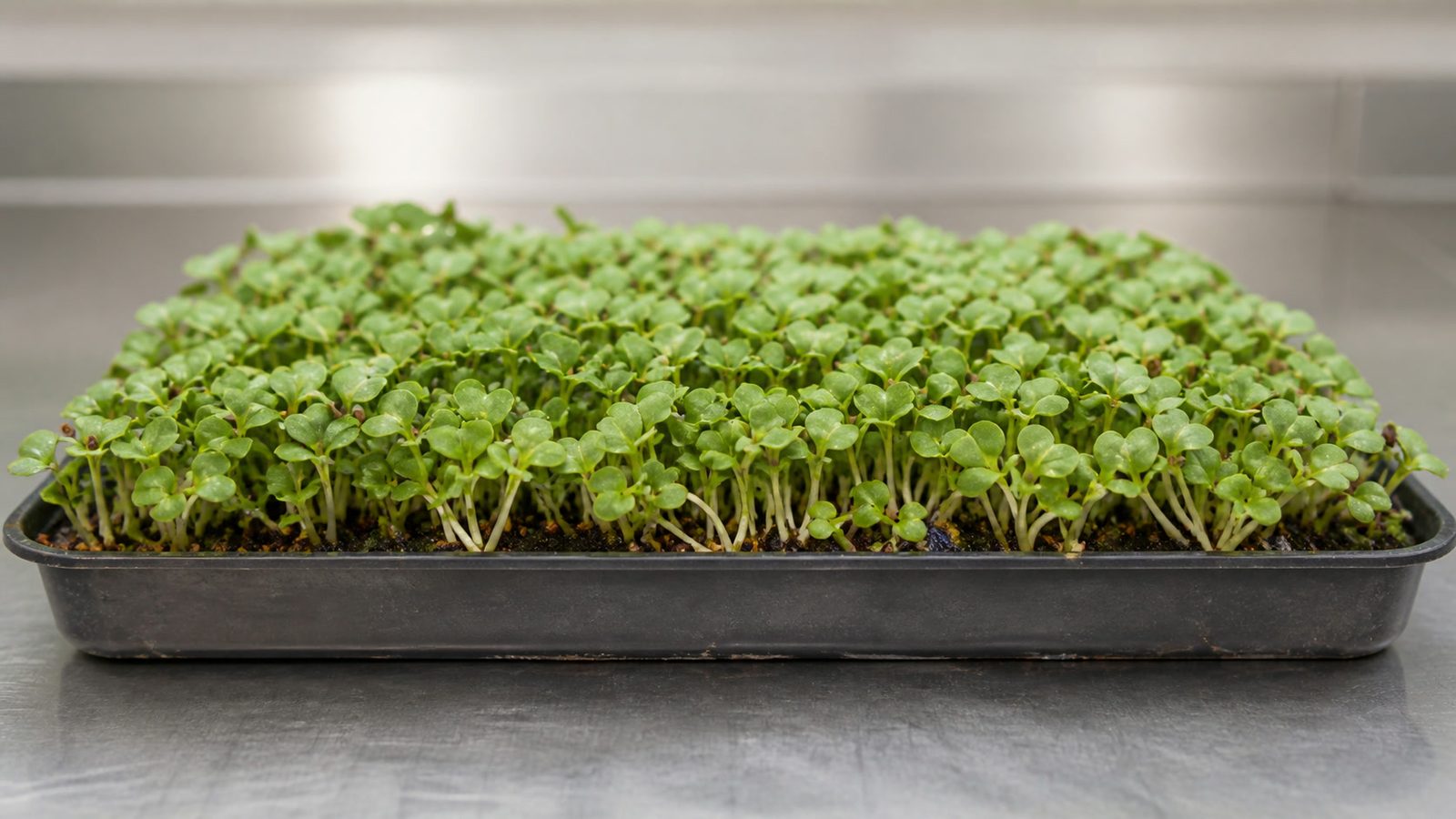
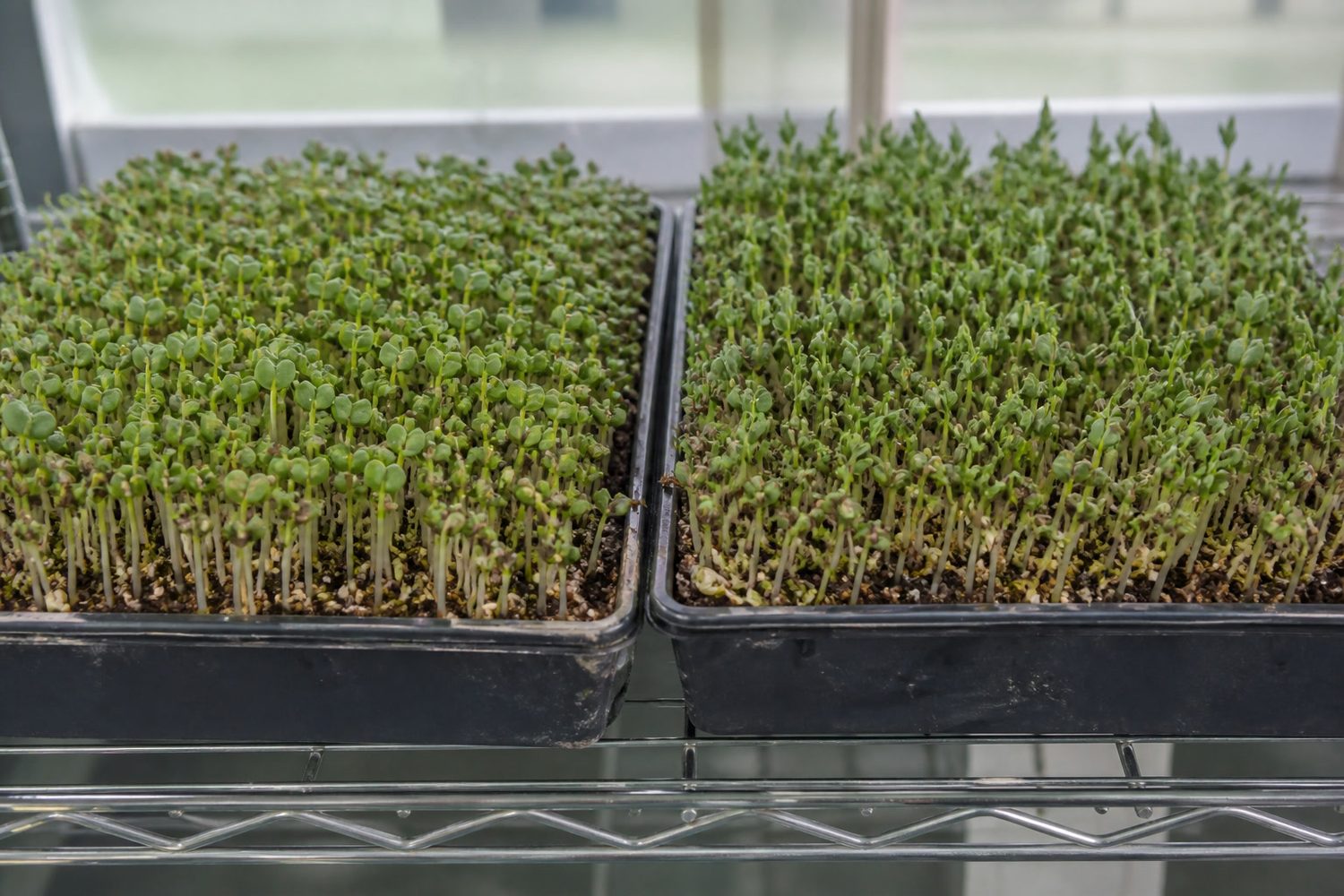
A correct tray reads as a low, wide, dense green mat rather than a tall canopy: fully opened green cotyledons on stems at least an inch tall, even enough that the stand has pushed its own cover up. Broadleaf Batavian's supplier puts the habit plainly, that it does not grow very tall but grows wide. Judge it by evenness and by the mat closing, not by height, because height is not what this crop does.
Two things about that stand are honestly unverified and worth saying so. No source that labels its photographs establishes a stem color, a stem thickness, or a height beyond the one-inch minimum, and no source establishes a single visual tell that separates endive from a chicory microgreen at cotyledon stage. Anyone naming the two apart from a tray photograph is guessing, and so is anyone telling you what shade the stems should be.
What it tastes like, and what to do with it
Mildly bitter at the cotyledon cut, and distinctly more bitter once true leaves begin. That second half is the crop-specific part, and it is unusual. Most microgreens held past their mark lose tenderness or go leggy; endive changes flavor, and it changes it in the direction of the thing some buyers already dislike.
It is one of four microgreens whose bitterness is the product rather than a fault, alongside broccoli raab, which is rapini, fenugreek, which is methi, and chia. On most other crops bitterness genuinely is a fault, and usually a timing one: barley grass, clover, lentil, lettuce and popcorn shoots all turn bitter only if you hold them too long, and the full flavor grouping is here. That makes endive a contrast ingredient rather than a volume green: it earns its place next to something sweet or rich, in a baby salad, on a sandwich, as a soup garnish, or as a lettuce replacement in a dish that can absorb a bitter edge.
It is the wrong choice in two obvious cases. If you want to fill a salad, this is not the crop, and not only because of the flavor: the stand is short and wide, so a tray does not carry the volume that pea shoots or sunflower do. If the plate is delicate, bitterness will dominate it.
Some people will simply not like it, and one seller says so directly, calling the flavor an acquired taste. That is worth repeating rather than softening. A grower who sells endive to a customer expecting a mild garnish has sold them the wrong thing, and the fix is the label, not the tray.
Growing it: only what differs from the standard method
Everything general about trays, medium, light and watering is on the standard tray method for growing microgreens. Endive's departures are few, and two of them are about temperature and timing rather than technique.
No soak. Sow it dry on the surface. The seed is small and thin, and its supplier says explicitly not to soak small or medium seed. Soaking turns a dry, easy-to-scatter seed into a clumping problem and buys nothing this crop needs.
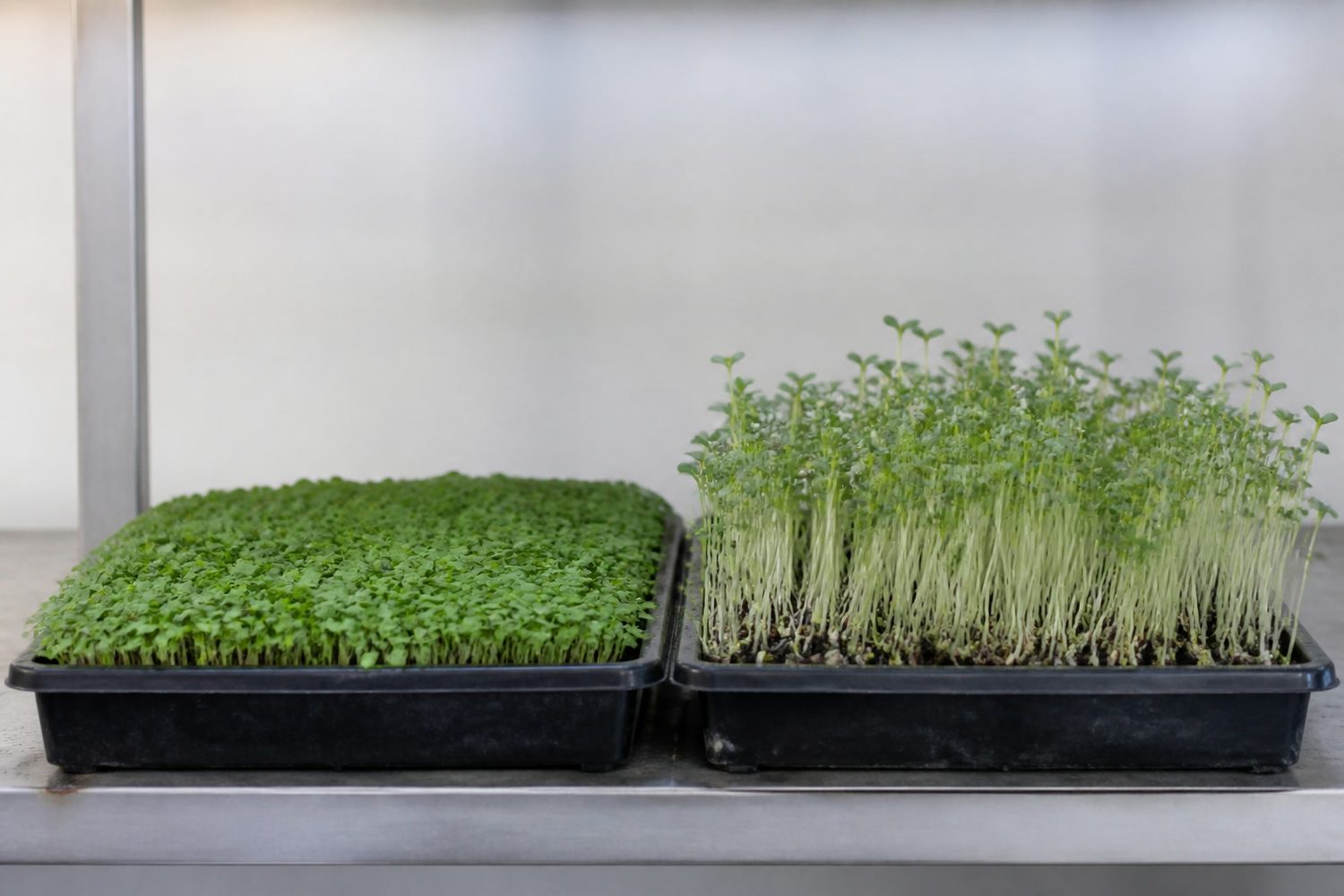
Level the medium and refuse to over-sow. This is the crop-specific instruction, and it follows from the habit rather than from the seed. A stand that grows wide instead of up closes its own airflow, so a density that looks merely full at sowing becomes a sealed wet mat by day five. The tell is seedlings overlapping rather than covering. Redistribute at sowing, because once they have knitted together there is no clean way to thin them.
Fifteen to twenty-eight grams per 1020, and start at the bottom. The supplier publishing that range gives it as a general small-seed starting point and says to sow less for a two to three week crop, not more. Since the whole risk on this crop is a mat that cannot breathe, and since nobody has ever run a density trial on it, the low end is the sensible place to begin.
Warm enough to germinate, and not one degree warmer. This is where endive is genuinely different from the brassicas. A grower guide for endive and escarole gives 60 to 68°F as the best range, reports usable germination anywhere from 41 to 85°F, puts the highest rate near 75°F, and warns that above 77°F the seed can enter thermal dormancy. That last word matters: dormancy is not slow germination, it is the seed declining to start. Most crops on this site get worse as the room warms. Endive has a ceiling it will refuse to cross, and a summer room at 80°F can produce a tray that simply never comes up, with nothing wrong with the seed.
Cover for about three to five days, then bottom water only. Hold the weighted cover until the seedlings lift it rather than until a date, then water from below for ten to fifteen minutes and pull the tray out rather than leaving roots sitting. On a low wide canopy, keeping the foliage dry is worth more than it is on a tall crop, because the leaves sit closer to the wet medium and stay closer to each other.
An endive tray, day by day
- 1
Day 0, sow dry
15 g broadcast on leveled, pre-moistened medium, pressed for contact. Seed touching seed is too dense on this crop. Hold the room at 60 to 68°F and keep it below 77°F, or the seed may not start at all.
- 2
Days 2 to 3, germination
Seedlings appear under the weighted cover. Roughly a 5 lb weight, which is the publishing grower's general figure rather than an endive measurement.
- 3
Days 3 to 5, cover off
Uncover when the stand lifts the cover, not on a date. This is the airflow decision, and leaving it late is the most common way to lose the tray.
- 4
Day 5 onward, light
At least 12 hours a day, one to two feet above the canopy. Bottom water for 10 to 15 minutes and pull the tray, so the mat stays dry on top.
- 5
Days 8 to 15, cut
Fully opened cotyledons on stems at least an inch tall. From here you have about one to three days before the true leaves start and the crop turns noticeably more bitter.
What goes wrong with endive specifically
The failures arrive in an order, and the last one is the one that separates this crop from the rest of the directory.
Uneven or bare germination, in the first two to three days. Islands of seedlings instead of an even lift, from uneven distribution, a dry spot or a weak lot. A patchy tray is fine for a kitchen and will not cut as a product. Re-sow rather than nursing it. And on this crop, check the room temperature before blaming the seed, because a bare tray in a warm room may be thermal dormancy rather than a bad lot.
A crowded wet mat, during the covered period. Seed overlap plus surface water restricts airflow on a stand that was already going to be tight. Recoverable only before collapse: uncover on the lift signal, improve airflow, and stop wetting the foliage.
Damping-off, from emergence onward. Pythium typically starts at the root tips and Rhizoctonia solani rots stems at or below the medium line, and neither is an endive disease: this is the general seedling complex that clean seed, clean water, clean medium and airflow are the defense against. A thinning patch with water-soaked or collapsing seedlings on a food crop is a discard and a sanitize.
And there is no endive root-hair test. The category's most repeated question, asked twice in r/microgreens in the last month alone, has no crop-specific answer here. No opened source gives a photograph-validated endive test, so a grower gets general triage: whether the growth stays at individual roots or bridges stems and medium, and whether seedlings are collapsing. Do not diagnose a white patch by color, and do not carry broccoli's rinse test across, because nobody has checked whether it behaves the same way on this crop.
Then the failure that is hardest to catch: harvesting late. On most crops here a late cut costs tenderness, uniformity or saleable appearance, and it shows. On endive it costs flavor. True leaves emerge, the crop becomes more bitter, and it is still perfectly edible, just no longer the mild-to-moderately bitter product that was ordered. Nothing rots and nothing collapses, so nobody catches it until somebody eats it.
Radish is the only other crop here that fails this way, and it fails more forgivingly: its late cut gets hotter, and plenty of radish buyers want it hotter. Nobody orders endive hoping it will be more bitter. You can see the true leaves coming before you cut, which is the only reason a one-to-three-day window is manageable at all.
Cut it now, or accept a different crop
Hover or tap a card to highlight it.
What you are watching
True leaves, not the calendar. The cut is at fully opened cotyledons on stems at least an inch tall, and the clock starts there.
How long you have
About one to three days. One of only two harvest windows anybody publishes for any microgreen, and radish carries the same figure from a different source.
What late costs you
Flavor, not weight. The crop turns noticeably more bitter as true leaves expand. Nothing rots and nothing collapses, which is exactly why it gets missed.
Who it hurts
The customer who ordered a mild bitter garnish and got a sharp one. The tray still cuts and still sells, so nobody catches it until it is eaten.
How confident to be
Not very. One grower guide supports this window and nothing replicates it. Treat one to three days as a starting figure and time your own trays against your own buyers.
Nutrition, and what is actually established
Nothing is established, and that is the whole of it.
There is no USDA FoodData Central record for endive microgreens, searched 2026-08-08, and the mature raw endive entry is not a substitute for one. No peer-reviewed paper measuring Cichorium endivia at the microgreen stage turned up in the opened literature. The nearest endive paper measures mature plants across six cultivars for vitamin C, minerals, chlorophyll, fiber, dry matter, nitrate, plant weight and field yield, which is useful work about a different growth stage and cannot supply a microgreen number.
One seller lists a string of nutrients, vitamins A, C and K, folate, minerals, inulin and fiber, with no study, no sample, no harvest stage and no values behind it. That is a marketing sentence, not an analysis, and repeating it here with a link would launder it. The literature does include Cichorium intybus microgreens in broader work, and that is the other species, so it cannot be relabeled endive either.
If you want microgreen nutrition that has actually been measured, broccoli is the crop with a real comparative study behind it. Endive is grown for flavor, and on the evidence available that is the only claim it can carry.
Which seed to buy
Two named cultivars are verifiably sold: Broadleaf Batavian, described as green, mildly bitter, cold tolerant, short and wide, and Green Curled Ruffec, described as bright green with serrated ruffled leaves and mild bitterness. Broadleaf and curled is a genuine presentation difference at the mature stage. Whether it is a difference at cotyledon stage is unmeasured, and no source compares the two on stem length, days or yield, so choose on availability and lot quality rather than on the cultivar name.
What to specify when ordering is more important on this crop than the cultivar is. Ask for the botanical name Cichorium endivia in writing, the named cultivar, the lot germination percentage and its test date, and untreated seed suitable for a food crop. Osborne publishes 92 percent on its Green Curled Ruffec lot and labels it untreated, which is the shape of answer to expect. Refuse anything whose treatment status is unknown: a coating not intended for food use has no place on a crop eaten whole eight days after sowing.
A bad lot shows as bare lanes and uneven canopy height on a tray that was level and evenly moist. The direct loss is small, well under two dollars of seed at bulk prices, and the real loss is eight to fifteen days of rack space and a tray too patchy to pack. Test a weighed mini-tray before committing a rack.
Now the part the search will not tell you. Endive seed on Amazon is the convenient route for a home grower, and the problem is not that the search is empty. Checked 2026-08-08, it returns 158 results with 17 endive or chicory listings on the first page, which is a well-populated shelf. Both problems are inside those 17.
First, almost none of it is sized for a tray. Endive at the garden counter is sold by the seed, in packets of 25, 100, 300, 500 or 1,000. A 1020 tray takes 15 to 28 grams.
Hover or tap a row to highlight it.
| Listing | Stated size | Price | What that is, against a 15 to 28 g tray |
|---|---|---|---|
| Mountain Valley Green Curled Ruffec | 1 g | $4.69 | A fifteenth to a twenty-eighth of one tray |
| Mountain Valley Frisse | 2 g | $4.69 | About an eighth of a tray |
| Mountain Valley Endive, Witloof Chicory | 2 g | $4.69 | About an eighth of a tray, and the wrong species |
| Organic Witloof Chicory Endive | 1.25 g | $4.29 | A twelfth of a tray, and the wrong species |
| Mountain Valley Sugar Loaf | 0.25 oz, 7.09 g | $9.32 | Under half a tray, and the species is contradicted |
| Sustainable Seed Co organic Tres Fine | 1 oz, 28.35 g | $20.86 | The only pack on the page that fills one tray |
| True Leaf Market Broadleaf Batavian | 5 lb bulk | $25.11 per lb | 80 to 151 trays, at $0.83 to $1.55 each |
The arithmetic is the finding. The one retail pack that fills a single tray costs $20.86 for that tray's seed. The same tray costs 83 cents to $1.55 from a bulk bag. That is about 13 times the price per ounce, and the small packets are worse: the 1 gram packet works out near 85 times the bulk rate. The seed cost in this page's spec block, like every other crop here, is a bulk price. On most crops that is a reasonable approximation of what a home grower pays. On endive it is off by an order of magnitude, because nobody bags this crop for microgreen growers at all.
Second, four of the seventeen are the other species. Two listings sell Witloof chicory under an "Endive Seeds" title, one sells Rouge de Verona radicchio as similar to endive, and one sells Sugar Loaf while asserting Cichorium endivia in the title. That last one is the trap worth naming, because it is a contradiction inside a single line of text: Fedco and Adaptive Seeds both list Sugar Loaf, Pan di Zucchero, as Cichorium intybus, and Adaptive says it in as many words, that Sugarloaf is not an endive but a true chicory. Witloof and radicchio at least announce themselves in the title. Sugar Loaf does not.
This is not the celosia situation, where the search returns something you should not eat. All of it is food-crop seed and all of it is a Cichorium. It does mean that on a crop whose entire identity problem is two species sharing one English word, a quarter of the shelf is the other one, and the title is the only thing you see before you click.
And one last labeling problem, from the same seller. Four Mountain Valley endive listings state both a weight and a seed count, and they do not reconcile: 900 seeds per gram on the Green Curled Ruffec, 225 on the Witloof, 200 on the Frisse, and 395 on the Sugar Loaf. That is a four and a half fold spread on the same shelf from the same company, which makes a seed count useless for working out what a packet will sow. Buy endive seed by weight. The counts on the shelf do not agree with each other.
Is it worth growing?
For most people, no, and for a specific person, yes.
It is not a beginner crop and it is not a volume crop. It has no measured yield, no nutrition record, a short wide stand that returns less weight than the same bench in pea or sunflower, a germination ceiling that can cost a whole tray in a warm room, and a one-to-three-day window at the end. Almost none of that is visible when you buy the seed.
It is worth growing when the bitterness is the point. A chef who wants a bitter contrast element at garnish scale has very little else to reach for. A home grower who likes bitter greens gets a genuinely different tray for about a dollar of seed, if they can find it in bulk. Its competition is not another microgreen at all, it is a head of frisee or escarole from the same store, which costs a few dollars, keeps longer and comes in the volume a salad actually needs.
That comparison is the real test. Endive earns a tray when you want the flavor at garnish scale and at garnish freshness. When you want a bowl of it, buy the vegetable.
A note on the numbers above
Hover or tap a row to highlight it.
| Figure | Value | Source | What kind of number it is |
|---|---|---|---|
| Days to harvest | 8 to 15 | Epic Gardening | Grower guide, at fully opened cotyledons, no temperature stated |
| Days to harvest | 1 to 3 weeks | Mumm's | Supplier's general microgreen window, no stage or temperature |
| Harvest window | About 1 to 3 days | Epic Gardening | Grower assertion, single source, and one of only two published for any microgreen |
| Seed per 1020 | 15 to 28 g | Mumm's | General small-seed starting range, not an endive optimum |
| Yield per 1020 | No published figure | Nobody | Endive is absent from the only per-tray trial that exists |
| Germination temperature | 60 to 68°F best | Holmes Seed | Field endive and escarole guidance, not a microgreen trial |
| Germination temperature | 41 to 85°F usable, dormancy above 77°F | Holmes Seed | Same guide, and the ceiling is the operationally important half |
| Blackout | 3 to 5 days | Mumm's, general non-brassica | Not an endive figure |
| Cover weight | About 5 lb | Epic Gardening | That publisher's house figure, see the caution below |
| Bottom watering | 10 to 15 minutes | Epic Gardening | That publisher's house figure, see the caution below |
| Shelf life | Up to 7 days | Epic Gardening | That publisher's house figure, see the caution below |
| Lot germination | 92 percent | Osborne | A real current lot, on Green Curled Ruffec |
| Seed price | $25.11 per lb at 5 lb | True Leaf Market | Listed 2026-08-08, bulk. Retail packs run 13 to 85 times this |
| Nutrition | Nothing established | Nobody | No FDC record, no C. endivia microgreen study |
The harvest window is a second data point, and two is not a pattern. This entry fills a column that thirty-one of the thirty-three crops here leave blank, which makes it the most quotable number on the page and the one most likely to be repeated without its caveat. It rests on one grower guide saying the crop can be cut all at once or over the span of a few days, combined with that same guide's statement that bitterness climbs as true leaves arrive. Nothing replicates it.
What makes it worth more than one page's figure is that radish already carried about one to three days, from a commercial grower protocol, with the flavor sharpening as the cost of overrunning it. Two crops, two families, two unrelated publishers, the same number and the same failure mode. That is suggestive and it is not evidence: two grower assertions agreeing is a reason to look harder, not a reason to state a rule. The interesting question it raises is whether the flavor clock is the general case on crops sold for taste, and answering it needs the other thirty-one crops to publish something.
A caution about a shared source. Endive's grow guide comes from a publisher that also supplies figures used in this directory's celery, chives and spinach entries. Comparing the endive and spinach guides directly on 2026-08-08, the crop-variable numbers differ sensibly, 8 to 15 days against 7 to 10, 12 hours of light against at least 6. The rest are the same sentence: about five pounds on the cover against five pounds or less, 10 to 15 minutes of bottom watering on both, one to two feet of light height against a foot or two, up to a week refrigerated on both, and no regrowth after harvest on both.
Those are house method figures, not measurements of endive or of spinach. They may be perfectly good advice, and this page follows them. They are simply not crop-specific evidence, and this directory exists to keep that line visible. The day counts carry the crop-specific information; the weight, the watering time and the shelf life carry the publisher's standard practice. It is the same lesson the chervil and dill entries record about a shared grower production sheet, arriving a second time from a different direction, and the affected earlier pages carry the note too.
Yield is blank, and it puts endive outside the ranked table. Endive is absent from the 29-variety trial that anchors most published comparisons's comparisons, and no opened source weighs an endive 1020. Without a yield there is no ounces per dollar and no ounces per tray-day, so the crop sits in the table with the columns it can fill and empty cells where it cannot. The empty cells stay in on purpose.
Hover or tap a row to highlight it.
| Crop | Seed per 1020 | Yield | Days | Cost per tray | Oz per $1 | Oz per tray-day |
|---|---|---|---|---|---|---|
| Sunflower | 48 to 167 g | 18.77 oz | 9 to 12 | $1.35 | 13.9 | 1.79 |
| Endive | 15 to 28 g | No published figure | 8 to 15 | $0.83 to $1.55 bulk, $20.86 retail | cannot be calculated | cannot be calculated |
| Lettuce | No published figure | No published figure | 8 to 16 | no rate to price | cannot be calculated | cannot be calculated |
A blank means nobody has published that figure, so the cell is left empty rather than filled with an estimate. How the numbers work
All 62 crops, sortable, on the microgreen comparison.
Endive is the widest bulk-to-retail gap in this directory, and it is a different kind of gap from the one barley grass records. That page found a 4.2x spread on identical seed between a 1 lb bag and a 30 lb sack, which is real money on a crop that eats 200 grams a tray. It is also a decision a grower can simply make better by buying the bigger sack.
Endive's spread is 13x at the best retail pack and about 85x at the small packets, three to twenty times barley grass's, on a crop that uses a fifteenth of the seed. Pack size is not the explanation and buying bigger is not the fix, because the retail shelf and the bulk shelf are not the same suppliers: one sells garden packets by the seed, the other sells five pound bags to people running racks. Endive is minor enough that no one bridges them. The bulk figure stays in the table because it is the only one that compares across crops. The retail figure sits beside it because it is the one somebody will actually pay.
Terms on this page
Tap a term to see what it means.
*Cichorium endivia*. The species grown here: curled endive and broad-leaved escarole. The plant this page is about.
Sources
- Epic Gardening, endive microgreens - the only crop-specific grow guide opened: 2 to 3 days to germinate, 8 to 15 days to harvest at fully opened cotyledons on stems at least an inch tall, harvesting all at once or over the span of a few days, bitterness increasing with true leaves, no soak, about a 5 lb weight, 10 to 15 minute bottom watering, at least 12 hours of light one to two feet above the tray, up to a week refrigerated, and no regrowth after harvest.
- Epic Gardening, spinach microgreens - read on 2026-08-08 specifically to test the previous source's figures across crops. Five pounds or less, 10 to 15 minute bottom watering, a foot or two of light height, up to a week refrigerated and no regrowth all repeat verbatim on a different species, which is what makes them house figures rather than endive measurements.
- Mumm's Sprouting Seeds, endive - the 15 to 28 g starting range for small seed in a 10 by 20, the instruction to sow less for a 2 to 3 week crop, no soak for small or medium seed, and 3 to 5 days stacked for non-brassicas.
- True Leaf Market, Broadleaf Batavian endive microgreen seed - the cultivar description, short and wide habit, cold tolerance, mild bitterness, and the $25.11 per lb bulk price behind the seed-cost calculation, listed 2026-08-08.
- Osborne Seed, Green Curled Ruffec untreated endive seed - the second verified cultivar, the untreated label, and 92 percent lot germination.
- Holmes Seed Company, endive and escarole growing guide - 60 to 68°F best, 41 to 85°F usable, the highest rate near 75°F, and thermal dormancy above 77°F.
- Koudela and Petrikova, 2007, nutritional composition of endive cultivars (PDF) - the three curled and three broad-leaved varieties of C. endivia, and mature-plant composition, which is a different growth stage and cannot supply microgreen values.
- Virginia Tech Extension SPES-756 (PDF) - the general 60 to 70°F microgreen production environment, used only as an indoor operating assumption.
- UC IPM, damping-off - Pythium and Rhizoctonia solani, symptoms at or below the medium line, and the link to damp conditions.
- SDSU Extension, growing microgreens at home - the general week or so of refrigerated life, and rinsing followed by thorough drying.
- Johnny's microgreens yield trial, method and discussion - the harvest standard, the caveat that one system's yields do not transfer, and the absence of endive from the 29 varieties tested.
- YaYa MicroGreens, endive - the acquired-taste description, and the unsourced nutrient string this page declines to repeat as a claim.
- Fedco Seeds, Pan di Zucchero chicory - Sugar Loaf listed as Cichorium intybus.
- Adaptive Seeds, Sugarloaf Borca chicory - Cichorium intybus, and the explicit statement that Sugarloaf is not an endive but a true chicory.
- USDA FoodData Central - searched 2026-08-08, no endive microgreen record.
Keep reading
The variety directory
Lettuce microgreens
One of only three microgreens whose seed needs light to germinate, so it must not be blacked out. It also has the longest harvest window in the directory at four to seven days, and the best evidence anywhere that a microgreen beats its adult.
Read Lettuce microgreensThe variety directory
Celosia microgreens
A color crop whose entire measured record is a single YouTube video: 8 g of seed, 3.4 oz, 13 days. Bought for pink and orange stems, never for weight.
Read Celosia microgreensThe variety directory
Chervil microgreens
A chef's herb almost nobody grows: mild sweet anise, 3 to 5 oz a tray, and two independent seed rates that agree to within six percent, which is rare on a crop nobody has trialled.
Read Chervil microgreensThe variety directory
Chive microgreens
One of the few crops where somebody actually ran a density trial, and poor value per dollar of seed. It also competes with a perennial you buy once.
Read Chive microgreens