What Each Microgreen Tastes Like, and What to Put It With
Cal HewittPublished Checked
- eating
- flavor
- evidence
- varieties
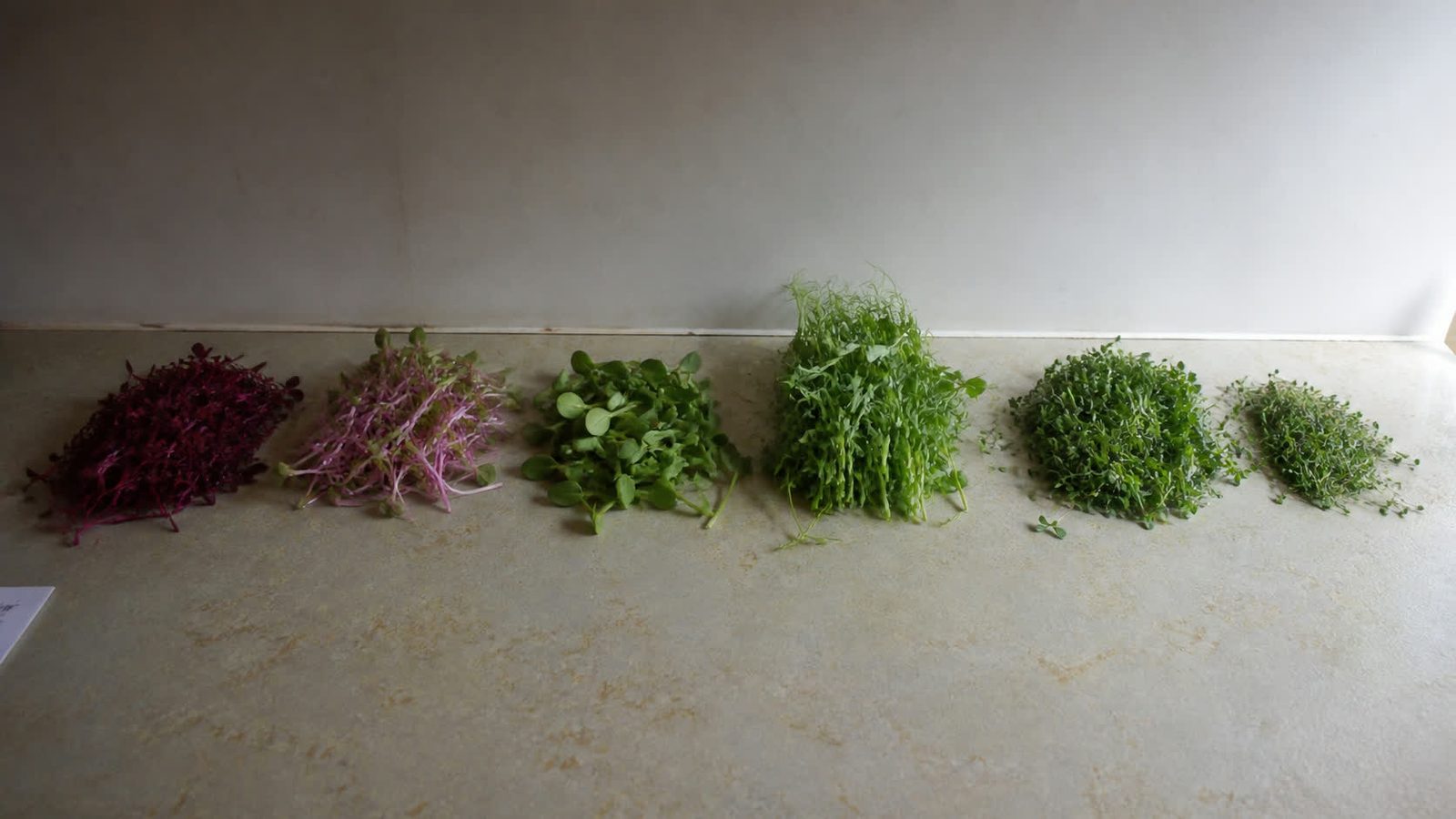
There is no published crop-by-crop flavor map for microgreens. What exists is seed-company descriptions for maybe a dozen popular crops, one real sensory panel, and nothing at all for whole categories of taste. Nobody, anywhere, names a sour one.
Below is a flavor line for all 62 crops, each one sourced on its own entry from suppliers, extension guides and trials, and sorted here into groups on 2026-08-11.
The useful axis turns out not to be how peppery a crop is. It is how much of it you can eat. Fifteen of the 62 are seasonings you use by the leaf. Thirty-two you can eat by the handful. The distance between those two groups is the whole reason "top it with microgreens" is bad advice.
Who describes what, and where they contradict each other
Almost every flavor description you can find for a microgreen was written by somebody selling the seed. That is not a scandal, but it does mean the descriptions were written to sell a crop rather than to compare it against another, and it shows.
Hover or tap a row to highlight it.
| Taste | Johnny's Selected Seeds | UConn Extension | UMass Extension | OZO Microgreens | The Chef's Garden |
|---|---|---|---|---|---|
| Peppery | arugula, cress | radish, arugula | mustard, arugula | wasabi mustard, mizuna, nasturtium | not named |
| Mild or nutty | broccoli, mizuna, kale, sunflower | sunflower | cabbage | sunflower | kale, sunflower, broccoli |
| Sweet | pea shoots | pea shoots | not named | not named | not named |
| Aromatic herb | Genovese basil | not named | not named | cilantro, Thai basil, shiso | celery, thyme, fennel, lemongrass |
| Bitter | not named | broccoli, wheatgrass | not named | not named | not named |
| Earthy | not named | not named | not named | red amaranth, Korean shiso | not named |
| Sour | nobody names one | nobody names one | nobody names one | nobody names one | nobody names one |
Two things in that table are worth more than the rest of it.
Nobody names a sour crop. Not one of these publishers places a single microgreen in the sour column, and sourness is not an obscure corner of the palate. It is one of the handful of things a cook needs to know before an ingredient goes on a plate. The answer is one crop, and it is sorrel.
Look at broccoli. Johnny's calls it mild. UConn calls it slightly bitter. Both are real published descriptions of the same crop, and a cook following one of them will be surprised by the other. Shiso gets the same treatment: aromatic to one grower, earthy to another. When your only evidence is marketing copy from different sellers, this is what you get.
The one piece of genuine sensory research is a USDA panel covering 25 varieties, and its useful finding is about the category rather than the crops: high sourness, astringency and bitterness all lower how much people say they like a microgreen. That is a preference result, not a map.
The map: 62 crops grouped by what they taste of
The grouping is editorial. The flavor descriptions under it are sourced on each crop's own entry, which is where every crop name below links, along with its growing numbers.
Hover or tap a row to highlight it.
| Group | Crops | Count |
|---|---|---|
| Heat is the point | arugula, garden cress, mustard, nasturtium, radish, watercress | 6 |
| A light bite | broccoli, collard, komatsuna, kohlrabi, mizuna, pak choi, red cabbage, tatsoi, turnip | 9 |
| Aromatic herb | basil, celery, chervil, cilantro, dill, fennel, mint, oregano, parsley, shiso, thyme | 11 |
| Onion family | chives, leek, onion | 3 |
| Bitter on purpose | broccoli raab, chia, endive, fenugreek | 4 |
| Sour | sorrel | 1 |
| Sweet | carrot, chickpea shoots, lentil, pea shoots, popcorn shoots | 5 |
| Nutty | alfalfa, mung bean shoots, sunflower | 3 |
| Earthy | amaranth, beet, bull's blood beet, celosia, spinach, swiss chard | 6 |
| Mild to neutral | buckwheat, cauliflower, clover, flax, green cabbage, kale, lettuce, purslane, quinoa | 9 |
| Cucumber | borage, cucumber | 2 |
| Grass, for juice | barley grass, wheatgrass | 2 |
| Sources disagree | sesame | 1 |
A few of those groups are worth pausing on, because they answer questions the published sources could not.
Sourness is one crop. Sorrel is bright, sharp and lemon-tangy, and it is the only crop here where acid is the defining note rather than a background one. Not one seed company or extension service names a sour microgreen, so if you want acidity from a tray, this is the one to know. A handful of others carry a trace: buckwheat has a tangy citrus edge, purslane a faint sourness, and one extension review flatly calls beet microgreens sour. None of them is an acidifier the way sorrel is.
One crop's sources flatly contradict each other. Sesame is called mildly sweet and subtle by one supplier and spicy by another, and the one guide that compares eating quality says it tastes better cooked. Nobody has resolved it, so it sits in its own row rather than being assigned a group it might not belong in.
And bitterness is not one thing.
Bitterness is three different things, and only one of them is a flavor you buy
Fifteen of the 62 flavor lines mention bitterness. Reading them together, they split three ways, and the split decides whether bitterness is a reason to buy the crop or a reason to cut it sooner.
The three bitternesses
Hover or tap a card to highlight it.
Bitter is the product
broccoli raab, endive, fenugreek and chia. The bitterness is what the crop is for. Rapini's bitterness is the reason anybody grows it, and a mild version is a failed product rather than a gentler one.
Bitter is a clock
barley grass, chia, clover, endive, lentil, lettuce and popcorn shoots all turn bitter if you hold them too long. Nothing about the tray looks wrong when it happens. This is a harvest decision, not a flavor.
Bitter is what is missing
cucumber, kale, parsley and spinach are all described by the absence of the bitterness their mature form carries. For these, the microgreen is the version without the problem.
Note that chia and endive appear twice. Their bitterness is both the product and a clock: sought early, excessive late. Fenugreek is the clearest case, mild around days 6 to 8 and unpleasantly bitter past day 10.
Four crops are grown deliberately for bitterness, not one. Broccoli raab is rapini, and its bitterness is the whole reason anybody sows it; endive, chia and fenugreek are the others. A mild version of any of them is a failed crop rather than a gentler one, which is the reverse of the seven crops where bitterness is the sign you held the tray too long.
The real finding: the flavor tells you the dose
Across the 62 flavor lines, the thing that jumps out is not the flavors. It is that eleven crops are described in the same construction, written on different days from different sources with no template: this is a seasoning, not a green.
a herb you use by the pinch, not a green you eat (thyme)
an acidifier you use by the leaf, not a salad base you eat by the handful (sorrel)
an aromatic finish measured in leaves, not a green you eat by the handful (mint)
seasoning rather than salad (onion)
That convergence is useful because it converts a flavor into an amount. Sorting the 62 by how much of the crop a plate can take gives four classes:
Hover or tap a row to highlight it.
| Class | What it means | Crops | Count |
|---|---|---|---|
| By the handful | Can be the salad, not just on it | the mild, nutty, sweet, earthy and light-bite groups | 32 |
| By the spoonful | An accent that seasons the dish | the peppery, bitter and cucumber groups | 12 |
| By the leaf or the pinch | A herb or an acid, used like a seasoning | the aromatic herbs, the onion family, sorrel | 15 |
| Juiced, not eaten | Too fibrous to be a salad at any amount | barley grass, wheatgrass | 2 |
| Unresolved | Sources disagree on the flavor | sesame | 1 |
Fifteen of 62 crops are seasonings. If you buy a clamshell of one of those expecting a salad green, the problem is not that you got a bad crop. And this is where the weight comes in: a garnish serving is about 2.5 grams a person, the only weighed per-person figure anybody publishes, while a cooked pea shoot side dish runs 113 grams a head. That is a fortyfold range, and the flavor class is what predicts where in it a crop sits.
Picking one crop for the job you actually have
The map is only useful if it tells you what to sow. Here is one crop per job, with the reasoning and the caveat that matters.
Hover or tap a row to highlight it.
| If you want | Grow | Why, and the catch |
|---|---|---|
| A salad you can eat a bowl of | Pea shoots or sunflower | Both are mild with real substance. Pea shoots take 150 g of seed a tray, which is heavy, and sunflower needs its hulls managed |
| Heat on a sandwich or taco | Radish | Fastest crop here, 6 to 10 days, and the pepper is the product. It sharpens as true leaves come, so cut early if you want it mild |
| A cheap tray with numbers behind it | Broccoli at $0.79 of seed, or turnip at $0.31 | Broccoli is the mild all-rounder, and it is the crop with the most fully measured figures. Turnip is cheaper still but nobody has weighed a tray of it |
| A herb to finish plates with | Basil or cilantro | Used by the leaf, so one tray lasts. Cilantro is slow at 13 to 25 days, and is the crop people most often quit on |
| Acidity without a dressing | Sorrel | The only genuine acid among the 62. The seed is the second most expensive per pound, but the rate is the lightest, so the tray is only $2.71 |
| Color on a plate | Amaranth or bull's blood beet | Bought with the eyes. Both are mild and earthy, so they add appearance rather than flavor |
| Something sweet children will eat | Popcorn shoots | Intensely sweet, closer to a dessert note. Grown entirely in the dark, and it turns fibrous if left tall |
Seed for any of these is available on Amazon: pea shoot seed, sunflower seed, radish seed, broccoli seed, basil seed, cilantro seed, sorrel seed, amaranth seed and popcorn shoot seed.
Read the crop's own entry before you buy, because on several of these the marketplace is the wrong place to shop. Sorrel and shiso both run well above the seed house price, and on some crops the search returns a different plant under the same common name. Those warnings sit on the crop pages, where a bare seed link cannot carry them.
What actually pairs with what, and how thin the evidence is
The documented, named-crop pairings are narrow enough to list in full, which is why most pages on this subject start inventing at this point.
Hover or tap a row to highlight it.
| Crop | Paired with | Source type |
|---|---|---|
| Pea shoots | Pasta, seared scallops, lamb chops; equal parts with basil for pesto | Food magazine test kitchen |
| Pea shoots | Cold soba, tofu, sugar snaps, radish, miso and mustard, 2 cups for four | Named recipe developer |
| Pea shoots | Garlic, ginger, soy and sugar in a stir-fry, 1 lb for four | University extension recipe |
| Radish | Goat cheese and eggs in a one-omelette recipe, 1/2 cup | Grower recipe page |
| Radish | Lemon, cumin, mustard oil and moong dal, 25 to 30 g | Named culinary author |
| Radish, daikon | Coleslaw; steak, tartare and charcuterie | Test kitchen; grower marketing |
| Radish and cress | With pea shoots in a blended soup, 1/2 cup each | Grower recipe page |
| Sunflower | Steak, salmon, grain bowls, guacamole | Grower marketing |
| Basil | Strawberry, chocolate, whipped goat cheese | Recipe index |
| Thai basil | Curries, pho, stir-fries | Grower marketing |
| Shiso | Sushi, sashimi, ramen | Grower marketing |
| Red amaranth | Raw bar, ceviche, tartare | Grower marketing |
| Broccoli | Salads and soups | Grower marketing |
Read the right-hand column before the middle one. Half of these are a seller describing its own product, which tells you what a grower thinks chefs want, not what was tested. Only four rows come from a recipe with a quantity attached, and every one of those four is pea shoots or radish.
Nobody publishes a failed pairing. Not chefs, not cookbooks, not extension services, not growers: there is no documented "do not put crop X with food Y" anywhere. That absence is not evidence that everything works together. It means the negative case has never been written down, because recipe publishing has no reason to publish it.
The advice that is everywhere, and why it is not usable
The most-repeated instruction in this category is "top it with microgreens", or its hot-dish variant, "stir microgreens into any hot dish".
It fails as an instruction for three reasons, and the map above names all three:
- It omits the crop, and the crop moves the amount fortyfold between a pinch of thyme and a plate of pea shoots.
- It omits the amount, which is the single most common missing field in published microgreen recipes.
- It omits the timing, which for the one crop with real cooked evidence is the difference between a minute and a ruined texture.
It is not that the advice is false. Microgreens do go on things. It is that as written it cannot be followed. What you need instead is a crop name, a real amount, and where in the dish it goes.
What nobody has measured, and what would settle it
Stating the gaps honestly is more useful than filling them with guesses.
- No sensory panel across the full range. The USDA work covers 25 varieties. The 62 here leave 37 that have never been tasted in a published comparison against anything.
- No flavor-by-harvest-day series for any crop. A documented flavor window exists on five crops, and all five come from grower observation rather than repeated blinded tasting at defined days. The harvest window is only measured where holding costs somebody money, and it has never been measured on an aromatic herb at all.
- No instrumented intensity scale, so "dominates the dish" is a judgment by the people selling the crop.
- No documented negative pairing, as above.
- No agreement on where bitter, sour and earthy crops belong, which is where the published descriptions contradict each other most.
None of that is exotic work. A daily staggered cut on one crop, tasted blind, would settle the flavor-window question in an afternoon. Nobody has spent the afternoon.
Terms on this page
Tap a term to see what it means.
Cotyledon. The seed leaf, the first leaf a microgreen produces. Most flavor descriptions here apply at the cotyledon cut, and several crops taste different once true leaves arrive.
Sources
Flavor descriptions for individual crops are sourced on each crop's own page in the variety directory. The sources below are the published material behind the general claims on this page, opened on 2026-08-11.
- USDA ARS sensory study of 25 microgreen varieties - the only sensory panel located covering a range of named varieties, and the finding that high sourness, astringency and bitterness all lower overall acceptability.
- Johnny's Selected Seeds, 12 best microgreens for beginners - supplier flavor descriptors for arugula, broccoli, cress, mizuna, kale and Tokyo Bekana.
- The Chef's Garden, microgreens as more than a garnish - Culinary Vegetable Institute executive chef Jamie Simpson on celery, thyme, fennel and lemongrass, and the three-or-four-leaves garnish practice.
- UConn Extension, the amazing power of microgreens - the flavor descriptors that place broccoli as slightly bitter and wheatgrass as sweet and bitter, against Johnny's and The Chef's Garden both calling broccoli mild.
- UMass Extension produce spotlight, microgreens - mild and spicy crop groupings, and the generic one-cup serving that cannot be converted to a weight.
- West Coast Seeds, going green winter salads - crop-specific flavor descriptions and the sunflower and pea shoot last-minute stir-fry practice.
- OZO Microgreens - a grower's stated culinary uses per crop, including daikon with steak and tartare, shiso with sushi, and amaranth with ceviche. Seller practice, not a tested pairing.
- Bon Appétit, fennel fronds, radish tops and pea shoots - Janet McCracken's pea shoot pairings with pasta, scallops and lamb, the equal-parts pesto ratio, and daikon sprouts in coleslaw.
- Bon Appétit, soba with tofu and miso-mustard dressing - Claire Saffitz's 2 cups of pea shoots for four in a cold noodle dish.
- Cornell Cooperative Extension, stir fried pea shoots - 1 lb of pea shoots for four with garlic, ginger, soy and sugar, and the one-minute first-wilt endpoint.
- Leath x Santé, radish goat cheese omelette - 1/2 cup of radish microgreens in a single three-egg omelette, added while the egg is still wet.
- Microganics recipes - named pea shoot, radish and cress amounts in soup, stir-fry, fish tacos and guacamole.
- Rootsy, how to use microgreens in any meal - a 13-item recipe index, the basil with strawberry and chocolate pairings, and the practice of adding greens to pizza after baking.
- Cotyledon, radish microgreen recipes - Rajesh Chauhan's 25 to 30 g raw radish portions and the end-of-cooking dal practice. A culinary source, not a nutrition authority.
- r/microgreens, looking for recipe inspiration - a grower with nearly 2 kg of surplus radish microgreens asking what to do beyond garnishing, and receiving one-line suggestions. Community practice, not tested recipes.
Keep reading
Growing guides
Why do my microgreens taste bitter? Usually because that crop is supposed to
Roughly three quarters of microgreen crops are described as sharp, peppery or bitter in their own tasting notes, so check the crop before you look for a fault. Plus why turning the lights down is a guess.
Read Why do my microgreens taste bitter? Usually because that crop is supposed toThe journal
Are Microgreens Low FODMAP? What Monash Research Shows
Are microgreens low FODMAP? Learn what Monash sprouting research shows, which crop families deserve extra caution, and how reintroduction testing works.
Read Are Microgreens Low FODMAP? What Monash Research ShowsThe journal
Best Microgreens for Kidney Health: Potassium by the Serving
See measured potassium and phosphorus for the best microgreens for kidney health, from lowest to highest, plus what your renal dietitian needs to know.
Read Best Microgreens for Kidney Health: Potassium by the ServingThe journal
Can You Cook Microgreens? Yes, and Pea Shoots Are the One With Real Evidence
Yes, and the technique is the whole answer: add them late. Every documented method adds them at or near the end, and pea shoots are the one crop with a real cooked recipe behind it.
Read Can You Cook Microgreens? Yes, and Pea Shoots Are the One With Real Evidence