At a glance
Fast, even and forgiving from small dry seed with no soak, and the only real risk is that a thick juicy canopy holds humidity at the stem base, so it punishes overwatering harder than a sparse tray does.
- Botanical name
- Brassica rapa subsp. chinensis
- Also sold as
- Pak choi microgreen seed, Bok choy, Pac choi, Rosie (F1), Red Pac Choi
- Family
- brassica
- Difficulty
- Beginner
- Days to harvest
- 8 to 13 days
- Harvest window
- No published figure
- Seed per 1020 tray
- 10.5 g
- Soak
- None
- Blackout
- 3 to 4 days
- Germination temperature
- 60 to 70 °F
- Yield per 1020 tray
- 11 oz
- Regrows after cutting
- No published figure
- Mold risk
- Medium
- Hull shedding
- some
- Shelf life
- No published figure
- Eaten as
- raw
- Seed cost per tray
- $2.50
10.5 g at $107.85/lb, Johnny's Rosie F1 at the 1 lb size, listed 2026-08-09. The ladder runs packet $6.45, 1 oz $13.25, 1/4 lb $33.90, 1 lb $107.85, 5 lb $519.80, 25 lb $2,395.75, so the same tray is $4.91 at 1 oz and $2.22 at 25 lb. That ladder is unusually flat above a pound, moving 11 percent where most crops swing threefold on pack size, so there is little to gain from buying deep. Seed only, excludes medium, tray, labor, light and loss.
Any field name above ranks every variety by it. No published figure means we researched it and nobody has established one, which is different from not yet researched. Every figure here is sourced at the bottom of the page. Compare every variety side by side.
Pak choi returns 11 ounces in 13 days from 10.5 grams of seed, which is a strong return on a bench, and it is forgiving enough to be somebody's first crop. Sow dry, no soak, three or four days covered, cut at first true leaf.
What you are really growing it for is the stem. The other mild brassicas are all competing for the same dense, tender, leafy slot; pak choi is the one that arrives with a thick, juicy, crisp hypocotyl in it, which is why it survives a hot noodle bowl when the others go limp. That same water-rich stem is the crop's one real risk, because a dense stand of them holds humidity right at the medium line.
The yield figure above is firmer than most. Johnny's weighed 10 and 11 oz per 1020 at first true leaf in a commercial trial, and a separate controlled study, by an entirely different method, measured 2.10 kg per square meter at the same stage, which works out to 9.56 oz per 1020. Two unrelated sources landing within 4 to 13 percent of each other is about as reliable a benchmark as this category offers, so you can plan a rotation against it rather than hedging.
What growers are saying right now
Sampled from public posts and videos, 10 July to 9 August 2026. Every line links what it is quoting. How often something is repeated is not evidence that it is true, so every line also says what the sources actually establish.
Grow red pak choi with almost zero maintenance
Circulating A Kratky-method walkthrough at 8,087 views, posted August 2025 and the most recent dedicated pak choi microgreen video anywhere
The low-maintenance framing matches every source here: no soak, dry sow, three to four covered days, cut at thirteen. The one thing that is not low-maintenance is the water, because this crop's selling point is a thick juicy stem and that same stem holds humidity at the base of a dense canopy. What goes wrong
Fast and easy, and it has been said for a decade
Circulating Epic Gardening's guide from 2016 at 22,745 views, Princeton Microgreens at 15,057, and a 2017 grow-along at 12,496
Fair, and better supported by numbers than most such claims are. Eleven ounces in thirteen days from 10.5 grams puts pak choi just behind broccoli on bench turnover, so this is one of the few crops where the easy reputation and the measured figures agree.
Pak choi microgreens update
Circulating A grower's in-window post at 181 views, 2026-08-06
Small, and worth noting because it exists at all. Onion and oregano have essentially no tray-version conversation to find; pak choi has a quiet but live one, with roughly 58,000 lifetime views of dedicated how-to content behind it.
Bok choy, best growing and harvesting tips, maximum production
Circulating A garden video at 103,713 views, nearly twice the reach of every pak choi microgreen video combined
The usual garden-versus-tray split, and milder here than on most crops: about two to one, against roughly eleven to one on mint. If you are learning this crop from video, check which version you are watching, because a garden bok choy runs most of a season and this tray runs thirteen days.
What it is, and how to tell you grew it right
Pak choi microgreens are seedlings of Brassica rapa subsp. chinensis. Pak choi, bok choy, pac choi and Chinese cabbage are market names for the same thing, not four crops.
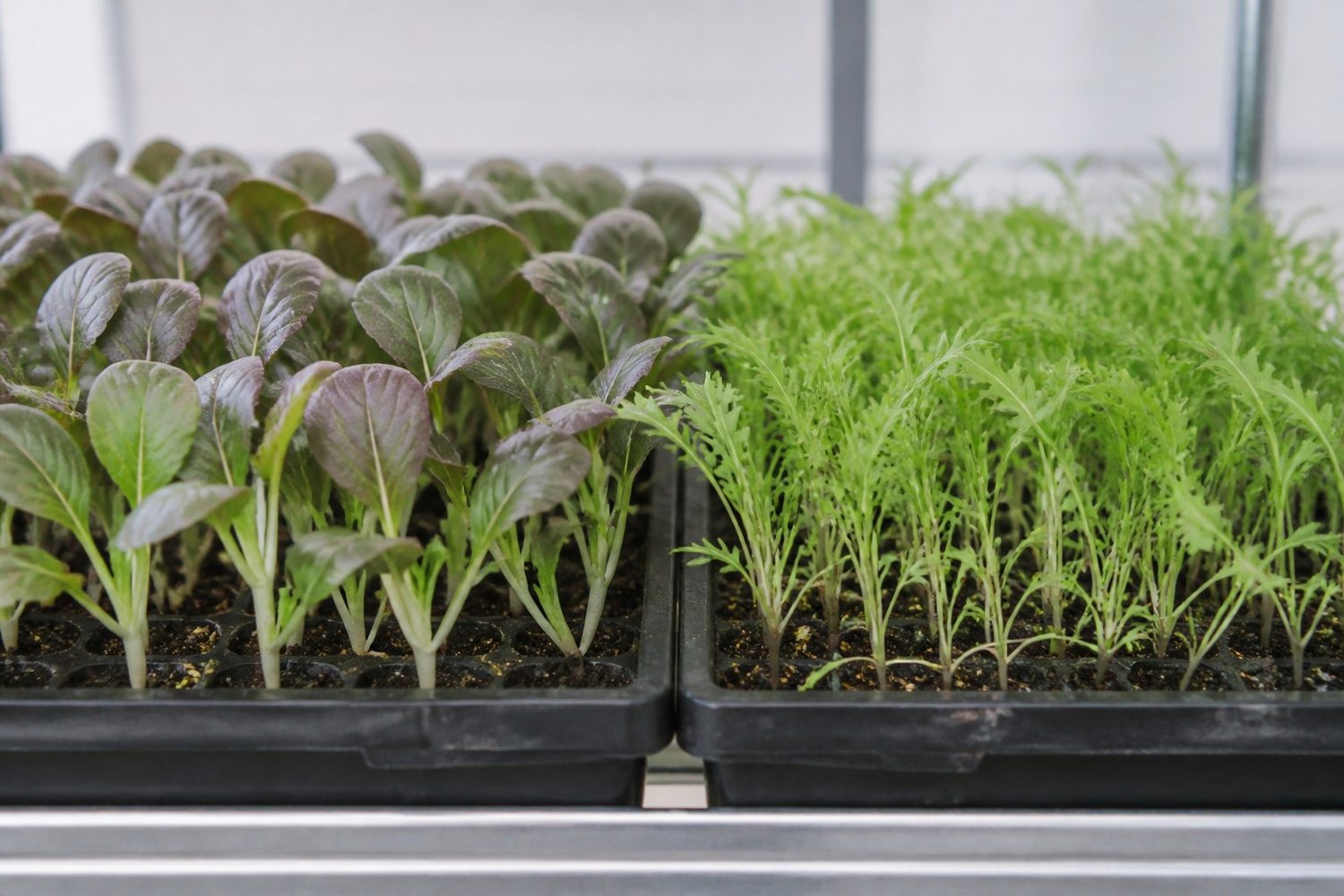
**It is one of several Brassica rapa types sold for trays, alongside komatsuna, mizuna and tatsoi, and you cannot separate any of them at cotyledon stage. What pak choi does have is a stem: the hypocotyl is notably thicker and juicier than its siblings', and the cotyledons are broad, smooth and spoon-shaped where mizuna's first true leaf turns angular and toothed. That is a tendency and not a key. No controlled photographic comparison of green B. rapa types at cotyledon stage exists**, so keep the seed label.
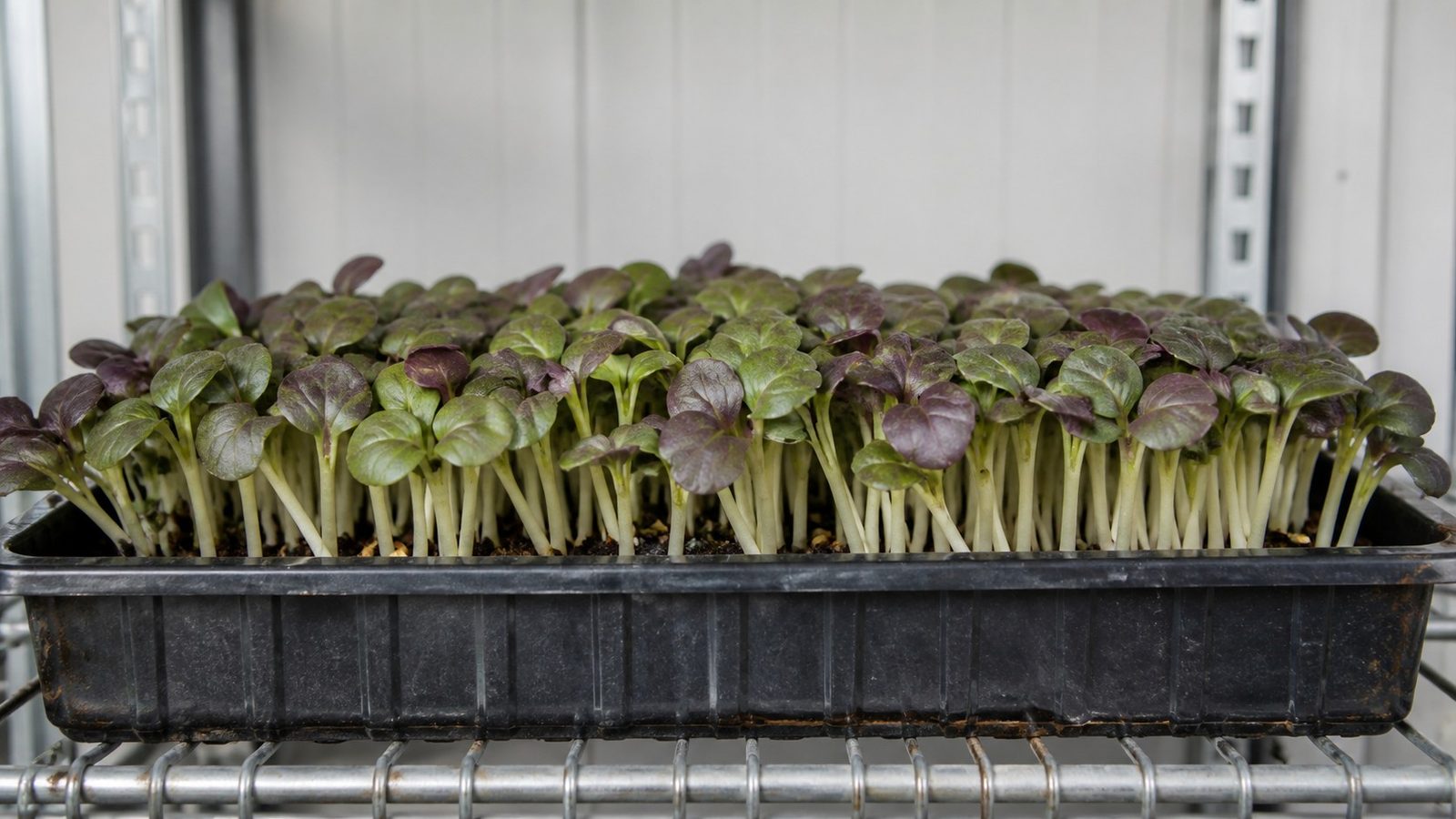
A correct tray is an even carpet at two to three inches early or seven to ten centimeters at the later target, with thick pale-white to pale-green stems and paired smooth cotyledons. Red selections carry pigment in stem and leaf; a generic green bag will not.
What it tastes like, and what to do with it
Mild, faintly sweet Chinese cabbage with a gentle brassica edge and no heat at all. The flavor is carried by texture as much as taste: the stem is crisp and full of water, and that is the point.
So, it goes where a dish wants crisp juicy volume rather than a seasoning. Pile it on finished ramen or pho, fold it into a noodle bowl off the heat, use it as a salad base, or scatter it as a fresh garnish. Brief residual heat softens the stem without destroying it.
It is the wrong choice when the plate needs a peppery hit, which radish or mustard supplies, or a feathery herb texture, which mizuna does better.
People who want a spicy microgreen will find it too mild, and people who dislike cabbage flavors will still notice the brassica note. No consumer study exists, so the honest test is a sample at your own harvest stage.
Growing it: only what differs from the standard method
Everything general is on the standard tray method for growing microgreens. Pak choi's deltas are few, which is most of why it is a beginner crop.
Sow dry at 10.5 g, no soak. Two crop-specific guides say no soaking is needed, and the seed is small and round rather than dust-fine, so it meters evenly by hand. The trial rate is 10.5 g for both measured cultivars.
Three to four days covered, with a light weight and only during germination. The published figure is 1.1 to 2.2 lb evenly distributed, for root anchoring and straight vertical stems rather than for compression. Off when most seedlings are pushing the tray above them.
Then get the air moving before the canopy closes. This is the one instruction that matters on this crop. A thick, water-rich stem in a dense stand traps humidity at the medium line, and the crop-specific guide flags root-neck rot with stagnant air specifically. Bottom water from the moment roots are established.
Seed lower, not higher, if you are growing past first true leaf. Johnny's own guidance is that a larger plant needs fewer seeds, for airflow and slower depletion of water and fertility. The temptation on a crop this productive is to crowd it for a heavier cut, and that is the failure mode rather than the optimization.
Hold 60 to 70°F. The crop guide reports usable performance at 61 to 72°F. Johnny's observed that high-80s and low-90s conditions accelerated growth while damaging uniformity and finished quality, which is a more useful warning than a simple ceiling: the tray will look fast and finish badly.
What goes wrong with pak choi specifically
Uneven emergence in the first three days, from unevenly distributed seed or unevenly wet medium. Clumps and dry gaps. Not repairable; accept the grade or resow.
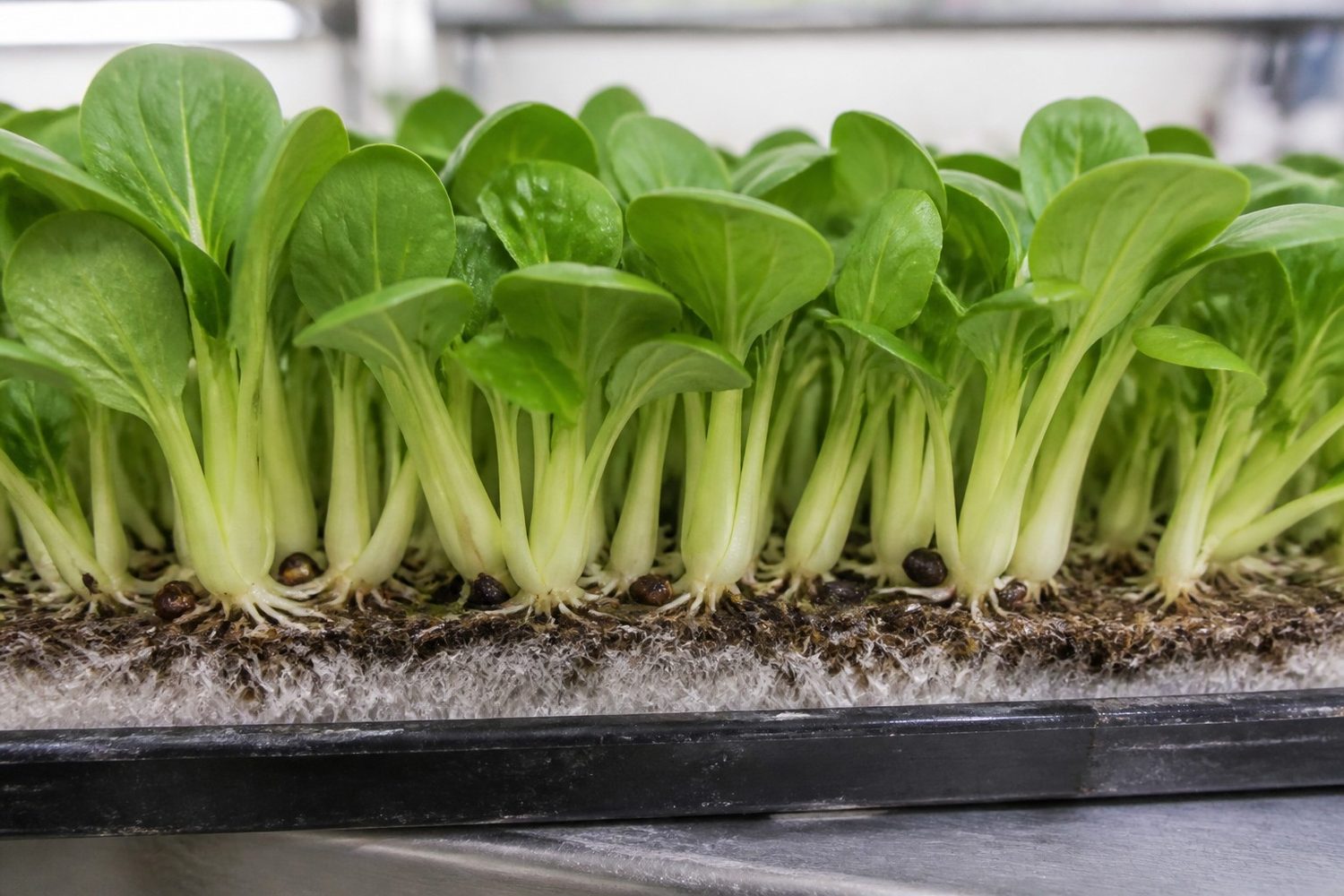
Stem-base rot, and this is the characteristic failure. Excess moisture, poor air exchange or a crowded stand. The early tell is specific and worth memorizing: the stem at the medium line looks translucent, water-soaked or pinched before anything falls over. Caught there, better drainage and airflow can save it. Once seedlings collapse at the medium line it is not food. Pythium and Rhizoctonia are the usual organisms.
On root hair against mold, pak choi makes this harder than most crops because a healthy tray produces conspicuous white root fuzz. Root hair is bright white, symmetrical, concentrated at the roots and the medium line, and it visibly shrinks when misted. Mold is patchy or web-like across seed, stems and medium, may run gray or green, smells off, and does not vanish when wet. Location plus the mist test, not whiteness.
Thin pale stretched stems from weak light or too long under cover. Correctable going forward; the height and uniformity you already lost do not reset.
Cut late and it goes woody. Stems coarsen, leaves yellow, true leaves advance and the tray loses uniformity. The controlled study found that waiting from first to second true leaf raised fresh yield from 2.10 to 2.80 kg/m², a third more weight, and its authors are explicit that this does not establish a better product: harvest stage needs a genotype-specific cost-benefit judgment. So, if you want the extra weight, taste and pack a tray at each stage before you commit a rotation to it. Komatsuna gains 26 percent on the same trade, measured in the same experiment.
Nutrition, and what is actually measured
There is real crop-specific measurement here, and it is the mineral panel.
The controlled study grew a red pak choi genotype at 70,000 seeds per square meter, germinated dark at 24°C, and harvested at both true-leaf stages with three replicates. Among the four Brassica rapa genotypes it compared, pak choi came out highest in phosphorus, potassium, magnesium, iron and zinc: phosphorus 10.58 and potassium 17.08 mg per gram dry weight, iron 180 and zinc 141 µg per gram dry weight.
Two things about that matter if you intend to repeat it to anyone. It is a dry-weight panel from one experiment rather than a per-serving figure, and turning it into what lands on a plate needs a moisture figure the study does not supply. And it is a comparison among four siblings, which is the useful form: it does not say pak choi is nutritious in the abstract, it says that among the B. rapa types this one carries the most of those five minerals.
What is not established is a USDA panel. No FoodData Central record for pak choi microgreens was confirmed, and mature bok choy values are not a substitute.
So, the supplier claims quoting precise vitamin A, C, K, calcium, folate and glucosinolate figures have no analytical basis attached, and "many times more than mature pak choi" is unverified for every nutrient, cultivar and harvest stage. The measured panel above is better than any of that, and it is narrower than any of that.
Which seed to buy
Three things are sold and two of them have numbers behind them. Rosie F1 is a named red hybrid with a measured 10.5 g and 11 oz. Red Pac Choi is a separate trial entry at 10.5 g and 10 oz. Generic "pak choi microgreen seed" names no cultivar, which is fine for a green mild crop and supports no promise about yield, stem length or color.
Specify untreated seed for edible microgreens, with a lot number, test date and germination percentage. Refuse coated or fungicide-treated seed. Johnny's own trial excluded flats with obvious poor germination from its averages and warns that seed lot changes yield, so the published 10 to 11 oz is a benchmark rather than a guarantee.
The marketplace is the better route for one tray and the worse route for ten. The Amazon search returns 177 results with eight genuine pak choi microgreen listings: Kitazawa Dwarf White Stem 1 oz at $15.39, Shanghai 1 oz at $17.73, and small bags at $3.98 for 10 g and $4.56 for 2 g. That 10 g bag is roughly one tray for four dollars. Johnny's works out at $2.50 a tray but only if you buy a pound at $107.85.
One listing on that page is worth flagging: "Pak Choi Rosette Tatsoi". Pak choi and tatsoi in a single product title, on a shelf where the two cannot be told apart once they are in a tray. Sibling mislabeling like that is common across the category, and it turns up on the komatsuna group, the onion alliums and under the nasturtium name too. Read the Latin name on the bag.
Pak choi microgreen seed on Amazon is the right place to buy a first tray. Past that, price the pound.
Is it worth growing?
Yes, and few crops make the case this easily.
It returns 11 ounces in 13 days from 10.5 grams, which is 0.85 ounces per tray-day. Only sunflower, radish and broccoli beat it on that, and mizuna sits just behind. At $2.50 of seed that is 4.4 ounces per dollar, which is unremarkable, and the seed price is what holds it back rather than the rate.
What sets it apart from the other mild brassicas is the stem. Kale, cabbage, komatsuna and mizuna are all chasing the same dense-tender-mild slot; pak choi is the one that arrives with crunch and water in it, which is why it holds up in a noodle bowl where the others wilt. Add a red cultivar and it is also the one that looks like something.
Choose something else if you want heat, a second cut, or the cheapest possible tray. And if you are buying seed by the ounce rather than the pound, know that the tray is closer to $5 than $2.50.
A note on the numbers above
Hover or tap a row to highlight it.
| Figure | Value | Source | What kind of number it is |
|---|---|---|---|
| Seed per 1020 | 10.5 g | Johnny's 2017 trial | Measured, for BOTH Rosie and Red Pac Choi |
| Yield per 1020 | 11 oz | Johnny's 2017 trial, Rosie | Measured, at first true leaf |
| Yield per 1020 | 10 oz | Johnny's 2017 trial, Red Pac Choi | Measured, at first true leaf |
| Fresh yield | 2.10 ± 0.04 kg/m² | Controlled study, first true leaf | Measured, n=3, 70,000 seeds/m² |
| Fresh yield | 2.80 ± 0.03 kg/m² | Same study, second true leaf | Measured. A third more for one leaf stage |
| Yield per 1020 | 9.56 oz | Area conversion of the study's first-true-leaf figure | 4 to 13 percent below two independent measured 1020s |
| Days to harvest | 13 | Johnny's 2017 trial | Measured, to first true leaf, both cultivars |
| Days to harvest | 8 to 10 | Supplier, at 64 to 82°F | An EARLIER cut at 2 to 3 inches, not the same product |
| Blackout | 3 to 4 days, 1.1 to 2.2 lb | Crop guide | Weight during germination only, for straight stems |
| Minerals | Highest P, K, Mg, Fe, Zn of four B. rapa | Controlled study | Measured, dry weight, comparative |
| Seed price | $107.85/lb Rosie F1 | Johnny's, checked 2026-08-09 | Ladder from $6.45 a packet to $2,395.75 for 25 lb |
| Shelf life | No published figure | Nobody | No pak choi storage trial |
| Harvest window | No published figure | Nobody | One guide says cut by day 11 in ITS system |
The two yield figures were reached by unrelated routes, which is why you can lean on them. The study measured 2.10 kg per square meter at first true leaf. A 1020 is 0.129 square meters, so that comes to 271 grams, or 9.56 oz. Johnny's, in an unrelated greenhouse with its own medium and its own seeding, measured 10 oz and 11 oz at the same stage. The conversion lands 4 percent under one and 13 percent under the other, which for a living crop is close agreement.
That is worth knowing whenever you meet a converted figure. A yield given in kilograms per square meter is not a tray measurement, and on several crops, including komatsuna, fennel, lentil and onion, a conversion is the only figure anyone has published. Pak choi is the one crop where that arithmetic can be checked against a real tray, and it holds to within about a tenth. One crop is not a guarantee, and a study tray a fifth the size of a 1020 has proportionally more edge to it, so check a converted number against your own scale before you build a plan on it.
One caution on the mineral panel. Pak choi and komatsuna come out of the same experiment, so those two sets of figures do not corroborate each other: they are one source reporting on two crops. What corroborates pak choi's yield is Johnny's, independently.
Bench turnover is where this crop earns its place, at 0.85 oz per tray-day against sunflower's 1.79, radish's 1.21, broccoli's 0.92 and mizuna's 0.83. On value it is unremarkable at 4.4 oz per dollar, and the seed price is why: at $107.85 a pound Rosie is expensive for a brassica, against mizuna's $18.76.
The pack-size ladder is unusually flat, which is mildly good news if you buy small. Most crops move threefold between a retail bag and a bulk one: mung bean goes from $5.48 to $1.80 a tray and nasturtium from $10.07 to $2.75. Pak choi at 25 lb is $2.22 against $2.50 at a pound, an 11 percent saving, so buying deep barely helps.
Nobody has measured how long a ready tray holds. One grower guide says cut by day 11 inside its own faster 8-to-10-day system, to stay ahead of woody stems and yellowing. Treat that as a signal rather than a rule: cut at first true leaf, see what one or two extra days do to the stem, and set your own limit from that.
Hover or tap a row to highlight it.
| Crop | Seed per 1020 | Yield | Days | Cost per tray | Oz per $1 | Oz per tray-day |
|---|---|---|---|---|---|---|
| Radish, Hong Vit | 28.5 g | 11.5 oz | 9.5 | $2.01 | 5.7 | 1.21 |
| Broccoli | 13 g | 11.5 oz | 12.5 | $0.79 | 14.5 | 0.92 |
| Pak choi, Rosie | 10.5 g | 11 oz | 13 | $2.50 | 4.4 | 0.85 |
| Mizuna | 9.5 g | 10 oz | 12 | $0.39 | 25.4 | 0.83 |
| Kale, Red Russian | 10 g | 11 oz | 13.5 | $1.07 | 10.3 | 0.81 |
All 62 crops, sortable, on the microgreen comparison.
Komatsuna, fennel, lentil and onion all carry a yield that started life as a square-meter figure. Pak choi is the crop where that conversion can be checked against a real tray, and it holds, so those rows are worth more than they look. They are still the ones to verify first on your own scale.
Terms on this page
Tap a term to see what it means.
*Brassica rapa* subsp. *chinensis*. Pak choi, also sold as bok choy, pac choi and Chinese cabbage. One crop, four market names.
Sources
- Johnny's microgreens yield trial results (PDF) - the measured rows: Rosie at 10.5 g, 11 oz and 13 days, and Red Pac Choi at 10.5 g, 10 oz and 13 days, both to first true leaf.
- Johnny's yield trial, method and discussion - 1020 flats, at least three seedings per variety, flats with obvious poor germination excluded, the seed-lot warning, and the guidance to seed lower for a larger plant.
- Johnny's Rosie F1 bok choy - Brassica rapa var. chinensis, and the price ladder verified 2026-08-09 at packet $6.45, 1 oz $13.25, 1/4 lb $33.90, 1 lb $107.85, 5 lb $519.80 and 25 lb $2,395.75.
- Kyriacou et al., 2021, Brassica rapa microgreens at two harvest stages (PDF) - the controlled study: 70,000 seeds/m², dark germination at 24°C, n=3, pak choi at 2.10 kg/m² at first true leaf and 2.80 at second, highest P, K, Mg, Fe and Zn of the four genotypes, and the authors' point that harvest stage needs a genotype-specific cost-benefit assessment. The same study behind the komatsuna entry's figures.
- UA Organic, pak choi microgreens - the crop-specific guide: no soak, 3 to 4 days dark with a 0.5 to 1 kg weight, 16 to 22°C, 16 to 18 hours of light, bottom watering, the root-neck rot warning under stagnant air, the abundant white root hairs, cutting by day 11, and the water-rich stems making a pack run wet.
- BageechaBox, pak choi microgreens - the 8 to 10 day claim at 18 to 28°C and 2 to 3 inches, small round seed, no soak, and the mild sweet flavor description.
- Virginia Tech Extension SPES-756 (PDF) - bok choy as B. rapa var. chinensis, uncovering after majority germination at 2 to 5 days, the 60 to 70°F and 50 to 70% RH baseline, and dark storage at 41°F.
- SDSU Extension, growing microgreens at home - the general method, the roughly one week refrigerated figure, and the advice to buy untreated seed.
- UC IPM, damping-off - Pythium and Rhizoctonia, and seed and seedling death at or below the medium line.
Keep reading
The variety directory
Arugula microgreens
Arugula is a seasoning green rather than a salad base: 10 g of seed makes 10 oz in 14 days, it is genuinely peppery, and its 10-day shelf life comes from a controlled storage study rather than an estimate.
Read Arugula microgreensThe variety directory
Broccoli microgreens
Broccoli takes 13 g of seed per 1020 tray and gives 11.5 oz at first true leaf, both from Johnny's trial. No soak, fast even germination, and the root-hair-or-mold test you will need in the first week.
Read Broccoli microgreensThe variety directory
Cabbage, red microgreens
Red cabbage is measured at 10.5 g per 1020 tray returning 8.5 oz, the lowest of the four mild brassicas measured in one trial. What it sells on is the purple veining, which no broccoli tray can give you.
Read Cabbage, red microgreensThe variety directory
Collard microgreens
The crop where more light did not buy more weight: collard was the documented exception in a controlled DLI study. Its mold risk is left blank because nobody has measured it.
Read Collard microgreens