At a glance
Dust-fine seed on a sixteen to twenty-five day schedule, which is a long time for an evenly wet surface to stay evenly wet, and there is no published rate to tell you how much of that expensive seed to put down.
- Botanical name
- Origanum vulgare
- Also sold as
- Oregano, Greek, microgreen seed, Oregano, Common Italian, organic microgreen seed, Origanum vulgare subsp. hirtum
- Family
- mint
- Difficulty
- Difficult
- Days to harvest
- 16 to 25 days
- Harvest window
- No published figure
- Seed per 1020 tray
- No published figure
- Soak
- None
- Blackout
- No published figure
- Germination temperature
- No published figure
- Yield per 1020 tray
- No published figure
- Mold risk
- High
- Hull shedding
- Not applicable
- Shelf life
- No published figure
- Eaten as
- raw
- Seed cost per tray
- No published figure
Any field name above ranks every variety by it. No published figure means we researched it and nobody has established one, which is different from not yet researched. Every figure here is sourced at the bottom of the page. Compare every variety side by side.
Oregano microgreens taste like oregano: concentrated, resinous, the pizza-herb note without the drying. A pinch finishes a plate. That is the case for growing them, and for a cook who wants fresh oregano as a garnish rather than a dried sprinkle it is a good one.
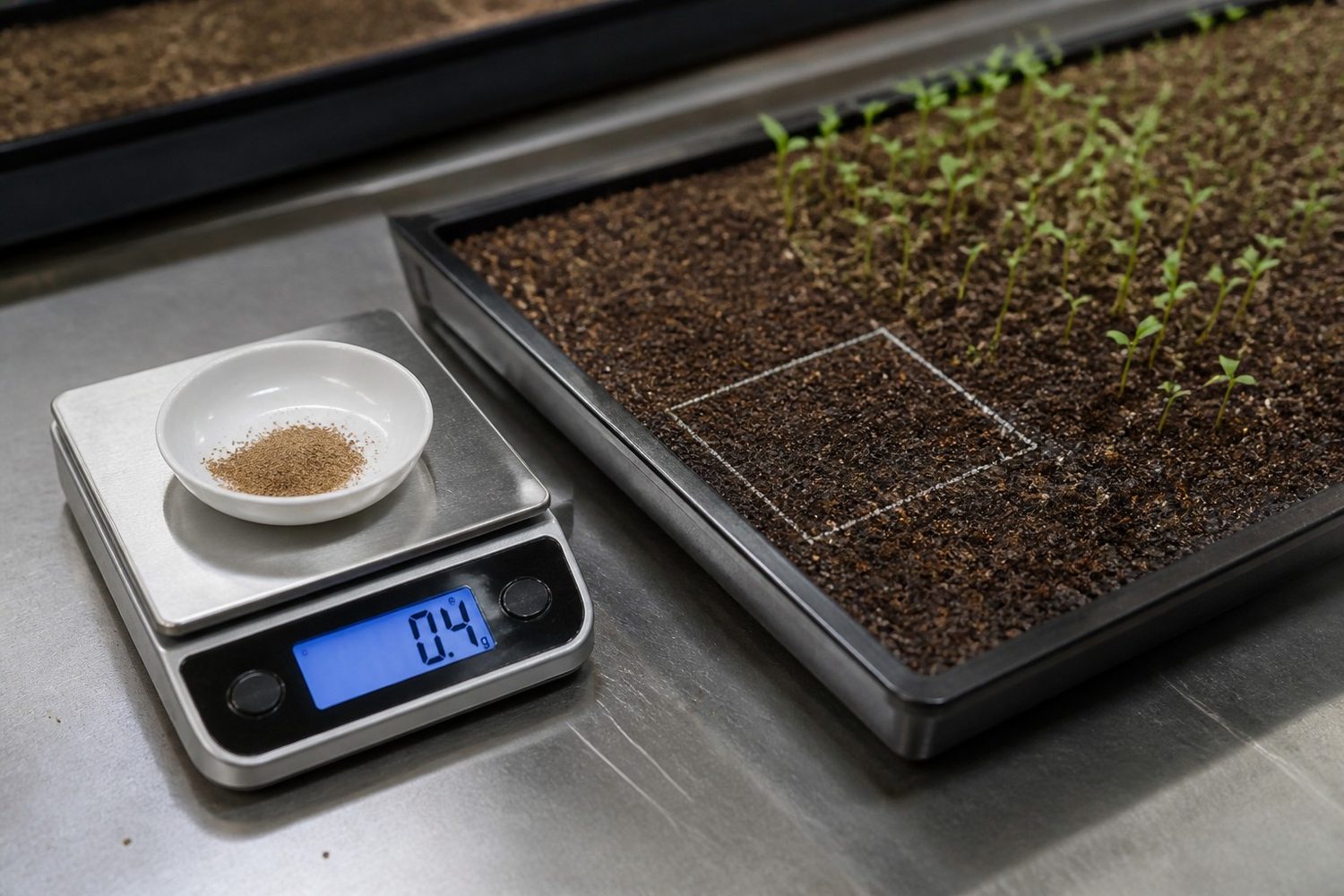
Three things make it an awkward crop, and they are worth knowing before you buy seed. It takes sixteen to twenty-five days, roughly twice a brassica, and spends all of that as a fine-seeded tray that has to stay damp. The seed runs $242.36 a pound, about 53 cents a gram, among the dearest here. And no source publishes a sowing rate for it, so there is no figure to look up: weigh a marked test patch on your first tray and work from your own number rather than guessing by eye, which on dust-fine seed at that price is the expensive way to find out.
If what you want is fresh oregano in the kitchen rather than on the plate, buy the potted plant instead. Oregano is a hardy perennial that comes back every year and tolerates being picked at continuously, and a twenty-day tray of expensive seed does not beat that.
What growers are saying right now
Sampled from public posts and videos, 10 July to 9 August 2026. Every line links what it is quoting. How often something is repeated is not evidence that it is true, so every line also says what the sources actually establish.
Give Greek oregano six to eight hours of full sun and let the soil dry between waterings for a stronger, richer flavor
Circulating Garden advice at 369 views
Sound for a potted plant and actively wrong for a tray. A microgreen is cut at two to three weeks under a grow light, long before sun hours or drought stress could concentrate anything, and letting the medium dry out during that period is how you lose an evenly germinating stand of dust-fine seed. Worth flagging because the oregano advice a grower will find is all written for the perennial. Growing it
Want to grow oregano? Let me show you some tips
Circulating A herb-garden clip at 510 views, and a harvest post at 7,715 views and 513 likes, the highest-engagement oregano item in the window
Both are about a mature plant in the ground, and that is what almost all oregano advice will be. Expect to translate: instructions written for a perennial in soil rarely transfer to a tray cut at three weeks. Is it worth growing
What it is, and how to tell you grew it right
Oregano microgreens are seedlings of Origanum vulgare, a mint-family plant like basil and mint, cut just after the cotyledons open.
Two products are actually sold for microgreen use and they are not the same thing on paper. Greek oregano is identified as O. vulgare subsp. hirtum. Common Italian, available organic, does not name a subspecies at all. A third catalogue entry, Cleopatra, is Origanum heracleoticum and is sold as herb and ornamental seed rather than for trays. No comparison exists between any of them on stem length, color, tenderness, days or yield.
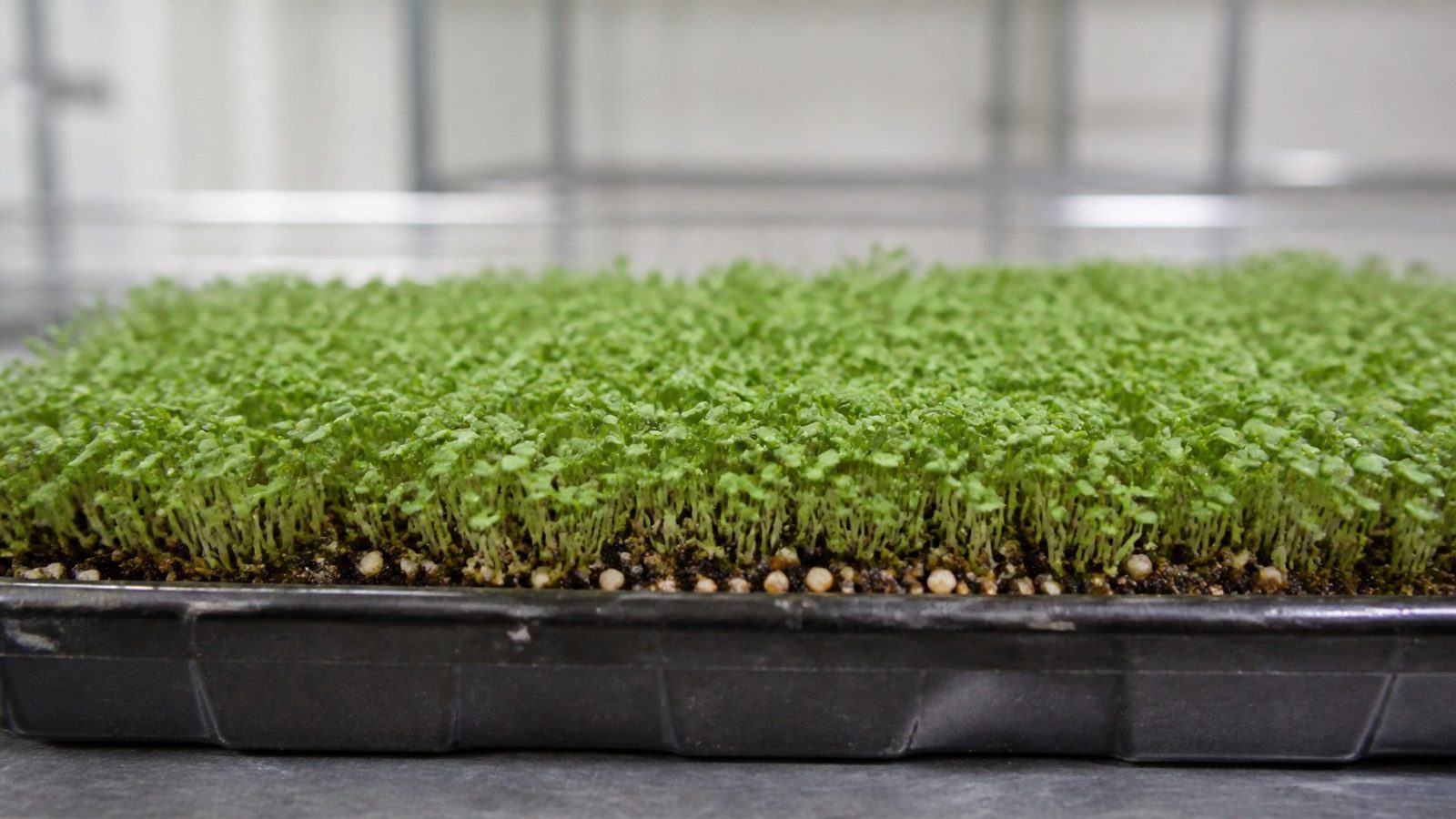
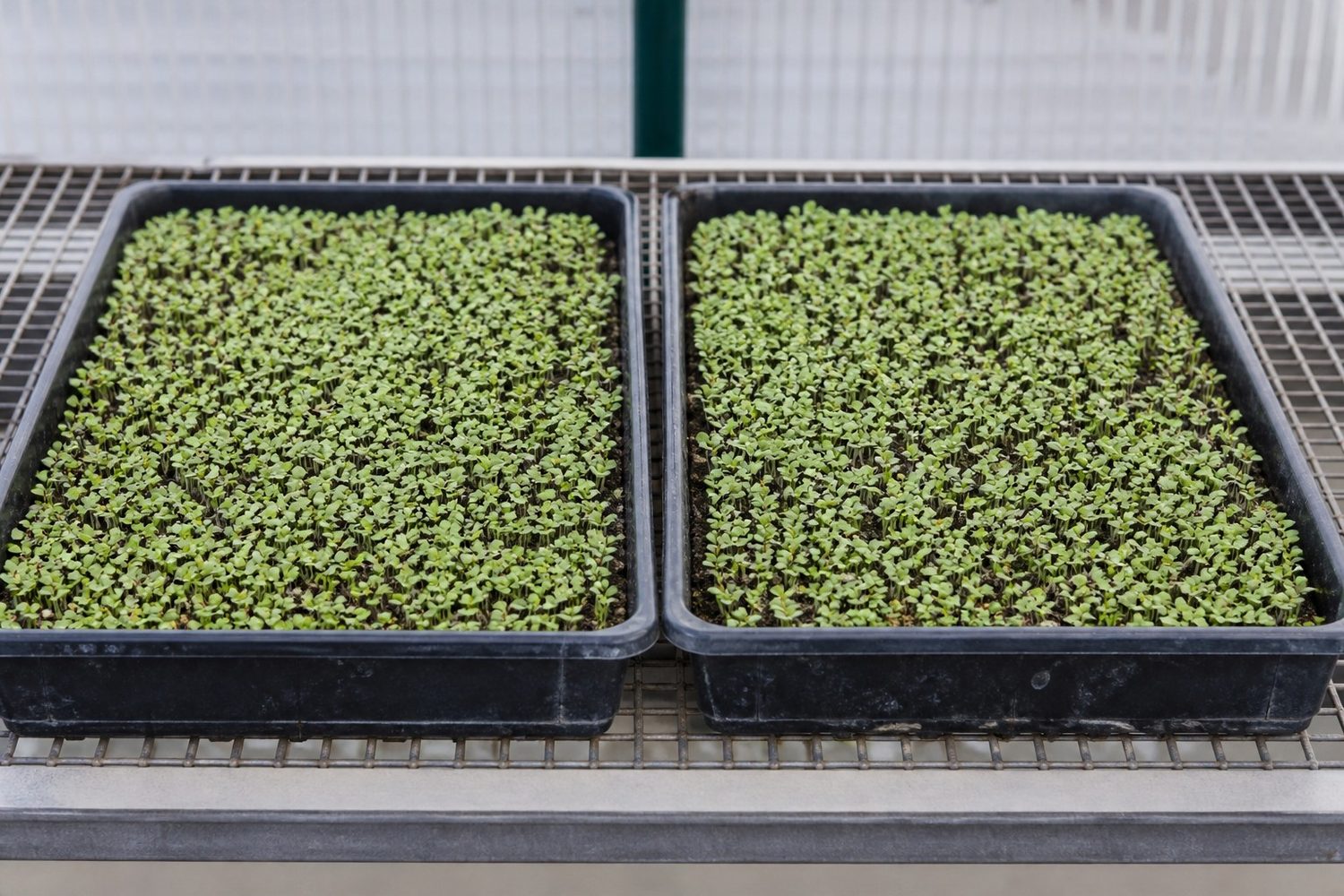
At the stated harvest point, just after the cotyledons open, expect a low dense field of small bright green oval leaves on fine delicate stems, with the medium showing only where coverage is thin. Harvest height, stem diameter and what the root mat looks like are all unpublished.
It is easily confused with other tiny mint-family seedlings, especially marjoram, and there is no reliable way to tell them apart in a tray. No labelled side-by-side of oregano and marjoram at cotyledon stage exists in the sources opened here, and a mature-plant leaf difference does not transfer down to a seedling. So, the seed label is your identification. Keep the packet, and label the tray. The same problem turns up on onion against the other alliums and on komatsuna against its Brassica rapa relatives, so it is worth making labelling a habit rather than a special case.
What it tastes like, and what to do with it
Concentrated, resinous, unmistakably oregano. This is the pizza-herb note without the drying, and it is a seasoning rather than a green.
Use it as a Mediterranean finish in small amounts: scattered on tomato soup, on pizza after it comes out of the oven, over a Greek salad, on roasted vegetables, or across tomato and mozzarella. Fine stems and low volume make it wrong as the bulk of anything.
The people who will not like it are the people who do not want the Italian-herb association in a fresh dish, and anyone expecting a mild salad green will be surprised by how far a pinch goes. Nobody has run a preference study, so that is inference from the flavor rather than measurement.
One thing is documented and worth acting on: the flavor changes as the plants grow past the microgreen stage. No source says in which direction or by how much. The crop guide's own advice is to taste your first tray and set your own cut point, which is the honest version of a harvest window on a crop that has none.
Growing it: only what differs from the standard method
Everything general is on the standard tray method for growing microgreens. Oregano's deltas are mostly about time, and two of them are honest blanks.
No soak. The crop guide says the tiny seeds emerge without one, and no source establishes a duration or temperature. On seed this fine a soak makes even distribution harder rather than easier, which is the same reason mint does not get one.
Surface-sow thinly and evenly, and level the medium first. The seed is small enough that you cannot judge quantity by eye, which matters more here than usual because you also have no published rate to aim at. Weigh a test area.
Bottom water, and the crop guide is specific about why. Oregano's long run to leaf formation gives overhead watering more chances to cause trouble, so water from below once it is up. A ten to fifteen minute soak is given as a method example rather than a validated duration.
Cover only until most of it has germinated. No oregano-specific blackout duration or weight is published. One guide shows a 5 lb weight among its equipment without prescribing it for this crop or saying when to take it off. The general instruction is to uncover at majority germination, usually two to five days and species-variable.
Then wait, and keep the surface merely moist for sixteen to twenty-five days. That is the crop. Everything about its risk profile follows from how long a fine-seeded, closely spaced tray stays damp, and the sixteen-to-twenty-five-day range is roughly twice a brassica's.
On temperature there is no number to give you, and the reason matters. The 65 to 75°F you will find quoted is a supplier's guidance for the mature herb in a garden, alongside 7 to 14 days to germination. It is not a microgreen trial. What Johnny's does say about slow microgreens generally is that above 75°F disease pressure rises and germination can be inhibited, with no lower bound given. Treat above 75°F as a known risk and everything below it as untested.
What goes wrong with oregano specifically
The characteristic error is sowing dust-fine seed too thickly, then keeping it wet for three weeks. You cannot judge the rate by eye, there is no published rate to judge against, and the crop then sits in a humid establishment phase for longer than almost anything else here. What you see is an irregular crowded carpet on a surface that never quite dries.
Pre-emergence loss. Seeds that never appear. Those positions do not recover and the gaps are permanent for that tray.
Damping-off after emergence. Soft, water-soaked collapse at or below the medium line, with Pythium often starting at the root tips. Drying the surface, improving drainage and pulling affected plants can limit a small outbreak; a spreading tray is not a food crop.
On root hair against mold, the location test. Root hairs are a fine white halo bound to the roots near the moist medium and do not bridge across stems or spread over foliage. Mold forms a spreading web across the medium and seedlings and comes with collapse or rot. Let the surface dry slightly and look at where the growth originates. No oregano-specific pathology comparison exists, so this is the general grower's diagnostic rather than an identification.
Stretched, uneven stands from uneven sowing or leaving the cover on too long. Recoverable only if the remaining plants have room and stay healthy.
Held too long, it stops being the product. The visible warning is development past opened cotyledons into defined leaves and a taller, less uniform stand. What that costs in flavor and texture is unmeasured, which is why the crop guide tells you to taste rather than to count days.
Nutrition, and what is actually established
Nothing has been measured for this crop at this stage.
USDA FoodData Central was searched on 2026-08-09 for oregano microgreens across every data type, Foundation, SR Legacy, FNDDS, Experimental and Branded: zero results. There is no FDC ID and no nutrient value to report.
**No peer-reviewed analysis of Origanum vulgare at microgreen harvest stage was located either.** What exists is mature-plant work, hydroponic herb studies and in-vitro shoot literature, none of which is the same thing as a tray cut at three weeks.
So, the claims you will meet, that oregano microgreens carry some multiple of the mature herb's rosmarinic acid, or proven antimicrobial, antiviral or antifungal effects, have nothing behind them for this crop at this stage. Those claims mostly come from research on oregano essential OIL, which is a concentrated extract and a different exposure entirely, in the same way that mint's page had to separate pennyroyal leaf from pennyroyal oil. Transferring an oil result to a garnish is not a small overstatement.
Where somebody has done the work the answer can go either way: lettuce measures higher in the seedling, celery higher in the adult, and mizuna shifts with the light spectrum. For oregano nobody has run it.
Which seed to buy
Two microgreen products exist and one of them tells you what it is. Greek oregano is named as O. vulgare subsp. hirtum. Common Italian organic does not state a subspecies. Given that no comparison between them has been published, buying the one that names its botanical identity is the only distinguishing information available.
Specify a food-use microgreen lot with a stated botanical identity, untreated seed status, and a lot and pack date. Refuse treated field seed outright: it is not sold for raw-food production.
Weigh a test area before you scale, and this matters more here than on any other crop. The seed is dust, so you cannot judge quantity by eye; there is no published rate to aim at; and the seed costs $0.534 a gram. A lot with poor germination will look exactly like your technique failing, and the only way to tell the difference is a weighed, dated, counted test patch. No oregano seed-count-per-gram, germination percentage or lot-variation figure is published anywhere, so the supplier's own lot test is the only number you will get.
The seed shelf is a garden shelf, and the marketplace has no oregano microgreen product at all. All 790 results of the Amazon search were read: 29 are oregano and not one is sold for microgreens, against 25 other-crop microgreen listings on the same page. The reason is simply that nobody grows the tray version at scale, so nobody packages seed for it. Fennel and mint are in the same position.
Two label traps sit on that same page. One listing reads "1,200 Italian Oregano ... Origanum Vulgare | Majoram", naming oregano and marjoram in one title, which is precisely the confusion this page says has no visual tell in a tray. Another sells "Broad Leaf Thyme AKA Cuban Oregano, Spanish thyme, Mexican thyme", which is Plectranthus amboinicus, a different genus entirely, wearing both an oregano name and a thyme one.
So, for a single tray the garden packet is the sensible route, at $4.84 to $7.49 for 1,200-plus seeds against $242.36 a pound. Oregano seed on Amazon is that shelf. Read the botanical name, and if the title also says marjoram or thyme, it is telling you something.
Is it worth growing?
For most people, no.
The crop takes sixteen to twenty-five days, roughly twice a brassica, on seed among the dearest here. Nobody has published how much a tray takes, what it returns, how long it keeps or what temperature it wants, so you cannot cost it, cannot plan a rotation around it and cannot compare it against another crop on paper. None of that means it grows badly. It means you will be working from your own records from the first tray onward, and you should expect to keep them.
Against that, the flavor is genuinely distinctive and genuinely useful. A chef who wants fresh oregano as a plated finish rather than a dried sprinkle has one obvious source for it, and that is a real, narrow market.
Its real competitor is a perennial in a pot. Oregano is hardy, comes back every year, tolerates neglect and can be picked continuously. For kitchen use that is very hard to beat, and mint loses the same argument for the same reason. If you want fresh oregano to cook with, buy the plant.
If you want an aromatic herb tray with published figures behind it, grow basil, the other Lamiaceae here, which has three named cultivars with measured yields and days. If you want speed and weight, nothing on this page is for you.
A note on the numbers above
Hover or tap a row to highlight it.
| Figure | Value | Source | What kind of number it is |
|---|---|---|---|
| Days to harvest | 16 to 22 | Crop-specific grow guide | Harvest just after cotyledons open, no temperature |
| Days to harvest | 16 to 25 | Johnny's slow-growing chart | For HERBS as a group, not oregano specifically |
| Soak | None needed | Crop-specific grow guide | The tiny seed emerges without one |
| Watering | Bottom water | Crop-specific grow guide | Because the long run to leaf raises overhead-water risk |
| Regrowth | None | Crop-specific grow guide | Compost and replant |
| Seed price | $242.36/lb, $15.15/oz | True Leaf, checked 2026-08-09 | Second highest per pound in this directory, after mint |
| Seed per 1020 | No published figure | Nobody | Absent from the yield trial AND the shoots comparison |
| Yield per 1020 | No published figure | Nobody | No weighed oregano tray at any stage |
| Cost per tray | Cannot be calculated | Nobody | A real price with no rate to multiply it by |
| Blackout | No published figure | Nobody | One guide shows a 5 lb weight without prescribing it |
| Germination temperature | No microgreen figure | Nobody | The 65 to 75°F quoted is MATURE HERB guidance |
| Shelf life | No published figure | Nobody | No oregano-specific storage trial |
| Harvest window | No published figure | Nobody | The guide says taste it and decide |
| Nutrition | No published figure | Nobody | Zero FDC results, no microgreen composition study |
Seven fields blank puts oregano third among the thin crops here, behind cucumber at ten and cauliflower at eight, counted across all 48 entries on 2026-08-09. The combination is different from either of theirs. Those two are crops nobody costed. Oregano is a crop somebody priced and nobody measured, which is the more frustrating shape: the expensive half of the arithmetic is documented to the cent and the other half does not exist.
The cost cell says "cannot be calculated" rather than sitting empty, and the distinction is real. Lettuce has the same problem and states it the same way. Seed is $242.36 a pound, which is $0.534 a gram. Whatever rate your own trial settles on, multiply. At anything between 5 and 15 grams that is $2.67 to $8.01 a tray, which would put oregano somewhere between mid-pack and fourth most expensive. That range is arithmetic on an unknown, not a finding, and it is not going in the comparison table as though it were one.
Oregano displaced onion as the second most expensive seed per pound, at $242.36 against onion's $113.30, both behind mint's $1,394.50. Onion had held that place for one entry, and oregano held it until sorrel arrived at $351.35 on 2026-08-09 and pushed it to third, then watercress at $296.25 pushed it to fourth the same day. Three crops have held second place and oregano has held three different ranks, which is the clearest sign yet that a rank against a growing table is a dated observation rather than a fact. What both of them show, and what wheatgrass shows from the opposite end at $3.12 a pound and a $3.10 tray, is that the price on the bag has never once predicted the cost of the tray in this directory. On oregano you cannot even check, because the rate is missing.
The harvest window is blank, which as of 2026-08-09 covers 44 of the 48 entries written. On this crop the absence has a documented consequence rather than being merely unmeasured: the flavor is reported to change past the microgreen stage, with no direction and no day count attached, which is why the only usable instruction is to taste your first tray.
Hover or tap a row to highlight it.
| Crop | Seed per 1020 | Yield | Days | Cost per tray | Oz per $1 | Oz per tray-day |
|---|---|---|---|---|---|---|
| Basil | 5 to 6.5 g | 5.5 to 7.5 oz | 12 to 26 | $0.83 | 7.8 | 0.34 |
| Thyme | 31 g, area-converted | 3.3 oz, area-converted | 20 to 35 | no price to multiply | cannot be calculated | 0.15 at 21.3 days |
| Chia | 26.3 to 28.35 g | No published figure | 6 to 12 | $0.78 | cannot be calculated | cannot be calculated |
| Mint | No published figure | No published figure | 10 to 18 | no rate to price | cannot be calculated | cannot be calculated |
| Oregano | No published figure | No published figure | 16 to 25 | no rate to price | cannot be calculated | cannot be calculated |
A blank means nobody has published that figure, so the cell is left empty rather than filled with an estimate. How the numbers work
All 62 crops, sortable, on the microgreen comparison.
Oregano is the fifth crop here with no rate and no yield, after lettuce, mint, cucumber and cauliflower, and the only one of the five whose seed price is known to the cent. That is why its cost cell says "no rate to price" rather than "cannot be calculated": the missing half is the quantity, not the money.
Terms on this page
Tap a term to see what it means.
*Origanum vulgare*. Oregano. Greek oregano is the subspecies hirtum; the Common Italian microgreen product does not name a subspecies.
Sources
- True Leaf Market, Greek oregano microgreen seed - Origanum vulgare subsp. hirtum identified, and the price ladder verified 2026-08-09 at 1/4 oz $10.54, 1 oz $25.83, 4 oz $75.98 and 1 lb $242.36, which is $15.15 an ounce and $0.534 a gram.
- True Leaf Market, Common Italian organic oregano microgreen seed - the second microgreen product, organic and non-GMO, with no subspecies named.
- Epic Gardening, oregano microgreens - the only crop-specific grow guide opened: 16 to 22 days harvesting just after the cotyledons open, no soak needed, bottom watering because of the long run to leaf formation, no regrowth after harvest, the flavor changing past the microgreen stage, and the advice to taste a first crop to set the cut point.
- Johnny's, year-round microgreens production - herbs grouped at 16 to 25 days against the fast brassicas.
- Johnny's slow-growing microgreens comparison chart (PDF) - oregano is absent from it, and the warning that above 75°F disease pressure rises and germination can be inhibited on slow crops.
- Johnny's microgreens yield trial results (PDF) - oregano is absent from the 29 varieties, which is why no rate and no yield exist.
- Johnny's yield trial, method and discussion - first-true-leaf harvest, at least three seedings per variety, and the caution that one system's results do not transfer.
- True Leaf Market, oregano herb growing guide - the 65 to 75°F preference and 7 to 14 days to germination, cited here only to mark that it is MATURE HERB guidance and not a microgreen range.
- Virginia Tech Extension SPES-756 (PDF) - uncovering at majority germination, typically 2 to 5 days and species-variable, and the general production environment.
- SDSU Extension, growing microgreens at home - the general refrigerated figure of about a week, dried after rinsing, cited only to mark that it is not oregano-specific.
- UC IPM, damping-off - Pythium and Rhizoctonia, root-tip onset, and rot at or below the medium line.
- USDA FoodData Central - searched 2026-08-09 across all data types, zero results.
Keep reading
The variety directory
Mint microgreens
Mint must not be blacked out, and its seed costs $1,394.50 a pound. The one published seed rate would put 154,000 seeds in a 1020 tray, ten times the densest sowing anyone has measured.
Read Mint microgreensThe variety directory
Thyme microgreens
Three weeks of bench for about three ounces, on a tray that never passes an inch and a half. Intense thyme by the pinch, and seed nobody sells at tray scale.
Read Thyme microgreensThe variety directory
Chia microgreens
A small bitter minty garnish in about a week. Chia seed is about 30 percent fat and the microgreen is not, so if you want the omega-3, eat the seed.
Read Chia microgreensThe variety directory
Celery microgreens
Three to four weeks of bench for a seasoning green, with an unusually complete measured nutrient panel behind it: 45.8 mg of vitamin C per 100 g, and four minerals that are higher in the mature leaf.
Read Celery microgreens