At a glance
Fast even emergence from small dry brassica seed with no soak, sown thickly on purpose, and the only real demand it makes is that a dense stand is kept evenly moist rather than wet.
- Botanical name
- Brassica oleracea var. botrytis
- Also sold as
- Cauliflower Microgreens Seeds
- Family
- brassica
- Difficulty
- Beginner
- Days to harvest
- No published figure
- Harvest window
- No published figure
- Seed per 1020 tray
- No published figure
- Soak
- None
- Blackout
- 2 to 3 days
- Germination temperature
- 60 to 70 °F
- Yield per 1020 tray
- No published figure
- Regrows after cutting
- No published figure
- Mold risk
- Medium
- Hull shedding
- No published figure
- Shelf life
- No published figure
- Eaten as
- raw
- Seed cost per tray
- No published figure
Any field name above ranks every variety by it. No published figure means we researched it and nobody has established one, which is different from not yet researched. Every figure here is sourced at the bottom of the page. Compare every variety side by side.
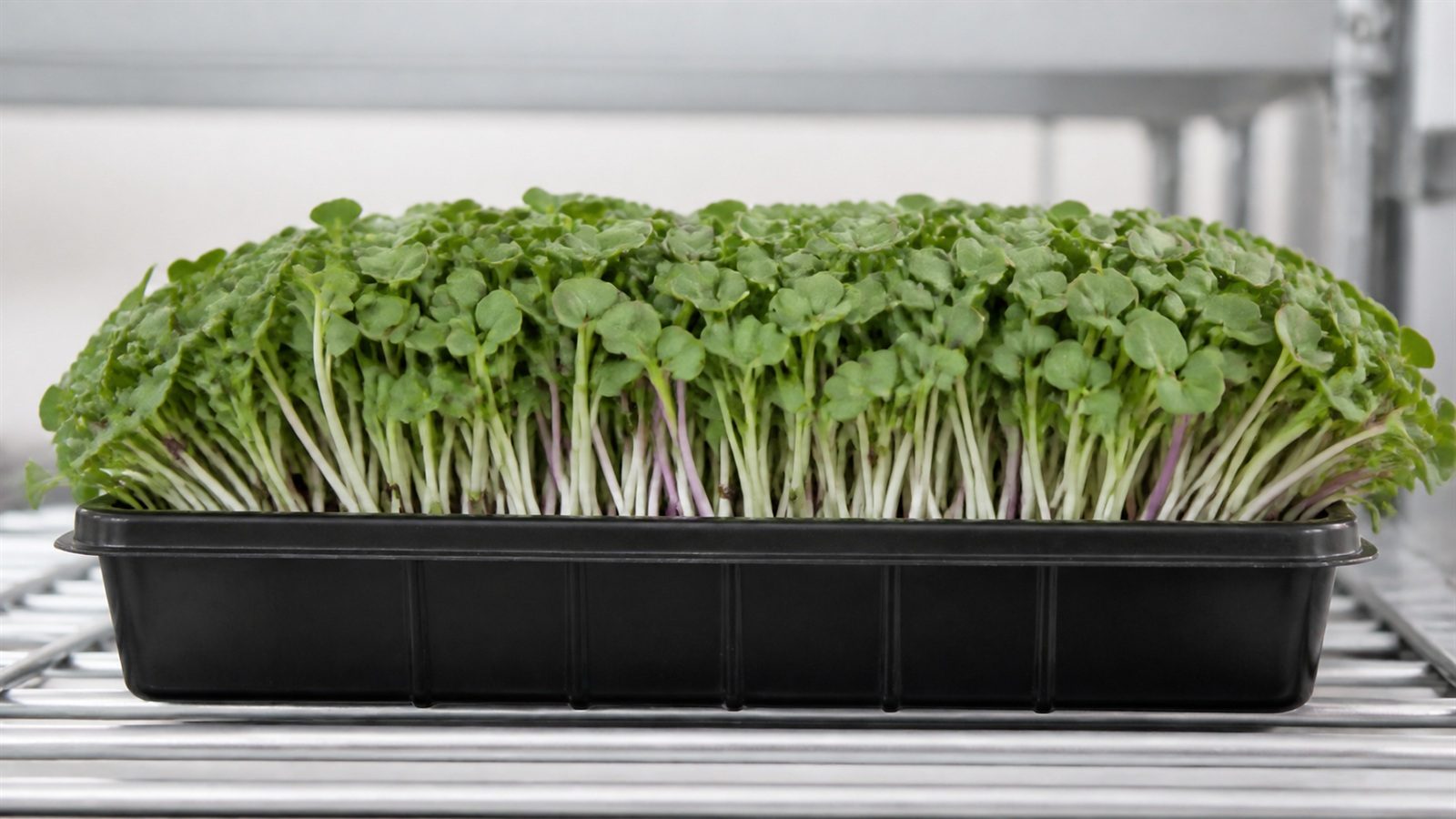
Cauliflower makes an easy, fast, substantial microgreen. If you have avoided it because cauliflower heads are difficult, that reputation does not follow the seed into a tray: it germinates in two or three days, cuts at about a week, and comes up as a dense dome of dark green cotyledons on pale cream stems, often with a purple or pink flush near the base.
It tastes of mild cabbage and fresh cauliflower with none of radish's or mustard's heat, and it has enough body to work as a salad base rather than a garnish.
One thing to know before you buy seed: almost nothing about this crop has been measured. There is no published seed rate, no yield per tray, no shelf life figure and no USDA nutrition record, and on the day this page was written the one retail listing selling cauliflower seed specifically for microgreens was out of stock. You can grow it well from what follows, but you will be keeping your own numbers rather than looking them up, so weigh what you sow and write down what you cut.
What growers are saying right now
Sampled from public posts and videos, 9 July to 8 August 2026. Every line links what it is quoting. How often something is repeated is not evidence that it is true, so every line also says what the sources actually establish.
Cauliflower is a tricky customer to grow, a bit of a diva
Circulating The framing of GrowVeg's "The Easiest Way to Grow Cauliflowers (Even if You've Failed)", a video whose entire premise is rescuing people who have already failed at it
True, and about a different crop. That reputation belongs to the head: months in the ground, cool weather, and a curd that ruins if the timing slips. A tray cut at cotyledon stage inherits none of it, and every source opened for this page rates cauliflower easy at the microgreen stage. Why the reputation does not transfer
Five common mistakes beginners make with broccoli and cauliflower
Circulating Epic Gardening's cauliflower video, the most engaged cauliflower content in the window, where the named mistakes are transplanting too late and missing an 80-day maturity date
Every one of those is a field-timing mistake. An 80-day number on a packet is 80 days to a head. The same seed makes a microgreen in about a week, and the maturity figure you are reading has nothing to do with the crop you are growing.
I thought the slugs had taken the lot, but the third planting came good
Circulating A grower's harvest post at 5,897 views, which is what cauliflower content in this window mostly looks like
A tray has no slugs and no third planting. It has one failure worth knowing, damping-off in a dense wet canopy, and it arrives in days rather than months. What goes wrong
What it is, and how to tell you grew it right
Cauliflower microgreens are seedlings of Brassica oleracea var. botrytis, the same species and variety group as the head, cut above the soil line while they are still a week old. Nothing about the curd is involved. You are eating the seedling.
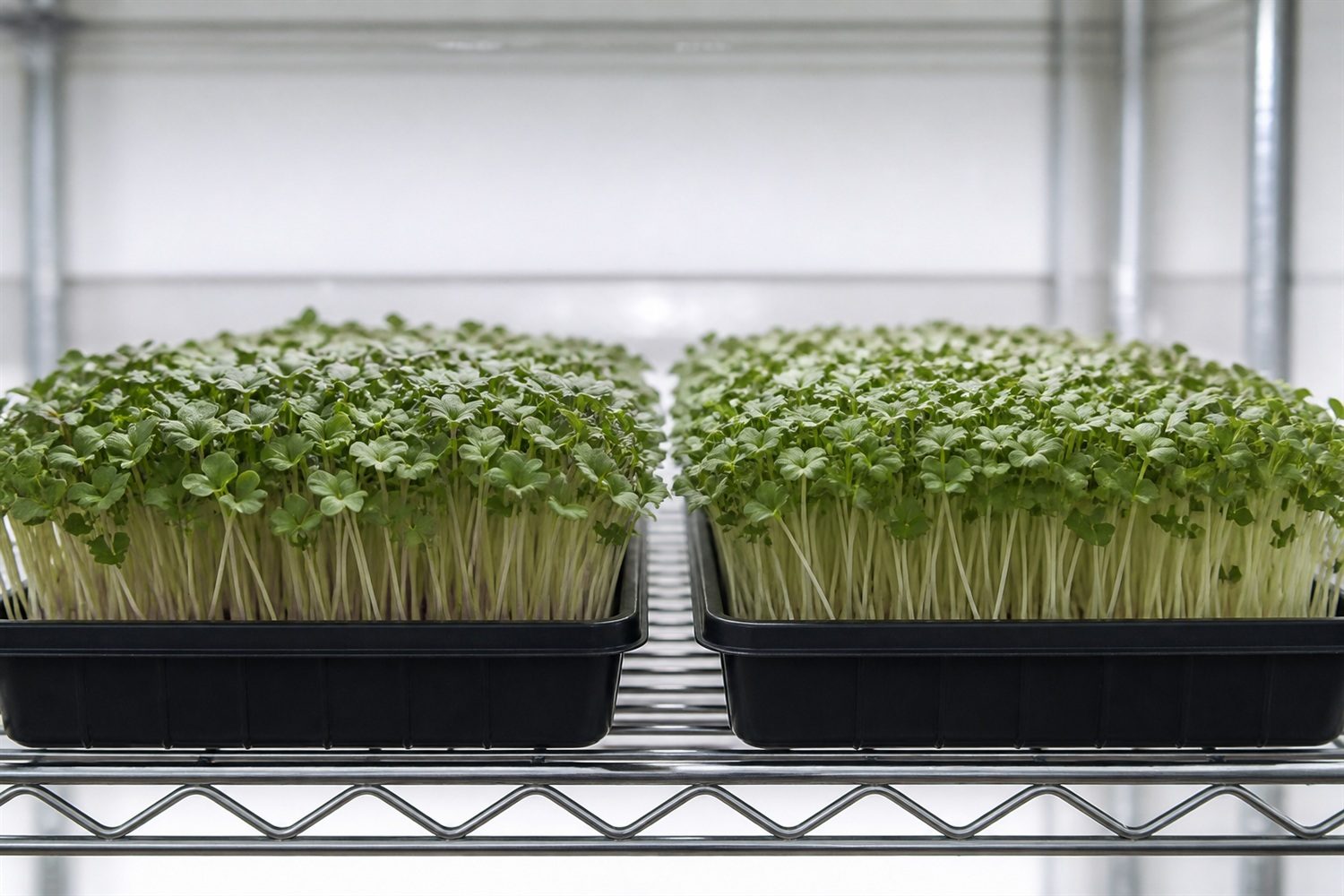
A correct tray is a close, even dome of mid to dark green heart-shaped notched cotyledons on pale cream to white stems, with subtle purple tinting on some stems and leaf edges showing on some stems, and the medium largely hidden by the density of the stand. It should look substantial rather than feathery. This is the opposite of carrot, where an open canopy is correct: on cauliflower, gaps, collapsed stems, wet bare patches or gray growth at the medium line are defects.
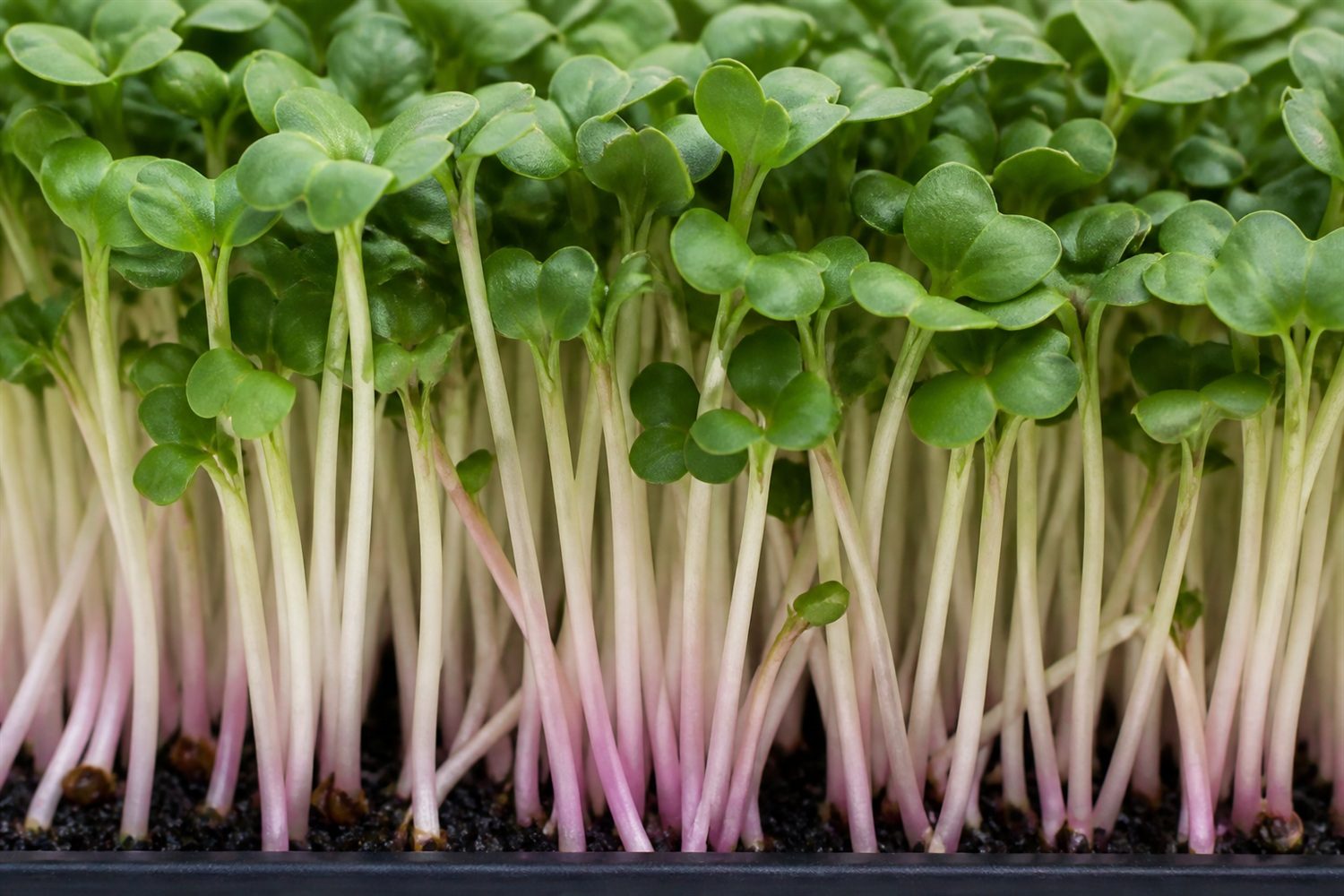
Now the honest part about identification, because it matters more here than on most crops. Cauliflower is very hard to tell from broccoli, green cabbage and the other green Brassica oleracea microgreens at this stage, and the only tell in the published material is that stem highlight, which is a characteristic of the lot sold rather than a taxonomic marker. Do not identify an unknown green brassica tray as cauliflower from the cotyledons. If you did not sow it yourself, you do not know what it is.
What it tastes like, and what to do with it
Mild cabbage and cauliflower, a fresh brassica note with none of radish's or mustard's heat, and enough crunch and substance to hold up as a base rather than a finish. Among the mild brassicas it sits on the substantial end.
That earns it a wider brief than most crops here. It works as a salad base in its own right, in sandwiches and wraps where a delicate green would disappear, folded into an omelet after the pan comes off, and as a topping on soup, fish, pizza or a grain bowl. Where carrot is a scatter, cauliflower is volume.
It is the wrong crop in two cases. If the dish wants a sharp mustard or radish kick, this will not deliver it at any density. If it wants an ultrafine delicate garnish, cauliflower is too substantial and the Apiaceae bench does that job better. And some people will simply taste cabbage: the brassica aroma is present at the seedling stage, and anyone who dislikes it in the mature vegetable is likely to notice it here.
Growing it: only what differs from the standard method
Everything general about trays, medium, light and watering is on the standard tray method for growing microgreens. Cauliflower's deltas are short, and the first thing to do is discard what you know about the vegetable.
The head crop's reputation does not transfer, and carrying it over will cost you. Cauliflower is genuinely demanding in a garden bed: months to maturity, tight transplant timing, cool weather, and a curd that fails if any of it slips. None of that applies to a seedling cut in about a week. Every source opened for this page treats cauliflower as an easy, fast, dense brassica. If you have avoided this crop because you failed at heads, you have been avoiding the wrong thing.
No soak. Sow it dry. The crop-specific guidance specifies no pre-soak and 2 to 3 day germination. The 8 to 12 hour soak in general microgreen guidance is for large seed, and applying it to small cauliflower seed adds wetness to a crop whose only real risk is wetness.
Sow it thickly, up to one even layer, and no further. This is the one crop here where the supplier explicitly says it may be sown more thickly than most seed. The limit is the shape of the stand, not a weight: increase density until the seed forms a single even layer, and stop before it forms piles. There is no published grams-per-1020 rate for cauliflower and nobody should hand you one. Weigh what you actually use, at your own stated cut stage, and you will have a better number than anything published.
Cover 2 to 3 days with a light clean weight, for contact only. The weight is there to hold seed against medium and to bring the canopy up level, not to compress seedlings. Take it off once most have germinated and are pushing it up. No cauliflower-specific weight in pounds has been published either.
If the stand comes up weak, flip the lid. The one crop-group-specific trick in the opened guidance is a flipped lid on day 4 or 5 for a day or two, to strengthen a weak brassica stand. It is worth knowing because the alternative most growers reach for, more water, is the move that loses the tray.
Then run the default brassica program. 60 to 70F, 50 to 70 percent relative humidity, real airflow, and a daily light integral of 9 to 16 mol per square meter. No source establishes a cauliflower-specific increase in light, water or airflow over a standard brassica tray. The only cauliflower-relevant direction is downward, on water.
A cauliflower tray, day by day
- 1
Day 0, sow dry and thick
Broadcast on a level pre-moistened surface, press for contact, do not bury. Thicker than most crops, up to one even layer, never piles.
- 2
Days 1 to 3, covered
Light clean weight for seed-to-medium contact only. Germination is fast here, 2 to 3 days, which is the crop's main advantage.
- 3
Uncover on emergence
Off once most seedlings have germinated and are lifting the cover. Then bottom water rather than wetting the canopy.
- 4
Day 4 or 5, the lid trick
If the stand is weak or leaning, a flipped lid for a day or two strengthens it. Reach for this before reaching for more water.
- 5
About day 7 to 8, cut
The only published timing is a family-level 7 to 8 day cycle for the Brassicaceae, not a cauliflower measurement. Cut at fully expanded cotyledons as the first true leaves begin, and judge it by the plant.
What goes wrong with cauliflower specifically
Four failures, in the order they arrive. Only one of them is really about cauliflower, and that one is about density.
Days 1 to 3, patchy emergence. Uneven moisture or poor seed-to-medium contact. The early sign is gaps and seed sitting proud of the surface rather than a uniform carpet. Caught early, re-leveling and adjusting moisture can still save it.
From emergence onward, damping-off. This is the one. Pythium and Rhizoctonia in a dense wet stand, encouraged by exactly the conditions this crop invites: thick sowing, a covered start, and a canopy that closes over quickly. The early sign is water-soaked, pinched stems at the medium line and isolated collapse. Affected seedlings do not recover, and on a food crop the affected area is not harvestable. Thin the seed layer and restore drainage and airflow before it spreads.
After emergence, a weak leaning stand. Not a disease, and recoverable if the stems are intact. The flipped lid for a day or two is the documented fix. Do not water it.
At the end, quality lost to overmaturity. True leaves advance past the intended stage, stems stop being uniform and tender, and the dense tray has spent extra days under disease pressure for the privilege. Cut at your intended stage. No cauliflower-specific measurement exists of what each extra day costs in bitterness, yield or shelf life, so growing it on is a gamble with no published odds.
Root hairs or mold? What actually discriminates
Hover or tap a card to highlight it.
Where it sits
Root hairs stay on individual roots. Growth that bridges between stems or spreads across the medium beyond the root zone is not root hair.
What it looks like
Root hairs are fine, bright white and even, and often look less prominent right after watering. Mold webs.
The company it keeps
Root hairs sit under healthy upright seedlings. Webbing alongside water-soaked or pinched stems is the damping-off picture, and that combination is the discard signal.
The honest limit
This is a grower's diagnostic, not an identification. Only a lab names an organism, and no cauliflower-specific comparison of root hairs against mycelium has been published.
Nutrition, and what is actually established
There is no USDA record. FoodData Central was searched directly for "cauliflower microgreens" on 2026-08-08 with Require All Words selected, and it returned zero results across Foundation Foods, SR Legacy, Survey, Experimental and Branded Foods. Mature cauliflower values are not a substitute for a seedling cut at seven days.
What does exist is narrower and more interesting than the usual claim. In a controlled comparison that grew cauliflower alongside twelve other brassica species under stated conditions, 400 g per square meter, four dark days, a 16 and 8 hour photoperiod at 24 and 18C, 60 and 80 percent humidity and 107.6 micromoles per square meter per second of LED light, harvested at 12 days, cauliflower came out highest of that set for ascorbic acid and total phenolics. A separate brassica study reported micro-cauliflower as the highest yielding of its genotypes and higher in some minerals and alpha-tocopherol.
Read that for what it is: a ranking within one experiment against a specific set of species, at one harvest age, under one light and nutrient regime. It is not a nutrient panel, not a serving size, and not a general claim that cauliflower leads the brassicas. In the same comparison, red mustard and red cabbage led on glucosinolates and broccoli and radish led on isothiocyanates, so "highest in brassicas" depends entirely on which compound you asked about.
Three things specifically are not supported by anything opened here: a multiple of mature cauliflower's nutrition, a sulforaphane or glucoraphanin quantity, and any claim that cauliflower microgreens are highest across the board. If you want the sulforaphane story told properly it belongs to broccoli, and even there most of the underlying research is on sprouts.
Which seed to buy
There is very little to buy, and that is the main difficulty with this crop.
The one verified retail offering sold as a cauliflower microgreen is an unnamed lot, SKU 48320, branded Mountain Valley Seed Company, listed for soil or hydroponic pads, described as dark green with purple and pink stem highlights and mild cabbage flavor, and sown thickly. It discloses no cultivar. On 2026-08-08 it was listed at $44.48 a pound, which is $0.0981 a gram, and it was showing out of stock.
There is no cultivar list to work from. No named cauliflower microgreen variety with a measured difference in stem length, colour, days, tenderness or yield turned up anywhere, so buy on supplier and lot rather than on variety name.
This entry carries no seed affiliate link, deliberately. Checking the Amazon results for cauliflower microgreen seed on 2026-08-08 found 185 results and, on the entire first page, not one product that is cauliflower seed sold for microgreens. Every cauliflower listing is ordinary head-cauliflower seed: Snowball Y Improved, Violetto di Sicilia, Snow Crown F1, Romanesco, all sold for growing curds in a garden. The single listing whose title contained both "cauliflower" and "microgreens" was a Snowball head cultivar with the word appended to a keyword-stuffed title. So, a link here would send you to head-cauliflower seed, which is the wrong product for a tray.
So, buy it from a seed house that sells microgreen seed as such, and specify: food-use microgreen or sprouting seed, a named seller, the lot number, untreated status confirmed by the supplier, and a current germination statement. Refuse anything treated, coated, or whose treatment status is undisclosed, because this crop is cut and eaten a week after sowing and a field seed treatment is not a food input. Note that Non-GMO on a label is not a treatment claim and does not answer the question.
A bad lot here looks like low, staggered or patchy germination in a tray whose medium, seed spread and moisture were all even. Since cauliflower has no published benchmark, you cannot tell a bad lot from a bad method by reading anything; the only way to separate them is a small germination test against a second lot, and a retained lot number.
Is it worth growing?
Yes, with an asterisk, and the asterisk is not about the plant.
It suits a beginner or a one-tray home grower who wants something fast, mild and substantial and can keep a dense surface evenly moist rather than soggy. It suits a market grower who wants a dark green dome with purple and pink stem accents on a plate. It is genuinely easy, genuinely quick, and pleasant to eat, and the head crop's fearsome reputation should not put anyone off.
The asterisk is that you will be growing it blind. There is no seed rate to start from, no yield to price against, no shelf life to quote a buyer, and no cost per tray, so every one of those numbers has to come from your own trays before you can plan anything around it. For a home grower that costs nothing. For anyone selling by weight, it means cauliflower is a crop you have to measure yourself before you can quote it, and the seed to do that with was out of stock on the day this page was written.
Its competition is the rest of the mild green brassicas: broccoli, green cabbage, kale and kohlrabi, all chasing the same slot. On the evidence available, broccoli wins on almost everything that can be checked, because it is the crop that has actually been measured: 13 g of seed per 1020, 11.5 oz at first true leaf, 12.5 days, 79 cents a tray. Cauliflower's honest pitch against that is the look, the purple and pink stems, and a slightly more substantial bite. It is not a pitch you can make with numbers, because there are none.
A note on the numbers above
There is no measured cauliflower figure on this page, and that is the finding.
Hover or tap a row to highlight it.
| Figure | Value | Source | What kind of number it is |
|---|---|---|---|
| Days to harvest | 7 to 8 | Penn State, Brassicaceae group | A family maximum, not a cauliflower measurement |
| Germination time | 2 to 3 days | Crop-specific grower guide | Observation, no temperature stated |
| Soak | None required | Crop-specific grower guide | Explicit, and the one clear instruction on this crop |
| Blackout | 2 to 3 days | General method | Contact only, no cauliflower weight published |
| Temperature | 60 to 70F | Virginia Tech | General microgreen band, not a cauliflower threshold |
| Seed per 1020 | No figure | Nobody | Cauliflower was not in the 29-variety trial |
| Yield per 1020 | No figure | Nobody | Cauliflower was not in the 29-variety trial |
| Seed price | $44.48/lb, $0.0981/g | True Leaf, listed 2026-08-08 | A real price, and the listing was out of stock |
| Cost per tray | Cannot be calculated | Nobody | Price is known, the rate to multiply it by is not |
| Shelf life | No figure | Nobody | The published storage work is on radish and roselle |
| Harvest window | No figure | Nobody | Nobody has established it |
| Regrows | No figure | Nobody | No cut-and-regrow trial exists |
| Nutrition, USDA | No record | USDA FoodData Central | Searched 2026-08-08, zero results in all datasets |
| Nutrition, research | Highest ascorbic acid and total phenolics | One 13-species controlled comparison | A ranking within one experiment at one harvest age |
Every blank above means nobody has published a figure, rather than the question not applying. Hull shedding is the one worth a word: no source prescribes hull removal for cauliflower and the product photography shows a clean stand, so a fine-seeded brassica probably sheds very little. That is a reasonable expectation from seed size rather than something anyone has counted, so do not plan a cleaning step around it either way until you have seen your own tray.
Cauliflower has too many blanks to compare against the crops below on anything except days.
Hover or tap a row to highlight it.
| Crop | Seed per 1020 | Yield | Days | Cost per tray | Oz per $1 | Oz per tray-day |
|---|---|---|---|---|---|---|
| Turnip, Purple Top White Globe | 10 g | No published figure | 7 to 12 | $0.31 | cannot be calculated | cannot be calculated |
| Komatsuna | 10 to 24 g | 10.6 oz at 1st true leaf, 13.4 at 2nd, area-converted | 8 to 12 | $0.47 to $1.12 | 10.0 | no day count for the measured stage |
| Collard | 28.35 g | No published figure | 7 to 15 | $0.90 | cannot be calculated | cannot be calculated |
| Cabbage, Green | No published figure | No published figure | 8 to 12 | no rate to price | cannot be calculated | cannot be calculated |
| Cauliflower | No published figure | No published figure | No published figure | cannot be calculated | cannot be calculated | cannot be calculated |
A blank means nobody has published that figure, so the cell is left empty rather than filled with an estimate. How the numbers work
All 62 crops, sortable, on the microgreen comparison.
Every other crop in that table can be argued about. Mizuna wins on seed cost, sunflower wins on bench turnover, and which of those matters depends on whether your constraint is money or space. Corrected 2026-08-09: arugula held the seed-cost column until mizuna was researched. Cauliflower cannot enter the argument, because a seed price of $0.0981 a gram multiplied by an unknown number of grams is an unknown number of dollars. Anyone quoting you a cauliflower cost per tray has chosen a seed rate and then hidden it inside a dollar figure.
That is a fair description of the whole crop. It is easy to grow, pleasant to eat, and completely unmeasured, and those three facts sit together more comfortably than the category admits.
Terms on this page
Tap a term to see what it means.
Curd. The white head of a mature cauliflower. The part the vegetable is famous for, the part that makes it hard to grow, and the part a microgreen never reaches.
Sources
- True Leaf Market, cauliflower microgreens seeds (SKU 48320) - the only verified retail listing sold as a cauliflower microgreen: unnamed lot, Mountain Valley Seed Company brand, soil or hydroponic pads, dark green with purple and pink stem highlights, mild cabbage and cauliflower flavor, may be sown more thickly than most seed, $44.48 a pound and out of stock, checked 2026-08-08.
- Penn State Extension, The ABCs of Microgreens - cauliflower grouped with the short-cycle Brassicaceae at a 7 to 8 day maximum growth cycle, and its use as a raw salad, sandwich and garnish green.
- Mapleton Ready, hydroponic microgreens guide (PDF) - the cauliflower entry: no pre-soak, 2 to 3 days to germination, and the flipped lid on day 4 or 5 for 1 to 2 days to strengthen a weak brassica stand.
- Johnny's microgreens yield trial results (PDF) - the 29-variety chart that contains no cauliflower line, the broccoli comparison figures, the exclusion of poor-germination outliers, and seed lot as a yield variable.
- Johnny's microgreens yield trial, method and discussion - harvest at first true leaf, and the warning that one system's yields do not transfer to another.
- Virginia Tech Extension SPES-756 (PDF) - the 60 to 70F general production band, 50 to 70 percent relative humidity, the 9 to 16 mol daily light integral, and harvest soon after first true leaves.
- UC ANR, indoor winter microgreens guide - the 8 to 12 hour soak reserved for larger seed, the weight used for contact and even germination rather than compression, and surface sowing with bottom watering.
- UC IPM, damping-off - Pythium and Rhizoctonia solani, rot at or below the medium line, and the link to cool wet conditions.
- Frontiers in Sustainable Food Systems, brassica microgreens review (PDF) - the 13-species controlled comparison and its stated conditions, cauliflower highest for ascorbic acid and total phenolics within that set, and red mustard and red cabbage leading glucosinolates while broccoli and radish led isothiocyanates.
- Foods, microgreens review (PDF) - micro-cauliflower as highest yielding of its brassica genotypes with higher some minerals and alpha-tocopherol, and the note that published storage work covers radish and roselle at 5C.
- USDA FoodData Central - searched for "cauliflower microgreens" with Require All Words on 2026-08-08, zero results across Foundation Foods, SR Legacy, Survey, Experimental and Branded Foods.
Keep reading
The variety directory
Garden cress microgreens
The crop where somebody finally measured what over-sowing costs: peak yield at 12 seeds per square centimeter, and roughly eight times the bacteria at 14. Plus 8 oz a tray at 13 days from the trade's own trial.
Read Garden cress microgreensThe variety directory
Komatsuna microgreens
The one crop where somebody weighed the same tray at two harvest stages: 26 percent more fresh weight for one extra leaf stage, against a flavor that sharpens as the leaves darken.
Read Komatsuna microgreensThe variety directory
Watercress microgreens
A sharp peppery leaf that is far easier in a tray than in running water. Watercress is Nasturtium officinale, the crop called nasturtium is not, and garden cress is a third plant again.
Read Watercress microgreensThe variety directory
Arugula microgreens
Arugula is a seasoning green rather than a salad base: 10 g of seed makes 10 oz in 14 days, it is genuinely peppery, and its 10-day shelf life comes from a controlled storage study rather than an estimate.
Read Arugula microgreens