At a glance
Small untreated seed that germinates in one to three days and a crop off in eight to twelve, with no soak and no weight to manage; what catches people is a dense canopy kept wet and covered too long, which is a moisture problem rather than anything about the crop's schedule.
- Botanical name
- Brassica oleracea var. capitata
- Also sold as
- Green Cabbage, Golden Acre, Copenhagen
- Family
- brassica
- Difficulty
- Beginner
- Days to harvest
- 8 to 12 days
- Harvest window
- No published figure
- Seed per 1020 tray
- No published figure
- Soak
- None
- Blackout
- 3 to 5 days
- Germination temperature
- No published figure
- Yield per 1020 tray
- No published figure
- Regrows after cutting
- No published figure
- Mold risk
- Medium
- Hull shedding
- No published figure
- Shelf life
- 5 to 7 days
- Eaten as
- raw
- Seed cost per tray
- No published figure
Any field name above ranks every variety by it. No published figure means we researched it and nobody has established one, which is different from not yet researched. Every figure here is sourced at the bottom of the page. Compare every variety side by side.
Search for a green cabbage seed rate or yield and you will find 10.5 grams and 8.5 ounces per 1020 tray, quoted confidently and everywhere. Those are red cabbage figures. Green cabbage is not one of the 29 varieties in the only public seeding-density and yield trial in this category, and no substitute for it exists.
The two are different cultivar groups grown for different reasons, so do not plan a tray against a red number. Weigh your own and you will know more than anybody has published.
What it is, and how to tell you grew it right
Brassica oleracea var. capitata, the same species as the red types. Green is a cultivar and color group within it, not a separate species, which is exactly why the two get conflated.
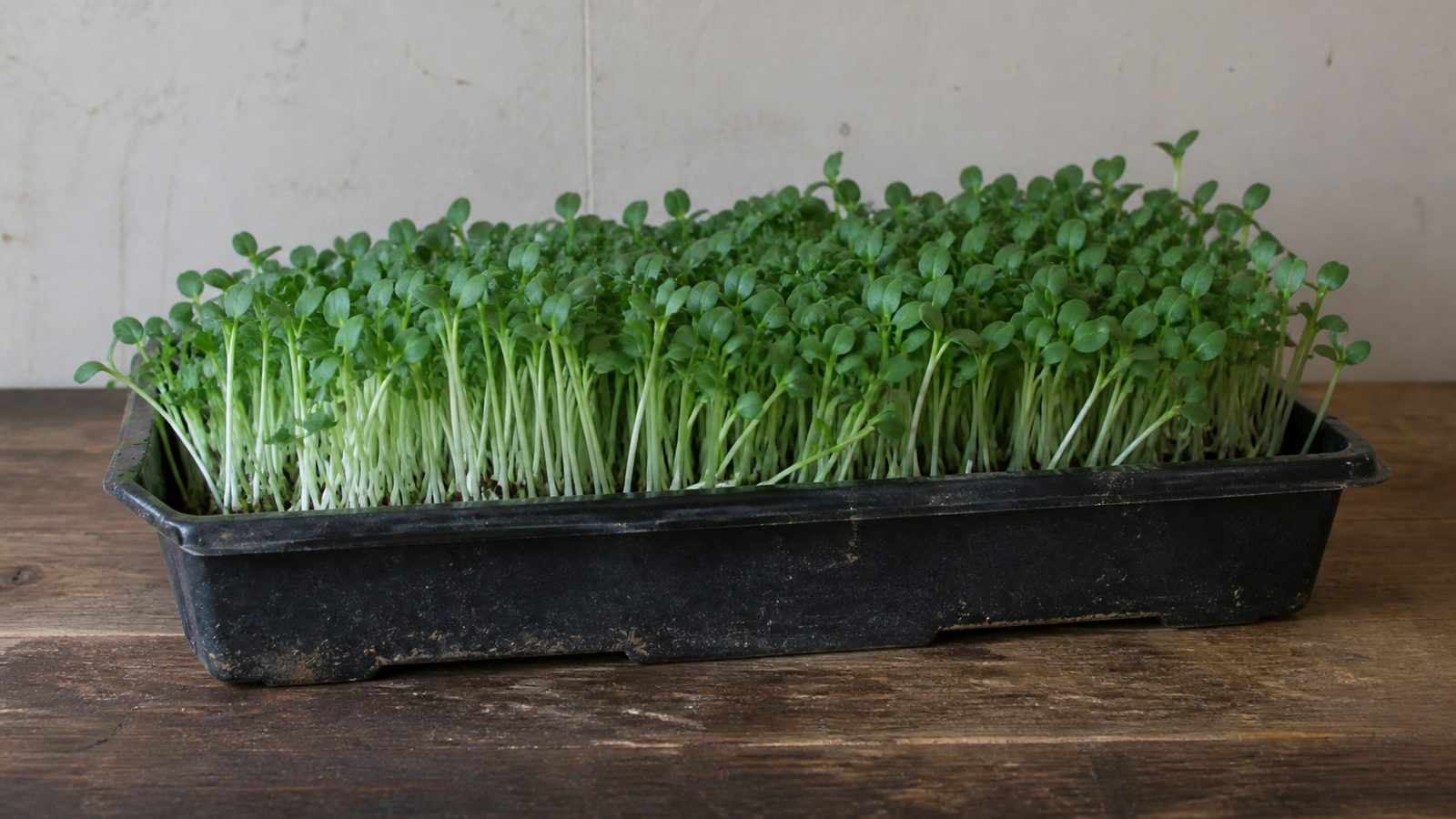
At harvest a correct tray shows two broad, rounded mid-green cotyledons on short, crisp white to pale stems, in a notably uniform stand.
The one tell that settles it: no purple. No purple veining through the leaf, no purple margin along the edge. Johnny's own description of the red type is dark green glossy leaves with purple vein and purple leaf margin, and that feature is simply absent here. If there is purple in the tray, it is not green cabbage.
Exact harvest height for a named green cultivar is not published. A grower guide's one to two inches is practice, not a measurement.
What it tastes like, and what to do with it
Mild, clean, slightly sweet cabbage with very little heat. Golden Acre's vendor calls it mild and tender; the unnamed green lots are sold on "mild cabbage flavor."
That green is less peppery than red is grower practice rather than a sensory trial. A grower guide describes green as mild and slightly sweet against red as more assertively peppery, and no panel study was found, so treat it as a useful expectation rather than a measured difference.
Use it where a dish wants crisp, tender bulk without a dominant brassica note: folded through a raw salad, layered in a sandwich or wrap, scattered over a grain bowl, or as a pale-green garnish. It is a poor choice when the plate needs purple, needs heat, or needs a green that will stand up to cooking. Eat it raw, or add it at the finish.
Cut late and it turns: once true leaves are fully developed, growers report it becoming more pungent and sometimes slightly bitter. How large that penalty is has not been quantified.
Growing it: only what differs from the standard method
Against the standard microgreen method, the green cabbage deltas are narrow.
- Sow dry. The green supplier marks pre-soak as not applicable. No source gives a beneficial soak time or temperature for this crop, so there is nothing to soak for.
- Three days of blackout, then flip the lid on days four and five. That is documented supplier practice. No weighted stack: the weight technique belongs to large seeds like sunflower and pea, and no green cabbage load is published.
- Sow at a density set for the cut you want. The one green-specific published density is 6 seeds per square centimeter, for 'Copenhagen' taken to a late 16-day, two-true-leaf harvest.
- Take it green-specific at harvest. Suppliers say 8 to 12 days. The research crop was deliberately grown to 16. Those are different products, not a range.
Everything else, clean draining trays, surface sowing, bottom watering and air circulation, is the standard method rather than a cabbage exception.
Surface sow evenly and do not bury it. The consequence for a seed this small is specific: clumps make an uneven canopy and concentrate moisture, where an even spread gives every stem the same light and air.
What goes wrong with green cabbage specifically
The one that matters: a dense tray kept too wet and covered too long after emergence. The early sign is an overly wet, uneven surface or seedlings pressing into the cover. The consequence is damping-off, meaning rot and collapse at or below the medium line, not just cosmetic mold. Take the cover off once most seedlings are up, drain standing water, bottom water, and give it gentle airflow.
This is a crop-specific application of general pathogen evidence, not a claim that green cabbage is unusually susceptible. Nobody has ranked microgreen species against each other for it, which is why the mold risk above is marked Medium as a practical classification rather than a measured one.
The other three failures, in grow order:
- Patchy emergence, from uneven sowing or weak seed. If adjoining seed has not germinated inside the normal one to three days, that is the sign. A sparse tray grows on but is not recoverable to a uniform product.
- Pale, leggy or leaning after uncovering, from too little light or too much warmth. Recoverable if the stand is sound. Do not confuse the normal pale look coming out of blackout with disease.
- Overgrown and pungent, from waiting past the window. Still edible if clean, but not recoverable to the tender profile by waiting longer.
Fuzz at the base is usually root hair, not mold. Mist a small area: root hairs lie down and nearly vanish when wet, then reappear as they dry. Mold stays as a spreading mat, crosses the medium between plants, and can smell stale. Damping-off is a different thing again and is diagnosed by rot at or below the medium line.
The numbers nobody has published, stated plainly
Every one of these gaps gets filled with red cabbage data somewhere, so here they are stated as gaps.
- Seed rate per 1020 tray: not established. Green cabbage is absent from Johnny's trial. The green-specific published density is 6 seeds per square centimeter for 'Copenhagen'. Converting that to a 10 by 20 inch area gives about 7,742 seeds, and at one green lot's stated 6,800 seeds per ounce that works out at roughly 1.14 oz, or about 32 g, per tray. Treat that as a derived research equivalent, not a rate to buy against: the density and the seed count come from different cultivars, and the density was chosen for a late harvest.
- Yield per 1020 tray: not established. The 8.5 oz figure is red. The green trial measured fresh yield in kilograms per square meter and reported it graphically, which will not support an honest per-tray number.
- Germination temperature range: not established. 75.2°F worked in a climate chamber. That is one successful point, not a range, and the general 60 to 70°F production band is not a species-specific germination figure.
- Harvest window, regrowth, hull shedding and shelf life: not established for green cabbage specifically. Treat it as a single-cut crop, because no trial has measured a marketable second cut. General extension guidance is about a week in the fridge at 41°F in the dark, and one grower guide says five to seven days in a paper-towel-lined container, washed only at use.
Do not chase yield by raising the density. The research density was tied to a late, larger crop, and the general trial methodology is explicit that larger plants need sowing less densely.
Nutrition, and what is actually established
There is no USDA FoodData Central entry for green cabbage microgreens. A search on 2026-08-11 returned other microgreens and the mature vegetable, including "Cabbage, green, raw," which is not a substitute. No nutrient panel should be published for this crop.
What does exist is condition-specific measurement. The 'Copenhagen' trial measured its crop at 6.1 percent dry matter and an average of 253.0 mg ascorbic acid equivalents per 100 g fresh weight across treatments, with total ascorbic acid at 286.5 mg/100 g without added nutrient solution against 219.5 with it. Those are values under one set of chamber conditions, not label figures.
Four claims to refuse, all of which circulate:
- that green and red cabbage microgreens share a nutrient profile, since the red pigment data are not green data
- that green cabbage microgreens have a USDA panel, since only the mature vegetable does
- that they are "4 to 40 times more nutritious" than mature cabbage, which we take apart properly in the 40 times question
- a supplier's unreferenced "vitamins C, K and E, and iron" line, which is not an analysis
Which seed to buy
Three green products were confirmed as actually sold for microgreen use:
- 'Golden Acre', an explicitly named cultivar, described by its vendor as light to deep green tops on pale stems, mild and tender, germinating in two to three days with a 6 to 14 day harvest range. Listed at $8.80 per pound on 2026-08-11.
- Unnamed "Organic Green Cabbage", white stems and green cotyledons, one to three day germination, 8 to 12 day harvest. Cultivar not disclosed.
- Unnamed "Green Cabbage", whitish stems and green leaves, 8 to 12 day harvest. Its own page warns that stem and leaf color can vary and recommends variety-specific seed for consistency, which is the supplier telling you a generic lot is not a cultivar guarantee.
'Copenhagen' is a real green cultivar and it is the one with a peer-reviewed microgreen trial behind it, but no retailer was found selling it as a microgreen product, so do not go looking for it on the strength of the paper.
Buy untreated seed suitable for food production, and buy a named cultivar if visual uniformity matters to you commercially. Refuse dyed, fungicide-treated or insecticide-treated field seed: treatments can be present in the young shoots, and this crop is eaten whole and raw. Organic, non-GMO and heirloom are attributes, not a substitute for confirming untreated status.
Cabbage microgreen seed on Amazon is the convenient home-grower route. If color consistency is the reason you are growing it, buy where the cultivar is named.
Is it worth growing?
Yes, for a specific person: a beginner who wants a fast, mild, pale-stemmed brassica, a home grower who will put one tray through sandwiches and salads, or a market grower whose customers want a neutral uniform green base.
No for two others. If your differentiator is purple color or peppery bite, grow red cabbage instead, which has both and has a measured seed rate and yield behind it. And if you are building a production schedule that needs a verified ounces-per-tray figure, green cabbage cannot give you one yet. Run your own cultivar-and-system yield trial before you commit a tray slot to it.
Against its closest competitor the comparison is not close on the numbers, and that is a statement about the evidence rather than about the plant: broccoli has 13 g of seed per 1020, 11.5 oz of yield and 12.5 days to first true leaf from a published trial. Green cabbage has a supplier's day range and a derived density. Choose it because mild pale-green seedlings are specifically what you want.
Hover or tap a row to highlight it.
| Crop | Seed per 1020 | Yield | Days | Cost per tray | Oz per $1 | Oz per tray-day |
|---|---|---|---|---|---|---|
| Turnip, Purple Top White Globe | 10 g | No published figure | 7 to 12 | $0.31 | cannot be calculated | cannot be calculated |
| Komatsuna | 10 to 24 g | 10.6 oz at 1st true leaf, 13.4 at 2nd, area-converted | 8 to 12 | $0.47 to $1.12 | 10.0 | no day count for the measured stage |
| Collard | 28.35 g | No published figure | 7 to 15 | $0.90 | cannot be calculated | cannot be calculated |
| Cabbage, Green | No published figure | No published figure | 8 to 12 | no rate to price | cannot be calculated | cannot be calculated |
| Cauliflower | No published figure | No published figure | No published figure | cannot be calculated | cannot be calculated | cannot be calculated |
A blank means nobody has published that figure, so the cell is left empty rather than filled with an estimate. How the numbers work
All 62 crops, sortable, on the microgreen comparison.
A note on the numbers above
Every unestablished field on this page is unestablished on purpose. The figures exist for red cabbage and they are one search away, and putting them here would have made this page look complete and be wrong. A grower who bought seed against a red rate would sow a green tray at a density chosen for a different cultivar and a different harvest stage.
If you have run a green cabbage tray by weight and know your seed rate and your yield, that is data this crop does not have, and we would like to hear about it.
Terms on this page
Tap a term to see what it means.
Cultivar. A named, propagated plant variety. Golden Acre and Copenhagen are cultivars; "green cabbage" on a bag is a color group, which is why two generic lots need not be the same seed.
Sources
- El-Nakhel et al., 2021, Agronomy - the only peer-reviewed microgreen trial found on a named GREEN cultivar, 'Copenhagen': 6 seeds/cm² in peat, 24/18 ± 2°C day/night, 70/80% RH, 300 ± 15 µmol·m⁻²·s⁻¹, 12 h photoperiod, harvested at 16 days and two fully formed true leaves; 6.1% dry matter, 253.0 ± 15.2 mg ascorbic acid equivalents/100 g FW averaged across treatments, 286.5 against 219.5 mg/100 g without and with nutrient solution, and fresh yield reported in kg/m² graphically.
- Johnny's Selected Seeds microgreen yield trial (PDF) and its methodology discussion - 29 varieties, and green cabbage is not among them. The 10.5 g and 8.5 oz figures are "Cabbage, Red". Also the caveat that yield varies with system, technique, harvest stage and seed lot, and that larger plants should be sown less densely.
- True Leaf Market, Cabbage Golden Acre microgreens seeds - a named green cultivar sold for microgreens: light to deep green tops, pale stems, mild and tender, 2 to 3 day germination, 6 to 14 day harvest, $8.80/lb checked 2026-08-11, and the 3-day blackout with a flipped lid on days 4 to 5.
- Organic Green Cabbage microgreens seeds - white stems and green cotyledons, seedlings in 1 to 2 days, 8 to 12 day harvest, pre-soak marked not applicable, and approximately 6,800 seeds per ounce.
- Green Cabbage microgreens seeds - whitish stems and green leaves, 8 to 12 day harvest, and the page's own warning that stem and leaf color may vary with a recommendation to buy variety-specific seed for consistency.
- Johnny's, Cabbage Red organic microgreen seed - the red type described as dark green glossy leaves with purple vein and purple leaf margin, which is the feature absent from green cabbage.
- Penn State Extension, growing microgreens at home - the standard method, the 8 to 12 hour soak limited to large or hard-shelled species, weight associated with large seeds like sunflower and pea, 41°F dark storage, and washing reducing shelf life on gentle tissue.
- Virginia Tech Extension SPES-756 (PDF) - uncovering once a majority have germinated at typically two to five days, Pythium and Phytophthora damping-off as the principal disease concern in moist systems, and the note that optimum storage temperature is still under evaluation and varies by species.
- UC IPM, damping-off - Pythium and Rhizoctonia solani, wet conditions favoring disease, and rot at or below the medium line with Pythium root-tip damage first.
- SDSU Extension, growing microgreens at home - cabbage listed as a suitable microgreen with no green-specific day range, about a week of refrigerated storage, and why treated seed is unacceptable on a crop eaten as young shoots.
- Wind River Greens, cabbage microgreens guide - grower practice: green described as mild and slightly sweet against red as more assertively peppery, 5 to 7 days in a paper-towel-lined container washed at use, the more pungent and slightly bitter late crop, and the raw uses.
- Oregon State Extension (PDF) - the root hair against mold distinction.
- Liu et al., 2022 (PDF) - cabbage cultivar 'Huafeng Zhonggan 110' at day 8 under LED intensity and photoperiod treatments, highest fresh weight at 50 µmol·m⁻²·s⁻¹ and highest pigments at 70 to 90, concluding 14 to 16 h/day. The paper does not state the cultivar is green, so it is cabbage evidence rather than confirmed green evidence.
- USDA FoodData Central - searched 2026-08-11 for green cabbage microgreens and three variants; no microgreen record located, the closest result being FDC 2709773 "Cabbage, green, raw", which is the mature vegetable.
Keep reading
The variety directory
Arugula microgreens
Arugula is a seasoning green rather than a salad base: 10 g of seed makes 10 oz in 14 days, it is genuinely peppery, and its 10-day shelf life comes from a controlled storage study rather than an estimate.
Read Arugula microgreensThe variety directory
Broccoli microgreens
Broccoli takes 13 g of seed per 1020 tray and gives 11.5 oz at first true leaf, both from Johnny's trial. No soak, fast even germination, and the root-hair-or-mold test you will need in the first week.
Read Broccoli microgreensThe variety directory
Broccoli raab microgreens
Rapini as a tray crop: bitter on purpose, 49 cents of seed a tray, and one of the few crops where the microgreen is genuinely easier than the vegetable.
Read Broccoli raab microgreensThe variety directory
Cabbage, red microgreens
Red cabbage is measured at 10.5 g per 1020 tray returning 8.5 oz, the lowest of the four mild brassicas measured in one trial. What it sells on is the purple veining, which no broccoli tray can give you.
Read Cabbage, red microgreens