At a glance
Small brassica seed that germinates in two to three days without a soak and is cut inside two weeks, with no handling quirk beyond keeping a dense surface from staying wet.
- Botanical name
- Brassica rapa var. ruvo
- Also sold as
- Broccoli Raab, Rapini, Broccoletti, Cime di Rapa
- Family
- brassica
- Difficulty
- Beginner
- Days to harvest
- 7 to 12 days
- Harvest window
- No published figure
- Seed per 1020 tray
- 12 to 37 g
- Soak
- None
- Blackout
- 2 to 3 days
- Germination temperature
- 64 to 72 °F
- Yield per 1020 tray
- 5.29 to 8.82 oz
- Regrows after cutting
- No published figure
- Mold risk
- Medium
- Hull shedding
- some
- Shelf life
- 13 days
- Eaten as
- raw
- Seed cost per tray
- $0.49
13 g at $16.96/lb, Holmes Seed Company broccoli raab, listed 2026-08-08. Fifth cheapest of the 50 costed crops, behind turnip $0.31, mizuna $0.39, lentil $0.47 and arugula $0.48. At the conflicting 37 g rate it is $1.38. Seed only, excludes medium, tray, labor, light and loss.
Any field name above ranks every variety by it. No published figure means we researched it and nobody has established one, which is different from not yet researched. Every figure here is sourced at the bottom of the page. Compare every variety side by side.
Broccoli raab is rapini, the Italian bitter green behind orecchiette con le cime di rapa. It is not broccoli and it is not a broccoli cultivar: it is Brassica rapa, closer to a turnip than to a heading broccoli, and its bitterness is the reason anybody grows it.
As a tray crop it is better value than its reputation suggests. Seed runs 49 cents a tray, which is among the cheapest you will find. It cuts in 7 to 12 days. It returns around 14.4 ounces per dollar of seed, within a rounding error of broccoli. And its shelf life comes from an actual refrigerated study rather than a supplier's guess, which is true of very few microgreens.
It also carries an unresolved seed-rate disagreement you need to know about before you sow: one supplier says 12 to 15 grams a tray and another says 37. That is not a range, it is a contradiction, and averaging the two would give you a number neither of them supports.
What growers are saying right now
Sampled from public posts and videos, 9 July to 8 August 2026. Every line links what it is quoting. How often something is repeated is not evidence that it is true, so every line also says what the sources actually establish.
Broccoli rabe wants to live in Mendocino County, California
Circulating A seed company's grower delivering the caveat before explaining how to get a crop anyway in the Northeast, complete with flea beetle bites. A viewer's reply underneath: "dam u broccoli rabe and your snooty weather conditions"
Entirely true of the field crop and entirely irrelevant to a tray. Rapini's difficulty is climate: it wants cool weather, it bolts, and it gets eaten. A microgreen cut indoors at 7 to 12 days meets none of that, which makes this one of the very few crops where the microgreen is genuinely EASIER than the vegetable. Why the reputation does not transfer
Germinate in about 14 days, harvest in 20 to 40
Circulating A winter-vegetable walkthrough giving the field timings for a bunching crop
Same seed, a completely different clock. In a tray rapini germinates in two to three days and is cut between seven and twelve. If you have grown it in a bed and are budgeting bench time from that experience, you are out by a factor of three.
Rapini with garlic, chilli and toasted breadcrumbs, through pasta
Circulating The dish rapini actually exists for
Worth knowing because it tells you who buys this crop and what they want from it. The flavor people seek in rapini IS the bitterness, so a mild version is a failed product rather than a gentler one. Do not sell this to somebody who wants an inoffensive green. What it tastes like
What it is, and how to tell you grew it right
Broccoli raab microgreens are seedlings of Brassica rapa var. ruvo, sold as rapini, broccoletti or cime di rapa. Suppliers are not perfectly consistent on the botanical treatment, some writing cymosa, but they are all selling rapini rather than a second species.
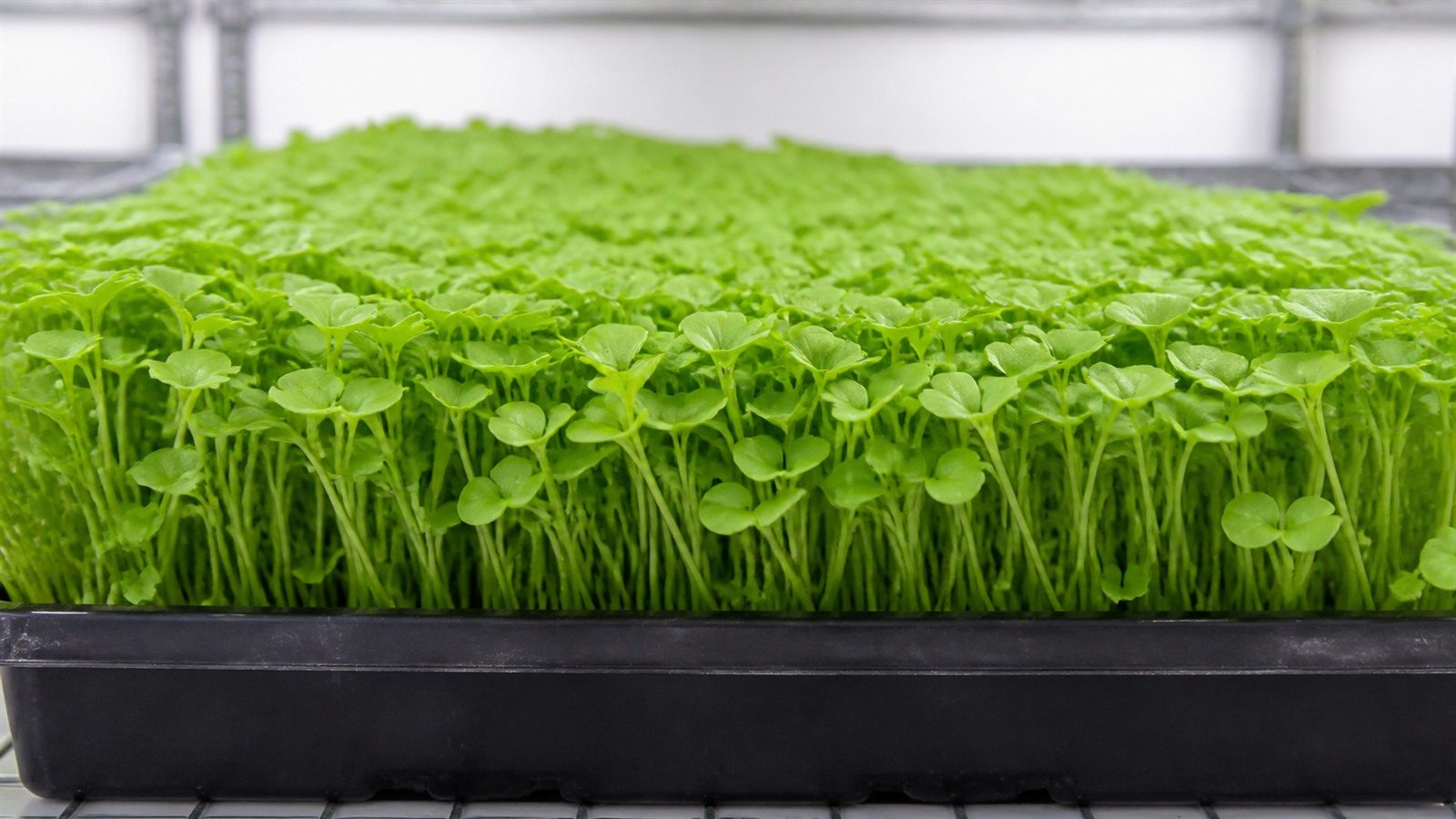
A correct tray is a close, even, bright lime green cotyledon canopy: small rounded to kidney-shaped paired leaves packed densely on bright green stems, with the medium mostly hidden. There is no purple or red anywhere on this crop. Nobody publishes a harvest height or stem thickness, so judge it on density and on catching it at the right leaf stage.
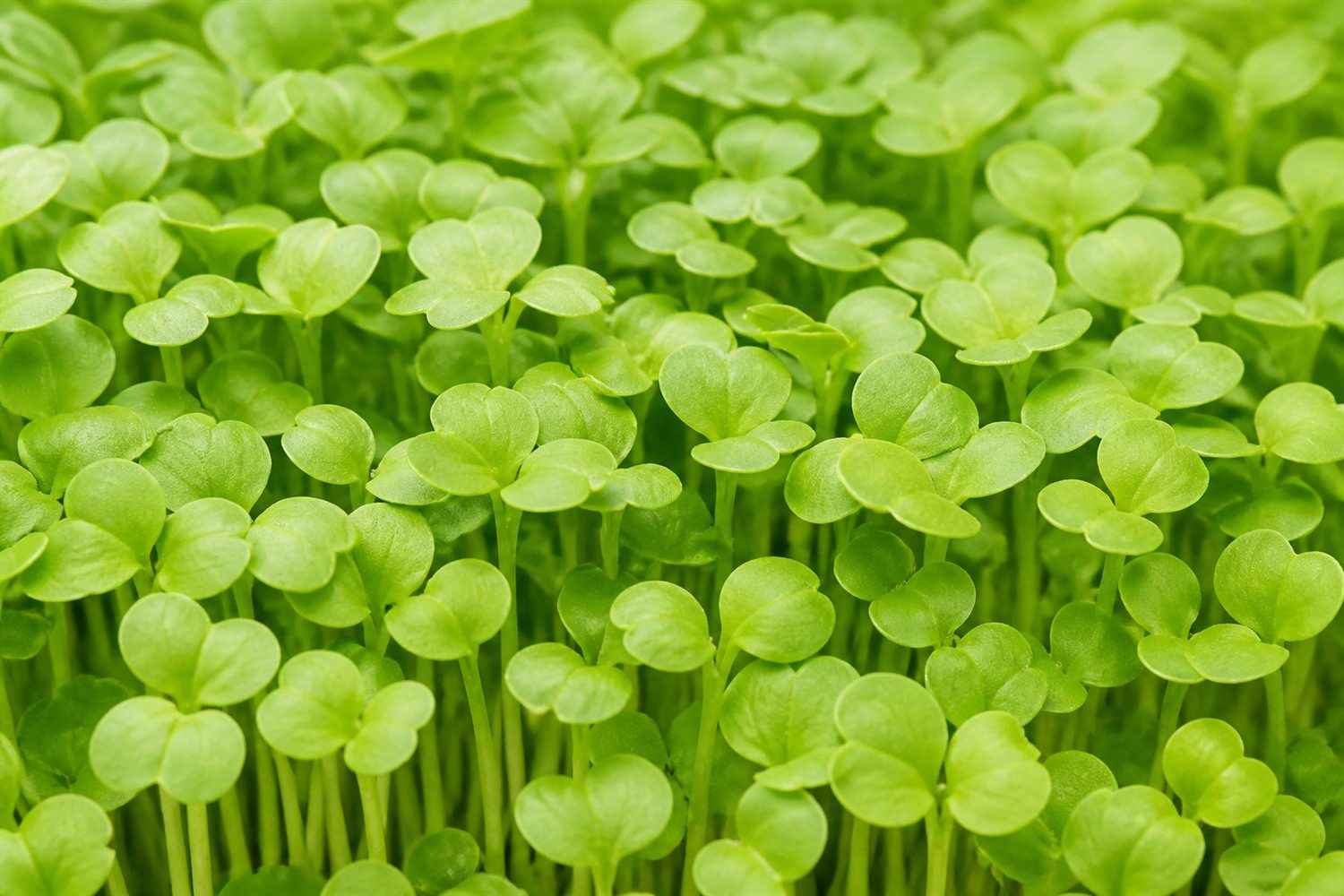
Here is the identification problem: you cannot reliably tell it from ordinary broccoli microgreens by looking. Both are green brassica cotyledons at the same stage and no verified side-by-side photographic key separates them. The tell is flavor. Broccoli is sold as mild; rapini has a savory bitter, sometimes peppery bite. If you are handed an unlabeled green brassica tray, taste it rather than examine it.
What it tastes like, and what to do with it
Tender, silky cotyledons with a savory brassica bite and a distinct, pleasant bitterness. Suppliers describe it from mild-peppery to strong and tangy, and the range in those descriptions is real, but nobody sells it as neutral. It is stronger and less sweet than broccoli, and the bitterness becomes more conspicuous if you leave it past the cotyledon to first-true-leaf window.
Raab is one of four microgreens whose bitterness is the product rather than a fault, alongside endive, fenugreek and chia. The distinction worth holding onto is that those four are bought for the bitterness, while on barley grass, clover, lentil, lettuce and popcorn shoots bitterness is purely a timing fault that arrives if you cut late. The full flavor grouping is here.
Use it as a high-flavor finish in small amounts: scattered over orecchiette with olive oil, garlic and ricotta, folded into scrambled eggs at the end, on bruschetta, in a sandwich, or a small handful through a salad. It is a seasoning green, not a base.
It is the wrong crop when a dish needs neutral leafy volume, and it fights with delicate fruit, sweet dressings and mild dairy if you use it as the main green. And the audience warning matters commercially: people who dislike bitter greens or mustardy brassicas will dislike this, and a large clamshell is a bad first purchase. Sell it with a tasting portion.
Growing it: only what differs from the standard method
Everything general about trays, medium, light and watering is on the standard tray method for growing microgreens. The deltas are few, and the first one is a piece of unlearning.
Forget everything rapini does in a garden. In the ground it is a cool-season crop that bolts, wants specific weather and attracts flea beetles, and every field guide leads with that. A tray cut at cotyledon stage never reaches the stage where any of it applies. If rapini has a reputation in your head, it belongs to a different crop.
No soak. Direct-sow dry. The crop-specific tray suppliers agree. Nothing establishes a beneficial soak duration or temperature for a tray, and jar-sprouting instructions for this seed should not be imported into soil, where the only effect is a slower-drying, more disease-friendly seed bed.
Two to three days of blackout, under a genuinely LIGHT weight. The published figure is 0.5 to 1 kg, roughly 1.1 to 2.2 lb, which is a fraction of what a cereal or a large seed gets. The weight is for seed-to-medium contact and a flat, synchronized emergence, not for stretching stems. Take it off when most hypocotyls are lifting the cover and cotyledons are starting to open; holding it longer produces pale, stretched seedlings.
Sow at 13 g and treat the higher figure as a hypothesis. This is the crop's open question. One crop-specific supplier recommends 12 to 15 g per 1020; another recommends 37 g, three times as much. Both are selling rapini seed for microgreens. Nothing in the published record resolves it, and averaging them would produce a number neither source supports. Start at 13 g, which is where the lower source points, and only raise it after a clean even stand at your intended cut. The general principle from the trade's yield trial applies: a larger harvest stage needs FEWER seeds, for airflow.
Then bottom water and keep the surface from staying wet. The characteristic mistake on a dense small-seed tray is treating more surface water as safer. It is not; it is how a crowded canopy damps off. Level the medium carefully, because a shallow dense seed layer dries out or waterlogs faster than a deeper one.
A broccoli raab tray, day by day
- 1
Day 0, sow dry
About 13 g broadcast on a carefully leveled, pre-moistened surface. Barely cover, do not bury. No soak.
- 2
Days 1 to 3, light weight
0.5 to 1 kg over the cover for contact and even emergence. Germination is fast here, two to three days.
- 3
Uncover at cotyledon opening
Off when most seedlings are lifting the cover and cotyledons are beginning to open. Past that point the dark only stretches them.
- 4
Days 3 onward, light and bottom water
64 to 72F. A general 9 to 16 mol daily light integral is the envelope; the published rapini study used 12 hours at 200 micromoles after germinating at 22C.
- 5
Days 7 to 12, cut
At fully open cotyledons, before the first true leaves materially expand. That window is where the tender texture and the intended bitterness both sit.
What goes wrong with broccoli raab specifically
Days 1 to 3, uneven emergence. Bare patches or exposed seed, from an unlevel medium or an uneven broadcast. Fixable if you catch it before roots anchor: settle the dry patch specifically rather than watering the whole tray, which is the instinct that causes the next problem.
From emergence, damping-off. Translucent pinched stems at the medium line, seedlings that never emerge, or a wet stagnant surface. Pythium often starts at the root tips and can kill before emergence. A small patch can be isolated; a spreading, foul tray is not a food crop.
At the end, etiolation and lost tenderness. Pale elongated growth if the tray is held dark too long, and a coarser, more dominantly bitter crop if it is held too long in light. The visible warning before cutting is that cotyledons are no longer the dominant leaf pair. Nobody has quantified how fast the flavor shifts past that point, so cut on the leaf rather than on a promise.
No rapini-specific indoor pest or pathogen has been established. The flea beetles in the field videos are a field problem, so watch for the general brassica issues rather than for a rapini-specific list that nobody has published.
Root hairs or mold? The check that decides it
Hover or tap a card to highlight it.
Where it is
Root hairs attach to the roots at the medium surface as fine white fuzz in a localized zone. They do not make stems or cotyledons slimy.
What mold does
Spreads across seed, medium and tissue together, and arrives with collapse, rot or a musty smell.
The decisive look
Inspect the STEM AT THE MEDIUM LINE. Damping-off is tissue rot right there. Clean white fuzz on roots under healthy upright seedlings is not.
What not to conclude
Not every white filament is mold. There is no rapini-specific rinse test published, so the stem check is the one that discriminates.
On a food crop
Unresolved doubt resolves toward discarding, because only a lab names an organism.
Nutrition, and what is actually established
There is no USDA record. FoodData Central was searched for "broccoli raab microgreens" on 2026-08-08 and returned zero results across Foundation, SR Legacy, FNDDS, Experimental and Branded Foods. The separate rapini search returns mature-food records, which are not a substitute for a ten-day seedling.
One peer-reviewed study measured this crop. Working with the local Italian cultivar 'Sessantina' at 22C and 85 percent humidity, sampled ten days after germination between fully developed cotyledons and first true leaf, it reported a median total chlorophyll of 499 micrograms per gram. That study was about chlorophyll, storage and image analysis. It did not measure vitamins, minerals, glucosinolates or sulforaphane.
So, the claims you will meet around this crop, particular amounts of vitamins A, C or D, calcium, iron, glucoraphanin or sulforaphane, and especially any "200 times" concentration figure, are not supported for broccoli raab by anything opened here. They are usually borrowed from broccoli sprout research, and broccoli raab is a different species from broccoli. If you want the sulforaphane story told properly, it belongs on broccoli, and even there most of the underlying work is on sprouts.
Which seed to buy
There is no cultivar decision to make. Suppliers sell it as Broccoli Raab, Rapini, Broccoletti or Cime di Rapa, and those are market names for the same crop. The only named cultivar in any crop-specific study is a local Italian 'Sessantina', and that paper does not compare it against another rapini for stem length, color, days or yield. Nobody has published a cultivar performance table, so buy on lot quality rather than on a variety name.
Lot quality is the real variable here, and it is unusually wide. Opened suppliers declare germination anywhere from 80 percent minimum to 94 percent on a current lot, and 200 to 400 seeds per gram. That is a big enough spread to change a stand visibly, and a grower with a weak lot will blame their watering or their density before they blame the bag. Ask for the lot number, germination percentage, test date and seed count per gram. Specify untreated, uncoated seed sold or handled for sprouts and microgreens, and refuse anything dyed, coated or treated with fungicide or insecticide, because the young shoot is the food and treatment chemicals can be in it.
With that said, broccoli raab seed on Amazon will do for a home grower, with one caveat. Checked on 2026-08-08, that search returns plenty of genuine rapini seed, Spring Raab, San Marzano, Sorrento, but the large majority is sold as garden seed for rows rather than labeled for microgreens: 25 rapini listings, only 2 pairing rapini with microgreen or sprouting. Garden rapini seed is the right plant and it is food-crop seed, so this is not the celosia situation where the search returns something you should not eat. It does mean most listings will not tell you the germination percentage or the treatment status, which on this crop is exactly what you needed to know.
Is it worth growing?
Yes, and it is quietly better value than most of what sits beside it on a rack.
Grow it if you want a fast, compact green brassica with a deliberately savory-bitter note, and especially if you sell to kitchens that cook Italian, where rapini is a named ingredient rather than a garnish. It is a legitimate beginner crop: two to three days to germinate, a light weight, a cut inside two weeks, and no handling quirk. And it is cheap to be wrong with, at 49 cents of seed a tray.
Do not grow it for somebody who wants a mild salad base, and do not plan a business on a measured tray yield, because there is no trial entry for it: the yield here is a supplier's estimate with one independent figure landing near it.
Its rivals are broccoli for a mild green brassica, kale and green cabbage for a gentler familiar profile, and mustard or arugula when a sharper note is wanted. Broccoli wins whenever bitterness would put a customer off, and it wins decisively on evidence, with a measured 13 g and 11.5 oz benchmark that raab has no equivalent of. Rapini wins when the Italian bitter-green flavor is the actual product.
A note on the numbers above
Hover or tap a row to highlight it.
| Figure | Value | Source | What kind of number it is |
|---|---|---|---|
| Days to harvest | 7 to 12 | One crop-specific supplier | At cotyledon to first true leaf, with a stated 64 to 72F |
| Days to harvest | 7 to 9 | A second supplier | No temperature or harvest stage stated |
| Days to harvest | 7 to 8 maximum | Penn State, brassica group | A family-level short cycle, not a rapini measurement |
| Seed per 1020 | 12 to 15 g | One crop-specific supplier | Recommends starting at 13 g |
| Seed per 1020 | 37 g | A second supplier | THREE TIMES the first. An unresolved contradiction, not a range |
| Seed per 1020 | No figure | Johnny's 2017 trial | Broccoli raab was not one of the 29 varieties |
| Yield per 1020 | 5.29 to 8.82 oz | The same supplier | Its own estimate at its stated cut stage. Not a trial |
| Yield, corroboration | 1.58 kg/m2 | A peer-reviewed production reference | Area-converts to about 7.2 oz per 1020, inside the range above |
| Soak | None | Crop-specific suppliers | Explicit for trays. Do not import jar-sprouting soak times |
| Blackout | 2 to 3 days at 0.5 to 1 kg | One crop-specific supplier | A genuinely light weight, for contact rather than stretch |
| Germination temperature | 64 to 72F | The same supplier | Crop-specific, with 2 to 3 day sprouting |
| Shelf life | 13 days at 5C | Peer-reviewed storage study | MEASURED. Bagged in LDPE, dark. Incipient etiolation by day 13 |
| Harvest window | No figure | Nobody | The signal is the leaf stage, not a number of days |
| Regrows | No figure | Nobody | The field crop's two to three cuttings are a different crop entirely |
| Total chlorophyll | 499 micrograms/g median | 'Sessantina', 10 days, 22C | Measured, and the ONLY nutrient figure that exists |
| Nutrition, USDA | No record | USDA FoodData Central | Searched 2026-08-08, zero results in all datasets |
The seed rate is the unresolved problem on this crop. Twelve to fifteen grams against thirty-seven is not a range with a sensible midpoint; it is two suppliers disagreeing about what the crop needs, by a factor of three. Sunflower is the only comparable case, with two documented protocols 3.5x apart and no trial to arbitrate. Both stay recorded as spans, because picking one would be inventing a number. So, weigh what you actually use on your first tray, and you will know more than either supplier has published.
And its shelf life is one of only five in any microgreen that rests on a controlled study, which is worth having when you are planning deliveries. The others are arugula at 10 days, mustard at 14, garden cress at 15 in modified-atmosphere packaging and buckwheat at 21, which is the longest measured anywhere. Rapini microgreens were bagged in low-density polyethylene and held dark at 5C for thirteen days, with incipient etiolation and chlorotic cotyledons visible by day thirteen although total chlorophyll had not significantly fallen. That is a real measurement under stated conditions, not a supplier's round number, and it is more than broccoli, carrot or celery can offer.
Where it lands.
Hover or tap a row to highlight it.
| Crop | Seed per 1020 | Yield | Days | Cost per tray | Oz per $1 | Oz per tray-day |
|---|---|---|---|---|---|---|
| Arugula | 10 g | 10 oz | 6 to 19 | $0.48 | 20.8 | 0.80 |
| Mustard, Garnet Giant | 8 g | 9.5 oz | 10 to 15 | $1.56 | 6.1 | 0.76 |
| Broccoli raab | 12 to 37 g | 5.29 to 8.82 oz | 7 to 12 | $0.49 | 14.4 | 0.74 |
| Cabbage, Red | 10.5 g | 8.5 oz | 8 to 15 | $1.27 | 6.7 | 0.74 |
| Tatsoi | 7.5 g | 8.5 oz | 8 to 15 | $0.93 | 9.1 | 0.74 |
All 62 crops, sortable, on the microgreen comparison.
On ounces per tray-day it lands tenth of those thirteen, in a cluster where it, red cabbage and tatsoi are separated by less than a hundredth of an ounce. Where it does well is seed cost: fourth of the thirteen at 14.4 ounces per dollar, essentially tied with broccoli and behind only mizuna and arugula. So, it is cheap to sow rather than heavy-yielding, and the reason it stays obscure is not agronomy. It is that most buyers do not want a bitter green, and the ones who do already know its Italian name.
Terms on this page
Tap a term to see what it means.
Rapini. The usual name for this crop, along with broccoletti and cime di rapa. All the same plant, and none of them are broccoli.
Sources
- Deliseeds, broccoli raab microgreens seeds - B. rapa var. ruvo, 7 to 12 days at cotyledon to first true leaf, 18 to 22C ambient with 2 to 3 day sprouting, 12 to 15 g per 1020, 150 to 250 g yield, no soak, 2 to 3 blackout days under 0.5 to 1 kg, bright green stems with flat vivid lime green cotyledons, and the bitter savory flavor description.
- MP Seeds, broccoli raab microgreens seeds - 7 to 9 days, the conflicting 37 g per 10x20 rate, 200 to 400 seeds per gram, 94 percent current-lot germination, and the strong tangy flavor description.
- Golinucci Organic, broccoli raabs (rapini) - the market names, 80 percent minimum germination, seeds per gram, and the raw culinary uses.
- Nature's Root, organic broccoli raab sprouting seeds - direct sowing without soaking and a 24 to 48 hour cover.
- Verdant Republic, broccoli raab - the mild-peppery to intensely bitter flavor range.
- Hudson Valley Seed Co., organic microgreens broccoli raab - coco coir, soil or hydroponic mats, and the green-brassica appearance.
- Holmes Seed Company, broccoli raab - the $16.96/lb price behind the seed cost, listed 2026-08-08, and the field crop's two to three cuttings in cool weather.
- Paradiso et al., Progress in Nutrition (PDF) - local 'Sessantina' at 22C and 85 percent RH sampled 10 days after germination, median total chlorophyll 499 micrograms/g, 12 hours at 200 micromoles after germination, and the LDPE storage at 5C for 13 days with incipient etiolation and chlorotic cotyledons by day 13 while total chlorophyll did not significantly decrease.
- Agronomy review (PDF) - the 1.58 kg/m2 production reference for rapini microgreens.
- Johnny's microgreens yield trial results (PDF) - the 29-variety chart that contains no broccoli raab line, the broccoli benchmark, and the instruction that larger harvests need fewer seeds for airflow.
- Johnny's yield trial, method and discussion - the warning that results depend on procedures, conditions, harvest stage and seed lot.
- Penn State Extension, The ABCs of Microgreens (PDF) - broccoli raab among the short-cycle brassicas at a 7 to 8 day maximum, the glucosinolate-associated cole crop flavor, and the supplier disclosures worth asking for.
- Virginia Tech Extension SPES-756 (PDF) - the general 9 to 16 mol daily light integral envelope.
- UC IPM, damping-off - wet conditions, drainage, depth and spacing as drivers, Pythium beginning at root tips, and loss before emergence.
- SDSU Extension, growing microgreens at home - seed treatment chemicals may be present in the shoot.
- USDA FoodData Central - searched for broccoli raab microgreens on 2026-08-08, zero results across all datasets.
Keep reading
The variety directory
Arugula microgreens
Arugula is a seasoning green rather than a salad base: 10 g of seed makes 10 oz in 14 days, it is genuinely peppery, and its 10-day shelf life comes from a controlled storage study rather than an estimate.
Read Arugula microgreensThe variety directory
Broccoli microgreens
Broccoli takes 13 g of seed per 1020 tray and gives 11.5 oz at first true leaf, both from Johnny's trial. No soak, fast even germination, and the root-hair-or-mold test you will need in the first week.
Read Broccoli microgreensThe variety directory
Cabbage, green microgreens
There is no published seed rate and no published yield per 1020 tray for green cabbage, and the red cabbage figures everyone quotes are not transferable to it.
Read Cabbage, green microgreensThe variety directory
Cabbage, red microgreens
Red cabbage is measured at 10.5 g per 1020 tray returning 8.5 oz, the lowest of the four mild brassicas measured in one trial. What it sells on is the purple veining, which no broccoli tray can give you.
Read Cabbage, red microgreens