Sunflower microgreens
Cal HewittPublished Updated Checked
- shoot
- moderate
- large seed
- aster
- needs soaking
- mold prone
At a glance
The large hull-bearing seed forces three steps no fine-seeded crop needs: a soak, a weighted cover, and active de-hulling, with Johnny's directing a daily pass to knock seed coats off and the removal of any plant whose coat will not release.
- Botanical name
- Helianthus annuus
- Also sold as
- Black Oil, Sunflower, Black Oil Shoot Seed, Black Oil (Organic) Microgreens Seeds, Grey Striped
- Family
- aster
- Difficulty
- Moderate
- Days to harvest
- 9 to 12 days
- Harvest window
- No published figure
- Seed per 1020 tray
- 48 to 250 g
- Soak
- 4 to 12 hours
- Blackout
- 2 to 4 days
- Germination temperature
- 70 to 74 °F
- Yield per 1020 tray
- 18.77 oz
- Mold risk
- High
- Hull shedding
- heavy
- Shelf life
- No published figure
- Eaten as
- raw
- Seed cost per tray
- $1.35
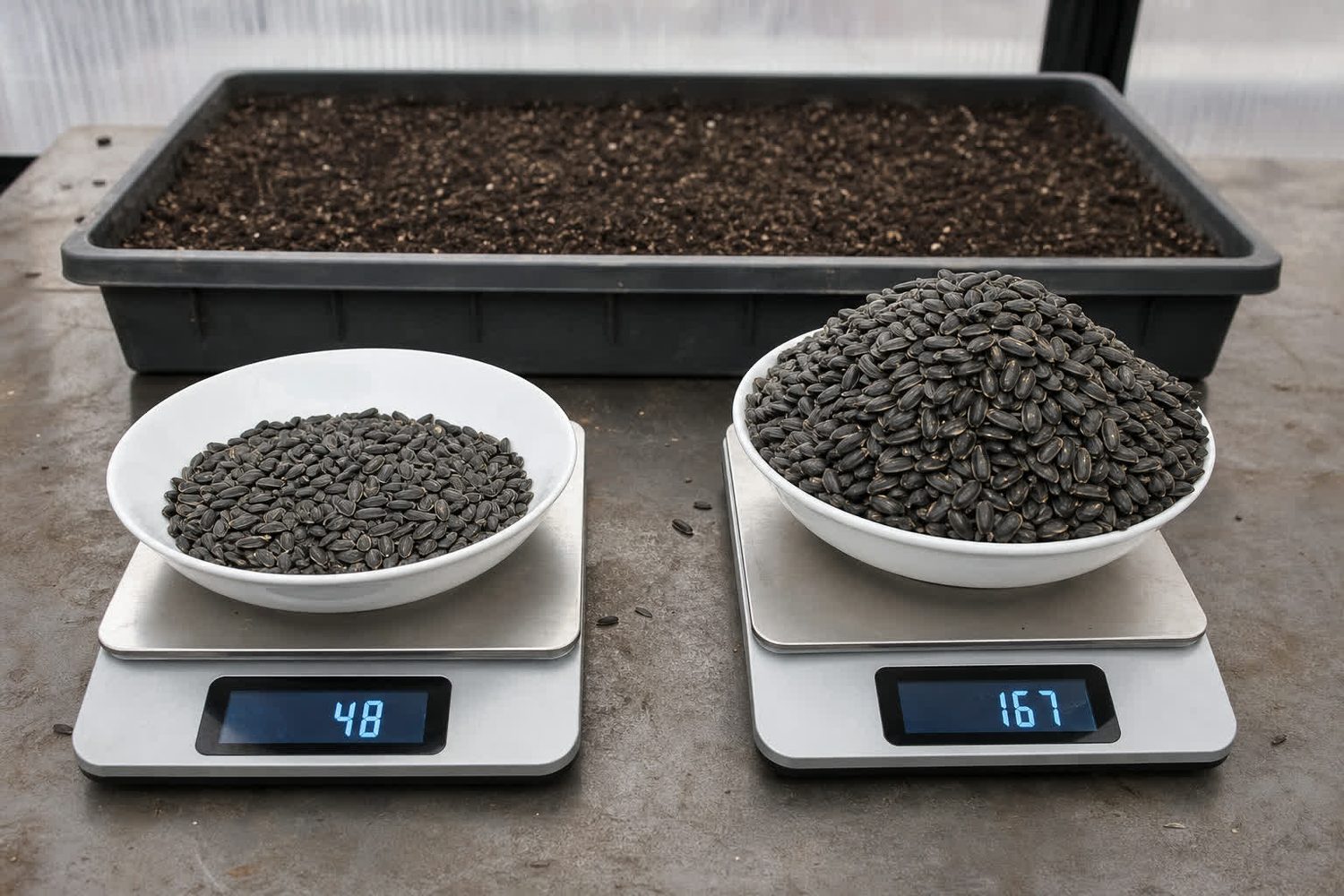
48 g at $12.75/lb, Johnny's organic black oil shoot seed, listed 2026-08-08. At the 167 g commercial rate the same seed costs $4.69 per tray. Seed only, excludes medium, tray, labor, light and loss.
Any field name above ranks every variety by it. No published figure means we researched it and nobody has established one, which is different from not yet researched. Every figure here is sourced at the bottom of the page. Compare every variety side by side.
Sunflower is the heaviest crop you can put on a bench: one farm targets 532 grams, about 18.8 ounces, from a single 1020 in roughly twelve days, which is far more than anything else returns. It is also the one crop whose method adds three steps nothing else needs. You soak the seed, you weight it down, and then you spend several days knocking black hulls off the cotyledons.
The seed rate is the one number you will have to decide for yourself. Published rates for a 1020 run from 48 grams to 250 grams, more than five times apart: Utah State Extension gives 48 g, a commercial protocol 167 g, Seedmart 150 to 170 g, and Bootstrap Farmer 150 g on one page and 250 g on another. No 1020 trial exists to settle it, because sunflower is absent from the only public per-variety yield trial in the category. The commercial rate buys weight per tray at the cost of air space; the extension rate buys margin for error. Start low, and move up only when your own trays stay uniform.
What growers are saying right now
Sampled from public posts and videos, 9 July to 8 August 2026. Every line links what it is quoting. How often something is repeated is not evidence that it is true, so every line also says what the sources actually establish.
What did I do wrong?
Circulating The single most-discussed thread in r/microgreens this window is a sunflower rescue, at 28 comments, and it sits in a month where mold questions dominated everything else: is this root hairs or mold at day four at 17 comments, please help, mold, and a whole setup lost in monsoon humidity
The rating on this page is High mold risk, and the reason is specific rather than general bad luck. Large hulls hold water against the canopy, NASA's crop screening observed fungus growing on attached black seed coats even where plant growth was not badly affected, and Johnny's own instruction is to switch to bottom watering when mold appears in warm conditions. What goes wrong
A hundred and twenty five grams of seed per tray
Circulating Weighed out on camera in the most-watched sunflower guide anywhere, 346,919 views, which says plainly "we got our 125 grams of seed and black oil sunflower seeds", while a 214,518-view walkthrough starts from 100 g
That is a sensible place to land. Utah State Extension publishes 48 g per 1020 and a commercial protocol runs 167 g, so 100 to 125 g sits squarely between the two documented systems, and it is a reasonable starting point if you do not want to pick an end. Seeding it
Soak it for eight hours
Circulating The same 346,919-view guide stops to explain why they soak for eight hours specifically, and eight is the number most repeated in the category
Eight is one documented answer of three. Johnny's says 8 hours, Utah State says 12, and the Paperpot commercial protocol says 4 to 8, so the real published span is 4 to 12 hours and no comparison exists to pick a winner. None of the three states a water temperature, so anyone who gives you one is supplying it themselves. The soak
They keep about ten days in the fridge
Circulating Told to viewers of a 214,518-view grow-along, and it is the number that circulates most for this crop
One sunflower postharvest trial exists: a 2026 cold-storage study found LDPE and PP film packs preserved color, antioxidant levels and freshness, but its summary gives no day count, and no other opened source establishes refrigerated days, a storage temperature, or whether washing before storage helps or hurts. The only crop-specific handling evidence is a commercial protocol that stops watering 24 to 48 hours before harvest so the crop goes into the bag dry. So, treat ten days as unconfirmed, keep it cold and dry, and find your own limit over two or three cuts. The numbers
Finally, someone who shows every step
Circulating The top comments under that most-watched guide are all about thoroughness. @anonymousjastyce2544, 84 likes: "The most specified, intricate, meticulous, detailed way on growing a sunflower microgreens." @repurposeyou, 27 likes: "This was so insanely informative and definitely was the easiest to follow"
The appetite for that level of detail is the tell. This is the crop whose method adds three steps nothing else needs, a soak, a weighted cover and hull removal, and Johnny's instruction is a daily pass brushing seed coats off plus culling any plant whose coat will not release. That is why it rates Moderate and not Beginner. Is it worth growing
What it is, and how to tell you grew it right
Sunflower microgreens are seedlings of Helianthus annuus, the common sunflower, almost always grown from black oil seed and cut above the medium once the seed leaves have opened. The trade calls them shoots as often as microgreens, and that is not a loose usage: Johnny's files sunflower in a separate shoots catalog rather than with the microgreens, which is why the crop is missing from the trial everyone quotes.
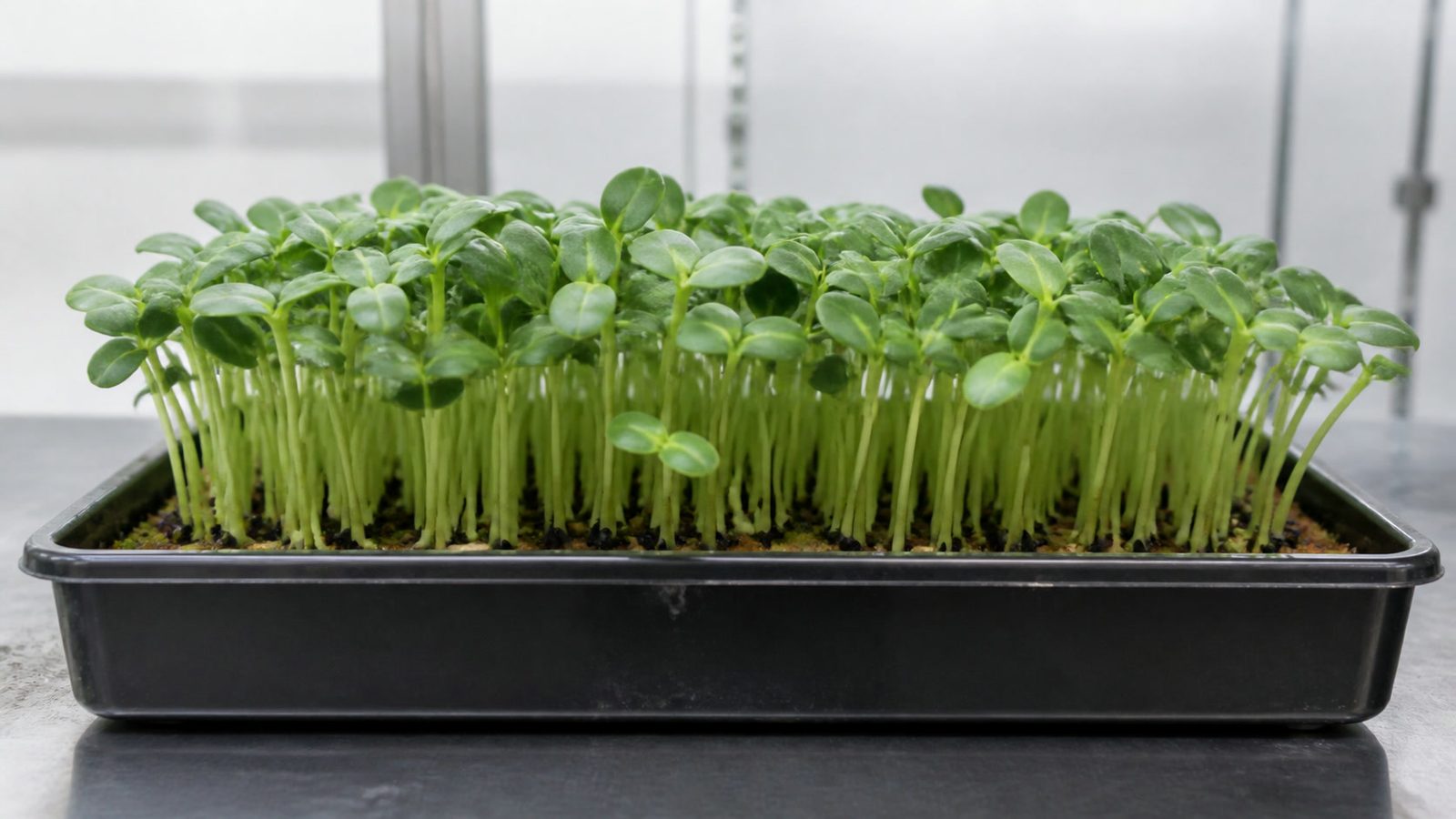
A correct tray reads as a dense, even stand of thick pale-to-green stems carrying large, smooth oval cotyledons in opposite pairs. The seed leaves are far bigger than anything a brassica produces, and the whole crop is built at a different scale: substantial, crunchy, and heavy in the hand. The published targets are 3 to 4 inches, stretching to 3 to 6 inches for market preference, or first true leaf just beginning to emerge in the commercial protocol. At the medium you should see black hulls that have shed, plus a minority still clinging to cotyledons. Those are yours to brush off or cull, and they are the defining job of this crop.
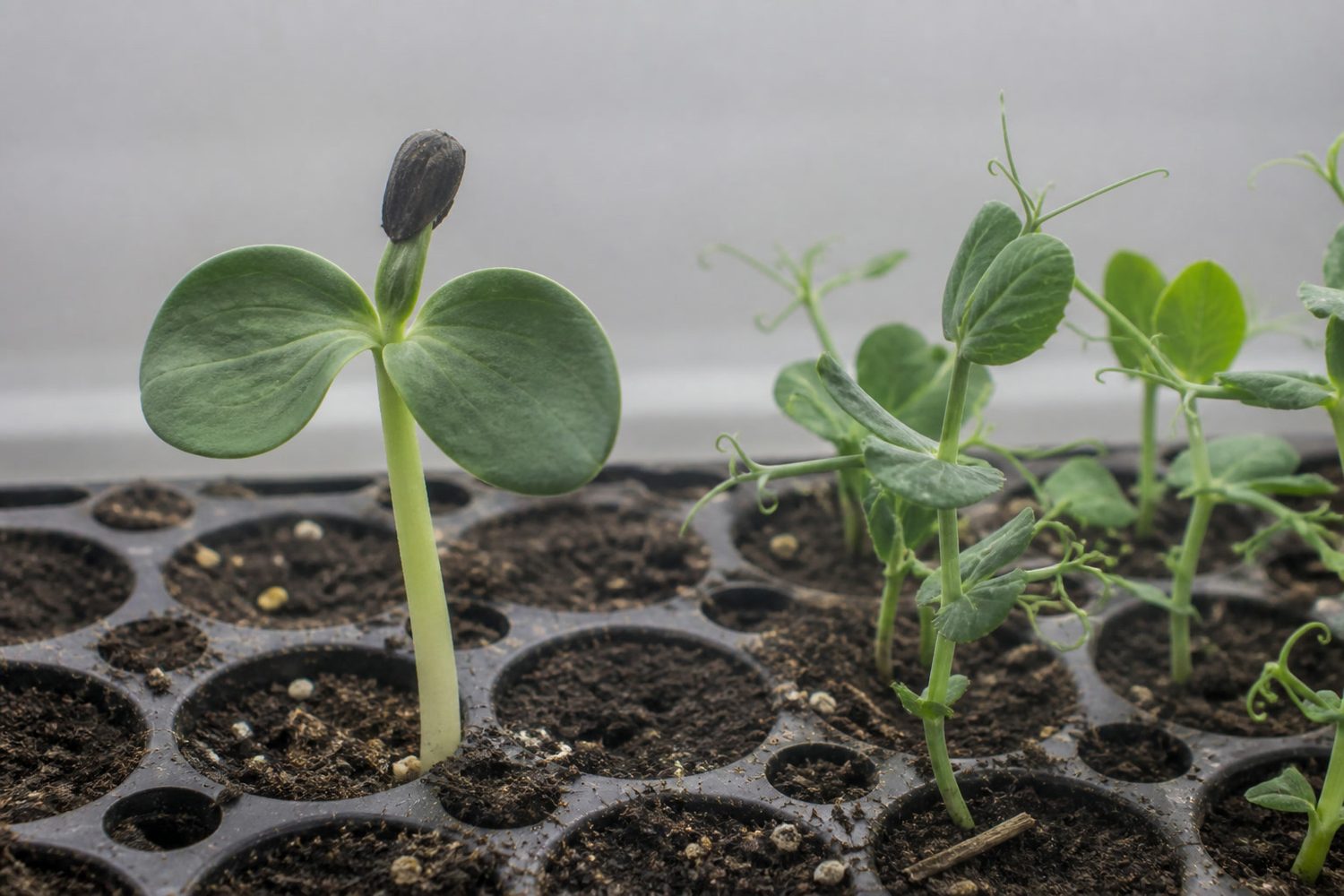
Sunflower is confused most often with pea shoots, the other large-seeded shoot, and the tell is straightforward once you know it. Sunflower makes two broad, flat, opposite oval seed leaves and usually leaves black hull evidence behind. Pea makes a paired leaf and shoot form with tendrils and no hull to speak of. Nothing else in the directory looks like either.
What it tastes like, and what to do with it
Mild, nutty and noticeably crunchy, much closer to a fresh sunflower seed than to anything peppery. Johnny's calls it mild and nutty; Utah State calls it nutty and sweet. There is no heat in it at all, which makes it the opposite proposition to radish and the reason the two sell well side by side.
Texture is what you are really buying. Sunflower is the bulk crop of the category: thick stems, broad leaves, and enough substance to be the body of a salad rather than a garnish on top of one. Use it in salads, sandwiches, wraps and grain bowls, and as a substantial garnish where you want the green to be eaten rather than admired. It is the one microgreen people snack on straight from the tray.
It is the wrong choice when a dish needs a fine, delicate finish or a peppery bite. Its thick stems and broad leaves take up too much room on a plate that wanted a whisper, and the mild flavor will not season anything. Anyone reaching for heat should take radish, mustard or arugula instead.
The people who reliably dislike it are the ones who do not like the flavor of sunflower seeds, and the ones who find a substantial raw stem unpleasant to chew. Both are fair, and neither is fixable in the tray.
Using it in the kitchen, and why one tray goes further than any other
Sunflower has unusually good published recipe amounts. Most crops get "top your dish with them"; this one gets grams.
Hover or tap a row to highlight it.
| Amount | Dish | Heat | Notes |
|---|---|---|---|
| 60 g | Pesto with pine nuts or cashews, parmesan, garlic and olive oil | None, blended cold | The only weighed amount, and the one to work from |
| 2/3 cup, roughly chopped | Guacamole with avocado, lime, red onion, jalapeno | None, stirred in after mashing | Chopped rather than whole |
| 1/2 cup | A second pesto | None | Different grower, same dish |
| 1/4 cup | Beet and goat cheese salad; burger, 4 buns; salsa | None, at assembly | |
| 1/4 cup | Pizza | Baked 15 to 20 minutes at 375°F | On before baking |
| 1 cup | Muffins | Baked in | |
| 2 cups | Soup | Simmered 5 minutes | |
| Not stated | Stir-fry | About 1 minute, at the end | Leaves brighten, stems soften |
Read the middle column, because six of those rows are one grower. A single farm's recipe page supplies the salad, burger, soup, pizza, muffins and salsa. That is one kitchen's practice repeated six times, not six independent cooks agreeing, and it happens to be the only source that bakes this crop. The two pesto amounts come from two different growers and land in the same place, which is the closest thing to corroboration here.
What a tray gives you, which nobody else can tell you
Sunflower returns more weight per tray than anything else measured: 18.77 oz, about 40 percent ahead of the next crop. That is roughly 532 grams from $1.35 of seed. So:
- About 8 or 9 batches of the 60 g pesto from one tray.
- About 213 servings at the 2.5 g garnish weight, which is under two thirds of a cent of seed each.
- At the best retail price found on 2026-08-11, a pound for $30, that tray is about $35 of shop-bought crop from $1.35 of seed, a factor of 26 before you count anything but the seed.
That gap between seed cost and shop price is the reason this crop is worth growing rather than buying. Just remember the figure it rests on is one farm's target rather than a trial, so weigh your own tray before you build a price on it.
The one crop people genuinely do cook
Most microgreens appear in exactly one published cooked recipe or none. Sunflower appears in four, and the reason is structural: these are thick, crunchy shoots rather than fine leaves, so there is something there to survive a pan.
That still is not evidence that cooking is good for them. Nobody has measured what baking a quarter cup of sunflower shoots for 20 minutes does to texture, color or nutrients. The one cooking observation anyone published is that in a stir-fry the leaves flash a vibrant green and the stems soften after about a minute, which is a description rather than a measurement. There is more in what cooking actually does to microgreens, and the short version is that pea shoots are the only crop with a real study behind cooking it.
The default that actually holds: raw, and the crunch is the product. If you are cooking it, add it at the end and give it a minute. If a recipe bakes it, you are making a baked good with sunflower shoots in it, not serving sunflower shoots.
The prep step this crop has and no other does
Hulls. Sunflower seeds are large and the black hulls come up stuck to the cotyledons. Grower notes say to pull the remaining ones off by hand, and one suggests a brief mist then a gentle brush to loosen them. It is a nuisance rather than a hazard, and no other crop asks it of you. A few hulls in a salad is the difference between a crop that looks bought and one that looks homemade in the wrong way.
Cut high. Cut well above the medium so shoots do not come away with substrate attached. That matters more on sunflower than on a fine crop because the stems are thick enough to drag material with them.
One allergen note, stated carefully
Sunflower seed is a real if uncommon allergen, with case reports in the medical literature, and one grower explicitly warns that sunflower microgreens can trigger a reaction in somebody allergic to sunflower seed. The honest limit of that: a seed allergy case report is evidence about the seed, not a measured reaction rate for an eight-day shoot. Nobody has tested whether the shoot carries the proteins. The same open question sits on sesame from the other direction. If you are selling trays, say what the crop is; if you are cooking for somebody with a seed allergy, do not treat the microgreen as automatically safe or automatically dangerous, because neither has been established.
Buying, storing and washing
Retail on 2026-08-11 ran $1.25 to $3.00 an ounce depending on pack size, with the per-ounce price falling steeply as the pack grows: $3 for one ounce against $1.875 an ounce by the pound. Sunflower microgreen seed on Amazon is the route if you would rather grow it, and at 48 to 167 g a tray the seed rate matters more here than on most crops.
Buy upright, firm and bright. Limp shoots have already lost the only thing you were buying. Gray fuzz, a sour smell or slime means discard. A few stuck hulls are a quality nuisance, not spoilage.
Store unwashed and cold, and wash only what you are about to eat, which is the rule across every crop. One grower puts wet microgreens at 24 to 48 hours before they degrade, which is the plainest statement of what washing early costs you.
There is a controlled sunflower storage study, and it does not describe your fridge. A 2026 study ran storage at 4°C and 12°C through 15 days and found some modified-atmosphere systems held visual quality better, and it cites earlier work reaching 16 days at 10°C with specific acid treatments. Household guidance is 5 to 7 days, from Purdue and from growers alike, and that is the number to plan around.
Growing it: only what differs from the standard method
Everything general about trays, medium, light and watering is on the standard tray method for growing microgreens. Sunflower departs from it further than any other crop here, and the departures are the whole job: soak the seed, weight it down, then manage the hulls.
Soak it, for somewhere between 4 and 12 hours. Every documented sunflower system soaks, which is not true of the brassicas. Johnny's specifies 8 hours and says not to reuse the water. Utah State specifies 12. The Paperpot commercial protocol specifies 4 to 8. Nobody has published a comparison, and none of the three states a water temperature, so pick a number inside that band, keep it consistent, and treat anyone quoting a precise optimum with suspicion.
Seed it somewhere between 48 and 167 grams, and understand which end you are aiming at. This is the page's central number and it refuses to collapse, and published supplier rates reach as high as 250 g. Utah State Extension's starting rate is 48 g per 1020 with a 12 hour presoak and three covered days. Scintilla Farms, via Paperpot, runs 167 g with a 4 to 8 hour soak, four stacked days, a 12 day harvest and a 532 g yield target. Both work. The commercial rate buys weight per tray at the cost of air space, and the extension rate buys margin for error. Go lower when crowding, humidity or hull retention start causing trouble, and go higher only after your own trial shows the stand stays uniform.
Sow on the surface and press, never bury. Spread soaked seed evenly over an inch to an inch and a half of moist soilless medium and press it into contact. The large seed will push itself upward instead of rooting down if the contact is poor, and that single failure produces most of the hull trouble later.
Cover and weight it for 2 to 4 days, then take it off by the signal, not the calendar. Johnny's uses an inverted tray for 2 to 3 days and says to remove it when germinating seeds lift the cover about an inch. Utah State uses 3 covered days with 2 to 5 lb of added weight during the contact phase. Paperpot uses a 14 lb paver on a stack for 3 to 4 days at 70 to 73°F. The weight exists to force roots down rather than let the heavy seed lift, and the moment the tray is visibly being pushed up, it has done its work. Leaving it on from there is how you get bent and crushed stems.
Stage the watering, and it is the opposite of what you might expect. Paperpot top-waters for the first 3 to 4 lighted days specifically to soften the attached hulls, then switches to bottom watering from day four onward. Johnny's likewise moves to bottom watering when mold shows up in warm conditions. So, early top water is a hull tool, and late top water is a mold risk. The same protocol stops watering entirely 24 to 48 hours before harvest so the crop is cut dry.
Give it more airflow than you think and 16 hours of light. Utah State calls for constant gentle fan airflow, and Paperpot's protocol runs 16 hours of light a day. Airflow here is not a nicety, it is the main control on the crop's biggest risk.
A sunflower tray, day by day
- 1
Day 0, soak
48 to 167 g of black oil seed in water for 4 to 12 hours depending on whose system you are following. Do not reuse the water.
- 2
Day 0, sow and cover
Spread soaked seed evenly on an inch and a half of moist medium and press for contact. Do not bury. Cover with an inverted tray, weighted: 2 to 5 lb in the extension method, a 14 lb paver in the commercial one.
- 3
Days 1 to 4, stacked
70 to 73°F. The weight forces roots down instead of letting the heavy seed lift. Check daily.
- 4
Day 3 or 4, uncover on the signal
Off when the seedlings lift the cover about an inch or visibly push the stack. This is a growth signal, not a date. Late removal bends and crushes the stems.
- 5
Days 4 to 7, light and top water
16 hours of light, constant gentle airflow. Top water deliberately for the first 3 to 4 lighted days to soften the hulls, then switch to bottom watering.
- 6
Days 5 onward, brush
A daily pass with a hand or a stake after watering, to knock the softened seed coats off. Any plant whose coat will not release gets pulled.
- 7
Days 9 to 12, cut
At first true leaf just beginning, or a 3 to 6 inch shoot. Stop watering 24 to 48 hours beforehand so it goes into the bag dry.
What goes wrong with sunflower specifically
Sunflower's failures come in a reliable order, and the two biggest ones are both consequences of the seed being large.
After sowing: uneven imbibition and a patchy stand. The early sign is that patches of the tray do not push the cover uniformly. The cause is uneven spreading or poor seed-to-medium contact. You can sometimes improve it with careful moisture management, but missing plants will not fill in on a dense sunflower tray, and reseeding is usually cleaner than nursing it.
During the stack: cover crush. The early sign is shoots visibly lifting the cover or the whole stack. The cause is leaving the weight on after the roots have anchored. Remove it immediately; bent shoots are saleable only if the stand recovers evenly. This is the failure that the calendar causes and the growth signal prevents.
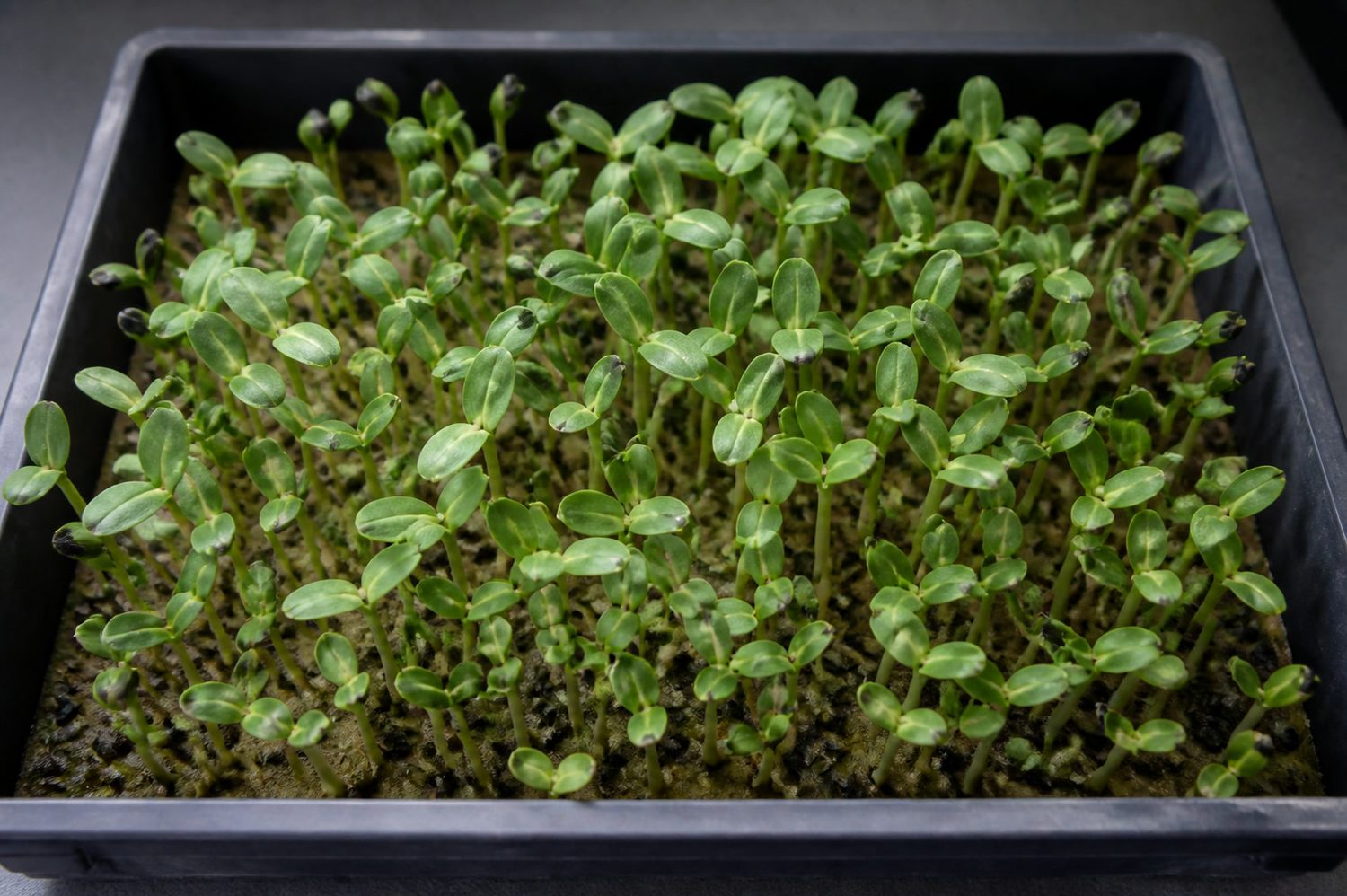
After emergence: hull retention, which is this crop's signature problem. Black seed coats stay clamped on the cotyledons, and growers call the worst of them helmet heads. Johnny's directs a daily gentle pass with a hand or a stake to knock the coats off, and the removal of any plant whose coat will not release. Paperpot places trays low so shed hulls can fall away and starts brushing after watering, when the coats are softened. Hull-attached plants do not go in a bag you are selling.
Hulls: brush, cull, or leave it alone
Hover or tap a card to highlight it.
Time the brushing
Do it just after watering, when the coats are softened. A dry hull is glued on, and forcing it takes the cotyledon with it.
Use a hand or a stake
A gentle pass across the canopy. This is a daily job from about day five, not a single operation on harvest morning.
Let gravity help
Trays sit low in the commercial protocol so shed hulls fall clear of the canopy rather than settling back into a damp mat.
Cull the refusers
Any plant whose coat will not release comes out. Johnny's says so explicitly, and a hull-wearing plant in a retail bag is the thing a customer notices first.
Watch the hull itself for fungus
NASA's crop screening found fungal growth on attached black seed coats where plant growth was not obviously suffering. Unsightly and not fit to eat, and the plant looks fine. Inspect the hull, not just the leaf.
Throughout: mold and damping-off, and sunflower is rated High for a reason. The early signs are wet collapse, rot at or below the medium line, or fungus on the attached hulls. The causes are warmth, damp, poor drainage, weak airflow and crowding, all made worse by large wet hull-bearing seed sitting in the canopy. Pythium and Rhizoctonia are the established damping-off agents. Individual hull problems can be culled. A tray with seedling rot and collapse is not a food crop, and it is not rescued by rinsing.
Root hairs or mold, the sunflower version. Root hairs stay on the roots as a fine even white fuzz radiating from healthy white root tissue, and they do not make cotyledons, stems or hulls collapse. Damping-off rots the seedling at or below the medium line, and UC IPM notes Pythium often starts at the root tips. On this crop, add one extra check the other entries do not need: inspect the black hull itself, because that is where NASA found fungus. A vague white fuzz diagnosis is not enough here.
Late: a coarse crop. True leaves plainly expanded rather than just emerging, and height past your market target. Harvest it immediately if it is clean, but the tender shoot window has gone and there is no second cut to fall back on. Whether the flavor or texture measurably changes with lateness has not been established by anything published, which is worth saying rather than asserting it does.
And a variety problem that is not a variety problem. Black oil seed is sold in large and small grades, and True Leaf has documented that these are physical size sorting rather than different genetics, to the point that one plant produces both and the company stopped sorting. So, a lot that behaves differently is a lot, not a cultivar. A bad one shows as uneven emergence, poor density, stubborn hulls and reduced harvest weight. Penn State's study recorded 90 percent germination for its purchased black oil lot, which is a reminder that lot germination is a real recorded input rather than a grower's personal failing.
Nutrition, and what is actually established
USDA FoodData Central holds sunflower microgreens only as branded label records, such as FDC ID 2463379, not as an analyzed generic food. A mature sunflower seed entry is not a substitute and should never be presented as one.
What does exist is a good peer-reviewed study, and it is worth reading for what it actually did. A Penn State team grew Johnny's black oil sunflower in peat-perlite trays at one seed per square centimeter under a weighted black-film cover, harvested at 9 days in a greenhouse at 23.8 to 26.6°C, and measured fresh and dry yield, macro and micro minerals, chlorophyll, carotenoids, phenolics, flavonoids, anthocyanin, antioxidant activity and phytate across zinc seed-priming treatments. The untreated control yielded 3,190.53 g/m² fresh. Priming with 200 ppm zinc sulphate raised zinc accumulation by 229.8 percent against that control, and the authors themselves note that commercial safety and residue research is still needed for some of those treatments.
That is a study about biofortification, not a nutrition label, and the honest reading of it is the opposite of a marketing claim: it demonstrates that sunflower's nutrient content moves substantially with how you treat the seed. Which means claims that ordinary sunflower microgreens are a complete protein, contain vitamin D, have a fixed vitamin panel per 100 g, or are universally more nutrient dense than the mature plant, are not supported by anything opened for this page.
Which seed to buy
Buy black oil Helianthus annuus, sold for edible shoots or microgreens. It is what Johnny's and True Leaf actually sell for this use, and Botanical Interests notes black oil is generally preferred for a tender seedling. It is associated with the standard mild, nutty 3 to 4 inch shoot and the 7 to 21 day market window Johnny's publishes.
Grey Striped is a genuine second type, and there is exactly one measurement of it. NASA's crop screening grew both on hemp mat and at 10 days recorded 217.1 fresh mass for Grey Striped against 185.0 for black oil under that specific experiment. That is a research result from a space-crop screening, not a supplier recommendation and not a 1020 yield figure, and it is the only side-by-side number that exists. Treat it as a reason to be curious rather than a reason to switch.
Large versus small black oil is not a choice at all. It is size sorting of the same genetics, and True Leaf has said so plainly and stopped grading. If two bags behave differently, that is lot variation.
Specify black oil, whole and shell-on, intended for edible shoots or microgreens, with treatment status declared, and a lot with germination information where the supplier publishes it. Refuse treated seed or seed whose food-use status is unknown. This is a crop eaten raw about ten days after the seed touched water, and an agricultural coating has no place on it.
A bad lot looks like uneven or sparse emergence, uneven height, stubborn hulls, and fungal problems concentrated on the seed coats. The cost is lost seed, extra culling labor, and saleable weight, and the exact dollar figure depends entirely on your rate and your selling format.
Sunflower microgreen seed on Amazon is the convenient route for a home grower. At commercial volume, buy from a supplier who declares treatment status and will name the lot.
Is it worth growing?
For a market grower selling by weight, sunflower is one of the strongest candidates in the directory, because it is heavy. One farm targets 532 g, about 18.8 oz, from a single 1020 in roughly 12 days. No other crop here has a published figure near that. But the target comes with that farm's seed rate, airflow, lot and hull-cleaning labor attached, and the labor is the part people underestimate.
For a home grower with one tray, it is excellent when you want a substantial crunchy green you will eat by the handful, and poor when you want a small, tidy, peppery garnish with no mess. There will be hulls, on the tray and on the floor.
For a beginner, be honest with yourself about the three extra steps. If soaking, watching for the lift signal, and brushing hulls daily sound like part of the fun, sunflower is a satisfying first crop and the payoff is visible. If they sound like chores, start with a fine-seeded brassica that needs none of them, and come back to this one.
Its real competition is pea shoots, the other large-seeded, substantial, mild shoot. Sunflower wins when the order wants broad, crunchy, nutty cotyledons and bulk. Pea wins when the buyer wants sweetness, tendrils, or the shoot format, and it wins on labor because it has no hull problem. Against a fast brassica tray, sunflower loses on turnaround and on effort and wins on weight and texture. There is no head-to-head consumer trial behind any of that; it is a use-case comparison from the documented descriptions.
A note on the numbers above
Hover or tap a row to highlight it.
| Figure | Value | Source | What kind of number it is |
|---|---|---|---|
| Seed per 1020 | 48 g | Utah State Extension | Published starting rate, 12 hr soak |
| Seed per 1020 | 167 g | Scintilla Farms / Paperpot | Commercial protocol, 4 to 8 hr soak |
| Seed per 1020 | 150 to 170 g | Seedmart | Supplier seeding chart |
| Seed per 1020 | 150 g and 250 g | Bootstrap Farmer | Two pages from one supplier |
| Seed per 1020 | 100 to 125 g | Two widely watched grow-alongs | Circulating practice, between the two |
| Seed per 1020 | No trial figure | Johnny's | Sunflower is absent from the trial entirely |
| Yield per 1020 | 532 g / 18.77 oz | Scintilla Farms / Paperpot | One farm's target from its own system |
| Yield | 3,190.53 g/m² fresh | Penn State, untreated control | Research yield, small trays, 9 days |
| Days to harvest | 9 to 12 | Virginia Tech | Crop table, no stated temperature |
| Days to harvest | 9 to 10 | Utah State | At 74/72/68°F program |
| Days to harvest | 7 to 21 | Johnny's | Commercial market window, not a stage |
| Soak | 8 hours | Johnny's | Do not reuse the water |
| Soak | 12 hours | Utah State | Extension protocol |
| Soak | 4 to 8 hours | Paperpot | Commercial protocol |
| Blackout | 2 to 3 days | Johnny's | Remove when seedlings lift about 1 inch |
| Blackout | 3 to 4 days | Paperpot | 14 lb paver at 70 to 73°F |
| Germination temperature | 70 to 74°F | Paperpot and Utah State | Program temperatures, not a crop range |
| Harvest window | No published figure | Nobody | The signal published is a stage, not a span |
| Shelf life | No day count located | 2026 cold-storage study | Films preserved color and freshness; the circulating 10 days is unconfirmed |
| Seed cost per 1020 | $1.35 or $4.69 | Calculated, Johnny's price | 48 g or 167 g at $12.75/lb, 2026-08-08 |
The seed rate does not resolve, so do not expect a single right answer. 48 g and 167 g are both real, documented, working systems, three and a half times apart, and supplier charts stretch the published range to 250 g. There is no trial to arbitrate, because Johnny's files sunflower as a shoot in a separate catalog, so the one public per-variety trial in the category has no sunflower row. That absence is the most useful thing to know about every sunflower seed rate you will ever read, this page's included: run your own tray at a rate you choose, weigh what comes off, and that becomes your number.
The yield figure is one farm's target, not a measurement of the crop. 532 g from a 1020 comes with 167 g of seed, a 4 to 8 hour soak, four stacked days and about 12 days to harvest, all from one system. Johnny's standing caveat applies with more force here than anywhere: yields shift with procedure, technique, system, conditions, harvest stage and seed lot, and one grower's numbers rarely transfer. The Penn State control yield is a genuine research measurement but it comes from 12 by 16 cm trays at one seed per square centimeter, so scaling it to a 1020 by area would assume the density transfers, which is exactly the assumption that fails. It is listed above in its own units for that reason.
Days to harvest is 9 to 12 because two extension sources agree closely. Virginia Tech's crop table says 9 to 12 with harvest as first true leaves form through fully emerged, without stating a temperature. Utah State says 9 to 10 at a defined 74°F germination, 72°F lights-on, 68°F lights-off program. Johnny's 7 to 21 days is a commercial market window tied to a 3 to 6 inch product rather than a growth stage, which is why it is not the range published at the top of this page.
The germination temperatures are program settings, not crop limits. 70 to 73°F is where Paperpot stacks its trays and 74°F is Utah State's germination temperature. Neither is a measured sunflower range, and no source establishes what happens above or below one. That distinction matters, because a program temperature repeated often enough starts being quoted as a threshold.
Two numbers you will have to establish yourself. Nobody has published how many days a sunflower tray holds a prime cut, so cut at first true leaf just beginning and note what a day or two longer does to the stems. And no sunflower shelf life in days has been located: a 2026 cold-storage study found film packs kept color and freshness, but the ten days refrigerated that circulates is unconfirmed, so hold yours cold and dry, unwashed, and record when it actually turns.
Terms on this page
Tap a term to see what it means.
Shoot. What the trade calls a large-seeded crop like sunflower or pea. Not a botanical distinction, but a catalog one, and it is why sunflower is missing from the microgreens yield trial.
Sources
- Johnny's Selected Seeds, sunflower black oil organic shoot seed - Helianthus annuus, the 8 hour soak and do-not-reuse instruction, inverted tray for 2 to 3 days removed at about 1 inch of lift, the daily brushing and culling instruction, bottom watering when mold appears in warm conditions, 7 to 21 days and 3 to 6 inch harvest, mild and nutty, and the $12.75/lb price behind the cost calculation, listed 2026-08-08.
- Johnny's shoots comparison chart (PDF) - the separate shoots catalog, and the appearance and harvest targets for sunflower.
- Johnny's microgreens yield trial results (PDF) - 29 varieties, and no sunflower row. The absence is why no measured seed rate or yield exists for this crop.
- Johnny's microgreens yield trial, method and discussion - the harvest standard and the warning that one system's yields rarely transfer to another's.
- Utah State Extension, grow your own microgreens (PDF) - 48 g per 1020, the 12 hour soak, three covered days with 2 to 5 lb of weight, the 74/72/68°F program, 9 to 10 days, constant gentle fan airflow, and nutty and sweet.
- Seedmart, microgreen seeding density chart - black oil sunflower at 150 to 170 g per 1020, and published 1020 recommendations ranging from roughly 120 g to 250 g.
- Bootstrap Farmer, the ultimate microgreen cheat sheet and growing resource chart - sunflower at 150 g on the cheat sheet and 250 g on the resource chart.
- Azarpazhooh et al., 2026, sunflower microgreens in modified-atmosphere packaging, Sustainable Food Technology - LDPE and PP films preserving color, antioxidant levels and freshness in cold storage.
- Scintilla Farms via Paperpot, sunflower microgreens growers notes (PDF) - 167 g per 1020, the 4 to 8 hour soak, a 14 lb paver for 3 to 4 days at 70 to 73°F, 16 hours of light, top watering for 3 to 4 lighted days then bottom watering, brushing after watering, stopping water 24 to 48 hours before harvest, about 12 days, and the 532 g target.
- Virginia Tech Extension SPES-756 (PDF) - 9 to 12 days with harvest as first true leaves form through fully emerged, and the general 60 to 70°F indoor production environment.
- UC IPM, damping-off - Pythium and Rhizoctonia, the conditions that favor them, and symptoms at or below the medium line.
- NASA, novel microgreen crop testing for space, ICES-2023-125 (PDF) - fungal growth observed on attached black oil seed coats, and the Grey Striped 217.1 against black oil 185.0 fresh mass comparison on hemp mat at 10 days.
- Zinc seed-priming study on sunflower microgreens, Frontiers in Plant Science, 2023 - Penn State work using Johnny's black oil sunflower at one seed per cm², harvested at 9 days, 3,190.53 g/m² fresh untreated control, 229.8 percent zinc increase at 200 ppm ZnSO4, 90 percent lot germination, and the authors' own caution on residue research.
- True Leaf Market, sunflower black oil organic microgreens seeds - whole shell-on organic non-GMO seed sold for microgreens, and the 8 to 12 day window.
- True Leaf Market, black oil sunflower seed size announcement - large and small are physical size sorting rather than genetics, one plant produces both, and the company ended sorting.
- Botanical Interests, sunflower microgreens seeds - black oil identified as the seed, and generally preferred for a tender seedling.
- USDA FoodData Central - searched 2026-08-08; branded label records only (FDC ID 2463379), no generic sunflower microgreen record.
Keep reading
The variety directory
Chickpea shoots
One of the very few crops with real regrowth data behind it: a measured second cut at 96 percent of the first, if you cut above a node instead of at the medium line.
Read Chickpea shootsThe variety directory
Lentil microgreens
The cheapest legume tray by a wide margin, because its seed is a grocery commodity: about 47 cents and 7 oz a tray, against pea shoots at $2.39 for eight.
Read Lentil microgreensThe variety directory
Buckwheat microgreens
Buckwheat keeps 21 days refrigerated, the longest shelf life measured for any microgreen, and has no measured tray yield at all. It is also the one crop where buying the wrong seed means nothing germinates.
Read Buckwheat microgreensThe variety directory
Barley grass
One of the dearest trays of seed you can fill at a 1 lb retail pack, and about a seventh of that in bulk. A juice crop whose buyers are mostly buying powder.
Read Barley grass