Sesame microgreens
Cal HewittPublished Checked
- moderate
- garnish
- unusual
- sesame
- needs soaking
- raw or cooked
At a glance
The growing is unremarkable; the buying is the hard part. Most sesame on sale is toasted or hulled and will never germinate, and a seller's own microgreen listing carries a review reporting no germination at all.
- Botanical name
- Sesamum indicum
- Also sold as
- Sesame Microgreen Seeds, Black Sesame Microgreen Seeds, Sesame brown for sprouting
- Family
- sesame
- Difficulty
- Moderate
- Days to harvest
- 5 to 10 days
- Harvest window
- No published figure
- Seed per 1020 tray
- No published figure
- Soak
- 0 to 6 hours
- Blackout
- 3 days
- Germination temperature
- 73 to 77 °F
- Yield per 1020 tray
- No published figure
- Regrows after cutting
- No published figure
- Mold risk
- No published figure
- Hull shedding
- No published figure
- Shelf life
- No published figure
- Eaten as
- raw or cooked
- Seed cost per tray
- No published figure
Any field name above ranks every variety by it. No published figure means we researched it and nobody has established one, which is different from not yet researched. Every figure here is sourced at the bottom of the page. Compare every variety side by side.
You can buy sesame seed in any supermarket in the country. Almost none of it will grow.
Sesame is sold toasted and sold hulled, and both are dead seed. Toasting kills the embryo. Hulling abrades the seed coat off, which is why hulled sesame makes good tahini and no seedlings. On 9 August 2026, a search for organic raw unhulled sesame seeds returned 58 sesame listings out of 60 tiles, and 10 of them were toasted and 10 more were hulled, on a query that names both words the reader needs.
Not one listing on either search was sold as sprouting or microgreen seed. The whole category is culinary.
That is the first thing to know about this crop and it is not the last: sesame is also a declared major food allergen in the United States, which changes what a grower selling it has to do.
What growers are saying right now
Sampled from public posts and videos, 10 July to 9 August 2026. Every line links what it is quoting. How often something is repeated is not evidence that it is true, so every line also says what the sources actually establish.
Whole sesame seeds often pass straight through your baby's gut undigested, which means the allergenic protein inside never actually gets released
Circulating Said by an infant first-aid educator at 143 views, posted 6 August, and about weaning rather than trays
The claim is that intact seed locks the protein in while ground sesame, tahini and hummus expose it fully. Treat it as an educator's claim rather than a study. It does sharpen the open question below: a germinated seed is neither intact nor ground, and nobody has measured which side of that line an eight-day shoot falls on. The allergen question
Black sesame balls, mochi filled with ground black sesame
Circulating A tang yuan recipe at 284,160 views and 26,498 likes, which dwarfs anything anyone has posted about growing it
That imbalance is the reason the seed aisle is full and the seed is dead. Sesame is a globally beloved ingredient and essentially all of it is sold to be eaten rather than sown. Which seed to buy
MICROGREENS. EDIBLE FLOWERS. TOASTED SESAME SEEDS
Circulating An English-for-chefs garnish vocabulary clip at 10,857 views, listing twenty garnishes
Accidentally the best summary of this crop's problem. The professional kitchen lists microgreens and toasted sesame seeds as two different garnishes, three items apart, and never imagines them as the same plant at two stages. Toasted is also, precisely, the form that will never grow.
Nothing from the place you would expect it
Circulating Not one thread in [r/microgreens](https://www.reddit.com/r/microgreens/) mentions sesame, and everything that ranks on the word is food rather than growing
So, you are on your own on this crop, and the published record says the same thing: no seeding rate, no yield, no harvest window, no shelf life. Buy carefully, pilot one tray, and keep your own figures, because there is nothing to check yourself against.
What it is, and how to tell you grew it right
Sesame microgreens are seedlings of Sesamum indicum, in the Pedaliaceae. No other tray crop comes from that family, so there is no near neighbor whose habits you can borrow: not brassica timing, not a legume soak, not chenopod density. Whatever you learn on other crops, assume none of it transfers here.
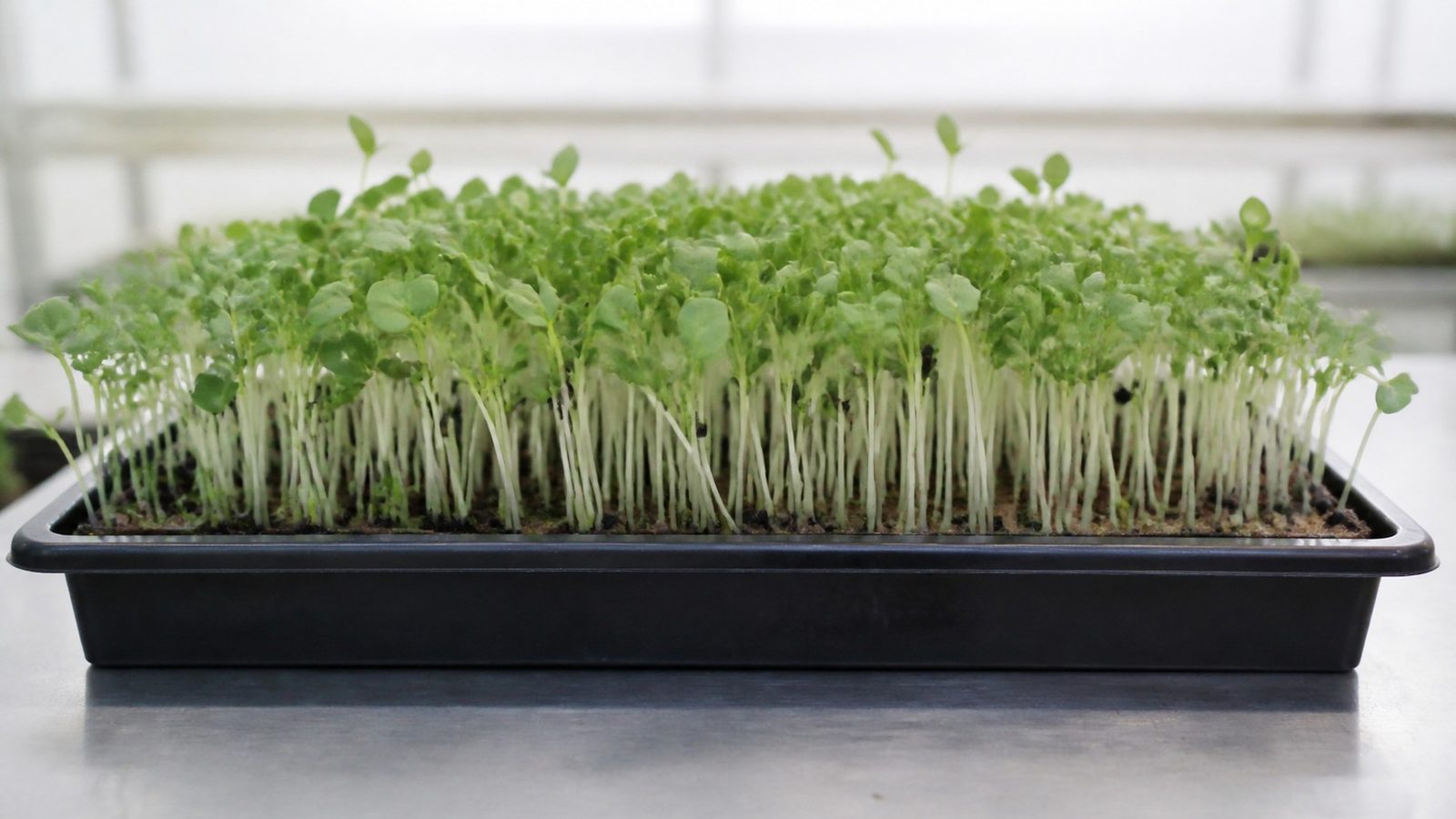
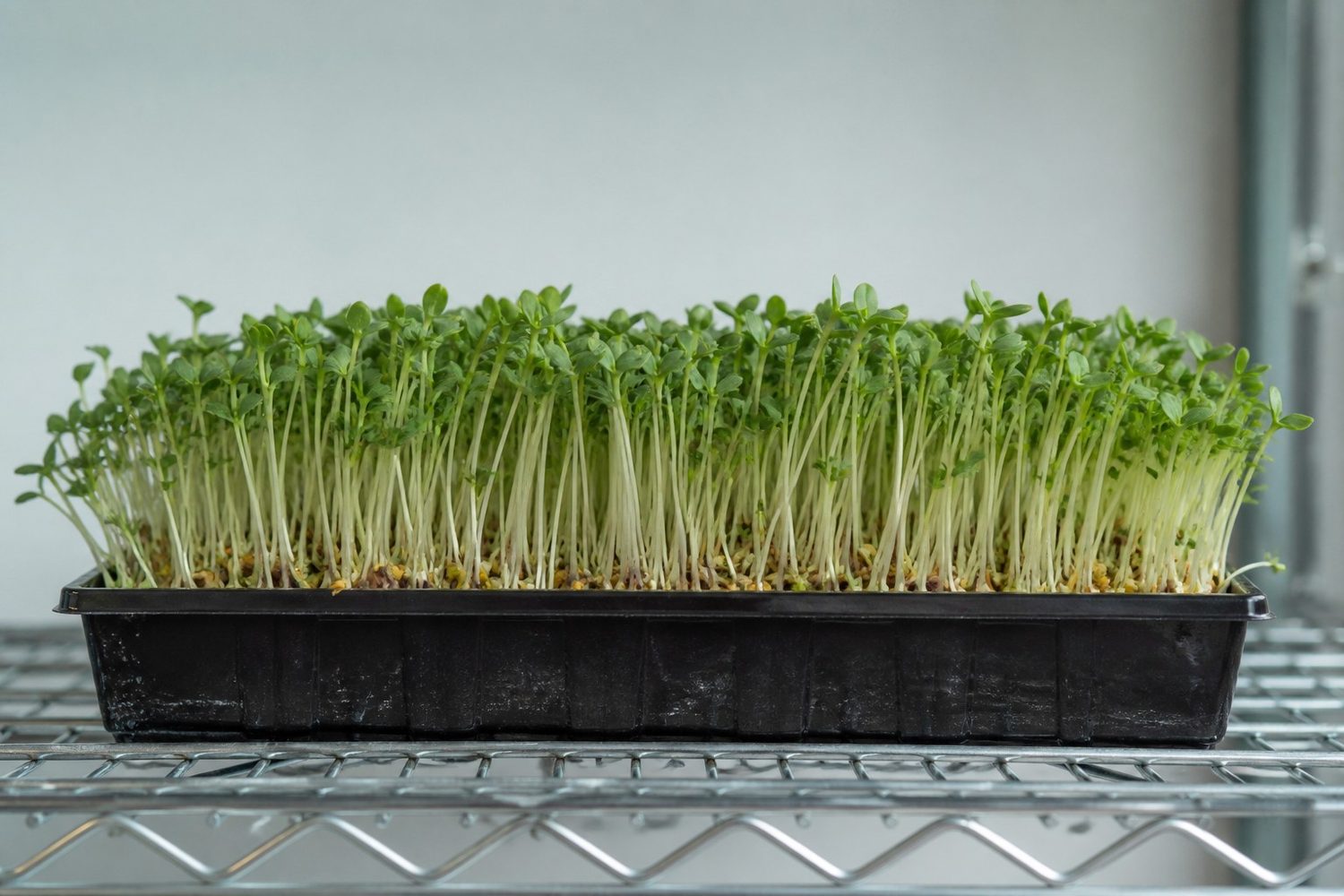
The only measured description of a finished tray comes from a controlled study of black sesame, which harvested on day 8 at fully developed cotyledons with one to two true leaves, after three dark days and five in light. The one supplier visual is green leaves on white stems.
Beyond that, nobody has described what a finished sesame tray looks like. No confirmed harvest photograph turned up in any source, so stem thickness, cut height, stand evenness and whether seed coats stay visible at the medium are all unverified, and there is no documented crop that sesame gets mistaken for. Photograph your own first tray at the cut, because it will be better evidence than anything you can look up.
Color is the one buying variable with any evidence behind it, and the sources split. A home-growing guide from a public library service specifically directs growers to buff or beige sesame rather than black. The controlled study grew black sesame successfully under its own soak-and-sterilize protocol. Both can be true: black works under a defined method, and beige is the safer default for someone without one.
What it tastes like, and what to do with it
The sources disagree, and the disagreement is the finding. One supplier calls sesame microgreens mildly sweet and subtle. Another calls brown sesame spicy. A third source, the only one that makes a direct eating-quality comparison, says sesame is a rare microgreen that tastes better cooked.
Those cannot all describe the same experience, and nothing opened reconciles them. Seed color, lot and growing method all differ across the three.
So, the honest use is a small-volume addition to a dish rather than a salad base: a finish on a stir-fry, a warm rice or noodle bowl, an Asian-style plate. That is what the supplier that markets it fresh actually markets it for, and it is compatible with the guide that prefers it cooked.
Very few microgreens are worth cooking at all. Buckwheat and pea shoots take heat, and sesame is the rare case where a source actually prefers it cooked rather than merely allowing it.
Taste your own lot before you sell a large raw pack. With one supplier saying mild and another saying spicy, that is not a formality.
The allergen question, and what it means for a seller
Sesame became the ninth major food allergen recognized in the United States under the FASTER Act, signed 23 April 2021, and all FDA major-allergen requirements including labeling applied to it from 1 January 2023. The nine are milk, egg, fish, crustacean shellfish, tree nuts, wheat, peanuts, soybeans and sesame.
Very few tray crops are on that list at all. Wheatgrass is Triticum aestivum, so wheat is the other one, but sesame is the case where the allergenic material is the seed sitting in the tray with the crop you cut.
Three things follow from that.
One, the seed is unambiguously the allergen. You sow sesame seed, the seed coat is present in the tray, and hull carryover into the cut is unmeasured on this crop.
Two, a grower selling this is selling a sesame product. Label it. Anyone packing microgreens for a market stall, a restaurant or a box scheme should treat a sesame tray the way they would treat anything else containing sesame, and should not assume that "it is a green now" changes the answer.
Three, nobody has tested whether an eight-day shoot still carries the allergenic proteins. No source measures it, in either direction. What is settled is that the seed it grows from is a declared allergen and that the labeling obligation on packaged food is real and dated. So, until somebody publishes otherwise, treat this crop as sesame, and tell a customer with a sesame allergy the same thing. The same open question hangs over wheatgrass and is equally unanswered.
Growing it: only what differs from the standard method
The schedule is the least interesting thing about this crop, which is a compliment.
Soak or do not: both are documented. The controlled study soaked for six hours at 21C, adding 200 mg/L sodium hypochlorite in the sixth hour as a surface sterilant, then germinated overnight at 24C. A supplier says plainly: pre-soak, no. Nothing tests anything between or outside those two, so treat six hours as a method that worked once and zero as a method a seller stands behind, and pick one rather than splitting the difference.
Surface sow and do not bury it. The seller says spread it and cover only thinly; general extension guidance for small seed is to press it into saturated medium rather than bury it.
Three days dark, then five in light. The study held darkness until the hypocotyl reached 5 to 10 cm. It reports no stacking and no weight, so no load is recommended here.
One thing worth knowing about the study before copying it: the black sesame was grown on Kinocloth, not in a 1020 soil tray. The schedule transfers; the substrate is not what most readers will use, and no source compares the two.
What goes wrong with sesame specifically
The first failure happens at the checkout, not in the tray. Toasted seed and hulled seed do not germinate, and both are sold in the same aisle as raw unhulled seed, often by the same brand. A seller's own sesame-microgreen listing carries a customer review reporting no germination at all. When a sesame tray does nothing, the seed is the first suspect and usually the right one.
Then damping-off, on general evidence rather than sesame evidence. The three-day moist dark phase is the exposure. Before emergence the pathogens kill the seed; after emergence it shows as rot at or below the medium line and collapsed seedlings, associated with Pythium and Rhizoctonia in damp conditions. Affected seedlings do not recover; the rest of the tray can sometimes be saved by correcting moisture and airflow.
There is no sesame-specific description of root hair or mold to work from, so use the narrower rule from the general pathology instead: if a tray shows collapse or rot at the medium line, treat it as disease rather than as harmless root hair.
Lot and color mismatch is the quiet one. Buying generic "sesame" and following a guide written for a different color under a different protocol produces a crop that does not match the expectation, and the grower blames the method. Counted germination test, then one pilot tray, then production.
Nutrition: the one thing that is actually measured
This is the reversal on this crop. Sesame has almost no production data and an unusually complete nutrient panel, from a controlled study that grew black sesame in duplicate trays and harvested on day 8.
Per 100 g fresh weight it reported 25.69 kcal, carbohydrate 3.58 g, protein 1.92 g, fat 0.41 g and moisture 93.75 g, plus chlorophyll 37.85 mg, carotenoids 9.56 mg, total phenolics 49.03 mg GAE, ascorbic acid 6.84 mg and DPPH antioxidant activity of 33.44 mM TEAC/g.
The ascorbic acid figure is the one worth reading twice: 6.84 mg was the lowest of the fourteen crops that study measured. Sesame is not a vitamin C crop, and the study that likes it says so.
USDA FoodData Central has no sesame microgreen record, searched 8 August 2026. That absence matters here more than usual, because mature sesame seed has a famous nutrient profile and it is the obvious thing to borrow. Do not. A 94 percent water, 25 kcal shoot is not a seed that is half fat.
The health claims attached to this crop are unsupported as written. Claims that sesame microgreens lower cholesterol, reduce inflammation, improve bone health or balance hormones appear on a supplier page with no study behind them, and no opened human study on sesame microgreens exists. "High in vitamin E, calcium and protein" is a sentence about the seed.
Which seed to buy
Three words do the work: organic, raw, unhulled.
Raw unhulled sesame seed on Amazon is scoped to exactly that, and it still is not sufficient, which is the point. On that query on 9 August 2026, 58 of 60 tiles were sesame and about a third of them were disqualified by their own titles: 10 toasted or roasted, 10 hulled. Read the title. The search will not do it for you.
Prices on that day, all organic, all raw and unhulled: a 2 lb bag at $16.99 ($8.50 a pound) and another at $17.49, a 1 lb bag at $13.27, black at $17.99 for 2 lb, and a 6 lb three-pack at $34.99, which is $5.83 a pound and the cheapest raw unhulled seed found.
Beyond the three words: specify untreated, food-use seed with a stated color and lot, and refuse dyed, fungicide-treated or insecticide-treated field seed, because those treatments can end up in a shoot you eat. Prefer buff or beige over black unless you are reproducing the study's protocol.
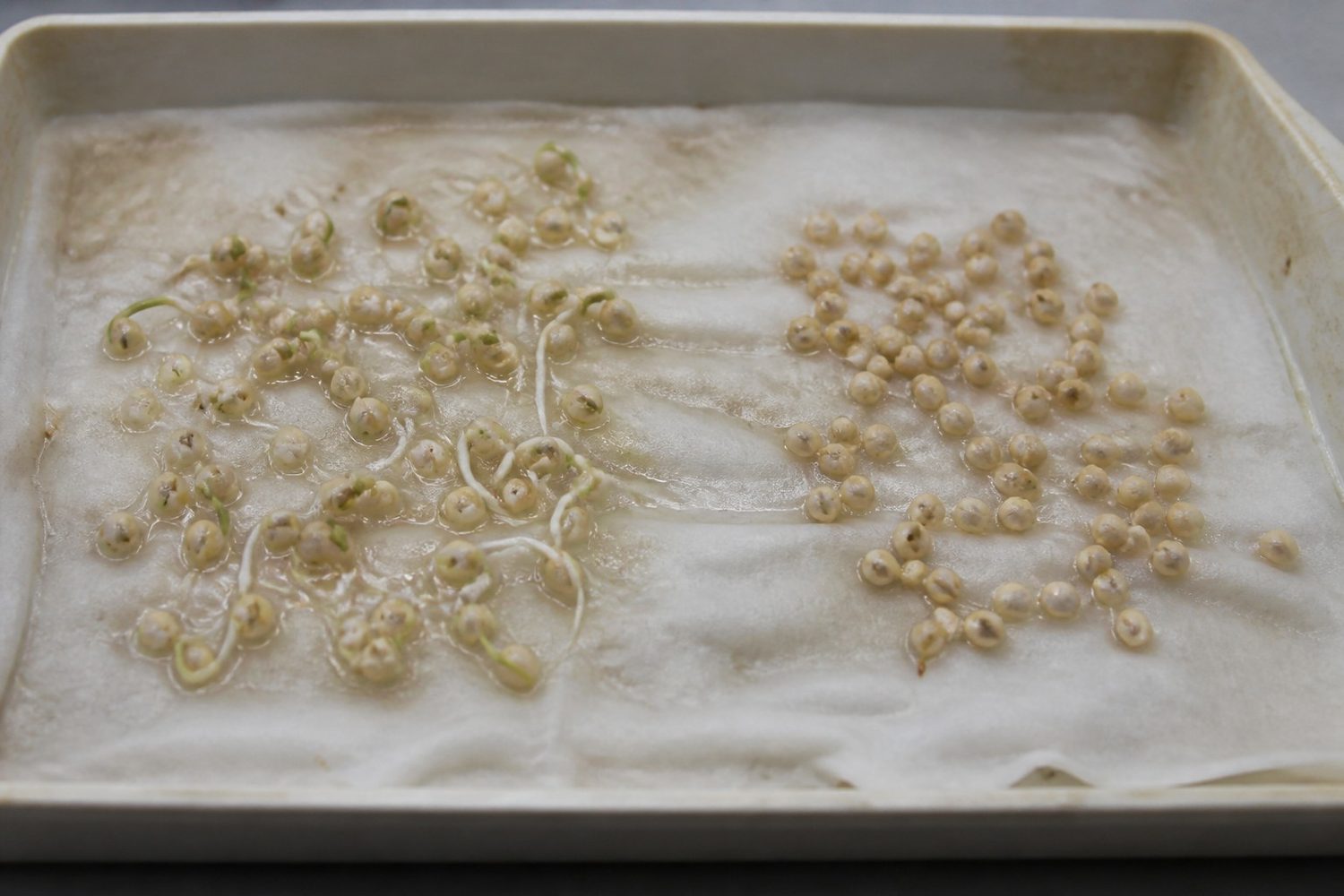
Then test it. A counted germination test on damp paper towel costs nothing and settles in a few days the one question the marketplace refuses to answer.
Is it worth growing?
Grow it if you want an unusual eight-day specialty green with a genuine story, you are willing to buy carefully and pilot a lot, and you can label it properly.
Do not grow it to sell by weight. There is no seeding rate, no yield, no shelf life and no harvest window for this crop anywhere. A grower who wants a predictable 8-to-10-day tray should take broccoli, which Johnny's measured at 13 g of seed, 11.5 oz of yield and 12.5 days. That is a production comparison, not a claim that they taste alike.
For a one-tray home grower it is a good experiment and a bad staple.
A note on the numbers above
Hover or tap a row to highlight it.
| Figure | Value | Source | What kind of number it is |
|---|---|---|---|
| Days to harvest | 8 | A controlled 2021 study, black sesame | Measured, at full cotyledons with 1 to 2 true leaves |
| Days to harvest | 8 to 10 | A microgreen seed supplier | Stated flat, no temperature and no leaf stage |
| Days to harvest | 5 to 7 | A second supplier, brown sesame | Stated flat, and it disagrees with the first |
| Soak | 6 h at 21C, hypochlorite in hour 6 | The 2021 study | An experimental protocol, with no endpoints tested |
| Soak | None | A microgreen seed supplier | The opposite instruction, from a seller |
| Blackout | 3 days, to a 5 to 10 cm hypocotyl | The 2021 study | Measured. No stacking or weight reported |
| Germination temperature | 24 +/- 1C overnight | The 2021 study | One experiment's condition, not a tested optimum |
| Calories | 25.69 kcal per 100 g fresh | The 2021 study | Measured, duplicate trays, day 8 |
| Protein | 1.92 g per 100 g fresh | The 2021 study | Measured |
| Ascorbic acid | 6.84 mg per 100 g fresh | The 2021 study | Measured, and the lowest of its 14 crops |
| Total phenolics | 49.03 mg GAE per 100 g fresh | The 2021 study | Measured |
| Seed rate | No figure exists | Every source opened | Not a conversion problem. Nobody states a mass |
| Yield | No figure exists | Johnny's 29-variety trial | Sesame is not in the trial |
| Fresh-weight panel | No FDC record | USDA FoodData Central, searched 8 August 2026 | An absence, confirmed rather than assumed |
| Major allergen status | Ninth, from 1 January 2023 | FDA, FASTER Act | Regulation, not a measurement |
| Crop | Seed per 1020 | Yield | Days | Cost per tray | Oz per $1 | Oz per tray-day |
|---|---|---|---|---|---|---|
| Sesame | No published figure | No published figure | 5 to 10 | no rate to price | cannot be calculated | cannot be calculated |
A blank means nobody has published that figure, so the cell is left empty rather than filled with an estimate. How the numbers work
All 62 crops, sortable, on the microgreen comparison.
Almost every production number on this crop is missing, which is the odd thing about it. The gap is not that nobody has looked at sesame. A peer-reviewed study measured ten things about the plant and not one thing about the tray it came off. If you want a crop you can plan on paper, sesame belongs with cucumber, cauliflower and collard in the group you have to trial instead.
And the missing seed rate is a genuine absence rather than a unit problem. On quinoa and purslane a rate exists for a smaller tray and has to be scaled. Sesame has no rate at any tray size, from any source, including the study that published a full protocol. It gave the tray dimensions, the temperature, the humidity, the light schedule and the substrate, and never said how much seed went in. So, weigh what you sow on the first tray and you will immediately know more than the published record does.
The mold risk is left blank on purpose. Low, Medium and High are comparative words, and nothing compares sesame's tray losses against any other crop, the same position cucumber and collard are in. Watch the three-day moist dark phase closely rather than assuming it behaves like a brassica.
Terms on this page
Tap a term to see what it means.
*Sesamum indicum*. Sesame, the crop on this page. The only Pedaliaceae grown as a microgreen, so no other crop's habits transfer to it.
Sources
- Kowitcharoen et al., 2021, nutritional profile of 14 microgreen species - the only controlled sesame-microgreen study opened. Black sesame, duplicate trays, 6 h soak, 3 dark and 5 light days, day-8 harvest, full nutrient panel.
- Sesame microgreen seeds, AllThatGrows - 8 to 10 days, no pre-soak, mild and sweet, and the source of the unsupported health claims this page rejects.
- Brown sesame for sprouting, VASKHNIL - 5 to 7 days, described as spicy and sold for fresh use.
- Black sesame microgreen seeds, Sow Rich - one of the color types actually sold.
- Microgreens at home, Greenville County Library System - directs growers to buff or beige rather than black, and is the one source that says sesame tastes better cooked.
- The FASTER Act: Sesame Is the Ninth Major Food Allergen, FDA - signed 23 April 2021, all major-allergen requirements applying from 1 January 2023.
- Johnny's microgreen yield trial summary and the trial tech sheet - 29 varieties, and sesame is not among them. Source of the broccoli comparison.
- USDA FoodData Central - searched 8 August 2026, no sesame microgreen record.
- Damping-off, UC IPM - the Pythium and Rhizoctonia complex, and the rot-at-the-medium-line signature.
- Growing microgreens at home, SDSU Extension - general method, and the untreated-seed requirement for a crop whose shoot is eaten.
- Microgreens production, Virginia Cooperative Extension - general room conditions, explicitly not used as sesame germination evidence.
- Amazon listings for organic raw unhulled sesame seed, titles and prices read 9 August 2026.
Keep reading
The variety directory
Buckwheat microgreens
Buckwheat keeps 21 days refrigerated, the longest shelf life measured for any microgreen, and has no measured tray yield at all. It is also the one crop where buying the wrong seed means nothing germinates.
Read Buckwheat microgreensThe variety directory
Pea shoots
Pea shoots are the easiest microgreen to start and one of the easiest to lose. Sourced figures for seed rate, days, yield and cost, plus the wet-seed failure that actually kills trays.
Read Pea shootsThe variety directory
Beet microgreens
Generic red beet, the cheaper and less uniform sibling of Bull's Blood. Its seed is a multi-seed cluster, several shoots from one point are normal, and it has no measured yield of its own.
Read Beet microgreensThe variety directory
Fenugreek microgreens
Methi as a tray crop: about 4 oz in 8 days, a two to three day flavor window before it turns bitter, and a published yield figure in circulation that is wrong by a factor of eight.
Read Fenugreek microgreens