At a glance
The seed is a hard multi-seed cluster that emerges over three to four days rather than as an even carpet, and the four to five day stack that fixes contact also leaves a long wet window.
- Botanical name
- Beta vulgaris
- Also sold as
- Beet, Red Leaf Organic Microgreen Seed, Red beet microgreen seed
- Family
- amaranth
- Difficulty
- Moderate
- Days to harvest
- 10 to 14 days
- Harvest window
- No published figure
- Seed per 1020 tray
- 20 to 30 g
- Soak
- 4 to 8 hours
- Blackout
- 4 to 5 days
- Germination temperature
- 65 to 85 °F
- Yield per 1020 tray
- No published figure
- Regrows after cutting
- No published figure
- Mold risk
- Medium
- Hull shedding
- some
- Shelf life
- No published figure
- Eaten as
- raw
- Seed cost per tray
- $2.30
30 g at $34.80/lb, Johnny's Red Leaf organic beet microgreen seed, listed 2026-08-08 and shown OUT OF STOCK. $1.53 at the 20 g end. Seed only, excludes medium, tray, labor, light and loss.
Any field name above ranks every variety by it. No published figure means we researched it and nobody has established one, which is different from not yet researched. Every figure here is sourced at the bottom of the page. Compare every variety side by side.
Generic red beet is sold as Red Leaf, and it is not the same product as bull's blood beet even though both are Beta vulgaris. Bull's Blood is a selection bred for consistently deep burgundy leaves and stems. Red Leaf is the cheaper, less uniform one, red-and-green with pink undersides.
Keeping them apart matters more than it sounds, because the trade's one published yield trial has a Bull's Blood row and no generic red beet row. So, the 7.5 ounces a tray you will see quoted for "beet microgreens" is a named cultivar's figure attached to a different bag of seed. If you are planning on it, weigh your own trays instead.
The one thing every beet grower should know before sowing: what you are handling is not a seed.
What growers are saying right now
Sampled from public posts and videos, 9 July to 8 August 2026. Every line links what it is quoting. How often something is repeated is not evidence that it is true, so every line also says what the sources actually establish.
Beet seed clusters can be separated for individual planting
Circulating A grower sharing five beet tips, aimed at garden rows rather than trays
Correct, and it is the single most useful fact about this crop in a tray too. A beet "seed" is a lumpy multi-seed cluster and several seedlings can come up from one point. In a microgreen tray that means clumped shoots are NORMAL, not a bad lot, and it is the reason beet needs wider spacing and a longer stack than a fine brassica. What that changes
Beets taste like dirt, in my opinion
Circulating Said plainly by somebody who takes them as a supplement instead
A fair warning, and the seedling does not escape it. The microgreen is milder than the root, but it is earthy and one extension review describes beet microgreens simply as sour. If the earthy note is what you dislike about beets, the seedling does not fix it. What it tastes like
Do not throw away store-bought beet tops, root them in water and keep harvesting
Circulating A kitchen regrowing tip that circulates constantly
A real technique for a different thing. That regrows a mature root's leaves, which are beet greens, not a microgreen: no red cotyledon stand, no tray, no cut at the medium line. Worth doing on its own terms, and it is not what this page is about.
Why beet microgreens stand out
Circulating A microgreen farm's own pitch for the crop
They stand out on color, and the numbers agree that color is what you are buying. Beet is slower than a brassica, costs more per tray than most, and has no published yield, so if the red stem is not the reason for growing it there is not a second reason. What it costs
What it is, and how to tell you grew it right
Beet microgreens are seedlings of Beta vulgaris, the garden beet, in the amaranth family alongside amaranth, spinach and Swiss chard.
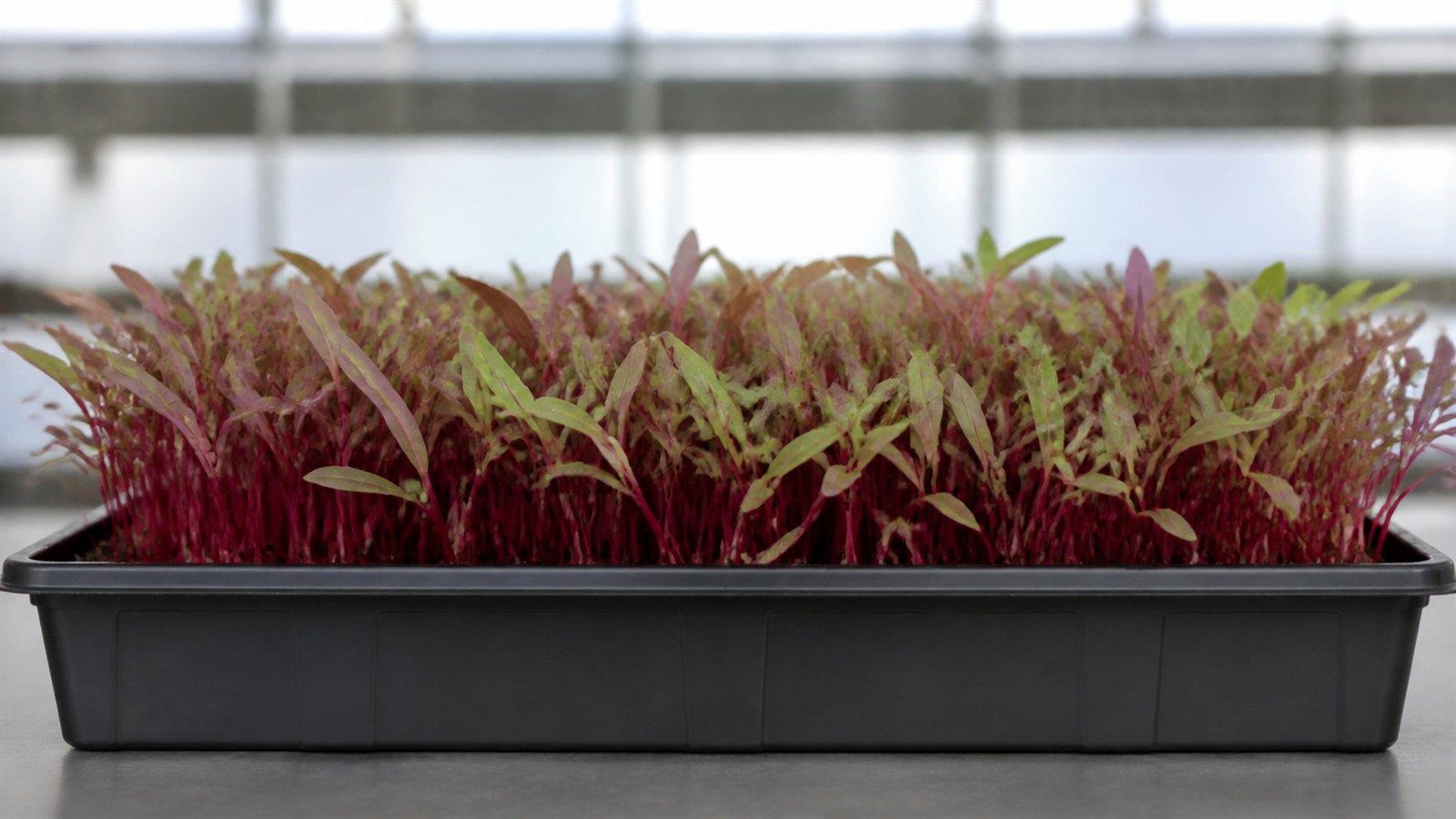
A correct Red Leaf tray is a dense but visibly separated stand of slender red stems carrying small rounded to oval cotyledons that are green with a red blush and pink, faintly shimmery undersides. The surface should be filled with upright shoots and free of bare waterlogged patches. If true leaves are allowed to develop they come green with red veins. No source publishes a harvest height for this crop, so judge it on the stand rather than a ruler.
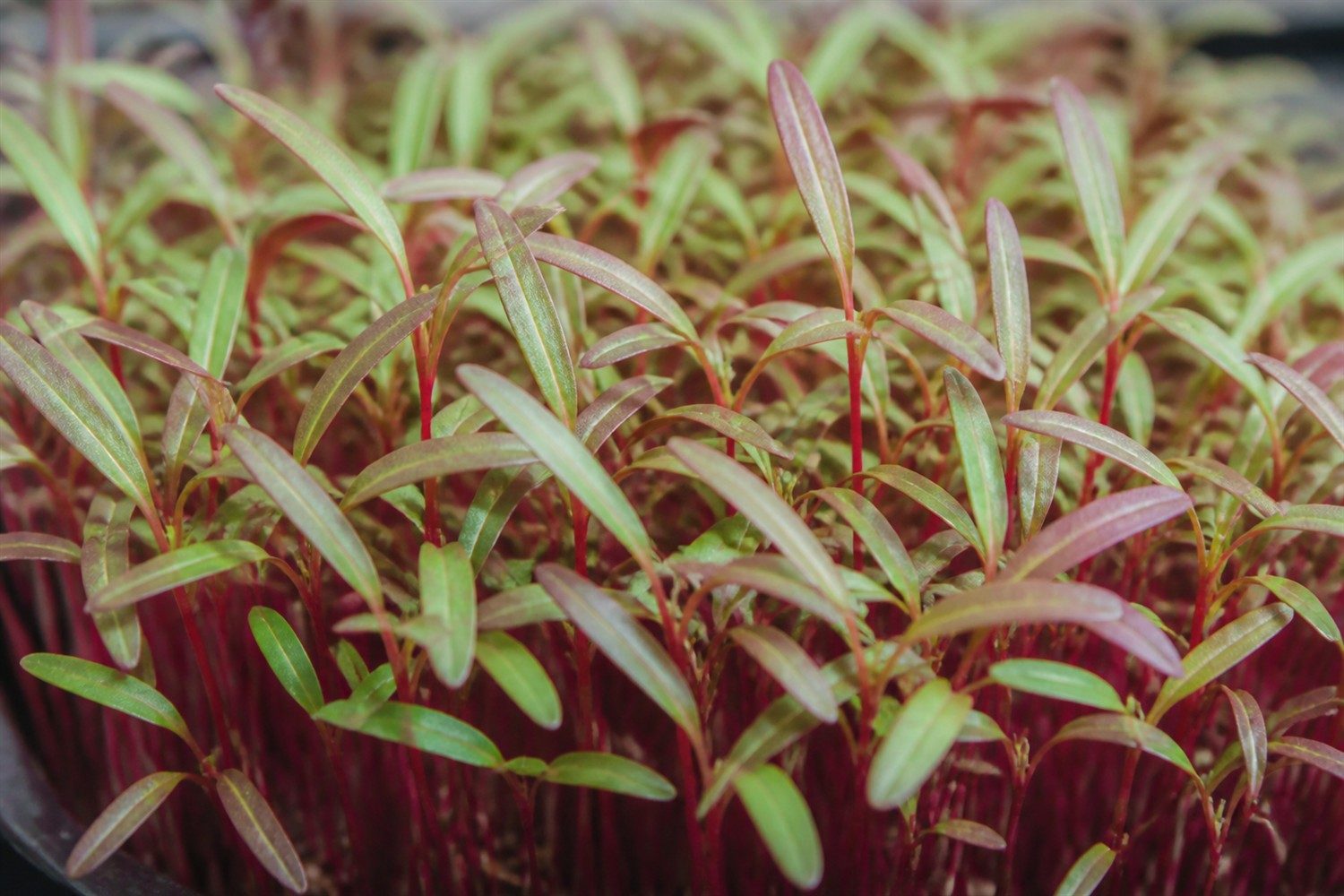
The confusion is with red Swiss chard and with Bull's Blood, and the tell between the two beets is the canopy rather than the stems. Red Leaf reads red-and-dark-green with pink undersides; Bull's Blood reads much more uniformly deep burgundy. Stem color alone will not separate them, because both have red stems.
What it tastes like, and what to do with it
Tender, earthy beet with a spinach note and a mild sweet edge. It is not radish heat and it is not neutral. One extension review of microgreen flavors describes beet simply as sour, which is blunter than a supplier will put it and matches what people who dislike beets actually complain about.
Use it where a tender red stem adds color without adding heat: a composed salad, avocado toast, an open sandwich, a grain bowl, a cold soup, or as a finish on fish or roasted vegetables. Add it after cooking rather than into the pan, because the red is the product and heat destroys the look you paid for.
It is a poor bulk salad base. The tray costs more and grows more slowly than a brassica, and the earthy note that reads well as a garnish gets heavy in a large handful. And be careful who you sell it to: people who dislike mature beet's soil-like taste will not be won over by a smaller version of it.
Growing it: only what differs from the standard method
Everything general about trays, medium, light and watering is on the standard tray method for growing microgreens. Beet's deltas all trace back to the cluster.
The seed is a multi-seed cluster, not a seed. It is hard, lumpy and irregular, and several seedlings can emerge from one point. Two consequences follow. First, sow it wider than instinct suggests, because each cluster is potentially several plants. Second, and more usefully: clumped shoots and uneven spacing are normal on beet. New growers read that as a bad lot and oversow the next tray, which is precisely the wrong correction.
Soak 4 to 8 hours in cold water. The hard clusters imbibe slowly and a soak evens out emergence. The source says cold and gives no number, so nobody should be quoting you a water temperature. Longer than 8 hours is not established as beneficial and adds wet-seed risk.
Stack 4 to 5 days, two days longer than a brassica. This is the crop's clearest measurable difference: broccoli is listed at 2 to 3 days stacked, beet at 4 to 5. The weight is doing contact work against an irregular cluster rather than blanching stems. Take it off when most shoots have emerged and are pushing the cover, not on a clock, because a cool tray may not be finished. No source specifies pounds for beet, so use enough for firm contact and no more.
A thin cover and a light tamp are acceptable here. Beet is one of the few crops where a very light covering of medium is crop-specific advice rather than a bad habit, because it helps the cluster hold contact and reduces caps stuck on the cotyledons.
Then bottom water and give it air. After emergence keep water off the stems and cotyledons. Nobody publishes a beet-specific light level, water volume or fan speed, so use the general 60 to 70F and 50 to 70 percent humidity with airflow, and treat a precise beet-specific figure from anywhere as unsourced.
A beet tray, day by day
- 1
Day 0, soak
4 to 8 hours in cold water. The clusters are hard and slow, and this is what makes emergence even.
- 2
Day 0, sow wide
20 to 30 g spread evenly on leveled medium, pressed for contact. A thin cover and a light tamp are fine on this crop.
- 3
Days 1 to 5, stacked
4 to 5 days weighted, two more than a brassica. Emergence itself takes 3 to 4 days, so the extra time is doing real work.
- 4
Uncover on emergence
Off when most shoots are up and pushing the cover. Expect several shoots from single points; that is the cluster, not a fault.
- 5
Days 10 to 14, cut
The generic red beet cotyledon cut. Bull's Blood at first true leaf is a longer crop, about 16.5 days in the trade's trial, and a different product.
What goes wrong with beet specifically
Before emergence, uneven hydration and seed rot. Dry clusters sitting beside saturated ones, or no radicle in the wettest spots. The cause is the irregular cluster plus too much standing moisture. Isolated gaps can be reseeded; a broadly sour tray is a discard.
At emergence, damping-off. Water-soaked or discolored stem bases, seedlings tipping at the medium, or cottony growth. Beet has two named seedling pathogens beyond the usual complex, Aphanomyces cochlioides and Phoma betae, which is unusual for a microgreen crop and is worth knowing when you are deciding whether to salvage. A few affected plants can be pulled and the moisture corrected. A spreading collapse is not a saleable tray.
At cotyledon stage, retained caps. The cluster clings to the cotyledons, especially where contact was poor or the tray came out of the stack early. Mostly cosmetic and mostly fixable on the next tray with better contact and the thin cover, rather than by repeatedly wetting the foliage to soften them.
Held too long, a coarser and less even crop. True leaves expand above the cotyledon canopy and the uniform garnish you were growing becomes a small salad green. Still edible, no longer the product.
Clumped shoots on beet: normal, or a bad lot?
Hover or tap a card to highlight it.
Normal
Several shoots emerging from ONE point, scattered across an otherwise even tray. That is the multi-seed cluster doing what it does, and it is not a defect.
Normal
Emergence spread over three to four days rather than arriving all at once. Beet does not come up like a brassica.
Suspect the lot
A broad pattern of delayed or absent emergence across a tray that was correctly moist and correctly warm. That is a lot problem, not a cluster quirk.
Suspect the handling
Dry clusters next to saturated ones, or caps stuck on most cotyledons. Both are contact and moisture, not seed.
The test
A small side-by-side germination check on delivery. On a clustered seed it is worth more than on any other crop here, because the normal appearance of beet hides the failure mode.
Nutrition, and what is actually established
There is no USDA record. FoodData Central was searched for the exact phrase "beet microgreens" on 2026-08-08 with Require All Words selected and returned zero results across Foundation, SR Legacy, Survey, Experimental and Branded foods. Mature beet and beet-green entries are not substitutes.
There is real published work, and it is cultivar-specific. A 2012 analysis of commercially grown microgreens assayed Bull's Blood and a separate red beet sample as fresh tissue from an unheated greenhouse. For Bull's Blood it reported vitamin K1 at 2.0 micrograms per gram fresh weight, beta-carotene at 5.3 mg per 100 g, and lutein and zeaxanthin at 4.3 mg per 100 g. A later study profiled red beet microgreens stored at 4C for 10 days, annotating 316 compounds and tracking polyphenol and betalain changes with antioxidant assays.
Both are measurements of specific samples, not a nutrition panel. And the claim you will meet most often, that beet microgreens contain some multiple of mature beet's nutrition, is not supported by any beet-specific comparison with matching cultivar, growing conditions, harvest stage and nutrient basis. Nobody has run that comparison. What can be said is narrower and still worth something: named samples contained measured amounts of specific nutrients, and the results vary by cultivar and study.
Which seed to buy
The choice here is genuinely simple, because it is a choice between two things.
Red Leaf is the economical generic red beet: red stems, red and dark green cotyledons with pink undersides, tender and earthy, and explicitly less dark and less uniform than the alternative. Bull's Blood is the selection, with consistently deeper burgundy leaves and stems and its own page here. Neither supplier page offers a comparable yield claim, so the difference you are paying for is color uniformity and nothing else is warranted.
Buy the one that matches what you are selling. A chef paying for burgundy wants Bull's Blood and will notice the substitution. A home grower who likes red stems and green leaves is better off with Red Leaf and the lower price. What nobody should do is buy generic red beet and then plan against Bull's Blood's numbers, which is the mistake this crop invites.
There is no /go/ seed link on this page, deliberately. The bull's blood beet entry already carries one, and its own affiliate note records that the same search returns generic beet microgreen seed mixed in with the named cultivar. Adding a second link to substantially the same set of results would be duplicating a recommendation rather than adding one, and a reader coming here specifically to tell the two cultivars apart is not helped by a search that blurs them. Buy Red Leaf by name from a seed house that lists the cultivar.
Specify seed sold for edible microgreen production, name the cultivar, and require untreated status. Refuse dyed or chemically treated field seed, because the shoots are eaten and treatment materials can be present in them.
A bad lot is delayed or absent emergence across a correctly hydrated, correctly warm tray. It is NOT several seedlings from one point. At the current price and rate a failed tray wastes $1.53 to $2.30 of seed before medium, labor, space and the missed sale, and one supplier's Red Leaf listing was showing out of stock on the day this page was written, which is worth planning around.
Is it worth growing?
Yes, if you are selling the color and you accept a slower tray.
It suits a chef or market grower who wants a red stem in a mix or on a plate and can measure their own yield rather than assuming a cultivar figure that was not measured on their seed. It suits a home grower who likes earthy beet flavor and does not mind a four to five day stack. Its real appeal is that a red-stemmed tender green is genuinely hard to substitute.
Do not make it a first tray. The longer stack, the uneven cluster emergence and the narrower moisture margin are all real, and a beginner learns more from a crop that comes up in one go. Do not plan revenue from it without weighing your own trays, because the number you would otherwise be planning from belongs to a different cultivar.
Its rivals are red Swiss chard and its own sibling. Bull's Blood wins whenever a uniformly burgundy canopy is the specification. Red Leaf wins on seed economy and when a red-and-green look with pink undersides is acceptable or preferred. A fast brassica wins outright whenever the constraint is turnover: broccoli runs 8 to 12 days with 2 to 3 stacked against beet's 10 to 14 with 4 to 5.
A note on the numbers above
Hover or tap a row to highlight it.
| Figure | Value | Source | What kind of number it is |
|---|---|---|---|
| Days to harvest | 10 to 14 | A grower crop sheet | Generic red beet, day 10 called ideal. Temperature unstated |
| Days to harvest | 16.5 | Johnny's 2017 trial | BULL'S BLOOD, at first true leaf. A different cultivar and a different stage |
| Seed per 1020 | 20 to 30 g | The same grower crop sheet | The only generic red beet rate opened. Assumes soil and a 4 to 5 day stack |
| Seed per 1020 | 23 g | Johnny's 2017 trial | Bull's Blood again, not this crop |
| Yield per 1020 | No figure | Nobody | There is no generic red beet row in the trial |
| Yield per 1020 | 7.5 oz | Johnny's 2017 trial | Bull's Blood, from 23 g, at first true leaf |
| Soak | 4 to 8 hours, cold | A grower crop sheet | "Cold" is the only temperature stated |
| Blackout | 4 to 5 days stacked | The same sheet | Against 2 to 3 for broccoli. No weight in pounds is published |
| Germination temperature | 65 to 85F optimum, 40 to 95F viable | UC seed germination table | Real beet SEED data. About 42 days to emerge at 41F |
| Storage | 10 days at 4C | A metabolomics study | Held for biochemical measurement. Not a sensory shelf-life result |
| Harvest window | No figure | Nobody | Nobody has established it |
| Regrows | No figure | Nobody | No cut-and-regrow trial exists for beet microgreens |
| Seed price | $34.80/lb | Johnny's Red Leaf, listed 2026-08-08 | A real current price, shown out of stock |
| Vitamin K1 | 2.0 micrograms/g fresh | 2012 analysis | BULL'S BLOOD sample, greenhouse grown |
| Nutrition, USDA | No record | USDA FoodData Central | Searched 2026-08-08, zero results in all datasets |
Two figures are worth carrying into any crop decision, and neither one is the crop people name. Sunflower, not radish, turns a bench over fastest, at about 1.79 ounces per tray-day against radish's 1.21, and that holds anywhere in sunflower's published 9 to 12 day range. And mizuna, not broccoli, is the best value per dollar of seed, at about 25 ounces per dollar against broccoli's 14.5, with arugula second at 20.8.
Read the per-tray-day figures as approximate. Some crops are averaged from a trial's own day count and others from the midpoint of a published range, so they are comparable in the broad sense rather than to the second decimal.
Hover or tap a row to highlight it.
| Crop | Seed per 1020 | Yield | Days | Cost per tray | Oz per $1 | Oz per tray-day |
|---|---|---|---|---|---|---|
| Amaranth | 7.5 g | 6.5 oz | 11 to 18 | $1.10 | 5.9 | 0.45 |
| Spinach, Winter Giant | 60 g | 7.2 oz | 18.0 | $2.52 | 2.9 | 0.40 |
| Celosia | 8 g | 3.4 oz, one tray | 13 | $1.06 | 3.2 | 0.26 |
| Beet, Red Leaf | 20 to 30 g | No published figure | 10 to 14 | $1.53 to $2.30 | cannot be calculated | cannot be calculated |
| Quinoa | No published figure | No published figure | 7 to 14 | no rate to price | cannot be calculated | cannot be calculated |
A blank means nobody has published that figure, so the cell is left empty rather than filled with an estimate. How the numbers work
All 62 crops, sortable, on the microgreen comparison.
Generic red beet cannot fill in that table, and its close relative can, which is exactly what makes it dangerous. Bull's Blood has real measured numbers and they are one row away. Same species, different cultivar, one measured and one not, so resist sliding the figures across.
Terms on this page
Tap a term to see what it means.
Seed cluster. What a beet "seed" actually is: a hard lumpy fruit containing several seeds. Several shoots from one point is normal, and mistaking it for a fault is the standard beet error.
Sources
- Johnny's Selected Seeds, Beet Red Leaf organic microgreen seed - Beta vulgaris, red stems with red and dark green cotyledons and pink undersides, described as less dark and less uniform than Bull's Blood, tender earthy flavor, and the $34.80/lb price behind the seed cost, listed and shown out of stock 2026-08-08.
- Johnny's Selected Seeds, Beet Bull's Blood organic microgreen seed - the selection with consistently deeper burgundy leaves and stems, earthy and spinach-like, and the 16 to 25 day range with 16.5 days to first true leaf in the trial.
- Bootstrap Farmer, microgreen crop sheet - generic red beet at 20 to 30 g per 1020, 10 to 14 days with day 10 ideal, 3 to 4 days to germinate, 4 to 5 days stacked against broccoli's 2 to 3, a 4 to 8 hour cold soak, soil rather than mat, and the thin cover and light tamp.
- Johnny's microgreens yield trial results (PDF) - the Bull's Blood row at 23 g and 7.5 oz at first true leaf, the absence of any generic red beet row, and the instruction to reduce density for a larger harvest stage.
- Johnny's yield trial, method and discussion - the warning that yield varies with procedure, system, conditions, harvest stage and seed lot, and that one grower's results will not translate perfectly to another's.
- UC Master Gardeners, beets - beet seeds as lumpy clusters from which several seedlings can germinate.
- UC Master Gardener, seed germination temperature and timing - beet at 40 to 95F viable with 65 to 85F optimum, about 42 days to emerge at 41F and roughly 4.6 to 6.2 days at 68 to 95F.
- University of Minnesota Extension, collapsed beet seedlings - Aphanomyces cochlioides and Phoma betae as named beet seedling pathogens, and the damping-off symptom pattern.
- UC IPM, damping-off - damp conditions favoring the disease, seed rot, and root-tip origin.
- Penn State Extension, growing microgreens at home - trays with drainage and bottom watering to keep water off the greens, soaking permitted for hard seed, weighting for larger seed, and the warning that washing may substantially reduce shelf life.
- Virginia Tech Extension SPES-756 (PDF) - the 60 to 70F and 50 to 70 percent humidity general range with airflow, the raw uses, and the description of beet microgreens as sour.
- Xiao et al., Journal of Agricultural and Food Chemistry, 2012 (PDF) - Bull's Blood and a separate red beet sample: vitamin K1 2.0 micrograms/g fresh, beta-carotene 5.3 mg/100 g, lutein and zeaxanthin 4.3 mg/100 g.
- Rocchetti et al., Food Chemistry - red beet microgreens held at 4C for 10 days, 316 compounds annotated, polyphenol and betalain changes and antioxidant assays.
- SDSU Extension, growing microgreens at home - seed treatment materials can be present in the shoots and should not be consumed.
- USDA FoodData Central - searched 2026-08-08 with Require All Words, zero results across all datasets.
Keep reading
The variety directory
Bull's Blood beet microgreens
Crimson stems under green cotyledons, 23 g of seed for 7.5 oz in 17 days, and one seed that is not one seed: beet is multigerm, which is why the tray behaves the way it does.
Read Bull's Blood beet microgreensThe variety directory
Amaranth microgreens
Red Garnet amaranth is the magenta garnish crop, and the trial numbers explain why it is a chef's crop rather than a grower's: 7.5 g of seed makes 6.5 oz in 17 days, against radish's 11 oz in nine.
Read Amaranth microgreensThe variety directory
Celosia microgreens
A color crop whose entire measured record is a single YouTube video: 8 g of seed, 3.4 oz, 13 days. Bought for pink and orange stems, never for weight.
Read Celosia microgreensThe variety directory
Fenugreek microgreens
Methi as a tray crop: about 4 oz in 8 days, a two to three day flavor window before it turns bitter, and a published yield figure in circulation that is wrong by a factor of eight.
Read Fenugreek microgreens