At a glance
One trait drives it: seed small enough to fall through a 1.2 mm reusable mat, so it clumps unless spread carefully, and the documented consequence of clumping is blocked airflow and mold.
- Botanical name
- Celosia argentea
- Also sold as
- Celosia Microgreen Seed, Celosia argentea plumosa, Celosia
- Family
- amaranth
- Difficulty
- Moderate
- Days to harvest
- 10 to 15 days
- Harvest window
- No published figure
- Soak
- None
- Blackout
- 4 to 5 days
- Germination temperature
- 65 to 75 °F
- Yield per 1020 tray
- 3.4 oz
- Regrows after cutting
- No published figure
- Mold risk
- Medium
- Hull shedding
- none
- Shelf life
- 5 to 10 days
- Eaten as
- raw
- Seed cost per tray
- $1.06
8 g at $60.20/lb, Johnny's celosia microgreen seed, listed 2026-08-08. The 8 g rate is one operator's filmed protocol, not a supplier or trial rate. Seed only, excludes medium, tray, labor, light and loss.
Any field name above ranks every variety by it. No published figure means we researched it and nobody has established one, which is different from not yet researched. Every figure here is sourced at the bottom of the page. Compare every variety side by side.
Celosia is a color crop. Narrow bright green leaves on fine stems shot through with pink, orange and yellow, mild and earthy to eat, and grown almost entirely because of how it looks on a plate.
It also has less evidence behind it than almost any microgreen, and you should know that before you plan around a number. Every tray figure below, the 8 grams of seed, the 3.4 ounces, the 13 days, the 10 pounds of weight, comes from one grower's filmed protocol on one tray. Not a trial, not replicated, no stated harvest-stage definition. Celosia is absent from the trade's 29-variety yield trial, so that single video is effectively the entire measured record. Use those figures as a starting point and weigh your own tray.
What growers are saying right now
Sampled from public posts and videos, 9 July to 8 August 2026. Every line links what it is quoting. How often something is repeated is not evidence that it is true, so every line also says what the sources actually establish.
Eight grams of seed, 96.2 grams harvested, thirteen days
Circulating Said and shown on camera in On The Grow's celosia walkthrough, the most engaged celosia microgreen content in the window: "From just one 10x20 tray, we grew 96.2 g of harvested celosia microgreens using 8 g of seeds in 13 days"
Those are the numbers this page uses, and it is worth knowing that they are the ONLY numbers this crop has. One tray, one operator, filmed rather than trialed. Real and checkable, and not a benchmark. How to read them
Celosia is in our top five favorite microgreen varieties for appearance
Circulating The same grower's opening pitch, framing it as a specialty crop for chefs and farmers markets
Appearance genuinely is the whole case, and the crop's own numbers agree. Thirteen days for 3.4 ounces means nobody is growing this for weight. If the color is not what the buyer is paying for, there is no reason to plant it.
Some people have strong opinions on these, it is a marmite plant
Circulating A horticulturist at Wisley putting it to a love-or-hate vote
That divide is about the mature flower, whose crested cockscomb form genuinely does repel people. The microgreen is the opposite proposition: no crest, no plume, just narrow green leaves with colored stems. If celosia the flower puts you off, it tells you nothing about celosia the tray.
Let us harvest the celosia
Circulating A cut-flower grower's harvest clip, which is what almost all celosia content is
This is the practical problem with the crop, and it starts at the checkout. Nearly all celosia seed sold anywhere is ornamental, for bedding and cut flowers, and ornamental seed is the category most likely to be dyed or chemically treated. Why this page has no seed link
What it is, and how to tell you grew it right
Celosia microgreens are seedlings of Celosia argentea, in the amaranth family, cut at cotyledon or first true leaf. The plumosa label on the seed bag names the feathery-plumed form of the same species, not a different plant.
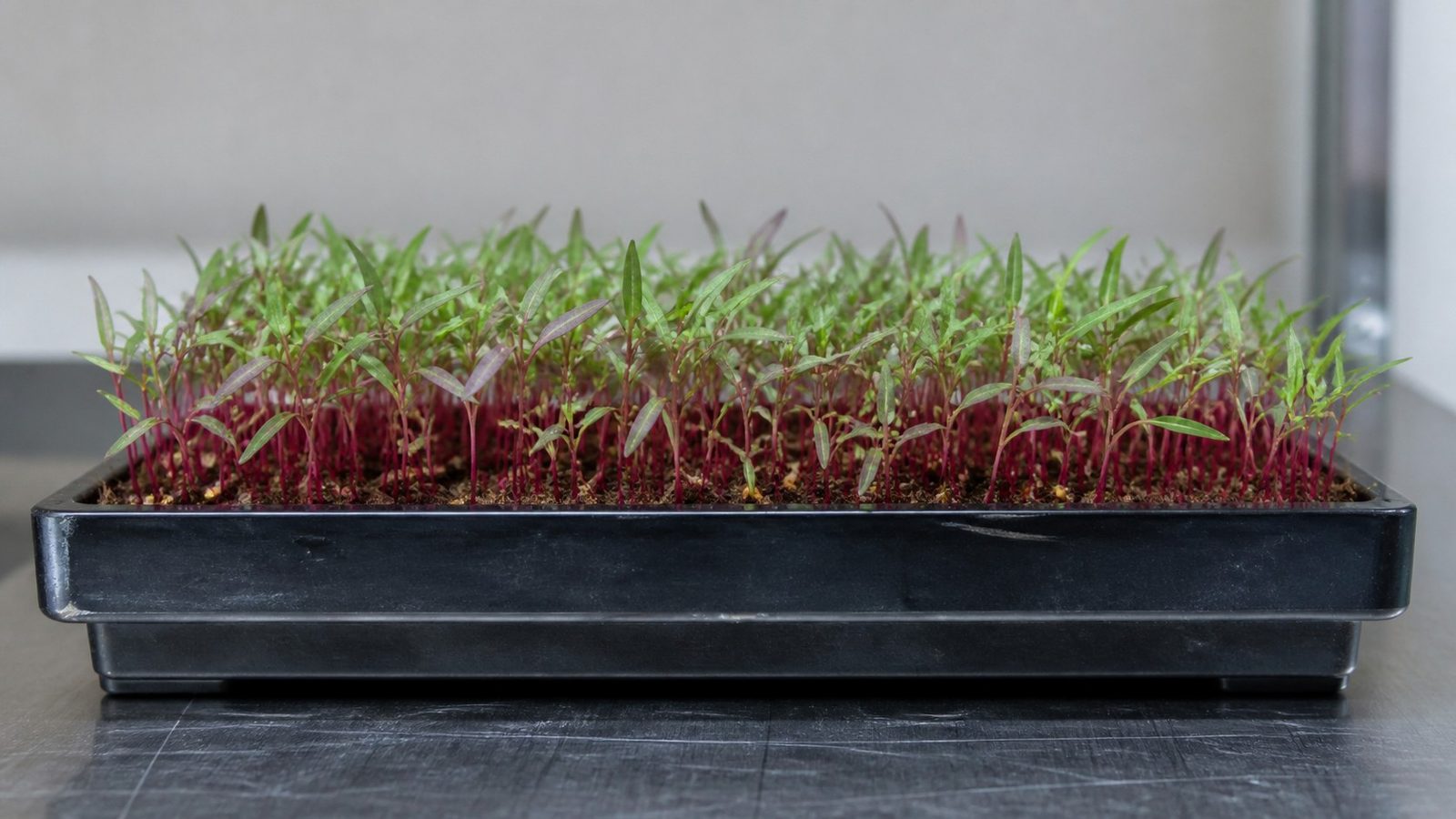
A correct tray is short and delicate: fine stems carrying narrow, pointed to lance-shaped bright green leaves, with pink, orange and yellow visible in the stems and veins. The supplier's own photograph shows a loose, airy pile rather than the thick upright stems of a radish tray, and the usual harvest height is half an inch to two inches. Nobody publishes a uniformity standard for celosia, so judge it on color and on whether the stand is evenly distributed rather than on density.
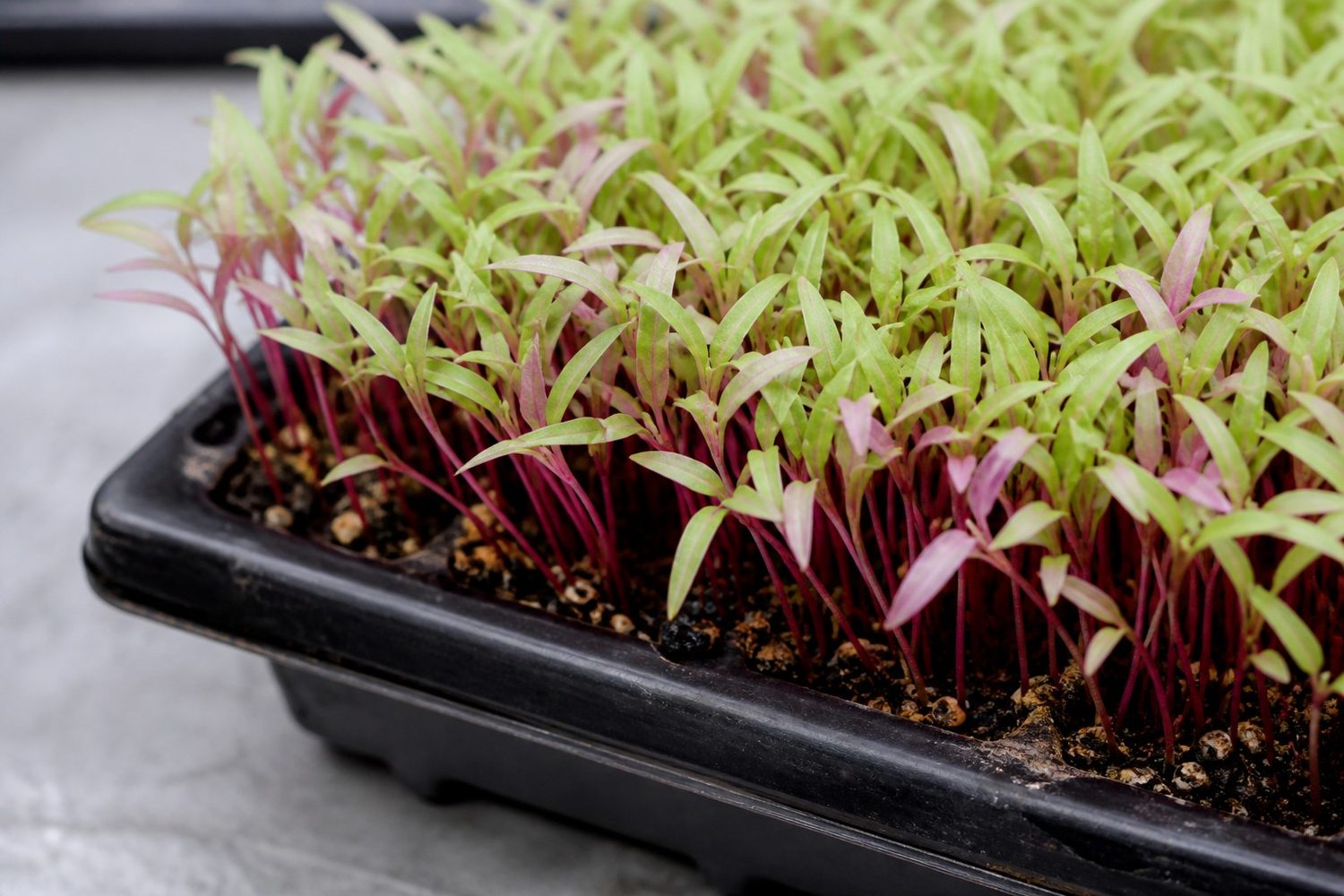
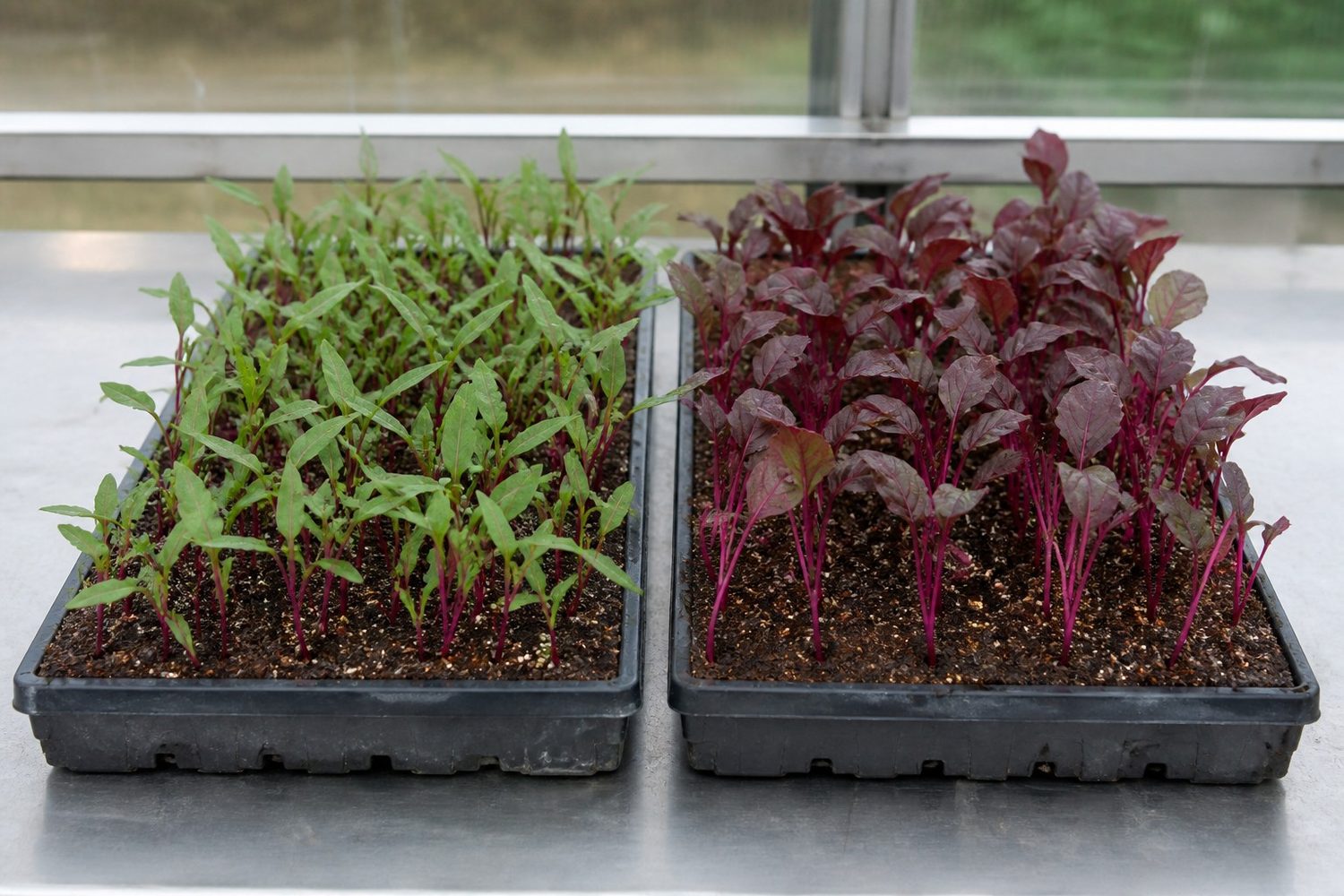
The confusion is with the red and purple crops in its own family, and the tell runs the opposite way to what people expect. Amaranth and bull's blood beet are red plants: red stems, red-tinged leaves. Celosia is a green plant with multicolored stems and veins. If the leaf itself is deep red or magenta, it is not celosia.
What it tastes like, and what to do with it
Mild and earthy, with a green note closer to spinach than to anything sharp. There is no heat, no pepper and no herb aroma. Both the supplier and the grower describe it in the same undramatic terms, and there is nothing more to report because there is nothing more there.
This is the rare crop where that is not a criticism. Celosia's job is color and delicacy: a small tuft finishing a salad, a scatter across a noodle bowl, a contrast on a composed plate. It is bought and specified for how it photographs and how it plates, and a mild flavor is exactly what you want from something whose purpose is to sit on top of a finished dish without arguing with it.
It is the wrong crop wherever bulk, crunch or flavor is the requirement. The leaves bruise more easily than broccoli or radish, so it does not survive rough handling or a heavy hand, and anyone hoping a colorful microgreen will also taste of something will find this one quiet. If somebody wants heat, mustard or radish does that. If they want a salad, almost anything here does it better.
Growing it: only what differs from the standard method
Everything general about trays, medium, light and watering is on the standard tray method for growing microgreens. Celosia's real deltas are about the size of the seed and the gentleness of the handling.
The seed is small enough to fall through a 1.2 mm reusable mat. That single fact drives most of what follows. Use a fine, level medium, or a backing that will actually hold it. If you are growing on a reusable silicone mat, check the aperture before you sow, not after you find your seed in the reservoir.
Spread it evenly, and treat clumps as the failure mode. The documented consequence of over-seeding or clustering is blocked airflow and mold. The operator rate is 8 g per 10x20 tray and the guidance is to reduce only by avoiding clusters, not by dropping the weight. This crop punishes an uneven hand more than a heavy one.
Sow dry and mist. There is no soak. The filmed protocol spreads dry seed and mists for 15 to 20 seconds with a pump sprayer. No source anywhere establishes a soak time, temperature, benefit or harm for celosia, so do not import a rule from large-seeded crops.
Light weight, gentle blackout. Ten pounds over the cover for four days, then flip the cover for one dome day, then light on day five. The weight here is for uniform contact and humid germination of tiny seed, not for forcing thick stems, and the same grower specifically advises keeping it light and gentle on this crop. Take the weight off when sprouts have emerged and the shells are mostly gone, around day four. Leaving it until stems flatten or yellow is the error.
On temperature, one correction worth making. The supplier says 75F at the medium until germination and 60F after, with 65 to 75F ambient favorable, and it is easy to read that as a warm-germination requirement peculiar to celosia. It is not. That is this supplier's standard microgreen instruction, and the identical wording appears on its broccoli page. Treat 65 to 75F as the ordinary target it is, and note that nothing has been published about what celosia does below it.
On light, there is one real study, and it says choose your goal. A 2022 controlled-environment experiment grew celosia under red and blue against red, blue and green LEDs at three intensities. Height was greatest under the RGB mix at 110 micromoles per square meter per second; biomass was higher under red and blue at 340. So, more light is not simply better here: brighter red and blue builds weight, while a lower RGB mix builds height. A tall delicate garnish and a dense tray are not the same product, and on this crop the published research actually lets you aim for one or the other.
A celosia tray, day by day
- 1
Day 0, sow dry
8 g broadcast evenly on a fine, level, pre-moistened medium. Press for contact, cover lightly, and mist for 15 to 20 seconds. Do not bury it.
- 2
Days 1 to 4, weighted cover
About 10 lb over the cover, for uniform contact and humidity around very small seed. This is the phase where clumps turn into mold.
- 3
Day 4, weight off
When sprouts have emerged and the shells are mostly shed. The shells release here, under the cover, which is why they are not a harvest-time problem.
- 4
Day 5, dome then light
One day with the cover flipped as a dome, then out into light. Bottom water from here so the delicate canopy stays dry.
- 5
Days 10 to 15, cut
The supplier range. The one filmed tray was cut on day 13. Harvest the whole mat at once: leaving part of it standing is reported to invite mold.
What goes wrong with celosia specifically
Four failures, and the first one causes most of the rest.
Uneven emergence from clumped seed. The early sign is bare zones next to seed piles. This is only fixable before germination, by redistributing. Once it has come up patchy, the piles are where the airflow stops and the trouble starts.
Seed rot and damping-off in those wet dense patches. Seeds or seedlings that never emerge, go slimy, or collapse at or below the medium line. Pythium and Rhizoctonia are the usual organisms and wet conditions favor them. A small early patch can be removed. A broadly collapsing tray is not a food crop.
Stretched, weak stems from too much time in the dark. Leaning stems are the warning. Get it into light before they fall. On a crop whose entire value is how it looks, a leggy tray is a total loss even though every plant in it is alive.
A bruised canopy at the end. This crop is more delicate than most and the leaves mark easily, so rough harvest or packing costs you the product. Pack it in a clamshell or a vented container and handle it once. Harvesting late compounds this, because a mat left standing after it is ready is reported to invite mold, and a bruised late tray has lost the only thing it was selling.
Root hairs or mold? What actually discriminates
Hover or tap a card to highlight it.
Where it attaches
Root hairs radiate from living white roots and stay in the root zone. Follow the fuzz to its attachment point before deciding anything.
What spreading looks like
Growth running across seed, stem and medium together is not root hair, particularly alongside wet or slimy tissue.
The company it keeps
Root hairs sit under healthy upright seedlings. Missing seedlings, an odor, or stems collapsing at the medium line is the damping-off picture.
The celosia angle
Clumps are where this starts on this crop. If the suspect patch is also the thickest patch, that is your answer about the cause whatever the fuzz turns out to be.
Where it stops
A grower's diagnostic, not an identification. Only a lab names an organism, and the reassuring claim that most white fuzz is just root hair has no measurement behind it.
Nutrition, and what is actually established
Very little is established, and there is more confident nutrition language attached to this crop than there is evidence.
There is no USDA record. FoodData Central was searched on 2026-08-08 for "celosia microgreen" and for "Celosia" and returned no usable result, so no nutrient values and no identifier can be published here.
There is one piece of genuine celosia microgreen research, and it is about light rather than nutrition per se: the 2022 study described above measured growth and functional-quality endpoints across three light intensities and two spectra. That is real work on this exact crop at this exact stage, and it is not a nutrient table for a serving.
What you will meet instead are confident claims that celosia microgreens are high in vitamins A, B, C and K, iron and manganese. No opened source supports them. They appear on a product page with no analytical values, no sample definition and no identifier, which makes them marketing rather than nutrition facts. There is also real research on mature celosia leaves, which are eaten as a vegetable in parts of West Africa, but those are five to fifteen week leaves and cannot stand in for a thirteen day seedling.
Eat celosia because it makes a plate look better. On the evidence available that is the only claim worth making for it.
Which seed to buy
There is one product, and one significant trap.
The only cultivar sold specifically as a microgreen is an unselected Celosia listing labeled Celosia argentea plumosa, with bright green leaves, pink, orange and yellow veins and stems, mild earthy flavor and 10 to 15 days. No supplier page demonstrated named microgreen cultivars with comparative stem length, tenderness, days or yield, so there is no cultivar decision to make here.
This entry carries no seed affiliate link, deliberately, and the reason is safety rather than relevance. Checking the Amazon results for celosia microgreen seed on 2026-08-08 returned 125 results, of which not one was celosia seed sold for microgreens. All 46 celosia listings on the first page were ornamental flower seed: Pampas Plume, Cockscomb Crested Mix, Dwarf Kimono Mix, Woolflower. Ornamental and field seed is precisely the category extension guidance warns about, because it may be dyed or treated with fungicides or insecticides that can be present in the shoots and should not be eaten. A link that sends a reader to buy flower seed to eat is not a bad recommendation, it is an unsafe one, and taking a commission for it would be worse.
So, buy this one from a seed house that lists it in a microgreen range. Specify untreated seed intended for edible microgreen use, with the botanical name on the label, lot information if available, and enough for a small trial. Organic is a preference; untreated food-use is the requirement.
A bad lot shows up as an irregular stand after you sowed evenly at a known rate: low emergence, clusters beside empty zones, or weak seedlings. Nobody publishes a celosia germination threshold or a lot-variability figure, so you cannot benchmark it. What you can do is note that this crop's most documented hazard is physical rather than biological: seed small enough to fall through a mat produces uneven stands that growers blame on their watering.
Is it worth growing?
Only if you are selling the way it looks, and then genuinely yes.
It suits a restaurant or market grower with a buyer who is paying for presentation: a chef who wants pink and orange on a plate, or a market stall that needs something on the table nobody else has. Thirteen days and a careful hand for 3.4 ounces is a real cost, and it is worth paying only when the color is the product.
It is a poor first tray. A beginner wants a crop that tolerates a rough sowing and gives back volume, and this is the opposite on both counts. It is also a poor choice for anyone selling by weight, because 0.26 ounces per tray-day is about as light as a microgreen gets.
Its competition is the other color-forward garnish crops, amaranth and bull's blood beet most directly. Celosia wins when the order calls for narrow green leaves with pink and orange detail, which is a genuinely different look from a red-leaved crop. It loses whenever speed, sturdiness, bulk or flavor matters. On economics there is no comparison to make: celosia has no trial data, so a yield matchup against its own family would be guesswork.
A note on the numbers above
Read this section before you plan against any figure above, because celosia's numbers look exactly as confident as a trial result and are not one.
Hover or tap a row to highlight it.
| Figure | Value | Source | What kind of number it is |
|---|---|---|---|
| Days to harvest | 10 to 15 | Johnny's product page | Supplier range, harvest at cotyledons or first true leaf |
| Days to harvest | 13 | One filmed grower tray | A single observed harvest, inside the supplier range |
| Seed per 1020 | 8 g | Same filmed protocol | One operator's rate. No tested range, no trial |
| Seed per 1020 | No figure | Johnny's 2017 trial | Celosia was not one of the 29 varieties |
| Yield per 1020 | 3.4 oz (96.2 g) | Same filmed protocol | ONE tray, one operator, no replication, no stated harvest stage |
| Yield per 1020 | No figure | Johnny's 2017 trial | Celosia was not one of the 29 varieties |
| Blackout | 4 days weighted, 1 dome | Same filmed protocol | 10 lb, removed when shells shed around day 4 |
| Soak | None | Same filmed protocol | Dry sown, misted 15 to 20 seconds |
| Germination temperature | 75F soil then 60F | Johnny's | The supplier's GENERAL microgreen instruction, not celosia-specific |
| Light | Height best at RGB 110, biomass best at RB 340 | Orlando et al. 2022 | Measured, controlled environment, on this crop at this stage |
| Shelf life | 5 to 10 days | Johnny's | "Proper storage conditions", undefined temperature and package |
| Shelf life | About 1 to 1.5 weeks | The filmed grower | Operator practice, vented container, leaves bruise easily |
| Seed price | $60.20/lb | Johnny's, listed 2026-08-08 | A real current price |
| Harvest window | No figure | Nobody | Nobody has established it |
| Regrows | No figure | Nobody | No second-cut report exists |
| Nutrition, USDA | No record | USDA FoodData Central | Searched 2026-08-08 |
One tray is not a yield. Broccoli's 11.5 oz comes from at least three seedings in a greenhouse trial that harvested every crop at a defined stage and still warns its numbers do not transfer between systems. Celosia's 3.4 oz comes from a single tray filmed for an audience, with no replication and no stated harvest-stage definition. Both appear in the same column of the same table, and they are not the same kind of fact. Treat celosia's as an order-of-magnitude guide: it tells you this is a light crop, not that it is a 3.4 ounce crop.
Two of celosia's spec fields say "no published figure," and one of them is doing real work. Regrowth is unanswered, and the one piece of guidance that exists points against it: harvest the whole mat at once, because a partly cut mat is reported to invite mold. That is a reason to expect no useful second cut, which is not the same as a measurement of one, so the field stays blank.
Where it lands against everything else researched here.
Hover or tap a row to highlight it.
| Crop | Seed per 1020 | Yield | Days | Cost per tray | Oz per $1 | Oz per tray-day |
|---|---|---|---|---|---|---|
| Amaranth | 7.5 g | 6.5 oz | 11 to 18 | $1.10 | 5.9 | 0.45 |
| Spinach, Winter Giant | 60 g | 7.2 oz | 18.0 | $2.52 | 2.9 | 0.40 |
| Celosia | 8 g | 3.4 oz, one tray | 13 | $1.06 | 3.2 | 0.26 |
| Beet, Red Leaf | 20 to 30 g | No published figure | 10 to 14 | $1.53 to $2.30 | cannot be calculated | cannot be calculated |
| Quinoa | No published figure | No published figure | 7 to 14 | no rate to price | cannot be calculated | cannot be calculated |
A blank means nobody has published that figure, so the cell is left empty rather than filled with an estimate. How the numbers work
All 62 crops, sortable, on the microgreen comparison.
Celosia sits third from the bottom of everything that can be calculated at all, and it costs about the same per tray as kale, which returns three times the weight in the same fortnight. Read purely as economics that is a straightforward loss, and it is the correct reading for anyone selling by the ounce.
It is also the wrong question for this crop, and celosia is the entry that makes the limit of this whole table visible. Every column here prices weight. None of them prices a color a chef cannot get anywhere else. Sunflower wins the table and loses the plate; celosia loses the table and gets specified by name. Where a buyer is paying for appearance, ounces per tray-day is measuring the wrong thing, and the honest version of a comparison table is one that says so on the crops where it does not apply.
Terms on this page
Tap a term to see what it means.
Amaranthaceae. The amaranth family, which holds celosia, amaranth, bull's blood beet, spinach and quinoa. Color-forward crops, and mostly light ones.
Sources
- Johnny's Selected Seeds, celosia microgreen seed (3369M) - Celosia argentea plumosa, bright green leaves with pink, orange and yellow veins and stems, mild earthy flavor, 10 to 15 days, harvest at fully developed cotyledons or first true leaves, half an inch to two inches, 1/8 to 1/4 inch spacing with light cover, 75F soil then 60F with 65 to 75F ambient, 5 to 10 refrigerated days, and the $60.20/lb price behind the seed cost, listed 2026-08-08.
- On The Grow, how to grow celosia microgreens on soil - the filmed protocol: 8 g per 10x20, dry sowing with a 15 to 20 second mist, 10 lb for 4 days then a 1 day dome, light on day 5, harvest day 13, 96.2 g harvested, shells mostly gone by day 4, seed falling through a 1.2 mm reusable medium, clumps causing blocked airflow and mold, bruising, and roughly 1 to 1.5 weeks in a vented container.
- On The Grow, celosia video walkthrough - the same protocol on camera, including the 8 g, 10 lb, day 13 and 96.2 g figures spoken aloud, and the framing as a specialty crop for chefs and farmers markets.
- On The Grow, when to move a tray from weight to blackout - light weight and gentle blackout specifically recommended for celosia, and the leaning-stem warning.
- Johnny's microgreens yield trial results (PDF) - the 29-variety chart that contains no celosia line.
- Johnny's yield trial, method and discussion - harvest at first true leaf, and the warning that yields vary with procedure, system, conditions, harvest stage and seed lot.
- Orlando et al., Horticulturae, 2022 - Celosia plumosa argentea microgreens under red and blue against red, blue and green LEDs at 110, 220 and 340 micromoles per square meter per second: greatest height under RGB at 110, higher biomass under red and blue at 340.
- Rise Gardens, celosia microgreens - the day 14 ready-to-harvest listing, the instruction to harvest the whole mat because leaving part of it invites mold, and the unsupported vitamin and mineral claims noted above.
- Kew, Plants of the World Online: Celosia argentea - the accepted species, with Celosia plumosa as a synonym and the plumosa and cristata forms under it.
- UC IPM, damping-off - Pythium and Rhizoctonia, rot at or below the soil line, and wet conditions favoring it.
- Virginia Tech Extension SPES-756 (PDF) - general microgreen production environment and the case for system-specific density trials.
- SDSU Extension, growing microgreens at home - seed treatments including dyes, fungicides and insecticides may be present in the shoots and should not be consumed.
- USDA FoodData Central - searched for "celosia microgreen" and "Celosia" on 2026-08-08, no usable record returned.
Keep reading
The variety directory
Amaranth microgreens
Red Garnet amaranth is the magenta garnish crop, and the trial numbers explain why it is a chef's crop rather than a grower's: 7.5 g of seed makes 6.5 oz in 17 days, against radish's 11 oz in nine.
Read Amaranth microgreensThe variety directory
Bull's Blood beet microgreens
Crimson stems under green cotyledons, 23 g of seed for 7.5 oz in 17 days, and one seed that is not one seed: beet is multigerm, which is why the tray behaves the way it does.
Read Bull's Blood beet microgreensThe variety directory
Chervil microgreens
A chef's herb almost nobody grows: mild sweet anise, 3 to 5 oz a tray, and two independent seed rates that agree to within six percent, which is rare on a crop nobody has trialled.
Read Chervil microgreensThe variety directory
Chive microgreens
One of the few crops where somebody actually ran a density trial, and poor value per dollar of seed. It also competes with a perennial you buy once.
Read Chive microgreens