Amaranth microgreens
Cal HewittPublished Updated Checked
- garnish
- premium
- measured yield
- amaranth
- moderate
- no soak
- mold prone
At a glance
It germinates readily and then punishes standing water and pressure: thread-like stems on a shallow root system, a longer wet window than a brassica, and one documented trial tray lost outright to root rot by day seven.
- Botanical name
- Amaranthus tricolor
- Also sold as
- Garnet Red, Red Garnet, Green Leaf
- Family
- amaranth
- Difficulty
- Moderate
- Days to harvest
- 11 to 18 days
- Harvest window
- No published figure
- Seed per 1020 tray
- 7.5 g
- Soak
- None
- Blackout
- 2 to 7 days
- Germination temperature
- 68 to 77 °F
- Yield per 1020 tray
- 6.5 oz
- Mold risk
- High
- Hull shedding
- some
- Shelf life
- 1 to 10 days
- Eaten as
- raw
- Seed cost per tray
- $1.10
7.5 g at $66.45/lb, Johnny's Amaranth Garnet Red organic microgreen seed, listed 2026-08-08. Seed only, excludes medium, tray, labor, light and loss.
Any field name above ranks every variety by it. No published figure means we researched it and nobody has established one, which is different from not yet researched. Every figure here is sourced at the bottom of the page. Compare every variety side by side.
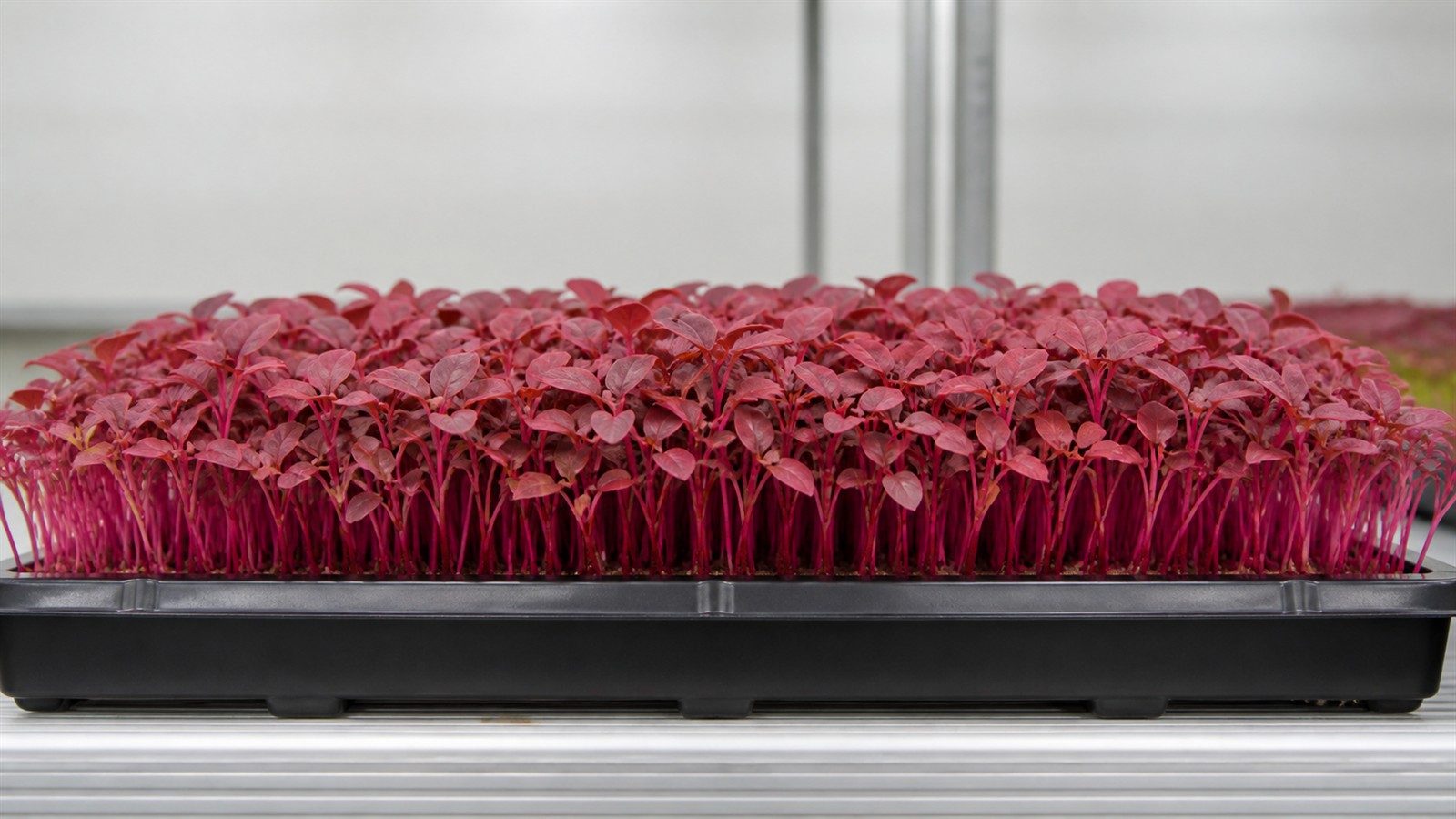
Red Garnet amaranth is the crop people buy with their eyes. It is a dense low mat of crimson and magenta, the color running through the leaves rather than stopping at the stems, and no other common microgreen looks like it. It is also slow, delicate and light: 17 days to first true leaf and 6.5 ounces a tray in the only trial that measured it, against radish's nine days and eleven ounces. Those two facts together are the whole story of this crop, and they explain why it turns up on plates far more often than in grow-along videos.
What growers are saying right now
Sampled from public posts and videos, 9 July to 8 August 2026. Every line links what it is quoting. How often something is repeated is not evidence that it is true, so every line also says what the sources actually establish.
Amaranth is a leafy green you boil
Circulating This is what the amaranth conversation is actually about. The month's traffic is Greek vlita salad, how to prepare the harvested leaf at 8,347 views, and the flowering plant
Different harvest stage, different product. The microgreen is cut at 11 to 18 days as a raw magenta garnish; the mature leaf is a cooked vegetable. Nothing about the mature plant's flavor, texture or use transfers to the tray, and neither does its nutrition data. What it is
You will not find much about growing this one
Circulating Search it and you get the mature plant, cut-flower growers, accounts that happen to share the name and even music. No grower discussion of the microgreen came back from the forums, YouTube or Instagram this month
Expect to work from the trial numbers rather than from somebody's grow-along, because at 6.5 oz per tray in 17 days this is a slow, fragile crop that earns its place on appearance. It lives in restaurant photographs rather than in beginner content, and that tells you who it is for. Is it worth growing
What it is, and how to tell you grew it right
The commercial microgreen is Amaranthus tricolor, and the type with evidence behind it is the red one, sold as Garnet Red or Red Garnet depending on which supplier printed the bag. The name is not taxonomically tidy, since A. cruentus is also grown as a microgreen, so treat red A. tricolor as the crop this page is about rather than assuming every amaranth behaves the same way.
A correct tray at cut is a dense, low, fine-textured mass of crimson to magenta, and the color carries through the leaves as well as the stems. Shoots are slender and genuinely delicate. Expect the stand to even out late, because a share of the seed always lags, and expect thin wispy roots at the medium with nothing gray spreading through them.
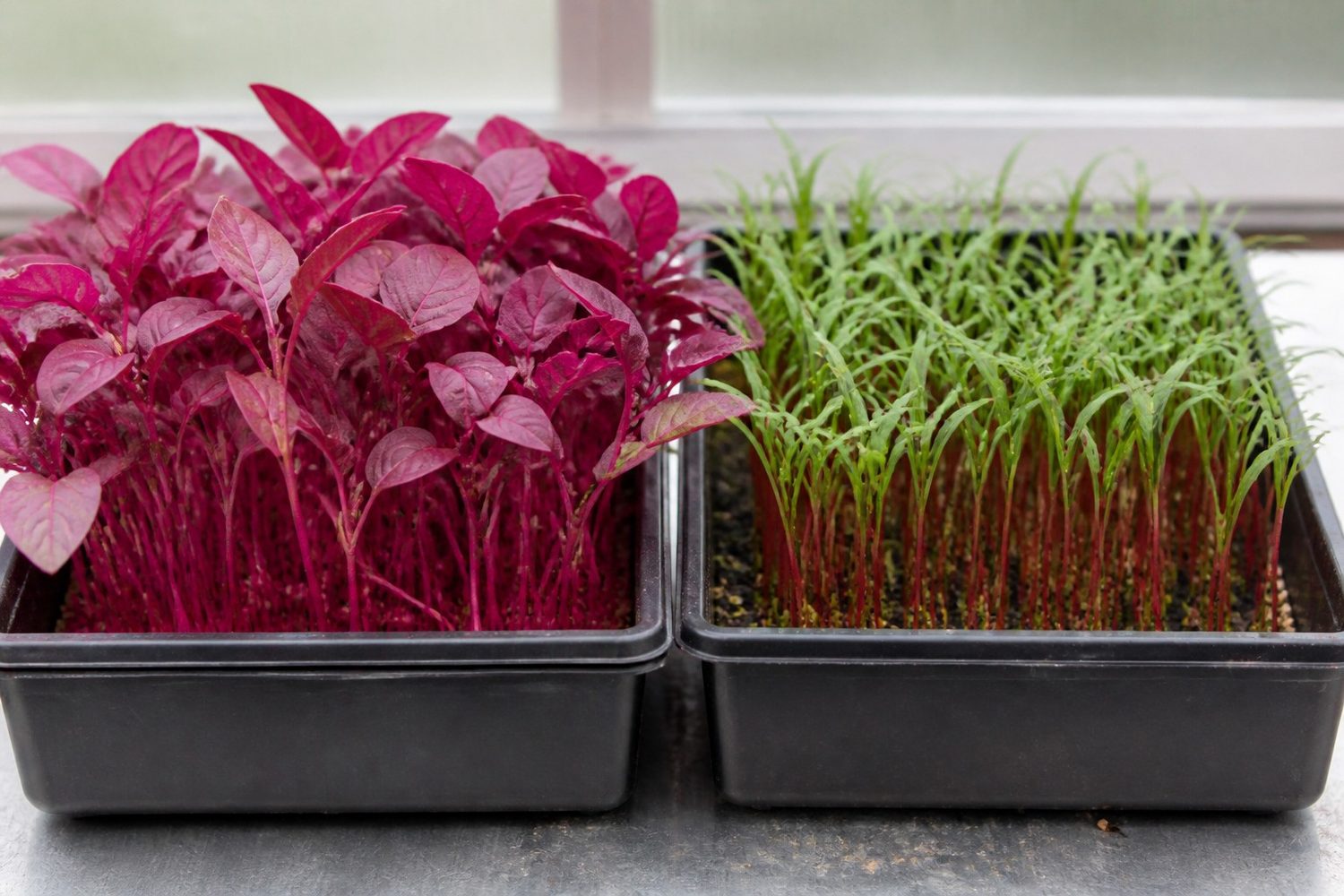
The confusion that matters is bull's blood beet, and there is one reliable tell: bull's blood is crimson stems carrying distinctly green cotyledons, a two-tone crop, while correctly grown Garnet Red is magenta more or less throughout. This is not a small distinction to get wrong. The two crops are nothing alike to plan around either: in the same Johnny's trial, amaranth is 7.5 g of seed for 6.5 oz and bull's blood beet is 23 g for 7.5 oz. Swap the photographs and you have also swapped a three-fold difference in seed.
What it tastes like, and what to do with it
Mild and earthy, and that is close to the whole description. Johnny's says mild and earthy; nobody claims more than that, and this is one of the few crops in the directory where the flavor is genuinely not the point. There is no pepper, no mustard heat and no real bite. What you are buying is color and a very tender texture.
So, it belongs where a small magenta accent has to stay visible and stay quiet: finishing a composed salad, on canapés and toast points, over a seafood or rice bowl, or added to an Asian-style dish after the heat is off. It gives a plate color and a little delicate volume without taking it over, which radish or mustard cannot do at any quantity.
It is the wrong crop for three jobs, and the trial numbers say so as clearly as the taste does. It is not a salad base: the stems are thin and the tray only makes 6.5 ounces. It is not a crunch ingredient. And it is not a volume line in a mixed pack you sell by weight, because you are paying 17 days of rack time for the lightest yield of the common varieties.
Some people will not get on with it: anyone wanting pepper, crunch or substance, and anyone who dislikes an earthy, faintly beet-like note. What is not established is how the flavor moves with harvest timing, though one grower guide links bitterness to slow, set-back or late-cut trays, which is worth knowing precisely because it is the only flavor warning anyone gives.
Growing it: only what differs from the standard method
The general method is on the standard tray method. Amaranth's departures are few and they all point the same way, at water and pressure.
Do not soak it. The seed is tiny, about 1,500 seeds per gram, so the large-seed overnight convention does not transfer and no source establishes any benefit. On a crop this sensitive to standing water, a long soak is free risk.
7.5 grams per 1020, which is about a third of what a beet tray takes. That is Johnny's trial rate, repeated on its own product page, and it works out at roughly 3.5 flats per ounce of seed. Sow lighter still if you intend to hold the tray to a larger second true leaf, because a thinner stand carries better airflow through a long cycle.
Broadcast it evenly and press, but barely cover. The seed is small and rolls, so a level pre-moistened medium matters more than usual: at this seed size, a high spot and a low spot become a dry pocket and a wet one within a day.
Blackout with a cover, and no weight at all. This is the crop-specific instruction and the reason for it is physical. Amaranth does not need pressure for root contact, and its thread-like stems will run sideways and twist under a weighted lid into what growers call spaghetti: a tangled horizontal mat that never straightens and never makes weight. Take the cover off by height, when shoots are lifting it at roughly half an inch to an inch, which lands somewhere between day two and day seven depending on your room. Watch the tray, not the calendar.
Then water from below. Continued misting wets the seedlings without properly watering the medium, which is the wrong result twice over on a crop whose main enemy is a wet canopy.
A tray of Red Garnet, day by day
- 1
Day 0, sow dry
7.5 g broadcast evenly on leveled, pre-moistened medium and pressed for contact. No soak, and barely any covering.
- 2
Days 1 to 3, dark and warm
68 to 77°F germinates it in two to three days. Cover for darkness and humidity, with NO weight on it.
- 3
Day 2 to 7, cover off by height
Off when shoots are lifting it at roughly half an inch to an inch. Leaving it longer, or weighting it, is how a tray becomes tangled spaghetti that never recovers.
- 4
Then, light and bottom watering
Water the medium from below or at the tray edge. The color deepens under light; a wet canopy is what kills this crop.
- 5
Days 11 to 18, cut
Studies that measured it disagree because they grew it differently. Cut when the magenta leaves are expanded and before growth coarsens, which is a stage rather than a date.
What goes wrong with amaranth specifically
Three failures, in the order they arrive, and the middle one is unique to this crop.
Uneven and lagging emergence. A patchy tray at day two or three. Small seed simply does not all come up together, and this is a known feature of amaranth rather than a fault. Keep the moisture even and give it a day; if the seedlings are clean and firm, it usually catches up.
Tangling under a cover, which is amaranth's signature failure. Shoots press against the lid and start running horizontally, and once a stand has snaked sideways it does not stand back up. Get the cover off. This one is largely not recoverable and the tray finishes light and unsaleable as a garnish, which on a crop bought for its appearance means it is not saleable at all.
Damping-off and root rot, and this crop is genuinely prone to it. Seeds fail, or seedlings soften and collapse at or below the medium line. A hydroponic study working with Garnet Red lost an entire uninoculated tray to root rot by day seven and identified Pythium as the organism, with fungus gnats a possible route in. Pythium and Rhizoctonia are the usual damping-off organisms and damp conditions are what favor them. A localized early patch can sometimes be isolated. A collapsing tray cannot.
Root hairs or mold, and here it is harder to call than on a brassica. The test is the same: mist it, and normal root hairs are fine, white, local to the roots and collapse and vanish when wet, while mold holds together as a webby mass, often shows gray flecks, spreads sideways and may smell musty. What is different is that amaranth's roots are so fine that its normal root hairs are much harder to see than broccoli's, so on this crop weight the other signs more heavily: spreading, gray color, smell, and soft collapsing stems.
Late cutting costs you the product rather than the plant. Second true leaves enlarge, the stand gets taller and coarser, and it stops being the small uniform garnish anybody was buying. One guide ties bitterness to late and set-back trays. Johnny's does sometimes suggest letting the second true leaf come, because a thickly sown Garnet Red tray has a slow understory, so "late" here means past the stage your buyer wants rather than past a fixed day.
Nutrition, and what is actually established
There is no USDA FoodData Central record for amaranth microgreens, searched 2026-08-08. Do not substitute the grain, the flour, or the mature leafy amaranth entries: those are different products at different stages, and the mature leaf is the thing most of the internet is actually talking about.
What does exist is better than most crops get, because Garnet Red has been measured twice in peer-reviewed work. Di Gioia and colleagues grew it in naturally lit soilless channels and reported a fresh yield of 897.2 g per square meter at 18 days, 64.05 g of dry matter per kg fresh weight, and 65.16 mg of magnesium per 100 g fresh weight. Lanoue and colleagues grew it under controlled light and measured height, fresh weight, pigments, antioxidant activity, phenolics and anthocyanins across four light treatments, finding that light affects pigmentation and biomass. Both are real measurements of this cultivar under stated conditions, and neither is a nutrition label for your tray.
The claims to leave alone: "high protein" appears on a retail page with no analytical basis behind it, and there is no crop-specific source for fixed vitamin amounts, detoxification, or any multiple of the mature plant's nutrition.
Which seed to buy
There is a real cultivar decision here, which is not true of every microgreen. Garnet Red, or Red Garnet, is the type with a per-tray trial behind it and the one that gives magenta through the leaves. Green Leaf is a different selection with green leaves and reddish stems, and there are pink and red-veined A. tricolor types as well. Only Garnet Red has published days and yield, so do not carry its 17 days and 6.5 ounces across to the others.
Specify a named A. tricolor cultivar sold for microgreen or sprouting use, untreated, with lot and pack date if the supplier gives them, and decide whether you need organic certification. Refuse dyed or treated field seed: extension guidance is direct that seed treatments can end up in the shoots, and shoots are what you eat. Untreated does not mean sterile, so keep the lot number, use clean trays and potable water, and run a germination check on a new lot.
A bad lot looks like poor or uneven emergence that never catches up, after the normal warm two to three day germination, on a tray with no disease and controlled moisture. The cost is not just the roughly $1.10 of seed: it is the medium, the rack space and 11 to 18 days, converted into a patchy magenta canopy that cannot be packed. One study measured 98 percent germination on its Garnet Red lot, which tells you what good looks like and guarantees nothing about yours.
Red Garnet amaranth microgreen seed on Amazon is the convenient route for a home tray. For anything you sell, buy from a supplier who will name the cultivar and the lot.
Is it worth growing?
Yes, if you are selling appearance. This is the crop for a chef or a grower supplying one, where a premium magenta garnish is the product and somebody will watch the moisture and cut at the right stage. For a single home tray it is a good choice for color and a mild flavor, and a poor one for reliability.
No, if you need weight or you need it to be easy. A market grower pricing by the ounce should trial it before committing, because 6.5 ounces over a 17-day cycle is the least productive combination in the common set. A first-time grower should start somewhere sturdier. And anyone who cannot check a covered tray daily during blackout will meet the spaghetti problem or the rot, both of which are decided in that window.
The tray-slot comparison is worth making with real numbers, because all three of these came out of the same trial:
Hover or tap a row to highlight it.
| Red Garnet amaranth | Bull's blood beet | Red radish | |
|---|---|---|---|
| Seed per 1020 | 7.5 g | 23 g | Higher again |
| Yield per 1020 | 6.5 oz | 7.5 oz | 10 to 11.5 oz |
| Days to first true leaf | 17 | 17 | 8 to 10 |
| Color | Magenta through the leaves | Crimson stems, green cotyledons | Pink to magenta stems |
| Flavor | Mild, earthy | Earthy | Peppery |
| Wins when | The leaves must be magenta and the accent tender | You want a red garnish with more weight behind it | You want speed, weight and heat |
Amaranth wins one of those columns and it wins it outright: nothing else gives you color in the leaf. If that is not what the plate needs, one of the other two is the better use of the tray.
Terms on this page
Tap a term to see what it means.
Cotyledon. The seed leaf, the first thing up. On correctly grown Garnet Red it is magenta like everything else, which is exactly what separates it from bull's blood beet.
Sources
- Johnny's Selected Seeds, Amaranth Garnet Red organic microgreen seed - Amaranthus tricolor, 7.5 g per 1020, mild and earthy, 5 to 10 days storage, seed spacing, bottom watering, and the price checked 2026-08-08.
- Johnny's microgreens yield trial results (PDF) - 7.5 g and 6.5 oz at 17 days for Garnet Red, and the bull's blood beet and radish figures it is compared against here.
- Johnny's trial method and discussion - the first-true-leaf harvest standard, the second-true-leaf note for thickly sown Garnet Red, and the transferability caveat.
- Di Gioia et al., 2023, seventeen microgreen species compared - Garnet Red at 18 days, 897.2 g per square meter fresh yield, dry matter, minerals and the 98 percent germination of its lot.
- Lanoue et al., 2022, light treatment of Garnet Red amaranth - 11 days after three dark days at 24°C, and pigment, phenolic and anthocyanin response to light.
- Fischer et al., hydroponic Garnet Red root rot - Pythium root rot, an uninoculated tray lost by day seven, and fungus gnats as a possible route.
- Virginia Tech Extension SPES-756 (PDF) - the amaranth species grown as microgreens and general production environment.
- SDSU Extension, growing microgreens at home - storage after cool rinsing and drying, and why treated seed is unacceptable for a crop eaten as shoots.
- UC IPM, damping-off - Pythium, Rhizoctonia, and the conditions that favor them.
- The Seed Collection, amaranth microgreens grow guide - no soak, 68 to 77°F germination in two to three days, the color selections, the 1 to 2 day storage figure, and bitterness in slow or late-cut trays.
- Home Microgreens, red garnet amaranth - the 48-hour dome, removal by height, asynchronous emergence, and the tangling failure.
- Quantum Microgreens, how to grow amaranth - the intermediate difficulty rating, no regrowth after cutting, visible seed coats around day five, and the root-hair test.
- True Leaf Market, Red Garnet amaranth organic - the alternate bag name and the culinary uses.
- USDA FoodData Central - searched 2026-08-08, no amaranth microgreen record.
Keep reading
The variety directory
Celosia microgreens
A color crop whose entire measured record is a single YouTube video: 8 g of seed, 3.4 oz, 13 days. Bought for pink and orange stems, never for weight.
Read Celosia microgreensThe variety directory
Basil microgreens
Basil is the slow one: 19 to 25.5 days to first true leaf against a brassica's twelve, on 6.5 g of seed, and the purple cultivars cost you another week. Three cultivars, three sets of measured numbers.
Read Basil microgreensThe variety directory
Bull's Blood beet microgreens
Crimson stems under green cotyledons, 23 g of seed for 7.5 oz in 17 days, and one seed that is not one seed: beet is multigerm, which is why the tray behaves the way it does.
Read Bull's Blood beet microgreensThe variety directory
Garden cress microgreens
The crop where somebody finally measured what over-sowing costs: peak yield at 12 seeds per square centimeter, and roughly eight times the bacteria at 14. Plus 8 oz a tray at 13 days from the trade's own trial.
Read Garden cress microgreens