Basil microgreens
Cal HewittPublished Updated Checked
- herb
- premium
- slow crop
- measured yield
- mint
- moderate
- no soak
- mold prone
At a glance
Slow warm germination and a seed that turns to gel when wet, which together hold a dense surface damp for four to seven covered days: a much longer window for uneven emergence and damping-off than a brassica's day or two.
- Botanical name
- Ocimum basilicum
- Also sold as
- Italian Large Leaf, Red Rubin, Dark Opal
- Family
- mint
- Difficulty
- Moderate
- Days to harvest
- 12 to 26 days
- Harvest window
- No published figure
- Seed per 1020 tray
- 5 to 6.5 g
- Soak
- None
- Blackout
- 4 to 7 days
- Yield per 1020 tray
- 5.5 to 7.5 oz
- Mold risk
- High
- Hull shedding
- some
- Shelf life
- 1 to 10 days
- Eaten as
- raw
- Seed cost per tray
- $0.83
6.5 g at $57.68/lb, Johnny's Italian Large Leaf organic microgreen seed, listed 2026-08-08. Red Rubin runs $1.24 a tray at $93.40/lb and 6 g. Seed only, excludes medium, tray, labor, light and loss.
Any field name above ranks every variety by it. No published figure means we researched it and nobody has established one, which is different from not yet researched. Every figure here is sourced at the bottom of the page. Compare every variety side by side.
Basil breaks every rule you learned on a brassica. It takes 19 to 25.5 days against a brassica's twelve, it sits covered and damp for four to seven days rather than two, its seed turns to gel the moment it gets wet, and it comes out of the tray bushy and leafy rather than as a stand of stems. It is also one of the few crops where three named cultivars each have their own measured numbers, and where choosing the purple one costs you an extra week for less yield. None of that makes it a bad crop. It makes it a herb, grown on a herb's clock, and most of what goes wrong with it comes from treating it like a fast green.
What growers are saying right now
Sampled from public posts and videos, 9 July to 8 August 2026. Every line links what it is quoting. How often something is repeated is not evidence that it is true, so every line also says what the sources actually establish.
Basil is the easy herb everyone grows
Circulating The month's basil content is overwhelmingly the garden plant: an 8-tips care guide at 718,367 views, "grow an endless supply" at 212,639, a whole-summer routine at 50,030, and a pesto harvest
All true, and none of it is this crop. Garden basil is pinched repeatedly for months; a microgreen tray is cut once at first true leaf, at 19 to 25.5 days, and does not regrow. The "endless supply" people mean comes from one plant over a summer. On a rack it comes from succession sowing, which is the production sheet's own instruction.
Cut it high so you get a second cutting
Circulating Said plainly in that pesto video: a first cutting taken deliberately high with the intention of a second
The single most transferable-looking piece of basil knowledge, and it is the one that does not transfer. That works because a garden plant keeps its growing points. A basil microgreen is cut at first true leaf and the commercial guidance calls microgreens a one-cut crop, so plan succession sowings rather than a second harvest. Is it worth growing
Bold flavor, big benefits
Circulating How Italian basil microgreens are pitched, leading on nutrition alongside the flavor
Half right, and the halves are not equal. The flavor claim is sound: Johnny's own word for both its green and purple basils is sweet-spicy, and it is concentrated. The nutrition claim has no general figure behind it. The measured work is treatment-specific, including a selenium study where the highest dose gave 690 µg/g of selenium and cut yield by 35.5 percent, which is biofortified basil rather than what comes off your rack. What is actually established
What it is, and how to tell you grew it right
Basil microgreens are Ocimum basilicum in the Lamiaceae, the mint family, and that placement predicts more than it sounds like: aromatic foliage, a slow crop, and a true-leaf harvest rather than the quick uniform cotyledon crop a fine-seeded brassica gives you.
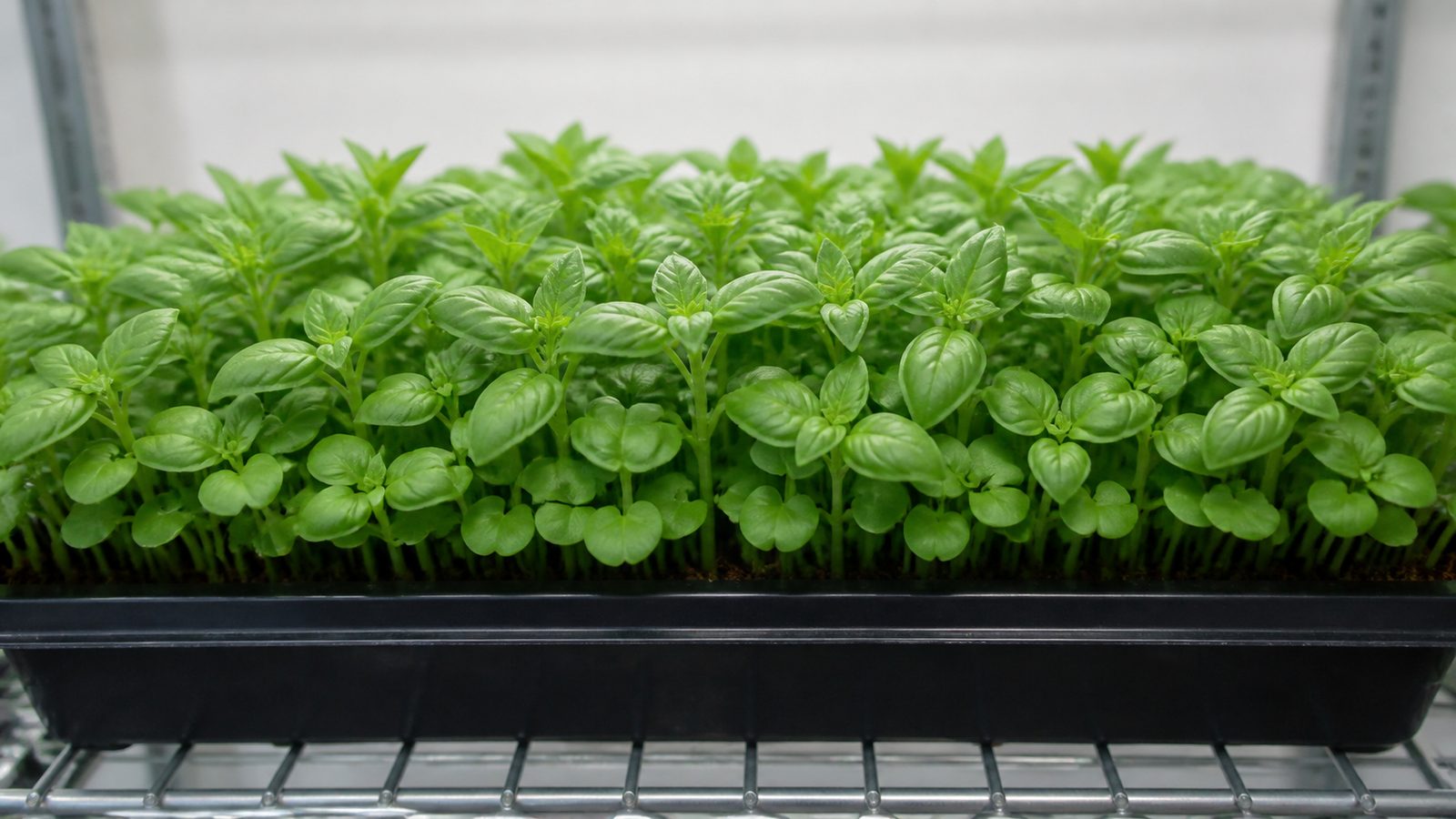
A correct tray does not look like a microgreen tray at all. It is dense and bushy rather than tall and sparse, with the paired cotyledons and the first pointed true basil leaves standing above them, so it reads as a miniature basil plant rather than a carpet of stems. Italian Large Leaf is medium green through leaves and stems; Red Rubin is all-purple leaves on light purple stems. The canopy should be even, with roots rather than foliage at the medium surface and no bare wet patches.
At cotyledon stage it is easily confused with other herb microgreens, shiso especially. The tell is the first true leaf, which comes in as a pointed opposite pair and smells unmistakably of basil. No published photographic comparison exists for that confusion, so treat the aroma as the practical test.
What it tastes like, and what to do with it
Concentrated sweet-spicy basil, and the emphasis belongs on concentrated. Johnny's uses "sweet-spicy" for both its green and its purple cultivars, and Utah State simply calls it intense basil. This is not a salad green with a hint of something. It is closer to a seasoning, and a small volume of it will take over a delicate plate.
So, it goes where a few leaves have to carry an unmistakable herb finish: caprese, pizza or pasta after they come off the heat, tomato bruschetta, seafood, soft cheese on a canapé. Red Rubin in particular is recommended for dessert garnish and cocktails, where the purple is doing as much work as the flavor.
It is the wrong choice for a neutral salad base, for bulk, and for anything hot, where you pay a premium price for an aroma the pan destroys. It is also the wrong choice for anyone who does not like basil's sweet, faintly anise character, which is worth stating plainly, because on most crops the flavor is a detail and here it is the entire product.
One flavor warning is worth carrying: slow, stressed or late-cut basil is reported to turn bitter. Nobody has quantified the point at which that happens, so it is a reason to watch the tray rather than a number to plan around.
Using it in the kitchen, where it already has a signature dish
Most microgreens have no classic preparation to point you at. Basil does: of the eight published basil microgreen recipes located, six are either a pesto or a Caprese. The mature herb's two signature dishes carry straight onto the seedling, so you already know what to do with the tray.
Hover or tap a row to highlight it.
| Amount | Dish | Serves | Heat |
|---|---|---|---|
| 3 oz | Pesto, pulsed cold with garlic and nuts, then oil and cheese | Not stated | None |
| 2 cups, loosely packed | Pesto with 1 cup sunflower shoots | 6 | None |
| 2 oz | Caprese with tomato and mozzarella | Not stated | None, piled on just before serving |
| 2 oz | Baby Caprese salad | Not stated | None, some reserved for garnish |
| 2 oz | Thai basil chicken wraps | Not stated | Folded in after the heat is off |
| 1 cup | Pesto for a summer squash galette, with 1 cup arugula microgreens | Not stated | Baked into the galette |
| A handful | Mini Caprese salad | Not stated | None. Not a usable amount |
| A small handful | Lemon spaghetti | Not stated | Tossed with hot pasta |
Note the galette. That recipe uses a cup of basil microgreens and a cup of arugula microgreens in one pesto, and it is the same dish cited on the arugula entry. One recipe appearing on two crop pages is one source, not two, and it is also the only published instruction to bake either crop. Treat it as untested on both pages rather than as two independent sources agreeing that basil bakes.
What a tray gives you
A 1020 tray of basil is 5.5 to 7.5 oz from 5 to 6.5 g of seed at 83 cents. So, one tray is:
- About 2 to 2.5 batches of the 3 oz pesto.
- About 3 Caprese platters at 2 oz each.
- Roughly 62 to 85 servings at the 2.5 g garnish weight, at about a penny of seed each.
Basil is a cheap tray of a dear seed, and the cultivar moves both numbers. The costed tray above is Italian Large Leaf at $57.68 a pound, and 6.5 g of it is 83 cents. Red Rubin, the purple one, is $93.40 a pound and works out at $1.24 a tray on 6 g. So, the seed price differs by 62 percent between two bags both labeled basil, and the tray cost still lands under a dollar and a quarter either way, because the rate is tiny. The price on the bag is a poor guide to what a tray costs, because the rate matters more than the pound price.
The two published ratios, which are more useful than the amounts
Most recipes tell you how much of one crop to use. Two here tell you how to balance basil against another microgreen, which is rarer and more useful:
- 2 cups basil to 1 cup sunflower shoots in a pesto. Basil is the aromatic and sunflower is the mild nutty bulk, so the ratio runs two to one in favor of the quiet one being outnumbered.
- 2 to 3 tablespoons of radish microgreens as a variation on that same pesto. That is the only published figure anywhere for how much of a hot crop to put into a mild dish, and it is a very small number. Radish is described in the same recipe as packing serious heat.
Do not convert these cups to grams
Three of the amounts above are volumes, and there is no published cup-to-weight conversion for basil microgreens. Resist the temptation to borrow one: pea shoots is the one crop where several publishers have tried, and their answers disagree by twofold on a single crop. A basil cup and a pea shoot cup are not the same object, and neither is a loosely packed cup and a pressed one. Where a recipe gives ounces, use the ounces, and the two that do are the ones to work from.
Raw, and the reason is texture rather than nutrition
Every reliable amount above is used cold or added after the heat is off, including the Thai basil wraps, which specify folding it in once the pan is killed. The one exception bakes it inside a pesto, and reports nothing about how it came out.
The mechanism is straightforward and it is not about nutrients: these are very small, very tender leaves on a crop whose selling point is aroma. Sustained heat wilts them away and drives off the volatiles that were the entire reason for using them. The wider cooking evidence is here, and it does not support a general ban on heat, only the observation that nobody has measured what heat does to this crop.
The flavor is stronger than the mature herb, not weaker. Growers describe it as sweet basil with clove and a peppery warmth, and one says outright that the microgreen is more intense than the full-grown leaf. So, a leaf-for-leaf substitution into a dish written for mature basil will overshoot. Start at the published weight.
Cultivar changes the flavor more than it changes the picture. Genovese is the creamy, milder sweet basil; Dark Opal is described as intense with clove depth; lemon basil is citrus-forward; Thai basil leads with anise and licorice. If a recipe names one, that is doing real work.
Buying it and keeping it
Basil has the shortest published shelf life of almost any microgreen, a minimum of 1 day, matched only by amaranth and against crops that reach 21. It is also chill-sensitive in a way most microgreens are not, which is why the floor is a 1 rather than a 5. Buy it for the day you are using it, and if you are growing it, cut it when the dish is being made rather than in advance.
Store it unwashed and wash only what you are about to eat, which matters more here than on a sturdy crop because there is very little leaf to lose.
Basil microgreen seed on Amazon is the convenient route. At 12 to 26 days it is a slow crop, so the bench time rather than the seed is what it actually costs you.
Growing it: only what differs from the standard method
The general method is on the standard tray method, and basil departs from it more than any other crop here.
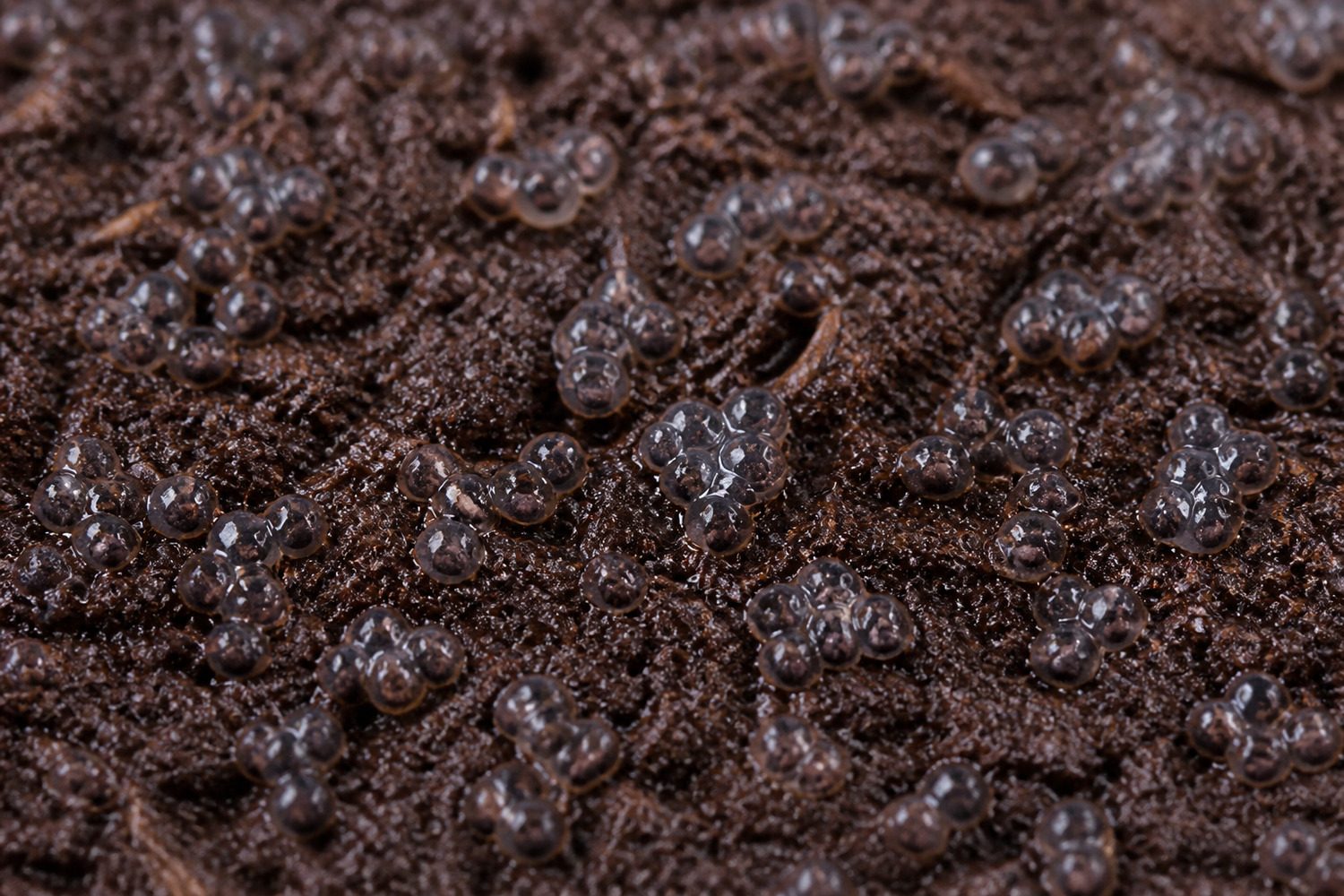
Never soak it. Both crop-specific sources say no, and the reason is physical rather than conventional: wetted basil seed forms a gel around itself. Soaking a mucilaginous seed produces a clumped, glued mass that sows unevenly and holds water exactly where you do not want it.
Five to 6.5 grams per 1020, which is a very light rate. Johnny's trial rates are 6.5 g for Italian Large Leaf, 6.0 for Red Rubin and 5.0 for Dark Opal, and its product pages repeat them. Utah State's home protocol says 28 grams, which is more than four times as much, and that is not a contradiction to average away: it is a different schedule, 12 to 16 days rather than 19 to 25.5, and a heavier stand cut earlier. Pick a schedule and use its rate. If you are holding to true leaf, go with the low numbers and go lower still rather than higher, because Johnny's guidance is that a longer crop needs fewer seeds for airflow and for water and fertility to last.
Sow onto a level, pre-moistened surface and press. Distribute so seeds are not touching, because the gel will glue neighbors into islands, and never hit a fresh sowing with a hard stream of water: the seed moves and clumps. Mist gently while it germinates, then bottom-water once it has rooted so the surface and foliage stay drier.
Four to seven days covered, with two to five pounds of weight. The weight is not there to stretch anything. It holds the seed against the medium so roots drive down instead of the seed lifting. Utah State takes the direct-contact cover off halfway through the dark period, and the humid weighted lid comes off once germination is visibly underway. Leaving it on emerged basil is how you lose the tray.
Warm, and this is the one crop here that genuinely wants heat. Johnny's target is 75°F at the medium until germination, then 60°F. The crop tolerates a much wider band, one guide gives 64 to 95°F with germination in five to ten days, but a tolerance is not a target and above 75°F disease pressure rises.
Then it needs light and attention for a long time. A basil study summarized by Virginia Tech ran a 16-hour photoperiod at 231 µmol m⁻²s⁻¹, raised to 300 for the last three days, against 70 to 90 for cabbage in a different study. Do not read that as a precise prescription, but do read it as a crop that is in the rack long enough to need real light and, on an inert medium, some fertility.
A tray of basil, day by day
- 1
Day 0, sow dry onto moist medium
5 to 6.5 g depending on cultivar, spread so seeds do not touch, pressed for contact. No soak, ever. The gel forms within minutes of wetting.
- 2
Days 0 to 7, covered and warm
75°F at the medium, four to seven days dark with 2 to 5 lb of weight. The direct-contact cover comes off halfway through; the rest comes off once germination is visibly underway.
- 3
Then, light and cooler
Around 60°F, a long photoperiod, bottom watering, and airflow that is not optional through a moist phase this long.
- 4
Days 12 to 26, cut once at first true leaf
Green Italian Large Leaf averaged 19 days in trial, purple Red Rubin and Dark Opal 25.5. The stage is the signal, not the date.
- 5
No second cut
Succession sow instead. The growing point goes with the harvest.
What goes wrong with basil specifically
Four failures, and the first is the crop's signature.
Clumped, ungerminated seed sitting in a wet bed. The tell is shiny islands of stuck-together seed with empty ground between them. This is the gel doing what gel does, and it is why uneven wetting and pooled water cost more on basil than anywhere else. Caught before anything rots, you can even out the moisture and stop the pooling and still get a crop.
Damping-off during that long covered window. Pythium and Rhizoctonia, the usual organisms, in the conditions they most like: a dense stand, a saturated medium, poor airflow, warmth, and four to seven days of it. The tell is soft, pinched, darkening tissue at or just below the medium line. A small patch can be cut out and the rest dried and aired. A collapsed seedling does not come back.
A leggy, weak canopy, because this crop is under light for far longer than a brassica and the light has more time to be wrong. Pale stretched stems are the sign. Fixing the light helps the rest of the crop; the stems that already stretched stay stretched.
A late crop that has gone coarse or bitter. True leaves enlarge past the small emerging pair Johnny's cut at, tenderness drops, and stressed or late plants are reported to taste bitter. You can see it before you cut. Nobody has established the day it goes, which is exactly why the instruction is to watch the stage.
Root hairs or mold: a screen, not a proof. Lift a seedling and look at the root zone. Root hairs arise evenly from healthy white roots, stay attached after a gentle rinse, and the seedling is firm. Mold bridges seed, stems and medium in irregular cottony mats and comes with soft or pinched tissue. UC IPM's diagnostic is rot at or below the soil line, with Pythium often starting at the root tips. Only a lab can confirm which it is, so treat these checks as a screen.
And expect some seed coats. Basil's are dark and visible, and the gel phase means they stick. Johnny's own research protocol removed them before analysis. Nobody publishes a carryover rate, so budget a little cleanup rather than a number.
Three cultivars, three sets of numbers
On most crops the cultivar decision only changes the color. On basil it changes the schedule, and all three of these came out of the same trial at the same harvest stage.
Hover or tap a row to highlight it.
| Italian Large Leaf | Red Rubin | Dark Opal | |
|---|---|---|---|
| Color | Medium green leaves and stems | All-purple leaves, light purple stems | Purple |
| Seed per 1020 | 6.5 g | 6.0 g | 5.0 g |
| Days to first true leaf | 19 | 25.5 | 25.5 |
| Yield per 1020 | 7.5 oz | 5.5 oz | 6.0 oz |
| Seed cost per tray | $0.83 | $1.24 | Not listed |
| Suggested for | Italian dishes | Dessert garnish, cocktails | Color |
The purple costs a week and an ounce and a half. Red Rubin takes 25.5 days against green basil's 19, yields 5.5 oz against 7.5, and its seed is two thirds more expensive per pound. Johnny's attributes the yield gap largely to stem length. If you want purple on a plate, that is the price; if you want color and do not specifically need basil, a purple brassica gets you there in a third of the time.
Nutrition, and what is actually established
Whether USDA FoodData Central holds a basil microgreen record is unknown, because its results interface could not be retrieved when this entry was researched. Look there yourself rather than assuming the record is absent, and do not substitute mature basil values either way.
The peer-reviewed work that does exist is real and specific, and it is not a nutrition label. Newman and colleagues grew Johnny's basil on felt mats, harvested at 25 days and two true leaves, and measured yield, minerals, phenolics and antioxidant capacity across three selenium treatments. At the highest dose the crop accumulated 690.0 µg/g of selenium on a dry weight basis and yield fell 35.5 percent, which is a study about biofortification rather than a figure for anybody's tray. A separate 2021 paper analyzed 25 market samples of basil microgreens and reported 71.0 mg per 100 g of ascorbic acid, 8.6 mg/g total phenolics and 94.3 percent water.
Both are measurements under stated conditions. Neither supports a fixed vitamin profile for basil microgreens, a multiple of mature basil, or a health claim.
Which seed to buy
The cultivar choice is the real decision and the table above is most of it. Italian Large Leaf is the default: fastest, highest yielding, cheapest seed, and the classic flavor. Red Rubin and Dark Opal are color purchases with a known cost in time and weight.
Specify untreated seed sold for microgreen or food use, with lot information where you can get it. Refuse dyed or chemically treated field seed, because the harvested product is the young shoot and extension guidance is explicit that treatments can carry into it. Organic is a sourcing preference and not evidence of germination or food safety.
A bad lot shows as low or uneven emergence after the expected warm four to seven day covered window, patchy areas despite even sowing, and uneven height afterwards. Be slow to blame it, though: waterlogging, a cool room and clumped seed produce exactly the same picture on this crop, and two of those three are gel-related. Johnny's excluded obvious poor-germination flats from its trial averages, which tells you lots do vary; no published basil figure says how often.
Basil microgreens seed on Amazon is the convenient route for a home tray. For anything you sell, buy the named cultivar from a supplier who will state the lot.
Is it worth growing?
Yes, if you are selling aroma. Basil is a premium herb line and it is priced and paced like one: 19 to 25.5 days of rack time for 5.5 to 7.5 ounces, against a brassica turning over in twelve for ten or eleven. A market grower can absolutely justify that, on flavor and on color, but should plan succession sowings rather than expect a second cut. A home grower who cooks Italian food, or wants one striking finishing herb, will get more use out of one tray of this than out of a bigger tray of something neutral.
No, if you are new, if you need volume, or if you cannot watch a warm damp covered tray for a week. Those four to seven days are where this crop is won or lost, and they are the part a brassica never asks of you.
Its competition splits by what you actually want. If you need weekly turnover and predictable weight, a fast brassica like broccoli or radish wins on every axis except flavor. If you only want color on the plate, amaranth or a purple brassica gets there far faster than Red Rubin's 25.5 days. Basil wins in one situation and wins it completely: when a few leaves have to say basil, unmistakably, and nothing else will do.
Terms on this page
Tap a term to see what it means.
Mucilage. The clear gel that forms around basil seed within minutes of wetting. It is why the crop is never soaked, why the seed clumps, and why a pooled surface is so much more costly here than on a brassica.
Sources
- Johnny's Selected Seeds, Basil Italian Large Leaf organic microgreen seed - the cultivar description, 6.5 g per 1020, sweet-spicy, 75°F then 60°F, and the price checked 2026-08-08.
- Johnny's Basil Red Rubin microgreen seed - all-purple leaves, 6 g per 1020, the dessert and cocktail uses, storage guidance, and the price checked 2026-08-08.
- Johnny's microgreens yield trial results (PDF) - all three cultivars at first true leaf: seed rates, 19 and 25.5 days, 7.5, 5.5 and 6.0 oz, and the exclusion of poor-germination flats.
- Johnny's microgreens production sheet (PDF) - microgreens as a one-cut crop, succession sowing, slow germinators and watering as failure causes, and seed coats.
- Utah State University Extension, grow your own microgreens - the 4 to 7 day covered period with 2 to 5 lb, no presoak, 28 g per 1020 on a 12 to 16 day schedule, and "intense basil".
- Clemson HGIC, growing microgreens - the 8 to 12 day estimate, storing unwashed in the refrigerator, and culinary uses.
- The Seed Collection, basil microgreens grow guide - Lamiaceae and the mucilage, no soak, 64 to 95°F germination in 5 to 10 days, the 1 to 2 day storage figure, and bitterness in slow or late crops.
- Virginia Tech Extension SPES-756 (PDF) - the basil lighting study, 16 hours at 231 µmol m⁻²s⁻¹ rising to 300, against the cabbage figures from a different study.
- UC IPM, damping-off - Pythium and Rhizoctonia, rot at or below the soil line, and Pythium beginning at root tips.
- Newman et al., selenium biofortification of basil microgreens - the growing method, 25 days to two true leaves, 690.0 µg/g selenium at the highest dose and the 35.5 percent yield loss.
- Sehgal et al., 2021, market samples of basil microgreens - 71.0 mg/100 g ascorbic acid, 8.6 mg/g phenolics, 94.3 percent water across 25 samples.
- SDSU Extension, growing microgreens at home - why treated seed is unacceptable on a crop eaten as shoots.
- USDA FoodData Central - the correct database, whose result interface could not be retrieved when this entry was researched.
Keep reading
The variety directory
Amaranth microgreens
Red Garnet amaranth is the magenta garnish crop, and the trial numbers explain why it is a chef's crop rather than a grower's: 7.5 g of seed makes 6.5 oz in 17 days, against radish's 11 oz in nine.
Read Amaranth microgreensThe variety directory
Chia microgreens
A small bitter minty garnish in about a week. Chia seed is about 30 percent fat and the microgreen is not, so if you want the omega-3, eat the seed.
Read Chia microgreensThe variety directory
Dill microgreens
Two suppliers disagree by ten days on when to cut it, and an indoor grower with no stake in the argument settles it. Plus why dill's yield figure should be read alongside chervil's.
Read Dill microgreensThe variety directory
Mint microgreens
Mint must not be blacked out, and its seed costs $1,394.50 a pound. The one published seed rate would put 154,000 seeds in a 1020 tray, ten times the densest sowing anyone has measured.
Read Mint microgreens