At a glance
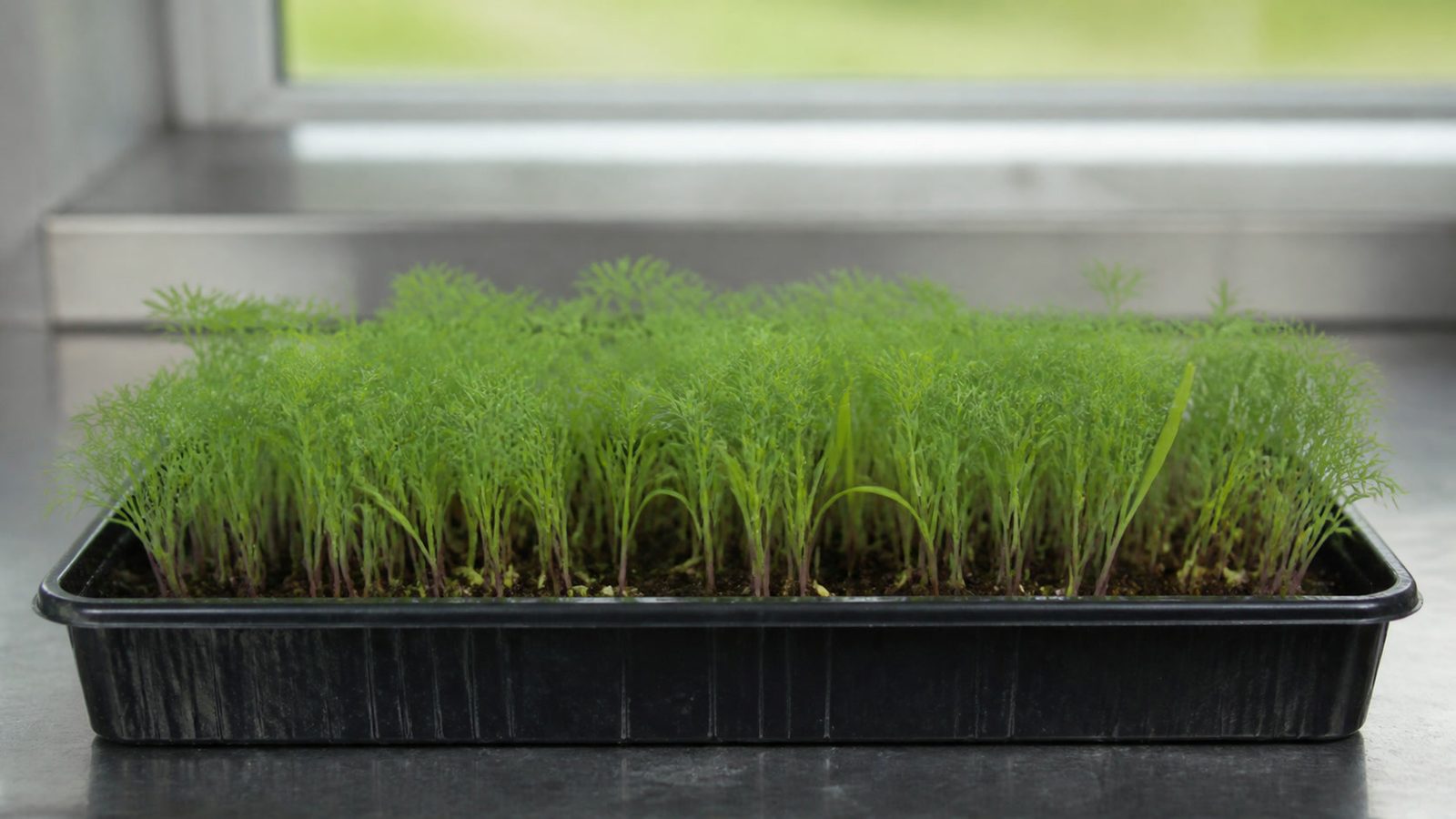
Slow uneven emergence followed by a canopy its own grow notes call extremely delicate, so the tray sits humid and covered for a long time and then bruises if you water it from above.
- Botanical name
- Anethum graveolens
- Also sold as
- Dill Microgreen Seed, Bouquet Dill
- Family
- herb
- Difficulty
- Moderate
- Days to harvest
- 12 to 25 days
- Harvest window
- No published figure
- Soak
- None
- Blackout
- 3 to 5 days
- Germination temperature
- 65 to 75 °F
- Yield per 1020 tray
- 3 to 5 oz
- Regrows after cutting
- No published figure
- Mold risk
- High
- Hull shedding
- some
- Shelf life
- 5 to 10 days
- Eaten as
- raw
- Seed cost per tray
- $0.52
10 g at $23.50/lb, Johnny's dill microgreen seed, listed 2026-08-08. One of the cheapest trays of seed you can sow. Seed only, excludes medium, tray, labor, light and loss.
Any field name above ranks every variety by it. No published figure means we researched it and nobody has established one, which is different from not yet researched. Every figure here is sourced at the bottom of the page. Compare every variety side by side.
Two suppliers sell dill microgreen seed and they disagree about the crop by ten days. One estimates 12 to 15 days to harvest. The other says 16 to 25. Both are describing a real crop, and neither states the leaf stage clearly enough to reconcile them.
What settles it comes from outside the microgreen trade entirely. An indoor grower demonstrating dill from seed, with no stake in how fast a microgreen sells, reports that seedlings emerge in one to two weeks and that after two to three weeks the plants "reclaim their signature thread-like structure of leaves." That feathery leaf is the thing a chef is buying. If the product is dill that looks like dill, the longer figure is the one to plan on, and the short estimate is describing a cut before the crop becomes recognizable.
What you are getting either way is a slow, delicate, cheap herb tray, with one caveat about its yield figure that is worth reading before you price it.
What growers are saying right now
Sampled from public posts and videos, 10 July to 9 August 2026. Every line links what it is quoting. How often something is repeated is not evidence that it is true, so every line also says what the sources actually establish.
After two to three weeks the dill plants reclaim their signature thread-like structure of leaves
Circulating An indoor grow-from-seed walkthrough at 235,728 views, also reporting emergence at one to two weeks
The most useful thing anybody said about dill this month, and it is not about microgreens at all. It independently corroborates the slow half of the supplier disagreement above. Dill's microgreen harvest is defined by that feathery leaf arriving, and an account with nothing to sell puts it at two to three weeks. How to read the timings
We prefer compact varieties such as Teddy or Thalia, because traditional dill reaches one to one and a half meters
Circulating An aeroponic grower explaining cultivar choice for vertical systems
A cultivar note nobody selling microgreen dill mentions. Height is irrelevant at day eighteen, so it does not transfer directly, but it tells you compact dill cultivars exist and are chosen deliberately for controlled environments, and that nobody has tested whether they behave differently in a tray. Which seed to buy
Do not pull your bolting dill, it means free seed
Circulating A gardener on hot weather bolting her crop at 147 likes, keeping the flowers for pollinators and the seed for next year
Worth knowing on a crop whose seed costs 52 cents a tray. Dill is among the cheapest trays you can sow, and one bolted plant makes a great deal of seed, so the economics of this crop were never going to be about the bag.
Seed heads always arrive before my cucumbers are ready, so they go in a ziplock in the freezer for pickle making
Circulating A gardener's timing workaround
The crop's culinary identity in one post. People buy dill for dill, and the microgreen is not a milder general-purpose green that happens to be dill-adjacent. Anyone who does not want the pickle note will not be won over by a smaller version of it.
What it is, and how to tell you grew it right
Dill microgreens are seedlings of Anethum graveolens, an annual Apiaceae herb, and this is a crop usually held to first true leaf rather than cut at cotyledons.
A correct tray is a low, fine-textured, medium green stand: slender pale green to green stems topped by feathery, finely divided first true leaves. Not broad, not scalloped, and not lobed. The canopy should be evenly distributed and upright enough to cut cleanly, with no collapsed, translucent or pinched stems at the medium line. Expect some dark seed hulls near the tips or on the medium on a younger tray.
Height is condition-dependent and worth not over-specifying: the general microgreen harvest range is half an inch to two inches, while a controlled study measured about 3.3 to 6.4 cm at 25 days under its own experimental systems, which is not a home-tray target.
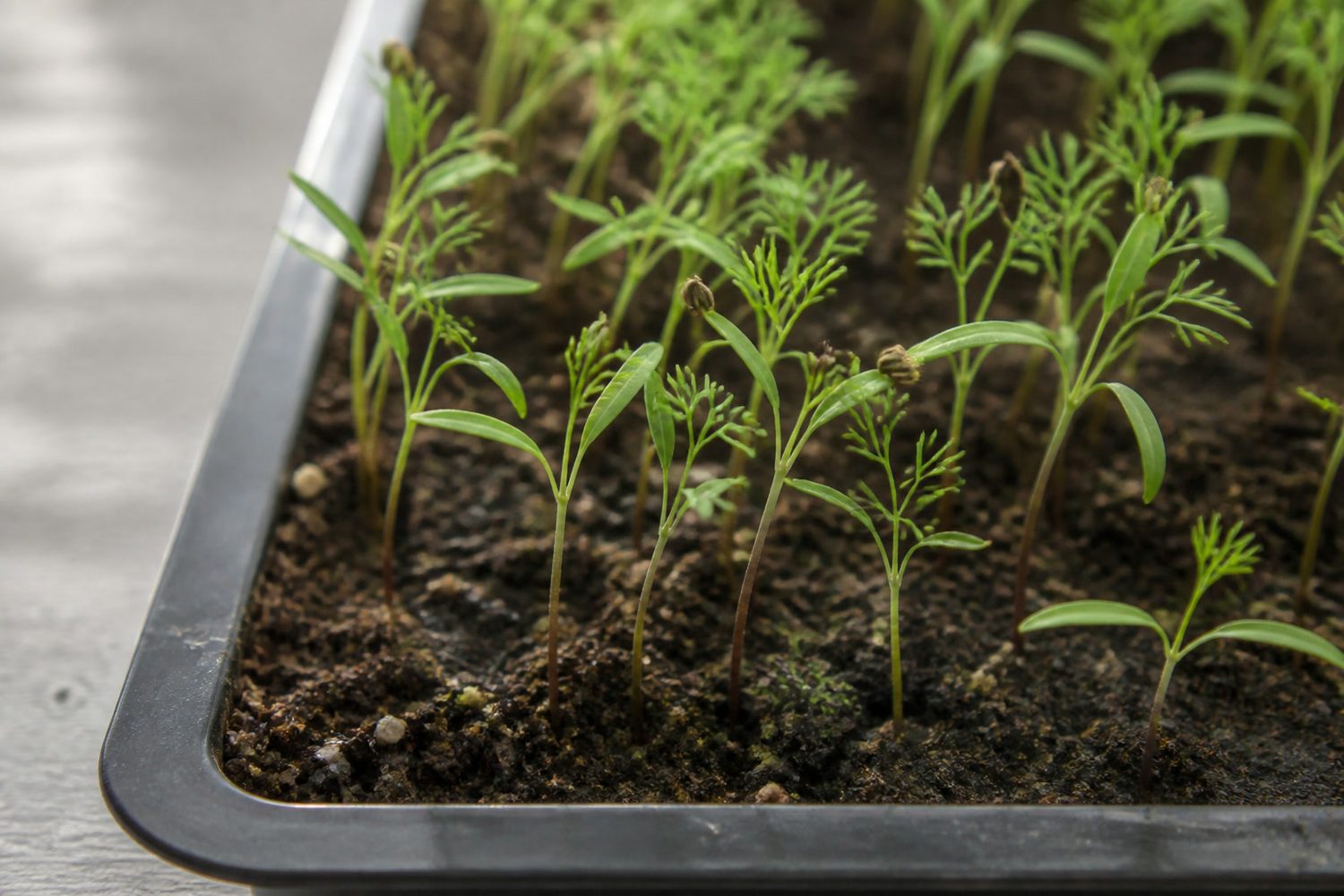
The confusion is with cilantro, and there is a clean tell for once. Wait for the first true leaf. Dill's goes fine, feathery and thread-like. Cilantro's goes divided but scalloped and lobed, never threadlike. At cotyledon stage the two are not reliably separable, so do not make the call early.
What it tastes like, and what to do with it
Mild at this stage but unmistakably dill: sweet, citrusy, an aromatic pickle and fresh-herb note. One supplier calls it mild and another calls it mild and tangy, and both are describing the same thing, which is that youth softens the intensity without changing the identity.
Use it where a small volume of aroma sits on top of finished food: cured or roasted fish, deviled eggs or egg salad, potato salad and roasted potatoes, cucumber salads, creamy soups, pickled dishes. It contributes scent rather than bulk or crunch.
It is the wrong crop as the body of a salad, as a sandwich filler, or anywhere it will be cooked hard: the fronds are very fine and bruise easily. And the audience warning is unusually clear-cut. People who dislike the mature herb's pickle aroma are not going to enjoy this, because it does not become a neutral leafy green by being young. Sell it as a labeled garnish, not hidden in a mixed salad blend where somebody meets it by accident.
Growing it: only what differs from the standard method
Everything general about trays, medium, light and watering is on the standard tray method for growing microgreens. Dill's deltas are all consequences of being slow and fragile at the same time.
Expect to wait, and decide what you are waiting for. Twelve to fifteen days by one supplier's estimate, fifteen to twenty on a grower sheet, sixteen to twenty-five on the other supplier's page. That spread is mostly about harvest stage rather than disagreement about the plant. If you want the feathery leaf, plan for the long end.
Sow dry at about 10 g per 1020. No soak. A research protocol did hydro-prime dill seed for eight hours as an experimental treatment, found no statistically significant yield benefit, and was investigating selenium biofortification rather than making a growing recommendation. Do not read it as a technique.
Three to five days of weighted or covered blackout, with an empty tray and a weight in the crop-specific sheet's method. The job is seed-to-medium contact and humidity while a slow crop anchors, not stretching stems. Uncover when most seedlings are up and pressing against the cover.
Then the thing that actually loses dill trays: keeping it wet and still while you wait. This is the crop's characteristic failure and it is a consequence of its own slowness. A grower watching a patchy tray at day eight is tempted to keep it covered and damp for the stragglers, and a warm, humid, motionless canopy on a delicate herb is precisely how the crop is described as going to mold and damping-off. Even moisture, not saturation, and get air moving as soon as it is uncovered.
Bottom water once it is established. Overhead watering flattens and dirties fronds this fine, and the canopy does not recover its look.
Keep it cooler after emergence. Warm and humid is a disease risk on this crop rather than a growth advantage, which is the opposite of the instinct a slow tray provokes.
A dill tray, week by week
- 1
Day 0, sow dry
About 10 g on leveled, pre-moistened medium, seeds an eighth to a quarter inch apart, pressed for contact and only lightly covered.
- 2
Days 1 to 5, covered
Three to five days weighted or covered. Emergence is slow and uneven and that is normal, not a signal to add water.
- 3
Uncover on emergence
When most are up and lifting the cover. From here, bottom water only and keep air moving.
- 4
Days 12 to 15, the early cut
A fine green, before the signature leaf. Saleable, and not yet distinctively dill.
- 5
Days 16 to 25, the feathery cut
The first true leaves arrive threadlike and the crop becomes recognizable. This is what a chef ordering micro dill expects.
What goes wrong with dill specifically
Slow, patchy emergence. Bare zones while a minority has sprouted, from uneven moisture, temperature, contact or a weak lot. Keep the medium evenly moist rather than saturated and check the actual temperature. Recoverable only while ungerminated seed is still viable.
Damping-off, during or just after emergence. Seedlings that never appear, root-tip rot, or water-soaked pinched stems at the medium. Pythium often begins at the root tips and wet conditions favor it. Reduce saturation, improve drainage and airflow, remove diseased material. A tray with widespread collapsed stems is not food.
Canopy mold or browning leaf tips under lights, specifically in hot, humid, low-airflow conditions. The crop's own grow notes name those conditions. Fix the air and the temperature immediately; visible spreading mold means discard rather than harvest.
An uneven, part-overmature tray. A mix of cotyledon-only seedlings and expanded feathered leaves, which is what slow uneven emergence produces at the other end. Cutting the advanced plants sacrifices uniformity; waiting for the laggards pushes the early ones past premium quality. There is no fix at harvest, only a better stand next time.
Root hair or mold on a slow, humid tray
Hover or tap a card to highlight it.
Root hair
Short fine white fuzz emerging evenly from roots at the medium, most obvious when the tray is thirsty. It stays on individual roots and does not web across stems or leaves.
Mold
Irregular cottony or web-like growth over seed, medium or stems, paired with wet or collapsing tissue, and spreading.
The test on this crop
Bottom water once and reassess. Root hairs lie down and lose their drama after rehydration; a web persists and expands.
The settled case
Pinched or rotting stems at the medium line are damping-off, not root hair, whatever color the fuzz is.
Why dill is exposed
It spends longer than most crops covered, humid and slow, which is the condition the whole complex likes.
Nutrition, and what is actually established
There is no USDA record for dill microgreens, searched 2026-08-08. Mature dill entries are not a substitute.
There is real peer-reviewed work, and it needs reading carefully because most of it is about a treatment rather than the plant. A 2024 study grew dill microgreens in a greenhouse and in an indoor farm, harvested at 25 days, and measured yield, dry matter, height, potassium, magnesium, selenium, color, chlorophylls and carotenoids, phenolics, sugars, nitrate and Brix. For the unprimed controls, potassium was 61.85 mg per gram of dry weight in the greenhouse and 48.79 indoors, with magnesium at 4.65 and 7.15 respectively.
The selenium numbers in that paper are not a fact about dill. They were created by deliberately priming seed with 1.5 or 3 mg per liter of selenium, which raised selenium to 1.00 micrograms per gram dry weight in the greenhouse and 0.72 indoors. Anyone quoting dill microgreens as a selenium source is quoting a biofortification experiment, not a crop.
There is also a cross-reference worth having. The study behind the chervil entry assessed dill alongside it, and reported that 40 g of chervil or dill microgreens could meet the 60 mg adult vitamin C reference intake that paper cites. That is a composition result for those samples under those conditions, not a serving label, and it is the closest thing to a consumer-facing nutrition figure this crop has.
What is not supported: any "X times the vitamins of mature dill" claim, any US nutrition panel for dill microgreens, and any treatment of selenium-primed plants as ordinary ones.
Which seed to buy
Two offerings exist and neither has been compared against the other.
Dill (920M) is open-pollinated, described as finely textured, medium green and feathery with a mild dill flavor, at 16 to 25 days. Bouquet Dill is a named type, sold untreated, described as feathery with a mild tangy flavor, at an estimated 12 to 15 days with 4 to 5 days blackout. No trial has grown them side by side at equal density, medium, light and harvest stage, so the day difference between them is at least as likely to be a difference in what each supplier calls harvest as a difference in the seed.
And there is a variable the microgreen suppliers never mention: compact dill cultivars like Teddy and Thalia exist, chosen by growers in vertical systems because ordinary dill runs to a meter and a half. Nobody sells them as microgreen seed and nobody has tested whether they differ in a tray, but if you are experimenting, that is where an untested variable sits.
Dill microgreen seed on Amazon is a reasonable route for a home grower. Specify Anethum graveolens sold for microgreen or food use, untreated, with a lot number and a current germination test date. Refuse seed treated with fungicide, insecticide, coating or dye for field planting, because treatments can be present in the young shoots you eat.
A bad lot is a real hazard here and it hides behind the crop's normal slowness. It shows as a low, patchy, asynchronous stand despite uniform sowing, contact, temperature and moisture, which is easy to blame on watering. One controlled study found dill had the lowest early germination of four herbal microgreens in its experiment, at 1 to 23 percent by day three depending on treatment, which shows how variable early establishment can be. Get the supplier's germination data and run a small logged test before committing several trays.
Is it worth growing?
Yes, for somebody with a dill customer, and only then.
Grow it if you sell to kitchens plating fish, eggs, potatoes, cucumber or pickles, or if you personally cook with dill often enough to use a tray. Its case is entirely flavor: it is cheap to sow at 52 cents, it is not difficult once you accept the pace, and micro dill is a thing chefs ask for by name.
Do not make it a first tray. It is slow, it emerges unevenly, its canopy is fragile, and it punishes exactly the instinct that slowness provokes. And do not grow it for volume: three to five ounces from a fortnight or more of bench is a garnish crop's return.
Its rivals are the other fine Apiaceae herbs. Cilantro wins whenever the buyer wants cilantro or the grower wants a documented benchmark, because it is the only Apiaceae crop with real trial figures behind it, at 26 g of seed and 6 oz. Fennel wins when the note wanted is anise. Dill wins when the dish needs dill, which is a narrow door and a real one.
A note on the numbers above
Hover or tap a row to highlight it.
| Figure | Value | Source | What kind of number it is |
|---|---|---|---|
| Days to harvest | 16 to 25 | Johnny's product page | To fully developed cotyledons through first true leaf |
| Days to harvest | 12 to 15 | Hoss Bouquet Dill | A supplier estimate, no leaf stage or temperature stated |
| Days to harvest | 15 to 20 | A grower production sheet | Paired with its own 10 g rate and 3 to 5 oz yield |
| Days to harvest | 14 cotyledon, 16 true leaf | A controlled-climate study | MEASURED, at a mean 22C and 65 percent RH |
| Seed per 1020 | 10 g | The same grower sheet | A starting point, not trial data |
| Seed per 1020 | No figure | Johnny's 2017 trial | Dill was not one of the 29 varieties |
| Yield per 1020 | 3 to 5 oz | The same grower sheet | An estimate. Harvest stage and environment unstated. SEE BELOW |
| Yield, measured | 599.82 g/m2 greenhouse, 1,173.2 g/m2 indoor | 2024 peer-reviewed study | Real, at 25 days in 130x70 mm boxes. NOT convertible to a 1020 |
| Soak | None | The grower sheet | An 8-hour hydro-prime in a study showed no significant yield benefit |
| Blackout | 3 to 4 days weighted, 16 lb paver | The grower sheet | Hoss instead says 4 to 5 days covered, no weight given |
| Germination temperature | 75F soil then 60F, 65 to 75F ambient | Johnny's general guidance | Not dill-specific. Above 75F, disease pressure rises |
| Shelf life | 5 to 10 days | Johnny's, and a general range | No temperature stated. 4C or below is the general recommendation |
| Harvest window | No figure | Nobody | Nobody has established it |
| Regrows | No figure | Nobody | No paired first and second cut trial exists |
| Early germination | 1 to 23 percent at day 3 | 2024 study, four herbs compared | Lowest of the four. Shows how variable establishment can be |
| Seed price | $23.50/lb | Johnny's, listed 2026-08-08 | A real current price |
| Nutrition, USDA | No record | USDA FoodData Central | Searched 2026-08-08 |
A caution about this crop's yield, and about chervil's. Dill's 3 to 5 oz comes from a grower production sheet. So does chervil's 3 to 5 oz, from the same document. The two crops are given different seed rates, 10 g against about 20 g, and different day counts, yet the identical yield range. That may simply be how both crops perform. It may also mean 3 to 5 oz is that operation's house figure for a fine herb tray rather than two independent measurements.
Nothing in the source settles which. So, treat those two rows in the table below as one document rather than two measurements, and weigh your own tray before you price either crop against them.
Where it lands.
Hover or tap a row to highlight it.
| Crop | Seed per 1020 | Yield | Days | Cost per tray | Oz per $1 | Oz per tray-day |
|---|---|---|---|---|---|---|
| Cilantro | 26 g | 6 oz | 20.0 | $1.10 | 5.4 | 0.30 |
| Parsley, Italian flat-leaf | 15 to 20 g | 6.25 oz, area-converted | 21 to 35 | $0.50 to $0.66 | 9.5 to 12.5 | 0.30 at 21 days |
| Dill | 10 g | 3 to 5 oz | 15 to 20 | $0.52 | 7.7 | 0.23 |
| Carrot | 6.2 to 9.4 g | 2.0 oz | 20.0 | $0.44 to $0.66 | 3.0 to 4.5 | 0.10 |
| Fennel | 28.3 to 43.0 g | 1.00 oz, area-converted | 16 to 25 | $1.55 to $2.36 | 0.42 | 0.04 |
All 62 crops, sortable, on the microgreen comparison.
The Apiaceae bench is now almost fully written and the pattern holds exactly. Carrot at 0.10, dill at 0.23, cilantro at 0.30, chervil at 0.38, and celery unable to complete a row at all. Five fine aromatic herbs clustered at the bottom of the table, and only one of them, cilantro, has a figure from the trade's actual yield trial. Everything else in this family rests on grower sheets and area conversions. That is not a coincidence about our research; it is what the published record looks like for slow, low-mass, low-volume crops that nobody runs trials on because a trial costs the same whatever the tray returns.
Dill's saving grace on that table is the seed price. At 52 cents a tray it is one of the cheapest crops here, so 7.7 ounces per dollar of seed puts it mid-pack on value even while it sits near the bottom on bench turnover. For a home grower with a dill habit, cheap seed and a slow tray is a perfectly reasonable trade.
Terms on this page
Tap a term to see what it means.
Apiaceae. The carrot and parsley family: dill, carrot, celery, cilantro, chervil, fennel. Fine seed, slow starts, aromatic leaves, and almost no published yield data.
Sources
- Johnny's Selected Seeds, dill microgreen seed (920M) - open-pollinated Anethum graveolens, 16 to 25 days, finely textured medium green feathery leaves, mild dill flavor with sweet citrusy notes for fish, egg and potato dishes, 1/8 to 1/4 inch spacing, 75F soil then 60F with 65 to 75F ambient and the above-75F warning, 5 to 10 refrigerated days, wash before serving, and the $23.50/lb price behind the seed cost, listed 2026-08-08.
- Hoss, Bouquet Dill microgreens - untreated A. graveolens, an estimated 12 to 15 days with 4 to 5 days germination and 4 to 5 days blackout, feathery green leaves and a mild tangy flavor.
- Vitality Farms, micro grow notes (PDF) - the dill sheet: 10 g per 1020, 15 to 20 days, 3 to 5 oz, dry sowing, 3 to 4 days stacked under a 16 lb paver, the crop described as extremely delicate, hot and humid low-airflow conditions named as the route to mold and damping-off, bottom watering typically every other day, and packaging as dry as possible with 7 to 10 days claimed.
- Sheikhi et al., 2024, Frontiers in Plant Science (PDF) - dill microgreens in greenhouse and indoor farm harvested at 25 days in 130x70 mm boxes: unprimed yields of 599.82 and 1,173.2 g/m2, potassium at 61.85 and 48.79 mg/g dry weight, magnesium at 4.65 and 7.15, selenium raised to 1.00 and 0.72 micrograms/g only by 3 mg/L priming, an 8-hour hydro-prime showing no significant yield benefit, and dill lowest of four herbs at 1 to 23 percent germination by day three.
- KSU Agricultural and Natural Sciences study (PDF) - dill cotyledon harvest at 14 days and true-leaf harvest at 16 days after sowing at a mean 22C and 65 percent RH.
- Daisy Creek Farms, how to grow dill indoors from seed - seedlings emerging at one to two weeks and the plants reclaiming their signature thread-like leaf structure at two to three weeks, which corroborates the longer supplier timing.
- Johnny's slow-growing microgreens comparison chart (PDF) - dill classified with the slow-growing herbs at 16 to 25 days.
- Johnny's microgreens yield trial results (PDF) - the 29-variety chart that contains no dill line, and the cilantro benchmark used for comparison.
- Johnny's yield trial, method and discussion - 1020 flats with seed weighed before and after sowing, first-true-leaf harvest, and the warning that one grower's yields are unlikely to transfer perfectly.
- Virginia Tech Extension SPES-756 (PDF) - uncovering when a majority has germinated, the 50 to 70 percent humidity range with airflow, density and lot testing per facility and system, and harvest timing affecting yield, shelf life and quality.
- Alberta Agriculture, microgreens postharvest (PDF) - 4C or below with rapid cooling and clean shallow packaging, most species varying between 5 and 10 days, and no unnecessary delay between washing, drying and packaging.
- SDSU Extension, growing microgreens at home - pressing small seed rather than burying it, and the warning that seed treatments may be present in the young shoots.
- UC IPM, damping-off - Pythium and Rhizoctonia, rot at or below the soil line, and Pythium commonly starting at root tips.
- USDA FoodData Central - searched for dill microgreens on 2026-08-08, no record located.
Keep reading
The variety directory
Celery microgreens
Three to four weeks of bench for a seasoning green, with an unusually complete measured nutrient panel behind it: 45.8 mg of vitamin C per 100 g, and four minerals that are higher in the mature leaf.
Read Celery microgreensThe variety directory
Chive microgreens
One of the few crops where somebody actually ran a density trial, and poor value per dollar of seed. It also competes with a perennial you buy once.
Read Chive microgreensThe variety directory
Basil microgreens
Basil is the slow one: 19 to 25.5 days to first true leaf against a brassica's twelve, on 6.5 g of seed, and the purple cultivars cost you another week. Three cultivars, three sets of measured numbers.
Read Basil microgreensThe variety directory
Borage microgreens
Borage microgreens taste of cucumber, and a 2025 study found them averaging 130 times the EU maximum for pyrrolizidine alkaloids. Use it as a garnish, not as a salad base or a juice.
Read Borage microgreens