At a glance
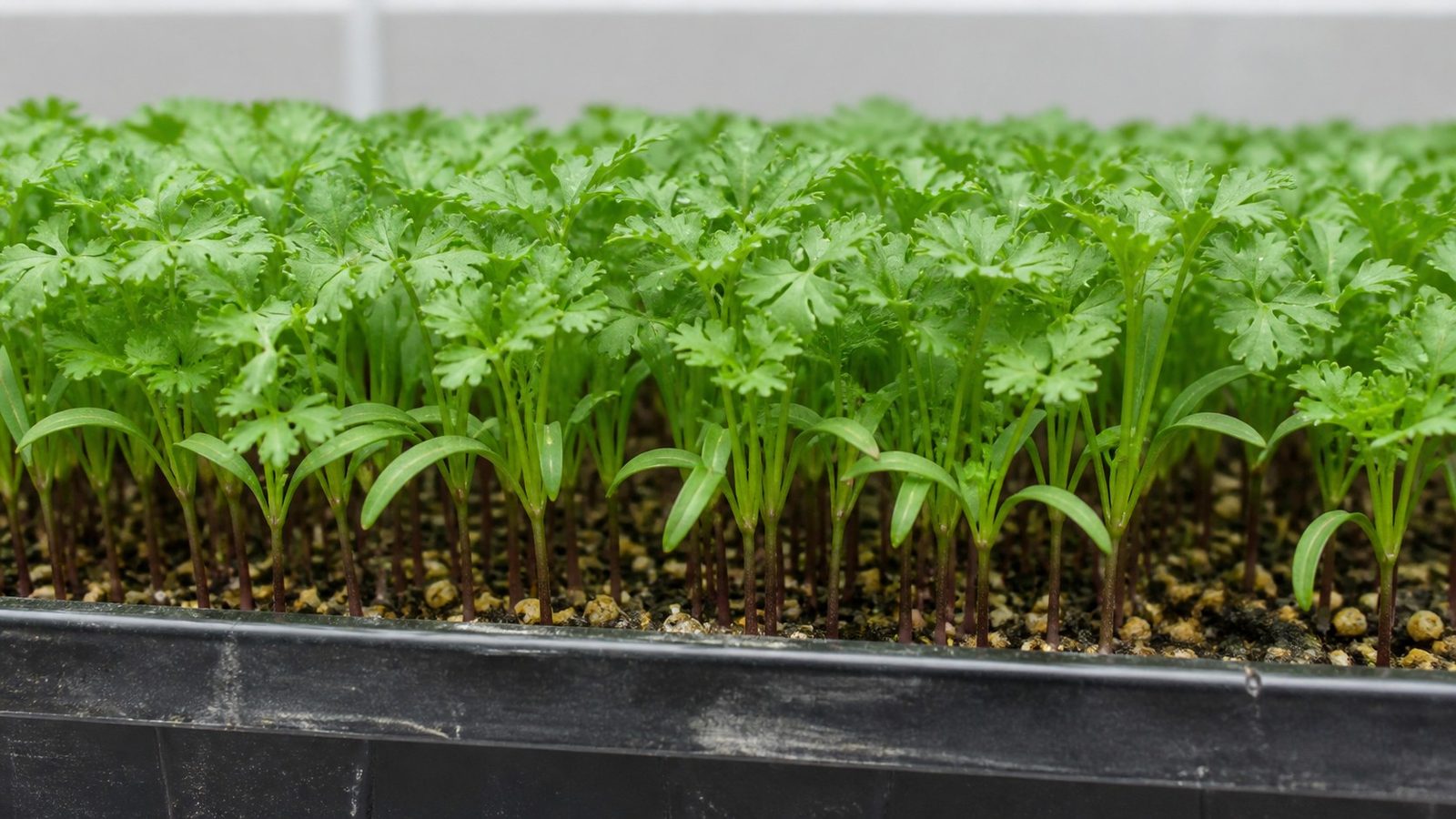
Slower and less even to emerge than a brassica, which keeps a covered tray in its wettest, most vulnerable phase for longer, but nothing about the crop itself is demanding once it is up.
- Botanical name
- Anthriscus cerefolium
- Also sold as
- Chervil, Chervil Microgreen Seed, Curled Chervil Seed
- Family
- herb
- Difficulty
- Moderate
- Days to harvest
- 9 to 21 days
- Harvest window
- No published figure
- Seed per 1020 tray
- 18.9 to 20 g
- Soak
- None
- Blackout
- 3 to 4 days
- Germination temperature
- 65 to 75 °F
- Yield per 1020 tray
- 3 to 5 oz
- Regrows after cutting
- No published figure
- Mold risk
- Medium
- Hull shedding
- No published figure
- Shelf life
- 7 to 10 days
- Eaten as
- raw
- Seed cost per tray
- $1.00
20 g at $22.74/lb, Johnny's chervil microgreen seed, listed 2026-08-08. Among the cheapest herb seed per pound, and still a dollar a tray because the rate is high. Seed only, excludes medium, tray, labor, light and loss.
Any field name above ranks every variety by it. No published figure means we researched it and nobody has established one, which is different from not yet researched. Every figure here is sourced at the bottom of the page. Compare every variety side by side.
Chervil is the crop a chef asks for by name and almost nobody grows. It is the fine French herb behind fines herbes, mild sweet anise rather than licorice, and as a microgreen it is a small, delicate, low-volume tray sold almost entirely into restaurant kitchens.
One thing about it is quietly reassuring. Chervil is absent from the trade's yield trial, as every fine herb is, but its two independent seed rates, one asserted by a working grower and one derived from a different supplier's pack-size claim, land within six percent of each other. That is not proof, and it is more agreement than celery or carrot can offer, so 19 to 20 g is a defensible place to start.
What growers are saying right now
Sampled from public posts and videos, 9 July to 8 August 2026. Every line links what it is quoting. How often something is repeated is not evidence that it is true, so every line also says what the sources actually establish.
Chervil is a crop I do not see on a lot of farms
Circulating Said by a microgreens consultant to a grower who does produce it, in the only substantive chervil growing conversation in the window
Accurate, and it explains the shape of everything below. A crop few farms run is a crop few people measure: no yield trial entry, two supplier sheets that disagree on timing, and no published harvest window, shelf-life study or regrowth data at all. What is missing
Mostly chefs, for the specialty, just a few trays right now
Circulating The same grower on who actually buys it
That is the honest market for chervil in one sentence, and it agrees with everything the crop is: mild sweet anise, fine foliage, 3 to 5 ounces a tray. Nobody is selling this by the pound to a grocery buyer.
Harvest days are the bottleneck, not the growing
Circulating The same conversation, where the grower explains he would rather cut ten trays of one crop than one tray each of ten, and the top question underneath the video is where to buy the harvester
This is the cost no yield table prices for you. Cutting a tray takes roughly the same labor whatever is in it, so a 4 oz chervil tray and an 11.5 oz broccoli tray cost the same to harvest and return very different weights. Factor your own harvest time in before you decide a light specialty crop pays. What the table does not price
What it is, and how to tell you grew it right
Chervil microgreens are seedlings of Anthriscus cerefolium, an Apiaceae herb, grown on toward recognizable true leaves rather than cut at cotyledons.
That last point is the crop. At its intended cut you want a fine, green, delicate canopy of intricate, curled, almost fernlike true leaves, not the broad paddles of a brassica. Cutting chervil early gives you a generic thin green that could be almost anything; cutting it once the curled leaf has arrived gives you something a chef recognizes across a kitchen. One supplier makes the trade explicit by quoting 12 to 14 days for the crop and up to 21 days for the curled true leaf.
Nobody publishes a harvest height, a stem thickness, a stand evenness standard or how much medium should show. Those specifications simply do not exist for this crop, and inventing a ruler measurement for it would be easy and wrong.
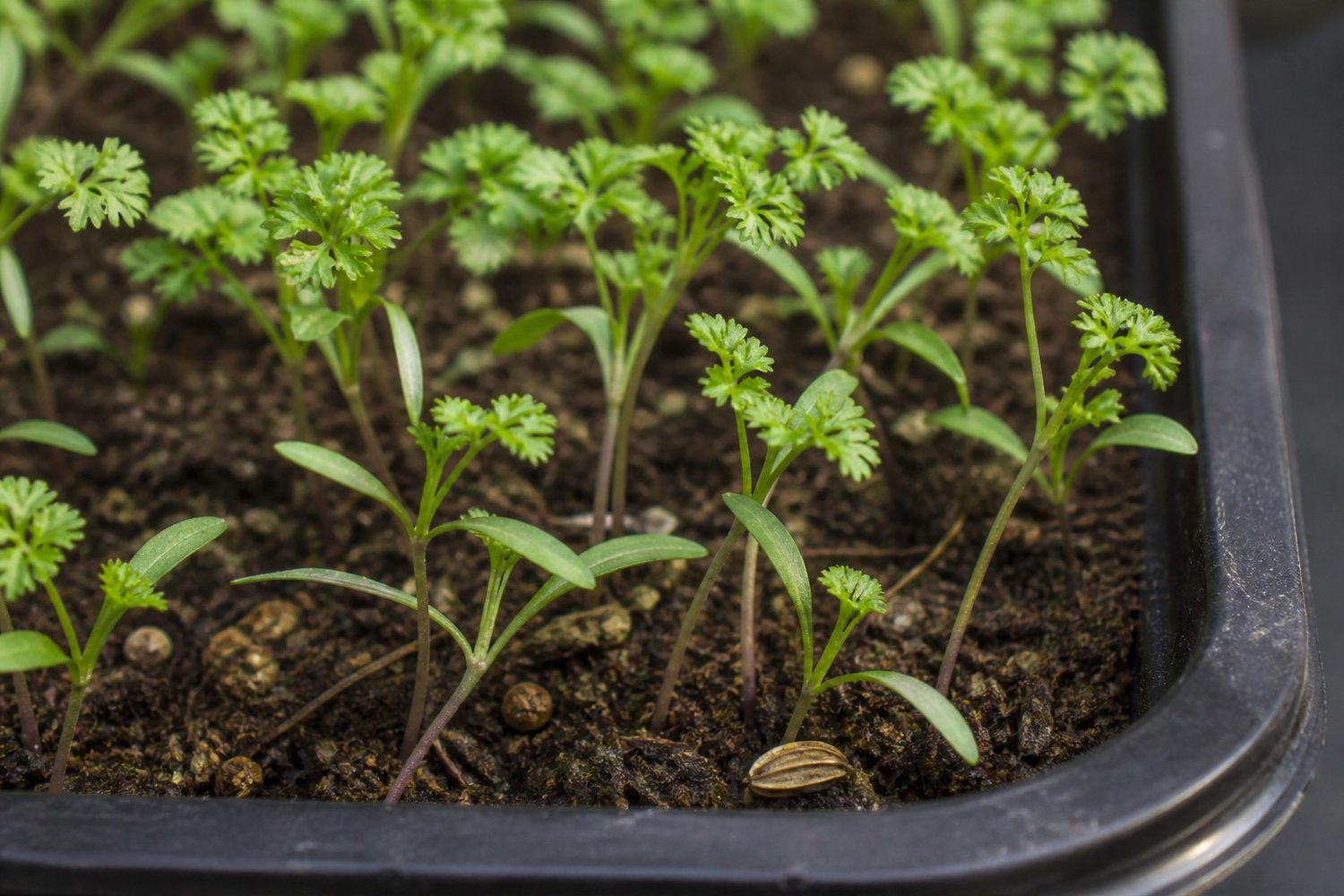
The confusion is with parsley, which is a culinary confusion more than a botanical one, and the tell is fineness: chervil's foliage is noticeably more intricate and lacier. A broad flat parsley-like leaf is not the chervil form you want. That is an inference from the supplier's own description rather than a validated identification rule, so if identity actually matters, read the bag and confirm Anthriscus cerefolium.
What it tastes like, and what to do with it
Delicate mild sweet anise. Three separate suppliers reach for the same register, and the useful clarification is what it is not: this is closer to parsley and tarragon than to licorice candy, and it is subtle where cilantro is loud.
Its job is aroma on soft, mild food at the last second. Over scrambled eggs or an omelet, on fish and seafood, with potatoes, over chicken, through a creamy soup, or folded into a cold sauce at service. It is the herb in fines herbes and it behaves that way: added at the end, in a light hand, on something that will not shout over it.
It is the wrong crop where a plate needs bulk, crunch or pepper. And it has a genuine dissenting audience: anyone who dislikes anise, licorice or tarragon-adjacent flavors will dislike this, because that note is the entire point rather than a background hint. It also disappoints anyone expecting a salad green. This is a garnish crop and its own suppliers describe it that way.
Growing it: only what differs from the standard method
Everything general about trays, medium, light and watering is on the standard tray method for growing microgreens. Chervil's deltas are few, and the biggest one is a decision rather than a technique.
Decide which crop you are growing before you sow. Nine to twelve days gives you a fine green. Twelve to fourteen is the standard cut. Up to twenty-one gives you the curled true leaf that makes it look and read as chervil. Those are three different products from one tray and the price a chef will pay is not the same for all of them. Pick the target, then judge the tray against the leaf rather than the calendar.
No soak. Both crop sheets say so in the same word. Sow dry seed into evenly moist medium. Nothing establishes a soak duration, temperature or benefit for chervil in either direction, and pre-wetting seed only adds moisture to a crop whose main risk is a long damp start.
Sow at 19 to 20 g per 1020, and take the agreement for what it is. One working grower asserts 20 g. A different supplier sells an ounce as enough for three 10x10 trays, which scales to about 18.9 g for a 1020. Two sources, two methods, six percent apart. That is not a trial and it is not nothing: on most specialty crops you cannot find two independent numbers that agree at all. Start at the lower end if your seed germinates well or you are growing on to the longer true-leaf cut, and move up only after a test tray comes out even and dry.
Three to four days stacked under weight, then light. The documented protocol uses an empty tray with a 16 lb paver on top for three to four days. The weight is for firm seed-to-medium contact and even emergence, not for building stems. Take it off at three to four days, or when the tray is pushing the cover up uniformly.
Then patience and airflow, for about eight more days. The crop sheet's instruction is to keep even moisture and maintain good airflow while watching for mold, and that is the whole of it. There is no published chervil light level, photoperiod, irrigation volume or airflow rate, so work from your general room settings and treat a precise chervil-specific figure from anywhere as unsourced. Bottom water once it is rooted, and keep water off the foliage.
Level the medium before you sow. Unevenly scattered seed on an uneven surface makes wet pockets, and wet pockets in a slow crop are where this one fails.
A chervil tray, day by day
- 1
Day 0, sow dry
About 19 to 20 g broadcast on leveled, pre-moistened medium, seeds an eighth to a quarter inch apart, pressed firm for contact and only lightly covered.
- 2
Days 1 to 4, stacked under weight
An empty tray with roughly 16 lb on top. Contact and evenness, not stem forcing. Off at day 3 or 4, or when the tray lifts the cover uniformly.
- 3
Days 4 to 12, under light
Even moisture, real airflow, bottom watering. About eight days here in the documented protocol. Slower and less uniform than a brassica, and that is normal.
- 4
Days 9 to 14, the early cuts
A fine green. Perfectly usable, and not yet distinctively chervil.
- 5
Days 14 to 21, the curled true leaf
What a chef is actually buying. Longer bench, better product, and the choice is yours rather than the crop's.
What goes wrong with chervil specifically
Three failures, and all of them trace to the same cause: a slow crop spends longer in the wet phase than a fast one.
Before emergence, gaps and seed rot. An overly wet, slow germination leaves bare patches, and the early sign is simply that emergence is not uniform when it should be. Improve drainage, temperature, seed contact and sanitation. A tray with widespread seed rot is not recoverable as food.
During emergence, damping-off. Stems collapse or rot at or below the medium line, and Pythium often starts at the root tips. Get the wet cover off, correct irrigation and airflow, and discard badly affected trays rather than selling around the damage.
While growing, surface mold and mildew. Patchy aerial growth or a spreading gray-white film under high humidity. The crop sheet's own instruction is to maintain airflow and watch for it, which is a fair signal about where this crop's risk actually sits. Correct it immediately, and do not market a visibly moldy tray.
There is no chervil-specific pest or pathogen, and nothing opened for this page names one. The risks are the general ones: in a moist microgreen room, damping-off and mildews, answered by sanitation and environmental control. Do not go looking for a chervil disease list, because there is not one.
Root hairs or mold? What actually discriminates
Hover or tap a card to highlight it.
Where it starts
Root hairs trace individual roots, short and evenly radial, concentrated where root meets moist medium. Follow the growth back to its origin before deciding.
What spreading looks like
Mold forms a cottony network that bridges between plants and expands across seed, medium and stems as a mat. Root hairs never bridge.
The stem check
If stems are pinched or rotting at the medium line, the question is settled and it is not root hair. That is damping-off and a food-safety problem.
Where it stops
A grower's diagnostic, not an identification, and no chervil-specific validation exists. On a food crop, let unresolved doubt resolve toward discarding.
Nutrition, and what is actually established
There is no USDA record for chervil microgreens, so there is no identifier and no nutrient panel to publish. Mature chervil entries are not a substitute for a two-week seedling.
There is, however, real peer-reviewed work on this exact crop. A 2022 study assessed chervil microgreens alongside anise, caraway and dill, in three replicates, measuring fresh yield, macro and micro minerals, total chlorophylls, ascorbic acid, carotenoids, polyphenols and antioxidant activity. Its most quotable result is that 40 g of chervil or dill microgreens could meet the 60 mg adult vitamin C reference intake the paper cites.
That is a genuine measurement and it is worth stating precisely, because it will be misquoted. It is a composition result for the samples that study grew, under its conditions, at its harvest stage. It is not a serving label, it is not a medical claim, and it does not transfer automatically to your tray or to a clamshell in a shop.
What is not supported is the retail language you will meet around this crop: that chervil microgreens are high in vitamins A, C and E and in iron, zinc, potassium, copper, calcium and magnesium. No opened source establishes that as a general claim across lots, harvest stages and growing systems, and the study above certainly does not. It measured composition; it did not issue a nutrition panel.
Which seed to buy
Three suppliers sell it and none of them names a cultivar.
The offerings are an open-pollinated Chervil described as mild sweet anise with intricate green leaves and stems, a second Chervil described as delicate with a hint of anise, and a Curled Chervil described as mild licorice or anise. No page anywhere gives a cultivar comparison for stem length, color, days or yield. The only real differentiation on offer is that curled-true-leaf timing of up to 21 days, and that is a harvest decision rather than a genetic one.
Chervil microgreens seed on Amazon is a workable route for a home grower. Checked on 2026-08-08, that search does return seed sold for microgreen and herb growing rather than only garden packets, which is worth confirming yourself, because on some crops the same search returns nothing but ornamental flower seed.
Specify untreated seed intended for food or microgreen production, the botanical name Anthriscus cerefolium, a lot number, a pack date if available, and a stated germination test. Refuse dyed, fungicide-treated, insecticide-treated or preservative-treated field seed, because the shoots are what you eat and treatments can be present in them. Organic is a useful sourcing preference and it is not the same check as untreated.
A bad lot shows as a sparse, delayed or uneven tray despite correct moisture and temperature, often with dead seed sitting in the gaps. On a delicate crop every missing plant is conspicuous, and the cost is bench time rather than seed: chervil is the cheapest herb seed per pound in this directory at $22.74, so a failed tray wastes a dollar of seed and two weeks of a rack position. Nobody publishes a chervil germination threshold or lot-failure rate, so run a small tray before committing a wave and keep the lot number.
Is it worth growing?
Yes, for a narrow and real market, and the grower quoted at the top of this page is the model: a few trays, mostly for chefs.
Grow it if you sell to kitchens that cook French, or that plate eggs, fish, potatoes and cream sauces and want the herb that belongs on them. Grow it if you are a home cook who will actually use it within the week. It is a genuine specialty: a chef who wants chervil cannot readily substitute anything, which is a stronger commercial position than most crops on this bench can claim.
Do not grow it as a first tray, and do not grow it to sell by weight. Three to five ounces from a fortnight of bench is a weak return, there is no trial benchmark to price against, and the yield figure you do have is one grower's assertion.
Its tray-slot rivals are parsley when the buyer wants a familiar garnish and cilantro when they want a louder, more recognizable herb. Both beat it on speed and on volume, and cilantro beats it decisively on evidence, being the one Apiaceae crop with real trial numbers. Chervil wins only where its exact mild sweet anise and lacy leaf are the requirement, and that is a smaller door than it sounds, but it is a door nothing else fits through.
A note on the numbers above
Hover or tap a row to highlight it.
| Figure | Value | Source | What kind of number it is |
|---|---|---|---|
| Days to harvest | 9 to 12 | One grower sheet | Paired with its own 20 g rate and 3 to 5 oz yield. No temperature, no leaf stage |
| Days to harvest | 12 to 14, up to 21 | A second supplier | 21 days specifically for the curled true leaf |
| Days to harvest | No figure | Johnny's 2017 trial | Chervil was not one of the 29 varieties |
| Seed per 1020 | 20 g | The same grower sheet | Asserted, not trialed |
| Seed per 1020 | About 18.9 g | Area-scaled from a second supplier | 1 oz stated as three 10x10 trays. Independent method, 6 percent apart |
| Yield per 1020 | 3 to 5 oz | The same grower sheet | Asserted planning range. No replicates, substrate or harvest stage |
| Yield per 1020 | Would scale to 6 to 8 oz | A second supplier's 10x10 figure | Methodologically incompatible. NOT averaged in |
| Soak | None | Both crop sheets | Explicit, and they agree |
| Blackout | 3 to 4 days, 16 lb | The same grower sheet | For contact and evenness, not stem forcing |
| Germination temperature | 75F soil then 60F | Johnny's | The supplier's general microgreen instruction, not chervil-specific |
| Shelf life | About 7 to 10 days | The same grower sheet | Bagged with paper towel, packed dry. Temperature NOT stated |
| Seed price | $22.74/lb | Johnny's, listed 2026-08-08 | A real current price, and the cheapest herb seed here |
| Harvest window | No figure | Nobody | Nobody has established it |
| Regrows | No figure | Nobody | No second-cut report exists for a tray |
| Hull shedding | No figure | Nobody | A real seed coat crop, and nobody has measured retention |
| Vitamin C | 40 g could meet a 60 mg reference intake | Giordano et al. 2022, 3 replicates | Measured composition, that study's samples and conditions |
| Nutrition, USDA | No record | USDA FoodData Central | No chervil microgreen entry located |
Two sources agreeing is worth more than one source being confident. Chervil's 18.9 to 20 g comes from a grower's asserted rate and, separately, from area-scaling a supplier's pack-size claim. Different people, different methods, six percent apart. Compare celery, whose only rate is arithmetic from a spacing instruction, or celosia, whose only rate is one filmed tray. None of the three is a trial. Chervil's is the sturdiest of them, and it is still an operator number rather than a measurement.
The yield is not, and it is the weakest figure on this page. Three to five ounces is asserted by the same sheet, with no replicates, no substrate, no temperature and no stated harvest stage, and the crop's harvest stage is precisely the variable that matters, since the same tray can be cut at day 9 or day 21. And that same grower sheet gives dill the identical 3 to 5 oz range, at half the seed rate and a different day count. That may be how both crops perform, or 3 to 5 oz may be the operation's house figure for a fine herb tray rather than two independent measurements. Nothing in the source settles it, so treat the two as one document rather than as two measurements agreeing. A second supplier's 10x10 result would scale to 6 to 8 oz, nearly double, and averaging two incompatible methods would only manufacture false precision. Weigh your own.
Where it lands, and the column nobody is pricing.
Hover or tap a row to highlight it.
| Crop | Seed per 1020 | Yield | Days | Cost per tray | Oz per $1 | Oz per tray-day |
|---|---|---|---|---|---|---|
| Chervil | 18.9 to 20 g | 3 to 5 oz | 9 to 12 | $1.00 | 4.0 | 0.38 |
| Cilantro | 26 g | 6 oz | 20.0 | $1.10 | 5.4 | 0.30 |
| Parsley, Italian flat-leaf | 15 to 20 g | 6.25 oz, area-converted | 21 to 35 | $0.50 to $0.66 | 9.5 to 12.5 | 0.30 at 21 days |
| Dill | 10 g | 3 to 5 oz | 15 to 20 | $0.52 | 7.7 | 0.23 |
| Carrot | 6.2 to 9.4 g | 2.0 oz | 20.0 | $0.44 to $0.66 | 3.0 to 4.5 | 0.10 |
All 62 crops, sortable, on the microgreen comparison.
Chervil lands mid-table and comfortably ahead of cilantro, which is a genuinely surprising result: the obscure French herb turns its bench over faster than the herb everybody grows, because it is cut in nine to twelve days rather than twenty. Read the row against clover, which is nearly identical on every column, and the difference between them is not agronomy. It is that a chef will pay a specialty price for chervil.
And there is a cost no comparison table carries. Harvest labor. Cutting a tray takes roughly the same time whatever is growing in it, so a 4 oz chervil tray and an 11.5 oz broccoli tray cost about the same to harvest and pack. On the ounces-per-tray-day column chervil trails broccoli by a factor of two and a half; on labor per saleable ounce the gap is nearly three to one, and none of that is visible here. Every specialty crop on this bench carries that hidden cost, and it is the reason a real farm runs a few trays of chervil for chefs rather than a rack of it.
Terms on this page
Tap a term to see what it means.
Fines herbes. The classic French blend of chervil, parsley, tarragon and chives, added at the end of cooking. Chervil's culinary home, and why chefs ask for it by name.
Sources
- Johnny's Selected Seeds, chervil microgreen seed (2441M) - Anthriscus cerefolium, open-pollinated, mild sweet anise, intricate green leaves and stems, the egg, potato, fish and poultry uses, 1/8 to 1/4 inch spacing with firm pressing and a light cover, bottom watering to avoid splashing, 75F soil then 60F with 65 to 75F ambient, the above-75F warning, and the $22.74/lb price behind the seed cost, listed 2026-08-08.
- Vitality Farms, micro grow notes (PDF) - the chervil sheet: 20 g per 1020, 9 to 12 days, 3 to 5 oz, no soak, 3 to 4 days stacked under a 16 lb paver, about 8 days under lights, maintain moisture and airflow and watch for mold, roughly 7 to 10 days bagged with paper towel packed dry, and washing not recommended when cutting from soil.
- Great Northern Microgreens, curled chervil seed - 12 to 14 days seed to harvest and up to 21 days for the curled true leaf, mild licorice or anise, no soak, small-seed classification, and 1 oz stated as planting three 10x10 trays.
- Mumm's Sprouting Seeds, chervil - delicate flavor with a hint of anise.
- Microgreens Consulting, chervil, cilantro and cantaloupe with a working grower - chervil as a crop rarely seen on farms, sold mostly to chefs as a specialty in a few trays, and harvest days as the farm's real bottleneck.
- Johnny's microgreens yield trial results (PDF) - the 29-variety chart that contains no chervil line.
- Johnny's yield trial, method and discussion - harvest at first true leaf, and the warning that yield shifts with procedure, system, conditions, harvest stage and seed lot.
- Virginia Tech Extension SPES-756 (PDF) - the 60 to 70F and 50 to 70 percent humidity general range, and the instruction to test density per species, cultivar, substrate and facility.
- UC IPM, damping-off - Pythium and Rhizoctonia, collapse at or below the medium line, and Pythium beginning at root tips.
- Giordano et al., Plants, 2022 - chervil microgreens assessed with anise, caraway and dill in three replicates for fresh yield, minerals, chlorophylls, ascorbic acid, carotenoids, polyphenols and antioxidant activity, including the finding that 40 g could meet a cited 60 mg adult vitamin C reference intake. Open-access record.
- Journal of Food Science, microgreen storage review - storage at 5C or below as general microgreen guidance, not chervil-specific.
- SDSU Extension, growing microgreens at home - seed treatments may be present in the shoots and should not be consumed.
- USDA FoodData Central - searched 2026-08-08, no chervil microgreen record located.
Keep reading
The variety directory
Dill microgreens
Two suppliers disagree by ten days on when to cut it, and an indoor grower with no stake in the argument settles it. Plus why dill's yield figure should be read alongside chervil's.
Read Dill microgreensThe variety directory
Celery microgreens
Three to four weeks of bench for a seasoning green, with an unusually complete measured nutrient panel behind it: 45.8 mg of vitamin C per 100 g, and four minerals that are higher in the mature leaf.
Read Celery microgreensThe variety directory
Borage microgreens
Borage microgreens taste of cucumber, and a 2025 study found them averaging 130 times the EU maximum for pyrrolizidine alkaloids. Use it as a garnish, not as a salad base or a juice.
Read Borage microgreensThe variety directory
Celosia microgreens
A color crop whose entire measured record is a single YouTube video: 8 g of seed, 3.4 oz, 13 days. Bought for pink and orange stems, never for weight.
Read Celosia microgreens