At a glance
A large, rough, irregular seed that needs several times the spacing of a brassica and carried among the highest microbial loads of 102 seed types surveyed, so sanitation, room and airflow matter more than technique does.
- Botanical name
- Borago officinalis
- Also sold as
- Borage, Borage microgreen seed
- Family
- borage
- Difficulty
- Moderate
- Days to harvest
- 10 to 21 days
- Harvest window
- No published figure
- Seed per 1020 tray
- 24.6 to 36 g
- Soak
- None
- Blackout
- 2 to 5 days
- Germination temperature
- 65 to 75 °F
- Yield per 1020 tray
- 8.05 oz
- Regrows after cutting
- No published figure
- Mold risk
- High
- Hull shedding
- some
- Shelf life
- 5 to 10 days
- Eaten as
- raw
- Seed cost per tray
- $3.94
36 g at $49.60/lb, Johnny's borage microgreen seed, listed 2026-08-08. Superseded repeatedly through 2026-08-09: endive, barley grass, popcorn shoots, mung bean shoots, nasturtium and chickpea shoots all sit above it, and shiso ties it exactly, so borage is now JOINT SEVENTH rather than third. Re-rank this against the comparison table rather than trusting this line. At the study-derived 24.6 g rate it is $2.70. Seed only, excludes medium, tray, labor, light and loss.
Any field name above ranks every variety by it. No published figure means we researched it and nobody has established one, which is different from not yet researched. Every figure here is sourced at the bottom of the page. Compare every variety side by side.
Borage tastes convincingly of cucumber, which is a genuinely useful thing for a tray crop to do.
Before anything else, the thing you should know before you eat it. A 2025 study measured 106 borage leaf samples and found the microgreens averaging 130 times the maximum level the EU sets for pyrrolizidine alkaloids in food. Those are compounds borage naturally makes, and they are regulated precisely because they are not something you want a lot of.
That does not mean a leaf on your soup will hurt you. Nobody has measured what a single serving does, so the honest answer about your own risk is that it is not known. It does mean this: use borage the way chefs already do, as a small garnish, and do not eat it by the handful, juice it, or make it a daily green. If you want something to eat every day, there are eight better crops in this directory and every one of them is cheaper.
Most borage content treats it purely as a superfood garnish and does not mention the finding at all, which is why it is stated up here rather than further down. there is no seed affiliate link anywhere on it, which is explained at the bottom.
What growers are saying right now
Sampled from public posts and videos, 9 July to 8 August 2026. Every line links what it is quoting. How often something is repeated is not evidence that it is true, so every line also says what the sources actually establish.
This plant does everything
Circulating The title of the largest borage video in the window at 194,281 views, with a second guide at 136,274 making much the same case
Both are about the garden plant and both are reasonable on their own terms. What neither mentions, and what nothing in this month's borage conversation mentions anywhere, is the 2025 study that measured pyrrolizidine alkaloids across 106 borage leaf samples and found the microgreens strikingly high, averaging 130 times the cited EU maximum. The silence is the finding here. What is actually established
Tiny greens, big health impact
Circulating A borage microgreen video making the wellness pitch directly
There is no USDA FoodData Central record for borage microgreens at all. The one controlled trial measured yield, dry matter and fourteen minerals, and separately classified borage's nitrate as high, in the 1,000 to 2,500 mg/kg fresh weight band. It did not measure the B, C and K vitamins that the retail claim usually names. The health pitch on this crop borrows the mature herb's reputation; it does not rest on a measurement of the microgreen.
It tastes exactly like cucumber
Circulating A seed company saying so and a grower repeating it
Accurate, and the most reliable thing anyone says about borage. Johnny's calls it mild cucumber and the extension description of the mature herb agrees. What both leave out is the texture: borage is bristly, and the fine hairs are noticeable in the mouth. It is a cucumber flavor on a furry leaf, which is exactly why it works as a garnish and fails as a salad base. What it tastes like
The borage has taken over
Circulating An allotment grower watching it spread, 100 likes on 782 views and the highest engagement ratio of any borage post in the window
A garden observation with a direct tray consequence. Borage seed is large, about 19 grams per thousand, and the controlled trial sowed it at one seed per square centimeter against two to four for the brassicas in the same experiment. It needs room. A grower who scatters it like broccoli does not get a dense tray, they get a crowded wet one. Growing it
Nobody in r/microgreens is growing it
Circulating Seventeen threads came back from the sub and not one is borage. What came back instead is sunflower at 28 comments, broccoli root hairs, monsoon mold and a soilless medium thread at 30 comments
Consistent with the economics. Borage is among the priciest trays of seed here at $2.70 to $3.94, third behind barley grass and chickpea shoots as of 2026-08-09, and returns 2.0 to 3.0 ounces per dollar, which was the weakest measured figure when this page was written and has since been passed by chives at 1.7 and fennel at 0.42. Corrected 2026-08-08. Its case is flavor and novelty for a chef rather than volume, and a month of silence in the growers' room is what that looks like from the inside.
What it is, and how to tell you grew it right
Borage microgreens are seedlings of Borago officinalis, the garden herb, cut at the cotyledon or very early true-leaf stage. There are no named microgreen cultivars: every supplier opened for this page sells generic open-pollinated borage, so there is nothing to choose between beyond seed quality.
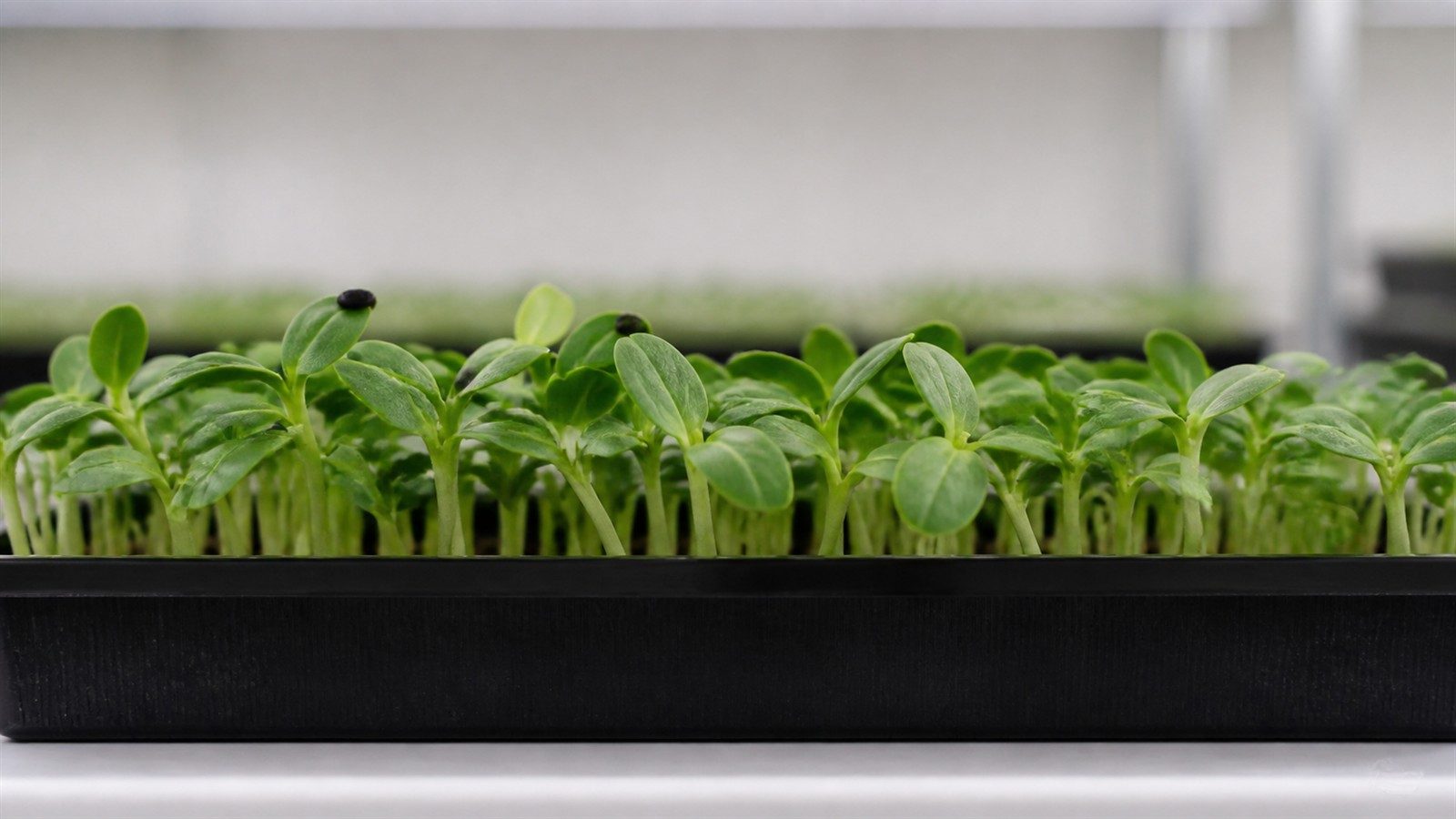
A correct tray looks unlike anything else in this directory. It is a relatively open stand of broad, thick, oval cotyledons on pale green stems, with visible medium between plants rather than a closed carpet. That openness is correct rather than a failure, and it follows directly from the seed being large enough to need the space.
Two features identify it immediately. Fine bristly hairs are visible on the leaves and stems, which is the same coarse hairiness the mature plant is known for. And black seed hulls stay attached, visibly, on a fair number of plants. Both show clearly in supplier photographs. Below the canopy you should see a dense white root mat, and the canopy itself should be green rather than the pale yellow of a tray held covered too long.
If it is confused with anything, it is another broad-cotyledon green in a mixed tray, and the hairs plus the retained dark hulls settle it. Do not try to identify it by cucumber smell before cutting.
What it tastes like, and what to do with it
Mild, juicy, unmistakably cucumber. It is one of the few crops here whose flavor is a genuine surprise rather than a variation on green, and that is the entire reason a chef would order it.
The texture is the other half of the story and it is rarely mentioned. Borage is furry. The fine hairs that identify it visually are also noticeable in the mouth, and that is a fixed property of the crop rather than something you can grow out of it. A cucumber flavor on a slightly bristly leaf is delightful in small amounts and tiring in large ones.
So, use it in small amounts where the cucumber note earns its place: on a chilled soup, with seafood, on an open sandwich, or folded through a creamy dip. It is a poor choice as the base of a large raw salad, both because of the texture and because of the alkaloid measurement below, which argues against concentrating intake of this particular crop.
The people who will not like it are those who dislike a fuzzy leaf, and anyone expecting the crisp smoothness that the word cucumber implies.
Growing it: only what differs from the standard method
Everything general about trays, medium, light and watering is on the standard tray method for growing microgreens. Borage's departures all follow from one thing: the seed is large, rough, and carries an unusually heavy microbial load.
Give it room, which is the opposite of the usual instruction. The controlled trial sowed borage at one seed per square centimeter while the brassicas in the same experiment ran at two to four. In tray terms that is about 24.6 g per 1020, converted from the trial's density and seed weight, against a supplier's stated 36 g. Start nearer the lower figure if you are cutting at first true leaf or your airflow is limited, and only move up after a clean, even test tray. Broad thick cotyledons need physical space, and a crowded borage tray traps moisture around exactly the seed that is least able to tolerate it.
Do not soak it. One supplier states plainly: pre-soak, no. Nothing opened here establishes a useful plain-water soak time or temperature for borage. A study did test a decontamination treatment, ten minutes in 3 percent hydrogen peroxide followed by 60°C heat for 20 hours, which reduced microbial populations without significantly harming germination. That is a laboratory protocol, not a home soaking instruction, and it should not be adapted casually.
Surface sow with visible medium between seeds, press for contact, and cover only briefly. Two days of cover is the crop-specific starting point, with one supplier allowing two to five. The cover exists for seed-to-medium contact and to send roots down, not to stretch the crop. Take it off when seedlings are rooted and lifting it; holding it longer adds humidity to the one crop here that can least afford it. No borage-specific weight in pounds is published, so anyone quoting you one is quoting a preference.
Then bottom water and keep the canopy dry. Adding water during the covered period is specifically called out as raising mold risk. Once rooted, water from below rather than repeatedly wetting the foliage and those rough hulls.
Sanitation is not a generic aside on this crop. In a survey of 102 seed samples, borage carried among the highest aerobic plate counts and the highest coliform population of the set, and its irregular rough surface was specifically noted as the likely reason. That is a measured property of the seed rather than a warning about carelessness, and it is why clean seed, clean trays, clean water, drainage and airflow matter more here than the technique does.
A borage tray, day by day
- 1
Day 0, sow dry
24.6 to 36 g surface sown with visible medium between seeds, pressed for contact, not buried. No soak.
- 2
Days 1 to 2, covered
A brief cover for contact and downward rooting. Do NOT add water during this phase; it is named as a mold risk on this crop.
- 3
Day 2 to 5, uncover
When seedlings are rooted, above about a centimeter, and lifting the cover. Longer adds humidity rather than useful resistance.
- 4
After uncovering
Bottom water only, so the foliage and the rough hulls are not repeatedly wetted. Keep air moving. 65 to 75°F ambient, and above 75°F raises disease pressure.
- 5
Days 10 to 21, cut
Four sources give four answers. The controlled trial cut at 12 days, at fully expanded colored turgid cotyledons with true leaves just beginning, which is the stage its yield figure belongs to.
What goes wrong with borage specifically
Seed-zone mold during the covered period. Gray or white growth concentrated on the hulls, or a sour, slimy seed zone. The cause is the combination this crop is built for: rough high-load seed plus humidity plus any added water. Uncover, improve airflow, stop saturating, and bottom water once rooted. A tray with mold spreading through the canopy is not a raw food crop to rescue.
Damping-off before or after emergence. Seed that never comes up, or stems pinching and rotting at or below the medium line, then collapse. Pythium and Rhizoctonia are the usual agents and affected plants do not recover.
A crowded, weak canopy. Cotyledons overlapping before they have greened, with the medium staying wet underneath. This is a sowing-rate failure rather than a watering one, and it is not really fixable mid-crop. Harvest early where the tray is clean.
Retained black hulls. Photographs confirm they stay on a fair number of plants, and no source quantifies the rate. The brief cover helps establish contact but nothing published shows that any particular weight solves the problem, so budget for picking them out rather than expecting a technique to do it.
A late, coarser crop. True leaves advancing and the canopy turning more textured and bristly. This is quality loss rather than disease, and the honest note is that borage gets hairier as it ages, which matters more on a crop whose texture is already its main drawback.
Root hairs against mold, with a borage-specific instruction. Use the mist test: root hairs are fine, bright, uniform fuzz at the roots that lose their fuzzy look when misted, while mold stays gray and web-like, bridges between seeds and stems, and does not vanish when wet. On this crop, inspect the retained black hulls particularly closely, because that is where growth concentrates and where the two are easiest to confuse.
Nutrition, and what is actually established
There is no borage microgreen record in USDA FoodData Central. The database does hold mature borage, raw, at FDC ID 170481, and a cooked entry, and neither is a substitute for the microgreen.
What was measured. A controlled Florida greenhouse trial grew borage on felt mats with a macronutrient solution and harvested at 12 days, at fully expanded colored turgid cotyledons with true leaves just beginning. It reported 1,766.8 g per square meter fresh yield, 44.07 g dry matter per kg, and fresh-weight minerals including potassium at 187.50 mg/100 g, calcium at 42.68, iron at 0.411 and zinc at 0.397. It also classified borage's nitrate as high, in the 1,000 to 2,500 mg/kg fresh weight band, without publishing an exact borage value in its displayed table.
What the alkaloid study measured
A 2025 study analyzed 106 borage leaf samples for pyrrolizidine alkaloids and found the microgreens carried strikingly high content: on average 130 times the maximum level the EU sets for these compounds in food.
Here is what that sentence means in ordinary terms, because a number like that is useless if it is not unpacked.
Pyrrolizidine alkaloids are compounds the plant makes, and they are regulated. The European Union sets maximum levels for them in food, which is not something regulators do casually. Borage is a known PA-containing plant, and that is why the limit exists and why anyone thought to measure this crop in the first place.
A hundred and thirty times a regulatory maximum is a large exceedance. Not a rounding error, not a borderline result, and not something to describe as "may contain trace amounts". It is the honest headline of this page and it belongs in the first screen, which is why it is there.
What the study does not tell you is how much matters for you. It measured what is in the plant. It did not measure what happens to a person who eats a pinch of borage on a soup, and this page has no basis to convert a concentration into a dose or to tell you a safe frequency. Anyone who gives you a precise safe amount for borage microgreens is making it up, including us if we tried.
So, here is the practical guidance, and it is the same conclusion the growing world already reached for other reasons. Use borage as a garnish, in the small amounts every supplier already describes. Do not use it as a salad base, do not juice it, and do not treat it as a daily green. If you want a green to eat by the handful every day, this directory has eight better options and they are all cheaper.
And be sceptical of the health claims, because they run the other way. That borage microgreens are high in vitamins B, C and K, or deliver the mature herb's nutrition, or that their gamma-linolenic acid makes them a routine anti-inflammatory food, are claims no borage microgreen source supports with matching values and serving context. The controlled trial measured minerals and nitrate, not those vitamins, and FoodData Central has no entry to check against. This is the one crop here being sold on wellness where the directly relevant measurement points at moderation instead.
Borage: what the evidence means for how you use it
Hover or tap a card to highlight it.
What was measured
A 2025 study of 106 borage leaf samples found the microgreens averaging 130 times the EU maximum level for pyrrolizidine alkaloids, compounds this plant naturally makes and that food regulators set limits on.
What that is NOT
It is a measurement of what is in the plant, not an observed harm in anyone. No study opened here converts it into a dose, a serving, or a safe frequency.
Use it as
A garnish. A few leaves for the cucumber flavor on soup, seafood, an open sandwich or a dip, which is exactly how every seed supplier already describes it.
Do not use it as
A salad base, a juice ingredient, a smoothie green, or something you eat by the handful daily. Concentrating intake is the one thing the evidence argues against.
If you want a daily green instead
Broccoli, pea shoots, radish or kale all cost less per tray, yield more, have no comparable finding against them, and are covered in this directory.
If you are selling it
Sell it as a chef garnish and price it that way. Marketing borage microgreens as a healthy bulk green is not supported by the evidence and is the specific claim to avoid.
Which seed to buy
There are no named borage microgreen cultivars. Every supplier page opened sells generic open-pollinated Borago officinalis, and the controlled study used unnamed borage. So, there is nothing to compare on stem length, color, days or yield, and any listing implying otherwise is inventing a distinction.
What to specify instead is all about the seed's condition. Untreated, explicitly sold for microgreen, sprouting or food use, with the botanical name, the lot and its date, a current germination test, and ideally a food-safety or pathogen-testing statement from the supplier. Refuse anything treated, pelleted with undisclosed materials, sold as ornamental only, or carrying a fungicide dye. SDSU Extension's reason applies with extra force here: young shoots are eaten, and this is already the crop with the heaviest measured seed microbial load in its survey.
A bad lot shows as poor uneven emergence, microbial growth concentrated on the rough seed, and wide gaps after the covered period. It is expensive to discover: at $49.60 per pound and 36 g a tray, the seed alone is about $3.94 before medium and labor. That was the highest in this directory when this page was written and is now joint seventh, tied to the cent with shiso, behind endive, barley grass, popcorn shoots, mung bean shoots, nasturtium and chickpea shoots as of 2026-08-09. Germination itself is usually not the problem, with one trial lot at 99 percent and an untreated survey sample at 94.3 percent.
There is no seed link on this page. Given the alkaloid finding above, pointing you at a purchase would sit badly with the advice to use it sparingly. Borage is the one crop where a published measurement points toward eating less of it, and earning a commission on the seed while saying so would put a small financial interest on the wrong side of the advice. The growing information stands on its own, and anyone who wants the seed will have no difficulty finding it.
Is it worth growing?
For a chef, or for a grower selling to one, quite possibly yes. Borage does something no other crop in this directory does: it tastes of cucumber, out of season, from a tray. That is a real culinary asset and it is why it appears on plates at all.
For almost everyone else, no, and the numbers say so before the alkaloid finding does. It is the third most expensive tray of seed here at up to $3.94, behind barley grass and chickpea shoots, and it returns roughly 2 to 3 ounces per dollar of seed against broccoli's 14.5. Corrected 2026-08-09; it held that record when this page was written. It needs more space, more airflow and more sanitation than a brassica, and its own seed is the dirtiest measured in a 102-sample survey. A beginner wanting a forgiving, dense, fast, smooth-textured green should grow broccoli, radish or pea shoots and come back to this one later, if at all.
And then the alkaloid finding sits on top of all that, so be straight with your customers about what they are buying. Borage is a garnish. Sold that way, in the amounts a garnish implies, it is a legitimate and interesting product with a real culinary case. Sold as a healthy bulk green, or blended into a juice, or recommended as a daily habit, it is being sold against the only directly relevant measurement anyone has published. A grower who knows that and markets it as a superfood anyway has made a choice, and a grower who does not know it should now.
Against pea shoots, borage loses on volume, texture and price and wins only on flavor novelty. Against a brassica it loses on everything except that. Which is a narrow case, and a real one.
A note on the numbers above
Hover or tap a row to highlight it.
| Figure | Value | Source | What kind of number it is |
|---|---|---|---|
| Seed per 1020 | 36 g | Mumm's | A supplier's stated starting rate |
| Seed per 1020 | About 24.6 g | Converted from the controlled trial | 1.0 seed/cm² at 19.039 g/1,000 seeds, over 0.129 m² |
| Seed per 1020 | No trial figure | Johnny's | Borage is absent from the 29-variety trial |
| Yield per 1020 | About 8.05 oz | Converted from the controlled trial | 1,766.8 g/m² at 12 days, scaled to 0.129 m² |
| Days to harvest | 10 to 15 | Johnny's | No trial temperature stated |
| Days to harvest | About 15 | Mumm's | Temperature unstated |
| Days to harvest | 12 | Controlled trial | At expanded cotyledons, true leaves beginning, 77.7°F air |
| Days to harvest | 12 to 21 | Premier | Harvested around 5 cm, temperature unstated |
| Soak | None | Premier | Stated as "Pre-soak: No" |
| Blackout | 2 days | Premier | The crop-specific starting point |
| Blackout | 2 to 5 days | Mumm's | Until rooted and lifting the cover |
| Blackout weight | No published figure | Nobody | No borage-specific weight in pounds exists |
| Seed size | 19.039 g per 1,000 | Controlled trial | Which is why it needs 1 seed/cm² spacing |
| Seed microbial load | Highest coliform of 102 samples | Seed survey | 3.77 log CFU/g, and among the highest plate counts |
| Germination | 99%, and 94.3% untreated | Trial and seed survey | Germination is usually not the problem |
| Nitrate | High, 1,000 to 2,500 mg/kg | Controlled trial | A band, not an exact borage value |
| Pyrrolizidine alkaloids | 130x the cited EU maximum, mean | 2025 study, 106 samples | The most consequential finding on this crop |
| Harvest window | No published figure | Nobody | Time-to-harvest is not a holding window |
| Regrows | No published figure | Nobody | Staged harvest is documented; a second CUT is not |
| Seed cost per 1020 | $3.94, or $2.70 | Calculated, Johnny's price | 36 g or 24.6 g at $49.60/lb, listed 2026-08-08 |
Both of the headline numbers on this page are conversions rather than measurements. The seed rate comes from the trial's density and thousand-seed weight, scaled to a 1020's area. The yield comes from its grams per square meter, scaled the same way. Both assume the density transfers, which is exactly the assumption that fails between systems, and the trial ran on felt mats under a macronutrient solution in a Florida greenhouse. Treat them as the best available starting point and weigh your own trays.
The seed rate is low and that is the point. One seed per square centimeter sounds sparse next to a brassica at two to four, and it is. Borage's broad thick cotyledons need the room, and the temptation to fill the tray is the single most expensive mistake available on the crop, because it produces the crowded wet canopy that its high-microbial-load seed is least equipped to survive.
Nobody has measured how long a ready borage tray holds. And regrows is left open rather than answered no, because what one supplier describes is staged harvest, taking what you need and leaving uncut plants to keep growing, which is not the same thing as regrowth from a cut stem. Nothing measures a true second cut and nothing rules one out.
Hover or tap a row to highlight it.
| Crop | Seed per 1020 | Yield | Days | Cost per tray | Oz per $1 | Oz per tray-day |
|---|---|---|---|---|---|---|
| Lentil | 19.1 to 28.7 g, area-converted | 6.1 to 8.4 oz, area-converted | 8 to 12 | $0.37 to $0.56 | 15.5 | 0.73 |
| Kohlrabi, Purple Vienna | 9.5 g | 11 oz | 10 to 16 | $0.89 | 12.4 | 0.69 |
| Borage | 24.6 to 36 g | 8.05 oz | 12 | $2.70 to $3.94 | 2.0 to 3.0 | 0.67 |
| Cabbage, Red | 10.5 g | 8.5 oz | 13.5 | $1.27 | 6.7 | 0.63 |
| Tatsoi | 7.5 g | 8.5 oz | 13.5 | $0.93 | 9.1 | 0.63 |
All 62 crops, sortable, on the microgreen comparison.
Borage sits at the bottom of the seed-efficiency column and mid-table on bench turnover, which is an unusual combination and a fair summary of the crop. It grows reasonably quickly and returns a respectable eight ounces; it simply costs a great deal to seed. At the supplier's 36 g rate it returns 2.0 ounces per dollar against broccoli's 14.5, a seven-fold difference, and even at the lower converted rate it only reaches 3.0.
Prices move, so the dollar columns are dated. The rankings are the durable part.
Terms on this page
Tap a term to see what it means.
Cotyledon. The seed leaf. Borage's are broad, thick and oval, several times the size of a brassica's, which is why the crop is sown so much more sparsely.
Sources
- Johnny's Selected Seeds, borage microgreen seed - Borago officinalis, open-pollinated with no named cultivar, 10 to 15 days, mild cucumber flavor, the general 75°F then 60°F soil program with 65 to 75°F favourable ambient and the above-75°F warning, 5 to 10 days storage, washing before serving, and the $49.60 per pound price behind the cost calculation, listed 2026-08-08.
- Johnny's microgreens yield trial results (PDF) - 29 varieties at first true leaf, with no borage row.
- Johnny's microgreens yield trial, method and discussion - the warning that yield changes with procedure, system, conditions, harvest stage and seed lot.
- Di Gioia et al., 2023, controlled borage microgreen trial - borage on BioStrate felt mats in a Florida greenhouse with macronutrient solution, harvested at 12 days at expanded colored turgid cotyledons with true leaves beginning, 1,766.8 g/m² fresh yield, 44.07 g dry matter/kg, potassium 187.50 and calcium 42.68 mg/100 g, iron 0.411 and zinc 0.397 mg/100 g, nitrate classified high at 1,000 to 2,500 mg/kg, 1.0 seed per cm² against 2.0 to 4.0 for brassicas, 19.039 g per 1,000 seeds, 99 percent germination, and 77.7°F average greenhouse air.
- Ocho Bernal, Lyttle and Jung, 2023, seed microbiology and decontamination - 102 seed samples, borage among the highest aerobic plate counts at 4.99 to 5.37 log CFU/g and the highest coliform population at 3.77 log CFU/g with its rough irregular surface noted, 94.3 percent untreated germination, and a 3 percent hydrogen peroxide plus 60°C treatment that cut microbial load without significantly changing germination.
- Sattler et al., 2025, pyrrolizidine alkaloids in borage - 106 borage leaf samples including microgreens, with the microgreens found strikingly high and mean exceedance of the cited EU maximum by a factor of 130.
- Mumm's Sprouting Seeds, borage - about 36 g per 10 by 20 tray, about 15 days, ready for light after 2 to 5 days, a weighted stack of 5 to 8 days or until rooted in its general method, staged harvest once the first two leaves spread, and harvesting dry into a sealed refrigerated container.
- Premier Seeds Direct, borage microgreen and sprouting - pre-soak no, 2 days blackout, cover for seed-to-medium contact and downward rooting rather than height, surface sowing and bottom watering, 12 to 21 days harvested around 5 cm, the warning that adding water during the covered period raises mold risk, and the salad, soup, dip and drink uses.
- St. Clare, borage microgreen seeds - product photograph inspected directly, showing broad oval green cotyledons, fine hairs, pale green stems and retained black hulls.
- University of Maryland Extension, borage - the cool cucumber-like flavor of the herb, and its coarse very hairy leaves and stems.
- Virginia Tech Extension SPES-756 (PDF) - general indoor microgreen production conditions.
- SDSU Extension, growing microgreens at home - about a week refrigerated, and why seed treatments may be present in shoots that are eaten young.
- UC IPM, damping-off - Pythium and Rhizoctonia, wet conditions favouring them, and rot at or below the medium line.
- Oregon State Extension, high desert gardening newsletter, April 2025 (PDF) - the mist test distinguishing root hairs from mold.
- USDA FoodData Central - searched 2026-08-08: no borage microgreen entry. Mature borage raw is FDC ID 170481 and is a different food.
Keep reading
The variety directory
Dill microgreens
Two suppliers disagree by ten days on when to cut it, and an indoor grower with no stake in the argument settles it. Plus why dill's yield figure should be read alongside chervil's.
Read Dill microgreensThe variety directory
Celery microgreens
Three to four weeks of bench for a seasoning green, with an unusually complete measured nutrient panel behind it: 45.8 mg of vitamin C per 100 g, and four minerals that are higher in the mature leaf.
Read Celery microgreensThe variety directory
Chervil microgreens
A chef's herb almost nobody grows: mild sweet anise, 3 to 5 oz a tray, and two independent seed rates that agree to within six percent, which is rare on a crop nobody has trialled.
Read Chervil microgreensThe variety directory
Chive microgreens
One of the few crops where somebody actually ran a density trial, and poor value per dollar of seed. It also competes with a perennial you buy once.
Read Chive microgreens