At a glance
Nothing about it is delicate, but it is slow and it is harvested at first true leaf rather than at cotyledons, so a density, moisture or light error sits in the tray for two to four weeks instead of one.
- Botanical name
- Perilla frutescens
- Also sold as
- Shiso, Britton, Shiso (Perilla), Green, Green Shiso, Perilla
- Family
- mint
- Difficulty
- Moderate
- Days to harvest
- 16 to 30 days
- Harvest window
- No published figure
- Seed per 1020 tray
- 11.5 g
- Soak
- 0 to 8 hours
- Blackout
- 4 to 11 days
- Germination temperature
- No published figure
- Yield per 1020 tray
- 6.5 oz
- Mold risk
- Medium
- Hull shedding
- No published figure
- Shelf life
- 6 to 7 days
- Eaten as
- raw
- Seed cost per tray
- $3.94
11.5 g at $155.50/lb, Johnny's Shiso Britton microgreen seed, listed 2026-08-08. 11.5 g is 0.406 oz and the pound works out at $9.72 an ounce. That is among the dearest microgreen seed sold, and shiso is the rare expensive herb with a published rate to multiply it by. Buying the same seed on Amazon runs 1.5 to 2.7 times dearer: Kitazawa 4 oz is $235.12/lb ($5.96 a tray) and 1 oz is $425.28/lb ($10.78 a tray). Seed only, excludes medium, tray, labor, light and loss.
Any field name above ranks every variety by it. No published figure means we researched it and nobody has established one, which is different from not yet researched. Every figure here is sourced at the bottom of the page. Compare every variety side by side.
Shiso is a slow, light, expensive tray bought entirely for flavor: 11.5 grams of seed in, 6.5 ounces out, sixteen days, at $3.94 of seed. None of those numbers is good. What you get for them is a ruffled, jagged, two-tone leaf, green on top and purple underneath, carrying a licorice and anise aroma that reads clearly from a few grams on a plate.
The seed is the expensive part, at $155.50 a pound, and that is normal for mint-family herbs. Mint runs $1,394.50 a pound and oregano $242.36, because these are plants the world propagates from cuttings and divisions rather than farming for seed. Chia at $12.48 is the exception that proves it, being a food grain harvested by the tonne. What makes shiso different from the other costly herbs is that it is a seed-grown annual, so somebody has actually measured a tray of it: mint and oregano have no published seeding rate at all, and nobody can tell you what a tray of either costs.
Harvest at first true leaf, not at cotyledons. That is around day sixteen, and cutting earlier throws away most of what you waited for.
What growers are saying right now
Sampled from public posts and videos, 10 July to 9 August 2026. Every line links what it is quoting. How often something is repeated is not evidence that it is true, so every line also says what the sources actually establish.
Tokyo Taste is a ready-to-use blend of Shiso Purple, Shiso Green, Daikon Cress and Mustard Cress, designed for chefs
Circulating A professional micro-herb house's product post at 1,999 views, posted 5 August
This is the market for this crop, stated by somebody selling into it. Shiso reaches chefs cut, ready to serve, and blended with cheaper cresses rather than sold as a tray of shiso. That is the commercial answer to the economics below: at 6.5 oz for sixteen days you do not sell volume, you sell a few grams of aroma on a plate. Is it worth growing
Making Shiso Perilla Microgreens
Circulating A grow-house clip at 111 views, posted 31 July
Almost the only thing anywhere showing this crop actually being grown as a microgreen, and it is a caption with no detail behind it. Nearly everything else you will find is the mature garden plant or the finished product on a plate. How to grow it
Once your shiso plant reaches around 6 inches tall in the summer, you can harvest
Circulating A seed supplier's own video at 87 views, posted 31 July
Worth noticing who said it. The company that sells shiso microgreen seed made a video about growing the full-size garden plant, harvested at six inches in summer, which is a different crop from the sixteen-day first-true-leaf tray this page is about. The biggest shiso item in the window, a chef's umeshu miso glaze at 95,850 views, is likewise a garden harvest. Shiso is a beloved plant with a small microgreen shadow.
Shiso is a member of the mint family, though unlike mint it does not spread aggressively by underground runners
Circulating A plant explainer at 2,226 views and 150 likes
Correct, and it connects to the price. Being Lamiaceae is exactly why the seed costs $155.50 a pound: these are herbs the world propagates from cuttings and divisions rather than from seed, so seed is a specialty item. The one thing to add is that shiso, unlike mint, is a seed-grown annual, which is the reason it has a measured tray at all and mint does not. What the numbers show
What it is, and how to tell you grew it right
Shiso microgreens are seedlings of Perilla frutescens, in the Lamiaceae, the mint family, alongside basil, chia, mint and oregano. Unlike mint and oregano, it is a genuinely documented tray.
"Shiso" is not one seed lot. Johnny's sells Britton as P. frutescens; True Leaf identifies its green shiso as P. frutescens var. crispa; the research literature separates green P. frutescens from red var. crispa. Buying "perilla" promises the species and nothing about the color or leaf you will get.
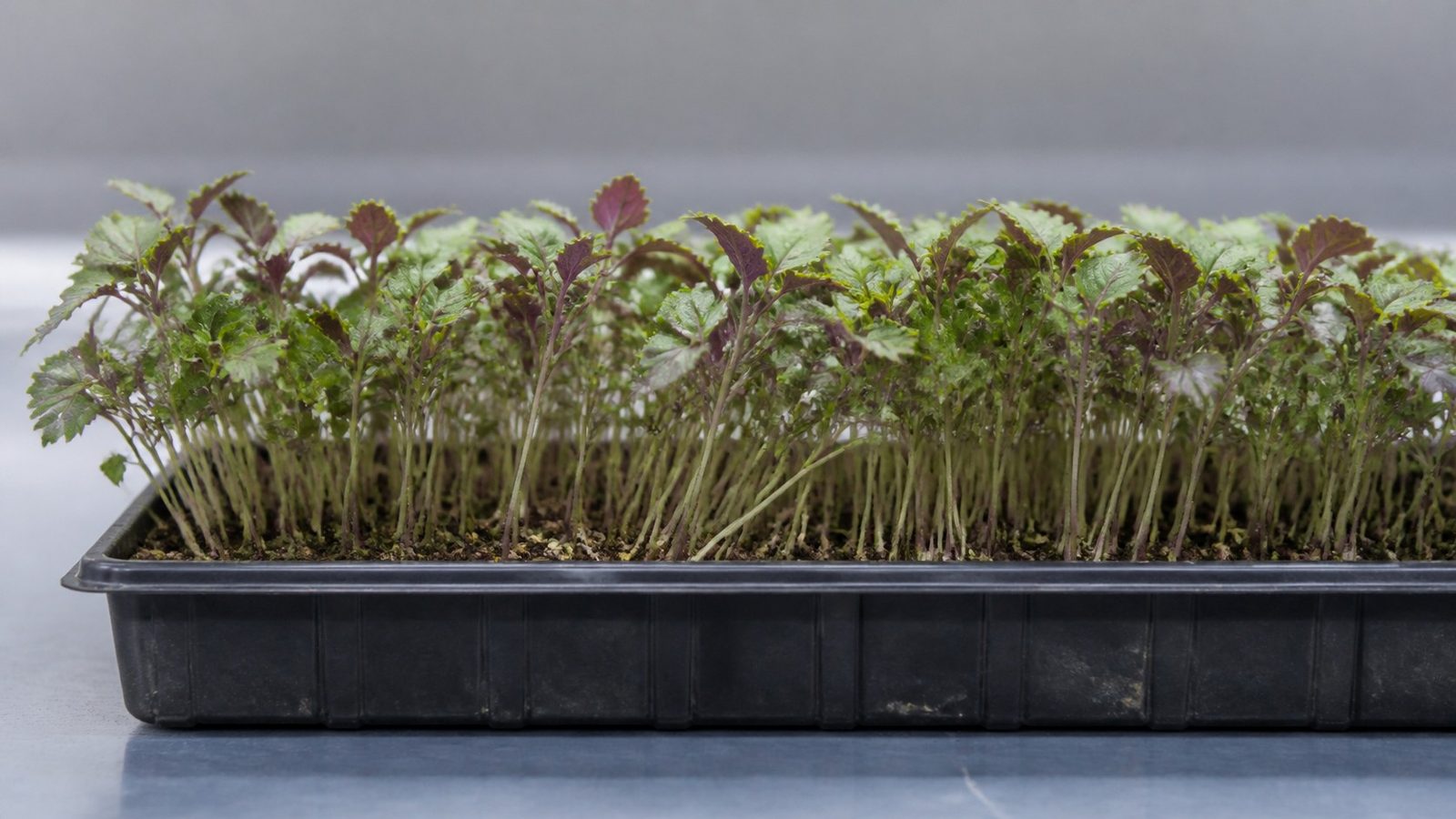
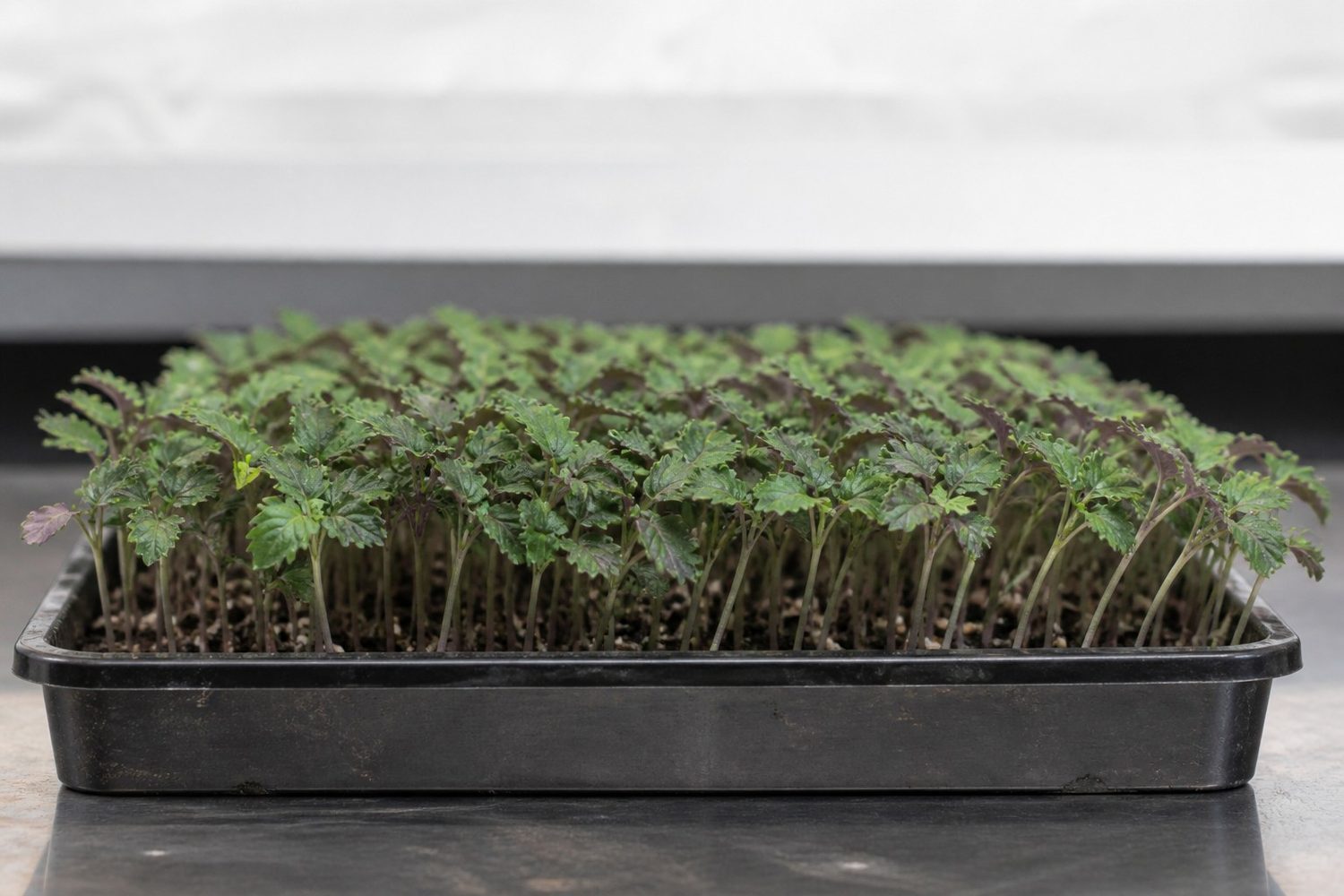
A correct Britton tray is a short, fairly delicate stand, not a thick brassica carpet: pale to silvery-green stems, round cotyledons giving way to ruffled, jagged true leaves, green on top with purple undersides. The supplier's own photograph shows mixed green and purple leaf faces sitting close to the medium rather than a uniformly purple sheet.
The harvest stage is the thing to get right, and it is later than you expect. Johnny's trial cut at first true leaf, at day 16. This is not a cotyledon crop, and cutting it at cotyledons gets you a fraction of the leaf and most of the wait.
Identification: the crop it gets confused with is purple basil, which is a reasonable mistake given they are in the same family and both sold as purple garnish herbs. The tell is the leaf shape rather than the color: shiso's true leaf is ruffled and jagged where basil's is smooth. That tell only works on Britton; green shiso has no purple underside to check.
What it tastes like, and what to do with it
Subtle licorice and anise with mint, basil and cinnamon behind it. It is an aromatic herb, not a mild green, and a small amount reads clearly on a plate.
That puts it on sushi and fish, in noodle dishes, in spicy Thai food, in cocktails and tea, and in desserts. It is the wrong crop for a bulk salad mix or a sandwich layer, where a few leaves stop reading as "green" and start reading as licorice.
It divides people, so sample before you commit a tray to a customer. Anyone who dislikes anise, mint, basil or cinnamon notes will dislike this, and the same aromatic weight that makes it a good garnish will dominate a mild dish.
And it sharpens. The flavor turns spicier and more basil-minty as the tray ages, which matters more than usual on a crop this slow, and is the subject of the section below.
Growing it: only what differs from the standard method
The whole delta is patience and restraint. Nothing here is technically hard; it just takes two to four weeks instead of one, and the standard fast-tray habits are wrong at that length.
Sow evenly on the surface, press for contact, cover lightly. Light covering, vermiculite or a humidity dome, not burial. One supplier notes that shiso actually benefits from light during germination, which is part of why the blackout guidance is so unsettled.
Soak or do not. Two to four hours in cold water is the conservative published practice and the seed germinates unsoaked; one supplier says eight hours for uniformity. Nothing controlled has tested any of it.
The blackout guidance genuinely conflicts and you should know that before following either. One supplier says a weighted cover or dome for four to five days. A commercial schedule stacks under a 14 lb paver for three to four days at 70F, then keeps a blackout dome on for seven more, which is ten or eleven dark days. The weight is for seed-to-medium contact, not to force a stem, and growers report that too much of it for too long gives long, white, fallen stems. Take it off when seedlings start pushing the tray up.
After that, bottom-water and give it room. Wet foliage over a sixteen-day cycle is the problem this crop punishes. Johnny's own trial note is that larger harvests need more airflow and deplete water and fertility more slowly, which is the closest thing to a spacing instruction anyone publishes.
Light schedules conflict too: six to nine hours a day from one supplier, sixteen from another. No source gives a PPFD, a fan speed or a water volume for this crop, and none is invented here.
What goes wrong with shiso specifically
Uneven emergence, and growers blame the seed. Multiple grower reports describe roughly half a tray coming up, or emerging in waves, and at least one reports it resolving after changing supplier. That is a recurring observation rather than a measured lot-failure rate, but it is consistent enough that a counted germination test before a sixteen-day tray commitment is simply good arithmetic.
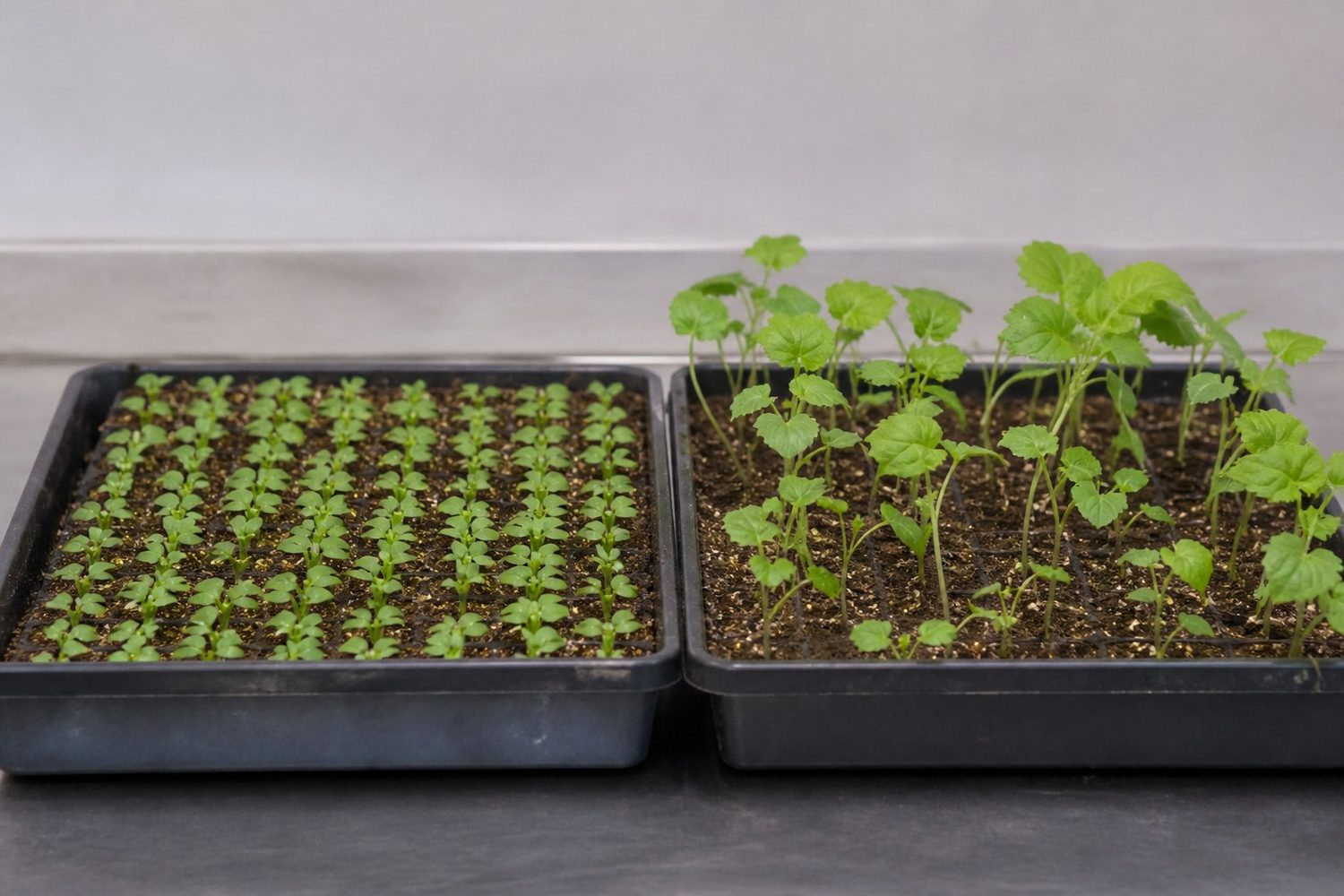
Stretch and collapse under the cover. Long, pale, spaghetti-like stems lying over the medium mean the weight stayed on too long or the dome stayed dark too long. Caught early it is recoverable: reduce the weight and give light.
Wet collapse. Growers describe a "goopy collapse" after too much water during the slow establishment. The general pathology behind it is the damping-off complex, Pythium and Rhizoctonia among others, which rots seedlings at or below the medium line. The usable field test is the stem base: firm stem with localized white fuzz on the roots is root hairs; a soft, pinched, water-soaked stem or a web spreading across the medium is disease. That test is general seedling pathology and has not been validated on shiso specifically.
And the slow one: holding it too long. Past first true leaf the plants keep going, the stand gets taller than the shallow-tray target, and the flavor moves toward the mature plant's spicy mint. It stays edible. It stops being the delicate thing you grew.
Nutrition, and what the studies actually measured
**USDA FoodData Central has no shiso or Perilla frutescens microgreen record**, checked 8 August 2026. Mature perilla values are not a substitute.
Two peer-reviewed studies exist and neither is a nutrition panel. One compared green P. frutescens var. crispa microgreens with germinated seed for macro and micronutrients and bioactive compounds, and reported quercetin-3-glucoside in the microgreen but not in the germinated seed. Another measured volatile compounds, total phenolics and antioxidant activity in red var. crispa and green var. frutescens microgreens against mature plants, under stated greenhouse conditions.
Those are cultivar, stage and system results. The claims circulating about shiso microgreens containing a specific amount of a vitamin, fiber or phosphorus, or having "three to five times" the antioxidants of the mature plant, are not supported by anything opened here. No crop-specific serving-value source exists.
Which seed to buy
Two verified microgreen offerings, and they are different products.
Britton is the documented one: silvery-green tops, purple undersides, ruffled two-tone leaf, and the only shiso with a measured rate, yield and harvest stage behind it. Johnny's listed it at $155.50 a pound on 8 August 2026.
Organic green shiso, P. frutescens var. crispa, is the tender jagged green type, listed by its supplier at 16 to 22 days. No controlled comparison of red against green for yield or tenderness exists.
Specify food-crop microgreen seed, untreated, with the botanical or type name, a lot identity and a germination test date. One supplier lists its green perilla explicitly as not treated; another describes its offering as organic and non-GMO. Refuse seed labeled for treated field or ornamental use, because you are eating the shoot and nothing opened here clears those treatments for that.
Where you buy it changes the tray cost more than the cultivar does. Shiso and perilla seed on Amazon is a working search, which is not something every crop can claim: 50 of 60 tiles were shiso or perilla on 9 August 2026 and 14 of those named microgreens. But it is dear. Kitazawa green shiso was $58.78 for 4 oz, which is $235.12 a pound and $5.96 a tray, and the 1 oz size at $26.58 works out to $425.28 a pound and $10.78 a tray. That last figure would be the second most expensive tray in this directory. Against Johnny's $155.50 a pound and $3.94 a tray, the marketplace runs 1.5 to 2.7 times dearer on this crop.
So, use the marketplace for a trial and buy the pound from a seed house if you are growing it for a buyer. The one thing Kitazawa does better is state seed counts, about 16,800 to the ounce for green and 25,000 for red, which lets you check a packet against the 11.5 g rate before you sow it. Ignore the $5 to $8 packets: those are 350-seed garden packets and nowhere near a tray.
Then test the lot. On a crop that occupies a tray for sixteen to thirty days, discovering a 50 percent germination rate on day twelve is the expensive way to find out.
Is it worth growing?
Grow it if you have a buyer. That is the honest version.
Shiso suits an intermediate grower or a chef with a specific use for a small aromatic garnish, who can accept a slow tray with expensive seed. At the measured figures it returns 6.5 ounces for sixteen days and $3.94 of seed, which is 1.65 ounces per dollar and 0.41 ounces per tray-day. Both sit near the bottom of what any tray crop returns.
It is a poor first crop for a beginner who needs quick, uniform feedback, and a poor choice for anyone paid by weight.
Its real competition is basil and other purple garnish herbs for the slow-herb slot, not radish for a fast bulk slot. Basil wins when you want a familiar sweet-herbal note or a more neutral green. Shiso wins when the plate wants ruffled two-tone leaves and a licorice lift. Against a fast crop there is no contest and no comparison worth making: Johnny's measured radish at 8 to 9.5 days and 8 to 11.5 oz against Britton at 16 days and 6.5 oz, all at first true leaf.
A note on the numbers above
Hover or tap a row to highlight it.
| Figure | Value | Source | What kind of number it is |
|---|---|---|---|
| Seed per 1020 | 11.5 g (0.41 oz) | Johnny's 29-variety trial, Britton | Measured, at 2.5 flats per ounce, first-true-leaf harvest |
| Seed per 1020 | 17 g per 10x20 | A commercial growers' schedule | A production target, harvest stage unstated |
| Yield per 1020 | 6.5 oz | Johnny's trial, Britton | Measured, first true leaf, from 11.5 g |
| Yield per 1020 | 160 g (5.64 oz) | The same commercial schedule | A target from 17 g, stage unstated |
| Days to harvest | 16 | Johnny's trial | Measured to first true leaf, temperature unstated |
| Days to harvest | 16 to 22 | A named seed supplier | Stage and temperature unstated |
| Days to harvest | 25 to 30 | The commercial schedule | Seed to harvest in a 10x20, stage unstated |
| Seed price | $155.50 per pound | Johnny's, listed 2026-08-08 | A price on a day, not a promise |
| Seed cost per tray | $3.94 | Calculated | 11.5 g is 0.406 oz, at $9.72 an ounce |
| Blackout | 4 to 5 days, weighted or domed | A supplier wholesale guide | Grower guidance |
| Blackout | 3 to 4 days under 14 lb, then 7 domed | The commercial schedule | Grower guidance, and it barely overlaps the above |
| Shelf life | 6 to 7 days at 38 to 42F | A commercial micro-shiso specification | A packing spec, packaging unstated |
| Seed count | about 135,400 per pound | Johnny's | Why hull shedding is not "not applicable" here |
| Germination temperature | No figure exists | Every source opened | Nobody pairs a temperature with an outcome |
| Harvest window | No figure exists | Every source opened | Nobody has measured how long the tray holds |
| Fresh-weight panel | No FDC record | USDA FoodData Central, searched 8 August 2026 | An absence, confirmed rather than assumed |
Expensive seed is a family trait, and it is worth understanding before you price anything. Shiso at $155.50 a pound sits below mint at $1,394.50, sorrel at $351.35, watercress at $296.25 and oregano at $242.36, and above onion at $113.30 and pak choi at $107.85. The mint-family herbs cluster at the dear end for one reason: they are propagated from cuttings or grown for leaf, so almost nobody harvests their seed at scale and a pound of it is a specialty item. Chia at $12.48 is the proof rather than the exception, because chia is farmed for its seed at commodity scale. The family does not make seed expensive. Not farming it does. Thyme has no price anyone will publish at all.
Shiso is the one costly herb you can actually cost, so use it as the reference. Mint and oregano carry the priciest seed of the group and no published rate between them, so nobody can tell you what a tray of either comes to. Shiso can: $3.94 a tray, 1.65 oz per dollar, 0.41 oz per tray-day. Both of those last two sit near the bottom of what any tray crop returns, which is the honest shape of a slow herb with expensive seed. If you are considering mint or oregano and want a number to plan against, shiso's is the nearest defensible one.
Nobody has measured how long a shiso tray holds. The mechanism is plainly there: the suppliers themselves say the flavor turns spicier and more basil-minty as it ages, and holding past first true leaf is described as a quality loss rather than a weight gain. That is true of most aromatic herbs and nobody publishes hold times for any of them; the crops with measured windows, like lettuce, are the ones sold by weight. So, cut one tray at first true leaf, leave the next two or three days longer, taste both, and set your own limit.
Hover or tap a row to highlight it.
| Crop | Seed per 1020 | Yield | Days | Cost per tray | Oz per $1 | Oz per tray-day |
|---|---|---|---|---|---|---|
| Shiso, Britton | 11.5 g | 6.5 oz | 16 | $3.94 | 1.65 | 0.41 |
| Basil | 5 to 6.5 g | 5.5 to 7.5 oz | 12 to 26 | $0.83 | 7.8 | 0.34 |
| Thyme | 31 g, area-converted | 3.3 oz, area-converted | 20 to 35 | no price to multiply | cannot be calculated | 0.15 at 21.3 days |
| Chia | 26.3 to 28.35 g | No published figure | 6 to 12 | $0.78 | cannot be calculated | cannot be calculated |
| Mint | No published figure | No published figure | 10 to 18 | no rate to price | cannot be calculated | cannot be calculated |
A blank means nobody has published that figure, so the cell is left empty rather than filled with an estimate. How the numbers work
All 62 crops, sortable, on the microgreen comparison.
Terms on this page
Tap a term to see what it means.
*Perilla frutescens*. Shiso, the crop here. Green and red types are sold as var. crispa and are not the same seed lot.
Sources
- Shiso Britton microgreen seed, Johnny's - the cultivar description, the leaf and color detail, about 135,400 seeds per pound, and the $155.50 per pound price listed 8 August 2026.
- Johnny's microgreen yield trial summary and the trial tech sheet - Britton at 11.5 g, 6.5 oz and 16 days to first true leaf, plus the radish comparison and the trial's own caveat that one grower's system does not transfer perfectly.
- Organic green shiso microgreen seed, True Leaf Market and its wholesale growing guide - P. frutescens var. crispa, 16 to 22 days, the 8-hour soak claim and the 4-to-5-day covered period.
- Green shiso growers' notes, Paperpot Co - the 25-to-30-day commercial schedule, 17 g per 10x20, 160 g target, and the 14 lb paver sequence.
- Shiso microgreens, Epic Gardening - the 2-to-4-hour soak, the thick hull, the regrowth statement, and the over-held flavor shift.
- Micro shiso red specification, Fresh Origins - 6 to 7 days at 38 to 42F.
- Shiso/Perilla Green, not treated, Seedway - an explicitly untreated listing.
- Perilla microgreen composition, Food Chemistry - green var. crispa microgreens against germinated seed, and the quercetin-3-glucoside result.
- Perilla microgreen and mature-stage comparison, Horticulturae - volatiles, phenolics and antioxidant activity in red and green types under stated greenhouse conditions.
- USDA FoodData Central - searched 8 August 2026, no shiso microgreen record.
- Damping-off, UC IPM - the pathology behind the collapse growers report.
- Grower reports on r/microgreens describing uneven emergence and weight problems, goopy collapse, seed quality and a purple lot.
Keep reading
The variety directory
Chia microgreens
A small bitter minty garnish in about a week. Chia seed is about 30 percent fat and the microgreen is not, so if you want the omega-3, eat the seed.
Read Chia microgreensThe variety directory
Nasturtium microgreens
A three-week tray that returns 5.64 oz and costs $5.74 of seed, so it earns its keep as a garnish and not by weight. Also the crop whose own name belongs to a different plant: search nasturtium in USDA's database and you get watercress.
Read Nasturtium microgreensThe variety directory
Mint microgreens
Mint must not be blacked out, and its seed costs $1,394.50 a pound. The one published seed rate would put 154,000 seeds in a 1020 tray, ten times the densest sowing anyone has measured.
Read Mint microgreensThe variety directory
Oregano microgreens
Concentrated resinous oregano as a fresh garnish, on a sixteen to twenty-five day tray. The seed is expensive and no sowing rate is published, so weigh a test patch before you scale.
Read Oregano microgreens