At a glance
The seed is dust and it needs light to germinate, so the covering and weighting almost every other crop teaches you will suppress it outright, and then it sits nearly invisible for ten to twelve days while a wet uncovered surface has every chance to grow mold instead.
- Botanical name
- Mentha spicata
- Also sold as
- Spearmint, Mint, Spearmint, Mint Seed, Garden mint, Common mint
- Family
- mint
- Difficulty
- Difficult
- Days to harvest
- 10 to 18 days
- Harvest window
- No published figure
- Seed per 1020 tray
- No published figure
- Soak
- None
- Blackout
- None
- Germination temperature
- 68 to 75 °F
- Yield per 1020 tray
- No published figure
- Regrows after cutting
- No published figure
- Mold risk
- High
- Hull shedding
- Not applicable
- Shelf life
- 7 days
- Eaten as
- raw
- Seed cost per tray
- No published figure
Any field name above ranks every variety by it. No published figure means we researched it and nobody has established one, which is different from not yet researched. Every figure here is sourced at the bottom of the page. Compare every variety side by side.
Mint seed needs light to germinate, so do not black it out and do not press it in. The one crop-specific guide reports minimal or no germination when mint seed is covered at all, which makes it stricter than lettuce and purslane, the other two light-responsive crops. It sits on the surface, unpressed and unweighted, for the ten to twelve days it can spend nearly invisible.
The second thing to know is about the rate. The only seed rate anybody publishes for mint, 14 grams a tray, would put roughly 154,000 seeds into a 1020, about ten times the densest sowing any published microgreen study has measured. Do not sow it. The arithmetic is at the bottom of this page.
What growers are saying right now
Sampled from public posts and videos, 10 July to 9 August 2026. Every line links what it is quoting. How often something is repeated is not evidence that it is true, so every line also says what the sources actually establish.
How to grow tons of mint and not let it take over
Circulating Epic Gardening's mint guide at 944,000 lifetime views, four years old, and still the highest-reach mint result this sweep returned
That is the mint conversation, and it is the reason there is no tray version of it. Every other crop in this directory has a garden competitor you have to plant each year. Mint's garden competitor is a perennial whose defining problem is that it grows too well, and the top-ranked content about it is containment advice. What it competes with
Grow mint from cuttings for an endless harvest in small containers
Circulating Posted two weeks into this window at 42 views, and it is the only in-window mint growing how-to the sweep returned
A rooted cutting is free, it cuts repeatedly, and it is the actual competitor to a mint tray. It is also why almost nobody buys mint seed: the plant is normally propagated vegetatively. The one seed lot on this page with a published germination figure tested at 40 percent. Which seed to buy
Here is how to trim your mint so it comes back bushier
Circulating Two pruning clips carried the mint conversation this month, one at 73,179 views and one at 20,222 views, both about cutting an established plant
Sound garden advice and entirely beside the point in a tray, where you cut once and there is no plant left to come back. Note the reply under the first one, "Tried this and they did not come back", which is the only mint failure report in the window and it is about a pot, not a tray.
These mint seeds are easy to grow and germinate well
Circulating A seed listing promoted on TikTok at 1,569 views, the only mint SEED content in the sweep and an advertisement
Treat it as an ad. The only lot in the opened evidence that publishes a germination test is Sheffield's *Mentha spicata*, at 40 percent germination, 99 percent purity, 2023 crop year. On a slow, expensive, dust-fine seed, a lot number and a germination percentage matter more than the marketing copy. Which seed to buy
Nobody is growing this as a microgreen
Circulating Twenty-one threads came back in full from r/microgreens in the window and not one is mint. What came back instead is kale, sunflower, broccoli root hairs, monsoon mold and wheatgrass
Several crops here have no conversation. Mint's silence is a different shape: it has an enormous conversation and every part of it is about the garden plant. The published record matches. No trial entry, no yield, no nutrition study, no crop-specific mold test. Where the numbers stop
What it is, and how to tell you grew it right
Mint microgreens are seedlings of Mentha spicata, spearmint, in the Lamiaceae. That puts them in the same family as basil, and the two share the family's tray problem: fine seed, slow start, and a schedule set by a herb rather than by a brassica.
"Mint" is not one plant and the seed shelf proves it. A specialist microgreen seller separates spearmint from peppermint, Mentha x piperita, and calls the peppermint types darker and more menthol-intense; "Chocolate" and "Black" mint belong to that group. Those are different plants sold under the same three-letter word, not grades of one thing. This page is about spearmint, because spearmint is the sweeter, softer one that a chef actually wants on a dessert.
Beyond the two true mints, the same searches return several plants that are not Mentha spicata at all: Corsican mini mint, which is Mentha requienii and sold as a drought-tolerant ground cover; mountain mint, a Pycnanthemum wildflower; lemon mint, which is Monarda; apple mint; and perilla, sold under the label "Asian mint", which is the plant this directory will eventually cover as shiso. Six different genera answer to the word.
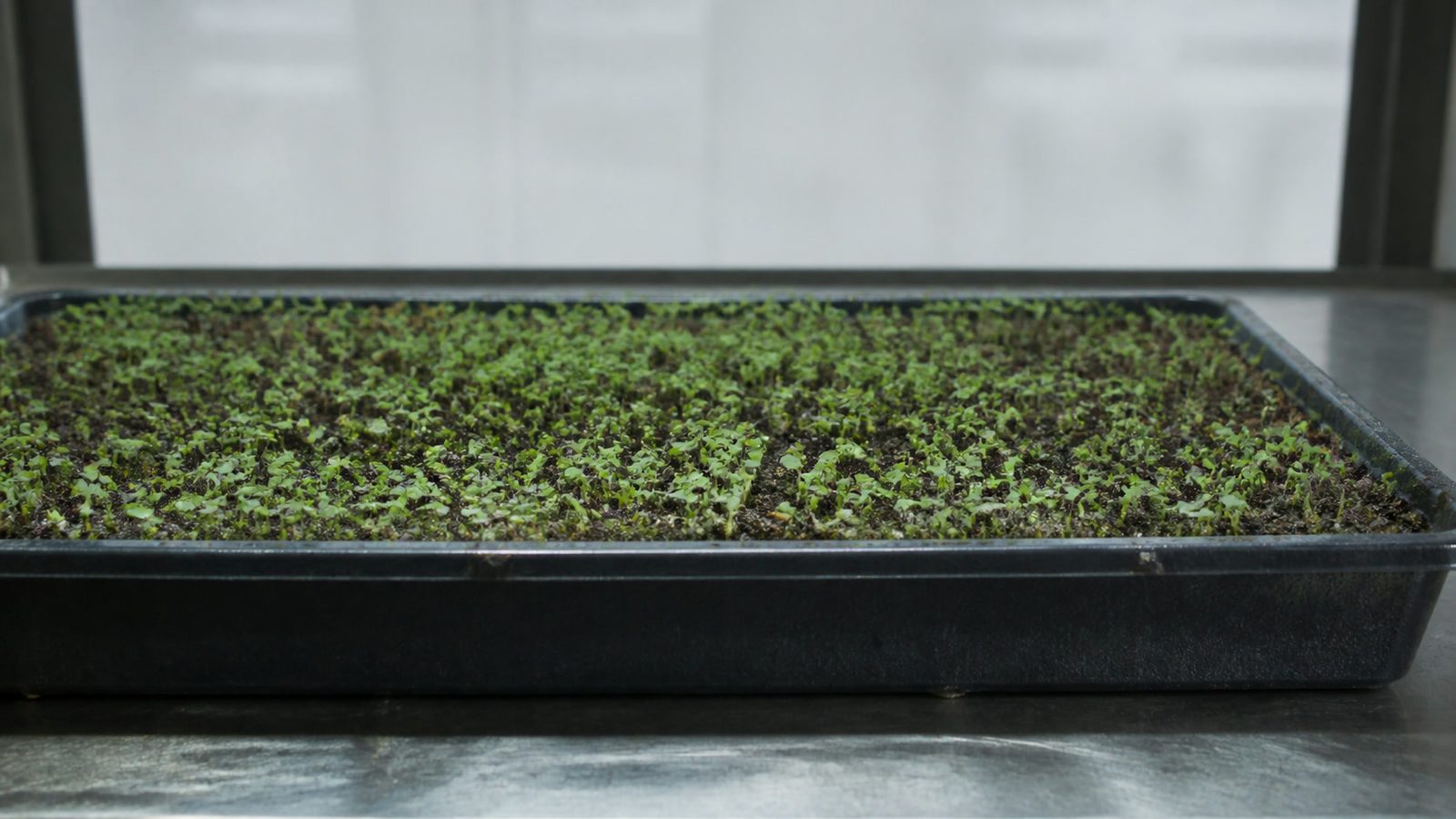
At harvest, expect a low, sparse, delicate stand rather than the dense upright canopy of a brassica. The best crop-specific description available calls the leaves soft and velvety with light pubescence, the fine hairs you can see when the light catches them side on. **Millimeter heights, stem color and stand evenness for a M. spicata microgreen tray are not published anywhere**, and image searching found real spearmint seedling trays but no authenticated microgreen-harvest photograph. Mature spearmint reference material describes bright green, spear-shaped, serrated leaves, which is the adult plant and not what you cut.
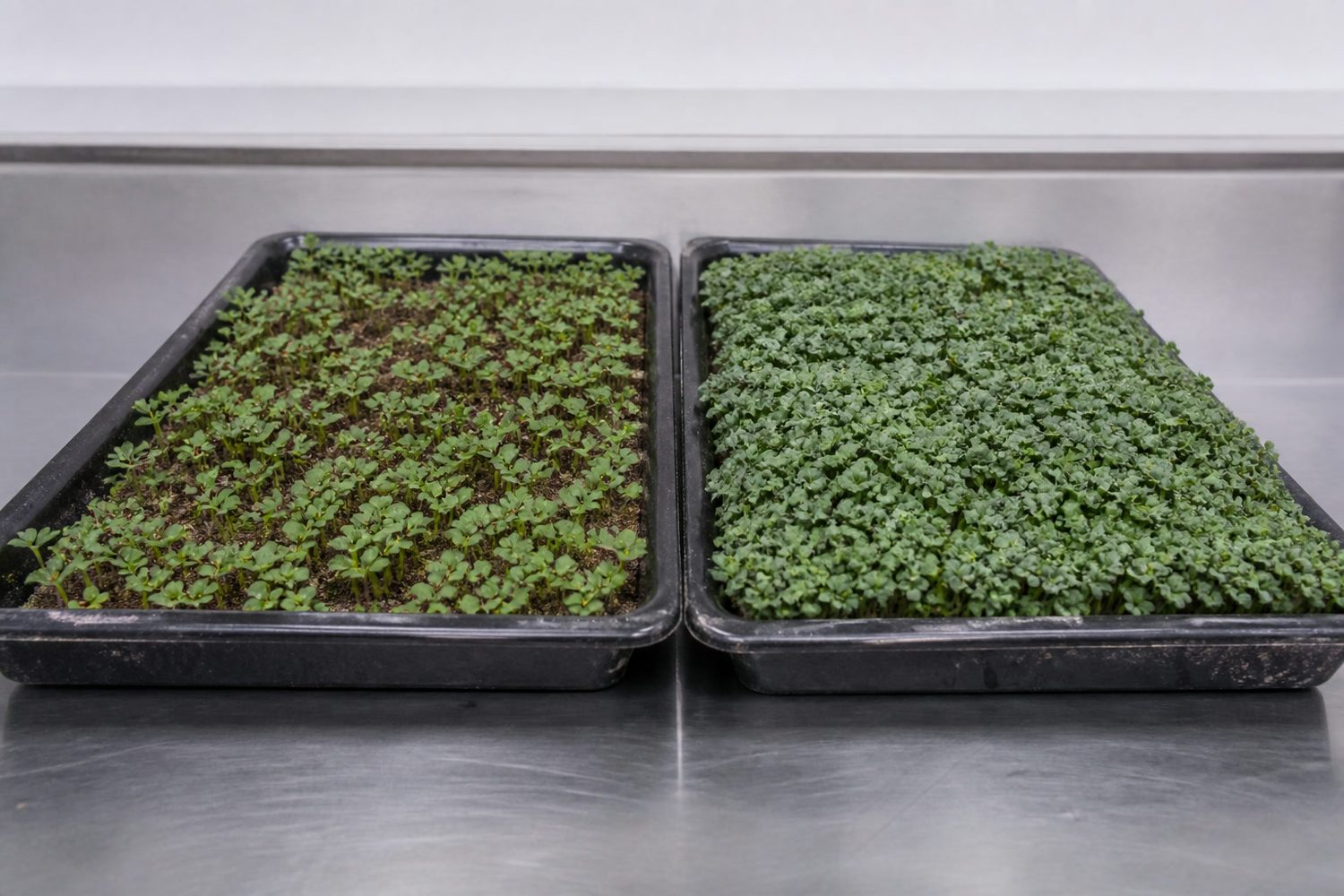
You cannot tell spearmint from peppermint by looking at a seedling. The separation the sources support is sensory: spearmint reads sweeter and softer, peppermint reads colder and sharper. No published leaf-color tell separates them at cotyledon stage, just as nobody can separate komatsuna from its Brassica rapa siblings at that stage.
What it tastes like, and what to do with it
Sweet, cooling and clean, with the menthol dialed well below peppermint's. It is the mint of a mojito and of lamb sauce rather than the mint of a candy cane.
That decides the quantity. Mint is a finishing herb measured in leaves, and it goes where a tiny amount of aroma does real work: whole leaves on panna cotta or ice cream, through a fruit salad, on lamb, in Vietnamese-style fresh rolls, in lime water, lemonade or a cocktail. It is a garnish crop in the strict sense, which is unusual here. Most microgreens get argued about in ounces per tray, because most of them are eaten by the handful. Nobody eats a handful of mint.
Two uses are wrong and the crop-specific source says so. Heat destroys it: hot food drives off the aroma and darkens the leaf, so it goes on after the pan comes off or not at all. And it is a poor partner for garlic, chile and heavily spiced dishes, which simply cover it. If your menu is built on those, this tray is a waste of the bench.
People who dislike menthol will dislike this, and there is no growing technique that fixes it. So will anyone hoping for a neutral crunchy salad green, which mint is not at any density.
Growing it: only what differs from the standard method
Everything general about trays, medium, light and watering is on the standard tray method for growing microgreens. Almost every mint-specific instruction is a subtraction from it.
Do not black it out, and this is the whole crop. Mint seed needs light. The crop guide reports minimal or no germination when the seed is covered, and a seed supplier specifies a maximum sowing depth of one sixteenth of an inch. Use a clear humidity dome or film until emergence, then vent it gradually. A cabinet manual estimates two to three days of germination under the dome. That is the only permitted cover, and it is transparent.
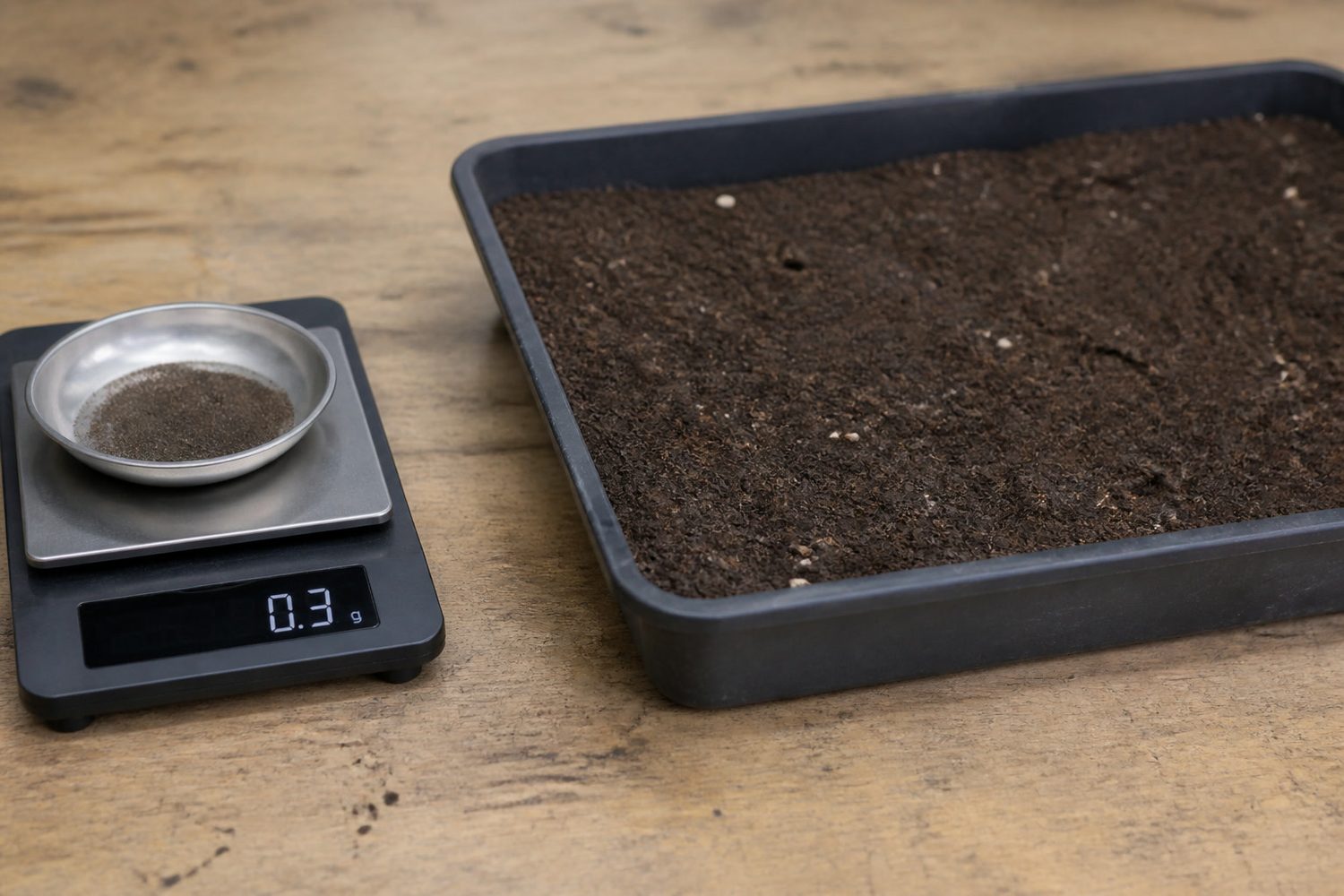
Do not weight it either. There is no blackout stack on this crop, so there is no weight, and pressing the seed for contact, which is standard advice on almost everything else, is specifically contraindicated here. On mint the blackout is zero days rather than a short one, which is true of almost nothing else.
Do not soak. The crop guide says no soaking, and the physical reason is obvious once you have handled the seed: it is dust, and wet dust cannot be spread evenly.
Water underneath, or very gently on top, and never with a coarse spray. Surface-sown seed at this size moves. A hard spray does not merely wet the tray, it rearranges the crop into piles and washes some of it under the surface, where the light requirement means it will not come up. This is the single most consequential handling difference between mint and everything else here.
Level the medium before you sow, more carefully than usual. A high spot dries and a low spot pools, and on a crop that takes ten days to show itself you will not learn which happened until it is far too late to fix.
Hold it at 68 to 75°F. That is the only crop-specific microgreen range published. Above about 79°F the same source says the aroma weakens, which on a crop grown entirely for aroma is the failure that matters. No validated lower limit exists for a mint tray, so cool rooms are an unknown rather than a known problem.
A mint tray, and why the calendar is the problem
- 1
Day 0, sow on the surface
Level the medium, moisten it, scatter the seed as evenly as dust will go, and leave it uncovered by medium. No pressing, no burying, no weight. Clear dome on.
- 2
Days 1 to 3, clear dome, light on
A cabinet manual estimates germination at two to three days under a dome. The dome is for humidity, not darkness. Nothing you do here looks like progress.
- 3
Days 3 to 10, the invisible stretch
The crop guide says mint can be almost invisible through days 10 to 12. This is the stretch where growers conclude the tray has failed and start watering it harder, which is the one intervention that makes it worse.
- 4
Days 10 to 14, the first source's harvest
A restaurant cabinet manual puts harvest here. It does not say what stage that means, and it overlaps the previous line, which is the sharpest evidence problem on this crop.
- 5
Days 14 to 18, the second source's harvest
The one crop-specific microgreen guide puts it here at 68 to 73°F, and gives a 20 to 30 day total cycle elsewhere on the same page. Nobody has reconciled the two.
What goes wrong with mint specifically
Buried seed, and it is the failure that defines the crop. Covering the seed, or splashing it under with a spray, produces minimal germination. What you see is a tray that is bare in patches and clumped where the water ran. It is not repairable: you cannot add seed to a running tray and get an even stand, so the fix is to resow. On most crops here burying the seed slightly is forgivable. On this one it is the end of the tray.
"Is it dead or is it slow?" and there is no honest test. Ten to twelve days of nothing visible is reported as normal. Ten to twelve days of nothing visible is also exactly what a failed sowing looks like. Nobody publishes a day count at which a mint tray should be written off. The one thing that resolves it is a labeled germination test on a damp paper towel from the same lot, run beside the tray, which tells you within a few days whether the seed can come up at all.
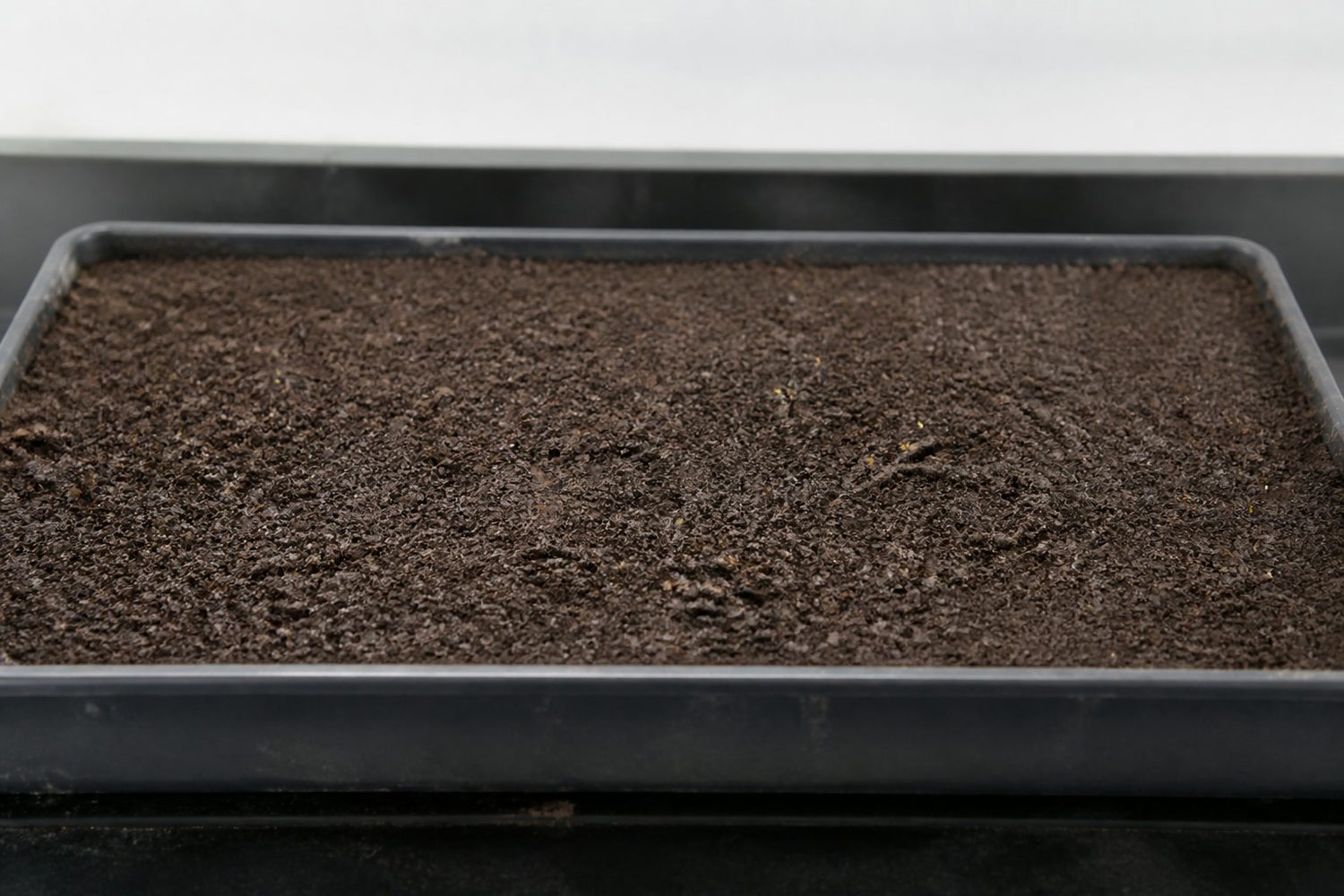
Mold at the surface, and mint stacks the odds against you. The crop guide flags excess moisture with poor ventilation as the mold risk, and mint arranges precisely those conditions: a humid dome, a surface you must keep damp because the seed is sitting on it, and a fortnight of it. The damping-off complex is the general one, Pythium and Rhizoctonia among the usual organisms, not a mint disease. Fine white growth that stays at the medium line and collapses when misted is root hair; growth climbing the stems, running gray or green, or smelling sour, is not. On a food crop that is a discard and a sanitize.
Dry shock when the dome comes off. Seedlings that have spent a week at dome humidity wilt and curl if you pull the cover in one go. Vent it in stages. This one is recoverable if the stems have not collapsed.
Weak aroma from heat or thin light. Pale, slow, faintly scented foliage. You can improve the tray's conditions from here, but the flavor of what you already cut does not come back, and flavor is the entire product.
Day 8 and nothing has come up. Is the tray dead?
Hover or tap a card to highlight it.
What is normal
The crop-specific guide says mint can be nearly invisible for its first 10 to 12 days. Bare medium on day 8 is not evidence of anything.
What is not normal
Seed visibly piled in low spots, or a surface that has been crusted over by hard watering. Both mean the seed moved, and moved seed is buried seed.
The test that actually answers it
Run 20 seeds from the same lot on damp paper towel in the light, dated, the day you sow. It reports on the seed while the tray is still ambiguous.
Why the lot matters
One opened Mentha spicata listing publishes 40 percent germination. At that rate half your sowing was never going to appear and nothing you do to the tray changes it.
What not to do
Water it harder. The only failure you can still cause on day 8 is washing the seed under the surface, where it needs light and will not get it.
Nutrition, and what is actually established
Nothing at all has been measured on this crop.
There is no mint microgreen record in USDA FoodData Central. Searches for "mint microgreens", "spearmint microgreens" and Mentha spicata returned no microgreen entry, so there is no FDC ID and no nutrient panel to quote. Mature spearmint values are not a substitute for one.
No peer-reviewed composition study of spearmint microgreens turned up either. The nearest published work is a Lamiaceae microgreen paper that names mint as a commercially relevant member of the family and then measures basil-family material, not Mentha spicata microgreens.
So, the claims you will meet, that mint microgreens have a specified vitamin and mineral profile, that they are more nutritious than mature mint, or that their menthol delivers a quantified health benefit, are unsupported for this crop at this stage. The specialist page that makes broad antioxidant and digestive statements supplies no analytical dataset behind them.
This directory has taken both sides of that question where the evidence supported it. Lettuce has real measurements showing the seedling beating its adult, and celery has real measurements going the other way. Mint has neither, because nobody has measured it. Grow it for the aroma, which is the thing you can actually verify by smelling it.
Which seed to buy
**Buy spearmint, Mentha spicata, named on the listing.** Peppermint is a different aroma and often a darker leaf, and "Chocolate" and "Black" are peppermint types rather than spearmint cultivars. No opened supplier publishes cultivar-specific stem length, days or yield for spearmint microgreens, so choose on species and on lot data, not on a variety name.
Ask for the four things that matter on a dust-fine, slow, expensive seed: the botanical name in writing, the crop year and lot, a germination percentage, and untreated food-use seed. The crop-specific source is explicit that pink or green dyed seed is not suitable for microgreens, and dye means a fungicide or insecticide coating. That seed is sold for a field, not for something you cut and eat in a fortnight.
Nobody sells mint seed for microgreens. A search for "mint microgreen seeds" on 2026-08-09 returned mint sold as a garden herb, a tea plant, a ground cover or a live plant, and microgreen seed for other crops, but not one Mentha listing sold for microgreens. Fennel is in the same position, except that its search fills up with culinary spice seed rather than garden packets.
So, buy garden spearmint seed, and buy it by the seed count. On most crops you would buy seed sold for microgreens; for mint there is none. Untreated heirloom spearmint packets are cheap and plentiful, run from a few hundred to twenty thousand seeds, and are the only practical route to a tray. Compare that with the seed-house ladder, which is where the crop's real cost lives.
Hover or tap a row to highlight it.
| Where | Pack | Price | Per gram | What it is |
|---|---|---|---|---|
| Urban Farmer | 250-seed packet | $3.00 | about $132 | List price, checked 2026-08-09. A packet is roughly 23 milligrams of seed |
| Urban Farmer | 1 gram | $10.80 | $10.80 | The smallest weight-labeled size |
| Urban Farmer | 1 ounce | $117.40 | $4.14 | |
| Urban Farmer | 1 pound | $1,394.50 | $3.07 | The floor, and about fifteen times the next most expensive microgreen seed |
| Amazon garden shelf | 20,000 seeds | $9.99 | about $5.49 | Outsidepride spearmint, listed 2026-08-09. Sold by count, not weight |
| Amazon garden shelf | 3,600 seeds | $6.29 | about $19 | A common packet size, sold as Mentha spp. rather than by species |
Pennyroyal, and this is the one safety item on the page. Mint is sold in variety packs, and one on the same search is a four-way pack of spearmint, peppermint, lemon mint and pennyroyal. Pennyroyal is Mentha pulegium, and it is not a culinary mint. Its oil is roughly 85 percent pulegone, and the US National Institutes of Health's LiverTox database records pennyroyal oil taken by mouth as highly toxic, linked to cases of toxic liver injury and death, through metabolites that deplete the liver's glutathione. That evidence is about the concentrated oil, not about seedlings, and nobody has measured pulegone in a pennyroyal microgreen, so this page will not tell you what a tray of it would do. What it will tell you is the instruction: a mint variety pack is sold to be planted as four separate garden plants, one of which you would not eat. Do not sow a mixed mint pack as a tray you cut and eat whole, and read the species list before you buy one.
Spearmint seed on Amazon is the garden shelf described above, and it is where a home grower will realistically buy this. Check the listing names Mentha spicata and states a seed count, and skip anything sold as a mixed mint pack.
Is it worth growing?
For almost everybody, no, and the reason is not the numbers. It is the competitor.
Most microgreens compete with a garden plant you have to sow every season. Mint competes with a spreading perennial that roots from a cutting in a glass of water, comes back every year whether you want it to or not, and can be cut repeatedly. Leek inverted this directory's garden-competitor pattern by being slower in the ground than in the tray. Mint inverts it the other way, harder than any crop here: the garden version is faster, free, effectively permanent, and its most-watched how-to is about stopping it.
Against that, the tray asks you to buy about the most expensive microgreen seed there is, sow it in a way that contradicts every habit another crop taught you, wait ten to eighteen days with nothing visible for most of it, and cut once, with no measured yield to plan against and no evidence that it regrows.
There is one real buyer. A restaurant or cocktail program that wants tiny, tender, uniform mint leaves, in winter, indoors, cut the same day, is buying something a pot on a windowsill does not supply: uniformity and a delivery date. Priced as a garnish, by the clamshell and never by the pound, that is a real product. Chives has the same shape of argument and better numbers behind it.
If you want mint for a kitchen, buy one plant. If you want a slow aromatic herb tray with published figures behind it, grow basil, which is the other Lamiaceae here and has three cultivars with measured yields. If you want volume, nothing on this page is for you.
A note on the numbers above
Hover or tap a row to highlight it.
| Figure | Value | Source | What kind of number it is |
|---|---|---|---|
| Seed per 1020 | 14 g per 10x20 | Restaurant growing-cabinet manual | An estimate the manual labels as one. Implies about 119 seeds per square centimeter |
| Seeds per gram | 10,999 | Urban Farmer product data | Supplier seed count, and the number that makes the rate checkable |
| Days to harvest | 10 to 14 | Restaurant growing-cabinet manual | Estimate, no harvest stage stated |
| Days to harvest | 14 to 18 | Crop-specific microgreen guide | Grower guidance at 68 to 73°F, no harvest stage stated |
| Total cycle | 20 to 30 days | Same guide, elsewhere on the page | Unreconciled with its own 14 to 18 |
| Germination under dome | 2 to 3 days | Restaurant growing-cabinet manual | Estimate |
| Visible growth | Nearly invisible to day 10 to 12 | Crop-specific microgreen guide | Grower guidance, and it overlaps the first harvest figure |
| Germination temperature | 68 to 75°F | Crop-specific microgreen guide | Crop guidance, not a trial |
| Seed lot germination | 40 percent | Sheffield's M. spicata, 2023 crop | One real lot's tested rate, not a species average |
| Shelf life, cut | Up to 7 days refrigerated | Crop-specific microgreen guide | No temperature, packaging, replication or endpoint |
| Seed price | $1,394.50 per pound | Urban Farmer, checked 2026-08-09 | List price, verified on the page |
| Yield per 1020 | No published figure | Nobody | Absent from the 29-variety trial and from everything else opened |
| Harvest window | No published figure | Nobody | Nobody has established it |
The seed rate is left blank, and here is why. A 1020 tray is 200 square inches, or 1,290 square centimeters. Fourteen grams of seed at Urban Farmer's own count of 10,999 seeds per gram is 153,986 seeds, which is about 119 seeds per square centimeter. For comparison, garden cress carries the only measured density study in this directory: peak biomass at 12 seeds per square centimeter, with total aerobic bacteria climbing steeply above that, and the study did not test past 14. A brassica tray runs two to four. So, the one published mint rate is roughly ten times the highest density anyone has measured as optimal, and thirty to sixty times a brassica.
At two to four seeds per square centimeter a 1020 would want 2,600 to 5,200 mint seeds, which is a quarter to a half of one gram. That range is arithmetic on this crop's seed count, not a measured rate, and it is not going in the table either. It is here so a grower can weigh out a trial that is in the right order of magnitude instead of inheriting a figure that is off by a factor of forty.
The cost per tray follows the rate, which is why it is blank. The seed price is the best documented number on this crop and the rate is the worst, so multiplying them produces a precise-looking figure resting entirely on the weak half. At 14 grams the seed alone would be $43.04 at the pound rate and $151.20 at the gram rate, which would make mint the most expensive tray in this directory by four to fifteen times. At a quarter to half a gram it is $1.30 to $5.10, mid-pack. The two answers differ by a factor of thirty and nothing published settles which is right.
What is not in doubt is the seed price itself. At $1,394.50 a pound, spearmint is by a wide margin the most expensive microgreen seed per pound anywhere. The next highest are sorrel at $351.35, watercress at $296.25, oregano at $242.36, shiso at $155.50, onion at $113.30 and pak choi at $107.85, with basil Red Rubin at $93.40 and mustard at $88.30 below them. Mint is about 4 times sorrel rather than fifteen times anything. That is a fact about the plant's economics, not about the tray: mint is propagated from cuttings, so almost nobody harvests mint seed at scale, and a pound of it is a specialty item rather than a commodity.
Days to harvest is 10 to 18 because two sources disagree and neither states a stage, which is a weaker position than broccoli's 7 to 15, where the sources agree and simply measure different harvest points. Worse, the same guide that puts harvest at 14 to 18 days says the crop can be nearly invisible until day 10 to 12, and gives 20 to 30 days as a total cycle a few lines away. That internal contradiction is the most load-bearing uncertainty on this page, because it decides whether mint is a two-week crop or a month-long one, and therefore whether the bench time is worth anything at all.
The harvest window is blank, and you should not assume one. Across the crops that do have a published window there is a pattern: those sold on taste sharpen as they sit and get one to three days, while lettuce has no flavor to sharpen and gets four to seven. Mint is sold entirely on aroma, so a narrow window would be the reasonable guess. Nobody has measured it, and a window is the figure almost nothing in this crop has, so cut on the day you need it rather than planning a hold.
Hover or tap a row to highlight it.
| Crop | Seed per 1020 | Yield | Days | Cost per tray | Oz per $1 | Oz per tray-day |
|---|---|---|---|---|---|---|
| Basil | 5 to 6.5 g | 5.5 to 7.5 oz | 12 to 26 | $0.83 | 7.8 | 0.34 |
| Thyme | 31 g, area-converted | 3.3 oz, area-converted | 20 to 35 | no price to multiply | cannot be calculated | 0.15 at 21.3 days |
| Chia | 26.3 to 28.35 g | No published figure | 6 to 12 | $0.78 | cannot be calculated | cannot be calculated |
| Mint | No published figure | No published figure | 10 to 18 | no rate to price | cannot be calculated | cannot be calculated |
| Oregano | No published figure | No published figure | 16 to 25 | no rate to price | cannot be calculated | cannot be calculated |
A blank means nobody has published that figure, so the cell is left empty rather than filled with an estimate. How the numbers work
All 62 crops, sortable, on the microgreen comparison.
Mint has no usable rate and no yield, which puts it with lettuce, cucumber and cauliflower. The difference is that on those three nobody published a number at all, while on mint somebody published one and it is roughly ten times any density anybody has measured.
Terms on this page
Tap a term to see what it means.
*Mentha spicata*. Spearmint, and the crop on this page. Sweeter and softer than peppermint, which is Mentha x piperita and a different plant.
Sources
- UA Organic, mint microgreens - the only crop-specific mint microgreen guide opened: no soaking, no pressing, seeds need light and germinate minimally when covered, mold under excess moisture and poor ventilation, 68 to 75°F with aroma weakening above 79°F, 14 to 18 days and a 20 to 30 day cycle, nearly invisible through days 10 to 12, spearmint against peppermint on flavor and color, up to 7 refrigerated days cut, the advice against selling cut mint, dyed seed being unsuitable, and the culinary uses and clashes.
- Urban Farmer, Spearmint mint seed (Mentha spicata) - the price ladder verified 2026-08-09 at $3.00 per 250-seed packet, $10.80 a gram, $38.20 a quarter ounce, $117.40 an ounce, $394.00 a quarter pound and $1,394.50 a pound, plus the 10,999 seeds per gram that makes the density check possible.
- Sheffield's Seed Company, Mentha spicata - one real lot at 40 percent germination, 99 percent purity, 2023 crop year, and a maximum sowing depth of one sixteenth of an inch.
- Carter-Hoffmann GardenChef growing cabinet manual (PDF) - the 14 g per 10x20 estimate, 10 to 14 days to harvest and 2 to 3 germination days under a dome, with the manual's own statement that its figures are estimates that vary with variety, quality and conditions.
- Johnny's microgreens yield trial, method and discussion - mint is absent from the 29-variety trial, and the warning that one grower's yields do not transfer to another's system.
- UC IPM, damping-off - Pythium and Rhizoctonia as the damping-off complex under damp conditions, and symptoms at or below the medium line.
- NIH LiverTox, pennyroyal oil - pennyroyal as Mentha pulegium, the oil at roughly 85 percent pulegone, hepatotoxic and abortifacient constituents, cases of toxic liver injury and death from ingestion, and the glutathione-depleting metabolites.
- Kumar et al., Lamiaceae microgreens, Scientific Reports 2024 - names mint as a commercially relevant Lamiaceae microgreen and measures basil-family material rather than Mentha spicata.
- USDA FoodData Central - searched 2026-08-09 for mint microgreens, spearmint microgreens and Mentha spicata, no microgreen record.
- Iowa State Extension, germination requirements - the general 65 to 70°F post-germination seedling guidance, cited only to mark that it is not mint-specific.
Keep reading
The variety directory
Oregano microgreens
Concentrated resinous oregano as a fresh garnish, on a sixteen to twenty-five day tray. The seed is expensive and no sowing rate is published, so weigh a test patch before you scale.
Read Oregano microgreensThe variety directory
Thyme microgreens
Three weeks of bench for about three ounces, on a tray that never passes an inch and a half. Intense thyme by the pinch, and seed nobody sells at tray scale.
Read Thyme microgreensThe variety directory
Chia microgreens
A small bitter minty garnish in about a week. Chia seed is about 30 percent fat and the microgreen is not, so if you want the omega-3, eat the seed.
Read Chia microgreensThe variety directory
Celery microgreens
Three to four weeks of bench for a seasoning green, with an unusually complete measured nutrient panel behind it: 45.8 mg of vitamin C per 100 g, and four minerals that are higher in the mature leaf.
Read Celery microgreens