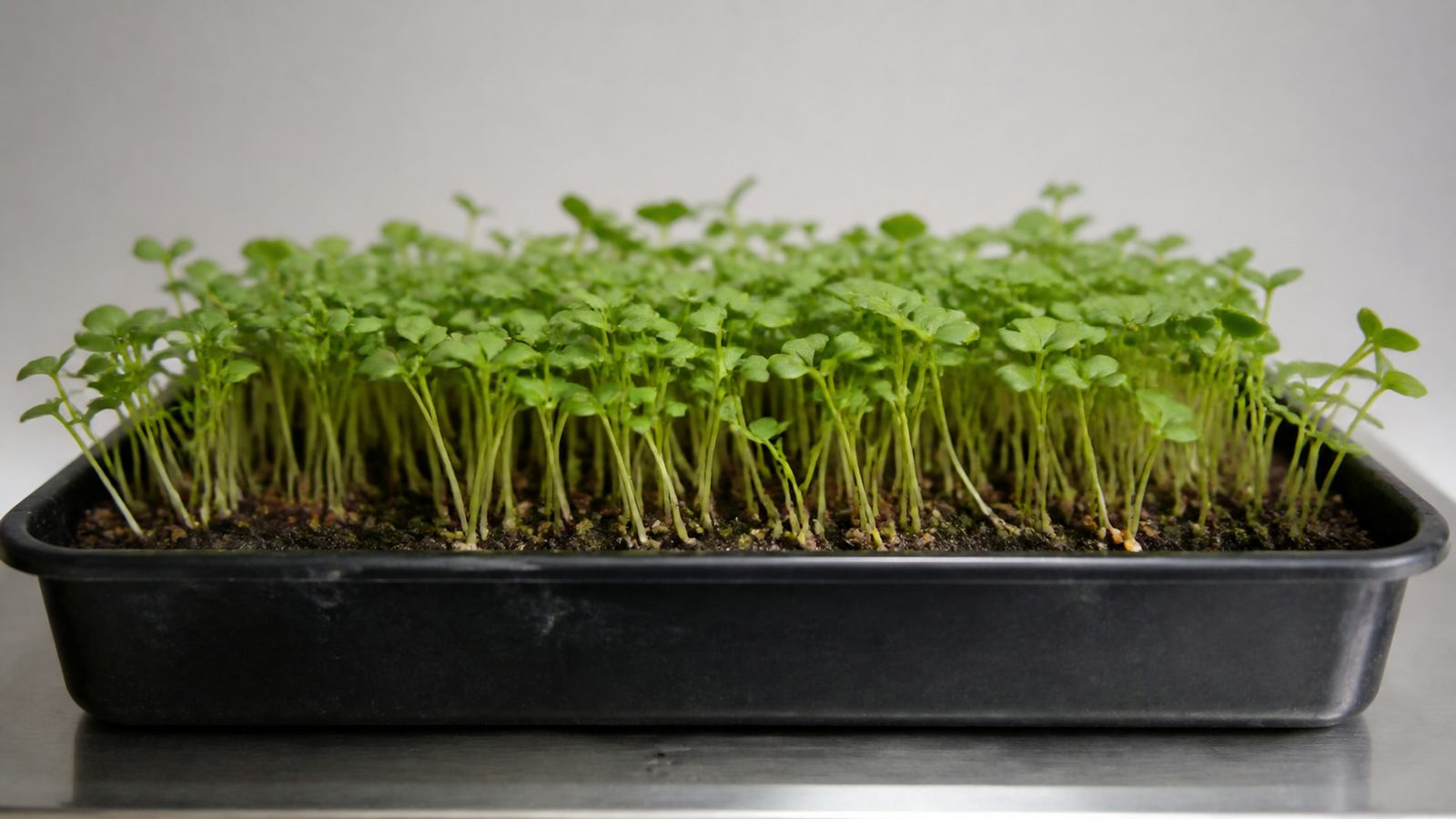
At a glance
Very fine seed on a slow cycle, which is the combination that punishes a saturated tray. Its own supplier says it is easier as a microgreen than in the field, so the difficulty is moisture management rather than the plant.
- Botanical name
- Nasturtium officinale
- Also sold as
- Watercress Microgreen Seed, Watercress, Microgreen/Sprouting
- Family
- brassica
- Difficulty
- Moderate
- Days to harvest
- 7 to 25 days
- Harvest window
- No published figure
- Seed per 1020 tray
- No published figure
- Soak
- None
- Blackout
- 4 to 5 days
- Germination temperature
- No published figure
- Yield per 1020 tray
- No published figure
- Regrows after cutting
- No published figure
- Mold risk
- High
- Hull shedding
- No published figure
- Shelf life
- No published figure
- Eaten as
- raw
- Seed cost per tray
- No published figure
Any field name above ranks every variety by it. No published figure means we researched it and nobody has established one, which is different from not yet researched. Every figure here is sourced at the bottom of the page. Compare every variety side by side.
Watercress gives you a sharp peppery bite on a small tender leaf, closer to mustard or radish than to a salad green. It is also far easier as a microgreen than as a crop: the field version wants running water and carries a reputation for being difficult, and the tray version is the easy way to get the same flavor.
Buy it by the botanical name, because this is the corner of the seed shelf where common names fail. Watercress is Nasturtium officinale. The plant everyone calls nasturtium is Tropaeolum majus, which is not in the genus Nasturtium and not even in the same family. And garden cress is Lepidium sativum, a third unrelated plant that grows on a completely different schedule. All three taste peppery, which is presumably how the names got tangled, and all three are sold under overlapping words.
Two practical cautions. The seed is expensive, at $296.25 a pound, and nobody has published how much of it goes in a tray, so you cannot cost this crop before you weigh your own sowing.
What growers are saying right now
Sampled from public posts and videos, 10 July to 9 August 2026. Every line links what it is quoting. How often something is repeated is not evidence that it is true, so every line also says what the sources actually establish.
How to grow watercress for the home gardener
Circulating The biggest watercress video going, at 179,923 views, and it is from 2015
Almost the whole conversation is about the pond plant rather than the tray. This one grows it on in containers with weak seaweed feed and picks at it for months, which is the watercress most people mean. If you are watching for tray technique, check which version you are being shown before you copy anything. Is it worth growing
Nothing from the growers
Circulating Not one thread in [r/microgreens](https://www.reddit.com/r/microgreens/) is about watercress
That is worth knowing about the community generally, not just this crop: growers talk about problems, not about crops. Root hairs, mold, lighting, a failed tray. So, when you want crop-by-crop figures, look at supplier pages and studies, and when you want help with a tray that is going wrong, the forums are where to ask.
What it is, and how to tell you grew it right
Watercress microgreens are seedlings of Nasturtium officinale, in the Brassicaceae. No supplier opened here names a cultivar; the labels are crop and use names.
A correct tray is a dense, fine stand of slender stems carrying small rounded cotyledons, cut somewhere between full cotyledons and first true leaves. One supplier harvests at 5 cm.
Do not substitute "cress" for it when buying. Garden cress, Lepidium sativum, is sold under the same shortened word, is a different plant, and behaves differently in the tray: garden cress is among the fastest microgreens you can grow, and watercress is among the slower.
This is much easier as a microgreen than as a crop. Field watercress wants running water and is genuinely difficult; its own supplier says the microgreen version is the easy way to get the flavor. That is worth knowing before the reputation puts you off.
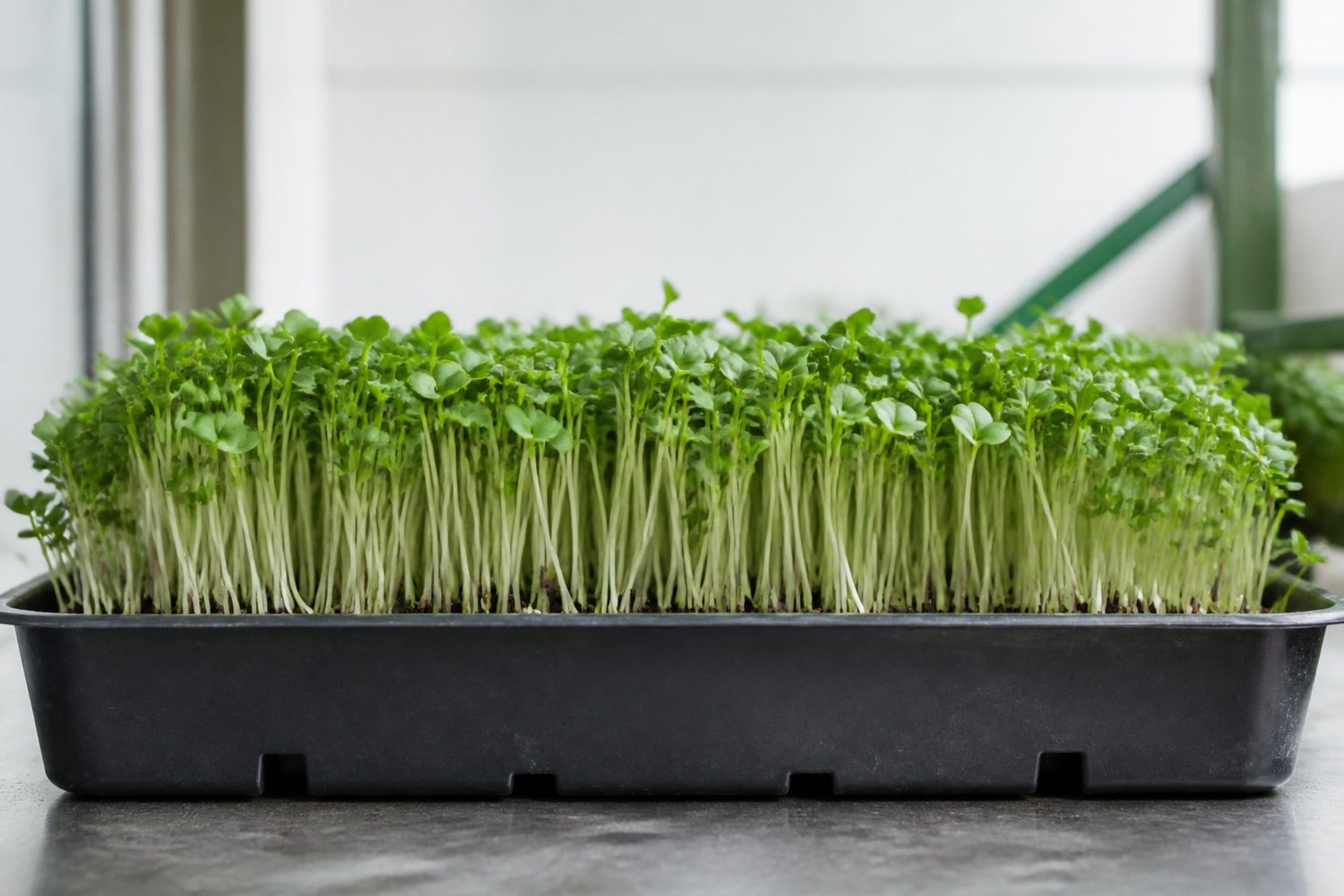
What it tastes like, and what to do with it
Sharp and peppery, closer to mustard or radish than to a salad green. Both crop-specific sources agree, and one calls it bold.
That makes it a flavor element rather than a base: on sandwiches and canapes, with fish and eggs, through a potato or leek soup at serving, and anywhere a dish wants heat and a small tender leaf at once.
It is the wrong choice for anyone who wants mild, and the wrong choice for volume.
Nobody has measured whether it sharpens with age.
Growing it: only what differs from the standard method
Two deltas, and the second is the one that matters.
No soak, stated outright by the crop-specific page rather than merely omitted.
Four to five dark days, uncovered at 1 to 2 cm. That is the only watercress-specific blackout duration published anywhere. No weight is verified for this crop: one extension says watercress benefits from covering, another gives a general two-to-five-pound contact weight, and neither of those is watercress data.
Then the real work, which is water discipline over a long cycle. Fine seed plus a slow crop is the combination that keeps a tray damp long enough for damping-off to take hold, and this page rates the mold risk high for that reason rather than because watercress is weak. Bottom-water, ventilate, and do not let the surface stay saturated.
Sow thickly but do not ask this page how thickly, because nobody publishes a rate. The supplier says 1/8 to 1/4 inch spacing, which is a spacing and not a mass, and converting one into the other would be arithmetic on a guess.
What goes wrong with watercress specifically
Damping-off, for the structural reason above. Rot at or below the medium line, collapse in patches, from the usual Pythium and Rhizoctonia complex. The mitigations are the ordinary ones and they matter more here than on a nine-day crop.
Uneven emergence on very fine seed, which is a distribution problem rather than a lot problem most of the time.
And one thing that is not a tray problem at all, but belongs on this page. Wild watercress growing in streams and ditches carries a real foraging hazard, and it is the reason some people are wary of the plant. A sown tray of purchased seed on clean medium indoors has nothing to do with that. If you are picking watercress out of a waterway, that is a different question and a different source.
Nutrition, and one measured study
USDA FoodData Central has no watercress microgreen entry, searched 8 August 2026. The mature-watercress record is not a substitute, and on this crop that substitution is unusually tempting, because mature watercress has a famous nutrient reputation.
One peer-reviewed study did measure the microgreen. Marchioni and colleagues compared pot-grown watercress against four other Brassicaceae microgreens: seed germinated two days at 24C, grown at 30C day and 20C night on a 16-hour photoperiod, cut after 14 days at fully expanded cotyledons with first true leaves.
For watercress it reported 88.94 percent water, reducing sugars at 8.44 mg glucose equivalents per gram fresh weight, total carotenoids at 96.9 micrograms per gram, anthocyanins at 52.28 micrograms per gram, and total ascorbic acid in a reported group range of 124.1 to 137.52 micrograms per gram fresh weight. It also found watercress among the highest-antioxidant samples in the comparison.
Those are one study's measurements under one set of stated conditions, including a 30C day that most growers will not be running. They are not label values, and the antioxidant finding is a ranking within five crops rather than a general claim.
Which seed to buy
Buy by botanical name. On no other crop is a common name this likely to get you the wrong plant, for the reason set out at the top of this page.
Specify Nasturtium officinale, untreated, sold for microgreen or food use, with a lot number and germination date. No cultivar choice is documented.
Then be ready for the price. Johnny's listed watercress microgreen seed at $296.25 a pound on 8 August 2026, which puts it among the dearest microgreen seed sold, behind mint at $1,394.50 and sorrel at $351.35, and ahead of oregano at $242.36.
Watercress seed on Amazon is scoped to the botanical name for the reason at the top of this page: a search on "cress" or "nasturtium" returns three unrelated plants and a bedding flower.
What it costs per tray, nobody can tell you, and that is not evasion. There is no published seeding rate for this crop, so the price cannot be multiplied by anything. The formula is simply tray grams / 453.592 x $296.25, and the first term does not exist yet.
Is it worth growing?
Grow it for the flavor and the specificity, not for the numbers.
It suits a chef or a direct-market grower selling something recognizable and sharp, and a home grower curious about watercress without a stream. It does not suit anyone planning a yield, because there is no rate, no yield, no harvest window and no cost per tray for this crop anywhere.
If you want peppery and documented, the directory has better answers. Radish is measured end to end and faster. Garden cress, confusingly close in name and nothing like it in the tray, has a rate, a yield and a measured density study behind it.
Watercress wins when what you specifically want is watercress.
A note on the numbers above
Hover or tap a row to highlight it.
| Figure | Value | Source | What kind of number it is |
|---|---|---|---|
| Days to harvest | 16 to 25 | Johnny's | Stated flat, no temperature |
| Days to harvest | 7 to 12, cut at 5 cm | A second supplier | More than twice as fast, and the same page sells the seed for sprouting |
| Blackout | 4 to 5 days, uncover at 1 to 2 cm | The same second supplier | The only watercress-specific duration published |
| Soak | None | The same source | Stated as "Presoak: No" |
| Seed price | $296.25 per pound | Johnny's, listed 2026-08-08 | Among the dearest microgreen seed sold |
| Seed rate | No figure exists | Every source opened | A 1/8-to-1/4-inch spacing is published, which is not a mass |
| Yield | No figure exists | Johnny's 29-variety trial | Watercress is not in the trial |
| Harvest window | No figure exists | Every source opened | And no flavor-change-with-age observation either |
| Water content | 88.94 percent | Marchioni et al., 2021 | Measured, at 14 days, 30C day and 20C night |
| Total carotenoids | 96.9 ug/g fresh weight | The same study | Measured under those conditions |
| Anthocyanins | 52.28 ug/g fresh weight | The same study | Measured under those conditions |
| Fresh-weight panel | No FDC record | USDA FoodData Central, searched 8 August 2026 | Mature watercress is not a substitute |
The name collision deserves one more paragraph, because getting it wrong costs you a tray and the seed money. Nasturtium officinale is watercress. Tropaeolum majus is what everyone calls nasturtium, and it is Tropaeolaceae, not even a brassica. Lepidium sativum is garden cress, a brassica but a different genus and a completely different crop in the tray: garden cress is among the fastest microgreens going and watercress among the slower. All three taste peppery, which is presumably how the names got tangled, and all three sell under overlapping words. The botanical name on the packet is your only reliable way through it.
You can price the seed and not the tray. Watercress sells by the pound at a figure you can read off the page, and nobody has published how much goes into a 1020. Thyme has the opposite problem, a measured rate with no seed sold by weight. A cost per tray needs both numbers, and on a lot of crops the literature supplies only one, so weigh what you sow and keep the receipt.
The day counts disagree by more than a factor of two, 7 to 12 against 16 to 25 on the same crop. One of those pages sells the same seed for sprouting, and a sprouting timeline is a different thing from a microgreen one. Do not split the difference: run the crop once, watch for full cotyledons and the first true leaves, and record what your own tray took.
Hover or tap a row to highlight it.
| Crop | Seed per 1020 | Yield | Days | Cost per tray | Oz per $1 | Oz per tray-day |
|---|---|---|---|---|---|---|
| Tatsoi | 7.5 g | 8.5 oz | 13.5 | $0.93 | 9.1 | 0.63 |
| Garden cress | 10.5 g | 8.0 oz | 8 to 15 | $0.96 | 8.3 | 0.62 |
| Watercress | No published figure | No published figure | 7 to 25 | no rate to price | cannot be calculated | cannot be calculated |
| Turnip, Purple Top White Globe | 10 g | No published figure | 7 to 12 | $0.31 | cannot be calculated | cannot be calculated |
| Komatsuna | 10 to 24 g | 10.6 oz at 1st true leaf, 13.4 at 2nd, area-converted | 8 to 12 | $0.47 to $1.12 | 10.0 | no day count for the measured stage |
A blank means nobody has published that figure, so the cell is left empty rather than filled with an estimate. How the numbers work
All 62 crops, sortable, on the microgreen comparison.
Terms on this page
Tap a term to see what it means.
*Nasturtium officinale*. Watercress, the crop here. The genus name is the source of the confusion below.
Sources
- Watercress microgreen seed, Johnny's - the species, 16 to 25 days, the 1/8-to-1/4-inch spacing, the note that it is easier as a microgreen than in the field, the general 5-to-10-day storage range, and the $296.25 per pound price listed 8 August 2026.
- Watercress microgreen and sprouting seed, Premier Seeds Direct - 7 to 12 days, harvest at 5 cm, 4 to 5 blackout days with the 1-to-2-cm uncover signal, "Presoak: No", and the mustard-or-radish flavor comparison.
- Johnny's microgreen yield trial and the trial tech sheet - 29 varieties, none of them watercress, which is why this page has no rate and no yield.
- Marchioni et al., 2021, five Brassicaceae microgreens compared - N. officinale var. microphyllum at 14 days, 24C germination then 30C day and 20C night, with water content, reducing sugars, carotenoids, anthocyanins, ascorbic acid and antioxidant activity.
- USDA FoodData Central - searched 8 August 2026, no watercress microgreen entry.
- Microgreens, UF/IFAS Gardening Solutions - the note that watercress benefits from covering, the general second-harvest caveat, and 5 to 6 days refrigerated.
- Grow your own microgreens, Utah State University Extension - the general 2-to-5-pound contact weight, explicitly not watercress data.
- Damping-off, UC IPM - the pathogens behind the high risk rating.
- Microgreens production, Virginia Cooperative Extension - why seed density is system-dependent and needs a trial rather than a conversion.
Keep reading
The variety directory
Arugula microgreens
Arugula is a seasoning green rather than a salad base: 10 g of seed makes 10 oz in 14 days, it is genuinely peppery, and its 10-day shelf life comes from a controlled storage study rather than an estimate.
Read Arugula microgreensThe variety directory
Garden cress microgreens
The crop where somebody finally measured what over-sowing costs: peak yield at 12 seeds per square centimeter, and roughly eight times the bacteria at 14. Plus 8 oz a tray at 13 days from the trade's own trial.
Read Garden cress microgreensThe variety directory
Amaranth microgreens
Red Garnet amaranth is the magenta garnish crop, and the trial numbers explain why it is a chef's crop rather than a grower's: 7.5 g of seed makes 6.5 oz in 17 days, against radish's 11 oz in nine.
Read Amaranth microgreensThe variety directory
Chia microgreens
A small bitter minty garnish in about a week. Chia seed is about 30 percent fat and the microgreen is not, so if you want the omega-3, eat the seed.
Read Chia microgreens