Nasturtium microgreens
Cal HewittPublished Checked
- herb
- moderate
- garnish
- nasturtium
- needs soaking
- cut and come again
- mold prone
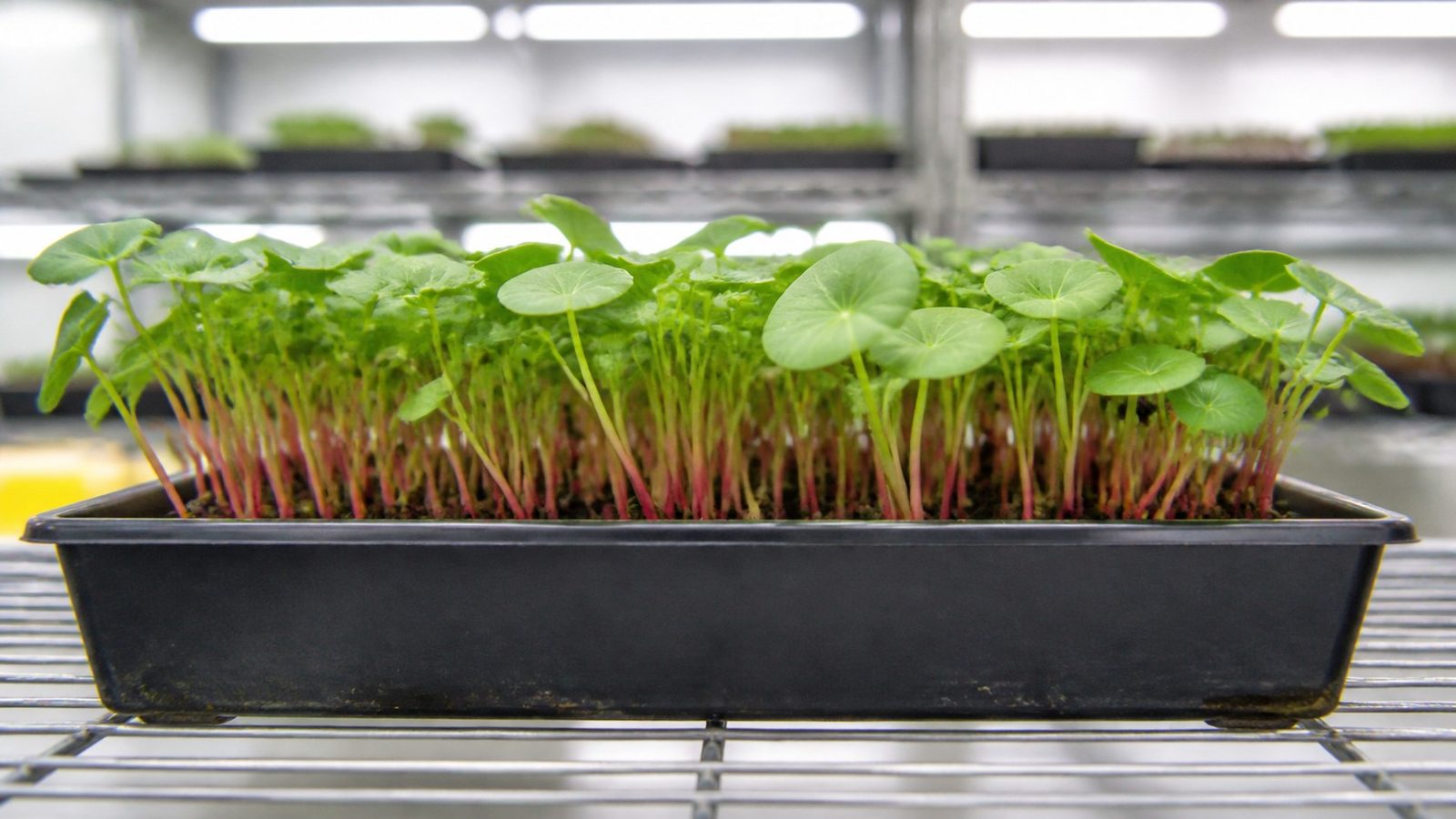
At a glance
The green-up is easy and the germination is not: a large hard seed that can take 7 to 14 days to come up unevenly, which means a long spell under a cover where too much water is the standing risk.
- Botanical name
- Tropaeolum majus
- Also sold as
- Empress of India, Jewel Mix, Blue Pepe, Emerald, Whirlybird Mix
- Family
- nasturtium
- Difficulty
- Moderate
- Days to harvest
- 12 to 21 days
- Harvest window
- No published figure
- Seed per 1020 tray
- 133 g
- Soak
- 0 to 6 hours
- Blackout
- 3 to 4 days
- Germination temperature
- 65 to 70 °F
- Yield per 1020 tray
- 5.64 oz
- Regrows after cutting
- partial
- Mold risk
- High
- Hull shedding
- heavy
- Shelf life
- 5 days
- Eaten as
- raw
- Seed cost per tray
- $5.74
133 g (4.69 oz) at $19.58/lb, True Leaf Market Nasturtium Jewel Mix microgreen seed at the 1 lb size, listed 2026-08-09. Paired with the 5.64 oz yield that is about 0.98 oz of crop per dollar of seed, which is poor value by weight and only sensible if you are selling the look. The ladder runs 1 oz $5.78, 4 oz $8.59, 1 lb $19.58, 5 lb $61.64, 25 lb $234.40, so the same tray is $10.07 at the 4 oz pack a home grower reaches for and $2.75 at 25 lb. Seed only, excludes medium, tray, labor, light and loss.
Any field name above ranks every variety by it. No published figure means we researched it and nobody has established one, which is different from not yet researched. Every figure here is sourced at the bottom of the page. Compare every variety side by side.
Nasturtium holds a bench for three weeks and comes off it with 5.64 ounces, roughly a quarter of what a brassica tray would have returned in the same space and time. What you get for that is a round shield-shaped leaf on a thick, pink-flushed stem with a wasabi hit, which is a garnish a restaurant will pay garnish prices for. Sell it by the clamshell and the arithmetic works. Sell it by the pound and it does not.
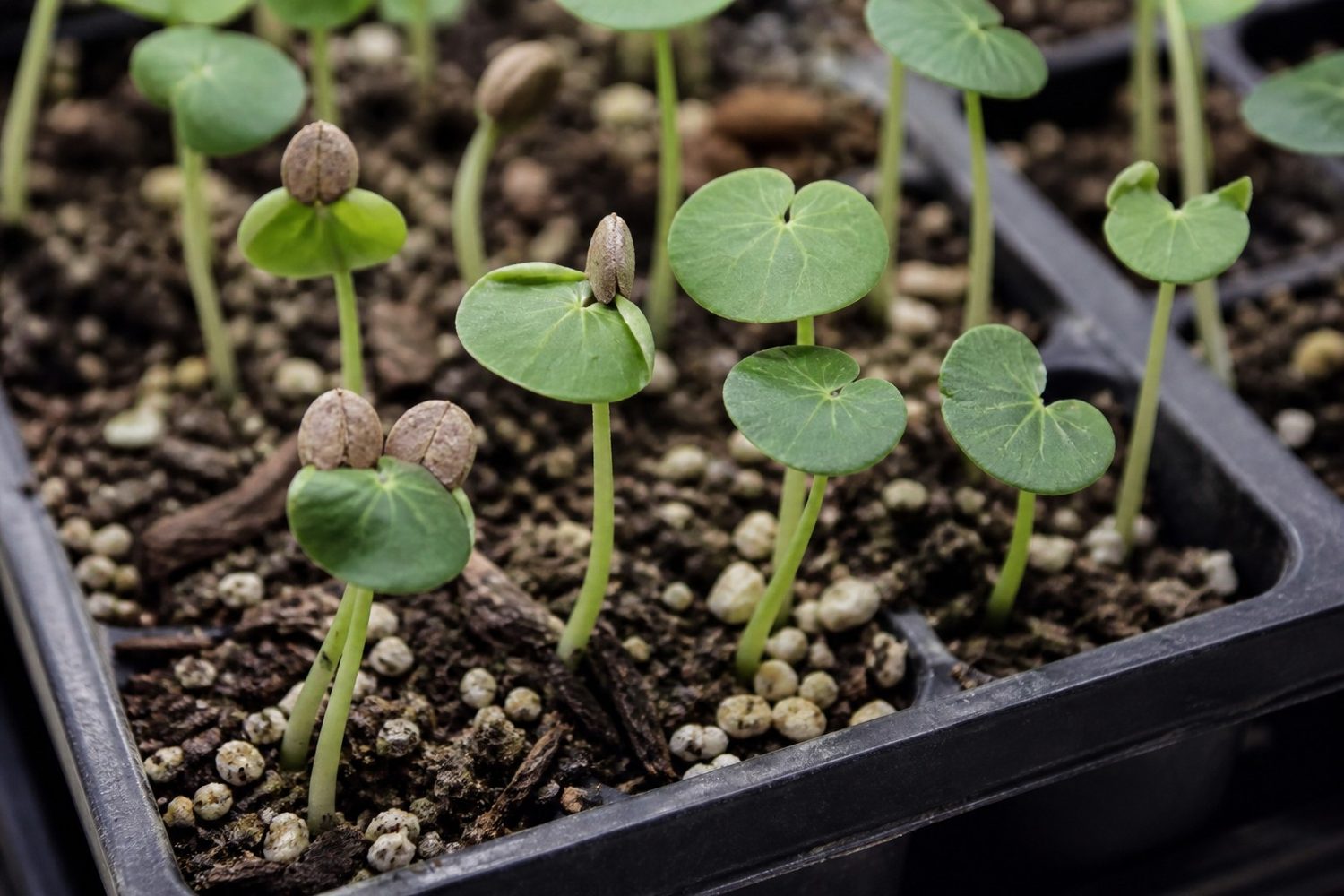
Three facts drive everything else on this page, and all three come from the seed being roughly the size of a pea. A 1020 swallows 133 grams of it. Germination straggles over 7 to 14 days, so a ragged stand is normal rather than your fault. And the seed coats frequently come up still stuck to the leaves, which on a garnish crop is a selling problem rather than a cosmetic one.
One trap before you buy anything: looking this crop up by name will hand you a different plant. The single hit for "nasturtium" in USDA FoodData Central is **FDC 170068, watercress, Nasturtium officinale, which carries the name as its genus and sits in another family entirely. The tray crop is garden nasturtium, Tropaeolum majus**, in the Tropaeolaceae. Check the Latin name on any nutrient panel or growing guide before you act on it.
What growers are saying right now
Sampled from public posts and videos, 10 July to 9 August 2026. Every line links what it is quoting. How often something is repeated is not evidence that it is true, so every line also says what the sources actually establish.
It will never grow the same as radish or broccoli, because nasturtium is a premium variety
Circulating Said flatly here by a seed vendor answering repeated grow questions, posted May 2026 at 154 views
Correct, and the numbers are blunter than the framing. Nasturtium takes 21 days to return 5.64 oz. Broccoli takes 12.5 days to return 11.5. That is a quarter of the bench productivity, and the crop only makes sense priced as a garnish rather than sold by weight. What the tray-day is worth
You do not need to soak the seed before planting, even though the seeds are pretty large
Circulating Stated on camera at 1,120 views, in a two to two-and-a-half week grow-along
A real disagreement, and the grower has the biggest supplier on their side. Johnny's also says soaking is not required. Against them, three suppliers specify 2 to 4 hours warm, 4 to 6 at room temperature, or a general 8. Nothing in the dispute is about whether the seed comes up; it is about how fast and how evenly, on a crop whose germination window is already 7 to 14 days. So, sow dry or soak, whichever suits your schedule, and do not expect either to rescue an uneven lot. Growing it
It is one of our chef's favorites, we sell to a lot of restaurants and we get a lot of requests
Circulating A commercial grower's walkthrough at 21,640 views, alongside a 56,152-view grow guide
That is the market, and it is the only one that works. A round shield-shaped leaf with a wasabi hit is a plated garnish, sold by the clamshell to somebody buying the look. Nothing on this page argues for it as a volume crop, and the economics agree with the chefs rather than with the scale.
The whole plant is edible, and the seed pods are called poor man's caper
Circulating A seed-saving clip at 862 views and 101 likes, the highest-engagement nasturtium item in the window
True of the garden plant, and it points at something specific to the tray version: the thing you sow is the same organ people pickle. It is a big seed, which is why 133 grams fills a 1020 and why the hulls are a visible problem at harvest rather than an invisible one.
The seeds look pretty different from each other, some big and some small
Circulating Noticed here at 2,199 views while germinating a bought packet
This is the likeliest explanation for the staggered emergence people complain about. Mixed seed sizes soak unevenly and come up unevenly. On a crop already published at 7 to 14 days to germination, a lot with two size classes in it turns a slow tray into a ragged one, and it looks exactly like grower error. Which seed to buy
What it is, and how to tell you grew it right
Nasturtium microgreens are seedlings of Tropaeolum majus, garden nasturtium. Family Tropaeolaceae, and it is the only tray crop of any consequence from that family.
The peppery flavor makes people assume it is a brassica, and it is not. It sits in the same broad order as the mustards and shares the glucosinolate chemistry that produces the heat, but the plant is unrelated to radish, arugula or mustard, and it behaves nothing like them in a tray: a huge seed, 7 to 14 days just to germinate, and three weeks to a cut.
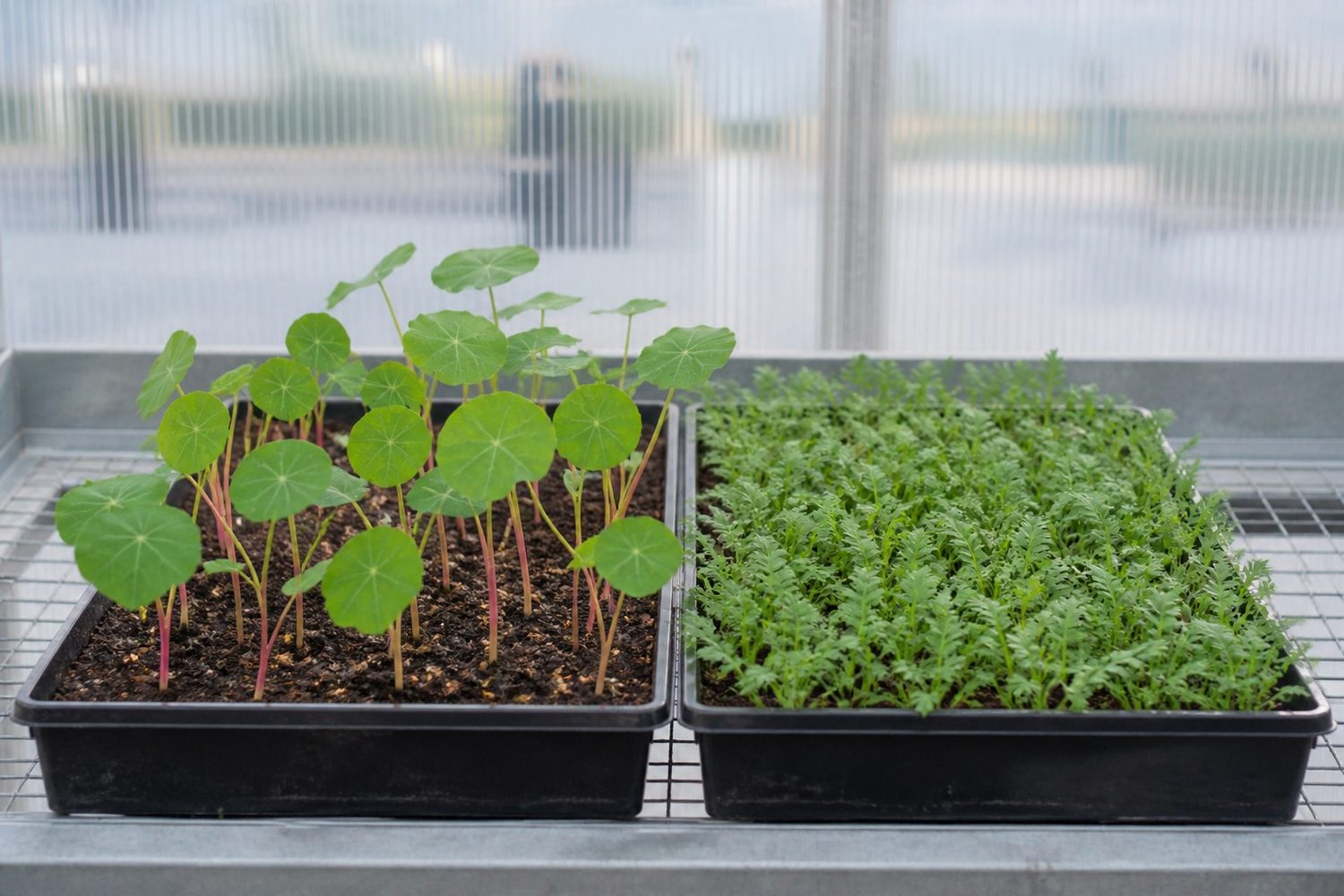
A correct tray reads as a dense but individually legible canopy rather than a solid carpet. Each plant carries a round, shield-shaped leaf, veins radiating from near the center, on a substantial green to pink stem. Johnny's marketable stage is 3 to 6 inches tall with 2 to 4 leaves. Color varies by cultivar from lime to dusty green to purple-edged, so a universal stem-color description would be wrong. The large seed is often visible at the medium early on.
The confusion that matters is watercress, and the tell is the leaf: nasturtium's is a single round peltate leaf with veins radiating from near its center, where watercress carries compound leaflets. They are different families, different requirements and different flavors, and USDA's own search will hand you the wrong one.
What it tastes like, and what to do with it
Strong, peppery, and closer to horseradish or wasabi than to black pepper, with a brief sweetness before the heat arrives. This is a condiment crop. Nothing about it is mild.
That decides the use. Whole leaves and stems go where a plate wants visible volume plus a wasabi hit: sushi, spring rolls, sandwiches, composed salads, and as a finishing garnish on hot dishes. The leaf is the selling point as much as the flavor, because it looks like nothing else on the tray shelf.
It is the wrong choice as a salad base or in a mixed pack of mild greens. The leaves are large and the heat will dominate everything around it.
The people who will not like it are the people who dislike horseradish, wasabi or mustard heat. The objection is heat, not bitterness, which is a distinction worth making because it means the fix is portion rather than harvest timing. Nobody has run a panel on it.
Growing it: only what differs from the standard method
Everything general about trays, medium, light and watering is on the standard tray method for growing microgreens. Nasturtium departs in four ways, all downstream of a very large seed.
Sow a single non-overlapping layer, and cover it lightly. This is one of the few microgreen crops that wants soil over the seed rather than surface contact: it needs darkness to germinate, and the published method is 1 to 1.5 inches of medium, seeds placed so they do not touch, a light press, and a thin layer over the top. That is the opposite of mint, which will not germinate if you cover it at all.
Soaking is optional and the sources disagree. Johnny's says it is not required, and a grower on camera agrees. Others specify 2 to 4 hours in warm water, 4 to 6 at room temperature, or a general 8 hours for hard seed. If you soak, 4 to 6 hours at room temperature and drain well before sowing. What nobody claims is that an unsoaked tray fails; the argument is about speed and evenness.
Three to four days stacked, and this crop has a real published weight. A farm crop sheet specifies a 14 lb paver on the top tray at 70°F, for seed-to-medium contact and downward rooting. Most crops leave you guessing at the weight, so use this one as given rather than approximating it. Take it off when the seedlings lift the stack.
Then keep it drier than instinct suggests. The failure on this crop is a big seed held wet under a cover while germination straggles. One supplier warns specifically against adding water in the first two days. After unstacking, the published regime is 16 hours of light a day and bottom watering once each morning, twice only if the medium will not hold moisture.
A nasturtium tray, and why it takes three weeks
- 1
Day 0, sow in one layer
Level 1 to 1.5 inches of medium, place seeds so they do not touch, press lightly, cover thinly. It needs the dark. Stack with a 14 lb weight at 70°F.
- 2
Days 1 to 2, do not water
The specific warning is that adding water here raises the mold risk. The seed is large and already carrying moisture.
- 3
Days 3 to 4, unstack
Weight and cover off when the seedlings are pushing the stack up. Germination itself is published anywhere from 4 to 6 days after a soak to 7 to 14 days without one, so expect the stand to arrive unevenly.
- 4
Days 4 to 14, light and patience
16 hours of light, bottom water each morning. This is the stretch where a brassica would already be cut.
- 5
Days 14 to 21, cut
3 to 6 inches with 2 to 4 leaves. Past four leaves the plant starts drawing from the medium rather than the seed, and it is becoming a petite green rather than a microgreen.
What goes wrong with nasturtium specifically
Before emergence: seed rot, and gaps you cannot fix. A wet covered tray plus a slow, staggered germination window. The early sign is soft or discolored seed instead of firm seed with a root showing. Individual seeds are not recoverable and reseeding into a running tray does not produce an even stand.
At emergence: damping-off. Thinning or pinched stems at or below the medium line and collapsing seedlings, Pythium and Rhizoctonia the usual organisms. A localized patch can be removed; a spreading tray is finished.
Do not diagnose this crop by the color of the fuzz. Root hairs occur on roots only, as a clean even fuzz, and do not spread across seed, stem or medium. What the extension literature anchors on is rot at or below the medium line and dying seedlings, not the whiteness of anything. If growth has spread beyond the roots and comes with soft seed, a water-soaked stem, odor or collapse, it is a failure regardless of color.
At harvest: the hulls, and on this crop they can cost you the tray. Seedlings frequently come up still wearing the seed coat. On a fine brassica that is invisible; on a seed this size it is obvious, and a premium garnish tray with hulls on the leaves is not sellable at garnish prices. There is a specific published remedy: wait a few days, mist the canopy, and briefly re-cover to loosen them. No retention percentage is published, so budget time for it rather than a number.
Late: it stops being a microgreen. Past four leaves the plant shifts toward a petite-green habit and starts drawing from the medium rather than the seed. It is obvious before you cut. No source measures what a day late costs in tenderness or flavor, so watch the leaf count.
Nutrition, and what is actually established
Nothing has been measured on this crop at this stage.
There is no Tropaeolum majus microgreen entry in USDA FoodData Central, searched 2026-08-09, and the only "nasturtium" result is watercress. No peer-reviewed composition study of nasturtium harvested as a microgreen was found either. What research exists is on mature leaves, flowers and extracts, which is a different plant part at a different stage and cannot be substituted for the tray crop.
So, the vitamin figures printed on supplier pages have nothing behind them here. The mature plant has real food chemistry and a long history of use; the 2-to-4-leaf seedling has simply never been analyzed. If you need a nutrition claim you can stand behind, for a label or for a customer who asks, do not make it on nasturtium. Lettuce, celery and mizuna all have real measurements, running in both directions against their adult forms.
Which seed to buy
Four named types are actually sold and they differ in color and schedule, not in a documented way in yield. Empress of India is the cultivar behind the only production record here, at 133 g and 21 days. Jewel Mix is variegated, claimed at 14 to 16 days. Blue Pepe is green with blue edges, claimed at 12 to 16. Emerald is a fourth. Tenderness and yield comparisons between them are not published, so buy on the look you want.
Ask for the lot and the germination test, and ask about seed size. This is the crop where the AeroGarden grower's observation matters commercially: a lot carrying two size classes soaks unevenly and emerges unevenly, and on a crop already published at 7 to 14 days to germination that reads as your fault rather than the lot's. No published germination specification exists for nasturtium microgreen lots, so ask the supplier for theirs rather than assuming one.
Refuse coated or fungicide-treated seed. NC State says plainly not to use fungicide-treated seed, often pink-coated, for microgreens. Nasturtium is widely sold as ornamental flower seed, which is exactly the channel where treated lots turn up, and "non-GMO" on a packet says nothing about treatment.
The marketplace is the expensive route on this crop. The Amazon search returns 167 results with 41 nasturtium listings on page one, but only two are sold for microgreens: Whirlybird Mix at 4 oz for $21.03 and Empress of India, the exact production cultivar, at 1 oz for $11.81. Against the seed house at $1.22 an ounce for a pound, that is roughly ten times the price per ounce. The other 39 are garden and edible-flower seed of the same species, mostly untreated heirloom, which is a genuine option for one tray at 700 seeds for $15 to $17.
Nasturtium seed on Amazon is where a home grower will find a packet, and it is the right size for a single tray. For anything past one tray, buy from a seed house instead, because the same seed runs several times cheaper by the pound.
Is it worth growing?
For a chef, or for a home grower cooking like one, yes. For anyone selling by weight, no, and the numbers are unambiguous.
Nasturtium occupies a bench for 21 days and returns 5.64 ounces. That is 0.27 ounces per tray-day against sunflower's 1.79 and broccoli's 0.92. At $5.74 of seed it returns 0.98 ounces per dollar, which is about as poor as tray crops get, with only fennel worse. Both numbers say the same thing: this is not a crop you sell by the ounce.
What it is instead is the most visually distinctive thing in the category. A round shield leaf on a thick stem, with a wasabi hit, is a plated garnish that a restaurant will pay garnish prices for, and the commercial grower in the pulse block above is describing exactly that trade. Sold by the clamshell at a garnish price, three weeks and six ounces is a perfectly good business. Sold by the pound, it is a bad one.
Choose something else if you want speed, forgiveness, or volume. Its rivals for the peppery slot, radish, arugula and mustard, all beat it on every economic column and none of them looks like this.
A note on the numbers above
Hover or tap a row to highlight it.
| Figure | Value | Source | What kind of number it is |
|---|---|---|---|
| Seed per 1020 | 133 g | Farm crop sheet, Empress of India | Production record, not a trial |
| Yield per 1020 | 160 g target, 5.64 oz | Same crop sheet | A farm's target at 21 days, leaf stage unstated |
| Days to harvest | 14 to 21 | Johnny's shoots guide | With a stated stage: 3 to 6 inches, 2 to 4 leaves |
| Days to harvest | 21 | Farm crop sheet | For a 10x20, stage unstated |
| Days to harvest | 14 to 16 | True Leaf, Jewel Mix | Supplier claim, no stage or temperature |
| Days to harvest | 12 to 16 | UK vendor, Blue Pepe | Supplier claim |
| Days to germination | 7 to 14 | Johnny's | The reason the crop is slow |
| Days to germination | 10 to 14 | Iowa State, at 65 to 70°F | Conventional annual table for T. majus |
| Days to germination | 4 to 6 | Mumm's, after soaking | Supplier claim |
| Soak | Not required | Johnny's | And a grower on camera agrees |
| Soak | 2 to 4 h warm / 4 to 6 h / 8 h | Three other sources | All disagree with the above and each other |
| Blackout weight | 14 lb paver at 70°F | Farm crop sheet | A rare case of a real weight for a real 1020 |
| Shelf life | Up to 5 days | Grower guide | Dry, unwashed, sealed. No temperature stated |
| Nutrition | No published figure | Nobody | No FDC record and no microgreen composition study |
| Harvest window | No published figure | Nobody | Nobody has established it |
Both money figures rest on one farm's crop sheet, so treat them as a starting point rather than a benchmark. The 133 g rate and the 160 g target come from the same document for the same cultivar, which means they do not corroborate each other: two numbers from one source are still one source. They are the only crop-specific 1020 figures that exist for nasturtium anywhere, so weigh your own first tray and work from that afterwards.
The poor value per dollar comes from quantity, not from price. At 0.98 oz per dollar, only fennel at 0.42 does worse, and chives at 1.7 is close behind. Chives gets there through expensive seed. Nasturtium gets there through bulk: at $19.58 a pound the seed is unremarkable, but a tray swallows 133 grams of it because each seed is the size of a pea.
The pack size moves this tray more than the species does. At the 4 oz pack a home grower actually reaches for, the same tray costs $10.07 of seed; at 25 lb it costs $2.75. That is a 3.7-fold swing on the bag alone, so if you intend to run nasturtium regularly, the size you buy matters more than any growing decision on this page.
Nobody has established a harvest window, so use the leaf count instead. The published trigger is 2 to 4 leaves at 3 to 6 inches, and past four leaves the plant is documented to start drawing on the medium rather than the seed. That is a boundary, not a window: cut at the leaf count and note the date, and after two trays you will know your own holding time.
Hover or tap a row to highlight it.
| Crop | Seed per 1020 | Yield | Days | Cost per tray | Oz per $1 | Oz per tray-day |
|---|---|---|---|---|---|---|
| Basil | 5 to 6.5 g | 5.5 to 7.5 oz | 12 to 26 | $0.83 | 7.8 | 0.34 |
| Cilantro | 26 g | 6 oz | 20.0 | $1.10 | 5.4 | 0.30 |
| Nasturtium | 133 g | 5.64 oz | 21 | $5.74 | 0.98 | 0.27 |
| Sorrel, Red Veined | 3.5 g | 6.5 oz | 24 | $2.71 | 2.40 | 0.27 |
| Parsley, Italian flat-leaf | 15 to 20 g | 6.25 oz, area-converted | 21 to 35 | $0.50 to $0.66 | 9.5 to 12.5 | 0.30 at 21 days |
All 62 crops, sortable, on the microgreen comparison.
On bench turnover nasturtium sits between cilantro and celosia, and near the bottom on value, which is a fair summary of the crop: it is not competing on either column and it does not need to.
Terms on this page
Tap a term to see what it means.
*Tropaeolum majus*. Garden nasturtium, the crop on this page. Family Tropaeolaceae, and unrelated to watercress despite the name.
Sources
- Johnny's Selected Seeds, nasturtium shoots key growing information - 14 to 21 days to marketable shoots at 3 to 6 inches and 2 to 4 leaves, 60 to 65°F minimum, 7 to 14 days to germination, soaking not required, single-layer sowing into 1 to 1.5 inches of medium with a light cover, and the Tropaeolum spp. label.
- Paperpot Co / Scintilla Farms, nasturtium microgreens grower's notes (PDF) - the only crop-specific 1020 figures anywhere: 133 g of Empress of India, a 160 g target yield, 21 days, 3 to 4 stacked days under a 14 lb paver at 70°F, 16 hours of light, morning bottom watering, and disposal rather than a second cut.
- True Leaf Market, Nasturtium Jewel Mix microgreen seed - the price ladder verified 2026-08-09 at 1 oz $5.78, 4 oz $8.59, 1 lb $19.58, 5 lb $61.64 and 25 lb $234.40, plus the 14 to 16 day claim and the variegated Jewel Mix description.
- Epic Gardening, nasturtium microgreens - 2 to 4 hours in warm water, non-overlapping seed under a thin soil layer, regrowth only where one or two leaves are left on the plant, up to 5 refrigerated days stored dry and unwashed, and the four-leaf boundary past which the plant draws on the medium.
- Mumm's Sprouting Seeds, nasturtium - 4 to 6 hour soak, visible germination in 4 to 6 days, the weighted empty tray for rooting, and the hull remedy: wait a few days, mist and briefly re-cover.
- Premier Seeds Direct, Blue Pepe microgreen nasturtium - 12 to 16 days, the slight sweetness before the peppery kick, and the warning that watering in the first two days raises the mold risk.
- Iowa State Extension, germination requirements - T. majus at 10 to 14 days to germination at an ideal 65 to 70°F in darkness, against broccoli's 4 to 7, which is the size of the difference.
- NatureServe Explorer, Tropaeolum majus - the taxonomy: Tropaeolaceae, not Brassicaceae, and not Nasturtium officinale.
- Penn State Extension, growing microgreens at home - the general 8 to 12 hour soak for large hard seed, and that washing before storage substantially reduces shelf life on delicate tissue.
- NC State, microgreens for school gardens - do not use fungicide-treated seed, often pink-coated.
- UC IPM, damping-off - Pythium and Rhizoctonia, and the diagnostic anchor being rot at or below the medium line rather than the color of any growth.
- USDA FoodData Central - searched 2026-08-09: no Tropaeolum majus microgreen record, and the sole nasturtium hit is FDC 170068, watercress.
Keep reading
The variety directory
Celery microgreens
Three to four weeks of bench for a seasoning green, with an unusually complete measured nutrient panel behind it: 45.8 mg of vitamin C per 100 g, and four minerals that are higher in the mature leaf.
Read Celery microgreensThe variety directory
Chickpea shoots
One of the very few crops with real regrowth data behind it: a measured second cut at 96 percent of the first, if you cut above a node instead of at the medium line.
Read Chickpea shootsThe variety directory
Pea shoots
Pea shoots are the easiest microgreen to start and one of the easiest to lose. Sourced figures for seed rate, days, yield and cost, plus the wet-seed failure that actually kills trays.
Read Pea shootsThe variety directory
Purslane microgreens
Purslane germinates in light rather than under blackout, and its whole reputation rests on a nutrient nobody has measured at this stage. It is the richest leafy source of omega-3 there is, as a mature plant.
Read Purslane microgreens