Celery microgreens
Cal HewittPublished Checked
- herb
- difficult
- slow crop
- garnish
- chef crop
- no soak
- cut and come again
- mold prone
At a glance
Ten to eighteen days just to germinate an extremely fine seed, then two to four more weeks to grow out, so any error in moisture, temperature or lot quality sits in the tray for weeks instead of days.
- Botanical name
- Apium graveolens
- Also sold as
- Cutting Celery Microgreen Seed, Celery Microgreens Seeds, Celery Micro-Greens, Celery, Microgreen Seeds
- Family
- herb
- Difficulty
- Difficult
- Days to harvest
- 21 to 30 days
- Harvest window
- No published figure
- Seed per 1020 tray
- 1.1 to 4.4 g
- Soak
- None
- Blackout
- 7 to 14 days
- Germination temperature
- 70 to 77 °F
- Yield per 1020 tray
- No published figure
- Regrows after cutting
- partial
- Mold risk
- High
- Hull shedding
- some
- Shelf life
- 5 to 10 days
- Eaten as
- raw
- Seed cost per tray
- $0.58
4.4 g at $59.45/lb, Johnny's Cutting Celery microgreen seed, listed 2026-08-08. At the sparse end of the calculated range, 1.1 g, it is $0.14. Both rest on calculated geometry rather than a weighed trial, so neither is a measured tray cost. Seed only, excludes medium, tray, labor, light and loss.
Any field name above ranks every variety by it. No published figure means we researched it and nobody has established one, which is different from not yet researched. Every figure here is sourced at the bottom of the page. Compare every variety side by side.
Celery asks for more bench time than almost any microgreen: ten to eighteen days just to germinate, then three to four weeks from sowing to a cut. What you get back is not volume. It is a concentrated, aromatic seasoning green that one supplier describes as celery, but even more so.
It is also, unexpectedly, one of the best documented microgreens on nutrition. Celery is absent from the trade's yield trial, so there is no measured yield to quote. But it is one of the few microgreens with its own peer-reviewed nutrient measurements, and a second study that compared the microgreen against the mature leaf across twenty genotypes. That study found four minerals higher in the mature leaf, which is not what anyone selling microgreens tends to mention.
What growers are saying right now
Sampled from public posts and videos, 9 July to 8 August 2026. Every line links what it is quoting. How often something is repeated is not evidence that it is true, so every line also says what the sources actually establish.
Celery and water for five days, and the results speak for themselves
Circulating By a very long way the biggest celery item in the window, a 2.1 million view TikTok from tanakay3 at 191,965 likes and 1,720 comments, describing a celery stick left in a water bottle overnight and drunk for five days
That is celery water, not a microgreen, and no source opened for this page speaks to it. What IS measured for the microgreen is narrower and more interesting, including the finding that potassium, zinc, copper and manganese all came out HIGHER in mature celery leaf than in the microgreen. What is actually measured
Most people harvest celery once and pull the whole plant, but you do not have to
Circulating A cut-and-come-again demonstration at 17,768 views and 882 likes, showing two ways to harvest garden celery
The tray version of that is real but unmeasured. Celery is one of only three microgreens reported to give a second cut, if you clip only the tops and leave substantial stem. Nobody has published what the second cut weighs or how long it takes. Whether it regrows
Celery microgreens go bad faster than other varieties, but stored right they are excellent
Circulating A microgreens farm posting about its own celery, which is the only crop-specific grower voice in the window
The direction matches the published guidance and the specifics are missing from both. One supplier gives 5 to 10 refrigerated days under "proper storage conditions" without defining temperature or packaging, and another simply says use it immediately because it is delicate. Nobody has run the trial. What is missing
Do not forage wild celery, because of its dangerous resemblance to Hemlock Water Dropwort
Circulating A grower's warning while harvesting from a veg plot, recommending buying seed and growing your own instead
Worth repeating rather than dismissing, and it is the strongest argument for the crop on this page. A sown tray of known Apium graveolens seed removes the identification problem entirely. Celery has toxic look-alikes in the wild; a labeled bag does not. How to buy it
Proud of our micro celery
Circulating A grower's tray photo in r/microgreens at 31 upvotes, which is roughly the entire volume of celery microgreen discussion in a month
The pride is earned. Three to four weeks of bench for a crop with no published yield is a real commitment, and finishing one well is not a small thing.
What it is, and how to tell you grew it right
Celery microgreens are seedlings of Apium graveolens cut above the medium. They are not celery sprouts, which are eaten seed and root intact, and they are not a young stalk.
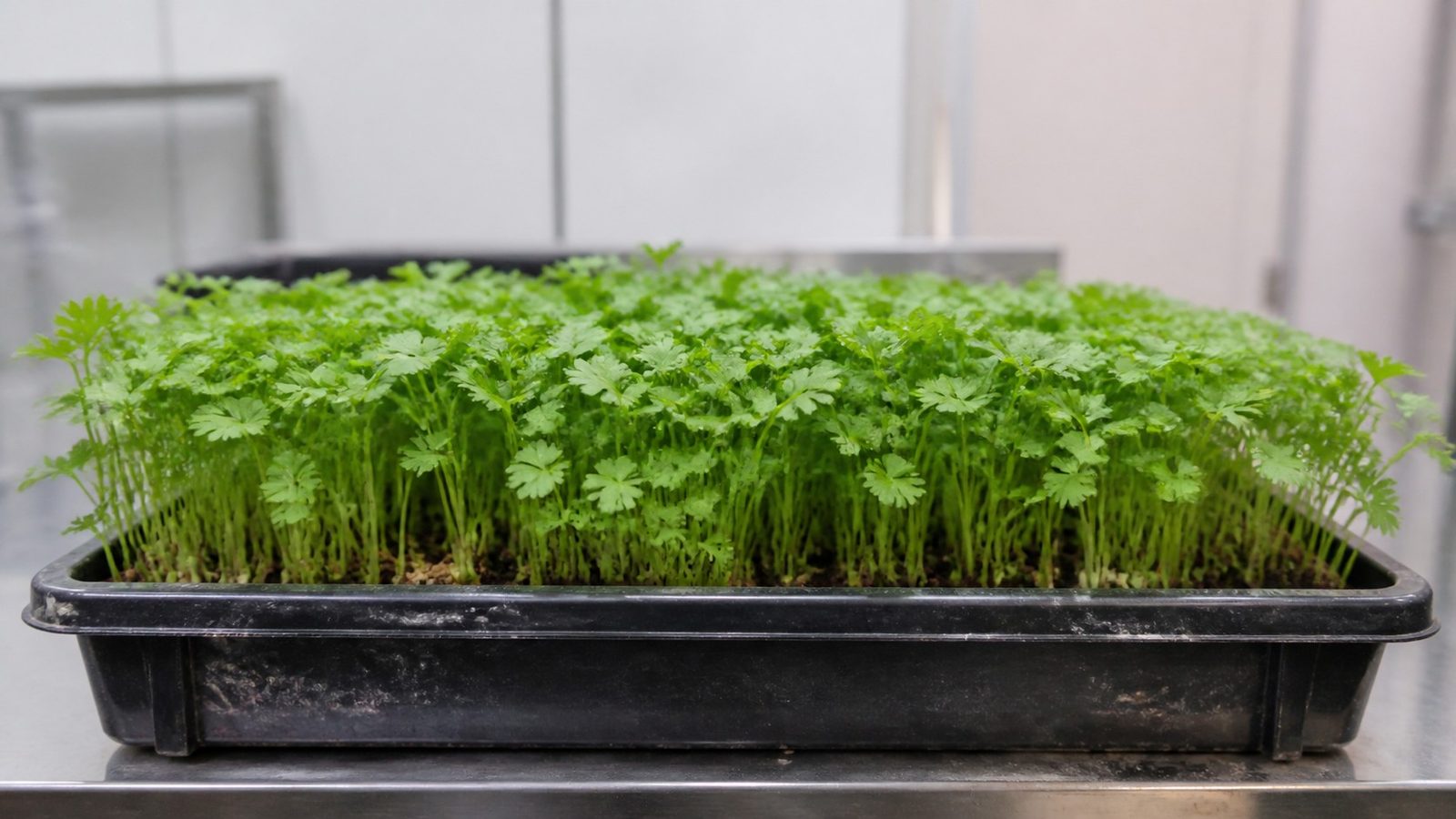
At harvest expect a small, finely textured, almost fernlike canopy of intricate divided green leaves on slender light green stems, roughly half an inch to two inches tall depending on which guide you follow. There are no thick pale stalks and there never will be. At the medium line a good tray shows many thin anchored stems with no collapsed, pinched or water-soaked bases. Nobody publishes a numeric evenness standard for celery, and given how variable the germination is, the useful confirmation is the distinct divided leaf rather than a uniform carpet.
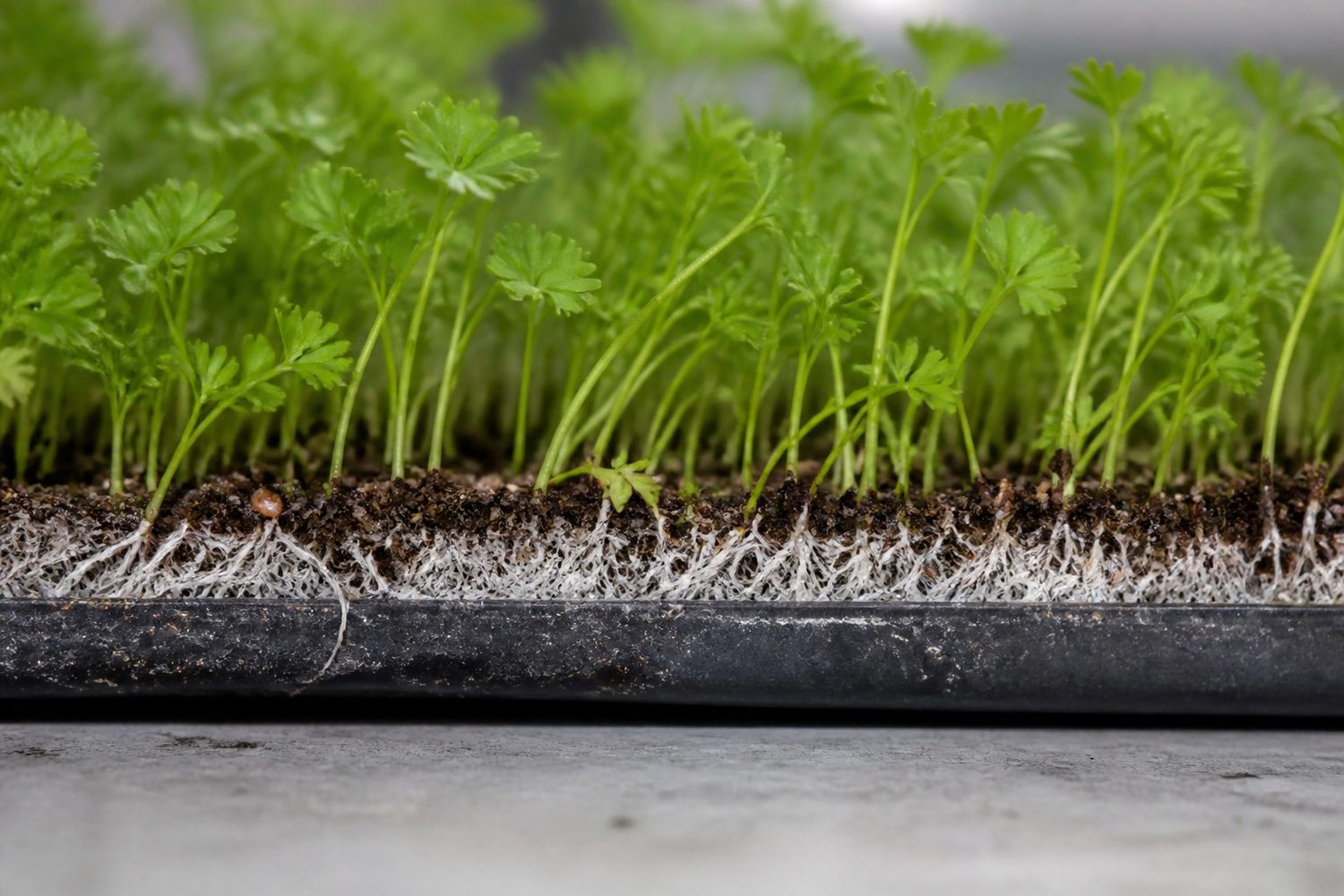
The confusion is with cilantro and the other fine Apiaceae greens. There is no clean published visual separator: the honest tell is celery's light green stems and, more reliably, its smell. Both crops announce themselves. If you are holding a tray you did not sow, use your nose before your eyes.
What it tastes like, and what to do with it
Concentrated and unmistakably celery, and stronger than the stalk it comes from. One supplier's summary is the best one written: celery, but even more so. Another describes its own named selection as mild, so there is real range between lots, but nothing here is a neutral green.
That makes it a seasoning rather than a salad. Use it where a small quantity carries celery aroma into a dish without the stringy, watery bulk of a stalk: over seafood, on a composed salad, dropped into soup at service, or through a savory casserole. The reported flavor also holds longer than many microgreens, which is part of why chefs use it.
It is the wrong crop as the main volume in a mixed salad, and the wrong crop if what you actually wanted was crunch. The leaves and stems are tender rather than crisp, so anyone reaching for celery's texture will be disappointed by a plant that only delivers its flavor. And anyone who dislikes celery will dislike this more, not less. A concentrated version of a divisive flavor is not a way to win somebody over.
Growing it: only what differs from the standard method
Everything general about trays, medium, light and watering is on the standard tray method for growing microgreens. Celery's deltas are almost all about patience, and the crop punishes a fast-crop reflex harder than anything else here.
Ten to eighteen days to germinate. Do not uncover on a brassica schedule. This is the single most important number on the page. Where broccoli is up in two or three days, celery is still germinating a fortnight in, and one supplier warns its germination can be slower in some years than others. A tray that looks dead at day eight is not necessarily failing.
Blackout 7 to 14 days, not 2 to 3. The cover stays on until the seed has finished germinating and the shoots push it up. That is a very long blackout, and it is the crop's central risk: fine seed sitting under cover on moist medium for up to two weeks is the textbook setup for seed rot.
Sow it sparse. The seed is tiny and the instinct to sow thick is wrong here. There is no weighed per-tray rate for celery anywhere, and the calculated range from the supplier's own spacing instruction is only 1.1 to 4.4 g per 1020, a fraction of any brassica. Crowding this crop is worse than crowding a fast one: older seedlings shade younger ones in a stand that is already emerging over two weeks, and airflow falls at exactly the moment the tray most needs it.
Level unusually carefully, press for contact, and barely cover. No more than a quarter inch of medium over seed this fine, and no more than an eighth to a quarter inch of spacing between seeds. The surface must not dry out during a long germination, and it must not sit saturated either, which is a narrower target than it sounds.
After emergence, bottom water and give it 12 to 14 hours of light. Bottom watering is the specific recommendation for this crop, because keeping water off the seedlings is what limits the damping-off and bacterial problems it is described as susceptible to. It does not want more heat and it does not want more total water. It wants less surface wetting and more air.
Feed it, or use a medium that can carry it. A three to four week crop can exhaust an inert medium before harvest, and the supplier allows dilute nutrition for slow species specifically for this reason.
One temperature tension worth knowing. The crop-specific germination band is 70 to 77F, while the same supplier's general microgreen guidance warns that above 75F germination can be inhibited and disease pressure rises. Those overlap awkwardly, and nobody has resolved it with a celery trial. The practical read is to aim at the lower half of that band, around 70 to 75F, where both sources agree.
A celery tray, week by week
- 1
Day 0, sow sparse
1.1 to 4.4 g broadcast on a carefully leveled, pre-moistened surface, pressed for contact, covered by no more than a quarter inch. Aim at 70 to 75F.
- 2
Days 1 to 10, nothing visible
This is normal and it is where most celery trays get thrown out. Keep it evenly moist, never saturated, and leave it covered.
- 3
Days 10 to 18, emergence
Germination completes across this window rather than on a day. Expect it to be uneven. Uncover when the shoots lift the cover, not on a date.
- 4
After the cover, light and air
12 to 14 hours of light, bottom watering only, and real airflow. This is the point where a wet tray turns into a lost one.
- 5
Days 21 to 30, cut
Two crop-specific sources give 21 to 28 and 26 to 30 days. Harvest at true leaves, roughly half an inch to two and a half inches, before the plants outgrow the tray.
What goes wrong with celery specifically
Four failures, and the first two are both consequences of a germination period long enough to lose patience in.
Before emergence, nothing happens. Low-vigor or old seed, temperature outside the band, a dried surface, or too much water. The early sign is very few seedlings after about a week in a tray that is warm and moist. This is only partly recoverable: stabilize conditions and wait, because celery genuinely takes 10 to 18 days, but a weak lot will not become an even stand. Seed here has a dry shelf life of one to two years and one supplier reports its own supply as difficult and variable year to year.
During blackout, seed rot in a wet crowded tray. Surface watering or saturation plus poor air exchange while fine seed sits covered for up to two weeks. The early sign is stagnant wet medium, yellowing or simply non-emergent patches, or a sour smell rather than clean white roots. Catch it early by reducing wetness and restoring airflow. Discard a tray with spreading rot.
After emergence, damping-off. Pythium and Rhizoctonia favored by wet conditions and compounded by slow dense growth. Stems go water-soaked and constricted at or just below the medium line and plants topple. Early losses can be contained by correcting drainage, irrigation, temperature and spacing. A spreading collapse is not a safe crop to salvage.
Through grow-out, an uneven shaded stand. Too much seed. Taller older seedlings shade the smaller ones and airflow drops. Improving light and airflow helps, but the uneven cut is already a quality loss you cannot recover.
Root hairs or mold? Celery is the crop that fools people
Hover or tap a card to highlight it.
Why celery specifically
Its root hairs are exceptionally fine and are commonly mistaken for mold, so the panic is more frequent here than on most crops.
Where it sits
Root hairs emerge from roots at the medium line and stay there. They are not a web across leaves or seed coats.
What it does when wet
Root hairs are most visible as the medium dries and recede when it is wet. A spreading patch that ignores watering is not root hair.
The company it keeps
Root hairs sit under healthy upright seedlings. Fuzz alongside soft, pinched, rotting stems and collapsing plants is the damping-off picture.
Where it stops
This is a grower's diagnostic, not an identification. Only a lab names an organism, so on a food crop let uncertainty resolve toward discarding.
Nutrition, and what is actually established
This is one of the few microgreens with real measured numbers behind it, and they are worth reading closely, because they do not say what you have probably been told.
There is no USDA record. FoodData Central was searched for "celery microgreens" on 2026-08-08 and returned nothing, so there is no FDC identifier or nutrient panel, and mature celery entries are not a substitute.
What exists is peer-reviewed. A 2012 analysis of 25 commercially grown microgreens included green Apium graveolens, grown mostly in soil in an unheated greenhouse under ambient light, in three replicates. It measured celery at 6.8 percent dry matter, 45.8 mg of total ascorbic acid per 100 g fresh weight, 5.6 mg of beta-carotene per 100 g, 5.0 mg of lutein and zeaxanthin per 100 g, 2.6 mg of violaxanthin per 100 g, and 2.2 micrograms of vitamin K1 per gram.
Then the finding that matters most to a reader. A 2022 study compared twenty celery genotypes at the microgreen stage against the mature leaf across ten minerals. Nitrogen, phosphorus, calcium, sodium and sulfur came out higher in the microgreens. Potassium, zinc, copper and manganese came out higher in the mature leaves. Iron showed no significant difference.
That is a measured counterexample to the claim you will meet everywhere. "Microgreens are more nutritious than the mature plant" is not a rule; on celery it is true for five minerals and false for four. The 10 to 50 times multipliers that circulate about this crop are not describing this data, so do not repeat one to a customer. Neither study supports a nutrition label or a health outcome, and none of these numbers should be converted into a disease-prevention claim.
If you are eating celery microgreens, eat them because they taste strongly of celery. That is a good enough reason and it is the one the evidence supports.
Which seed to buy
The commercial set is thin, and only one selection is actually named.
Cutting Celery is the one named product: open-pollinated, light green stems, intricate green leaves, a mild celery flavor, 26 to 30 days, and marked as a hydroponic performer. Everything else sold as celery microgreen seed is generic Apium graveolens with no named cultivar and no measured difference in stem length, color, days or yield. A pair of research breeding lines with superior mineral performance appear in the literature, but no retailer sells them as microgreen seed, so they are not an option.
Celery microgreens seed on Amazon is a reasonable route for a home grower. Checked on 2026-08-08, that search returns genuine celery microgreen products rather than repackaged garden seed, which is not something to take for granted on every crop. Read the listing before you order.
Specify untreated seed explicitly, from a supplier listing it for microgreen or food use, with lot and germination test information if you are buying volume. Refuse dyed, fungicide-treated, insecticide-treated or undisclosed-treatment seed: extension guidance is that treatments may be present in the young shoots and should not be eaten. Outdoor-sowing vegetable seed is the specific thing to watch for here, because celery seed is widely sold for gardens.
A bad lot on this crop is expensive in a way it is not elsewhere. It presents as very slow, patchy emergence in a crop already expected to take 10 to 18 days to germinate, so a grower blames the room, the temperature and themselves before suspecting the seed. Meanwhile it holds a tray and a rack position for weeks and ends as an uneven cut. Run a small germination test before committing a production wave, and keep the lot number.
Is it worth growing?
For the right buyer, yes, and it is about as specialist as a microgreen gets.
Grow it if somebody specifically wants celery aroma as a garnish and you can accept three to four weeks of tray time, small tender plants, and setting your own density by trial. Chefs, specialty market growers, and patient home growers who want the flavor without growing stalks are the audience. The wild-celery warning is a real point in its favor too: a sown tray of labeled seed gives you celery aroma with none of the identification risk that makes foraging the umbellifers genuinely dangerous.
Do not make it your first tray. A beginner needs feedback, and this crop offers none for two weeks. And do not build a weight-based business around it, because you would be pricing a crop with no published yield per tray at all.
For a tray slot it competes with cilantro most directly, and with the fast brassicas whenever the buyer's real requirement is reliability. Cilantro wins when the aroma wanted is cilantro, and it wins on evidence too: it is the only Apiaceae crop in the trade's yield trial, at 26 g of seed, 6 oz and 20 days. Radish and broccoli win outright when speed, a known per-tray yield or salad volume matter, at 8 to 12.5 days and 8 to 11.5 oz. Celery wins only when its exact aroma and that intricate leaf are the point, which is a narrow case and worth being clear-eyed about before you commit a rack to it.
A note on the numbers above
Hover or tap a row to highlight it.
| Figure | Value | Source | What kind of number it is |
|---|---|---|---|
| Days to harvest | 21 to 28 | The Seed Collection | Crop guide, at a stated 70 to 77F |
| Days to harvest | 26 to 30 | Johnny's Cutting Celery | Product page, no temperature or leaf stage stated |
| Germination time | 10 to 18 days | The Seed Collection | Crop guide, at 70 to 77F |
| Blackout | 7 to 14 days | True Leaf and Epic Gardening | Until germination completes, not a fixed period |
| Seed per 1020 | 1.1 to 4.4 g | Calculated here | Geometry from 1/8 to 1/4 inch spacing and 1,311,000 seeds/lb. NOT a tested rate |
| Yield per 1020 | No figure | Nobody | Celery is in neither the yield trial nor the shoots chart |
| Soak | Not required | The Seed Collection | Explicit. A 24 to 48 hour warm soak is offered elsewhere as optional only |
| Blackout weight | No figure | Nobody | A general method uses 2 to 5 lb; nothing celery-specific exists |
| Shelf life | 5 to 10 days | Johnny's | "Proper storage conditions", undefined temperature and package |
| Seed price | $59.45/lb, $0.131/g | Johnny's, listed 2026-08-08 | A real current price |
| Harvest window | No figure | Nobody | Nobody has established it |
| Regrows | Possible, unquantified | Epic Gardening | Reported for tops-only clipping; no weight, no interval |
| Vitamin C | 45.8 mg/100 g fresh weight | Xiao et al. 2012, 3 replicates | Measured, greenhouse-grown, one sample set |
| Beta-carotene | 5.6 mg/100 g fresh weight | Xiao et al. 2012 | Measured, same sample set |
| Vitamin K1 | 2.2 micrograms/g fresh weight | Xiao et al. 2012 | Measured, same sample set |
| Micro vs mature | K, Zn, Cu, Mn higher in MATURE leaf | Singh et al. 2022, 20 genotypes | Measured, and the opposite of the category's claim |
| Nutrition, USDA | No record | USDA FoodData Central | Searched 2026-08-08 |
The seed rate is arithmetic, not a measurement. Johnny's publishes an eighth to a quarter inch spacing and 1,311,000 seeds per pound. Across a 200 square inch 1020 that is roughly 3,200 to 12,800 seeds, which is 1.1 to 4.4 g. Every step of that is checkable and none of it is a trial. A four-fold interval is as close as anyone can get you, which is exactly why you should start sparse and weigh your own.
Celery cannot complete the comparison table below, because nobody has measured its yield.
Hover or tap a row to highlight it.
| Crop | Seed per 1020 | Yield | Days | Cost per tray | Oz per $1 | Oz per tray-day |
|---|---|---|---|---|---|---|
| Parsley, Italian flat-leaf | 15 to 20 g | 6.25 oz, area-converted | 21 to 35 | $0.50 to $0.66 | 9.5 to 12.5 | 0.30 at 21 days |
| Dill | 10 g | 3 to 5 oz | 15 to 20 | $0.52 | 7.7 | 0.23 |
| Carrot | 6.2 to 9.4 g | 2.0 oz | 20.0 | $0.44 to $0.66 | 3.0 to 4.5 | 0.10 |
| Fennel | 28.3 to 43.0 g | 1.00 oz, area-converted | 16 to 25 | $1.55 to $2.36 | 0.42 | 0.04 |
| Celery | 1.1 to 4.4 g, calculated | No published figure | 21 to 30 | $0.14 to $0.58 | cannot be calculated | cannot be calculated |
A blank means nobody has published that figure, so the cell is left empty rather than filled with an estimate. How the numbers work
All 62 crops, sortable, on the microgreen comparison.
Celery's calculated cost per tray, 14 to 58 cents, overlaps carrot and dips below it at the sparse end. Do not read that as a cheap tray. Celery's 14 cents is the sparse end of a rate worked out from a spacing instruction and a seed count, while carrot's comes from a production record, so only one of them has ever been weighed. The cheapest costed tray anybody has actually priced is turnip at 31 cents, and celery's own field figure of 58 cents puts it ninth of the 50 costed crops. A calculated cost and a measured one are worth more than the ten cents between them.
And here is the pattern this crop makes visible. The Apiaceae bench, carrot, celery, dill, fennel, chervil and cilantro, is almost entirely unmeasured. Cilantro is the only one of the six that appears in the trade's yield trial, which is why it is the only one with a yield, a tested seed rate and a real cost per tray. Every other fine aromatic crop in that family is sold with confident day counts and no weight behind any of them. That is not a coincidence about this site's research; it is the shape of what has been published, and it is worth knowing before you plan a bench around any of them.
Terms on this page
Tap a term to see what it means.
Apiaceae. The carrot and parsley family, holding celery, carrot, cilantro, dill, fennel and chervil. Fine seed, slow germination, aromatic leaves, and almost no published yield data.
Sources
- Johnny's Selected Seeds, Cutting Celery microgreen seed (922M) - the named selection at 26 to 30 days, finely textured intricate leaves on light green stems, mild celery flavor, 1/8 to 1/4 inch spacing, 1,311,000 seeds per pound, 5 to 10 refrigerated days, the dilute-nutrition allowance for slow species, the above-75F warning, and the $59.45/lb price behind the seed cost, listed 2026-08-08.
- The Seed Collection, celery microgreens grow guide - 10 to 18 days to germinate at 21 to 25C, 21 to 28 days sowing to harvest, no soak, and true-leaf harvest at 2 to 6 cm.
- True Leaf Market, celery microgreens seeds - 21 to 28 days, darkness for about 7 to 14 days to complete germination, no more than a quarter inch of medium over the seed, and the advice to use microgreen-specific or organic seed rather than treated outdoor vegetable seed.
- Epic Gardening, celery microgreens - the optional 24 to 48 hour soak for difficult germination, 12 to 14 hours of light after emergence, bottom watering to limit damping-off and bacterial growth, hull retention as a hat and brushing it off, possible regrowth from tops-only clipping, the crowding and shading failure, and very fine root hairs mistaken for mold.
- Sproutpeople, celery micro-greens - "celery, but even more so", exceptionally slow and year-to-year variable germination, difficult seed supply, and a 1 to 2 year dry seed shelf life.
- Johnny's microgreens comparison chart (PDF) - Cutting Celery placed in the 26 to 30 day slow-growing group.
- Johnny's microgreens yield trial results (PDF) - the 29-variety table that contains no celery, and the cilantro, radish and broccoli comparison figures.
- Johnny's yield trial, method and discussion - weighed per-1020 rates harvested at first true leaf, and the warning that yields do not translate perfectly between systems.
- USU Extension, grow your own microgreens - the general 2 to 5 lb top-tray weight used to drive roots down, which is not celery-specific.
- UC IPM, damping-off - Pythium and Rhizoctonia rotting seedlings at or below the soil line, and cool wet conditions favoring some Pythium species.
- Xiao et al., Journal of Agricultural and Food Chemistry, 2012 (PDF) - 25 commercially grown microgreens including green Apium graveolens: 6.8 percent dry matter, 45.8 mg/100 g total ascorbic acid, 5.6 mg/100 g beta-carotene, 5.0 mg/100 g lutein and zeaxanthin, 2.6 mg/100 g violaxanthin, 2.2 micrograms/g phylloquinone.
- Singh et al., 2022, celery microgreen and mature leaf mineral comparison - twenty genotypes across ten minerals: N, P, Ca, Na and S higher in the microgreens, K, Zn, Cu and Mn higher in the mature leaves, no significant iron difference, and the PAU2, PAU4 and PAU16 breeding lines.
- SDSU Extension, growing microgreens at home - seed treatments may be present in the young shoots and should not be consumed.
- USDA FoodData Central - searched for "celery microgreens" on 2026-08-08, no record located.
Keep reading
The variety directory
Dill microgreens
Two suppliers disagree by ten days on when to cut it, and an indoor grower with no stake in the argument settles it. Plus why dill's yield figure should be read alongside chervil's.
Read Dill microgreensThe variety directory
Fennel microgreens
The only umbellifer anybody measured, and the measurement is brutal: about 1 oz after 25 days, 0.04 oz per tray-day, on seed that costs more than most. Grown for aroma, not for weight.
Read Fennel microgreensThe variety directory
Carrot microgreens
Carrot is one of the cheapest trays of seed you can sow at 44 to 66 cents, and one of the poorest uses of a bench: about 2 oz after 20 days, a twelfth of radish's daily turnover.
Read Carrot microgreensThe variety directory
Chive microgreens
One of the few crops where somebody actually ran a density trial, and poor value per dollar of seed. It also competes with a perennial you buy once.
Read Chive microgreens