At a glance
Slow, uneven germination followed by a canopy so thin that the obvious fix, sowing heavier, is the exact move that produced frequent fungal disease in the only measured carrot production record.
- Botanical name
- Daucus carota
- Also sold as
- Carrot Microgreen Seed, Carrot, Microgreens Seeds, Lunar White, Danvers 126
- Family
- herb
- Difficulty
- Difficult
- Days to harvest
- 14 to 25 days
- Harvest window
- No published figure
- Seed per 1020 tray
- 6.2 to 9.4 g
- Soak
- No published figure
- Blackout
- 3 to 5 days
- Germination temperature
- 65 to 75 °F
- Regrows after cutting
- No published figure
- Mold risk
- High
- Hull shedding
- No published figure
- Shelf life
- 5 to 10 days
- Eaten as
- raw
- Seed cost per tray
- $0.66
9.4 g at $32.01/lb, True Leaf Market carrot microgreens seed, listed 2026-08-08. Superseded 2026-08-09 and recounted 2026-08-12 against the fields: nine crops come in below it, so carrot is tenth of the 50 costed crops. The earlier version ranked it fourth behind celery at $0.14, which is the sparse end of a calculated range rather than the $0.58 celery publishes, and behind lentil at $0.37 against its published $0.47. At the low end of the same density range, 6.2 g, it is $0.44. Seed only, excludes medium, tray, labor, light and loss.
Any field name above ranks every variety by it. No published figure means we researched it and nobody has established one, which is different from not yet researched. Every figure here is sourced at the bottom of the page. Compare every variety side by side.
Carrot microgreens taste of the tops rather than the root: green, faintly sweet, carrying the parsley-family aroma the plant is built on. They are a fine scatter rather than a bulk green, and a tray of seed runs 44 to 66 cents. For the record, recounted 2026-08-12 that is tenth of the 50 costed crops, behind turnip at 31 cents, mizuna at 39, lentil at 47, arugula at 48 and five others. It was the cheapest here when this page was written. It also has close to the worst bench economics in the directory: about 2 ounces after roughly 20 days, which is a twelfth of what a radish tray turns over per day on the same shelf, and is beaten for last place only by fennel at 0.04. Both of those are true at once, and a grower who reads only the first number will plant it.
The thing to prepare for is germination. Carrot is slow and uneven off the mark, and that is the crop's defining characteristic in a tray rather than a sign you did something wrong. Expect emergence spread over several days, and resist fixing it with more water or a longer cover, which is how the tray is usually lost. Carrot is also missing from the industry's one published yield trial, so there is no benchmark weight to aim at.
What growers are saying right now
Sampled from public posts and videos, 9 July to 8 August 2026. Every line links what it is quoting. How often something is repeated is not evidence that it is true, so every line also says what the sources actually establish.
The best part of a carrot is not the orange part, the leafy tops are the most nutritious part of the plant
Circulating The most-engaged carrot-greens post in the window is this 16,681-view explainer from nutrilab17 at 1,328 likes, built around carrot tops carrying more vitamin C than the root
That video is about the tops of a mature carrot, which is a different plant part at a different age from a carrot microgreen, and the claim does not carry across. For the microgreen itself there is no verified USDA record at all. What is and is not established
Carrots are little divas, they only behave when you give them a clean clear runway, and then comes the germination
Circulating A grower's season write-up, 2,093 views, framing germination as the part that decides the crop
Said about roots, and true of the tray. Slow, uneven emergence is carrot's defining characteristic as a microgreen too, and it is the first link in the failure chain rather than a nuisance at the start of it. What goes wrong
For better germination keep the soil constantly moist and lay cardboard over the row to hold the moisture in
Circulating Row-sowing advice from kandykevans1, the only carrot germination how-to in the window
Sound in a garden bed and the most expensive thing you can carry into a tray. Constant moisture under a cover is precisely the condition that made fungal disease frequent in the one measured carrot tray record. The tray version is 3 to 5 days of cover, then air. What goes wrong
What it is, and how to tell you grew it right
Carrot microgreens are seedlings of Daucus carota, the cultivated carrot, cut above the soil line at cotyledon or first true leaf stage. They are the same species as the root and nothing like it to eat.
At a true leaf cut the plant is delicate to the point of looking underfed: a hair-thin pale green stem, two very narrow strap-like cotyledons, and a bright green, deeply divided carrot leaf pushing up between them. The base can carry a faint pink cast. That is what a correct carrot seedling looks like, from the supplier's own photograph of its lot.
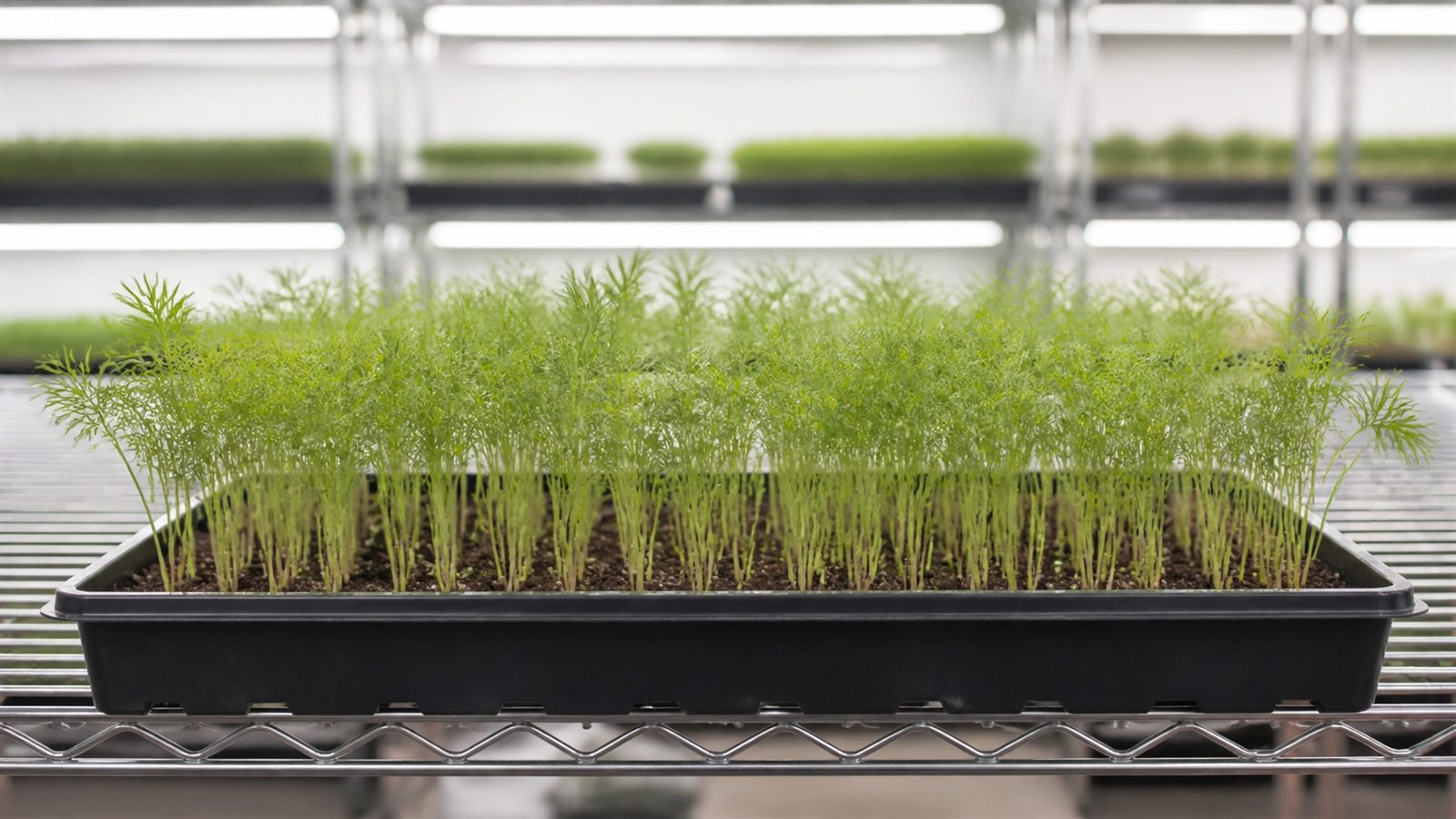
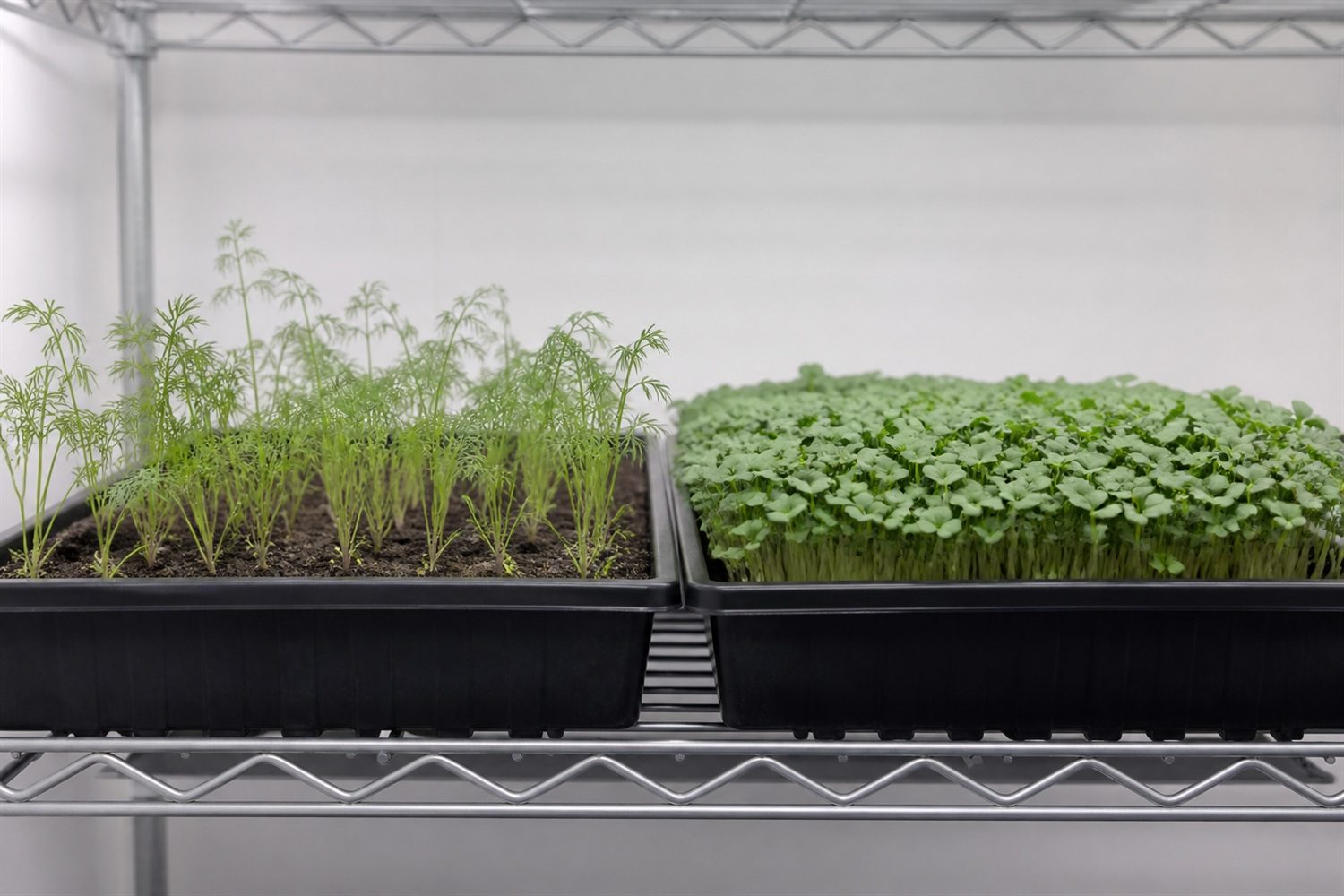
The tray reads differently from anything else in this directory. A correct carrot tray is a fine, feathery, open canopy, and you should be able to see medium between the stems more readily than in a dense radish or broccoli tray. This is the single most important thing to know before you grow it, because the tray that looks right for carrot looks like a failure if you have only ever grown brassicas. A grower who reaches for more seed to close that gap is not correcting an error, they are creating one.
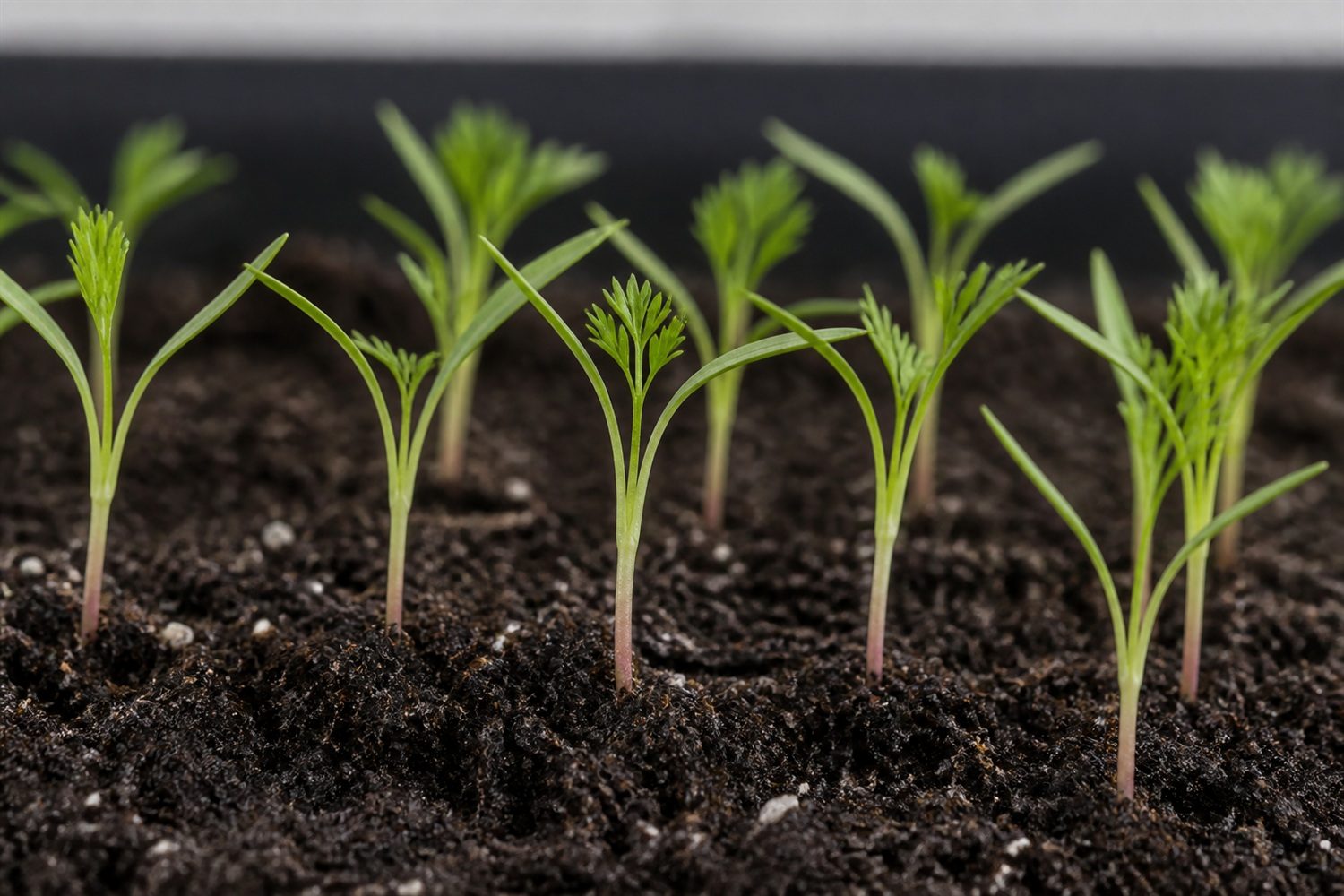
The confusion is with the other Apiaceae greens, cilantro most of all, and with dill. The reliable tell is the same architecture: two long narrow strap cotyledons with a finely divided carrot true leaf arriving between them. Anyone naming carrot from the seed leaves alone, before that true leaf shows, is guessing.
What it tastes like, and what to do with it
Mild and sweet, and recognizably carrot in the way the tops of a carrot are, not in the way the root is. The supplier that sells the named cultivar describes the texture as dill-like without the dill taste, which is the most useful sentence written about this crop: the mouthfeel is fine and feathery, and the flavor is a soft, sweet green.
That decides what it is for and it is a narrow brief. Carrot is a garnish. Scatter it over a composed plate, a soup, an egg dish or a sandwich, where a light green with a real flavor and a distinctive divided-leaf look is worth something. It is not a salad base and it will not carry a bowl. The crop's own numbers say so before any chef does: at roughly 2 ounces a tray it does not have the mass to be volume, so using it as volume means growing several trays over three weeks for one salad.
Two groups will be disappointed, and both are worth naming because the disappointment is predictable. Anyone expecting the sweet crunch of a baby carrot is buying the wrong part of the plant. Anyone who dislikes fine, feathery, dill-textured greens will find the texture unsatisfying regardless of how well it was grown. Neither objection is fixable in the tray.
Growing it: only what differs from the standard method
Everything general about trays, medium, light and watering is on the standard tray method for growing microgreens. What carrot does differently is mostly about time, and about resisting the one instinct this crop rewards least.
Sow light and leave it light: 6.2 to 9.4 grams per 1020. Read that number with the caveat attached, because it is not what it looks like. Carrot is absent from Johnny's 29-variety trial, so unlike broccoli there is no soil-tray seeding rate for it anywhere. This range is a hydroponic NFT and burlap production record converted to a 1020 footprint, and the record's most common setting was the low end. Treat it as the starting range for your own density trial, and go lower rather than higher when your airflow, light or seed lot is doubtful.
Do not sow heavier to close the gaps. In that same record, the high end of carrot's density range produced frequent fungal disease, and the single highest-yielding channel still contained mold and dead plants. That is the crop's whole economics in one sentence: the yield you buy with extra seed is the yield most likely to be unsaleable.
Cover 3 to 5 days, and judge it by height, not by the calendar. Uncover when the crop is fully emerged and about 1.2 to 2 inches tall. The cover's documented job here is darkness for germination. No weight was reported and no crop-specific reason to weight a carrot tray has been published, so if someone hands you a poundage they are handing you a preference.
Then give it light, not more darkness. This is the one place a real measured comparison exists: carrot's growth ratio was significantly higher in sunny channels than shaded ones, 9.2 against 6.4. Strong light and moving air after the cover comes off is the intervention that pays. Nobody has published a carrot light level, a fan speed or an irrigation increase, so the direction is established and the magnitude is not.
Feed it, or pick a medium that can. This is the practical consequence of a 20-day crop that nobody warns you about. Johnny's notes that slow growers can exhaust an inert medium before harvest, and carrot is the slowest crop on this site. A medium that carries a brassica for twelve days may run out under a carrot at day eighteen.
A carrot tray, day by day
- 1
Day 0, sow light
6.2 to 9.4 g broadcast evenly on a level, pre-moistened surface, pressed for contact, seeds about an eighth to a quarter inch apart. Medium about 75F until it germinates.
- 2
Days 1 to 5, covered
Darkness for germination, no weight. Keep the surface evenly moist and water from below or mist carefully, because splashed medium lands on seedlings you cannot clean.
- 3
Uncover at height, not at a date
Off when the crop is fully emerged and 1.2 to 2 inches tall. Expect this to be uneven, and expect it to take longer than any other crop here.
- 4
After the cover, light and air
Drop toward 60F, give it the brightest position you have and real airflow. Sunny channels outgrew shaded ones by a measured margin.
- 5
Days 14 to 25, cut
Suppliers publish 16 to 25 days and 14 to 20 days; a measured production record averaged 20, with individual harvests from 13 to 27. Cut at your intended stage rather than waiting for a number.
What goes wrong with carrot specifically
The failures arrive in an order, and on this crop the order matters more than usual because each one leads into the next.
First, slow and patchy emergence. The early sign is empty patches after the cover period a brassica would have finished under. The cause is the crop's genuinely slow germination, compounded by poor seed-to-medium contact or a weak lot. There is no rescue for the tray you are looking at. The only real error at this point is trying to fix it with water.
Second, and because of the first, a wet congested canopy. This is where carrot loses trays. The tray looks thin, so it gets more seed next time or more water this time, and a slow crop under constant moisture in a canopy with little air movement is the documented condition for fungal loss. Damp congested patches with declining seedlings is what it looks like before it is obvious.
Third, damping-off. Stems rot at or below the medium line and seedlings collapse. Pythium and Rhizoctonia are the usual organisms and Pythium often starts at the root tips. Affected seedlings do not recover. On a food crop, once it is widespread the tray is a discard and a sanitize.
Fourth, a clean tray that simply weighs very little. Carrot's fresh-mass growth ratio of 7.8 was the lowest of six crop groups tested. A light tray is not necessarily a failed tray on this crop, it is the crop. Letting it run longer does add fresh weight, but that is a margin decision, not a repair.
And a warning specific to carrot: the root-hair-or-mold test is not reliable here. On broccoli there is a five-second check worth committing to memory. Do not carry it onto this crop with the same confidence. Carrot's documented problem is real fungal disease at real densities, damping-off organisms begin at the root tips where you would be looking, and the one carrot tray a grower posted asking whether it was mold is exactly the case the shortcut is bad at. Nobody has published a carrot-specific comparison of root hairs against mycelium. If white growth is spreading across stems or medium, or plants are collapsing or rotting at the line, treat it as disease. If you are genuinely unsure on this crop, discard rather than harvest.
Why carrot loses trays, in order
Hover or tap a card to highlight it.
It starts slow
Emergence is genuinely slower and less even than any other crop here. Bare patches after the cover period are normal, not a fault to correct.
The tray looks wrong
A correct carrot canopy is thin and open. It looks like a failure to anyone whose eye was trained on brassicas.
So, it gets more
More seed, or more water, or more time under cover. This is the decision that loses the tray, and it feels like diligence.
The wet canopy pays out
Frequent fungal disease at high carrot density, and mold and dead plants even in the highest-yielding channel of the one measured record.
The verdict
The fix is upstream, not downstream. Sow lighter, uncover on height, then give it light and air. A thin clean tray beats a full spoiled one at any price.
Nutrition, and what is actually established
Almost nothing, and that is the honest answer rather than a placeholder for one.
There is no verified carrot microgreen record in USDA FoodData Central to report. Peer-reviewed carrot microgreen papers exist in search results, but their full texts were not retrievable for this page, so no cultivar, harvest stage, sample basis or nutrient figure is quoted here. Recording that gap is the point: it means anyone publishing a carrot microgreen nutrition panel is either citing something this page could not open or filling it in from the mature root.
Two claims specifically do not stand up. The first is the one the current conversation runs on, that carrot tops are the most nutritious part of the plant. Whatever its merits for the tops of a mature carrot, it is a statement about a different plant part at a different age and it is not evidence about a microgreen. The second is the blanket claim that carrot microgreens are more nutritious than mature carrots. USDA ARS is clear that nutrient levels vary substantially between microgreen species and that growing and handling conditions affect them, which is the opposite of a rule you can apply to a crop nobody has measured.
If you want the nutrition argument for microgreens made properly, it is made on broccoli, which is the one crop in this directory with a real sourceable story. Carrot is not that crop, and pretending otherwise is how the category earned its reputation.
Which seed to buy
Three saleable types turn up, and no controlled comparison between them exists.
Generic carrot microgreen seed is the default and the cheapest per tray. Note the trade-off the supplier states plainly: on the generic product, stem and leaf color can vary, and it recommends variety-specific seed if you want that consistency. For a garnish crop sold on appearance, that is a real cost, not a footnote.
Lunar White is a named Daucus carota variety sold specifically for microgreens, listed at 14 to 21 days and roughly 18,000 seeds per ounce, with a mild sweet flavor intended. It publishes no measured stem length, color or yield comparison against generic carrot, so buy it for consistency, not for a promised gain.
Danvers 126 is named by one supplier as the variety in its microgreen product. No controlled cultivar comparison was found for it either.
Then there is what you will actually meet when you shop, and it is worth knowing before you click. Looking at the current carrot microgreen seed listings on Amazon on 2026-08-08, a real carrot microgreen product does exist, but much of the page is ordinary garden carrot seed with "microgreens" added to the title: Imperator 58, Tendersweet, Red Cored Chantenay, Danvers 126, Scarlet Nantes. Some of those will grow perfectly good microgreens. What none of them gives you is a lot selected and sold for eating young, which is the actual question.
So, specify it. Untreated seed sold for edible microgreen use, the variety name if color consistency matters to you, and lot or germination information if the supplier publishes it. Refuse anything labeled with fungicide, insecticide, dye, or an unspecified treatment: extension guidance is that treatments can be present in the young shoots and should not be eaten, and rinsing does not fix it. Cleaned or purified seed is a different thing from chemically treated seed.
A bad lot shows up here as poor, staggered emergence and a sparse tray, and then as the temptation to compensate. The cost is not the seed, which is the cheapest on this site. The cost is two to four weeks of a tray slot and the disease exposure you invite trying to save it. No carrot-specific germination threshold for rejecting a lot has been published, so buy enough to run a small density trial before you commit a bench to it.
Is it worth growing?
For most people, no, and this is one of the clearer verdicts in the directory.
Grow it if you specifically want a delicate, feathery, mild-sweet garnish with a distinctive divided leaf, and you can afford to give a tray three weeks to produce a garnish quantity. A chef who wants that exact look, or a market grower with a customer who has asked for it by name, has a reason. Nobody else does.
Do not grow it as a first crop. It is slow, it germinates unevenly, it punishes the instinct to sow heavier, and it gives a beginner almost no feedback for two to three weeks. Do not grow it for weight, and do not grow it as the salad you eat this month.
Its real competition is the rest of the delicate Apiaceae bench: cilantro, dill, fennel, celery and chervil, all chasing the same garnish slot. Cilantro is the one to beat, and it is instructive that cilantro, whose verdict on its own page is already close to "grow something else," turns over three times more per tray-day than carrot does. Against a bulk crop like pea shoots or radish it is not a comparison at all.
A note on the numbers above
Carrot's figures are the least transferable on this site, and it is worth being specific about why rather than presenting them with everyone else's.
Hover or tap a row to highlight it.
| Figure | Value | Source | What kind of number it is |
|---|---|---|---|
| Seed per 1020 | 6.2 to 9.4 g | Virginia Tech hosted production record | Converted from 48 to 73 g/m2, hydroponic NFT and burlap |
| Seed per 1020 | No figure | Johnny's 2017 trial | Carrot was not in the trial |
| Yield per 1020 | 2.0 oz | Same production record | Converted from 443 +/- 183 g/m2, mean of 42 harvests |
| Yield per 1020 | No figure | Johnny's 2017 trial | Carrot was not in the trial |
| Days to harvest | 16 to 25 | Johnny's product page | Published range, from seeding |
| Days to harvest | 14 to 20 | True Leaf, repeated by Virginia Tech's guide | Published range, sowing to harvest |
| Days to harvest | 20 average | Production record | Measured, harvests from 13 to 27 |
| Days to harvest | 14 to 21 | True Leaf, Lunar White | Published range for one named cultivar |
| Growth ratio | 7.8 | Production record | Measured, lowest of six crop groups tested |
| Growth ratio, light | 9.2 sunny vs 6.4 shaded | Production record | Measured, p=0.048 |
| Germination temperature | 75F then 60F | Johnny's guidance | Crop guidance, not a trial |
| Shelf life | 5 to 10 days | Johnny's | Refrigerated, no temperature or package stated |
| Soak | No published figure | Nobody | Nobody has established it, in either direction |
| Harvest window | No published figure | Nobody | Nobody has established it |
| Regrows | No published figure | Nobody | One-cut production is all that has been recorded |
The yield and seed rate come from a different growing system, not a different farm. Every other yield on this site traces to soil-filled 1020 flats. Carrot's traces to Daucus carota on a single burlap layer in hydroponic NFT, harvested on a weekly schedule at 13 to 27 days, with true leaf size recorded but no single harvest stage set. The standard deviation is large: 443 g/m2 plus or minus 183 is a spread of plus or minus 41 percent. This is the only measured carrot number available and it should be read as a first approximation for a soil tray, not a benchmark to plan a business against. Weigh your own trays.
Four figures are simply not published for this crop. Soak, harvest window, regrowth and hull shedding are all researched, all genuinely applicable, and all unanswered anywhere. Hull shedding is the one worth naming, because the tempting move is to write "not applicable" on the grounds that carrot seed is fine. Fine seed is a reason to expect little retention. It is not a measurement of it, and the difference between those two is this site's entire premise.
And carrot is where the two economic columns disagree most violently.
Hover or tap a row to highlight it.
| Crop | Seed per 1020 | Yield | Days | Cost per tray | Oz per $1 | Oz per tray-day |
|---|---|---|---|---|---|---|
| Parsley, Italian flat-leaf | 15 to 20 g | 6.25 oz, area-converted | 21 to 35 | $0.50 to $0.66 | 9.5 to 12.5 | 0.30 at 21 days |
| Dill | 10 g | 3 to 5 oz | 15 to 20 | $0.52 | 7.7 | 0.23 |
| Carrot | 6.2 to 9.4 g | 2.0 oz | 20.0 | $0.44 to $0.66 | 3.0 to 4.5 | 0.10 |
| Fennel | 28.3 to 43.0 g | 1.00 oz, area-converted | 16 to 25 | $1.55 to $2.36 | 0.42 | 0.04 |
| Celery | 1.1 to 4.4 g, calculated | No published figure | 21 to 30 | $0.14 to $0.58 | cannot be calculated | cannot be calculated |
A blank means nobody has published that figure, so the cell is left empty rather than filled with an estimate. How the numbers work
All 62 crops, sortable, on the microgreen comparison.
Superseded 2026-08-08, and by a measurement rather than an estimate. Fennel now holds the worst tray-day in this directory at 0.04, against carrot's 0.10. Carrot's figure was never wrong; the set has grown, and the crop that took the record is the one umbellifer somebody put through a controlled trial. Carrot is still the second-worst use of a bench here, which is the part that mattered. Corrected 2026-08-11: this paragraph also claimed carrot kept the cheapest tray of seed, which the 2026-08-09 correction two paragraphs below had already overturned and this sentence was missed.
Carrot has the tenth cheapest tray of seed of the 50 costed crops here, corrected 2026-08-09 from the cheapest and recounted 2026-08-12 against the fields, and what was, until fennel was researched, the worst tray-day, by a factor of three against the next worst and a factor of twelve against radish. Nothing about those two facts is in tension: they are answers to different questions. Seed cost per tray asks what the inputs cost. Ounces per tray-day asks what the bench earns while it is occupied. On a crop that takes 20 days to make 2 ounces, the seed is close to free and the shelf is the whole expense.
That is worth stating plainly because it is the trap the seed price sets. Cheap seed reads as a cheap crop, and across ten crops now it has not once predicted one. Mustard is $88.30 a pound and $1.56 a tray. Wheatgrass is $3.12 a pound and $3.10 a tray. Carrot is 32 dollars a pound and among the cheapest trays here, and it is still the most expensive crop in the directory to actually grow.
Terms on this page
Tap a term to see what it means.
Apiaceae. The carrot family, which also holds cilantro, dill, fennel, celery and chervil. On a bench they behave alike: slow, fine, feathery and low in mass.
Sources
- Virginia Tech, hydroponic microgreens production record (PDF) - the 48 to 73 g/m2 carrot seeding range, 443 +/- 183 g/m2 mean fresh yield across 42 harvests, mean 20 days with a 13 to 27 day span, the 7.8 growth ratio as lowest of six crop groups, the 9.2 sunny against 6.4 shaded light comparison at p=0.048, frequent fungal disease at high carrot density, and the 3 to 5 day cover to 1.2 to 2 inches.
- Johnny's Selected Seeds, carrot microgreen seed - 16 to 25 days from seeding, mild carrot flavor, 75F soil then 60F with 65 to 75F ambient favorable, the above-75F disease warning, 1/8 to 1/4 inch spacing, bottom watering, 5 to 10 refrigerated days, the slow-grower medium-fertility note, and the photograph the seedling description is taken from.
- Johnny's microgreens yield trial, method and discussion - the 29-variety trial method that carrot is absent from, and the warning that one grower's yields do not transfer to another system.
- True Leaf Market, carrot microgreens seed - 14 to 20 days, the sweet flavor with dill-like texture and no dill taste, the warning that stem and leaf color vary on the generic product, and the $32.01/lb price behind the seed cost calculation, listed 2026-08-08.
- True Leaf Market, Lunar White carrot microgreens seed - the named cultivar at 14 to 21 days and roughly 18,000 seeds per ounce, with no published comparison against generic carrot.
- Home Microgreens, carrot microgreen seed - Danvers 126 named as the variety in one commercial microgreen product.
- Virginia Tech Extension SPES-756 (PDF) - the 14 to 20 day carrot range reproduced as sowing to harvest, and the general production environment.
- SDSU Extension, growing microgreens at home - refrigerated storage guidance, and that seed treatments may be present in the young shoots and should not be consumed.
- UC IPM, damping-off - Pythium and Rhizoctonia, symptoms at or below the medium line, and the link to wet conditions.
- USDA FoodData Central - searched 2026-08-08, no verified carrot microgreen record returned.
- USDA ARS - nutrient levels vary substantially among microgreen species, and growing and handling conditions affect them.
Keep reading
The variety directory
Celery microgreens
Three to four weeks of bench for a seasoning green, with an unusually complete measured nutrient panel behind it: 45.8 mg of vitamin C per 100 g, and four minerals that are higher in the mature leaf.
Read Celery microgreensThe variety directory
Fennel microgreens
The only umbellifer anybody measured, and the measurement is brutal: about 1 oz after 25 days, 0.04 oz per tray-day, on seed that costs more than most. Grown for aroma, not for weight.
Read Fennel microgreensThe variety directory
Dill microgreens
Two suppliers disagree by ten days on when to cut it, and an indoor grower with no stake in the argument settles it. Plus why dill's yield figure should be read alongside chervil's.
Read Dill microgreensThe variety directory
Mint microgreens
Mint must not be blacked out, and its seed costs $1,394.50 a pound. The one published seed rate would put 154,000 seeds in a 1020 tray, ten times the densest sowing anyone has measured.
Read Mint microgreens