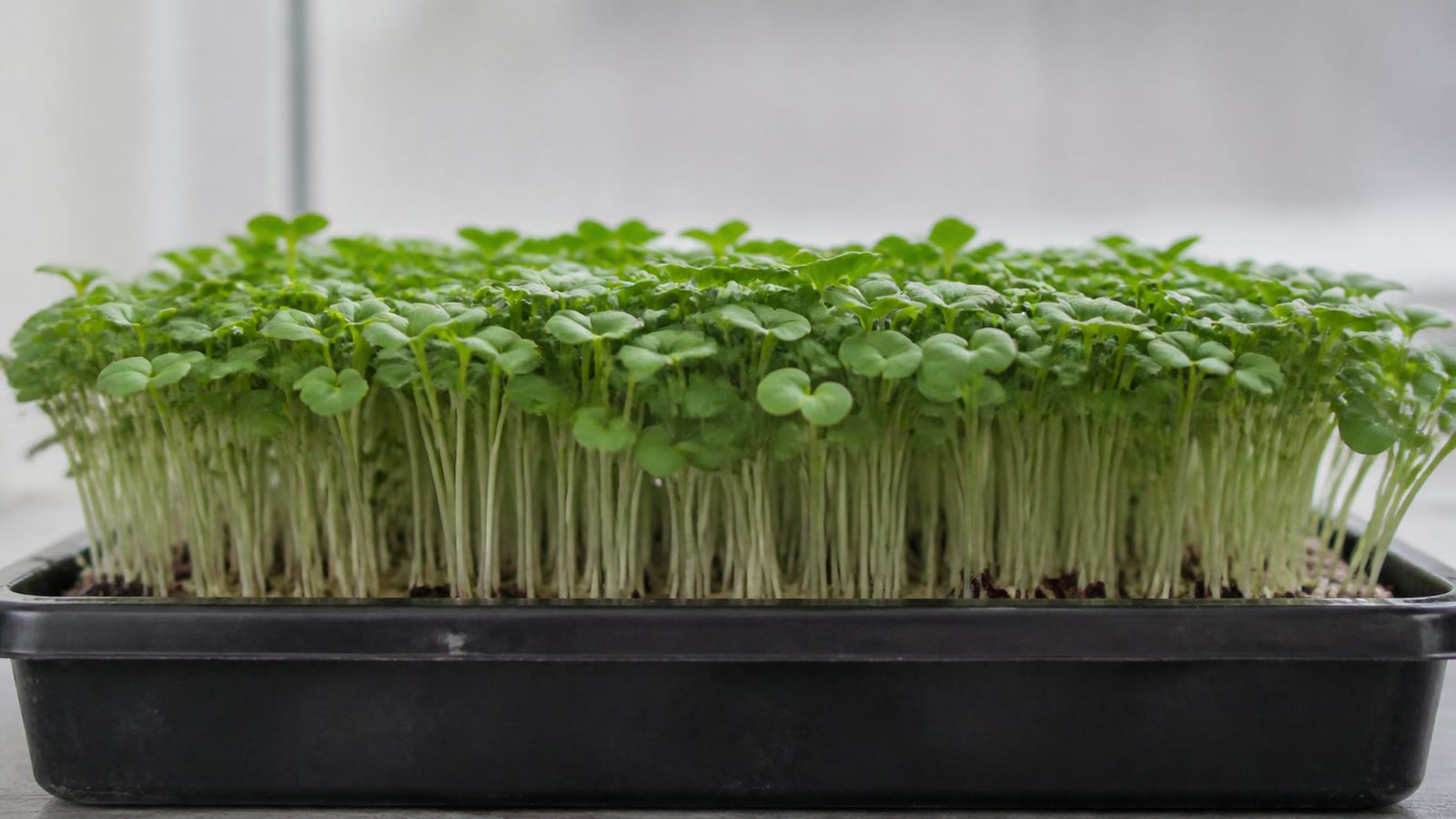
At a glance
Round, substantial seed that germinates reliably without a soak, on a seven-to-twelve-day cycle. The only way to spoil it is to turn that reliability into a tray sown too thick and kept too wet.
- Botanical name
- Brassica rapa subsp. rapa
- Also sold as
- Turnip, Turnip, microgreens seeds, Organic Turnip, Purple Top White Globe
- Family
- brassica
- Difficulty
- Beginner
- Days to harvest
- 7 to 12 days
- Harvest window
- No published figure
- Soak
- None
- Blackout
- 2 to 4 days
- Germination temperature
- 64 to 72 °F
- Yield per 1020 tray
- No published figure
- Regrows after cutting
- No published figure
- Mold risk
- Medium
- Hull shedding
- some
- Shelf life
- 3 days
- Eaten as
- raw
- Seed cost per tray
- $0.31
10 g at $13.90/lb, Mountain Valley Seed Co Purple Top White Globe turnip seed, 1 lb, read 2026-08-09. That is about as cheap as a tray of untreated garden seed gets. Food-plot turnip at $5.00 to $6.20 a pound would come to 11 to 14 cents a tray and is excluded here, because it is frequently treated and is not handled as food. Seed only, excludes medium, tray, labor, light and loss.
Any field name above ranks every variety by it. No published figure means we researched it and nobody has established one, which is different from not yet researched. Every figure here is sourced at the bottom of the page. Compare every variety side by side.
Turnip is one of the easiest trays you can run and one of the least documented. It germinates without a soak, it finishes in seven to twelve days, the seed costs about 31 cents a tray, and nobody has ever weighed a tray of it.
Sow 10 grams, cover for two to four days, take the cover off when the shoots are one to two centimeters and pushing it up, and cut at fully spread cotyledons at about two to three inches. That really is the whole method. The seed helps: at 320 to 380 to the gram it is coarse enough to place rather than dust, which is most of why beginners do well with it.
The one thing to get right is not holding it too long. Turnip is cut before true leaves arrive, and one source says the flavor changes sharply once they do. Watch the cotyledons rather than the calendar.
What growers are saying right now
Sampled from public posts and videos, 10 July to 9 August 2026. Every line links what it is quoting. How often something is repeated is not evidence that it is true, so every line also says what the sources actually establish.
T8 blurple versus T8 shop light for turnip microgreens, a budget light comparison
Circulating A grower's lighting experiment at 57,971 views and 91 comments, one of at least two on this crop
That choice tells you something useful about the crop. When somebody wants to A/B test a pair of shop lights, they grow turnip, because it is fast, cheap, uniform and reliable enough that any difference showing up in the tray is the light rather than the plant. Turnip is what people use as the control. It is also why nobody has measured it: they are growing it to study something else. Is it worth growing
Active Grow 23W versus Barrina 42W blurple on turnip microgreens
Circulating The same channel's second lighting test on the same crop
Two experiments, same crop, and neither reports a turnip yield in ounces, because turnip was never the subject. A crop can be filmed hundreds of thousands of times and still have no published figures, so do not assume popularity means somebody has done the arithmetic.
Nothing from the growers directly
Circulating Not one thread in [r/microgreens](https://www.reddit.com/r/microgreens/) is about turnip, even though the YouTube side is enormous, 27 videos and 5.7 million views between them
And none of that footage contains a rate, a yield or a harvest window for the crop it is filming. Weigh your own tray, because there is nothing to check it against.
What it is, and how to tell you grew it right
Turnip microgreens are seedlings of Brassica rapa subsp. rapa. Purple Top White Globe is the one named cultivar found on a microgreen listing; the other labels opened are just the crop name.
The seed is bigger than you expect from a brassica, about 320 to 380 to the gram, which is roughly a thirtieth as fine as mint and coarse enough that you place it rather than dust it. That is most of why this is a beginner crop.
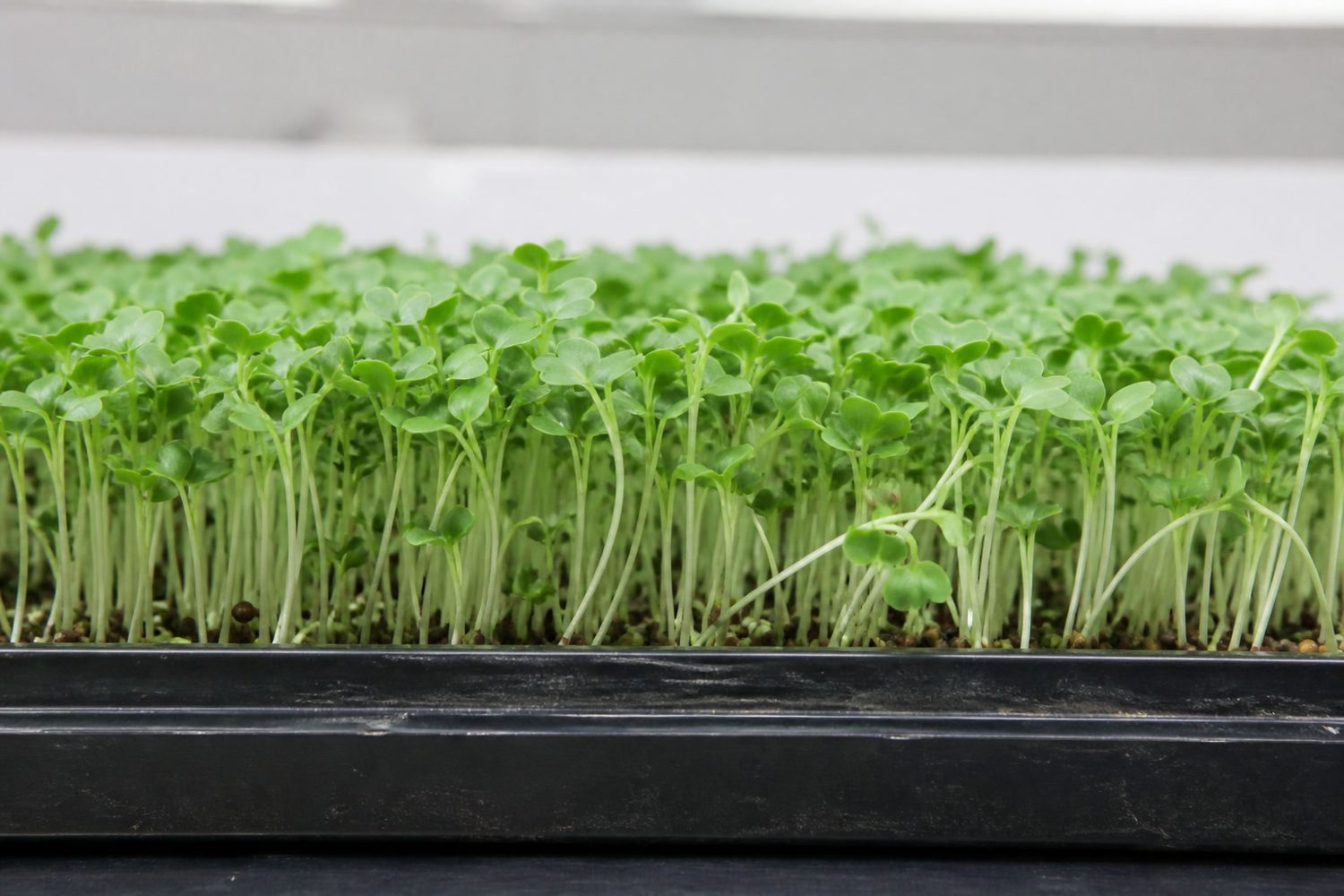
A correct tray is an even stand of pale stems with fully spread, bright green cotyledons, cut at about two to three inches. That is the whole specification, and all three crop-specific sources agree on it.
You cannot tell it from its siblings by looking, and on this crop it is worse than usual. Turnip sits in the same cotyledon-stage blur as komatsuna, tatsoi, pak choi and mizuna, and unlike those it is normally cut before true leaves arrive at all. So, the one stage that separates them is the stage turnip never reaches. The seed label is the identification.
What it tastes like, and what to do with it
Crisp and mild-sweet: cabbage and turnip, with a light pepper finish rather than a mustard bite. It is milder than radish and less assertive than arugula.
That makes it a salad and sandwich green with enough character to be noticed, and a reasonable choice for anyone who wants brassica flavor without heat.
Past the cotyledon window the flavor changes "dramatically", according to the supplier that says so, and no source opened here says in which direction or by how much. That is an unusually blunt warning with an unusually empty middle, and the practical response is simply to cut on time.
Growing it: only what differs from the standard method
Very little differs, which is the appeal.
No soak, stated outright by both crop-specific suppliers rather than merely omitted.
Sow about 10 grams and distribute deliberately. The seed is round and substantial enough to roll into hollows, so level the medium first. Go lighter if you intend to hold the crop longer.
Two to four dark days, and watch the crop rather than the calendar. The better instruction from the crop-specific page is to remove the cover and weight when shoots are 1 to 2 cm and pushing it up. A secondary source suggests around five pounds of weight; nothing crop-specific is published, and the weight's job here is even anchorage rather than stretch.
64 to 72F, then bottom-water and ventilate. That temperature range is the only one paired with an actual schedule by any source.
What goes wrong with turnip specifically
The failure is the one that follows from the crop being easy. Reliable germination on a substantial seed invites sowing thick, and a thick turnip stand held wet is the standard damping-off setup: rot at or below the medium line, then collapse in patches, from the usual Pythium and Rhizoctonia complex. Bottom-water and give it air.
Hulls ride up occasionally. The brown round coat can stay on the medium or cling to a seedling. Nobody has quantified it and it is not a sunflower-scale job.
And cutting late, which is genuinely under-specified here. Every source says harvest before true leaves and one says the flavor then changes dramatically, but the window between "cotyledons fully spread" and "too late" has never been counted. See below.
Nutrition: brassica-wide ranges, and nothing turnip-specific
No USDA FoodData Central record for turnip microgreens was located.
The nearest real evidence is a peer-reviewed 2016 study that assayed 30 Brassicaceae microgreen varieties for calcium, magnesium, phosphorus, sodium, potassium, copper, iron, manganese and zinc. Its accessible summary reports group ranges rather than a turnip row, and a 2023 review that appears to contain a turnip row could not be opened, so its values are not repeated here.
Brassica-wide ranges are not turnip nutrition facts, so do not quote one to a customer as though it were.
So, the claims to reject are the standard set: that turnip microgreens are "rich in vitamins C, K and A", that they contain a specified glucosinolate-derived compound, or that they deliver a named health benefit. Those may well be reasonable things to expect from a brassica. None of them has a turnip-specific measurement behind it.
Which seed to buy
Specify untreated seed sold for microgreen or food use, with a lot number and a germination date. Purple Top White Globe is the named cultivar with a microgreen listing; nothing establishes that it grows differently from generic turnip seed.
Turnip is also sold enormously cheaply as forage and food-plot seed, and now this page can put a number on the temptation. Turnip microgreen seed on Amazon returned 54 turnip listings out of 60 tiles on 9 August 2026, and 16 of them are food-plot, forage, deer or cover-crop seed. A 5 lb bag of food-plot Purple Top at $30.99 is $6.20 a pound; another at $24.99 is $5.00. At the 10 g rate those are 11 to 14 cents a tray, which would be the cheapest tray on this entire site.
Do not take it. Cover-crop and wildlife-plot seed is frequently treated, is not handled as food, and its lot is not tested for a crop eaten raw at seedling stage. The saving is real and so is the reason for it.
The garden-seed price is cheap enough that the saving is not worth chasing. Mountain Valley's Purple Top White Globe at $13.90 a pound works out to 31 cents a tray, which undercuts mizuna at 39 cents and lentil at 47. Buy the pound: a 12 g garden packet at $5.99 would put $4.99 of seed in the same tray, which is the usual packet penalty and easy to avoid here.
One buying note. Several supplier pages quote turnip "from $8.45" without saying which pack weight that belongs to, so you cannot divide it by ten grams. Marketplace listings tend to state a weight, which is what makes the price above checkable. Insist on a stated weight before you compare anybody's seed price.
Is it worth growing?
Yes, for a beginner, and with an unusual caveat.
It is fast, it is forgiving, the seed is cheap and substantial, and the flavor is agreeable to almost everyone. As a first brassica after broccoli it is a sensible choice.
The caveat is that you will be growing it slightly blind. There is no measured yield, no measured harvest window, no usable seed price, and no turnip-specific nutrition. Its siblings mizuna, pak choi and tatsoi all sat in a real trial and have rate, yield and days pinned down. Turnip did not.
If you want the same easy brassica with numbers behind it, grow tatsoi: 7.5 g in, 8.5 oz out, 13.5 days, and every figure measured. If you want turnip specifically, grow turnip and weigh your own tray.
A note on the numbers above
Hover or tap a row to highlight it.
| Figure | Value | Source | What kind of number it is |
|---|---|---|---|
| Seed per tray | 10 g per 25x50 cm | A crop-specific supplier | A recommendation. The tray is 3 percent smaller than a 1020, inside its own rounding |
| Days to harvest | 8 to 12 at 18 to 22C | The same supplier | The only schedule paired with a temperature |
| Days to harvest | 8 to 10 after 3 to 4 dark days | A second supplier | No temperature |
| Days to harvest | 7 to 12, at 2 to 3 inches | A third source | No temperature, cotyledons unfolded |
| Yield | about 300 g (10.58 oz) | The first supplier | An estimate by the seller, at a round number. Treat it as a target |
| Blackout | 2 to 3 days, remove at 1 to 2 cm | The crop-specific page | The height signal is the useful half |
| Weight | about 5 lb | A secondary source | Not crop-specific, and no supplier publishes one |
| Seeds per gram | about 320 to 380 | A crop-specific supplier | Why this is a place-it rather than dust-it seed |
| Shelf life | up to 3 days, dry and sealed | The same supplier | No refrigerator temperature, no measured failure point |
| Harvest window | "a few days" | A third source | Described and never counted. A shape without a number |
| Seed price | Starting at $8.45, weight not shown | A U.S. supplier | Not divisible by anything |
| Seed price | $13.90 per pound | Mountain Valley, read 2026-08-09 | A weight and a price, which is what the cost cell needed |
| Seed cost per tray | $0.31 | Calculated | 10 g at $0.0306 a gram. Second cheapest here |
| Food-plot seed | $5.00 to $6.20 per pound | Two 5 lb listings | Would be 11 to 14 cents a tray. Frequently treated, not food-handled |
| Fresh-weight panel | No FDC record | USDA FoodData Central | Brassica-wide ranges exist and are not turnip |
The harvest window is described and never counted, which is an awkward thing to plan around. One source says plainly that there are "a few days" between the cotyledons spreading and the true leaves arriving, and that the flavor changes sharply after. That is a real observation of a real window with no number attached to it. So, cut your first tray as soon as the cotyledons are fully spread, leave the next two days longer, taste both, and you will have the number nobody published.
Treat the yield estimate as a target, not a benchmark. A supplier estimates about 300 g, which is 10.58 oz, and it is a round figure from the page selling the seed, with no method behind it. If your tray lands anywhere near that you are doing well; if it lands well under, that tells you nothing until you have weighed two or three.
Three numbers are missing on this crop and all three are about measurement rather than method. There is no measured yield, no counted harvest window and nothing on a second cut. The growing itself is well enough described that none of that should stop you: sow ten grams, cut at spread cotyledons, and keep your own figures. If you want a crop you can plan on paper instead, swiss chard has a measured rate, yield and day count from a single trial, while celery, popcorn shoots and thyme all have gaps of their own.
Hover or tap a row to highlight it.
| Crop | Seed per 1020 | Yield | Days | Cost per tray | Oz per $1 | Oz per tray-day |
|---|---|---|---|---|---|---|
| Garden cress | 10.5 g | 8.0 oz | 8 to 15 | $0.96 | 8.3 | 0.62 |
| Watercress | No published figure | No published figure | 7 to 25 | no rate to price | cannot be calculated | cannot be calculated |
| Turnip, Purple Top White Globe | 10 g | No published figure | 7 to 12 | $0.31 | cannot be calculated | cannot be calculated |
| Komatsuna | 10 to 24 g | 10.6 oz at 1st true leaf, 13.4 at 2nd, area-converted | 8 to 12 | $0.47 to $1.12 | 10.0 | no day count for the measured stage |
| Collard | 28.35 g | No published figure | 7 to 15 | $0.90 | cannot be calculated | cannot be calculated |
A blank means nobody has published that figure, so the cell is left empty rather than filled with an estimate. How the numbers work
All 62 crops, sortable, on the microgreen comparison.
Terms on this page
Tap a term to see what it means.
*Brassica rapa* subsp. *rapa*. Turnip, one of several B. rapa crops grown in trays alongside komatsuna, mizuna, pak choi, tatsoi and broccoli raab.
Sources
- Turnip microgreens seeds, Deliseeds - the species, 10 g per 25x50 cm tray, 8 to 12 days at 18 to 22C, 2 to 3 blackout days with the 1-to-2-cm removal signal, about 320 to 380 seeds a gram, the 300 g yield estimate, the 3-day storage claim and the flavor description.
- Organic turnip microgreens, Golinucci - 8 to 10 days after 3 to 4 dark days, no soak, and the second flavor account.
- Purple Top White Globe untreated turnip seeds, Osborne - the one named cultivar on a microgreen listing, priced from $8.45 with no pack weight exposed.
- Turnip microgreens, Epic Gardening - 7 to 12 days at 2 to 3 inches, the roughly 5 lb weight suggestion, and the "a few days" harvest window with its warning to cut before true leaves.
- Johnny's microgreen yield trial and the trial tech sheet - 29 varieties, none of them turnip, which is why three of its siblings have measured figures and this crop does not.
- Mineral composition of 30 Brassicaceae microgreens, USDA-ARS record - the nearest real analysis, reporting group ranges rather than an accessible turnip row.
- USDA FoodData Central - no turnip microgreen record located.
- Damping-off, UC IPM - the wet-and-crowded risk this crop's easiness invites.
- Microgreens production, Virginia Cooperative Extension - the general 41F dark storage guidance and the single-cut treatment, neither used as a turnip figure.
Keep reading
The variety directory
Tatsoi microgreens
A fast, mild, forgiving brassica: 7.5 g of seed, 8.5 oz, 13.5 days, at 93 cents a tray. It turns seed into leaf better than mizuna or pak choi and takes longer to do it.
Read Tatsoi microgreensThe variety directory
Arugula microgreens
Arugula is a seasoning green rather than a salad base: 10 g of seed makes 10 oz in 14 days, it is genuinely peppery, and its 10-day shelf life comes from a controlled storage study rather than an estimate.
Read Arugula microgreensThe variety directory
Broccoli microgreens
Broccoli takes 13 g of seed per 1020 tray and gives 11.5 oz at first true leaf, both from Johnny's trial. No soak, fast even germination, and the root-hair-or-mold test you will need in the first week.
Read Broccoli microgreensThe variety directory
Broccoli raab microgreens
Rapini as a tray crop: bitter on purpose, 49 cents of seed a tray, and one of the few crops where the microgreen is genuinely easier than the vegetable.
Read Broccoli raab microgreens