At a glance
Germination is not the problem; holding a warm, wet, densely packed bed of large kernels in total darkness for a week or more without it souring is, and a single light leak turns the product from sweet yellow into ordinary green grass.
- Botanical name
- Zea mays
- Also sold as
- Popcorn shoot seed, Corn, Yellow Popcorn, microgreens seed, Popcorn shoots, Zea mays var. everta
- Family
- grass
- Difficulty
- Moderate
- Days to harvest
- 6 to 14 days
- Harvest window
- No published figure
- Seed per 1020 tray
- 142 to 227 g
- Soak
- 8 to 12 hours
- Blackout
- 6 to 14 days
- Germination temperature
- 65 to 72 °F
- Yield per 1020 tray
- No published figure
- Regrows after cutting
- No published figure
- Mold risk
- High
- Hull shedding
- heavy
- Shelf life
- 10 to 14 days
- Eaten as
- raw
- Seed cost per tray
- $9.28
8 oz at $18.55/lb, Johnny's organic popcorn shoot seed at the 1 lb size, listed 2026-08-09. $5.80 at the 5 oz end. THE SECOND MOST EXPENSIVE TRAY OF SEED IN THIS DIRECTORY at that pack size, after barley grass. The ladder runs 1/4 lb $5.80, 1 lb $18.55, 5 lb $79.00, 25 lb $338.50, so the same tray falls to about $4.23 to $6.77 at 25 lb. As with barley grass and mung bean, the seed is ordinary and the tray swallows half a pound of it. Seed only, excludes medium, tray, labor, light and loss.
Any field name above ranks every variety by it. No published figure means we researched it and nobody has established one, which is different from not yet researched. Every figure here is sourced at the bottom of the page. Compare every variety side by side.
Popcorn shoots never see light. The tray stays in complete darkness from sowing to harvest, and that is the entire product rather than a preference. It is the far end of a range: lettuce needs light to germinate at all, most crops take a few covered days and then go under lights, and popcorn stays in the dark the whole way.
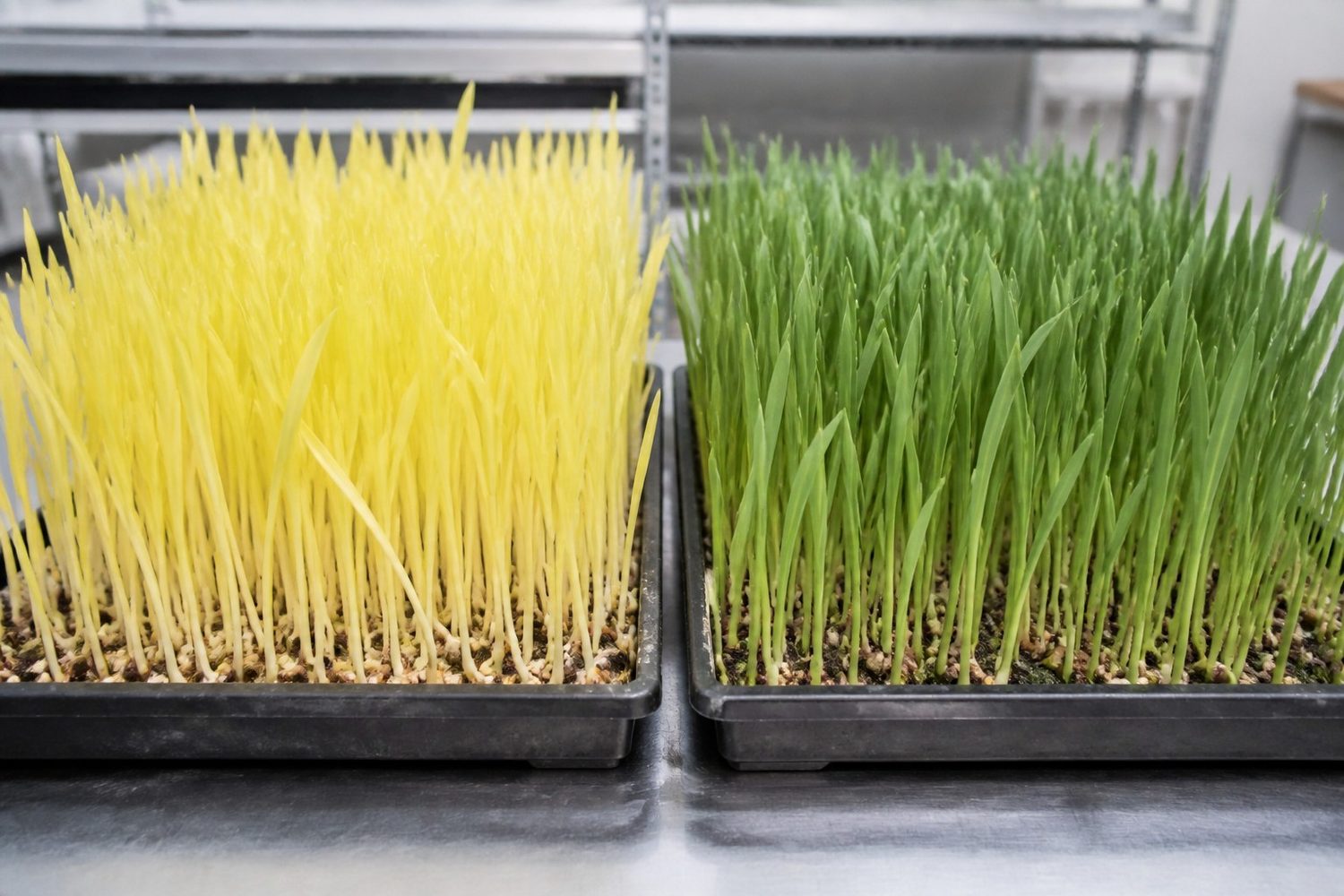
Most crops spend a few days covered and then go under lights. Popcorn stays covered for the whole six to fourteen days. Let light in and the shoots turn green, lose the sweetness, and become ordinary corn grass. You cannot make a greened tray yellow again.
Everything else about growing it follows from keeping the light out.
What growers are saying right now
Sampled from public posts and videos, 10 July to 9 August 2026. Every line links what it is quoting. How often something is repeated is not evidence that it is true, so every line also says what the sources actually establish.
Growing popcorn this year
Circulating The garden post above at 18,562 views and 3,099 likes, easily the biggest corn item in the window
Worth naming because the garden competitor here is not really a competitor at all. Field corn and popcorn shoots are not the same product in any sense: one is a season-long crop grown for dry kernels in the sun, the other is a seven-day blanched shoot grown in the dark and eaten fresh. Nothing about growing popcorn in a garden transfers.
What it is, and how to tell you grew it right
Popcorn shoots are seedlings of Zea mays, specifically a popcorn type, often written var. everta. That makes this the third grass in the directory after barley grass and wheatgrass, and the only one of the three you eat rather than juice.
The kernel is enormous by the standards of this category. Johnny's counts about 3,000 seeds per pound, so a 5 to 8 ounce tray holds roughly 940 to 1,500 kernels. Compare broccoli, where 13 grams is about 4,000 seeds. You place popcorn as a single layer, not a broadcast.
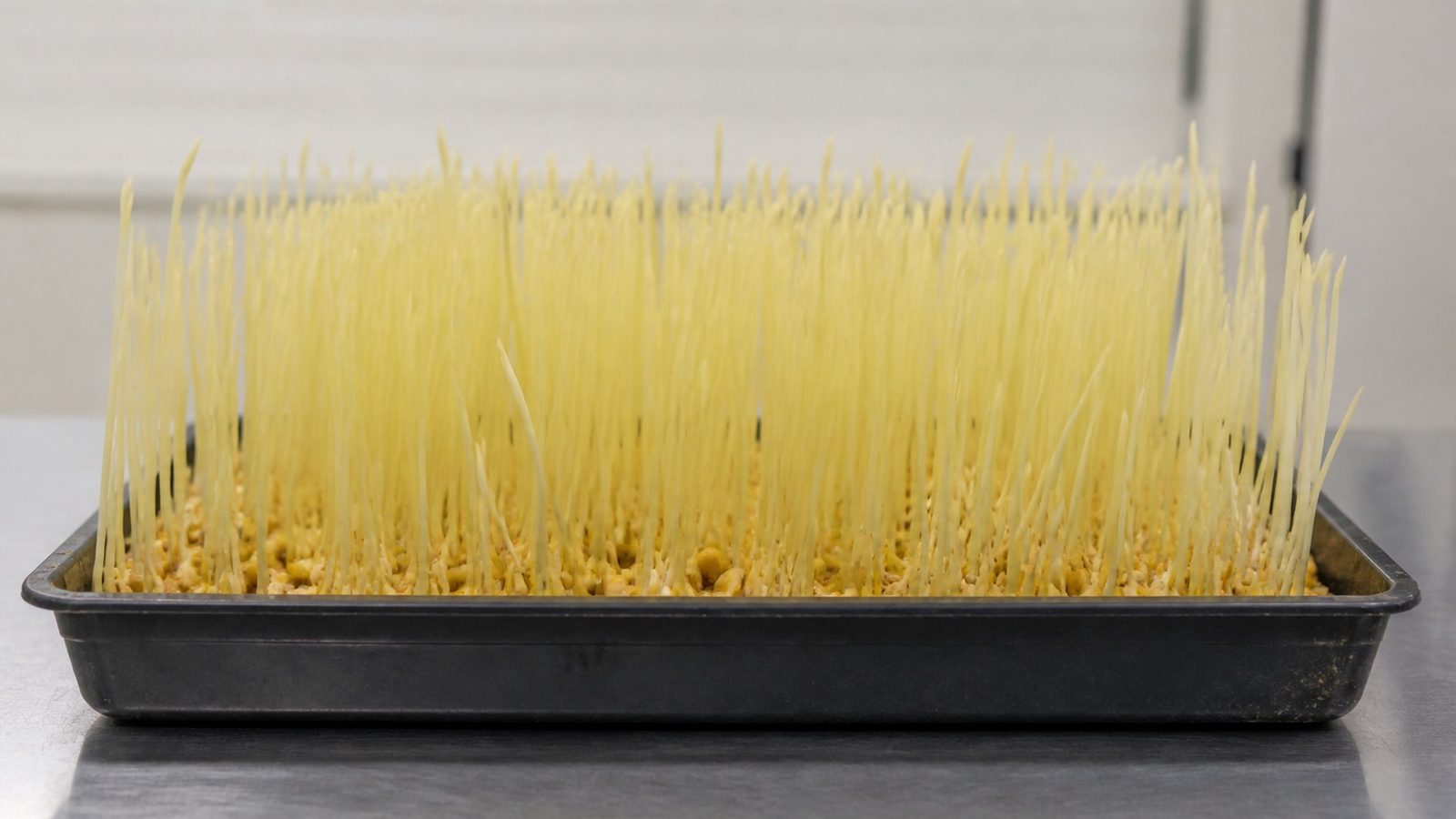
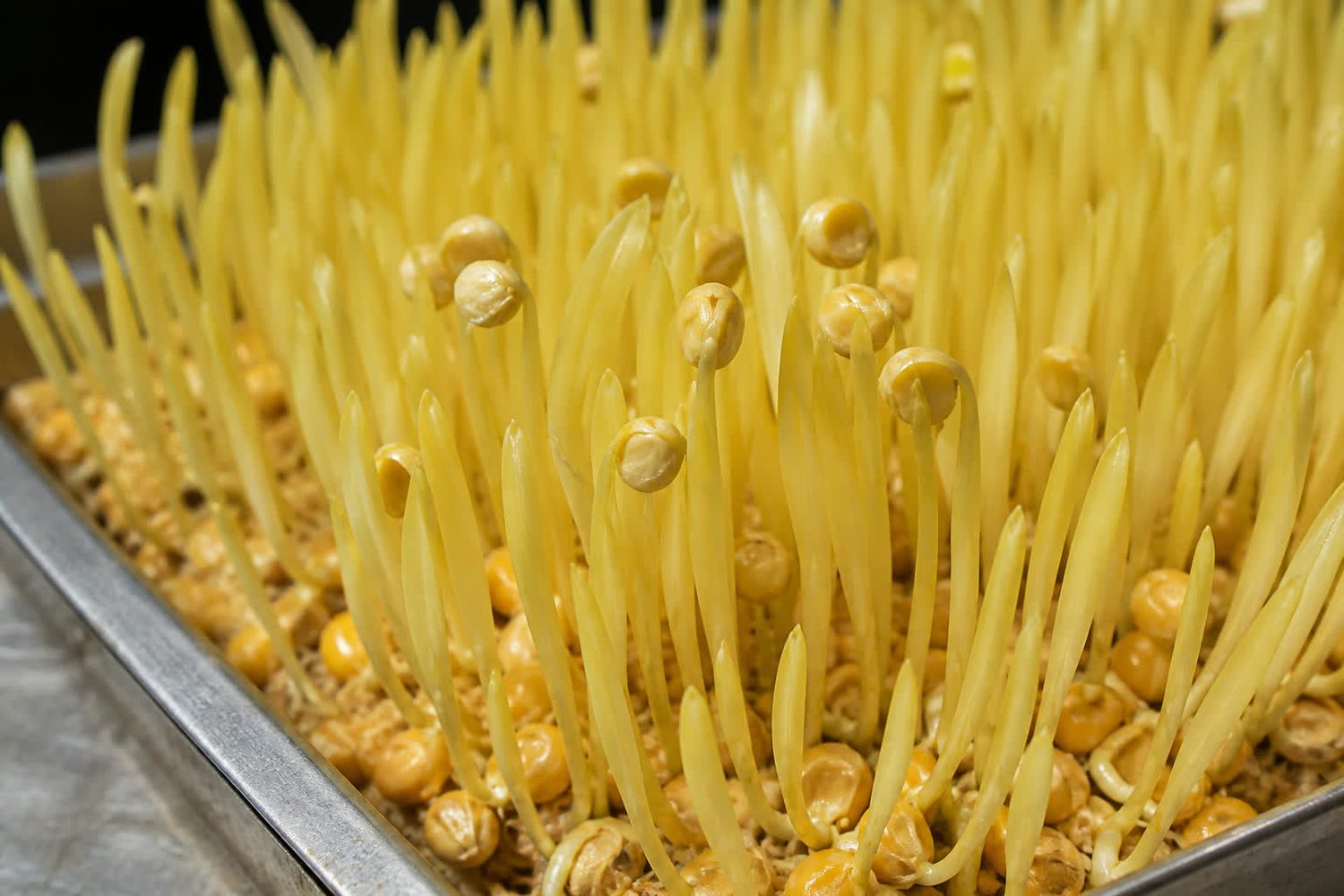
A correct tray is unmistakable: long, narrow, pale butter-yellow to cream grass blades, three to six inches, rising out of a visible bed of large kernels, and no green anywhere. At the medium there is a dense white root mat and, usually, a number of seed coats still attached to the tips.
What it is confused with is itself grown wrong. A light-grown corn shoot is green and looks like wheatgrass. The yellow is not a cultivar and it is not the kernel color: red, white and yellow popcorn all blanch to the same pale yellow. The color is the darkness.
What it tastes like, and what to do with it
Intensely sweet, juicy corn with a crisp snap. It is closer to a dessert note than to a vegetable, and the sweetness is the reason anyone grows it.
That makes it a garnish where sweetness, crunch and an unusual pale yellow are wanted: on ramen, sushi, fish tacos, a salad that can take a sweet note, or a dessert plate. The blades are long, so it also brings height to a plate in a way nothing else here does.
It is the wrong choice in a mixed green salad, where the sweetness fights everything, and wrong wherever you wanted pepper or a leaf.
One supplier says plainly that the intense sweetness is not for everyone, which is a more useful warning than most crops get. Add the texture: left tall it turns stringy, and people who dislike a grassy chew will notice.
Using it in the kitchen, and the crop that restaurants use and nobody weighs
Popcorn shoots break the pattern of every other crop researched alongside them, and they break it twice. The recipes come from actual restaurant chefs rather than from the people selling the seed, and not one of them states a weight.
Hover or tap a row to highlight it.
| Amount | Dish | Serves | Source |
|---|---|---|---|
| 1 punnet | Warm salad of char sui barbecue pork | 4 | A broadcaster's food site |
| 1 punnet | Ham hock, charred corn and mustard with chicory | 6 | A professional chefs' recipe site |
| Not stated | Seared scallops with sweet corn nage | Not stated | A foodservice distributor |
| For garnish, not stated | Chilled corn soup | Not stated | A magazine recipe |
A punnet is not a unit. One supplier's popcorn shoot punnet is 70 g, and neither recipe using the word says whose punnet it means, so there is no safe conversion to give you. What the word does tell you is real: this is a crop bought in a small clamshell and used as a finish, not weighed out of a bag.
Notice what the four dishes have in common. Three of the four pair it with corn: charred corn, sweet corn nage, chilled corn soup. Chefs are using the shoot to restate the flavor of the thing it grew from, on a plate that already contains corn. The fourth is barbecue pork. The pattern is sweet crop against rich or smoky protein, which is exactly what the flavor would suggest, and it is the clearest set of chef-attributed pairings for any crop in this directory.
The arithmetic this page cannot do, and will not fake
For arugula, sunflower, radish and the rest, this site can convert a recipe into trays, because it carries a measured yield. For popcorn shoots it cannot, and that is a deliberate blank rather than a gap in the research.
This entry's yield field is unestablished. The only figure anyone publishes is a supplier's estimate off a 10x10 tray with no method attached, and as the note on the numbers explains, taking it would have put this crop at the top of the yield table on the weakest evidence in the directory. So, there is no ounces-per-tray figure here to divide a punnet into.
The cost side is clear enough: popcorn shoots is the second most expensive tray of seed here at $9.28, behind only barley grass at $9.69, as of 2026-08-11. It takes 142 to 227 g of seed. So, this is a crop where you are spending nine dollars of seed to fill a tray whose output nobody has weighed, and the honest position is that you cannot cost a serving of this crop and neither can anyone else.
Retail, for comparison, ran $11 for 4 oz, $17 for 8 oz and $32 a pound at one listing on 2026-08-11. That is the dearest retail of any crop checked for this wave, which at least tells you the market agrees it is a specialty item.
Raw, at plating, and the reason is the sugar
Every one of the four chef recipes adds the shoots after the cooking is finished. One removes the dressing from the heat before the pork goes in, then tosses the shoots through. One plates the scallops and then adds them. One tops an assembled salad. One garnishes a chilled soup.
Nobody cooks them, and nobody has tested cooking them. No source measures wilting, flavor loss or color after heat, so sautéing is an unsupported alteration rather than a known mistake. The wider cooking evidence is here.
The reason to keep them raw is the same reason the crop exists: the sweetness is the entire product, and it is a sugar note that reads as closer to a dessert than a vegetable. Heat is the wrong tool for a garnish whose job is a bright sweet contrast against something rich.
One thing to plan around that no recipe mentions: this crop turns fibrous and loses the sweetness if it is left tall. The window is a harvest decision rather than a kitchen one, and it is covered in the failures section below, but it matters here because a tough popcorn shoot is not a garnish anyone wants on a plate.
Buying it and keeping it
This entry publishes 10 to 14 days, which is toward the longer end of this directory. Store unwashed and cold, and wash only the portion you are about to use, which matters on a crop this pale and tender.
Popcorn shoot seed on Amazon is the convenient route, and on this crop the seed choice does real work: it is grown entirely in the dark, so what you are buying is a corn that yellows well without light.
Who this crop is actually for. The published evidence answers that unusually clearly. Four recipes, all from professional kitchens, all using it as a finish, all pairing sweet against rich. If you are cooking at home and want volume on a plate, this is the wrong crop and an expensive way to find out. If you want one striking sweet garnish that nobody at the table has tasted before, this is exactly what it is for.
Growing it: only what differs from the standard method
The standard tray method covers a tray for a few days and then gives it light. On this crop, that sequence is the failure. Everything below follows from keeping the lights off.
Soak eight to twelve hours in cool water, 60 to 70°F, then drain thoroughly and do not re-soak. Standing water past that point is specifically warned against here. Sow once a root tip shows.
Lay the soaked kernels in one even layer with minimal overlap, pressed into an inch to an inch and a half of medium, not buried. The kernels are large enough to displace medium and to hold water around themselves, so a level tray matters and a pooled low spot will sour.
Weight for two to three days only, then keep it dark for the rest of the crop. A second tray or a board gives contact weight, drives the roots down, and helps the shoots strip their seed coats on the way up. Take the weight off when the shoots lift it. Do not take the darkness off. A non-contact cover or a dark cabinet carries the crop to harvest.
Bottom water, and keep the air moving. A warm, wet, densely kerneled bed in the dark is exactly the condition mold wants, and this is the one crop where you cannot open it up to light and air as a corrective. One farm bottom-waters five or six times a day in its own system, which is a system-specific frequency rather than a rule.
65 to 72°F. Below about 50°F corn germinates poorly and slowly, which is a well-documented field hazard. Warmer raises the mold pressure, and the crop-specific instruction when mold appears in warmth is to switch to bottom watering rather than to reduce moisture generally.
Then cut at three to six inches, on height rather than on a date.
What goes wrong with popcorn shoots specifically
A light leak, and it is the failure unique to this crop. Green tips. The tray is still edible and it is no longer the product you were growing, and there is no way back. Check the enclosure before you sow rather than after.
Souring and seed rot under the cover. Overwatering, warmth, humid darkness, kernels packed too close. The early tell is a sour smell and soft or discolored kernels before anything collapses. Small pockets can be pulled; a widely soft, foul tray is not food.
Damping-off at the medium line, Pythium and Rhizoctonia, brown collapsed stems. Not recoverable once it spreads.
On root hair against mold, popcorn is unusually clear. Root hairs are a fine bright white fuzz attached only to the roots, often appearing after watering, and they do not make stems collapse or smell sour. Growth that bridges between kernels or climbs the stems, or a kernel that has gone soft and brown, or any odor, is the other thing.
The hulls, and on this crop they are a real job. Large seed coats cling to the tips as the shoots rise. The published remedy is to brush the stand gently by hand or with a stake, then hand-remove what is left and pull the plants whose hulls will not release before you harvest. Budget the time; nobody publishes a retention rate.
Left tall, it stops being sweet. Past three to six inches the blades coarsen, tenderness goes, and the crop can turn bitter. You can see it before you cut.
Nutrition, and the honest trade
One peer-reviewed study measured this crop, and its result is the direct consequence of how it is grown.
Xiao and colleagues assayed 25 commercially grown microgreens for carotenoids and tocopherols. Yellow popcorn shoots came in at 0.6 mg beta-carotene, 1.3 mg lutein and zeaxanthin, and 0.9 mg violaxanthin per 100 g fresh weight, with 0.9 µg vitamin K1 per gram and 7.8 mg alpha-tocopherol per 100 g. Those carotenoid figures put popcorn shoots at the low end of the 25 crops tested.
That is not a defect in the crop, it is the arithmetic of blanching. Carotenoids and chlorophyll are what a seedling builds in light. Popcorn shoots are deliberately denied light for their entire life, which is precisely what produces the sweetness and the pale yellow that people pay for. You are trading the pigments for the sugar, on purpose.
So, the retail language about popcorn shoots being loaded with vitamins A, B, C and E, or being a beta-carotene crop for eye health, is not supported and runs against the one measurement that exists. It does not mean the shoots contain none of those things. It means the sweeping claim has no crop-specific panel behind it and the panel that does exist points the other way.
There is no USDA FoodData Central record for popcorn shoots, searched 2026-08-09, and mature sweet corn values are not a substitute.
This directory has answered the nutrition question in both directions across eight crops now, and popcorn is the clearest case of a mechanism: it is low in carotenoids for a reason you can state in one sentence, rather than for reasons nobody has isolated.
Which seed to buy
Buy food-use, untreated popcorn or corn shoot seed with lot traceability. Refuse anything labeled treated, dyed, or for planting only: those treatments can persist in a shoot you eat a week later, and this is a crop where the seed is a large fraction of what ends up in the tray.
Kernel color does not determine shoot color. Yellow, white and red popcorn are all sold for shoots and all blanch to the same pale yellow. No supplier trial establishes a difference between them in stem length, days or yield, so buy on price, lot quality and availability.
Grocery popcorn is the tempting shortcut and growers report it going badly. The seed is not sold with germination data, has not been handled as a food-crop planting lot, and a bad lot on this crop is conspicuous: hard kernels that never swell after a standard soak, patchy root tips at day two or three, and early softening. Run a documented germination test before committing trays, because half a pound of kernels a tray makes a failed lot expensive twice over.
Seed cost is real here and the ladder is worth using. Johnny's lists 1/4 lb $5.80, 1 lb $18.55, 5 lb $79.00 and 25 lb $338.50. At a pound that is $5.80 to $9.28 a tray depending on your rate; at 25 lb it is $4.23 to $6.77. A pound is only two or three trays of this crop, so anyone growing it regularly should be buying at 5 lb or above.
Popcorn shoot seed on Amazon is worth one warning about the search itself: the plain word returns snack popcorn, microwave bags and movie-theatre product, so the link is scoped to shoots and sprouting seed. Read the listing for a germination figure and a lot, and if it does not carry one, it is a snack rather than a crop.
Is it worth growing?
Yes, for one specific reason, and no for every general one.
The reason is that nothing else looks or tastes like it. A pale yellow, three-to-six-inch, intensely sweet, crunchy shoot is a garnish a chef cannot get from any other tray in this directory, and it photographs. Priced as a garnish it is a real product.
Everything else argues against it. It is the second most expensive tray of seed here at $5.80 to $9.28, behind only barley grass, and for the same reason as barley grass and mung bean: the seed is ordinary and the tray eats half a pound of it. There is no measured yield to plan against. The hulls are hand work. And the whole crop depends on a light seal that most home setups do not actually have.
Its rivals are the other big-seed shoots. Sunflower returns a measured 18.77 oz and is the most productive crop on this site. Pea shoots return a measured 8 oz. Both are grown in light, both have numbers, and neither needs a dark cabinet. Choose popcorn when the sweetness and the color are the point, and choose almost anything else when they are not.
A note on the numbers above
Hover or tap a row to highlight it.
| Figure | Value | Source | What kind of number it is |
|---|---|---|---|
| Seed per 1020 | 5 to 8 oz, 142 to 227 g | Farm crop notes | Supplier guidance, not a trial |
| Seeds per pound | About 3,000 | Johnny's | Which makes a tray roughly 940 to 1,500 kernels |
| Days to harvest | 7 to 14 at 65°F or warmer | Johnny's | Cut at 3 to 6 inches |
| Days to harvest | 6 to 7 | Farm crop notes | At 3 to 4 inches, no temperature |
| Days to harvest | 7 to 10 at 64 to 72°F | European supplier | For blanched yellow shoots |
| Soak | 8 to 12 h at 60 to 70°F | Two suppliers | And an explicit warning against longer |
| Darkness | The entire crop | Every crop-specific source | Not a blackout phase. The whole thing |
| Yield, 10x10 tray | 6 to 10 oz | One supplier | No seed weight, no method. See below |
| Yield per 1020 | No published figure | Nobody | And this page declines to convert the above |
| Shelf life | 10 to 14 days at 36 to 40°F | Farm crop notes | Sealed and unwashed |
| Beta-carotene | 0.6 mg/100 g fresh | Xiao et al., 25 crops | Measured. Low end of the set |
| Lutein and zeaxanthin | 1.3 mg/100 g fresh | Same study | Measured. Also low, and blanching is why |
| Alpha-tocopherol | 7.8 mg/100 g fresh | Same study | Measured |
| Seed price | $18.55/lb | Johnny's, checked 2026-08-09 | Ladder from $5.80 a quarter pound to $338.50 for 25 lb |
| Harvest window | No published figure | Nobody | Manage by height; fiber and bitterness are the cost |
The yield is blank and the reason is the rule this directory added after fenugreek. One supplier estimates 6 to 10 oz from a 10 by 10 inch tray. A 1020 is exactly twice that area, so the implied figure is 12 to 20 oz per 1020, which would sit alongside or above sunflower's measured 18.77 oz and take first place in the directory. It comes with no stated seed weight and no method. A supplier's estimate that would rewrite the top of the table does not get published as a measurement, and this is the third time this session that rule has held a number back, after mint's seed rate and mung bean's calculator yield.
Worth being precise about what would make it publishable. Pak choi showed that an area conversion can land within 4 to 13 percent of a real tray, so the arithmetic itself is not the objection. The objection is the source: pak choi's figure came from a controlled study with a stated density, replicates and a named harvest stage, and this one is an estimate on a product page.
Popcorn is the second most expensive tray of seed in this directory at the retail pound, $5.80 to $9.28, behind barley grass at $7.72 to $9.69 and ahead of mung bean shoots at $5.48 to $5.89. One figure on the table is higher, endive's $20.86, and it is a different kind of number: endive's bulk price is 83 cents to $1.55, and the retail figure exists only because that crop is sold in packets too small to fill a tray. All three sit at the top for the same reason and it is never the price of the seed: barley grass takes 175 to 220 g, mung 200 to 215 g, popcorn 142 to 227 g. In this directory the tray cost is a rate story roughly every time, and the four crops with the priciest seed per pound, mint, oregano, onion and basil Red Rubin, are all mid-pack or cheaper per tray.
Its blackout figure is the only one in the directory that equals the crop length, checked across all 51 entries on 2026-08-09. Every other entry's blackout is a phase inside a longer cycle. Popcorn's 6 to 14 days of darkness is the 6 to 14 day crop. That is worth stating as a fact about the spec table rather than as a claim about the plant.
The harvest window is blank, which as of 2026-08-09 covers 47 of the 51 entries written.
Hover or tap a row to highlight it.
| Crop | Seed per 1020 | Yield | Days | Cost per tray | Oz per $1 | Oz per tray-day |
|---|---|---|---|---|---|---|
| Barley grass | 175 to 220 g | No published figure | 6 to 12 | $7.72 to $9.69 at 1 lb retail | cannot be calculated | cannot be calculated |
| Popcorn shoots | 142 to 227 g | No published figure | 6 to 14 | $5.80 to $9.28 at 1 lb | cannot be calculated | cannot be calculated |
| Wheatgrass | 450 g | No published figure | 7 to 12 | $3.10 | cannot be calculated | cannot be calculated |
A blank means nobody has published that figure, so the cell is left empty rather than filled with an estimate. How the numbers work
All 62 crops, sortable, on the microgreen comparison.
Three of the four priciest trays here are heavy-seeded shoots and popcorn is the newest of them: barley grass at 175 to 220 g, popcorn at 142 to 227 g, mung bean at 200 to 215 g. None of the three has expensive seed. All three have a tray that eats half a pound of it.
Terms on this page
Tap a term to see what it means.
Blanching. Growing a crop in complete darkness so it never makes chlorophyll. On popcorn it produces the pale yellow color and the sweetness, and it is also why the crop measures low in carotenoids.
Sources
- Johnny's organic popcorn shoot seed - Zea mays, 7 to 14 days at 65°F or warmer, harvest at 3 to 6 inches, about 3,000 seeds per pound, surface sowing and pressing, the contact tray for the first days, brushing and hand-removing hulls, the bright-yellow blanched result, and the price ladder verified 2026-08-09 at 1/4 lb $5.80, 1 lb $18.55, 5 lb $79.00 and 25 lb $338.50.
- River Fork Farms crop notes - 5 to 8 oz of dry seed per 1020, 6 to 7 days to 3 to 4 inches held in complete darkness, bottom watering several times daily in its own system, and 10 to 14 days at 36 to 40°F sealed.
- Deliseeds corn microgreen seed - var. everta, 7 to 10 days at 64 to 72°F, about 1 cm of cover, and darkness through the crop for blanched yellow shoots.
- Sproutpeople popcorn shoots - the 8 to 12 hour cool soak with the warning against standing water, red, white and yellow types, the root-hair description, and the plain statement that the intense sweetness is not for everyone.
- Hamama popcorn microgreens guide - about 10 days refrigerated stored unwashed, that washing shortens shelf life, and that taller shoots become fibrous with the flavor changing.
- Great Northern Microgreens, yellow popcorn seed - the 6 to 10 oz from a 10 by 10 tray estimate, with no seed weight or method stated, which is why this page does not convert it.
- Xiao et al., 2012, carotenoid and tocopherol content of 25 commercially grown microgreens, with the per-crop table in the University of Maryland source - yellow popcorn shoots at 0.6 mg beta-carotene, 1.3 mg lutein and zeaxanthin and 0.9 mg violaxanthin per 100 g fresh weight, 0.9 µg/g vitamin K1, and 7.8 mg alpha-tocopherol per 100 g, n=3, at the low end of the 25-crop set.
- Johnny's microgreens yield trial results (PDF) - corn is absent from the 29 varieties, and the trial measured microgreens at first true leaf rather than a blanched shoot.
- Purdue Extension, corn germination and cold - poor germination from cold soil as a documented corn hazard below about 50°F.
- UC IPM, damping-off - Pythium and Rhizoctonia, root-tip onset, and rot at or below the medium line.
- Penn State Extension, growing microgreens at home - the default blackout-then-light sequence this crop deliberately departs from.
- SDSU Extension, growing microgreens at home - untreated seed, because treatments can remain in shoots that are eaten.
- USDA FoodData Central - searched 2026-08-09, no popcorn shoot record.
Keep reading
The variety directory
Barley grass
One of the dearest trays of seed you can fill at a 1 lb retail pack, and about a seventh of that in bulk. A juice crop whose buyers are mostly buying powder.
Read Barley grassThe variety directory
Wheatgrass
The crop you juice rather than eat. It takes 450 g of soaked kernels to a 1020 tray, the heaviest sowing of any microgreen, and cuts at 3 to 6 inches in 7 to 12 days.
Read WheatgrassThe variety directory
Nasturtium microgreens
A three-week tray that returns 5.64 oz and costs $5.74 of seed, so it earns its keep as a garnish and not by weight. Also the crop whose own name belongs to a different plant: search nasturtium in USDA's database and you get watercress.
Read Nasturtium microgreensThe variety directory
Alfalfa
Alfalfa grows in a jar in four to six days, rinsed twice a day and eaten whole, root and all. The care goes into the food safety rather than the growing.
Read Alfalfa