At a glance
The growing is simple, a jar rinsed twice a day, and the difficulty is entirely food safety: the whole seedling is eaten raw and the warm wet cycle that sprouts the seed will also multiply anything living on it.
- Botanical name
- Medicago sativa
- Also sold as
- Alfalfa sprouting seed, Organic alfalfa sprouting seed
- Family
- legume
- Difficulty
- Moderate
- Days to harvest
- 4 to 6 days
- Harvest window
- No published figure
- Seed per 1020 tray
- Not applicable
- Soak
- 4 to 12 hours
- Blackout
- Not applicable
- Germination temperature
- 60 to 70 °F
- Yield per 1020 tray
- Not applicable
- Regrows after cutting
- Not applicable
- Mold risk
- High
- Hull shedding
- some
- Shelf life
- 7 days
- Eaten as
- raw
- Seed cost per tray
- Not yet researched
Any field name above ranks every variety by it. No published figure means we researched it and nobody has established one, which is different from not yet researched. Every figure here is sourced at the bottom of the page. Compare every variety side by side.
Alfalfa grows as a sprout, in a jar or a sprouting tray rather than a 1020 microgreen tray, and it is ready in about four to six days. Rinse and drain it twice a day, give it a few hours of light at the end to green up, and eat the whole thing, root and all. The growing is genuinely easy. The care goes into food safety, because the warm wet cycle that sprouts a seed also multiplies anything already living on it, and you are eating the seedling raw.
That method is also what makes alfalfa a sprout rather than a microgreen, and the difference is not a quibble about vocabulary. It moves the crop under a different part of federal food safety law, and it is why the tray figures on this page read "Not applicable" rather than carrying a number. Anyone quoting you a seed rate or a yield per 1020 tray for alfalfa is quoting something that does not exist.
What growers are saying right now
Sampled from public posts and videos, 9 July to 8 August 2026. Every line links what it is quoting. How often something is repeated is not evidence that it is true, so every line also says what the sources actually establish.
Alfalfa filed as a microgreen
Circulating This fifteen-day growing timelapse is tagged #Microgreens and ran to 13,940 views in the window, and the tag is routine across short-form content
It is a sprout. Alfalfa is customarily eaten whole at four to six days, before the true-leaf stage a microgreen is cut at, and it is absent from the one public per-tray trial in the category. The label is not cosmetic: it decides which federal rules apply and whether any tray figure means anything. What it is
Alfalfa, broccoli and clover sprouted in the same jar
Circulating A 450,662-view jar-sprouting guide runs an antioxidant mix of alfalfa, broccoli and clover seed through one method, and a hydroponics thread lists alfalfa beside radish, mustard and sunflower as the same kind of crop
The seeds are interchangeable in a jar; the crops are not. Broccoli grown in a jar and eaten whole is a sprout too, and falls under Subpart M exactly as alfalfa does. Broccoli grown in a medium and cut above the line is a microgreen and does not. Same seed, different product, different rules, and it is the method that decides which.
Alfalfa sprouts are risky because they are grown warm and constantly moist, which encourages bacteria
Circulating Put this way in wellness content, framed as a reason to avoid the sprouts while still using the mature plant
The mechanism is right and it is not a fringe position. FDA says the same thing: the warm humid conditions that sprout a seed also let Salmonella, Listeria and E. coli multiply from a small contamination already on it, and it documented an alfalfa sprout outbreak with 63 illnesses across eight states and 10 hospitalizations. What does not follow is that the plant is the problem. The risk lives in the raw sprout process, cooking removes it, and FDA's advice is aimed at people at higher risk of foodborne illness. What goes wrong
What it is, and why the label matters
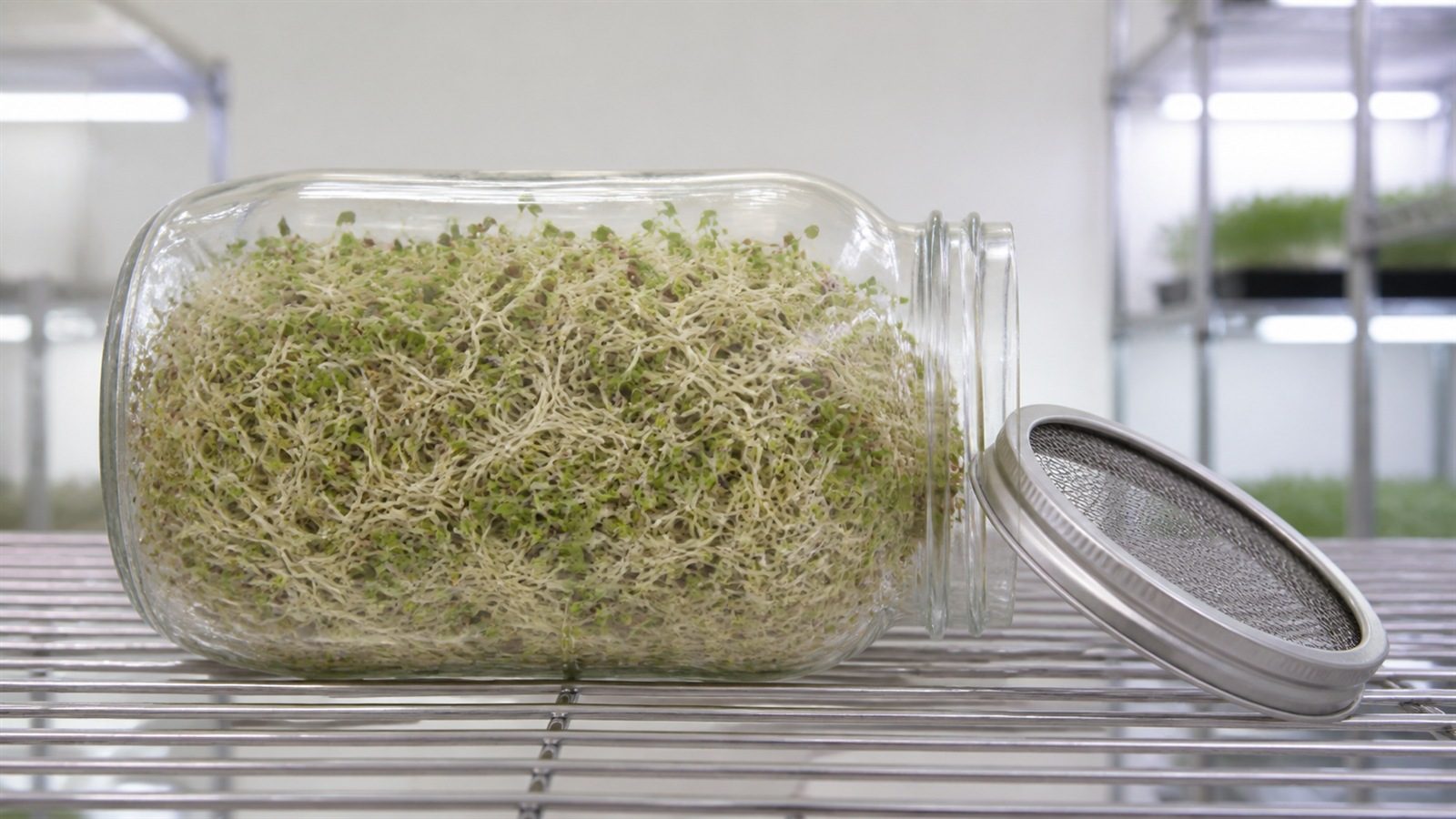
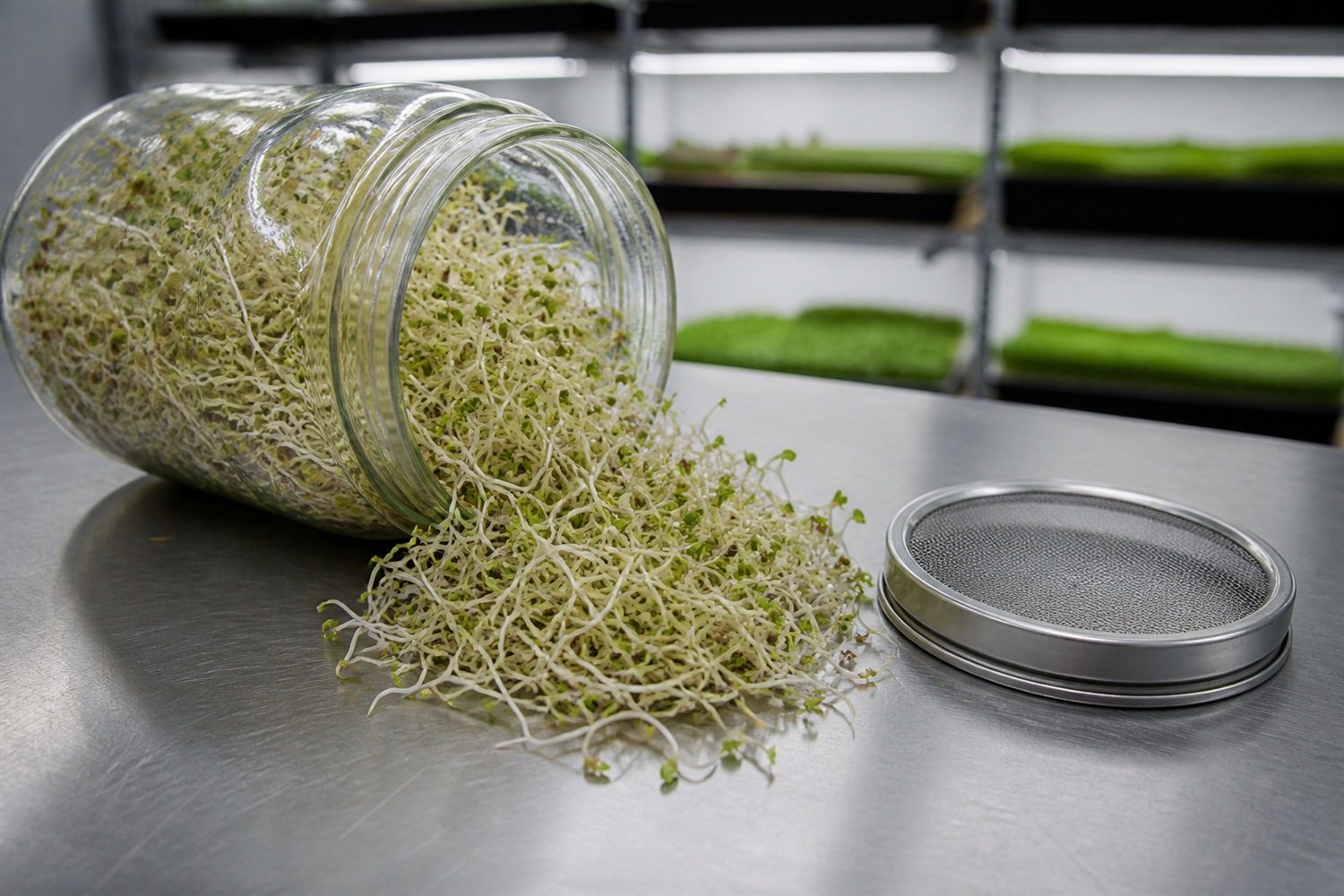
Alfalfa is Medicago sativa, a legume in the Fabaceae, and what you buy is sprouting seed rather than a named microgreen cultivar. A correct batch is a loose tangled mound of very slender pale white to cream stems with fine white roots, many tiny paired green leaves, and the odd tan hull mixed through it. There is no even canopy because there is no medium: the whole thing grows in a drained jar, and growers harvest at one to two inches or at the first tiny green leaves.
The distinction from a microgreen is a legal line, not a stylistic one. A sprout is germinated seed grown in water and eaten whole. A microgreen is grown in a medium and cut above the soil line, leaving the seed and root behind. The FDA Produce Safety Rule turns on exactly that: Subpart M covers sprouts, and it excludes crops grown in soil or substrate and harvested above the line without roots. Subpart M is materially more stringent and carries its own compliance dates, which is why how the FDA separates sprouts from microgreens is worth reading before you sell anything you germinated in a jar.
It is most easily confused with clover, which is also pale, fine-stemmed and mild. At the ordinary harvest stage you often cannot tell them apart from a photograph, so do not rely on one to identify a bag. The tell only arrives if you let it run past the usual point, when a true alfalfa leaf comes in trifoliate, with three leaflets.
What it tastes like, and what to do with it
Mild and nutty, with a delicate fresh crunch. Johnny's and Sproutman independently land on the same two words, and there is no pepper, no mustard heat and nothing assertive about it. Alfalfa is a texture and a volume ingredient rather than a flavor one.
That puts it in sandwiches first: turkey, egg, avocado, anything that wants a light green lift without a fight. It folds into a salad, it sits well on toast, and it is the classic sprout for exactly this job. What it will not do is survive heat. It is described as too delicate to cook, so a stir-fry or a braise turns it into nothing, and if you want a peppery hit you want radish or mustard instead.
Two groups of people reliably do not get on with it. Some dislike the texture, which is loose and can read as wet, and the visible hulls put others off; if you are expecting the substantial snap of a mung bean sprout, this is not that. The second group is not a matter of taste: FDA advises people who are pregnant, older, or immunocompromised to avoid raw and lightly cooked sprouts entirely. That is worth saying plainly on a page recommending the crop, and no amount of care in your own kitchen changes it, because the risk starts on the seed.
Growing it: only what differs from the standard method
Almost everything, which is the point. The standard tray method does not apply here at all: there is no medium, no tray, no blackout blanket, no weight, and no cut. The published method is a jar, and some makers sell sprouting trays for it.
Soak, then rinse and drain, twice a day minimum. Four to six hours in lukewarm water by one supplier's method, six to eight by another, four to twelve by a third. They disagree because none of them measured the outcome at each endpoint, so treat the spread as the real state of the published knowledge rather than picking one and calling it optimal. After the soak, drain completely and rinse two to three times a day.
The non-negotiable step is complete drainage after every rinse. Every source that gives a method says it, and it is the one instruction that separates a batch you eat from a batch you throw away. Retained water is what turns a jar of sprouts into a warm wet mass.
Dark, then a few hours of light at the end. The jar sits at 60 to 70°F out of direct sun for most of the cycle, then gets a few hours of light once the sprouts reach length or show their first tiny leaves, which is what greens them. There is no lighting target to hit and no cut stage to time.
Expect hulls and plan to deal with them. They are normal and harmless to eat, but they shorten storage life, so the standard handling is a final rinse in a bowl of water where the loose hulls float off and can be skimmed. It is a real step on any batch you intend to keep for a week rather than eat that afternoon.
A jar of alfalfa, day by day
- 1
Day 0, soak
One tablespoon of seed in a wide-mouth jar with a mesh lid, covered in lukewarm water. Published soaks run from four hours to twelve; drain completely when it is done.
- 2
Days 1 to 3, rinse and drain
Twice a day minimum, two to three times in the cited methods. The jar sits dark at 60 to 70°F, uncompressed, and inverted so it keeps draining between rinses.
- 3
Day 4 or 5, watch for the tell
Sprouts reach roughly one to two inches and the first tiny green leaves appear. That is the harvest signal, not a date.
- 4
Day 4 to 6, green it
A few hours in indirect light to bring the color up. Still no direct sun.
- 5
Harvest and dry
Final rinse in a bowl so the loose hulls float off and can be skimmed, then dry thoroughly before it goes anywhere near a container. Wet sprouts spoil fast.
What goes wrong with alfalfa specifically
Three failures, and the third is a different category of problem from the other two.
Poor or uneven germination. Hard, unsprouted or discolored seeds scattered through the batch. No source establishes a measured cause, so fix the basics of the jar method first and replace a lot that keeps doing it, rather than diagnosing something you cannot see.
Clumping and retained water. The batch goes from loose and draining to a compact wet mass. Caught early, with no smell, it is recoverable: improve the rinse and drain discipline and stir gently to break the clump up.
Spoilage and microbial growth, which is not recoverable and not a judgment call. An unpleasant odor or visible mold means discard the batch. Do not rinse it harder, do not pick through it, do not cook it and hope.
And here is the part that makes alfalfa different from every brassica in this directory: do not run the root-hair test on it. On broccoli or radish, fine white fuzz at the root line is normal and disappears when you mist it, and knowing that saves trays. Nothing in the sources extends that test to alfalfa, and carrying it across from a brassica is how a grower talks themselves into eating a bad jar. On a crop eaten whole and raw, in a system that amplifies bacteria, the conservative rule is the correct one: fuzzy growth, an off smell or a texture you are unsure about means it goes in the bin.
The hazard here is not a pest, it is human pathogens carried on the seed itself. Salmonella, E. coli and Listeria can arrive on seed at levels too low to matter and be multiplied by four days of warmth and moisture into levels that do. FDA documented a multi-state Salmonella Typhimurium outbreak traced to raw alfalfa sprouts: 63 illnesses across eight states and 10 hospitalizations. That is materially more important than damping-off, and it is why the difficulty rating on this page is Moderate for a crop whose actual growing is a jar and a tap.
Nutrition, and what is actually established
There is no USDA FoodData Central entry for alfalfa microgreens, which follows from there being no such thing. There is a record for the real food, Alfalfa seeds, sprouted, raw, FDC ID 168384, and that is the one to look up. Mature alfalfa leaf and hay figures are not a substitute and should never be used as a proxy.
The variety-specific research that exists is on sprouts and it is narrow. A peer-reviewed study compared alfalfa sprouts germinated with and without light using metabolomic and transcriptomic profiling, and found green sprouts carried a wider range of lipids, flavonoids, phenolic acids and terpenoids, while yellow sprouts held relatively more isoquercitrin. That is a real finding about how light changes composition, and it is not a nutrition panel for your jar.
The claim that alfalfa carries some multiple of the nutrition of the mature plant is not supported by any crop-specific source opened for this page, and neither are claims about preventing or treating disease.
Which seed to buy
There is no cultivar decision to make. Every supplier checked sells the same thing under slightly different bag names, alfalfa sprouting seed, Medicago sativa, and no page established named selections that change stem length, color, tenderness, days or yield. Anyone selling you a superior alfalfa strain for sprouting is describing something the suppliers themselves do not claim.
What you specify instead is the seed's food-safety provenance, and on this crop it is the whole decision. Ask for seed sold for sprouting and human food use, untreated, from a supplier with a stated pathogen-testing program and lot traceability. Johnny's, for example, states that its sprouting seed is untreated and has tested negative for E. coli O157 and Salmonella. A negative test reduces risk; it does not make the batch sterile, and FDA's guidance on seed for sprouting exists because contamination happens along the whole seed production chain rather than at one point in it.
Refuse treated, coated, or agricultural and forage seed. That seed may germinate perfectly well and still be entirely unsuitable, because here the seed does not get left behind in the medium: you eat it.
A bad lot shows up as poor germination, unsprouted or discolored seed, and a wasted four to six day cycle. That is the cheap version of the problem. The expensive version is a lot with no food-safety provenance at all, and it does not announce itself.
There is deliberately no seed link on this page. Every other entry in this directory carries one, and the reason this one does not is that the advice above is a requirement a search results page cannot satisfy. Buy this from a supplier who will tell you their testing program and name the lot.
Is it worth growing?
Yes, for a specific person: someone who wants a mild, fast, jar-grown sandwich sprout, will actually rinse it twice a day, and is comfortable managing raw-sprout hygiene. It is genuinely quick, it needs almost no equipment, and the flavor does the job it is there to do.
No for three others. If you are choosing your first cut microgreen, this is not one. If you are a market grower who needs to price by weight, alfalfa has no validated per-tray yield to price against and you should choose a crop that does. And if you or your customers are in one of the higher-risk groups FDA names, this is the wrong crop and there is no technique that fixes that.
Its closest competitor for the same sandwich and salad job is a mild brassica grown properly as a microgreen, and the comparison is not close on the numbers. Broccoli has a measured 13 g of seed per 1020 tray, 11.5 oz of yield and 12.5 days to first true leaf from a published trial. Alfalfa has a jar, a tablespoon, and one and a half to three cups. Choose alfalfa when the fine, mild, whole sprout is specifically what you want, and not because it looked like the same category of thing.
Terms on this page
Tap a term to see what it means.
Sprout. Germinated seed eaten whole, root and seed included, grown in water rather than a medium and harvested in days. Alfalfa is one, and that is what puts it under Subpart M.
Sources
- Johnny's Selected Seeds, alfalfa organic sprouting seed - Medicago sativa, the jar method, 4 to 6 days at 60 to 70°F, one tablespoon per jar yielding 2 to 3 cups (Johnny's printed sprouting instructions, revised 2018, give 3 to 5 days and about 1½ cups), mild and nutty, hull handling, untreated seed tested negative for E. coli O157 and Salmonella, and the price checked 2026-08-08.
- Mumm's Sprouting Seeds, alfalfa - a 5-day crop, a 4 to 12 hour soak, stirring a clumped batch, and drier sprouts keeping better.
- Mountain Rose Herbs, alfalfa sprouting seed - Medicago sativa, a 4 to 6 hour soak in lukewarm water.
- Sproutman, organic alfalfa sprouting seed - a 6 to 8 hour soak, mild and nutty, and that the sprout is too delicate to cook.
- Todd's Seeds, how to sprout alfalfa - 1 to 2 inch harvest length, floating the hulls off in a final rinse, and refrigerated storage.
- FDA, selecting and serving produce safely - why warm humid sprouting conditions multiply bacteria present on seed, and the advice for people at higher risk of foodborne illness.
- FDA, Salmonella outbreak linked to sprouts, December 2022 - 63 illnesses across eight states and 10 hospitalizations.
- FDA, sprouts and the Produce Safety Rule (PDF) - the definition line: Subpart M covers sprouts and excludes crops grown in soil or substrate and harvested above it without roots.
- FDA, guidance on reducing microbial hazards in seed for sprouting - hazards across the seed production chain.
- USDA FoodData Central - Alfalfa seeds, sprouted, raw, FDC ID 168384, and the absence of any alfalfa microgreen record.
- Metabolomic and transcriptomic profiling of alfalfa sprouts under light and dark germination - composition differences between green and yellow sprouts.
- Johnny's microgreens yield trial, method and discussion - the 29-variety scope that excludes alfalfa, the first-true-leaf harvest standard, and the transferability caveat.
Keep reading
The variety directory
Chickpea shoots
One of the very few crops with real regrowth data behind it: a measured second cut at 96 percent of the first, if you cut above a node instead of at the medium line.
Read Chickpea shootsThe variety directory
Mung bean shoots
The crop where the sprout and microgreen line stops being a technicality: mung is the bean sprout of commerce, and the two products sit under different food-safety law. 200 to 215 g a tray, and no measured yield anywhere.
Read Mung bean shootsThe variety directory
Pea shoots
Pea shoots are the easiest microgreen to start and one of the easiest to lose. Sourced figures for seed rate, days, yield and cost, plus the wet-seed failure that actually kills trays.
Read Pea shootsThe variety directory
Lentil microgreens
The cheapest legume tray by a wide margin, because its seed is a grocery commodity: about 47 cents and 7 oz a tray, against pea shoots at $2.39 for eight.
Read Lentil microgreens