Pea shoots
Cal HewittPublished Updated Checked
- legume
- moderate
- needs soaking
- cut and come again
- mold prone
- raw or cooked
At a glance
Easy to germinate, easy to lose: 150 g of soaked seed under weight punishes a small excess of water or a day too long covered.
- Botanical name
- Pisum sativum
- Also sold as
- Field Pea, Dwarf Grey Sugar, Tendril Pea (Afila), Maple / Speckled
- Family
- legume
- Difficulty
- Moderate
- Days to harvest
- 8 to 14 days
- Harvest window
- No published figure
- Seed per 1020 tray
- 150 g
- Soak
- 6 to 8 hours
- Blackout
- 2 to 3 days
- Germination temperature
- No published figure
- Regrows after cutting
- partial
- Mold risk
- High
- Hull shedding
- some
- Shelf life
- No published figure
- Eaten as
- raw or cooked
- Seed cost per tray
- $2.39
150 g at $7.226/lb, True Leaf Afila Tendril 5 lb, listed 2026-08-08. Seed only, excludes medium, tray, labor, light and loss.
Any field name above ranks every variety by it. No published figure means we researched it and nobody has established one, which is different from not yet researched. Every figure here is sourced at the bottom of the page. Compare every variety side by side.
Pea shoots are the crop almost everyone tells you to start with, and the advice is sound: the seed is big enough to handle, it germinates in a day or two, and it forgives a lot. What the advice leaves out is that the same qualities make it the easiest tray to lose. A correct 1020 sowing is 150 grams of soaked seed, covered and weighted, which is a far larger wet mass than any brassica tray. Get the moisture or the timing slightly wrong and you do not get a slow crop, you get a sour one.
What it is, and how to tell you grew it right
Pea shoots are the young plant of the common garden pea, Pisum sativum, cut above the medium. They are not pea sprouts, and the difference decides which rules apply: a sprout is the whole just-germinated seedling eaten seed, root and all, harvested at two to three days, while a shoot is a taller leafy plant harvested at 10 to 14 days and cut above the soil line.
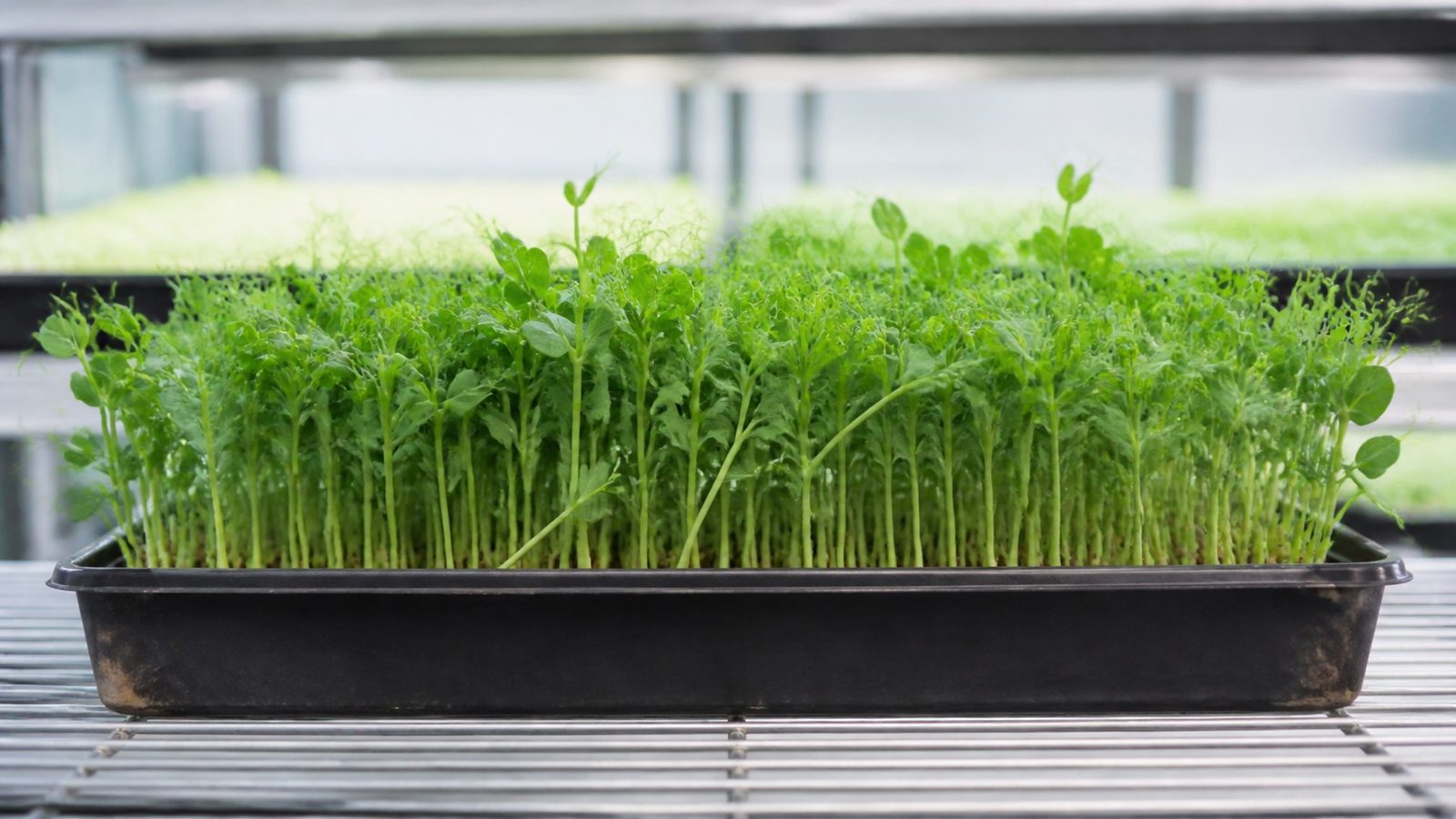
A tray at a correct harvest reads as an even, upright green canopy rather than a mat of exposed seed. Lower stems are pale to white at the medium, upper stems and leaves are green, and by cultivar you get either gray-green shoots covered in tendrils (Tendril or Afila) or round green leaves on reddish-tinted stems (Dwarf Grey Sugar). Johnny's harvest size for its pea shoot types is 3 to 5 inches; Cornell works to about 4 inches. The medium should be mostly hidden by rooted plants, with no pooled water, no collapsed seed layer, and nothing fuzzy spreading out of dead seed.
Growers who sell them describe the ceiling in inches rather than days: cut before they pass about eight inches, or the shoots tangle and the stems toughen. That is more useful than a date, because the date moves with cultivar, temperature and density.
What it tastes like, and what to do with it
At market size pea shoots taste mildly sweet and recognizably like a fresh garden or snap pea, with a crisp watery stem and none of the pepperiness of a brassica. Johnny's describes Dwarf Grey Sugar as a nice sweet pea flavor and charts both Field and Dwarf Grey Sugar as mild pea; Utah State records it simply as sweet pea.
That puts them where a plate needs fresh green volume rather than a concentrated hit: through salads, layered in sandwiches, folded into pad Thai or risotto at the end, or laid whole across cheese and charcuterie. They are also genuinely a cooked shoot rather than only a raw garnish, which very few microgreens are. Gentle or late cooking keeps them; sustained heat collapses the volume that made them worth buying in the first place.
They are the wrong choice twice over. If a dish wants a small peppery garnish, radish or mustard does that and pea cannot. If it wants a green that survives long cooking, use a sturdier one.
Some people will not like them, and it is worth saying so. Anyone put off by fresh pea sweetness, watery crunch, visible tendrils or fibrous stems is not going to be talked round. The objection gets likelier with a late, tall cut, though no study puts a day number on when the stems turn stringy, so treat harvest height as a market choice rather than a deadline.
Using it in the kitchen, and the cup problem this crop finally exposes
Pea shoots are the most-cooked microgreen there is, and the one with the most published recipes by a distance. They are also where you will run into the problem that a cup is not a weight.
Three people converted cups to grams, and they disagree by twofold
Almost every microgreen recipe measures in cups, which is useless across crops because a cup of thyme and a cup of pea shoots are nothing like each other. Pea shoots are the one crop where several publishers have actually stated a conversion, so you can check them against each other:
Hover or tap a row to highlight it.
| Source | What it says | Works out at |
|---|---|---|
| Washington State University | 1 cup is about 1/2 oz, lightly packed | 14 g a cup |
| A pasta recipe | 2 oz is 3 cups | 19 g a cup |
| A stir-fry recipe | 6 to 8 oz is about 8 cups | 21 to 28 g a cup |
The heaviest cup is twice the lightest. All three are describing the same crop, and the variable is how hard you press. "Lightly packed" against a cook filling a measuring cup by hand is the whole difference, and it means a recipe calling for two cups is asking for somewhere between 28 and 57 grams without telling you which.
That is worth knowing before you buy: one 8 oz tray of pea shoots is somewhere between 8 and 16 cups, depending entirely on whose cup you are using. Where a recipe gives ounces, use the ounces.
The amounts, and what each costs you in trays
A 1020 tray of pea shoots runs about 8 oz from 150 g of seed at $2.39, which is a low return on the seed you put in and the reason these recipes get expensive. One New Hampshire farm's USDA SARE grant report recorded more, 17.28 oz a tray on a stated 10 by 20 inch tray from 6.8 oz (193 g) of soaked seed in winter 2020 to 21, which is a heavier sowing and one farm's result (SARE FNE20-966).
Hover or tap a row to highlight it.
| Amount | Dish | Trays | Heat |
|---|---|---|---|
| 1/4 cup, packed and chopped | Pesto with pistachio, mint and tarragon | A few percent | None |
| 2 cups | Pea shoot pesto with green peas, parmesan and almonds | 0.1 to 0.25 | None |
| 24 shoots, about 1 cup | Spring pea toasts, one shoot per crostini | About 0.1 | None, added at plating |
| 2 oz, stated as 3 cups | Farfalle with mushrooms, prosciutto and parmesan | 0.25 | 1 to 2 minutes, just wilted |
| 6 cups | Edamame with dill salt | 0.4 to 0.75 | Off the heat, tossed into cooled edamame |
| 6 to 8 oz, about 8 cups | Stir-fry with garlic, shallot, chile and mirin | 0.75 to 1 | 30 to 60 seconds, then 30 more |
| 1 lb | Rice bowl with scallions and green garlic | 2 | Steamed 2 to 4 minutes |
| 1 and 1/4 lb | Flash-cooked greens with garlic | 2.5 | High heat, 1 minute or less |
Read the trays column. Three of these recipes want one to two and a half whole trays. That is the structural fact about this crop: it is cooked as a vegetable rather than scattered as a garnish, and a vegetable portion is a lot of bench time. There is more on what it costs to cook microgreens by the portion.
Cooking it: everybody agrees on the endpoint and nobody agrees on the clock
Five published recipes give five different times, and every one of them stops at the same visual cue.
- 20 seconds tossing with garlic, then a minute or less on high heat.
- 30 to 60 seconds, then 30 seconds more to cook off the mirin.
- 1 to 2 minutes in a pasta pan.
- 2 to 4 minutes covered and steamed.
- Off the heat entirely, tossed into edamame that has already cooled for two minutes.
The instruction that matters is not the number, it is "just wilted". Every source says some version of it, and one says plainly not to overcook them. Nobody has measured a color or texture curve, so there is no crop-specific number to give you, and the honest advice is to watch the pan rather than the clock. If the antioxidant question matters to you, the one study on cooked pea shoots found steaming preserved them and boiling and microwaving did not, which is set out in full in what cooking does to microgreens.
What a pea shoot actually is, and what to throw away
This is one of the few crops where the harvested thing is not simply "leaves". Washington State describes the desirable shoot as the top pair of small leaves, the delicate tendrils, a few larger leaves, and any blossoms or immature pods. That is what you are buying and what you should cut.
Two published prep steps follow from it:
- Cut long stems into pieces before they go in a pasta pan, or they tangle.
- Discard thick stalks, thin tendril ends and budding flowers on an older cut. The tender tip is the product; the woody base is not.
There is no seed-coat step on this crop and the roots are not part of it. Do not invent either.
Storing it, and the one thing not to do
Do not freeze plain shoots. Washington State says freezing damages the leaf tissue, and it is one of the few crops anybody has published that warning for. Pesto freezes fine, which is the standard surplus route and one growers use in ice-cube trays.
Do not pack them tightly and do not store them wet. Both come from the same extension source: tight packing bruises and crushes the shoots, and excess moisture invites rot. Shake them off before they go away, store unwashed, and wash only the portion you are about to eat.
Buying it
Retail on 2026-08-11 ran $0.80 to $3.50 an ounce across four listings, so shop around before you conclude that buying beats growing. At the middle of that, a shop-bought equivalent of one tray is roughly $16 against $2.39 of seed. Pea shoot seed on Amazon is the convenient route, and at 150 g a tray this is a crop where the seed price genuinely moves the answer.
Growing it: only what differs from the standard method
Everything general about trays, medium, light and watering lives on the standard tray method for growing microgreens. What pea does differently:
Soak first, 6 to 8 hours. Utah State specifies 6, Johnny's specifies 8 and says not to reuse the water. Soaked peas roughly double in size, so a dry single layer is not the same as a soaked single layer and you cannot plan the tray from the dry volume. No source opened here gives a pea-specific water temperature, so cool to room-temperature potable water is the honest instruction; a number would be invented.
Sow far more sparsely by seed count than a brassica, and far heavier by weight. Penn State's rule is roughly 2 seeds per square inch for large seed against up to 12 for fine seed. For pea that lands at 150 grams per 1020. Spread soaked seed nearly side by side in a single layer and press lightly. Never buried, never stacked: clumps make uneven germination and wet pockets.
Weight it, then take the weight off on time. Utah State calls for a tray directly on the seed plus 2 to 5 pounds for the first half of the dark period, then inverted so it covers without touching. The weight is not there to stretch a fine seedling; it holds large swelling peas against the medium so the roots drive down instead of the seed lifting. Remove it when roots are visibly pushing into the medium, or when shoots lift the inverted tray about an inch.
Then water from below. Johnny's directs bottom watering and circulation fans when mold is a problem in warm conditions. On a crop whose failure mode is a wet seed layer, keeping the surface dry is most of the job.
The single most consequential mistake is leaving a densely soaked pea layer under weight too long or too wet. It does not present as a slow tray. It presents as a normal one, right up until the seed layer sours.
What goes wrong with pea specifically
Failures arrive in a fixed order, and knowing which stage you are in tells you whether the tray is recoverable.
Before emergence: dead or soft seed and gaps. Seeds that stay dull, go soft, or smell sour while their neighbors germinate. A few isolated ones can be picked out. Widespread soft or sour seed means discard, not harvest around it.
During covered germination: damping-off. Pythium and Rhizoctonia are the usual organisms. The tell is weak seedlings collapsing or rotting at or below the medium line. On a food crop, discard the affected tray rather than attempt a rescue.
After the cover comes off: surface mold and a patchy stand. Visible growth on dead seed, with no drying between waterings. Caught early and localized, pull the bad seed, get air moving and switch to bottom watering. Once there is odor, slime or broad collapse, it is finished.
At market stage: overgrown, uneven, coat-littered shoots. Some shoots over-tall while others have not opened. Often harvestable after cleanup, never recoverable into a uniform premium tray.
The one test worth memorizing: root hair or mold? Growers confuse these constantly and it decides whether a tray gets eaten or binned. Normal root hair is fine, white, dry-looking fuzz emerging evenly from healthy roots, and it lies down and visually disappears when misted. Mold spreads through soft brown seed and brings slime, collapse or a sour smell with it. Check moisture, smell and tissue together: firm, white and odorless at the seed and collar is almost certainly root hair. That is a grower's diagnostic, not a lab identification, and only a diagnostic lab can name an organism.
Pea also sheds seed coats, and some stick to the cotyledons. Johnny's recommends running a hand or a stake over the growing shoots to brush stubborn coats away, or floating them off in a water bath after harvest. Shoots whose coats will not come off are better removed before harvest than sold. It is a real handling step on any bag a customer expects to be clean.
And it is not always your method. Johnny's notes that seed lots of the same pea variety vary widely in quality depending on how the seed crop was grown. Empty patches or several height classes despite even medium and watering point at the lot rather than the grower. Run a small counted germination test before changing anything, and do not compensate by crowding a weak lot, which turns a viability problem into a rot problem.
Nutrition, and what is actually established
USDA FoodData Central holds pea shoots only as branded label records, not as an analyzed generic food. Two entries, searched 2026-08-08: FDC ID 2383201, Wegmans, with a 42.5 g label serving, and FDC ID 1912829, Jonathan Sprouts organic, with an 85 g label serving. FoodData Central stores branded nutrients per 100 g, calculated from each label, which is why both show 35 kcal and 2.35 g protein per 100 g (with 2.4 g fiber and 23.5 mg vitamin C for Wegmans, and 24.7 mg vitamin C for Jonathan Sprouts). A 42.5 g serving holds about 1 g of protein. Those are manufacturer labels for particular products, not a claim about every cultivar and harvest stage.
Pea-specific research exists but is thin next to the brassicas. A 2025 peer-reviewed greenhouse study tested Field Pea and Dwarf Grey Sugar shoots under supplementary UVA, UVB and combined UVAB. Twelve hours a day of UVA raised fresh yield and dry weight; UVB or UVAB beyond three hours a day cut both yield and antioxidant synthesis, and UVB reduced mineral accumulation. That is genuine pea evidence, and it is a light-treatment experiment rather than a composition table.
Three claims circulate that nothing above supports, so do not repeat them to a customer: that pea shoots contain all nine essential amino acids, that they carry some multiple of another food's vitamin C, or that they are the highest-antioxidant microgreen. Mature pea nutrition is not a substitute for a cut shoot either.
Which seed to buy
Four types are genuinely sold for shoot production and they differ in ways worth choosing between.
- Field Pea is Johnny's preferred shoot variety for uniform germination, mild pea flavor, 3 to 5 inch harvest. The sensible default when an even stand matters most.
- Dwarf Grey Sugar gives a round green leaf on a reddish-tinted stem and a sweet character. Pick it for presentation, not for a documented yield advantage.
- Tendril or Afila produces gray-green shoots covered in curly tendrils over 7 to 14 days. Pick it for visual texture. It is not automatically the most uniform.
- Maple or Speckled is a big beige seed, 8 to 12 hour soak, 10 to 14 day harvest, soft green shoot on a white stem.
Specify untreated, food-use seed, name the cultivar, and ask for the lot germination percentage and lot number. South Dakota State's reasoning is direct: dyes, fungicides and insecticides applied to seed may end up in shoots that get eaten, and a seed treatment is not made safe by rinsing or soaking it. Refuse treated field seed, unlabeled bulk seed with no food-use information, and any lot that cannot document germination. Organic is useful positioning; untreated food-use is the actual safety requirement.
Pea shoot seed on Amazon is the convenient route for a home grower. For anything you intend to sell, buy from a supplier who will name the lot.
One thing worth knowing before you spend anything. A large share of the pea shoot content online is people growing them from bags of dried peas out of the supermarket, and it works well enough to be the most-watched version of this crop. For one tray on a windowsill, that is a legitimate way to start and nobody should pretend otherwise. If you intend to sell what you grow, buy seed with a lot number and a germination figure on the label, so each tray can be traced back to its lot; a bag of cooking peas carries neither.
Is it worth growing?
Yes, with a caveat most guides skip. Pea shoots suit the home beginner who will actually look at a heavy moist tray every day, the market grower who has validated density and yield in their own system, and the one-tray grower who wants a substantial 3 to 5 inch harvest rather than a garnish.
Choose something else if you cannot manage airflow and moisture, if you need a short standardized brassica cycle, or if you want peppery intensity.
Its direct competitor for the tray slot is black oil sunflower, and the two split cleanly. Both are large-seeded shoot crops needing a presoak and three days covered. Sunflower wins on a compact 9 to 10 day cycle, a nutty snackable shoot, and a far lower seed rate: 48 grams per 1020 against pea's 150. Pea wins when the menu wants mild fresh pea flavor, long stems and tendrils, salad and sandwich volume, and the option of gentle cooking. Neither is a universal winner, and the comparison only settles in your own trays, media and light.
A note on the numbers above
Treat the yield figure as the softest number here. Johnny's 2017 microgreens yield trial is the only public per-variety trial in the category, and it contains no pea row: its 29 varieties are brassicas, herbs, beet, chard and others, because Johnny's files pea as a shoot rather than a microgreen. Anyone quoting "Johnny's trial data" for pea is quoting something that does not exist.
The 8 ounces per 1020 above comes from a University of Missouri 2024 enterprise budget, where it is a planning assumption over an 11.5-day cycle, not a measured harvest. Grower reports run from 8 to 18 ounces, which tells you how much systems vary and nothing you can budget from. Weigh your own trays before you price anything.
Three numbers are missing, and none of them is a reason to wait. Shelf life has no pea-shoot storage study behind it, so hold them at 41°F in the dark like any other microgreen and find your own limit by tasting. Harvest window has no published number of extra marketable days, so cut by height, at three to five inches, and stop before eight. Germination temperature has no pea-specific range, so use ordinary room temperature and judge the tray rather than the thermometer. Missing is not the same as not applicable: nobody has established these, which is different from them not existing.
Terms on this page
Tap a term to see what it means.
Shoot, not sprout. A pea shoot is cut above the medium at 10 to 14 days and the seed is not eaten. A sprout is the whole germinated seedling eaten at two to three days, seed and root included, and different food-safety rules follow from that.
Sources
- Utah State University Extension, Grow Your Own Microgreens - 150 g per 1020, 6-hour presoak, 3 days covered, 2 to 5 lb weight, 8 to 10 days, and the sunflower comparison rate.
- Cornell Cooperative Extension, How to Grow Pea Shoots (PDF) - 10 to 14 days to about 4 inches, 8 to 24 hour soak, sowing depth and spacing.
- Johnny's Selected Seeds, Tendril Pea shoot seed - 7 to 14 days, 3 to 5 inch harvest, 8-hour soak, seed coat removal.
- Johnny's shoots growing instructions (PDF) - medium depth, the inverted-tray cue, bottom watering and circulation fans.
- Johnny's microgreens yield trial, method and discussion - trial method, the transferability caveat, and the 29-variety scope that excludes pea.
- Johnny's shoots comparison chart (PDF) - per-cultivar flavor and harvest size.
- Penn State Extension, The ABCs of Microgreens - seeds per square inch by seed size, and adjusting density for lot germinability.
- Virginia Tech Extension SPES-756 (PDF) - general microgreen environment, damping-off, and the 41°F storage recommendation.
- UC IPM, Damping-off - Pythium and Rhizoctonia, and symptoms at or below the soil line.
- University of Missouri Extension enterprise budget (PDF) - the 8 oz per 1020 planning assumption over 11.5 days.
- USDA FoodData Central - branded records 2383201 and 1912829, searched 2026-08-08.
- Winstead et al., 2025, supplementary UVA and UVB on pea-shoot microgreens - cultivar and exposure effects on yield, minerals and antioxidants.
- South Dakota State University Extension, Growing Microgreens at Home - untreated food-use seed and why seed treatment matters.
- Johnny's on pea seed quality - lot-to-lot variation within a single variety.
- True Leaf Market, Afila Tendril pea seed - the 5 lb price behind the seed-cost calculation, listed 2026-08-08.
Keep reading
The variety directory
Chickpea shoots
One of the very few crops with real regrowth data behind it: a measured second cut at 96 percent of the first, if you cut above a node instead of at the medium line.
Read Chickpea shootsThe variety directory
Nasturtium microgreens
A three-week tray that returns 5.64 oz and costs $5.74 of seed, so it earns its keep as a garnish and not by weight. Also the crop whose own name belongs to a different plant: search nasturtium in USDA's database and you get watercress.
Read Nasturtium microgreensThe variety directory
Alfalfa
Alfalfa grows in a jar in four to six days, rinsed twice a day and eaten whole, root and all. The care goes into the food safety rather than the growing.
Read AlfalfaThe variety directory
Mung bean shoots
The crop where the sprout and microgreen line stops being a technicality: mung is the bean sprout of commerce, and the two products sit under different food-safety law. 200 to 215 g a tray, and no measured yield anywhere.
Read Mung bean shoots