At a glance
Fast and reliable from small dry seed, with one real caveat the beginner lists never mention: a dense stand held wet is where this crop is lost, and a greenhouse study found arugula the one showing disease pressure when the substrate held excess moisture.
- Botanical name
- Eruca vesicaria
- Also sold as
- Arugula, Rocket, Roquette, Astro
- Family
- brassica
- Difficulty
- Beginner
- Days to harvest
- 6 to 19 days
- Harvest window
- No published figure
- Soak
- None
- Blackout
- 2 to 5 days
- Germination temperature
- 65 to 75 °F
- Yield per 1020 tray
- 10 oz
- Mold risk
- Medium
- Hull shedding
- none
- Shelf life
- 10 to 14 days
- Eaten as
- raw
- Seed cost per tray
- $0.48
10 g at $21.90/lb, Johnny's conventional arugula microgreen seed, listed 2026-08-08. Seed only, excludes medium, tray, labor, light and loss.
Any field name above ranks every variety by it. No published figure means we researched it and nobody has established one, which is different from not yet researched. Every figure here is sourced at the bottom of the page. Compare every variety side by side.
Arugula is a seasoning green rather than a salad base, and that is the thing to plan around. It is fast, it is cheap to sow at 48 cents of seed a tray, and it makes a respectable 10 ounces, but none of that is why you grow it. You grow it because it is genuinely peppery, and a small amount changes a plate in a way a mild brassica cannot at any quantity. Its shelf life is also one of the few in this crop that rests on a controlled storage study rather than a supplier's estimate, so the 10 days below is a measurement you can plan a delivery round against.
What growers are saying right now
Sampled from public posts and videos, 9 July to 8 August 2026. Every line links what it is quoting. How often something is repeated is not evidence that it is true, so every line also says what the sources actually establish.
Arugula is one of the easy ones to grow
Circulating A seed giveaway at 1,959 views pitches it among nine other easy plants, and it lands on beginner lists all month
True for the microgreen, with one caveat those lists never carry. It is fast and forgiving from small dry seed, and the failure is specific: a Cornell greenhouse experiment found arugula was the crop showing disease pressure when the substrate held excess moisture. Easy does not mean it tolerates a wet tray. What goes wrong
Bold flavor is the whole pitch
Circulating Bold flavor, tiny leaves, big nutrition is how it is introduced, and a market grower adding it as a new line leads on the same thing
Accurate, and it is the deciding factor rather than a selling line. Pungency is the defining sensory attribute in the one published storage study, which is also why arugula is a seasoning green rather than a salad base. If your buyer dislikes mustard or radish heat, this is the wrong crop and no growing technique softens it.
The arugula everyone means is the field crop, not the tray
Circulating The biggest arugula item in the window is a 39,264-view piece on hi-rotation planting for arugula yields, which is outdoor baby-leaf farming
Worth separating, because the numbers do not transfer in either direction. A microgreen tray is 10 g of seed making 10 oz over about 14 days indoors, cut once at first true leaf and never regrown. Field arugula is a different crop on a different clock, and its yields, spacing and cut-and-come-again economics say nothing about a 1020.
What it is, and how to tell you grew it right
Arugula is Eruca vesicaria, which you will also see published as Eruca sativa, and it is sold as arugula, rocket or roquette depending on who printed the bag. Wild rocket, Diplotaxis tenuifolia, is a different plant and no source opened here establishes that it behaves the same way in a tray, so do not treat the two as interchangeable seed.
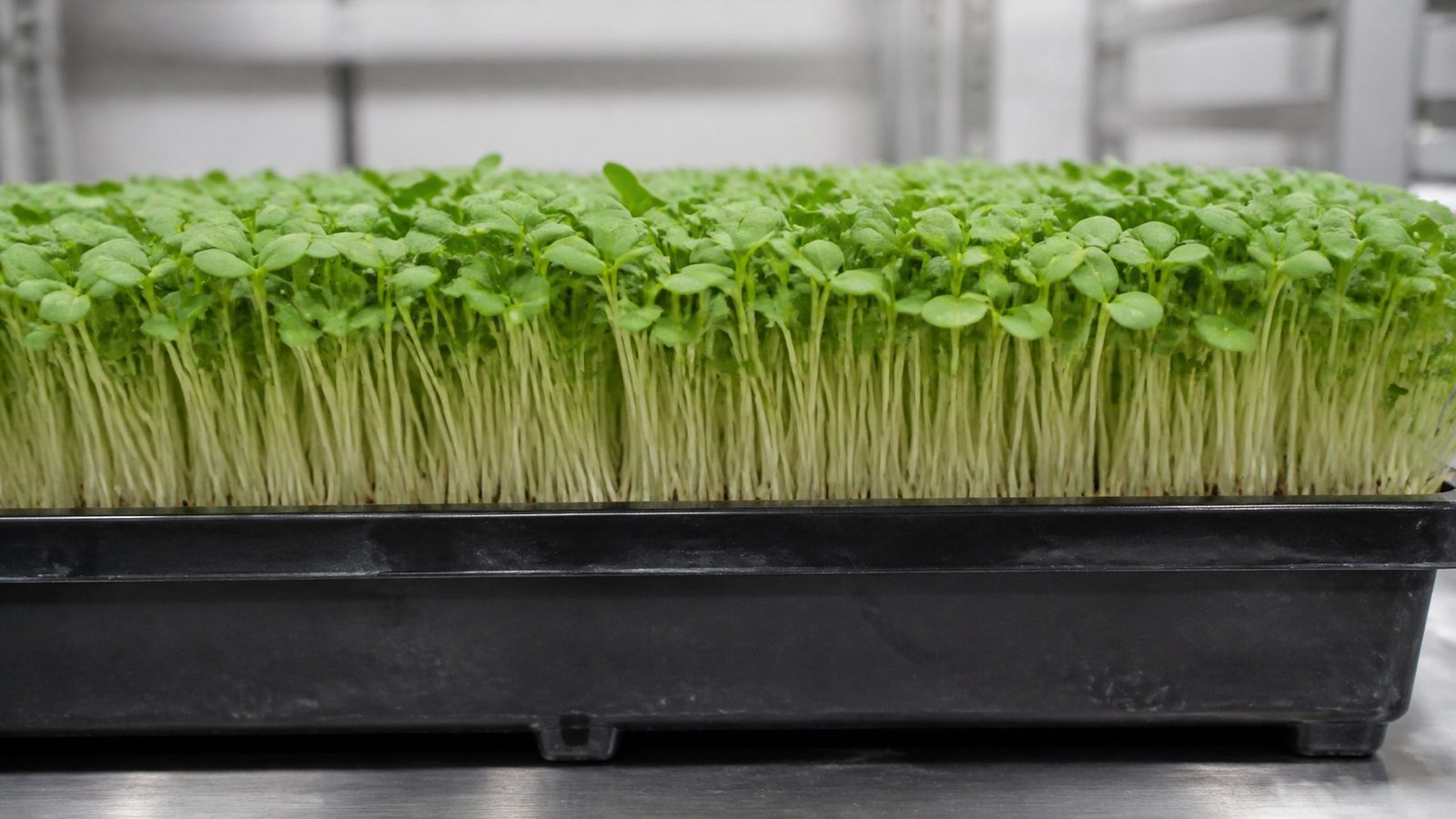
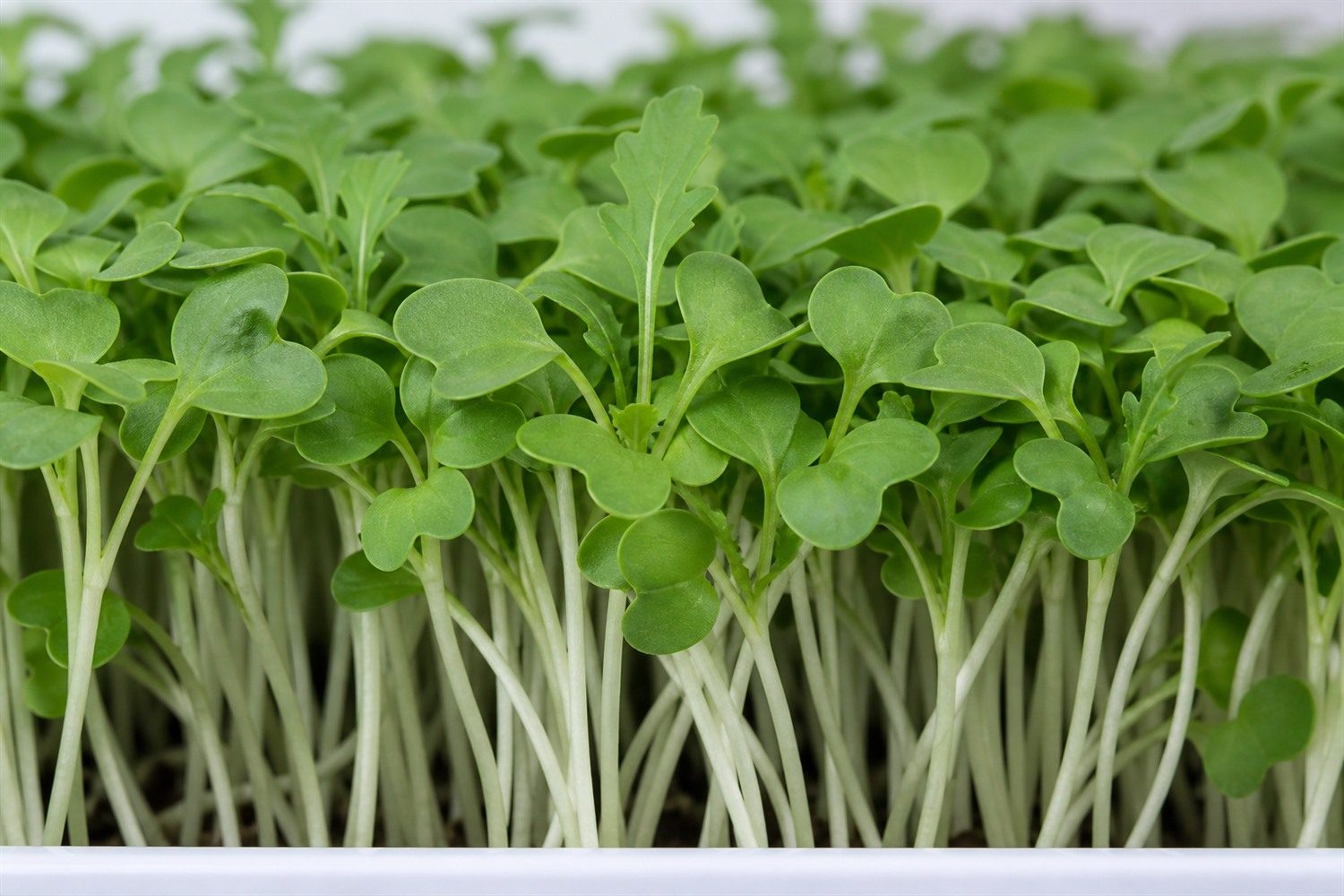
A correct tray at harvest is a dense, even, low stand of fine white stems carrying two rounded, slightly spade-shaped mid-green cotyledons. The medium is mostly hidden but visible at the cut line. Johnny's harvest target is first true leaf, and its general microgreen guidance puts that around half an inch to two inches.
The identification trap here is the leaf everyone pictures. Arugula is known by its deeply lobed mature leaf, and that leaf is a true leaf: if your tray shows it, the crop is older than the microgreen stage people expect. At harvest, arugula's cotyledons are rounded, which is why it is easily confused with broccoli or green cabbage rather than instantly recognizable. Identify it by cotyledon shape and by the taste, never by the leaf on the seed packet.
One note about color. Johnny's product page describes purple stems with dark green leaves, while the trays photographed for this entry showed fine white stems and rounded mid-green cotyledons. Both are real, so treat stem color as lot and culture variation rather than as an identification test.
What it tastes like, and what to do with it
Tender and nutty-green with a real peppery heat. Johnny's calls it spicy and nutty, Virginia Tech calls it peppery, and that pungency is the defining attribute rather than a note on top of a neutral green. It is not the tough, chewy pepper of a mature leaf; it is a softer texture carrying a sharper flavor, which is an unusual combination and the reason chefs use it.
That makes it a seasoning green, and the distinction is worth taking seriously when you plan a tray. Use it in small volumes where a deliberate peppery lift is the job: over pizza after it comes out of the oven, on avocado toast, on eggs, over a burger, through a grain bowl, in a sandwich or panini, or as a finish on soup. Its fine stems and tender leaf make it weak as the bulk of a salad, so it works as a component or an accent, not as the bowl.
Who dislikes it is easy to predict and worth saying plainly: anyone who dislikes mustard, radish or wasabi heat. The published storage work identifies aroma, pungency and crunchiness as the attributes deciding whether people accept the crop at all, and pungency is the one arugula leads with. This is a crop that divides people on purpose.
Using it in the kitchen, with amounts that came from somewhere
"Top your dish with them" is not an instruction you can shop against. Arugula is one of the few crops where published recipes state an actual quantity, so here they are, with what each works out to against a tray.
Hover or tap a row to highlight it.
| Amount | Dish | Serves | When it goes in |
|---|---|---|---|
| 1/4 to 1/2 cup, loosely packed | Caprese toast on ciabatta with tomato and mozzarella | 6 | After toasting, divided over the finished toasts |
| 2 cups | Microgreen pesto with pine nuts, parmesan or nutritional yeast, garlic and olive oil | Not stated | Blended raw, no heat |
| 1/2 cup, loosely packed | Watermelon juice with lime, honey and sea salt | 4 | Pulsed into cold puree 8 to 10 times, then strained |
| 1 cup | Pesto for a summer squash galette, with 1 cup basil microgreens | Not stated | Spread thin, then baked at 400°F for 15 to 20 minutes |
| A generous handful | Cherry tomato and micro arugula salad | Not stated | Raw. No usable amount, and this is the norm rather than the exception |
A tray of arugula goes further than any of those recipes suggest. A 1020 tray is 10 oz of harvested crop from 10 g of seed at 48 cents, or about 283 grams. Against the 2.5 g garnish serving that is roughly 113 servings from one tray, at about four tenths of a cent of seed each. Against the pesto recipe, the heaviest published use at 2 cups, one tray makes several batches. So, sow for how often you will actually reach for it, not for how much a recipe asks for.
Raw and late is the default, and there is one exception worth naming. Growers who sell this crop are blunt that it will practically dissolve if you cook it, which is why every raw recipe adds it after the heat is off. The galette is the one published exception, and it bakes the greens inside a thin layer of pesto for 15 to 20 minutes without reporting a thing about how they came out. Treat that as untested rather than as permission, and note it is pesto doing the protecting, not the leaves surviving on their own. There is no measured heat threshold for this crop, so nobody can tell you how many seconds is too many.
That galette is also the only baking instruction published for basil microgreens, because it uses a cup of each in the same pesto. One recipe covering two crops is one data point, not two, so do not read it as independent evidence that either crop bakes well.
The peppery edge is the point, so aim it at something rich. Tomato and mozzarella, a fatty cheese, an oily dressing, a sweet fruit. Suppliers describe it as bold, peppery and nutty, sometimes bitter, and one is candid that it is "majorly intense" while lacking the brutal bitterness of the mature leaf. Against the mild brassicas, kale and broccoli, it will win any contest it enters. Use the quarter to half cup the recipe gives you rather than a pile.
Three ways to spoil it, all from growers who sell the crop rather than from a controlled trial:
- Refrigerating it wet. It goes mushy. Dry it completely, then store it in a rigid airtight container with a paper towel, and pour off condensation. A rigid container matters more here than on most crops because these leaves bruise.
- Spin drying it. One grower is explicit that spin drying damages an arugula crop, and instead stops watering for at least 12 hours before harvest so it comes off the tray dry. That sits alongside the wider evidence on washing and drying, where a USDA experiment found centrifugal dewatering damaged microgreens generally.
- Cooking it, per the above.
Buying it rather than growing it, on 2026-08-11, ran from $3.00 an ounce for a 2 oz container to $5.50 an ounce at 1 oz, with a 4 oz pack working out at $5.00. Against 48 cents of seed for 10 ounces, that is the usual gap, and the serving cost article works through what it does and does not include. Buy crisp: limp, dark or musty crop should be thrown out rather than rescued with dressing, and a grower notes that limp low-flavor arugula was probably cut days ago. Arugula microgreen seed on Amazon is the convenient route if you would rather grow it.
Published sources disagree on how long it keeps. Storage life for cut arugula is given as "a few days" by one grower, "usually one week" at 35 to 38°F by a retailer, and 5 to 7 days by Purdue for microgreens generally, against the 10 to 14 days two controlled studies measured. The gap between a grower's few days and a measured ten is the difference between a handling instruction and a shelf-life measurement. Plan deliveries on the measurement and handle the crop as though the grower is right.
Growing it: only what differs from the standard method
The general method is on the standard tray method. Arugula's deltas are short, and they are mostly about density and water.
No soak. The seed is small, the published directions broadcast it dry onto moist medium, and no source establishes any soak duration for it. On a dense small-seed stand, added water is the risk rather than the help.
10 grams per 1020, and that number is measured. It is Johnny's trial rate, repeated on its own product page, roughly three flats per ounce of seed. Sow lighter if you want more airflow through a longer hold; do not sow heavier without trialing it, because density and wetness are exactly what this crop punishes.
Broadcast on the surface, roughly an eighth to a quarter inch apart, press for contact. Do not bury it. The seed is small enough that clumps and gaps show plainly in the finished stand, so a level, evenly pre-moistened medium does most of the work. Mist carefully at first so the seed does not migrate, then bottom-water so you are not splashing medium onto fine stems.
Cover for two to five days, and take it off when the majority is up. The cover is for darkness and humidity, not for pressure: no weight figure for arugula appears in any source opened here. Leaving a wet cover on past emergence is the single most consequential mistake on this crop, because it converts humidity control straight into disease pressure.
Warm to germinate, then cool. Johnny's brassica directions are 75°F at the medium until germination, then 60°F, with 65 to 75°F broadly favorable, and it warns that above 75°F germination can be inhibited and disease pressure rises. Its own trial recorded high-80s and low-90s weather accelerating growth while hurting uniformity and quality, which is a useful reminder that faster is not better here.
Light: about 9 mol per square meter per day. That is the arugula-specific figure, and it is lower than the 12-plus cited for mizuna and mustard, so do not assume the peppery brassicas all want the same light.
A tray of arugula, day by day
- 1
Day 0, sow dry
10 g broadcast evenly on leveled, pre-moistened medium and pressed for contact. No soak, no burial. Medium at about 75°F to germinate.
- 2
Days 1 to 5, covered
Dark and humid, no weight. Off as soon as most seedlings are up, which is usually day two to five.
- 3
Then, light and cooler
Down to around 60°F, about 9 DLI, bottom watering, and enough gentle airflow that the foliage is not sitting wet.
- 4
Days 6 to 19, cut at the stage
The span is mostly temperature. A greenhouse experiment got 19 days at 57°F and 12 at 72°F for the same target, and Johnny's trial averaged 14 days to first true leaf.
- 5
Store it dry and cold
Unwashed, at 41°F, in open or breathable packaging rather than vacuum sealed. Wash immediately before eating.
What goes wrong with arugula specifically
Three failures, in the order they show up.
Patchy emergence from uneven sowing or migrated seed. Bare patches and clumps before the stems rise. There is no fix mid-crop: do not reseed into a wet germinating tray. Weigh the seed and distribute it properly next time.
Damping-off in a crowded wet stand, which is this crop's real risk. The tell is water-soaked, pinched stems at or just under the medium line and localized collapse. Pythium and Rhizoctonia are the usual organisms, and Pythium often starts at the root tips. A small dry-able patch can sometimes be isolated; a collapsing dense tray is not something to salvage on a food crop. What makes this arugula's failure rather than a generic warning is that a Cornell substrate-depth experiment found disease pressure specifically in arugula when the substrate retained excess moisture.
Heat, which speeds the crop up and makes it worse. Johnny's trial recorded high-80s and low-90s conditions accelerating growth while limiting uniformity and quality. The tell is a tray that is racing but looking ragged. Harvest to the actual stage rather than the calendar, and fix the room.
Root hairs or mold: the same test as every brassica, with location doing most of the work. Root hairs are fine white fuzz anchored at the root zone, they lie down and visually vanish when misted, and they come back as the roots dry. Suspect mold when the fuzz spreads across the medium or up the stems away from the roots, persists as a web after watering, or arrives with soft collapsing stems and a smell.
Cutting late costs you the benchmark. Arugula's 10 ounces was measured at first true leaf. Held past clearly expanded true leaves, the stand loses uniformity, stems and leaves enlarge, and the crop drifts toward baby leaf: still edible if it is sound, but no longer the product that figure describes. Johnny's trial says plainly that every day can materially change size and yield.
Storing it: the numbers somebody measured
Shelf life is the number growers are least likely to find published anywhere, and arugula is one of the exceptions. A postharvest study held cut arugula at 5°C, which is 41°F, in three treatments and found the product safe through 10 days.
A second study, Berba and Uchanski (2012), rated arugula in vented clamshells as marketable for 14 days at 4°C, falling to 7 days at 10°C. Other crops with a controlled refrigerated storage study behind them include broccoli raab at 13 days, mustard at 14, garden cress at 15 in modified-atmosphere packaging, and buckwheat at 21, all longer than the five to seven days the extension services give for microgreens generally. The storage containers review sets out what that gap is actually measuring.
The useful part is the comparison rather than the number. Open packaging lost less weight and degraded chlorophyll more slowly. Vacuum-sealed packs began losing sensory quality from day five. Modified-atmosphere bags held visual quality best. If you are selling this crop, that is a real finding: sealing it tighter is not the same as keeping it better.
General extension guidance fills in the rest: refrigerate microgreens unwashed and wash immediately before eating, and expect roughly a week from a fresh harvest. Whether washing before storage changes arugula's shelf life was not tested, so nobody should tell you it does.
Nutrition, and what is actually established
USDA FoodData Central holds arugula microgreens only as a branded label record (FDC ID 2480841, a 14 g serving), not as an analyzed generic food, and the mature raw arugula entry is not a substitute, because it is a different harvest stage.
What exists instead is a peer-reviewed comparison of arugula sprouts against arugula microgreens, which is genuinely interesting because it separates two things people conflate. For its microgreen sample it reported 18.2 percent protein and 28.7 percent total fiber on the paper's stated basis. Ascorbic acid was far higher in the microgreens, 5.17 mg/g on a dry basis against 1.22 for sprouts, while total carotenoids ran the other way, 11.88 µg/g against the sprouts' 74.00. That is a real measured contrast and it does not resolve into "microgreens are more nutritious", which is exactly why it is worth quoting properly.
Those are experimental samples under stated conditions, not a serving label. The claims to leave alone are a specific USDA vitamin profile for this crop, and any multiple-of-mature-arugula figure, because no opened source supports either.
Which seed to buy
Two supportable choices. Generic arugula microgreen seed, conventional or organic, is what Johnny's sells and what its 10 g and 10 oz trial figures were measured on, at 10 to 15 days. Astro is a real cultivated selection rather than a relabel, with less lobed and milder, nuttier mature leaves, listed at 12 to 15 days to indoor microgreen. What Astro's page does not give is a microgreen yield, stem length or color comparison, so treat any claim that it performs differently in a tray as unverified.
Specify untreated seed sold for edible microgreen use, with lot identification, and for a commercial purchase a current germination test. Organic is a purchasing preference and not a substitute for a germination specification. Refuse dyed or chemically treated field seed: extension guidance is explicit that the treatment can end up in the shoots you eat.
A bad lot shows as low or uneven emergence despite even moisture and temperature, and it is conspicuous in a 10 g fine-seed sowing where the stand is supposed to be continuous. Johnny's excluded obvious poor-germination flats from its trial averages, and a controlled study measured 93 percent germination on its arugula lot, which tells you what good looks like without guaranteeing yours. The cost is gaps you cannot pack, lower fresh weight, and a lost 10 to 15 day slot on the rack.
Arugula microgreens seed on Amazon is the convenient route for a home tray. For anything you sell, buy where the lot and its germination test are named.
Is it worth growing?
Yes, provided you know what you are buying, and it is an easy crop to recommend on that basis. It suits a beginner who wants a fast small-seeded brassica, a home grower who will actually reach for a peppery garnish most days, and a market grower whose customers buy flavor rather than bulk. The benchmark to trial against is 10 ounces per 1020 at 14 days to first true leaf.
Choose something else in three cases: the eater dislikes pepper heat, the goal is maximum weight per tray, or the grow space cannot keep a dense stand from sitting wet. That last one is not a small caveat on this crop.
Its tray-slot competition splits cleanly. Against mild brassicas like broccoli and kale, arugula trades a little yield for a lot of flavor: 10 oz against broccoli's 11.5 in the same trial, and a crop nobody describes as neutral. Against radish and mustard, the question is what kind of heat you want. Radish gives you a sturdier, crunchier stand and an obvious familiar bite; arugula gives you a finer, more tender green and a nuttier pepper. Arugula wins when the dish wants a delicate garnish that still tastes of something.
Terms on this page
Tap a term to see what it means.
Cotyledon. The seed leaf. Arugula's are rounded to slightly spade-shaped, which is why it looks like broccoli at harvest rather than like the lobed leaf on the packet.
Sources
- Johnny's Selected Seeds, arugula microgreen seed - Eruca sativa, 10 g per 1020, 10 to 15 days, spicy and nutty, sowing and watering directions, 75°F then 60°F, and the price checked 2026-08-08.
- Johnny's arugula organic microgreen seed - the organic offering, also generic rather than a named cultivar.
- Johnny's microgreens yield trial results (PDF) - 10 g and 10 oz at 14 days to first true leaf, the broccoli comparison, the heat observation, and the exclusion of poor-germination flats.
- Johnny's trial method and discussion - the harvest standard, that every day changes size and yield, and the transferability caveat.
- Virginia Tech Extension SPES-756 (PDF) - 6 to 14 days from sowing, the 60 to 70°F production environment, uncovering at majority germination, the 9 DLI figure, and arugula's peppery character against neutral brassicas.
- Cornell greenhouse microgreen work, summarized - 19 days at 57°F against 12 at 72°F, and disease pressure in arugula where the substrate held excess moisture.
- Arugula postharvest storage study (PDF) - safe through 10 days at 41°F, open packaging against vacuum and modified atmosphere, sensory loss in vacuum packs from day five, and pungency as a decisive acceptance attribute.
- Berba and Uchanski, 2012, postharvest physiology of microgreens - arugula held marketable for 14 days at 4°C and 7 days at 10°C in vented clamshells, unwashed, rated weekly on visual quality.
- University of Maryland Extension, microgreens and baby greens indoors - that cut microgreens do not regrow, and culinary uses.
- Purdue Extension, grow microgreens at home - root hairs at the seed and root area are normal, and storing unwashed then washing before eating.
- UC IPM, damping-off - Pythium and Rhizoctonia, and the conditions that favor them.
- SDSU Extension, growing microgreens at home - why treated seed is unacceptable on a crop eaten as shoots.
- Di Gioia et al., 2023, seventeen microgreen species compared - arugula's 1,000-seed weight against broccoli's, and 93 percent germination on its arugula lot.
- Komeroski et al., 2023, arugula sprouts against arugula microgreens - protein, fiber, ascorbic acid and carotenoid comparison between the two stages.
- Sakata, Astro arugula - the named selection and its 12 to 15 days to indoor microgreen.
- USDA FoodData Central - searched 2026-08-08; a branded label record only (FDC ID 2480841), no generic arugula microgreen record.
Keep reading
The variety directory
Watercress microgreens
A sharp peppery leaf that is far easier in a tray than in running water. Watercress is Nasturtium officinale, the crop called nasturtium is not, and garden cress is a third plant again.
Read Watercress microgreensThe variety directory
Broccoli microgreens
Broccoli takes 13 g of seed per 1020 tray and gives 11.5 oz at first true leaf, both from Johnny's trial. No soak, fast even germination, and the root-hair-or-mold test you will need in the first week.
Read Broccoli microgreensThe variety directory
Cabbage, red microgreens
Red cabbage is measured at 10.5 g per 1020 tray returning 8.5 oz, the lowest of the four mild brassicas measured in one trial. What it sells on is the purple veining, which no broccoli tray can give you.
Read Cabbage, red microgreensThe variety directory
Collard microgreens
The crop where more light did not buy more weight: collard was the documented exception in a controlled DLI study. Its mold risk is left blank because nobody has measured it.
Read Collard microgreens