Microgreens Storage Containers: The Package Is Not the Variable
Cal HewittPublished Checked
- storage
- packaging
- equipment
- buying
- harvest
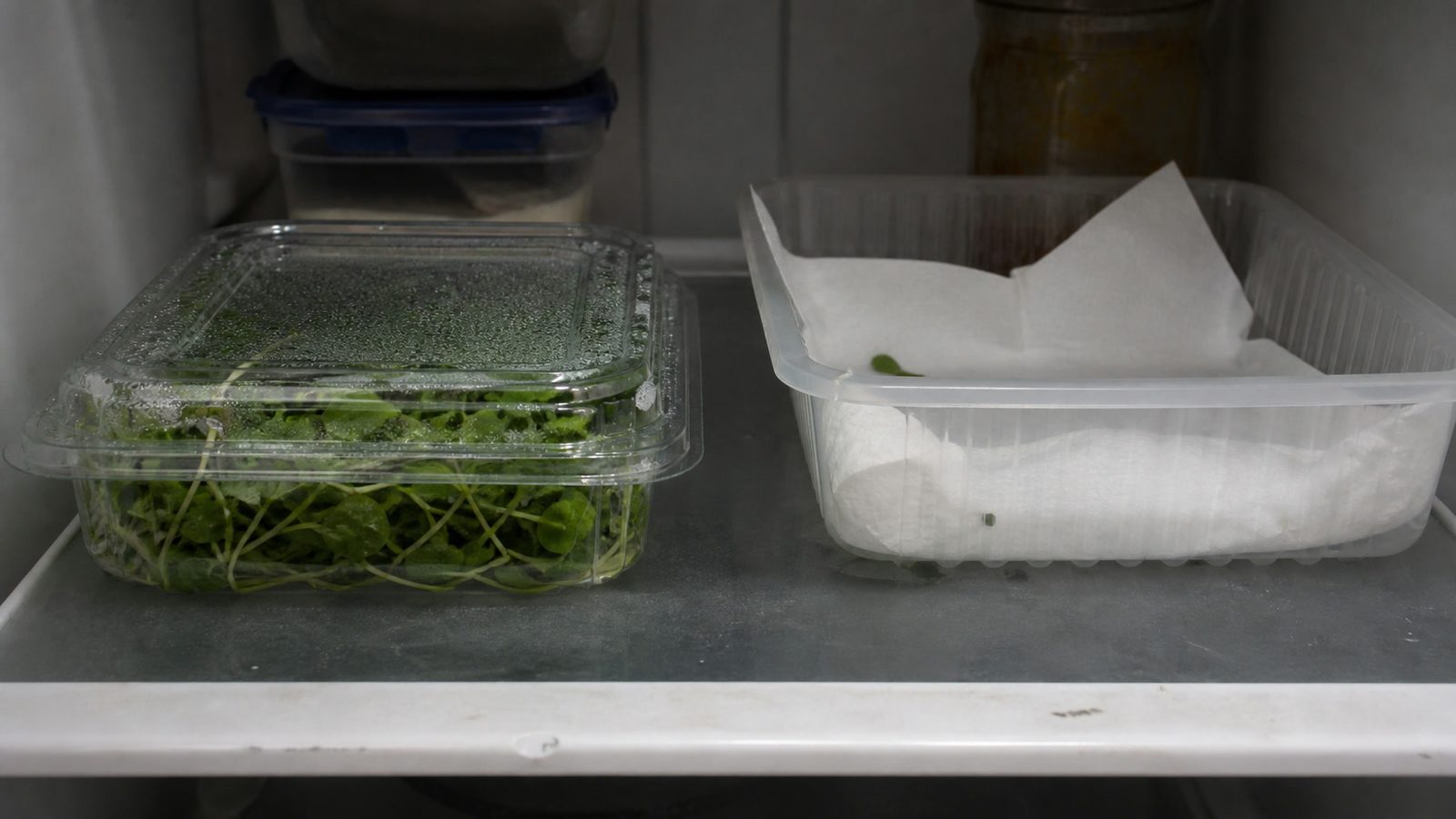
Put the crop in any clean rigid food container with a dry paper towel, get it cold, and stop shopping. A 240-pack of deli cups is about 10 cents each, bulk clamshells start at 16.5 cents, and a gallon zipper bag is 11.3 cents. If you are selling, buy clamshells for presentation and crush protection. If you are eating it yourself, you almost certainly already own the container.
No independent study publishes a shelf-life figure for any named retail microgreen container. Not True Leaf's clamshell, not Farmers Friend's, not Rubbermaid FreshWorks, not Pyrex, not the Choice deli cup. That absence is the finding, and it means the category cannot be ranked. What research does exist compares package formats under logged temperatures, and the clearest result in it is that temperature outweighed the bag material.
The order to buy in
What to buy, and when to stop
Hover or tap a card to highlight it.
A clean rigid container you already own
Plus a dry paper towel, unwashed crop, and a cold fridge. For home use this is usually the whole answer and it costs nothing.
A gallon zipper bag
When crush protection genuinely does not matter, at about 11 cents. It is the cheapest purchased option and the worst at protecting a canopy.
Bulk deli cups, about 10 cents
The cheapest rigid, stackable, lidded option once you are storing real volume. Borrowed from takeout, and a sealed format, so watch for condensation.
Clamshells, from 16.5 cents in bulk
Buy these when you are SELLING. Clear display, consistent portions, crush protection and a labeling surface are the actual product, and the retailer in the SARE project preferred them. Check the DEPTH against your crop, because the cheapest ones are the shallowest.
A premium reusable keeper, about $5.83
Only after you have measured the refrigerator, fixed the wash step and still lose crop to condensation. Not a first purchase.
Stop before compostable formats
Until somebody publishes how they hold up through a real cold chain and a retail display. Brooklyn Grange's customers could not tell which was which.
The premature purchase is a freshness-technology container bought before anything is measured. Refrigerator temperature, how dry the crop is at harvest, whether condensation is actually appearing, and how much crop is genuinely being lost are all free to find out and all upstream of the box.
Against a fixed first budget, packaging ranks below refrigeration, clean harvest tools and sanitation, and the growing setup itself. It ranks above cosmetic upgrades the moment you start selling, because condensation and crushing can make product unsaleable even when the crop is perfect.
The number you are looking for does not exist as one number
Most sources give a single figure. Purdue Extension says five to seven days, UF/IFAS says five to six. Those are reasonable general answers, and the crop-by-crop figures run much wider than either.
Thirty-eight crops have a published shelf-life figure as of 2026-08-11, and they run from 1 day to 21. On the other 24 nobody has published one at all, so plan on finding out from your own crop.
Hover or tap a row to highlight it.
| Crop | Published shelf life | Where it comes from |
|---|---|---|
| Amaranth and basil | 1 to 10 days | Not a range, a disagreement. Three published figures that do not reconcile |
| Garden cress | 2 to 3 days | A supplier's practical home advice, loosely wrapped and refrigerated |
| Turnip | Up to 3 days | A supplier, dry and sealed, no temperature stated |
| Chia | 3 to 5 days at 4 to 6°C | A crop grow card, sealed, damp towel kept off the leaves |
| Lettuce | 4 to 6 days at 39 to 43°F | A grow card, lidded, one dry paper towel |
| Most of the rest | 5 to 10 days | Johnny's general microgreen guidance, no temperature or package stated |
| Arugula | 10 days at 5°C | A postharvest study, three treatments, product safe through day 10 |
| Broccoli raab | 13 days at 5°C | A peer-reviewed study, bagged in LDPE, held dark |
| Mustard | 14 days at 5°C | A packaged storage study, sensory scored at day 14 |
| Buckwheat | 21 days at 5°C | Kou et al. 2013, in a film with a stated oxygen transmission rate |
Five crops have a controlled refrigerated storage study behind them rather than a supplier's estimate, and every one of the five came back longer than the general five-to-seven-day advice: 10, 13, 14, 15 and 21 days. That is not evidence that the extension advice is wrong. It is evidence that a logged 5°C and a controlled package are a different situation from a home refrigerator and a clamshell, which is the entire subject of this page.
Garden cress is the one to look at hardest, because it is the only one of the five where the study result is not the figure to plan on. Its study kept cress in good condition through 15 days by sealing it in active modified-atmosphere polypropylene at 4°C. The figure published for it is the supplier's 2 to 3 days, because that is what a person with a clamshell and a fridge should expect. The gap between those two numbers is the value of packaging you cannot buy, and it is the honest scale of what a retail container is and is not doing for you.
So, find your own number for your own crop. A radish tray and a buckwheat tray are not the same storage problem, and no container makes them the same.
What the sellers claim, against what it establishes
Hover or tap a row to highlight it.
| The claim | Who says it | What it establishes |
|---|---|---|
| FreshVent lid regulates oxygen and carbon dioxide, elevated base lifts produce off moisture | Rubbermaid FreshWorks | A designed mechanism. No microgreen result for that retail SKU exists |
| BPA-free microgreen clamshells, 4.5 x 4.5 x 2.75 in and 5 x 5.13 x 3.25 in | True Leaf Market | Fit and a materials disclosure. The listing publishes no vent specification |
| 100% post-consumer recycled, and explicitly no vents | Farmers Friend | Useful construction information. Not an outcome |
| Heavy duty polypropylene deli container with a tight-fitting lid | Choice, via WebstaurantStore | A sealed format borrowed from takeout. Not designed for a respiring crop |
| NSF compliant | Rubbermaid Commercial | Foodservice sanitation and cleanability. Not a shelf-life certification |
| "Keeps produce fresher longer", "optimal environment", "prevents spoilage" | Across the category | Nothing checkable. No crop, control, temperature, duration or endpoint |
| Three-year limited warranty | Rubbermaid Commercial | The most concrete promise in the category, and it is about the box, not the crop |
"BPA-free" is a materials disclosure and "compostable" is a disposal claim. Neither is evidence that a package holds a crop in condition. The trays page runs into the same trap, where a resin code gets read as a food-contact certification. Environmental attributes can be perfectly good reasons to buy something. They are not shelf-life data.
A comparable seller claim would need the crop, harvest maturity, wash and dry state, pack weight, headspace, package geometry and perforation, a logged refrigerator temperature, a handling schedule and a predetermined failure point. No retail listing reviewed here supplies that. FreshWorks' own "fresher longer" language is framed around lettuce on its commercial pages, not microgreens.
What has actually been measured
Three bodies of work exist, and none of them tested a product you can buy off a shelf as a microgreen container.
A radish and roselle experiment is the strongest case for a rigid vented package. Ghoora and Srividya packed 15 g into either a macro-perforated PET clamshell with four 3 mm holes, or an LDPE self-seal bag, and held both at 5°C for eight days. At day 8 the clamshell had lost 6.8 percent of its weight on radish and 8.1 percent on roselle, against 10.2 and 10.9 percent for the bags. Rigid and vented beat flexible and sealed, on those two crops, at that temperature.
A Tartary buckwheat experiment found the opposite kind of answer. Yan et al. stored 30 g in 20 by 30 cm PE, LDPE or HDPE bags at 5°C. LDPE held the best visual quality at day 8, but the authors reported no major difference in overall quality between the materials by the study endpoint. What did move the result was temperature.
Those two studies are not in conflict, and the reason matters. They used different crops, different package geometries and different endpoints. Read together they say the package can matter and the crop decides whether it does, which is exactly why a universal "best container" recommendation does not survive contact with the literature.
A third study sits behind buckwheat. Buckwheat reaches 21 days at 5°C in Kou et al. 2013, and the variable that produced it was the film's oxygen transmission rate, with the best film tested at 16.6 pmol/(m²·s·Pa). Note that Kou tested common buckwheat, Fagopyrum esculentum, and Yan tested Tartary buckwheat, F. tataricum. Two different species, two independent packaging studies, and they disagree about whether the film is the lever. Nobody has run the comparison that would settle it.
The one real-world package comparison, and its warning
Brooklyn Grange ran a SARE-funded project comparing five packages with its own farmers, retailer and customers. It is a farm project rather than laboratory research, and it is the most decision-useful document in the category anyway.
Hover or tap a row to highlight it.
| Package | Result recorded | Worth knowing |
|---|---|---|
| PET TS-24 clamshell | About two weeks | The retailer preferred clamshells for display |
| Good Natured PLA clamshell | About two weeks | Sourced the same product as the other "different" clear bioplastic clamshell |
| Grounded bioplastic pouch | About 10 days | Soft walls let the product get damaged |
| Biotre kraft pouch | About 10 days | Same soft-wall damage problem |
| Ready Cycle vented cardboard clamshell | No more than two days | Its vents dried harvested greens. It worked for live microgreens |
The cardboard result is the most expensive lesson available for free. A package that reads as the responsible choice made harvested crop nonviable in two days in that system, while working fine for live trays. A vent is not a feature, it is a variable, and which way it cuts depends on whether the crop is still growing.
Two secondary findings from the same project are worth carrying. Two clamshells marketed as different products turned out to be the same item from the same source, so brand differentiation in this category is not always real. And customers were confused about which packages were compostable and which were recyclable, which means the disposal claim needs its own proof before it is worth paying for.
The failure everybody actually has is condensation
This is the single most repeated owner complaint, and it appears across separate discussions in 2021, 2023, 2024 and currently rather than in one thread. Water forms inside the closed package, the crop goes limp or slimy, crunch goes, and at a market stall the fogged lid hides the product a customer is deciding to buy.
That recurrence is problem discovery, not a frequency. These threads are self-selected and no percentage of growers can be derived from them.
The mechanism is not mysterious. Cut microgreens keep respiring and keep giving off water. A sealed package holds that water, and a cold surface condenses it. One current grower report describes losing crunch within 24 hours in an airtight container at about 5°C.
Three things growers report that actually help, none of which is buying a better box:
- Do not wash before storage. NMSU is explicit that early washing damages tissue, adds moisture and can increase bacterial growth, and recommends washing at meal preparation instead. The harvest and washing page covers this in full, including the common advice that gets it backwards.
- Cool the crop before packing it. Packing a warm tray into a cold box is a condensation recipe.
- Use an absorbent liner, a dry paper towel or a produce pad, and expect to have to find out which for your crop.
And the advice on ventilation is genuinely contradictory, which is worth knowing before you spend anything. UF/IFAS recommends a plastic container with air holes. Several growers and at least one commercial guide favor keeping packages sealed to prevent drying. Brooklyn Grange found a vented cardboard package dried harvested greens in one to two days. Nobody is simply wrong here. The variables are crop, package geometry, moisture load, temperature and refrigerator airflow, and no controlled test has separated them.
One widely repeated figure has nothing behind it. A retailer guide states that a paper towel "alone can add two to three extra days" and that airtight containers make greens slimy within two to three days. Both are plausible and neither comes with a crop, a temperature, a control or a method. "Paper towel adds X days" is not a published microgreen result. Treat it as practice advice, which is what it is.
What they cost
Prices move. Every figure here is what that listing showed on 2026-08-11, and this page is rechecked at least every two months.
Hover or tap a row to highlight it.
| Option | Price seen | Seen at | Per unit |
|---|---|---|---|
| Choice heavy duty 8 oz deli container and lid, 240 pack | $24.49 | WebstaurantStore | $0.10 each, the cheapest rigid option anywhere |
| Karat 8 oz hinged clamshell, 200 count | $33.00 | Amazon | $0.165 each, and the title names microgreens. 1.32 in deep |
| Karat 4 oz hinged clamshell, 400 count | $59.99 | Amazon | $0.15 each. Half the volume |
| Ziploc gallon storage bags, 150 | $16.99 | Walmart | $0.113 per bag. No crush protection |
| 8 oz deli containers with lids, 240 | $31.50 | Amazon | $0.13 each. The same idea, 30 percent dearer than food service |
| True Leaf microgreen clamshells, 500 | $131.00 | True Leaf Market | $0.26 each, the bulk rate |
| Mountain Valley microgreens clamshells, 250 | $80.60 | Amazon | $0.32 each. Sold specifically for this crop |
| True Leaf microgreen clamshells, 100 | $49.90 | True Leaf Market | $0.50 each |
| True Leaf microgreen clamshells, 10 | $8.49 | True Leaf Market | $0.85 each, the sampling quantity |
| Bounty Essentials Select-A-Size, 972 sheets | $13.69 | Target | About $0.014 a sheet, the liner |
| Pyrex Simply Store, three 1-cup glass with lids | $9.99 | Target | $3.33 each, reusable, heavy |
| Rubbermaid FreshWorks, three containers | $17.49 | Target | $5.83 each. $8.33 each on Amazon, so Target is the cheaper route |
| Farmers Friend clear clamshells, 8 to 64 oz | No price published | Farmers Friend | Unvented by design. The page did not expose a price |
The spread on a single sold pack is 10 cents to 85 cents, and the ceiling is a quantity decision rather than a quality one. True Leaf's clamshell at 500 units is 26 cents; the same clamshell at 10 units is 85 cents. Buying small costs three times as much per pack for an identical item.
The two containers sold FOR microgreens are the two dearest
The clamshells marketed specifically for this crop cost the most. True Leaf's is 26 cents at 500 units. Mountain Valley's, also sold as a microgreens container, is 32 cents at 250. A Karat produce clamshell that lists microgreens in its own product title is 16.5 cents at 200, which is roughly half of one and two thirds of the other.
The honest difference is depth, not branding. Karat's 8 oz is 1.32 inches deep. True Leaf's formats are 2.75 and 3.25 inches. For a short brassica that is headroom you were not using. For pea shoots or sunflower, where lid contact damages the canopy, the shallow pack is the wrong buy at any price. Measure your crop before you order 200 of anything.
The marketplace is dearer everywhere else in this category. Deli cups are 13 cents on Amazon against 10 from a food-service supplier. FreshWorks is $8.33 a container on Amazon against $5.83 at Target, which is 43 percent more. The links here pay this site a commission, and where Amazon is not the cheaper route the table names the seller that is.
The premium reusable containers are a different purchase entirely. A $5.83 FreshWorks container buys an elevated base, a vent filter the seller says never needs replacing, NSF compliance and a three-year warranty. It does not buy a published microgreen shelf-life result, because none exists for that SKU. If your batches are being lost to condensation and you have already fixed the temperature and the wash step, it is a reasonable thing to try. As a first purchase it is solving a problem you have not measured yet.
What it costs to be wrong
On packaging alone, very little. The difference between the cheapest and dearest disposable here is about 75 cents a pack, and on a single home batch it is nothing at all.
The real cost is the crop inside it. Brooklyn Grange's cardboard result is the concrete example: a cheap, environmentally sensible package made harvested product unsaleable in two days in that operation, while its clamshell alternatives ran two weeks. A package that fails is not a 30-cent mistake, it is a tray.
And the most expensive error in this category is not a container at all. If the refrigerator is warm, if the crop went in wet, or if the product sits through a market-day temperature excursion, no box fixes it. The buckwheat study is direct about this: temperature outweighed the packaging material. Money spent on a produce saver before the cold chain is measured is money spent on the wrong variable.
Who should skip this entirely
Skip the category if you harvest as you eat. NMSU notes that leaving greens uncut until use avoids the damage and stress of cutting altogether. A live tray on the counter is the best storage container available and it costs nothing.
Skip it if the crop is eaten within a day or two, or if it already fits in a clean rigid container you own.
Skip clamshells if you are not selling. Their value is display, portioning, stacking, labeling and tamper resistance. If nobody is looking at the package, you are paying for a shop window you do not have.
Skip pouches if the crop will be handled. The SARE evaluation found soft walls let the product get damaged, and the retailer in that project preferred rigid clamshells for exactly this reason.
Skip glass for retail. Pyrex is a fine home box and it is heavy, breakable and far too expensive to send out the door with a customer.
What is still genuinely unknown
- The usable shelf life of any named retail container with a real crop, at a logged temperature, with a stated failure point. Not one exists in the sources reviewed.
- Whether vented, unvented or selectively permeable is right per crop and per refrigerator. The published evidence points both ways and the extension advice contradicts the grower advice.
- Whether a dry towel, a lightly damp towel, both, an absorbent pad or no liner gives the best result, and for which crop. "Paper towel adds days" has never been measured against a control.
- How much headspace is right, and whether tall crops such as sunflower and pea need more than a standard clamshell gives before lid contact damages them.
- Whether consumer produce keepers beat a plain rigid box for microgreens specifically.
- Whether ethylene does anything measurable to a packaged microgreen. No source reviewed measured it at all, in any container.
- How compostable formats behave through an actual cold chain and retail display.
The first of those needs several crops, replicated harvests, matched pack mass, logged temperature including a realistic abuse cycle, headspace gas measurement, weight loss, visual and odor scoring, microbiology, and a failure threshold set in advance. Nobody has run it.
The terms on this page, in plain words
Tap a term to see what it means.
Aerobic plate count. A laboratory count of microorganisms growing under specified oxygenated conditions. A general hygiene indicator, not a count of anything dangerous.
Sources
Every price above was seen on 2026-08-11, and the prices on this page are rechecked at least every two months.
- Ghoora and Srividya, 2020, packaging and storage of microgreens - 15 g radish and roselle in macro-perforated PET clamshells or LDPE self-seal bags at 5°C for eight days, with day-8 weight loss of 6.8 and 8.1 percent against 10.2 and 10.9 percent.
- Yan et al., Foods 2022, Tartary buckwheat microgreen storage - 30 g in PE, LDPE and HDPE bags at 5°C, LDPE best on visual quality at day 8, no major overall-quality difference between materials at the endpoint, and temperature more influential than material.
- Kou et al., 2013, postharvest quality of buckwheat microgreens - 21 days at 5°C for common buckwheat in a film with a stated oxygen transmission rate, the study behind buckwheat's 21-day figure.
- Brooklyn Grange, SARE FNE22-029 final report - the five-package farm comparison, its method and its conclusions.
- SARE package comparison sheet (PDF) - two weeks for the PET and PLA clamshells, 10 days for both pouches, no more than two days for the vented cardboard clamshell with harvested greens, the two "different" clamshells sourcing the same product, soft-wall product damage, the retailer's clamshell preference, and customer confusion over compostable against recyclable.
- New Mexico State University, microgreens for consumers - early washing damages tissue, adds moisture and can increase bacterial growth, wash at meal preparation, and leaving greens uncut until use avoids cutting damage entirely.
- Purdue Extension FoodLink, microgreens - unwashed greens lightly wrapped in a damp paper towel in a plastic bag, and five to seven days.
- UF/IFAS Gardening Solutions, microgreens - a plastic container with air holes, and five to six days. The clearest statement of the pro-ventilation position.
- True Leaf Market, microgreens clamshells - both formats and dimensions, the BPA-free statement, and the 10, 100, 250 and 500 pack prices seen on 2026-08-11. No vent specification is published.
- Farmers Friend, clear produce clamshells - 8, 16, 24 and 64 ounce formats, 100 percent post-consumer recycled, and the seller's explicit statement that they have no vents. No price was exposed in the page text, so none is reported here.
- WebstaurantStore, Choice heavy duty 8 oz deli container combo - $24.49 for 240, polypropylene with a tight-fitting lid, sold for deli and takeout use.
- Rubbermaid FreshWorks at Target - $17.49 for three containers, the FreshVent lid and elevated base claims, and the statement that the filter never needs replacing.
- Rubbermaid Commercial, FreshWorks produce saver - the NSF compliance statement, the three-year limited warranty, and the "fresher longer" claim framed around lettuce.
- Pyrex Simply Store at Target - $9.99 for three 1-cup glass containers with plastic lids. A kitchen product, not a microgreen product.
- Ziploc gallon storage bags at Walmart - $16.99 for 150 bags, about 11.3 cents each.
- Bounty Essentials Select-A-Size at Target - $13.69 for 972 sheets, the disposable liner component.
- Wind River Greens, how to store microgreens - the claim that a paper towel alone adds two to three days and that airtight containers make greens slimy within two to three days, published with no crop, temperature, control or method.
- Home Microgreens, how to store microgreens - the Lock and Lock container with towels above and below the crop. Commercial affiliate-style content, not a controlled comparison.
- A 2021 packaging condensation discussion - towels, FreshWorks, cardboard and clamshell moisture.
- A discussion on the best storage method - unwashed crop, sealed containers, towels and pre-cooling, and the tradeoff between no-hole freshness and condensation.
- A 2023 farmers market condensation thread - condensation appearing even with an absorber pad, and suggestions to pack on site.
- A 2024 packaging condensation thread - ridged salad boxes reported with no condensation outdoors, and benefit reported from absorbent pads and cooling before packing.
- A refrigerator transpiration thread - condensation and loss of crunch within 24 hours in an airtight container at about 5°C.
Keep reading
The test bench
Seed Storage for Microgreens: For 17 Crops the Container Costs More Than the Seed
A $0.92 container has to save three trays of turnip seed to pay for itself, or a tenth of a tray of barley grass. Nothing sold as airtight publishes a test, and a seal locks in whatever state the seed is already in.
Read Seed Storage for Microgreens: For 17 Crops the Container Costs More Than the SeedThe journal
How to Store Microgreens in Soil and Keep Them Growing
See how to store microgreens in soil so a ready tray keeps growing: what changes to expect, how watering should shift, and what is not yet established.
Read How to Store Microgreens in Soil and Keep Them GrowingThe journal
Have These Gone Bad? Judging a Box of Microgreens in the Fridge
A warm fridge costs days: arugula, radish and red cabbage lost a week of quality at 10C against 4C, and one mustard study lost ten. And no visible sign has ever been validated as a safety test.
Read Have These Gone Bad? Judging a Box of Microgreens in the FridgeThe journal
How to Tell if Microgreens Are Fresh When Buying
Wondering how to tell if microgreens are fresh at the store or market? Check color, texture, smell, and cold storage in this order before you buy them.
Read How to Tell if Microgreens Are Fresh When Buying