How to Tell if Microgreens Are Fresh When Buying
Cal HewittPublished Checked
- buying
- storage
- food safety
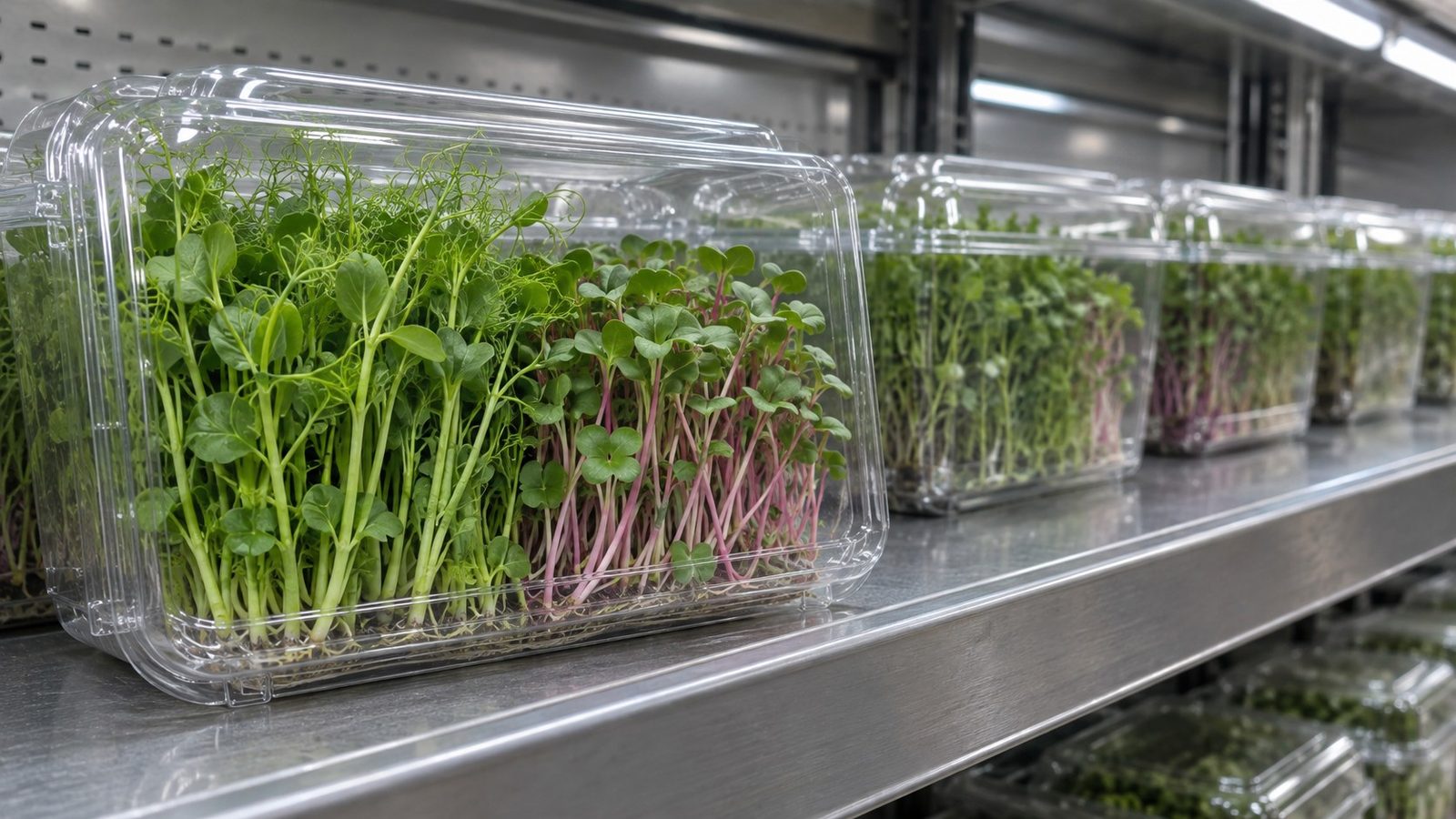
Run three checks, in this order, before you pay. First, the pack should be sitting cold, in a working refrigerated case or cooler. Second, the greens should look dry, upright and normally colored through the plastic.
Third, if you can smell the pack without opening it, it should smell like the plant and nothing else. Put back anything warm, wet, slimy, collapsed or sour-smelling, and don't count on words like organic, local or living, or a best-by date weeks away, to tell you how the greens are doing right now.
The whole thing takes under a minute. One limit applies to all of it: a pack that looks and smells good tells you it's a good-looking pack, not that it's free of pathogens.
The one-minute check at the shelf
The first check can rule a pack out before you even pick it up.
- Cold. Is the pack in a working refrigerated case or a cooler, rather than on a warm counter, an unrefrigerated display or a table in the sun?
- Look. Is the color normal for the crop, with dry, upright leaves and no wet, see-through, slimy or flattened patches and no pooled water?
- Smell. If you can smell it without opening it, is there any sour, musty, fermented or otherwise unpleasant odor?
- Label, last. What kind of date is printed, and who packed it?
If a pack fails any of the first three, you don't need to read the label. For wider advice on where and what to buy, see the post on buying microgreens.
Start with where the pack is sitting
The number to hold in your head is 41 F (5 C). The FDA recommends that stores keep cut leafy greens at or below that temperature in cold storage and display (FDA guidance on cut leafy greens). Not every microgreen pack automatically falls under that definition, so treat it as the closest retail benchmark rather than a microgreen rule. It still gives you a check you can make without touching anything.
Storage research shows why temperature comes first. In a 2023 study, mustard microgreens held at 5 C kept good sensory quality for 14 days. At 10 C that fell to 4 days, at 15 C to 2 days, and at 20 or 25 C the greens had deteriorated beyond eating by the first sample, taken at day 1 (2023 mustard study). Radish microgreens held at 1 C kept acceptable quality through day 28 in a 2014 packaging trial, and that work found temperature mattered more than the oxygen transmission of the packaging film (2014 radish study).
Those figures come from controlled storage, so they can't tell you how old a pack is. They do show why a warm display is a bad sign.
Look through the package
Once the pack has passed the cold check, use the container as a window. A clear clamshell makes color, free water and crushed leaves easy to see; an opaque bag hides most of that.
Color
You're looking for normal color for the crop. Researchers who study microgreen shelf life judge many of the same things a shopper can see. In a 2024 arugula study, 40 adult panelists scored appearance, texture, odor, color, taste and overall acceptance on a nine-point scale, while the lab also tracked weight loss and chlorophyll (2024 arugula study). That paper cites earlier work treating bright green as a high-quality sign in green microgreens and yellowing as a sign of decline.
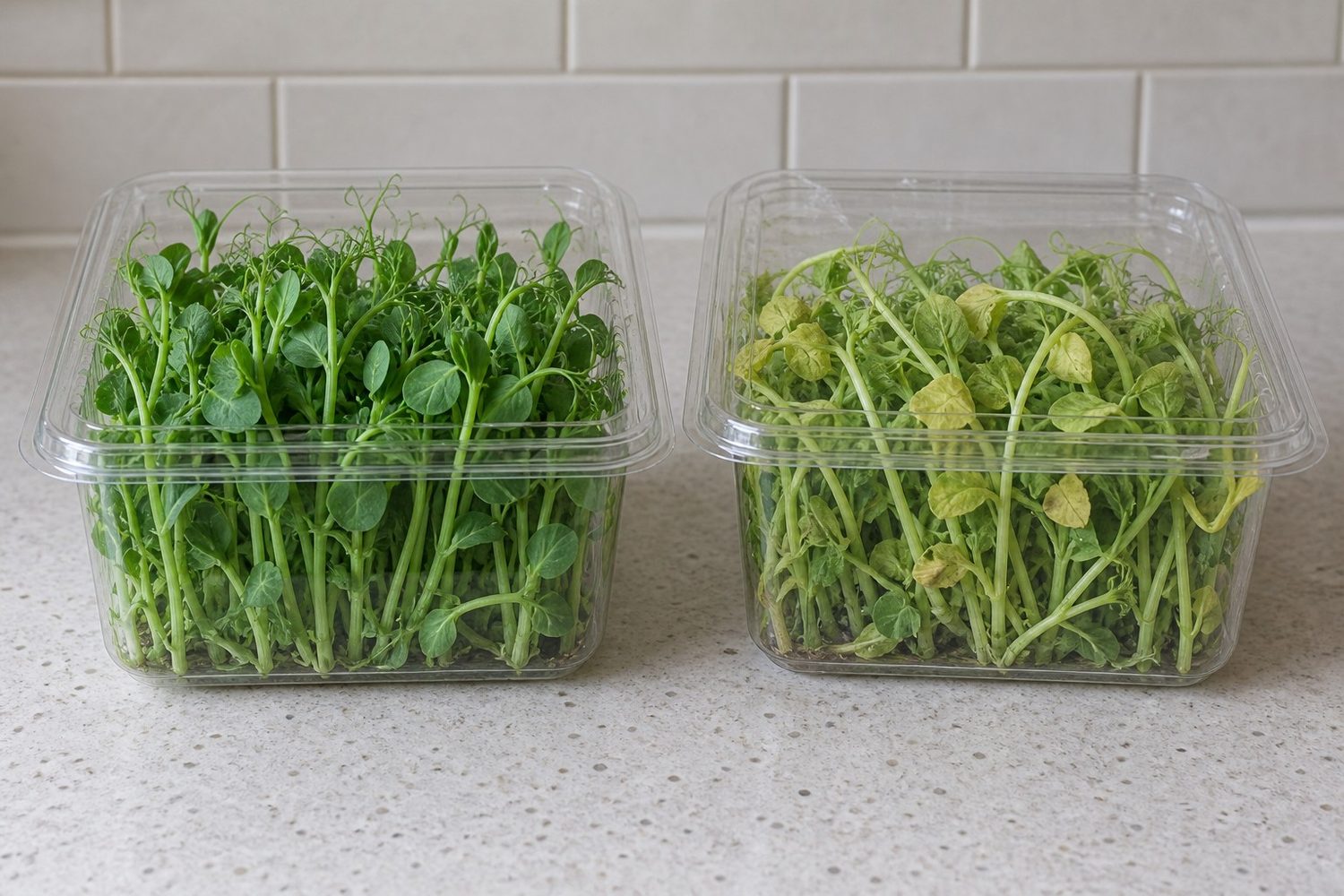
Color can start to slip before anything looks obviously wrong. In the same arugula work at 5 C, chlorophyll decline was detectable from day 3, and over 10 days total chlorophyll fell by 27.8% in open packs, 41.0% in vacuum-sealed packs and 51.5% in modified-atmosphere packs. Even so, panel color scores for the open and modified-atmosphere packs stayed statistically level with fresh greens through day 7, so an early change may be hard to see by eye.
So, don't wait for leaves to collapse before you get choosy. If two packs of the same crop sit side by side and one looks duller or has yellow creeping in, take the greener one. No one has published which sign shows up first across different crops, so treat dulling as an early caution rather than a verdict.
Dry and upright, or wet and collapsed
Next, look at the leaves and stems themselves. Dry-looking, slightly limp greens often come from moisture loss; in the arugula packaging trial, the greens nearest an open package dried out and looked worse. That is a loss of quality, but it's a different problem from leaves that look wet, translucent or water-soaked, slimy, or collapsed into a mat, or stems that have turned dark and wet. Those point to tissue breakdown, and a pack showing them is one to leave on the shelf.
No one has published a microgreen-specific limit for how much translucence, slime or collapse is too much, so work from a simple rule: if you can see it through the plastic, choose a different pack.
Droplets on the lid
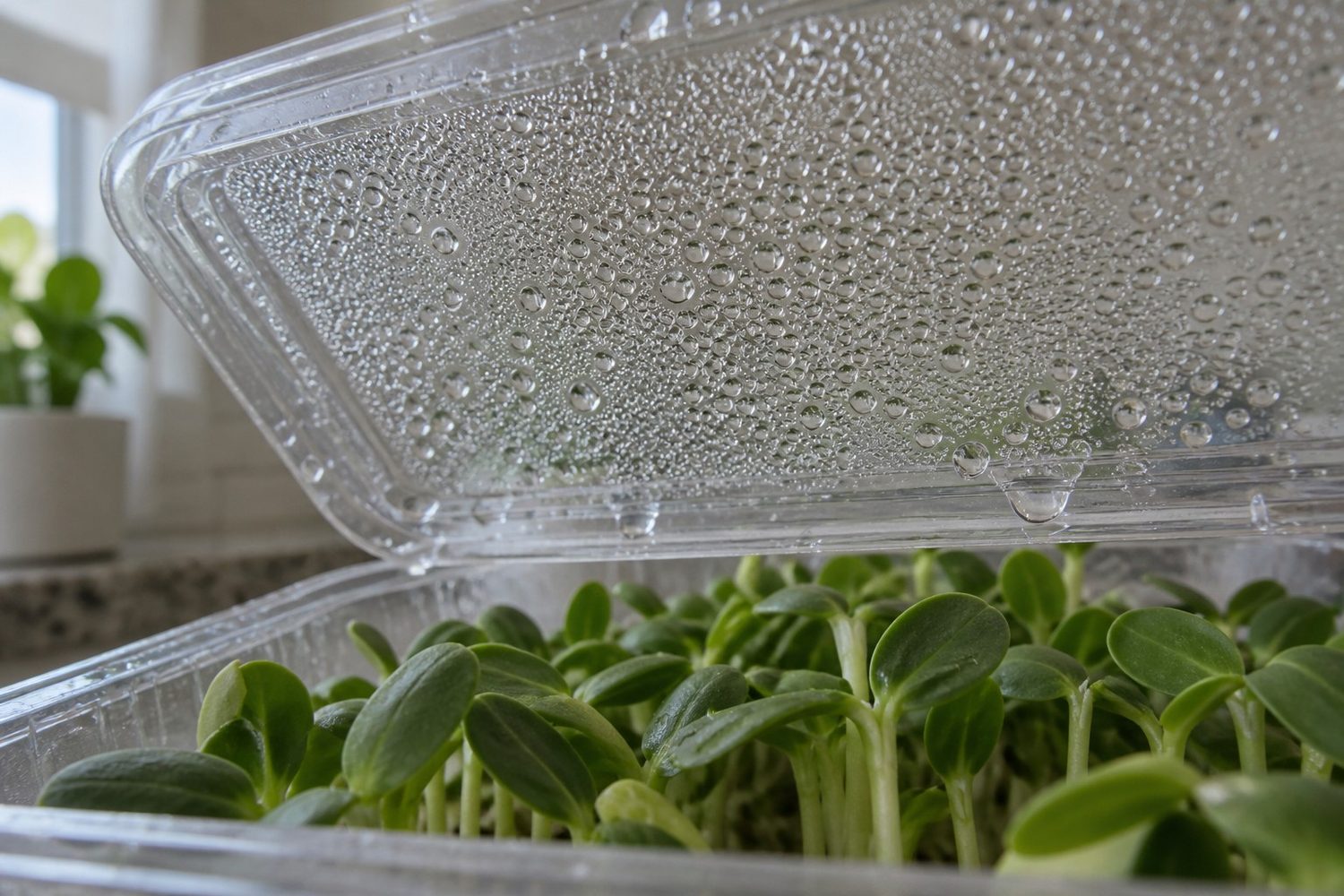
A few drops of water inside the lid don't prove the pack was left warm. Condensation can come from a temperature swing, greens packed while still warm, extra free water or plain high humidity. Penn State Extension notes that temperature changes can produce condensation and shorten postharvest life (Penn State Extension). Treat a few droplets alone as a reason to look closer. Droplets together with wet greens, water pooled in the bottom, an off smell or collapsed leaves means put it back.
Crushing, hulls and roots
Check the container too. Pass on a cracked clamshell, a bag squeezed tight enough to mash the leaves, or a pack whose bottom layer looks flattened and wet. FDA's guidance explains that cutting damages leaf surfaces and opens the way for invasion, though it sets no limit for crushed microgreens.
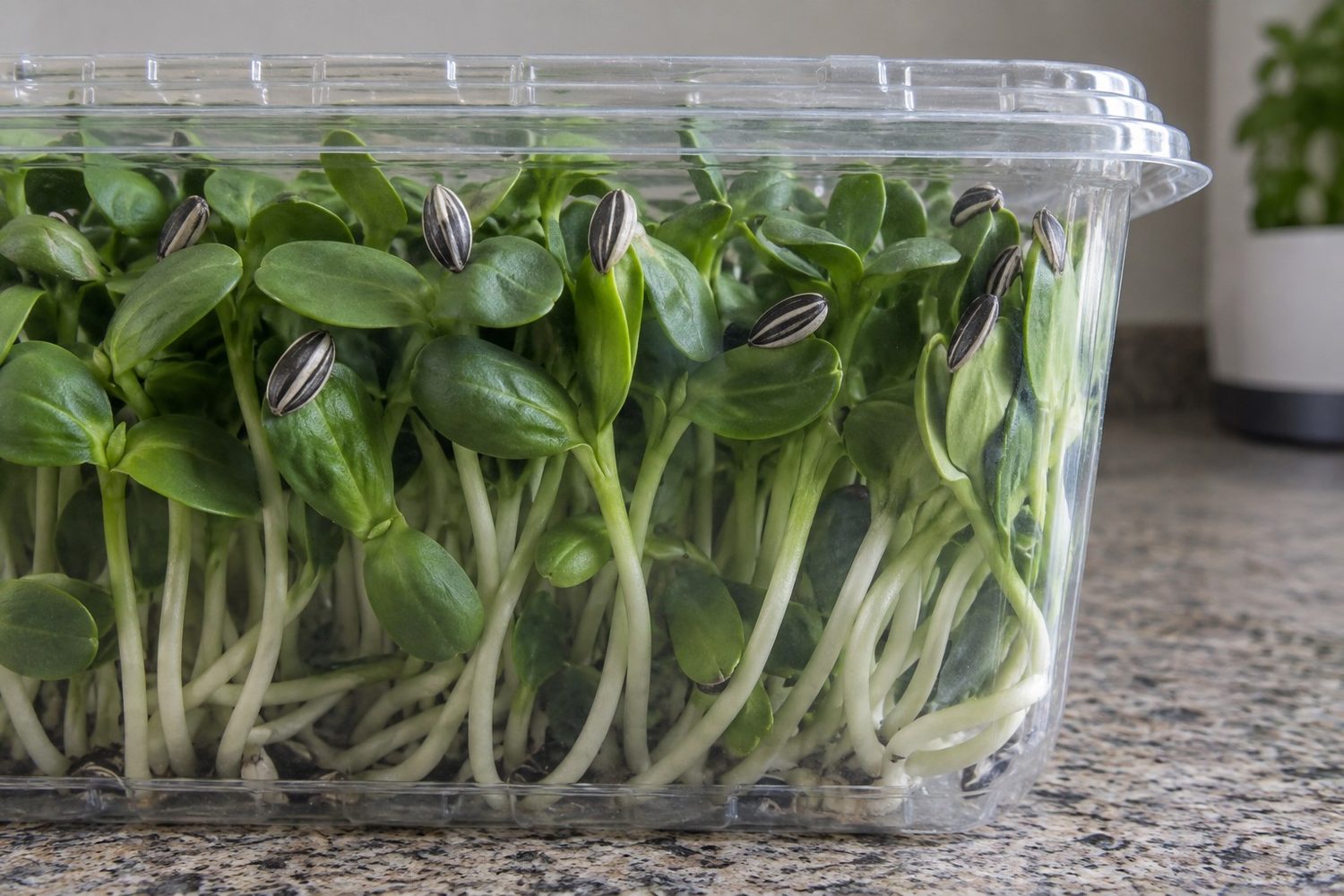
A few seed hulls or bits of root are a different matter. Hulls are mostly an eating nuisance, and roots or growing medium often just mean you're looking at a living tray rather than cut greens. A lot of loose, wet medium or dirty water is a fair reason to ask the seller how the greens were handled, but it isn't proof of contamination.
Don't mark a pack down for what is normal for its crop, like a thick sunflower stem or a pea tendril; no crop-specific buying signs have been published for sunflower, pea shoots or basil.
Smell it if you can without opening it
If the pack lets you smell the greens without opening it, take a sniff. Microgreen shelf-life studies score off-odor as one of their quality measures, and the arugula paper notes that a poor gas balance inside a package, with too little oxygen, can injure the tissue and cause unpleasant odors. USDA describes spoiled food as developing an off odor, flavor or texture from spoilage organisms (USDA on food product dating).
Leave anything that smells sour, fermented, musty or unpleasant, or that simply doesn't smell like the plant. You don't need to know which kind of off smell it is; either kind is a reason to put the pack down. If the pack is sealed, skip this step rather than opening it.
What the label and the claims can't tell you
Read the label after you've looked, because most of what's printed on a microgreen pack describes something other than the state of the greens today.
Dates
Apart from infant formula, federal rules don't require dates on food, and USDA describes dates as generally about quality rather than safety. "Best if Used By" is the maker's estimate of best flavor or quality, "sell-by" is inventory guidance for the store, and "use-by" marks peak quality (USDA on food product dating). So, a best-by date two weeks away is a seller's quality judgment shaped by the product, the temperature and the packaging. It isn't a harvest date, and it isn't a safety certificate. Read the words beside the date so you know which kind you have.
A harvest or packed date is voluntary unless a state or local rule applies, but when it's printed, it marks one real point in time. If two packs look equally good and are equally cold, take the one with a clearly stated recent harvest date. No days-since-harvest cutoff has been published for microgreens, though, so don't let any date overrule what you can see.
The rest of the label, the product name, the business that packed or distributed it and the net weight (FDA Food Labeling Guide), tells you whose greens you're buying and helps you match a pack to a recall later. It doesn't describe freshness.
Words that describe something else
Each of these claims can be true and still say nothing about the pack's condition this morning.
- Organic means the crop was produced and handled to USDA organic standards (USDA AMS organic basics). It's a production method, not a freshness test.
- Local tells you a geography only if the seller defines it. Origin, including country-of-origin disclosure (USDA AMS), says where greens came from, not when they were harvested or whether they stayed cold.
- Hydroponic describes a growing system. It isn't a date, a safety result or a quality grade.
- Living usually means the greens are sold with roots or medium attached. The word alone does not guarantee freshness, and a living tray can still be warm or wet.
- Clear packaging makes your inspection easier. It doesn't make the greens inside any fresher.
- Modified-atmosphere packaging (MAP), which alters the gases around the greens, isn't automatically fresher either. In the arugula trial, MAP and open packs held their sensory quality better than vacuum-sealed packs, which scored worse from day 5, and how any package performs depends on temperature, humidity and gas balance.
Questions to ask at a market table
A farmers market gives you something a store shelf can't: the person who grew the greens. Favor a grower who keeps them in a cooler or a cold, shaded setup rather than on a warm table in direct sun. Penn State Extension says microgreens ideally go to market immediately after harvest. Ice on the table isn't proof that the greens themselves are cold and dry, so it's worth asking a few questions:
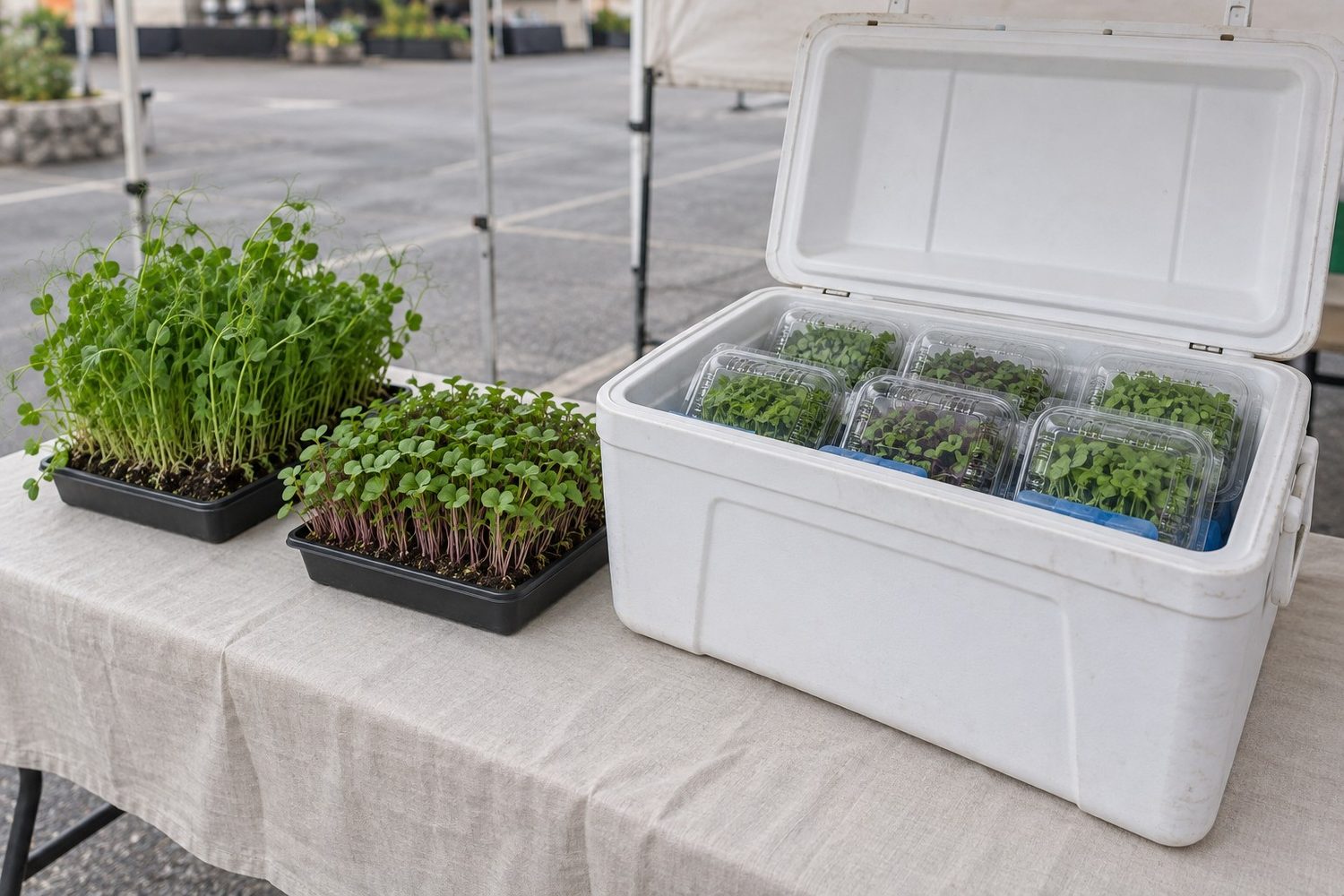
- When were these harvested or packed?
- Have they stayed cold today, and how?
- For a living tray, what medium is this, and should I cut above it?
Treat the answers as the seller's word unless records or a certification back them up. Buying direct does not guarantee a shorter time from harvest to sale, so run the same look and smell checks at the table. If you're still looking for growers near you, start with how to find local microgreens.
What a good-looking pack can't prove
The look-smell-cold order is our own synthesis of the sensory research and FDA's cold-display guidance. It isn't a validated diagnostic test. It's good at sorting tired packs from sound ones, and it can't tell you anything about pathogens. FDA's guidance says higher temperatures can let pathogens grow and that greens which look acceptable aren't necessarily safe (FDA guidance on cut leafy greens).
That's one more reason the cold check comes first. At home, follow how to store microgreens, and if you're unsure about a pack a few days later, check the signs in have microgreens gone bad. To check a brand for recalls, search FDA's recalls, market withdrawals and safety alerts and match the exact brand, package or lot, date and place sold; not every recall gets a press release, and a similarly named sprout product isn't a match.
Frequently asked questions
These cover the questions that come up just before or just after buying.
Are some microgreens more perishable than others?
No one has published a fair ranking, because it would take the same harvest, packaging, temperature and scoring across every crop. The studies that exist differ: arugula stayed consumable through a 10-day test at 5 C, mustard was described as highly perishable, and radish reached 28 days only at 1 C under one trial's packaging. Judge the pack in front of you rather than the crop's reputation.
Can limp microgreens be revived at home?
Some limpness from moisture loss may improve once the greens get water again, but there's no test a shopper can run on a sealed pack to know that in advance. Wet, translucent, slimy or collapsed greens are showing tissue damage, which is a different problem, so don't buy those counting on a revival.
Is a washed pack safer than an unwashed one?
Not automatically. Penn State Extension advises against washing microgreens after harvest unless necessary, because it can spread contamination and shorten shelf life for such tender greens, and it presents washing in fresh drinking water just before eating as the alternative (Penn State Extension on microgreen food safety). "Washed" means a water step happened, not that the greens are sterile, and "unwashed" doesn't mean unsafe; the post on whether you should wash microgreens goes further.
What should I check when microgreens arrive by delivery?
Inspect them before they go into the refrigerator: the package should be intact, the greens dry and whole, with no pooled water, crushing, slime or off odor, and the contents cool to the touch. If something is wrong, photograph it and keep the label and lot number, since no national delivery standard for microgreens exists to fall back on.
What should I do if a pack I bought is recalled or turns out bad?
For a recalled pack, follow the notice; FDA says it can often be returned for a refund, and otherwise it should be thrown away securely rather than given away (FDA on food recalls). For a pack that simply turns out poor, keep the package and lot, take a photo and contact the retailer or grower promptly about their return policy. Don't taste questionable greens to decide, and if you suspect illness, seek medical advice and report it as FDA directs.
Before you hand over the money
Cold first, then look, then smell, and read the label last. A pack that's sitting cold, looks dry, upright and normally colored, and smells only like the plant is the best choice you can make at the shelf, and a pack that fails any one of those checks is worth putting back, whatever its label says. Just keep the limit in mind: these checks find good-looking greens, not proven-safe ones, so keep them cold once they're yours.
Sources
Prices, stock and specifications are as the linked pages showed them on 2026-09-12.
Keep reading
The journal
Have These Gone Bad? Judging a Box of Microgreens in the Fridge
A warm fridge costs days: arugula, radish and red cabbage lost a week of quality at 10C against 4C, and one mustard study lost ten. And no visible sign has ever been validated as a safety test.
Read Have These Gone Bad? Judging a Box of Microgreens in the FridgeThe test bench
Microgreens Storage Containers: The Package Is Not the Variable
Deli cups run 10 cents and clamshells start at 16.5 cents. What moves shelf life is how cold the fridge is and how dry the crop went in.
Read Microgreens Storage Containers: The Package Is Not the VariableThe test bench
Seed Storage for Microgreens: For 29 Crops the Container Costs More Than the Seed
A $1.29 jar has to save four trays of turnip seed to pay for itself, or 0.13 of a tray of barley grass. Nothing sold as airtight publishes a test, and a seal locks in whatever state the seed is already in.
Read Seed Storage for Microgreens: For 29 Crops the Container Costs More Than the SeedThe journal
Four Bags Labeled Kale, Two Species and a 227 Percent Price Gap: How Microgreen Seed Actually Gets Named
Federal law makes a seed packet state its kind and variety, not its species. One catalog's four kale microgreen listings span two different species and $25.73 to $84.25 a pound.
Read Four Bags Labeled Kale, Two Species and a 227 Percent Price Gap: How Microgreen Seed Actually Gets Named