Seed Storage for Microgreens: For 17 Crops the Container Costs More Than the Seed
Cal HewittPublished Checked
- equipment
- seed
- storage
- buying
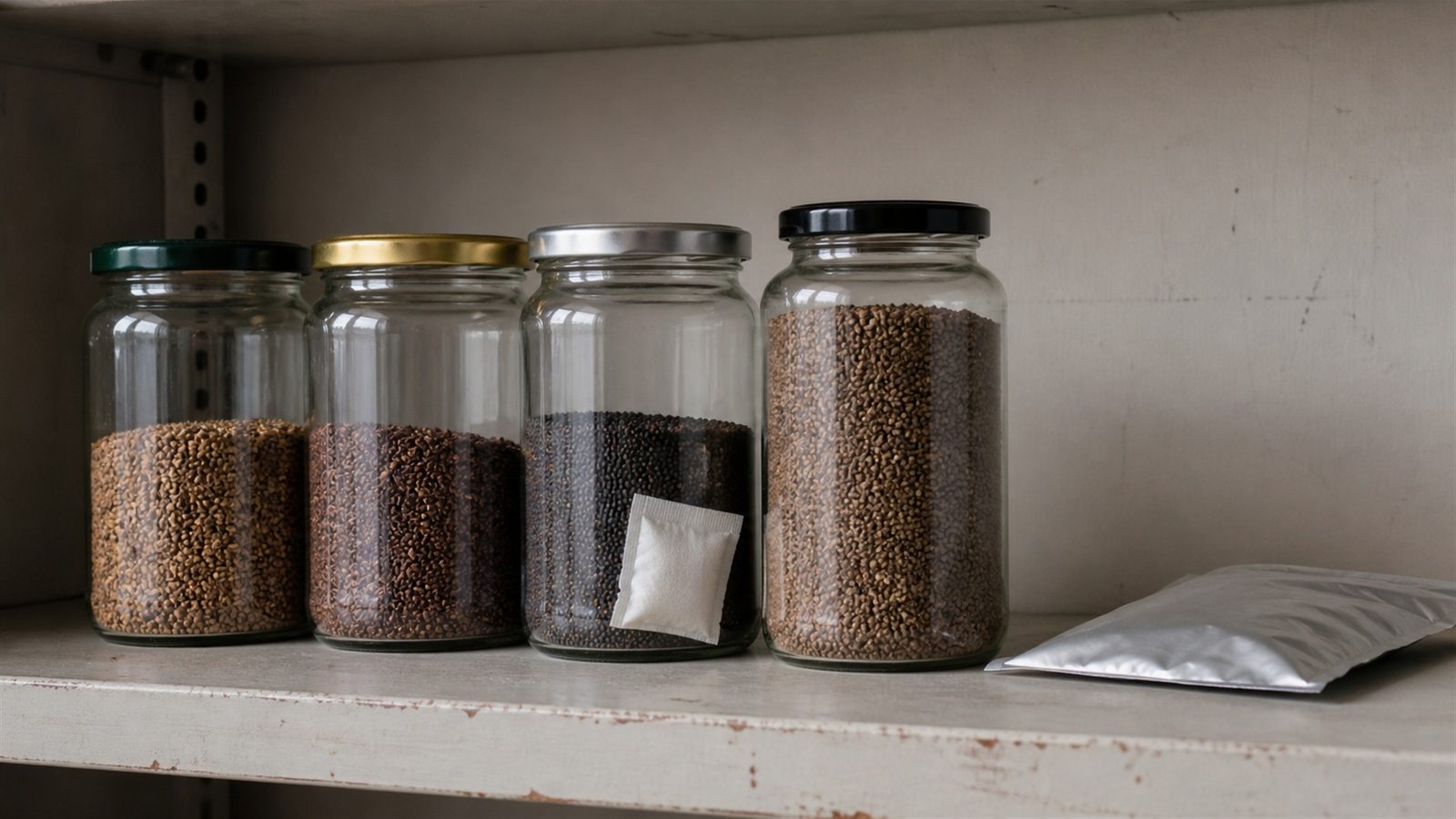
A container does not dry seed. It preserves whatever state the seed is already in, and if that state is damp, the documented outcome is mold, sealed in with no route back to room equilibrium.
Seeds equilibrate their moisture to the humidity around them. That is why the closure only matters after the seed and the air inside are already dry, and why "airtight" is not automatically a good thing. It locks in the correct dry state or the damaging wet one with equal commitment.
What to actually do
- Dry first, seal second. A seal on damp seed causes the problem it was bought to prevent. If a lot arrived questionable, do not seal it away.
- Do not buy storage for cheap fast-turning crops. For 17 of 50 crops a single tray of seed costs less than the box, so use the supplier packet and buy what you will sow.
- Buy pantry gasket boxes or canning jars, not seed tins. Same barrier, a fraction of the price, and glass lets you see insect damage.
- Label everything with crop, cultivar, supplier lot, purchase date and any desiccant recharge date. Extension guidance is unanimous on this and it is free. Untraceable seed cannot be rotated or tested.
- Warm a cold container to room temperature before opening it, every time. Several hours, sealed. This is the step that ruins lots when skipped.
- Keep a small working packet so the main lot is opened rarely.
- Treat desiccant as a capacity. Watch the indicator, and take it out rather than over-dry a lot below about 4% moisture.
- Never put a calcium chloride moisture absorber near seed. It becomes liquid.
- If a lot matters, test it rather than trust the jar. Run the same germination check annually on a counted sample and let the result decide.
The arithmetic that decides whether to buy anything
Twelve gasket food boxes cost $10.99, which is $0.92 a crop. Set that against what a crop's seed actually costs, computed from the seed-cost field on the 50 crops that publish one.
Per tray, seed runs from $0.31 for turnip to $9.69 for barley grass, a 31-fold spread, with a median of $1.08.
Hover or tap a row to highlight it.
| Crop | Seed cost a tray | Trays-worth it must save |
|---|---|---|
| Turnip | $0.31 | 3.0 trays |
| Mizuna | $0.39 | 2.4 trays |
| Arugula | $0.48 | 1.9 trays |
| The median crop | $1.08 | 0.8 trays |
| Mung bean shoots | $5.89 | 0.16 trays |
| Popcorn shoots | $9.28 | 0.10 trays |
| Barley grass | $9.69 | 0.09 trays |
For 17 of the 50 crops, one whole tray of seed costs less than the $0.92 box you would store it in. Turnip, mizuna, lentil, arugula, broccoli raab, parsley, dill, fenugreek, celery, carrot, flax, chia, broccoli, basil, endive, kohlrabi and collard are all in that group. On those crops, buying storage to protect a small quantity is buying a container worth more than its contents.
At the other end the calculation is not close either. The whole twelve-box setup costs about 1.1 trays of barley grass seed and 35 trays of turnip.
And the dearest seed per pound is not the dearest tray, which is worth holding onto. Sorrel is one of the most expensive seeds by weight and still only $2.71 a tray, because it is sown at 3.5 grams. Barley grass is cheap by weight and dear per tray because it is sown at 220. The 409-fold seed-rate spread drives this, so decide by the value of what is actually in the jar rather than by the headline price per pound.
Set your own threshold rather than trusting a payback figure. If you want a $10.99 setup to repay inside one storage cycle by averting at least 10% of a loss, you need $109.90 of inventory at risk. At a 25% avoided-loss assumption it is $43.96. Those are arithmetic scenarios rather than evidence, because no source publishes a container-specific avoided-loss rate at all. Put your own numbers in.
The rule that actually governs seed life
Harrington's rule, as extension services present it: every one percentage point of seed moisture removed, or every 5°C (9°F, often rounded to 10°F) of storage temperature removed, roughly doubles the safe storage period. The companion form is that temperature in °F plus relative humidity should not exceed 100.
The two trade against each other, which is why a cool damp cupboard and a warm dry one can land in similar places. It is a rule of thumb rather than a species forecast, and lot quality, treatment and packaging all still matter.
Where the targets land, by source:
- Below 60% RH for ordinary stored garden seed.
- 50% RH and under 50°F from another extension service.
- Under 40% RH for long-term storage, from a supplier technical sheet and a third extension service.
- 30% RH for national seed-bank drying, and a working collection held at 4°C and 30% RH.
If you can only control one, control moisture. That is extension guidance stated outright, and the reasoning is practical: a refrigerator full of humid air and leaky packaging can re-wet a lot. Buy the barrier and dry the seed before you buy the fridge.
Nothing sold as airtight publishes a test
Across every consumer jar, tin, pouch, vacuum bag and food box listing opened, none published a water-vapor transmission rate, a seal-leak rate, an achieved internal humidity, or any seed-viability result.
What they publish instead is adjectives. One pouch brand advertises a "resealable airtight zipper" and an aluminum layer that keeps moisture out; a food-box brand says silicone gasket lids "ensure an airtight seal"; a seed tin says it keeps the collection dry. These are seller claims with no standard behind them.
Some listings do publish something useful: bag thickness in mils, container volume, tin dimensions and compartment counts, oxygen absorber counts, label counts. That is a specification of the object, not of its performance as a moisture barrier.
The honest ranking is therefore by physics and by pest resistance rather than by claim. Glass with a screw or gasket lid is a genuine barrier and lets you inspect for insect damage and fungal growth. A rigid bin or metal can resists rodents in a way a zipper pouch is not independently claimed to. An ordinary plastic zip bag is permeable, which extension guidance says directly, so it is organization rather than protection.
Cold storage, and the mistake that undoes it
This is the step most likely to ruin a stored lot, and only 3 of the 8 guides checked even mention it. All three prescribe the same protocol.
Cold sealed air holds little water vapor. Open a cold container in a warm humid room and that room air hits cold seed and cold glass, drops below its dew point, and deposits liquid water on the lot you were trying to protect.
So, take the sealed container out, leave it several hours until it reaches room temperature, and only then open it. Never browse a cold bulk jar repeatedly. Divide the seed you use often into a small working packet so the main lot is opened rarely.
Freezing is not simply "colder is better". Guidance genuinely conflicts: one extension service permits zip bags in the freezer and recommends freezing beans and corn for several days to kill insects, another recommends a few freezer days for insect eggs, a university seed-technology source says low temperature but not below freezing for home storage, and the national collection freezes at -18°C but only after professional drying. That conflict is about moisture content, not about cold. Without knowing your lot's moisture, a sealed refrigerator for working stock is the defensible choice, with the freezer reserved for very dry divided backups and short insect-killing runs.
Desiccant, which is a capacity and not a schedule
Silica gel has a capacity, not a service interval. One indicating product specifies that 20 grams absorbs about 4 grams of water at 23°C and 40% RH. How long that lasts depends on your container's leak rate, its headspace, and how often you open it, none of which is published for any consumer container. So, watch the indicator and the weight, not the calendar.
The advice conflicts here too. Extension guidance suggests silica roughly equal to the seed weight in a separate envelope, then removing it after a couple of weeks to avoid over-drying. That is the opposite of leaving a sachet in forever. Seed can be damaged below about 4% moisture, and a sealed jar with unlimited desiccant is a way to get there.
And the packets on sale are mostly the wrong size for this job. Checked across the rechargeable indicating desiccant category on 2026-08-12, the common formats are 100 gram and 120 gram packs aimed at gun safes and storage totes. Against a 13 gram tray's worth of broccoli seed, a 100 gram pack is roughly eight times the seed weight, where the guidance above calls for something close to parity. The small 10 gram packets, about $0.47 each in a thirty pack, are the ones sized for a seed jar.
An indicating color is an exhaustion cue, not a humidity meter. A peer-reviewed assessment of indicating desiccants found that the partial-indicating products it examined needed strong light or opening the package to read the color at all, and that the indicator chemistries varied. No supplier publishes an accuracy, a sensitivity or a false-change rate for a seed jar. Confirm with a calibrated humidity indicator card if the answer matters.
One product must never go in a seed jar. Household moisture absorbers based on calcium chloride are deliquescent: they turn into liquid brine as they work. They are made to collect water in a tray, and putting one loose beside seed is introducing the exact hazard you are storing against.
Prices, and what the premium actually buys
Hover or tap a row to highlight it.
| Class | Example seen | Price | Per unit |
|---|---|---|---|
| Gasket food boxes | Vtopmart, 12 at 1.6 L | $10.99 | $0.92 a box |
| Screw-top jars | Ball 32 oz wide mouth, 12 | $16.19 | $1.35 a jar |
| Vacuum bag roll | FoodSaver 8 in by 15 ft | $8.98 | roll |
| Mylar heat-seal bags | Wallaby, 30 at 1 gallon | $16.99 | $0.57 a bag |
| Zipper pouch bundle | Wallaby 60 with absorbers and labels | $42.49 | $3.54 a crop over 12 crops |
| Impulse heat sealer | 4 inch | $70.41 | one-off |
| Purpose-sold seed tin | 3-compartment steel | £19.99 and $36.95 | organizes packets only |
The pantry aisle undercuts the garden aisle by a wide margin. A twelve-pack of gasket food boxes at $0.92 each does the same physical job as a purpose-sold seed tin at $36.95 or £19.99, and the tins publish compartments and dimensions rather than any barrier test. You are paying for organization, which is a real benefit and not the same as preservation.
A full heat-sealing setup is $112.90, or $9.41 a crop across twelve crops. Against a median seed cost of $1.08 a tray, that is an upgrade for someone carrying valuable inventory across seasons, not the entry ticket. The container-only plan is the rational default.
Who should skip this entirely
Anyone buying seed and sowing it inside the next crop cycle. Supplier guidance is to keep seed in its unopened original package for short-term use and to use it in the purchase year, and a microgreen rack turns stock over faster than almost any other growing.
Anyone in a genuinely cool, dry, dark room with intact packets. Paper envelopes work in an arid climate if they are protected.
Do not skip labeling, and do not skip a closed dry outer container if the room is humid, hot or pest-prone, or if you are carrying an expensive lot over. And note that treated, primed or pelleted seed is specifically flagged by suppliers as poor for carryover, so it is the wrong thing to build a storage system around.
What is still genuinely unknown
- Any tested barrier performance for any consumer container. No water-vapor transmission rate, no leak rate, no achieved internal humidity, on any listing opened.
- How many years a refrigerator actually buys, for these crops. One extension source says "several years" without species, starting moisture, container or paired comparison.
- Whether household vacuum sealing damages dry seed. The documented vulnerability is to rough handling of large seed, not to suction, and nobody has run the vacuum against non-vacuum germination test.
- Indicator accuracy in a seed jar, including how often the color misleads.
- A defensible failure rate for any of these products. Listings expose rating counts, which are not failure counts.
- A real desiccant cost per liter or replacement interval, because leak rate, headspace and opening frequency are all unpublished.
- The packet-versus-bulk premium for microgreen seed, which nothing opened here establishes, so no universal saving is claimed.
Terms on this page
Tap a term to see what it means.
Seed moisture content. The water in the seed as a percentage of its weight. The variable Harrington's rule turns on, rarely known at home, and destructive to measure properly.
Sources
Opened 2026-08-12. Prices are snapshots on that date, not price promises, and this page is rechecked at least every two months. The cost arithmetic is computed from the seed-cost field on all 62 crop entries, of which 50 publish one.
- New Mexico State University on storing seed - the 50% RH and under 50°F target, tight-lid glass jars for small quantities against permeable plastic zip bags, mold as the documented outcome of sealing damp seed, glass allowing inspection for insect and fungal damage, freezing beans and corn for several days to kill insects, and the warm-before-opening instruction.
- South Dakota State University Extension on leftover garden seed - humidity as the priority, refrigeration extending life by several years without a paired comparison, and the same condensation protocol.
- NC State Extension seed-saving primer - Harrington's rule in both forms, the conclusion that moisture matters more than temperature for a home grower, and the note that vacuum packing wants seed 2 to 4 points drier.
- UC Agriculture and Natural Resources - labeling contents, source and date, desiccant use, a few days in the freezer for insect eggs, and condensation on removal from cold.
- Utah State University Extension on seed storage and handling - the under 40% humidity guidance and the mechanical susceptibility of large seed to rough handling.
- Iowa State University Extension - silica roughly equal to seed weight in a separate envelope, and removing it after a couple of weeks to avoid over-drying.
- UF/IFAS - drying duration before storage and the labeling minimum.
- Virginia Tech seed technology - the 6 to 8% moisture range for sealed storage, about 5% as a general level, damage to some seed below 4%, and low temperature but not below freezing for home storage.
- USDA on seed drying and equilibrium and USDA ARS storage conditions - that seed equilibrates to surrounding humidity, the roughly 30% RH long-term drying context, and the working collection at 4°C and 30% RH against an original collection at -18°C after drying.
- US Forest Service on seed moisture measurement - the destructive oven weight-loss method, which is why home growers rarely know their moisture content.
- Seminis vegetable seed storage and handling (PDF) - supplier guidance on 35 to 40°F and under 40% RH, keeping seed in its unopened package for short-term use, using it in the purchase year, and the specific warning against carrying over some treated, primed or pelleted seed. This is industry guidance from a seed seller rather than independent evidence.
- A peer-reviewed assessment of indicating desiccants - that the partial-indicating products assessed required strong light or opening the package to read, and that indicator chemistries varied.
- A silica gel supplier's indicating product page for the 20 gram sachet absorbing about 4 grams of water at 23°C and 40% RH, and a manufacturer color-change specification. Both are product specifications rather than seed evidence, and the first returned an anti-bot block when opened, so its claims are not relied on as independent evidence.
- A calcium chloride household moisture absorber listing - identifying the active ingredient and that it collects liquid, which is why it does not belong beside seed.
- Container prices and published specifications, all practice listings: Ball jars at Target; Vtopmart 12 at 1.6 L and Sorbus latch boxes for the gasket claims; Wallaby Mylar bundles and the Mylar zipper category; the vacuum bag category and Uline FoodSaver bags; impulse sealers; and the purpose-sold seed tins at Garden Netting and Two Wests.
Keep reading
The test bench
Microgreens Storage Containers: The Package Is Not the Variable
No retail microgreen container has a published shelf-life result at a stated temperature. Deli cups run 10 cents, clamshells start at 16.5 cents, and the two things that actually move the number are how cold the fridge is and how dry the crop went in.
Read Microgreens Storage Containers: The Package Is Not the VariableThe test bench
Scales for Microgreens: The $460 Balance Publishes No More Than the $19 One
Seed rates here run 1.1 to 450 grams a tray, a 409-fold range. One scale covers all of it for about $19, and neither it nor a $460 balance publishes the one specification that would let you trust either.
Read Scales for Microgreens: The $460 Balance Publishes No More Than the $19 OneThe journal
How Long Do Microgreen Seeds Last in Storage?
How long do microgreen seeds last on the shelf? Compare sourced storage ranges by crop, learn why tables disagree, and test old seed before wasting a tray.
Read How Long Do Microgreen Seeds Last in Storage?The journal
Have These Gone Bad? Judging a Box of Microgreens in the Fridge
A warm fridge costs days: arugula, radish and red cabbage lost a week of quality at 10C against 4C, and one mustard study lost ten. And no visible sign has ever been validated as a safety test.
Read Have These Gone Bad? Judging a Box of Microgreens in the Fridge