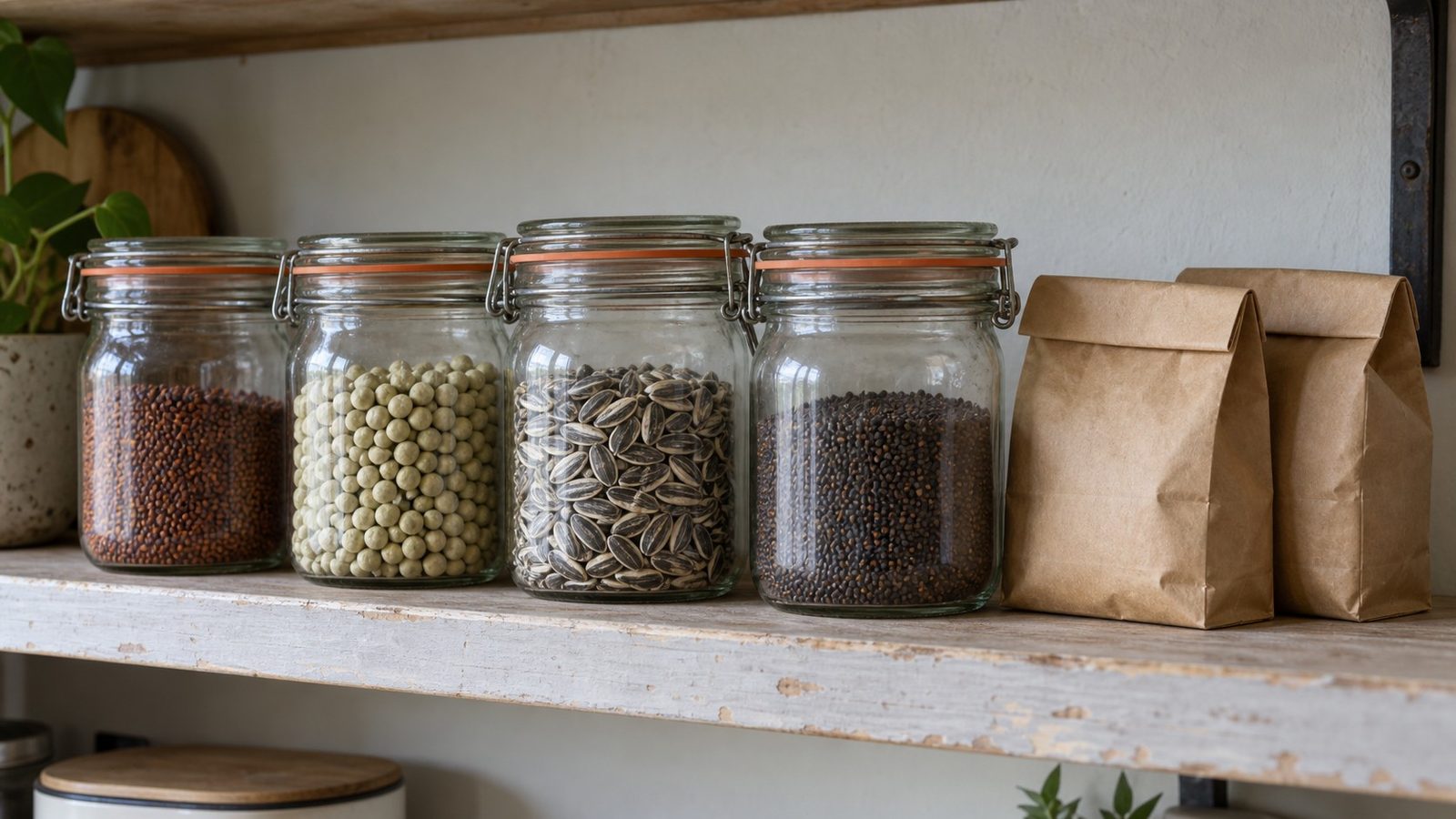
Common microgreen crops such as broccoli, radish, kale, pea and lettuce have published storage lives of 1 to 5 years, depending on the crop and on how the seed was kept.
Lettuce and onion sit at the short end of some tables, while radish, kale, beet and chard reach 4 or 5 years in others, and dry seed packed airtight and frozen can last up to 10 years according to Colorado State University Extension and Utah State University Extension. Those figures come from garden vegetable seed tables, not dense microgreen tray trials.
For last season's bag, the number that decides it is a germination count you run yourself, which takes 6 to 14 days for most of the crops below.
Storage life by crop, table by table
Five Extension publications give crop-by-crop figures you can check. Each was written for ordinary garden vegetable seed, and each states its own storage condition, so read every number with its condition beside it.
- CSU: Colorado State University Extension's Table 1, in a fact sheet reviewed August 2025, calls its figures "relative longevity" and describes good long storage as seed dried below 8% moisture and kept below 40°F.
- UGA: University of Georgia Extension's Table 1 in publication B1486 (2023) gives years of seed storage under ideal dry, cold conditions.
- USU: Utah State University Extension's table, published November 2012, gives reasonable storage times for seed kept cool and dry.
- Illinois 2021: Illinois Extension's March 6, 2021 post gives viable life under average storage conditions.
- Illinois 2023: Illinois Extension's January 20, 2023 post groups crops by how long properly stored seed lasts.
Hover or tap a row to highlight it.
| Crop | CSU 2025 (below 8% moisture, below 40°F) | UGA 2023 (ideal dry, cold) | USU 2012 (cool, dry) | Illinois 2021 (average storage) | Illinois 2023 (stored properly) |
|---|---|---|---|---|---|
| Broccoli | 3 years | 3 to 5 years | 4 years | 1 year | 4 to 5 years |
| Cabbage | 4 years | 3 to 5 years | 3 years | 2 years | 4 to 5 years |
| Kale | 4 years | 5 years | 4 years | 2 years | See source |
| Kohlrabi | 3 years | 3 to 5 years | 5 years | See source | See source |
| Radish | 4 years | 3 to 5 years | 5 years | 2 years | 4 to 5 years |
| Mustard | No entry | 5 years | See source | See source | See source |
| Pea | 3 years | 3 years | See source | 1 year | See source |
| Beet | 4 years | 4 years | 4 years | 2 years | See source |
| Chard | 4 years | 4 years | 4 years | 2 years | See source |
| Lettuce | 1 year | 5 years | See source | 1 year | 4 to 5 years |
| Onion | 1 year | 2 years | See source | See source | See source |
| Carrot | 3 years | 3 years | See source | 1 year | See source |
| Basil | No entry | Test your own tray | See source | See source | 4 to 5 years |
| Sunflower | No entry | Test your own tray | See source | See source | 4 to 5 years |
"No entry" and "Not listed" mean that table has no line for the crop. "See source" means check the linked table for that crop. Illinois Extension's 2021 post also puts most herbs at 1 year under average storage.
Why the figures spread so widely
The gap between columns comes mostly from the storage each table assumes. The clearest case is Illinois Extension itself: broccoli is 1 year under average storage in its 2021 post and 4 to 5 years for properly stored seed in its 2023 post. Lettuce runs from 1 year in CSU's table to 5 years in UGA's, and onion from 1 year (CSU) to 2 years (UGA). Radish is 4 years at CSU, 5 at USU and 3 to 5 at UGA.
Don't average these or pick the one you like. Find your crop, then find the column whose storage condition is closest to how your seed actually spent the year. A bag kept sealed in the refrigerator belongs with the cold, dry columns. A packet that sat in a warm room belongs with the average-storage column, and it is the lot most worth testing before you sow.
Crops to test yourself
Arugula, buckwheat, amaranth, cilantro (coriander) and chives have no crop-specific storage life in the CSU, UGA or USU tables. CSU's table has no entries for them at all, and it also leaves out basil, sunflower and mustard. UGA gives mustard 5 years, and Illinois Extension's 2023 post places basil and sunflower in its group of 4 to 5 years for properly stored seed.
For the crops with no figure, don't borrow a number from a neighboring crop. Test every bag before its first tray, write the test date and result on the bag, and test again after another season in storage. Your own records become the storage figure for that crop. Chives do carry a low federal sale minimum of 50% germination, according to the University of Arizona Extension, but that is a labeling floor, not a storage life.
What keeps seed alive longer
Low moisture and low temperature are the two things that matter most. Illinois Extension gives a rule of thumb: the storage temperature in Fahrenheit plus the relative humidity should add up to less than 100. Its examples are 60°F at 30% humidity as favorable, and 50°F at 60% humidity as conditions that shorten seed life. It is a garden rule of thumb, not a microgreen formula, but it points the right way.
Utah State's vegetable guide sets a target of 35 to 40°F and below 40% relative humidity, and warns against storage above 70°F and 60% humidity because both reduce germination and vigor. A refrigerator is cold but humid, so the seal on the container is what protects the seed. USU's 2012 home guide suggests packets inside rubber-sealed buckets or lidded Mason jars, and CSU recommends sealed cans or jars rather than plastic bags for long storage. If you are choosing a container, the seed storage container reviews compare the options.
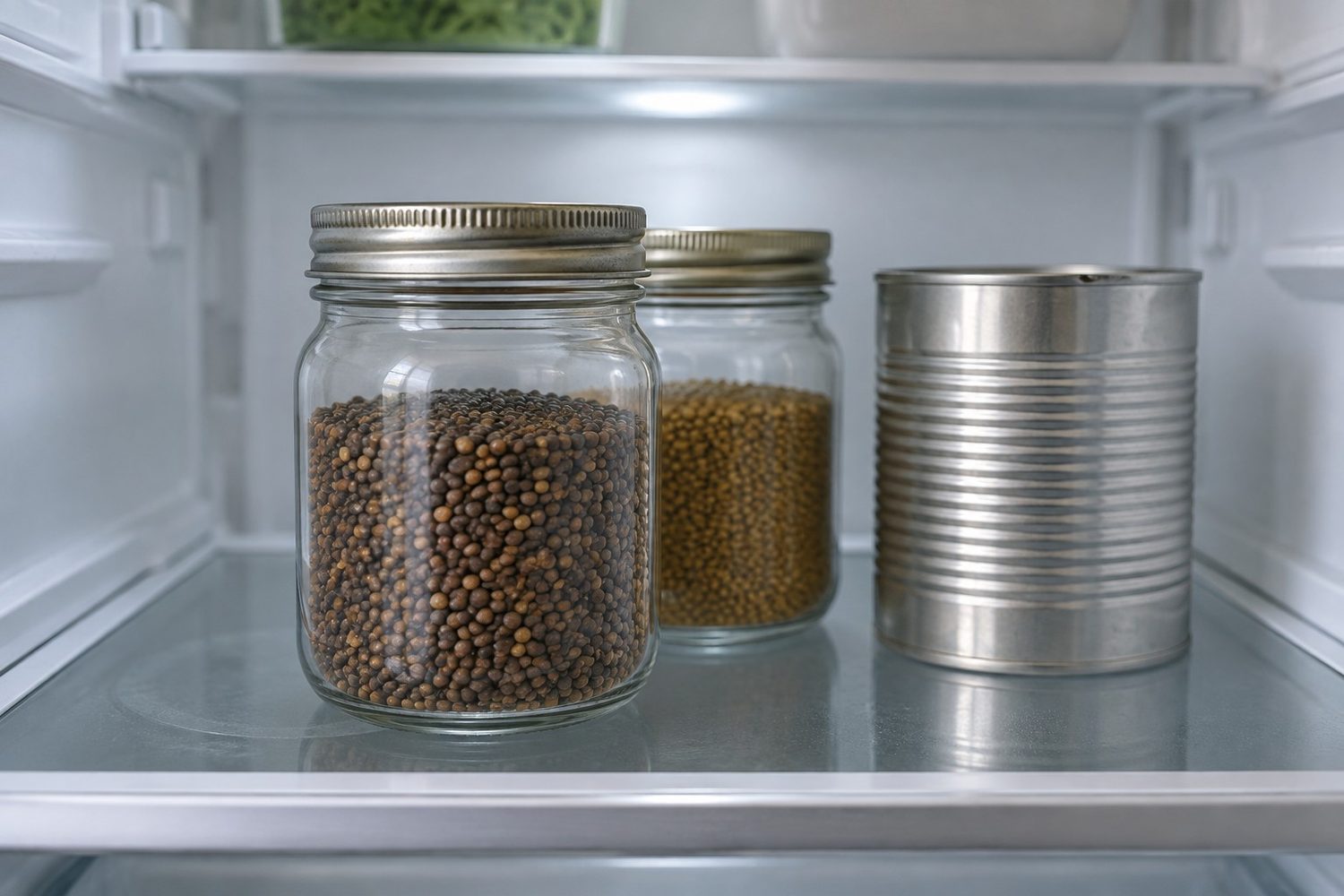
CSU gives a concrete example of why humidity matters. Seed held at 90% relative humidity reached 19% moisture and germinated poorly after one year, while seed held at 15% humidity dried to 6% moisture and stored safely for several years. Keep in mind that a sealed jar keeps dry seed dry; it does not dry seed that is already damp.
Freezing extends life further when the seed is dry to begin with. CSU says many seeds can last 10 years after drying below 8% moisture, packing in moisture-proof containers and refrigerating or freezing them. USU says frozen seed needs airtight packaging so freezer moisture does not reach it, and reports storage of up to 10 years. When you take a cold container out, leave it sealed until it has warmed to room temperature, so humid air cannot condense on the seed. Go by touch, and give a large bag longer.
USU notes that primed seed should be used in the same planting year, and pelleted seed older than two years may lose germination. What matters is exposure: every time a bag is opened in a humid room, the seed takes on some of that air, so keep bulk bags sealed between uses.
Read the bag label before you test
The label may already tell you where the lot started. Under the federal seed rules in 7 CFR Part 201, a vegetable seed container over 1 lb must show the germination percentage, any hard seed percentage, a lot number, and the month and year of the germination test. That test normally can be no more than five calendar months old at interstate shipment, or 24 months for hermetically sealed seed. Packets of 1 lb or less that meet the federal minimum do not have to show germination or a test date, but a packet below standard must say "Below Standard" and show its germination.
The federal minimums, as listed by the University of Arizona Extension, are 75% for radish, broccoli, kale, cabbage, kohlrabi and mustard; 80% for pea and lettuce; 70% for onion; 65% for beet and chard; 55% for carrot; and 50% for chives. These are the lowest figures seed can be sold at without a below-standard label. They are not a target for a dense tray.
Listings vary. True Leaf Market's bulk speckled pea page describes germination as "High" rather than a number, while its micro anise listing states current lots at 49 to 70% and says that may be too low for some microgreen uses. Keep the physical bag label to compare against your own test. The guide to buying microgreen seed covers what else to look for on a label.
Run a home germination count
Utah State's home test needs only paper towels and a plastic bag:
- Moisten two or three layers of paper towel.
- Lay out 25 to 50 seeds in rows.
- Fold or roll the towel and put it in a plastic bag left unsealed.
- Keep it warm, at 70 to 80°F.
- Check every 2 to 3 days. Count and remove each seed that has put out a root, and write the number down.
- When no more seeds germinate, divide the rooted seeds by the seeds you started with and multiply by 100.
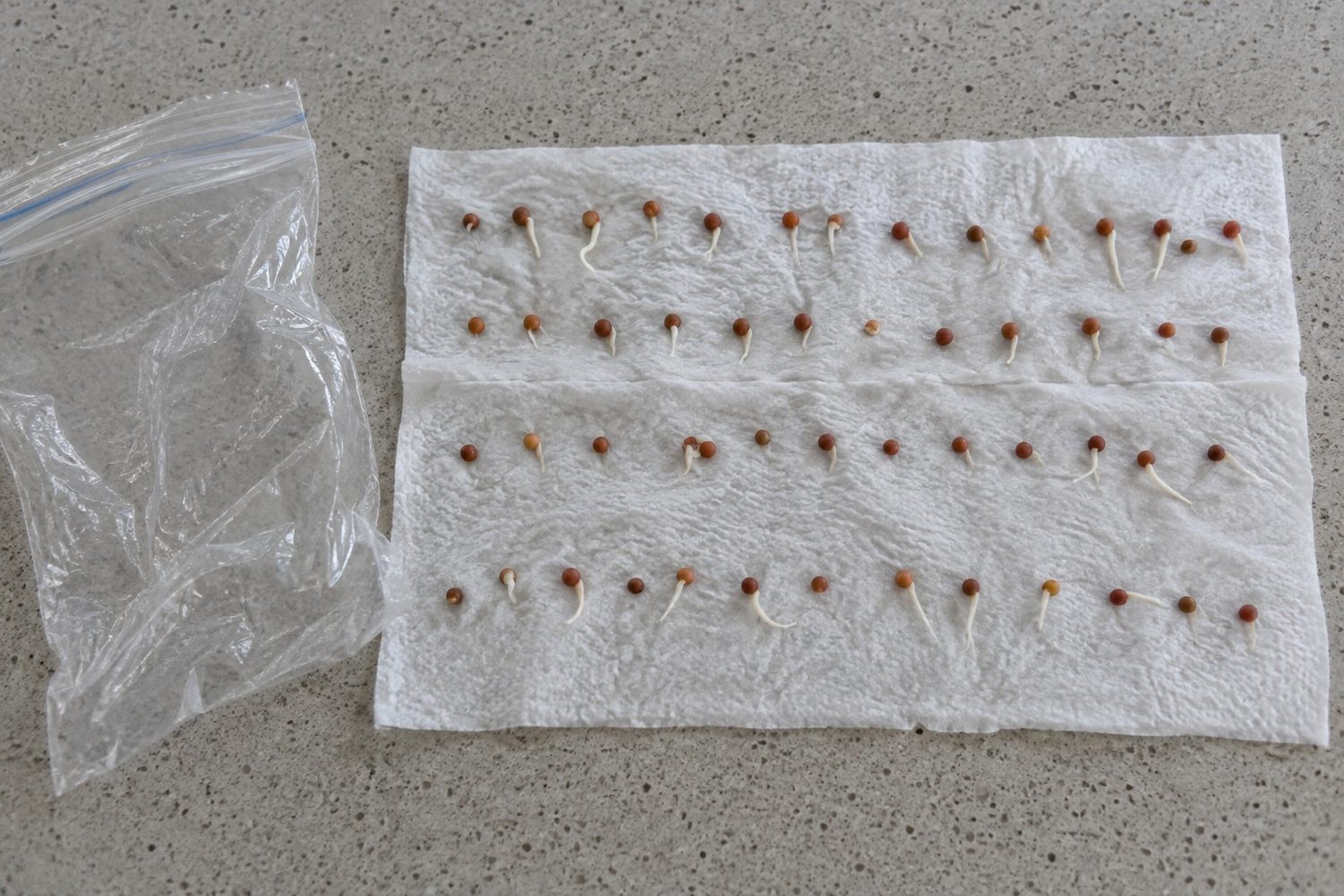
The University of Alaska Fairbanks Extension lists how long to run the test: radish and buckwheat 6 days, lettuce 7, peas 8, broccoli, cabbage and kale 10, carrot 14 and spinach 21. USU notes that radish may finish in as little as 2 to 3 days.
Pay attention to speed as well as the final count. Illinois Extension explains that vigor declines before the simple sprouting percentage does, so old seed can still sprout and yet give weak seedlings, and Oregon State University Extension makes the same point. For a dense tray, 90% of seeds sprouting eventually is not the same as 90% coming up together. Note how many had roots at your first check; if most of the count arrived late, expect an uneven tray.
Turn your result into a sowing rate
Start with the germination percentage your normal sowing rate was based on, usually the label figure or your first test of a fresh lot. Then:
adjusted grams = normal grams × assumed germination % ÷ current test %
Say your 10×20 tray normally takes 50 g of seed from a lot that tested at 90%. Your towel test gives 35 rooted seedlings out of 50, which is 70%. Sow 50 × 90 ÷ 70 = 64.3 g, and round it to 64 g for one trial tray. If you have never recorded your normal rate, measure the seed for your next good tray by weight and write it down, because that figure is the base for every adjustment after it. See sowing and seed density for setting that base rate.
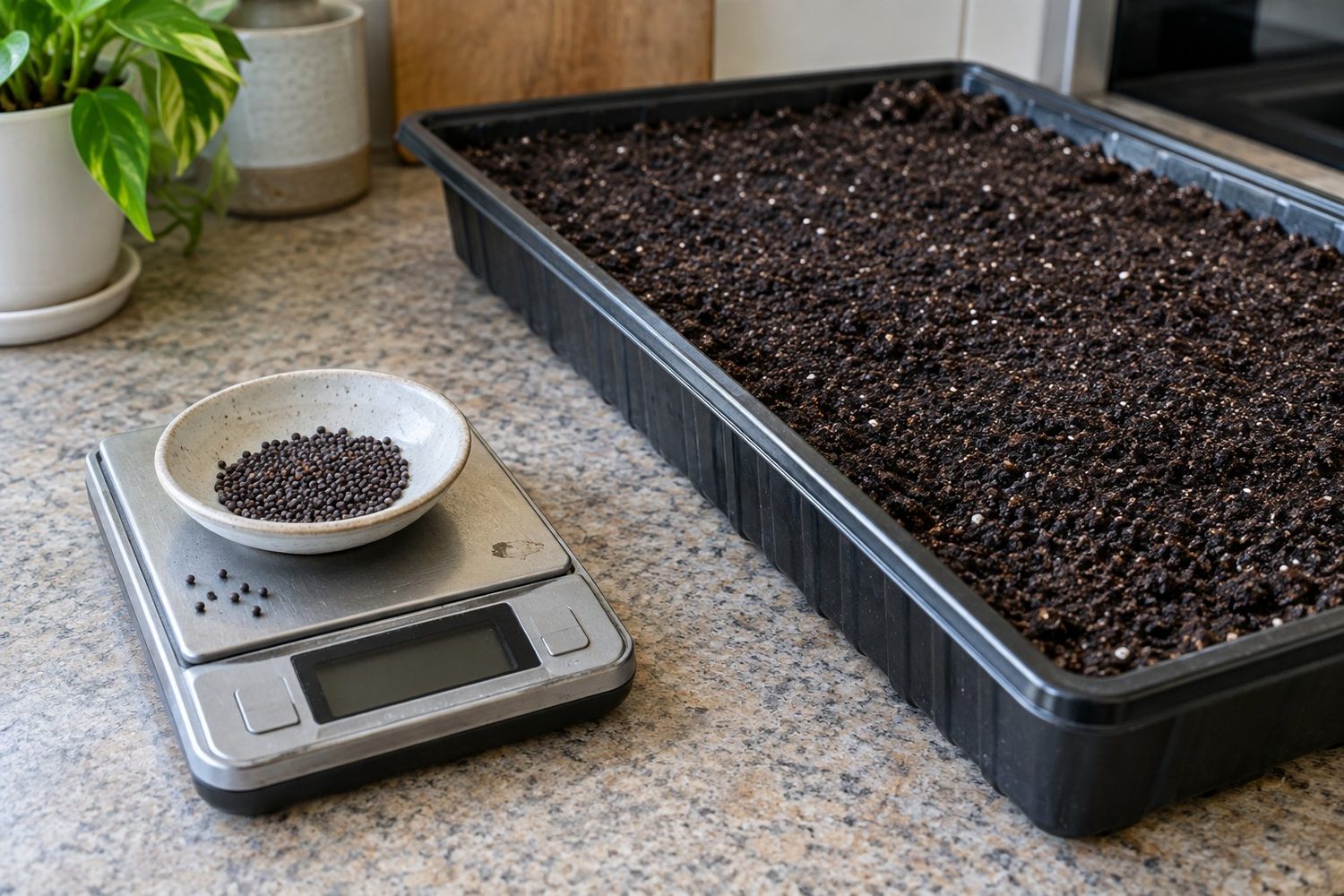
This arithmetic only makes up for the number of seeds that fail to sprout. It does not fix slow emergence, disease or hard seed, and sowing heavier brings its own crowding and mold risk. Run one small tray before committing a full batch. If emergence is still patchy at the adjusted rate, replace the lot rather than keep raising the density.
Sow heavier or buy new seed?
Illinois Extension's home garden advice is to sow slightly heavier when a test comes in at 70 to 90%, and to buy new seed when it falls below 50 to 60%. USU calls seed above 80% high quality, and for a test lower than normal it suggests sowing two or three times the usual garden rate. Both are garden guidance. For dense microgreen trays, set your own line: record each lot's test percentage next to how its trial tray turned out, and let those records decide where you stop sowing heavier.
Don't count on soaking to rescue old seed. No crop-specific evidence shows that an ordinary soak revives aged microgreen seed. CSU notes one exception of a different kind: peas and beans that were dried too far can become hard seed, and may germinate better after two weeks in humid air rather than an overnight soak. USU says old seed should not be given hot-water treatment. The guide to soaking microgreen seed covers soak times for seed in normal condition.
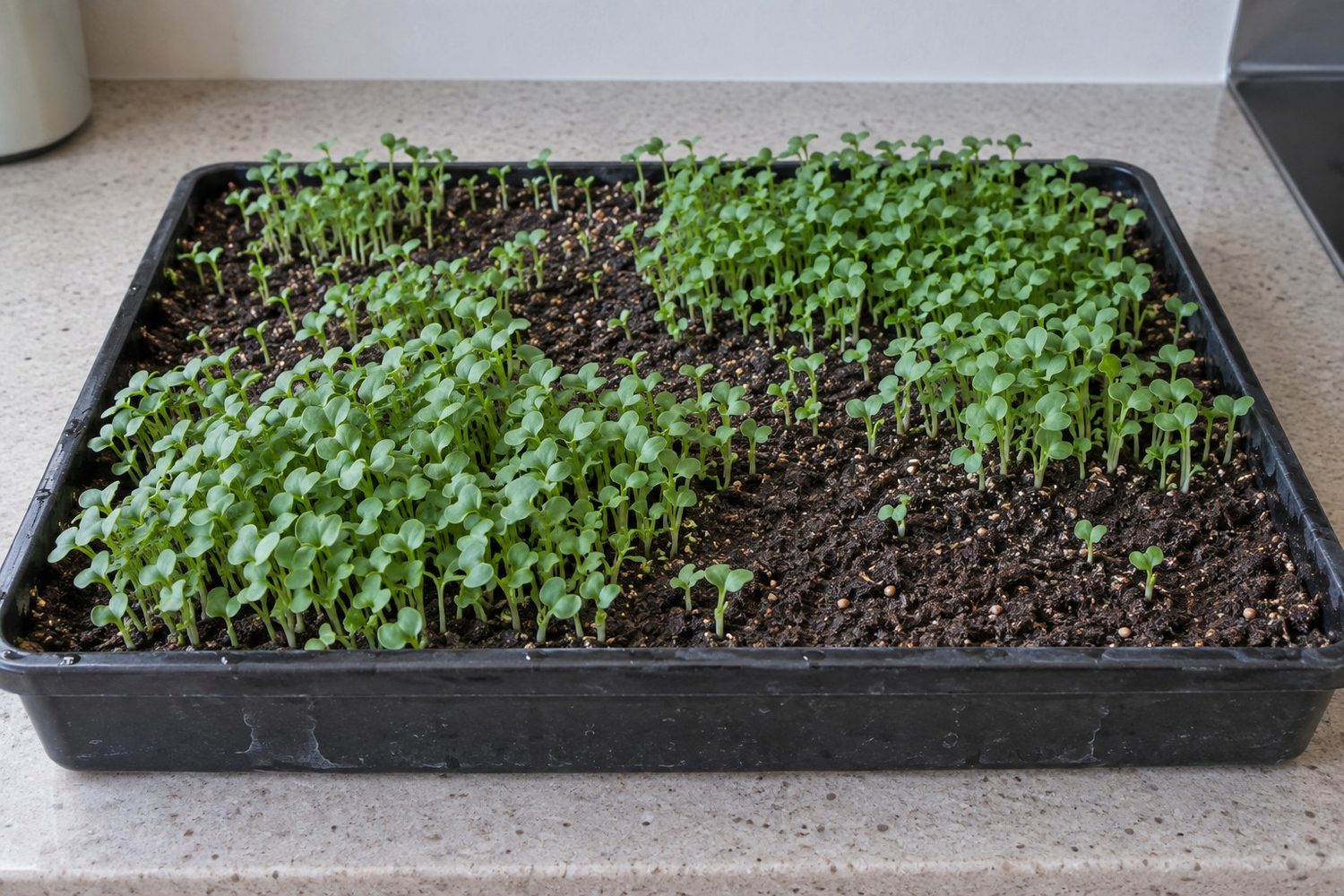
A patchy tray is not always the seed's age. Water, temperature, pathogens and sowing density can all produce the same uneven look, and mold on seed that never sprouted points first to sanitation and growing conditions. A George Mason University sunflower microgreen trial found less mold and higher germination where seed was sanitized before soaking, though it did not show that the non-germinating seeds caused the mold. If a tray fails after a good test, work through the poor germination checklist before blaming the lot.
What growers and sellers report
Sellers give their own shelf lives. Microgreen-shop says its seed keeps at least one year under cool, dark, dry and airtight storage (seller FAQ). Ingarden offers a two-year guarantee and says seed lasts longer kept cool, dry and out of sunlight (seller FAQ). On The Grow says 2 to 5 years, and advises using pea and sunflower within 1 to 2 years (seller blog).
Growers on r/microgreens report mixed results. In a thread from around 2020, one grower said 2017 radish seed still worked pretty well while a 2016 batch was terrible, and another said an arugula test lost 15% the following year (Reddit). In another 2020 thread, a grower reported old broccoli seed bought on Amazon still growing after two house moves (Reddit). Treat these as individual experience and seller guidance, and test your own bag.
Frequently asked questions
Are 10-year-old seeds still good?
They can be if they were dried and kept airtight in the cold. CSU says many seeds can last 10 years after drying below 8% moisture and refrigerating or freezing, and USU reports up to 10 years for airtight frozen seed. Under average storage, Illinois Extension's 2021 figures run only 1 to 2 years for the crops it lists, so run a towel test before you buy soil for old seed.
Is seed sold for microgreens different from garden seed of the same crop?
A 2023 survey in Frontiers in Sustainable Food Systems bought 102 microgreen seed samples across 14 species from 26 online vendors, but it tested their microbiological quality within three days, not their storage life. Garden seed tables are the closest published figures for the same species, and for eating, choose seed whose label and supplier suit raw food rather than colored, chemically treated garden seed.
Does organic seed keep longer?
Organic seed is not promised to keep longer. The USDA organic handbook defines which seed treatments are allowed and makes no claim about longevity, so test organic seed as you would any other bag. Processing is a separate question: USU says primed seed should be used in the same planting year.
Does old seed change the flavor or nutrition of microgreens?
If flavor matters for a sale, grow a small tray of old and fresh seed side by side and taste both.
Does sunflower seed go bad faster because it is oily?
Illinois Extension places sunflower in its 4 to 5 year group for properly stored seed. A September 2026 r/microgreens thread has growers reporting hard-to-crack sunflower germination and blaming a poor lot (Reddit), which is a reason to test each sunflower bag.
Before you fill a tray
Find your crop in the table, match the column to how your seed was stored, then count 25 to 50 seeds on a damp towel, adjust your sowing weight with the formula, and run one small tray. Write the test result, date and tray outcome on the bag, and next season you will have your own storage figure for that lot.
Sources
Prices, stock and specifications are as the linked pages showed them on 2026-09-12.
- Colorado State University Extension
- Utah State University Extension
- University of Georgia Extension's Table 1
- Illinois Extension's March 6, 2021 post
- Illinois Extension's January 20, 2023 post
- University of Arizona Extension
- vegetable guide
- 7 CFR Part 201
- bulk speckled pea page
- micro anise listing
- University of Alaska Fairbanks Extension
- Oregon State University Extension
- George Mason University sunflower microgreen trial
- seller FAQ
- seller FAQ
- seller blog
- Frontiers in Sustainable Food Systems
- USDA organic handbook
Keep reading
The test bench
Seed Storage for Microgreens: For 29 Crops the Container Costs More Than the Seed
A $1.29 jar has to save four trays of turnip seed to pay for itself, or 0.13 of a tray of barley grass. Nothing sold as airtight publishes a test, and a seal locks in whatever state the seed is already in.
Read Seed Storage for Microgreens: For 29 Crops the Container Costs More Than the SeedThe journal
How to Store Microgreens in Soil and Keep Them Growing
See how to store microgreens in soil so a ready tray keeps growing: what changes to expect, how watering should shift, and what is not yet established.
Read How to Store Microgreens in Soil and Keep Them GrowingThe journal
Can You Use Your Own Seeds in an AeroGarden?
Yes, you can use your own seeds in an AeroGarden. See current sponge and pod prices, seed counts per position, and sprouting times for your own crop.
Read Can You Use Your Own Seeds in an AeroGarden?The journal
Microgreen Seeding Rate Chart: Grams Per 1020 Tray
Find grams per 1020 tray for common crops in this microgreen seeding rate chart, plus why rates differ and how to set your own rate from a first tray.
Read Microgreen Seeding Rate Chart: Grams Per 1020 Tray