Disclosure: Microgreens Guru may earn a commission if you buy seed, trays or scales through some links on this site. It does not change the numbers below.
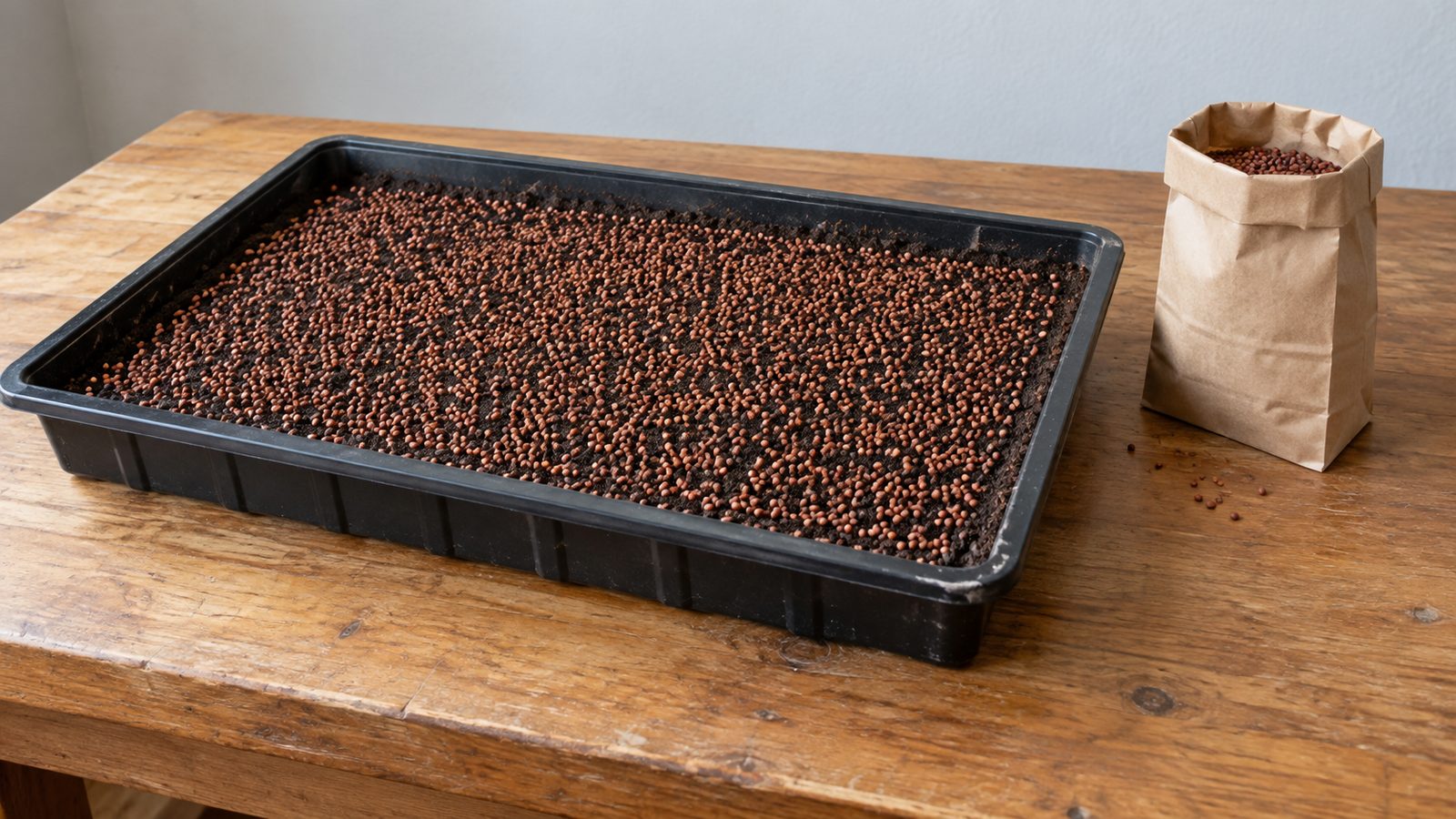
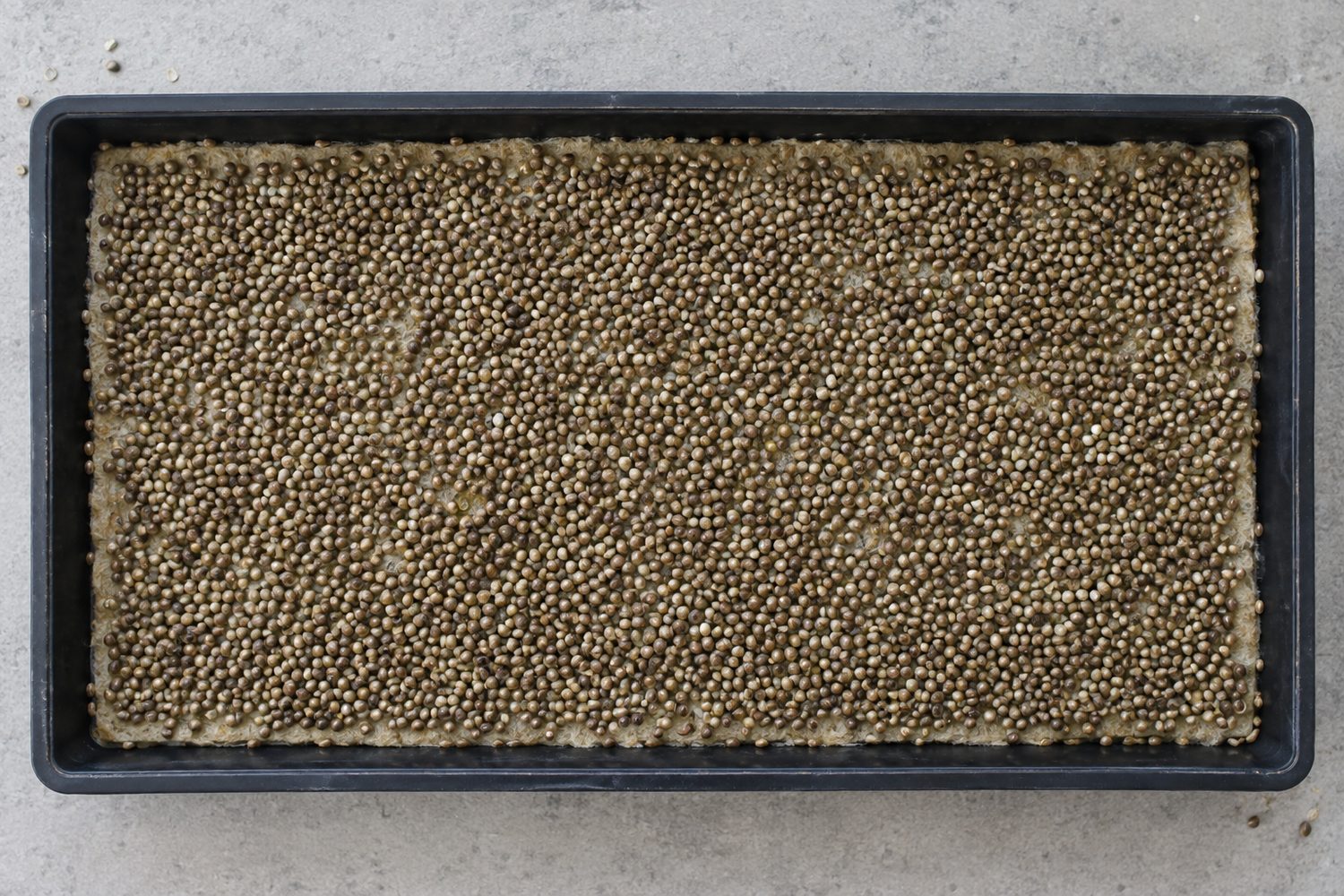
Most small-seeded microgreens are sown at about 10 to 20 grams of seed per 1020 tray, radish and cilantro at roughly 20 to 40 g, and the big shoot crops much heavier: sunflower at 48 to 250 g and pea shoots at 150 to 275 g. The chart below gives every rate crop by crop, with the source that publishes it, whether that source is a university extension service or a seed seller, and the tray size the source itself states. Pick a figure from the middle of your crop's range for the first tray, then adjust from what that tray does.
A 1020 here means a nominal 10 by 20 inch tray, about 200 square inches or 1,290 cm². The real growing floor is a little smaller: Bootstrap Farmer's own 1020 microgreen tray measures 19 3/4 by 9 1/2 inches on the inner bottom, about 187.6 square inches.
The chart: grams of seed per 1020 tray
Every rate below is published practice, not a tested best density. Seller figures are what that seller recommends. Johnny's Selected Seeds figures are a supplier's trial average: in 2017 Johnny's sowed 29 varieties in 1020 flats at least three times each, seeded by eye, with the packet weighed before and after, and harvested at the first true leaf (Johnny's trial sheet). Each variety went in at roughly one rate, so the figure records what was sown, not what worked best.
Hover or tap a row to highlight it.
| Crop | Grams per 1020 | Who gives it | Kind of figure | Tray the source states |
|---|---|---|---|---|
| Amaranth | 15 g | Bootstrap Farmer cheat sheet | Seller recommendation | 1020 |
| Amaranth | 15 to 20 g | Seedmart (Australia) | Seller recommendation | 1020 |
| Amaranth, Garnet Red | 7.5 g | Johnny's | Supplier's trial average | 1020 |
| Arugula | 10 g | Utah State University Extension | Extension guideline | 1020 |
| Arugula | 12 g | Bootstrap Farmer | Seller recommendation | 1020 |
| Arugula (rocket) | 10 to 12 g | Seedmart | Seller recommendation | 1020 |
| Arugula, Slow Bolt | 9 g | Mountain Valley Seed Co., on True Leaf Market | Seller recommendation | 10 by 20 inch |
| Arugula | 10 g | Johnny's | Supplier's trial average | 1020 |
| Basil | 28 g | Utah State | Extension guideline | 1020 |
| Basil, Genovese | 1 oz (28.3 g) | Mountain Valley Seed Co. | Seller recommendation | 10 by 20 inch |
| Basil | 10 g | Bootstrap Farmer | Seller recommendation | 1020 |
| Basil | 8 to 10 g | Seedmart | Seller recommendation | 1020 |
| Basil, Dark Opal / Red Rubin / Italian Large Leaf | 5 g / 6 g / 6.5 g | Johnny's | Supplier's trial average | 1020 |
| Beet, chard | 20 to 30 g | Bootstrap Farmer | Seller recommendation | 1020 |
| Beet, Bull's Blood / chard, Bright Lights | 23 g / 31.5 g | Johnny's | Supplier's trial average | 1020 |
| Broccoli | 28 g | Utah State | Extension guideline | 1020 |
| Broccoli, Waltham 29 | 1 oz (28.3 g) | Mountain Valley Seed Co. | Seller recommendation | 10 by 20 inch |
| Broccoli | 15 to 20 g | Bootstrap Farmer; Seedmart | Seller recommendation | 1020 |
| Broccoli | 13 g | Johnny's | Supplier's trial average | 1020 |
| Cabbage | 15 to 20 g | Bootstrap Farmer | Seller recommendation | 1020 |
| Cabbage, red | 10.5 g | Johnny's | Supplier's trial average | 1020 |
| Kale | 28 g | Utah State | Extension guideline | 1020 |
| Kale | 15 to 20 g | Bootstrap Farmer; Seedmart | Seller recommendation | 1020 |
| Kale, Red Russian | 10 g | Johnny's | Supplier's trial average | 1020 |
| Cilantro | 28 g | Utah State | Extension guideline | 1020 |
| Cilantro | 30 to 40 g, whole seed | Bootstrap Farmer | Seller recommendation | 1020 |
| Cilantro | 25 to 35 g | Seedmart | Seller recommendation | 1020 |
| Cilantro | 26 g | Johnny's | Supplier's trial average | 1020 |
| Mustard, mizuna | 10 to 15 g | Bootstrap Farmer; Seedmart | Seller recommendation | 1020 |
| Mustard, Garnet Giant / mizuna | 8 g / 9.5 g | Johnny's | Supplier's trial average | 1020 |
| Radish | 42 g | Utah State | Extension guideline | 1020 |
| Radish | 30 to 35 g | Bootstrap Farmer | Seller recommendation | 1020 |
| Radish | 28 to 35 g | Seedmart | Seller recommendation | 1020 |
| Radish | 20 to 30 g | True Leaf Market | Seller recommendation | 1020 |
| Radish (Daikon to Hong Vit) | 22.5 to 28.5 g | Johnny's | Supplier's trial average | 1020 |
| Sorrel | 3 g | Bootstrap Farmer; Seedmart (about 3 g) | Seller recommendation | 1020 |
| Sorrel, red-veined | 3.5 g | Johnny's | Supplier's trial average | 1020 |
| Pea shoots | 150 g, 6 hour presoak | Utah State | Extension guideline | 1020 |
| Pea shoots | 200 to 275 g | Bootstrap Farmer; Seedmart | Seller recommendation | 1020 |
| Black oil sunflower | 48 g, 12 hour presoak | Utah State | Extension guideline | 1020 |
| Black oil sunflower | 150 g and 250 g | Bootstrap Farmer (cheat sheet; resource chart) | Seller recommendation | 1020 |
| Black sunflower | 150 to 170 g | Seedmart | Seller recommendation | 1020 |
| Popcorn shoots | 225 to 275 g | Bootstrap Farmer | Seller recommendation | 1020 |
| Wheatgrass | 450 g | Bootstrap Farmer | Seller recommendation | 10 by 20 inch |
| Most crops (general rate) | 8.3 to 12.5 g (converted) | Penn State Extension | Extension guideline | 12 by 20 inch |
Bootstrap Farmer also lists 15 to 20 g for kohlrabi, cauliflower, collards, lettuce, parsley and clover, and 10 to 15 g for red komatsuna. Seedmart gives 15 to 20 g for kohlrabi and parsley. Utah State gives 28 g for mesclun mix and rutabaga.
A few notes on reading the chart. Bootstrap Farmer prints ounce figures beside its grams, and they are rounded (its 15 to 20 g is printed as 0.5 oz, though it is really 0.53 to 0.71 oz), so use the gram figure. Mountain Valley Seed Co.'s 1 oz converts at 28.35 g to the ounce, which gives 28.3 g. Seedmart publishes a second, smaller column for a 30 by 35 cm tray (radish 23 to 28 g, sunflower 120 to 140 g), which is about 81 percent of a 1020, so the chart uses its 1020 column only.
The one conversion in the chart
Penn State Extension reports success with 10 to 15 g of seed for most of the microgreens it grows, but on a "standard 12-inch x 20-inch 10-row seeding tray," which is 240 square inches rather than 200. Scaled by growing area:
- 10 g × 200 ÷ 240 = 8.3 g per 10 by 20 inch tray
- 15 g × 200 ÷ 240 = 12.5 g per 10 by 20 inch tray
That is the only rate on the chart that needed converting, because every other source states its rate per 1020 or per 10 by 20 inch tray directly. The same arithmetic works for any tray you own: new rate = published rate × your growing area ÷ the source's growing area. A 20 g rate for a 200 square inch tray becomes 10 g on a 10 by 10 inch tray and 2.5 g on a 5 by 5 inch insert. Bootstrap Farmer's chart uses the same rule, halving the 1020 rate for a 1010 and dividing by eight for a 5 by 5. The sowing and seed density page covers spreading the seed once you have the number.
Why the numbers spread so far
Some crops show a narrow band. Arugula runs from 9 g to 12 g across every source on the chart. Others are wide enough to look like a typo, and they are not.
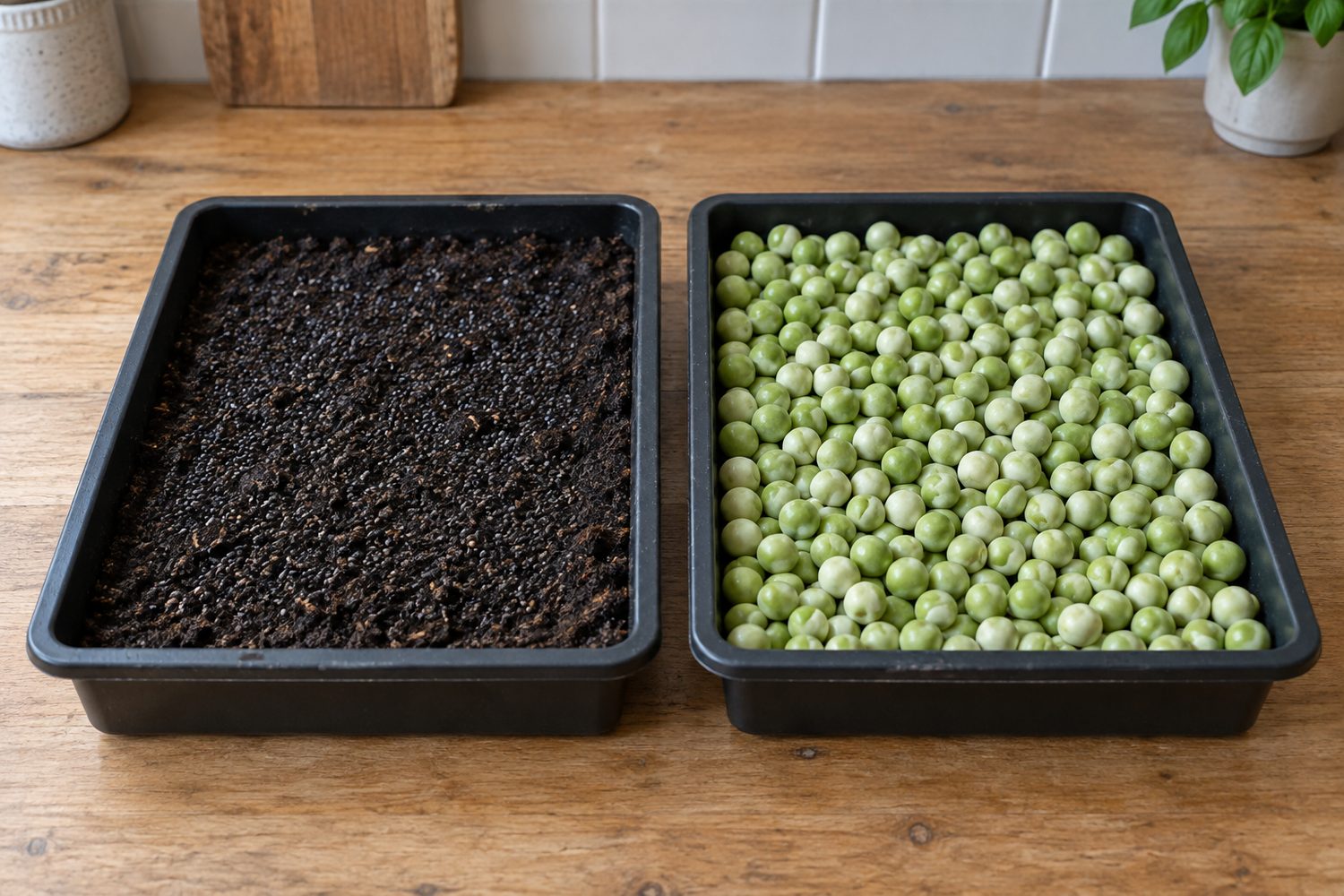
Basil runs from 5 g to 28 g per 1020, a factor of 5.6 between Johnny's Dark Opal trial average and Utah State's 28 g, with Mountain Valley Seed Co.'s 1 oz sitting at the top too. Black oil sunflower runs from 48 g to 250 g, a factor of 5.2 between Utah State and Bootstrap Farmer's resource chart. Bootstrap Farmer itself gives sunflower as both 150 g and 250 g, and Seedmart sits between at 150 to 170 g.
Penn State Extension gives the reasons seeding rates vary: the germination rate of the seed, the size of the seed, and the season and growing conditions, including soil and air temperature and light. It recommends lower rates for larger seed than for smaller seed, and lower rates in summer.
Both of the first two reasons come down to how many live plants a gram of seed actually delivers. A lot that germinates at 70 percent puts fewer seedlings on the tray than the same weight of a lot at 95 percent. A lot with bigger seeds has fewer seeds in every gram. A gram figure on a chart cannot promise the same stand from one seed lot to the next.
What the density trials found
A handful of studies have sown one crop at several densities and measured the result. Each is one study, on its own seed lot, in its own growing setup, and none of them publishes a rate in grams per 1020. The conversions below are arithmetic on each study's figures and a 1,290 cm² tray.
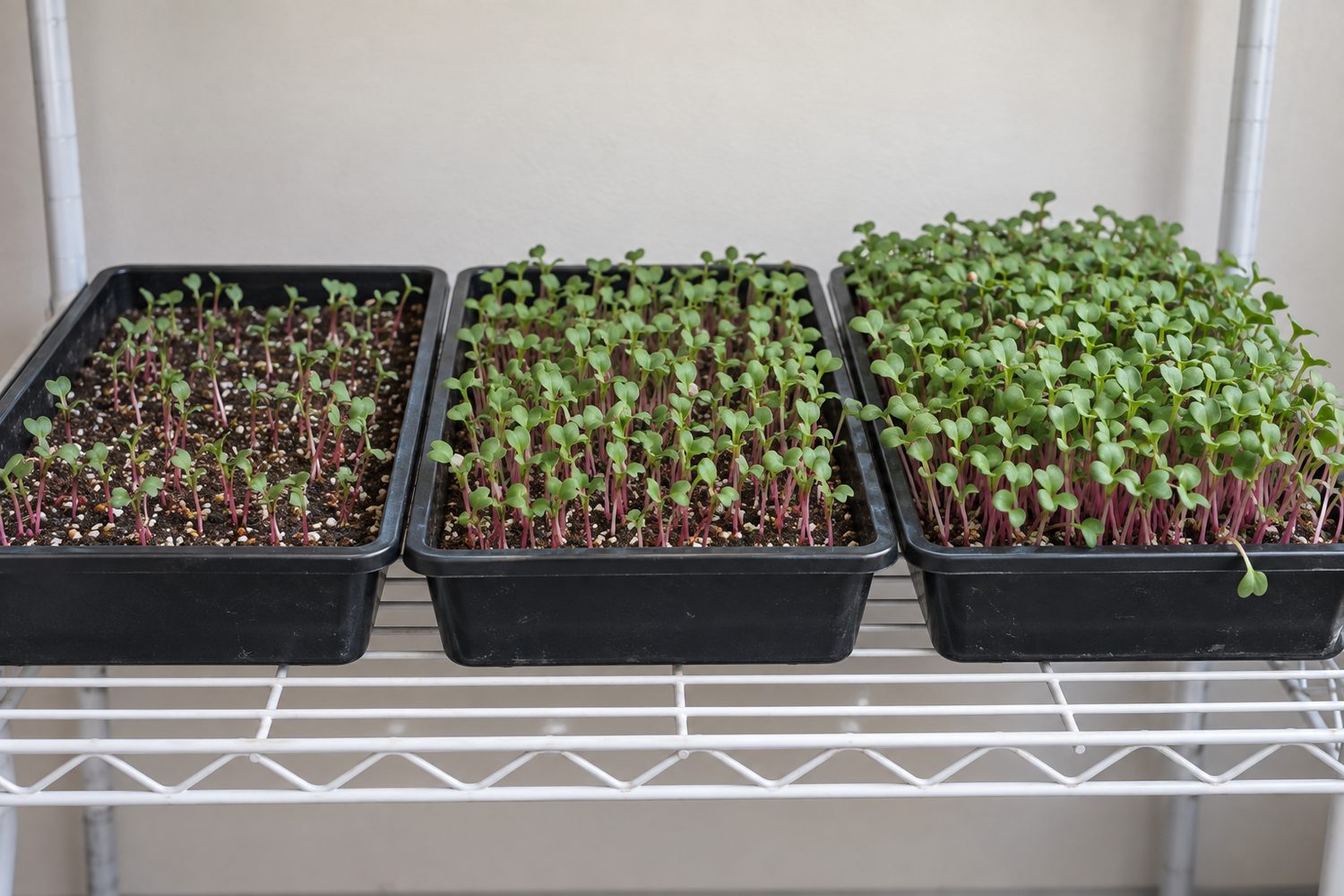
Radish. In a greenhouse trial in Vinh Phuc, Vietnam (Thuong and Minh, 2020), fresh shoot yield peaked at 8 seeds per cell, which the authors put at 109.81 g of seed per square meter, and fell at the highest density. On a 1020 that works out as 109.81 × 0.129 = about 14.2 g, and the 8 to 10 seeds per cell range comes to roughly 14 to 18 g. Published radish rates on the chart run 20 to 42 g. The study also recorded root rot in some trays at its highest density, 164.72 g per square meter, about 21.3 g on a 1020. That was one crop, one seed lot of about 10 g per 1,000 seeds, machine-sown cell trays and one harvest, so treat it as a single data point rather than a limit for your tray.
Mungbean, lentil and Indian mustard. A study of 20 mungbean, 20 lentil and two Indian mustard lines (Priti and colleagues, 2022) found yield kept rising with density, but set the optimum at 3 seeds per square centimeter for mungbean and lentil and 8 for mustard, because above that the shoots stretched and marketable quality dropped. Using the study's own seed weights, 3 seeds per cm² on a 1020 is 116 to 209 g of mungbean or 77 to 151 g of lentil, and 8 seeds per cm² is 34 to 45 g of Indian mustard. That mustard seed weighed 3.3 to 4.4 mg each, against about 2 mg for the Garnet Giant lot in the Frontiers study below, so do not read 34 to 45 g against the 8 to 15 g mustard rates above. None of the sources on the chart publishes a mungbean or lentil rate, so those two figures are the only numbers available.
Six crops at three densities. A 2025 growth-chamber study by Balık and Yıldız-Daşgan (full text) sowed broccoli, radish, beet, pea, sunflower and bean at a full-cover rate, then 50 and 100 percent more. Its gram figures come from small containers and scale to several times any published tray rate, so they do not carry over to a 1020. The pattern does: for broccoli and sunflower, yield per square centimeter went up as density rose while the weight of each plant went down. More seed buys more total weight, in smaller, lighter plants.
One fixed density per species. A 17-species greenhouse study in Frontiers in Plant Science (2023) grew each species at a single chosen density, for example black oil sunflower at 1 seed per cm² and arugula at 4. Density was not tested, so it tells you nothing about which rate works better.
Finding your own rate from the first tray
The chart gets you a starting weight. Your own seed lot, tray and room decide the rest, and one tray tells you more than any published figure can.
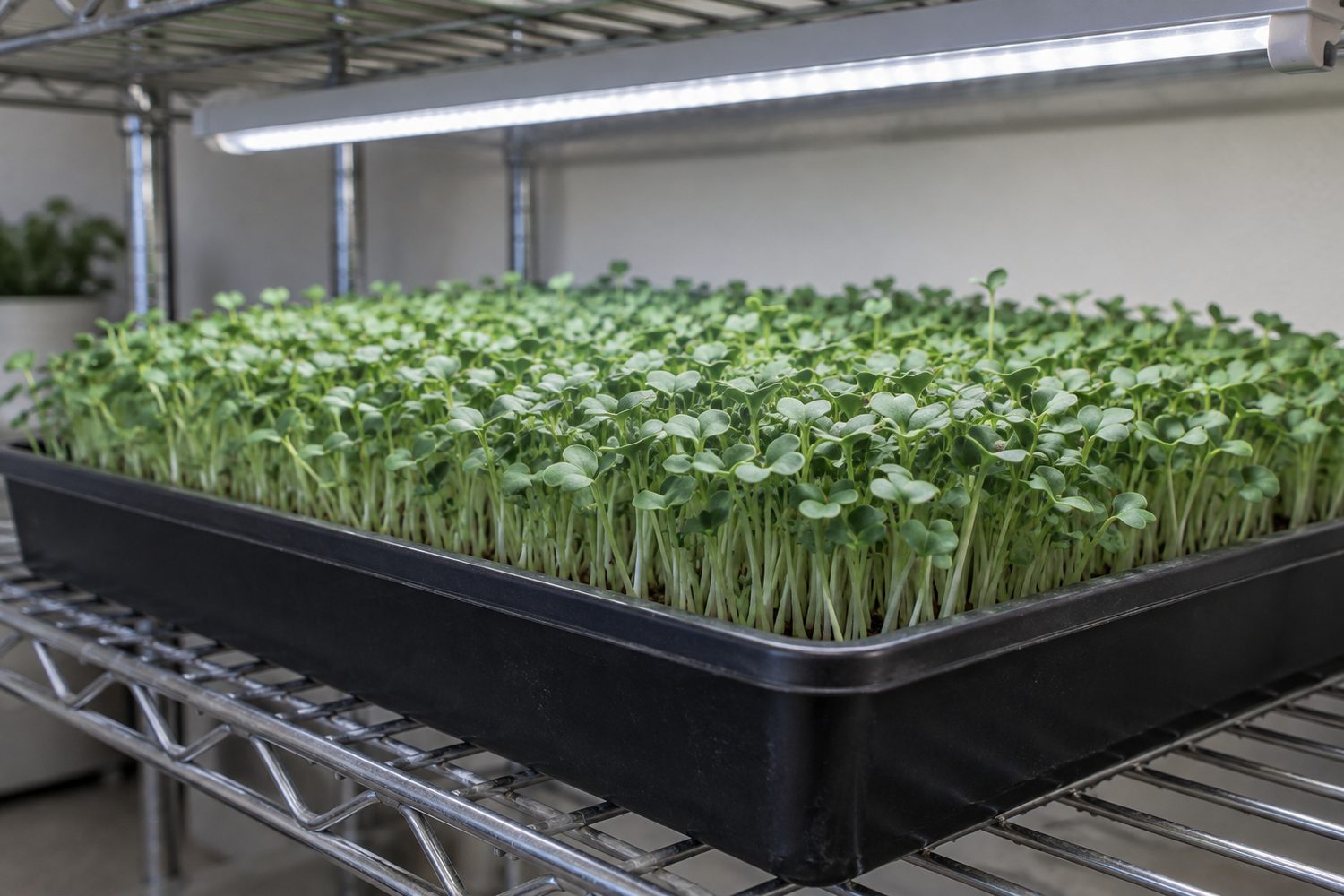
- Pick a mid-range figure for your crop from the chart. For broccoli that might be 15 to 20 g, for radish around 28 to 30 g, for sunflower about 150 g.
- Weigh it on a gram scale. Volume measures drift with seed size; a scale that reads to the gram takes the guesswork out. Soak large seed such as pea and sunflower first if that is your practice; the soaking page covers which crops need it.
- Write down the seed weight, the lot and the date on the tray label or in a notebook.
- Watch germination and the stand. Bare patches point to low germination. Crowded, stretched, matted seedlings point to too much seed, and density is a factor in mold: Bootstrap Farmer and True Leaf Market both warn that overcrowded trays trap moisture and cut air flow.
- Weigh the harvest and note it beside the seed weight. The pages on what a tray actually yields and yield per square foot give you figures to compare against.
- Adjust the next sowing. Following Penn State's reasons, go lighter if your seed is large or it is summer, and heavier if germination ran low. Johnny's adds that if you want larger microgreens than first true leaf, you should sow fewer seeds per flat for more air flow.
Two or three trays in, you will have a rate for your crop, your seed and your setup that no chart can give you. If you buy seed in bulk, a new lot can germinate or size differently, so run one test tray at your usual rate before committing a full batch; the bulk seed page covers buying it.
Common questions
What if my crop is not on the chart? Start from a general rate. Penn State's 10 to 15 g on a 12 by 20 inch tray converts to 8.3 to 12.5 g per 1020, and Virginia Cooperative Extension uses 13 g per 1020 as an example while advising you to test rates for your own setup and cultivar. Go lighter for large seed and heavier if germination runs low.
How do I adjust a rate for a 10 by 10 tray or a 5 by 5 insert? Scale by area. A 10 by 10 tray is half of a 1020, so halve the rate, and a 5 by 5 insert is one eighth, so divide by eight. Bootstrap Farmer's chart and Seedmart both use this same area rule.
Should cilantro seed be whole or split? Bootstrap Farmer's 30 to 40 g per 1020 is for whole seed, and its cheat sheet recommends split seed. Utah State gives 28 g, Seedmart 25 to 35 g and Johnny's trial average was 26 g, so cilantro sits well above the other herbs on the chart whichever source you use.
Does a tablespoon work instead of a scale? Penn State says one tablespoon of brassica seed weighs about 11 to 12 g, which puts one level tablespoon close to the small-seeded rates on the chart. True Leaf Market gives its radish rate as 2 to 3 tablespoons, or 20 to 30 g. A scale is still the more repeatable choice, since seed size changes the weight of a spoonful.
Is a higher seeding rate always more yield? In the density trials, total yield usually rose with more seed, but each plant got lighter, and the radish trial's yield fell at its highest density. The mungbean, lentil and mustard study set its best density below the yield peak because the shoots stretched and quality dropped.
Start in the middle of your crop's range, weigh the seed and the harvest, and let your first tray set the number for the second.
Sources
Prices, stock and specifications are as the linked pages showed them on 2026-09-26.
- Bootstrap Farmer's own 1020 microgreen tray
- Johnny's trial sheet
- Bootstrap Farmer cheat sheet
- Seedmart
- Utah State University Extension
- Mountain Valley Seed Co., on True Leaf Market
- Mountain Valley Seed Co.
- Mountain Valley Seed Co.
- True Leaf Market
- resource chart
- Penn State Extension
- Thuong and Minh, 2020
- Priti and colleagues, 2022
- full text
- Frontiers in Plant Science (2023)
- Virginia Cooperative Extension
Keep reading
The journal
Can You Use Your Own Seeds in an AeroGarden?
Yes, you can use your own seeds in an AeroGarden. See current sponge and pod prices, seed counts per position, and sprouting times for your own crop.
Read Can You Use Your Own Seeds in an AeroGarden?The journal
How Long Do Microgreen Seeds Last in Storage?
How long do microgreen seeds last on the shelf? Compare sourced storage ranges by crop, learn why tables disagree, and test old seed before wasting a tray.
Read How Long Do Microgreen Seeds Last in Storage?The journal
Microgreen Seeds vs Regular Seeds: What the Label Must Say
Microgreen seeds vs regular seeds: garden packets, dried beans, and birdseed follow different label rules. Know what to check before you sow any bag to eat.
Read Microgreen Seeds vs Regular Seeds: What the Label Must SayThe journal
The Cheapest Microgreens to Grow, Tray by Tray
Find the cheapest microgreens to grow by seed cost per tray and per ounce of harvest, plus how small a share seed is of the full cost of a tray.
Read The Cheapest Microgreens to Grow, Tray by Tray