Microgreens Yield per Square Foot, Crop by Crop
Cal HewittPublished Checked
- yield
- growing
- business planning
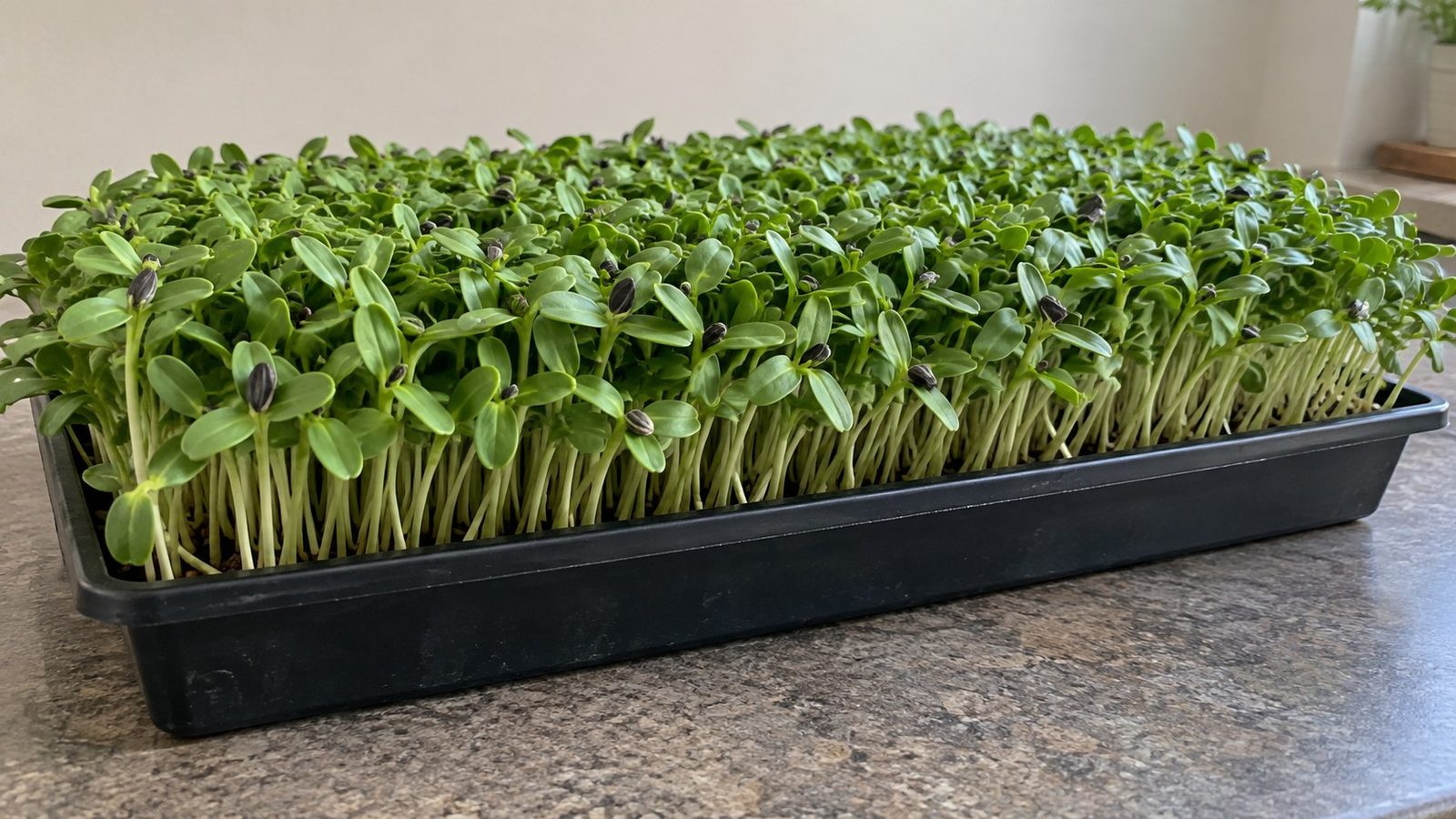
A square foot of growing area produced about 1.34 to 7.40 ounces of microgreens per harvest in the one controlled trial that measured 17 crops by area, with radish at the top and lemon balm at the bottom.
Published per tray yields from growers and seed sellers, converted the same way, put the median crop at 5.08 ounces per square foot per harvest, or 2.52 ounces per square foot for each week the tray is in use. Those are square feet of growing area, not of shelf or floor. To convert any tray weight yourself, divide it by 1.39, the square footage of a nominal 1020 tray.
How to turn a tray weight into ounces per square foot
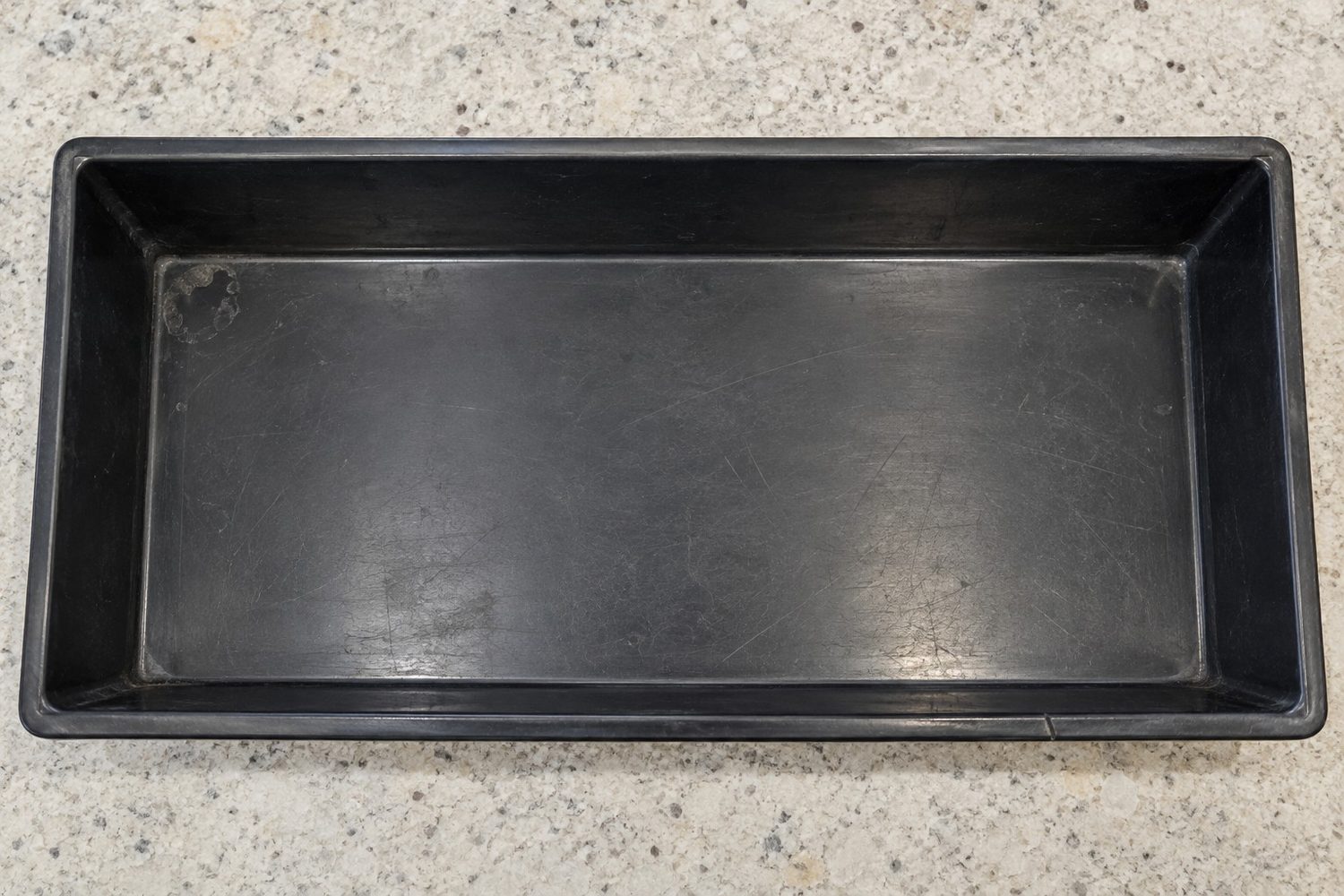
Almost every published microgreen yield is written against a 1020 tray, which is nominally 10 by 20 inches, or 200 square inches. That comes to 1.39 square feet (0.129 square meters). Divide a tray weight by 1.39 and you have ounces per square foot of tray; multiply a per square foot figure by 1.39 and you're back to a tray. A sunflower tray that yields 18.77 ounces, for example, works out to 13.51 ounces per square foot.
Two more conversions help when you read research papers, which usually report yield in grams or kilograms per square meter. One gram per square meter is 0.00328 ounces per square foot. One pound per square foot is 22.2 ounces from a single nominal 1020, which is a useful check when you see a pounds per square foot claim and want to know what it would mean for one tray.
The nominal size is a little generous. Two 1020 trays on sale measure 187.6 and 192.6 square inches of inside floor, which is 1.30 and 1.34 square feet, so the area your seed actually sits on is 3.7 to 6.2 percent smaller than the 200 on the label. For published figures, stay with 1.39, since that's the size they were written against. For your own trays, measure the inside floor and use that number instead. The tray setup and drainage page covers real inside tray areas in more detail.
Seventeen crops grown side by side
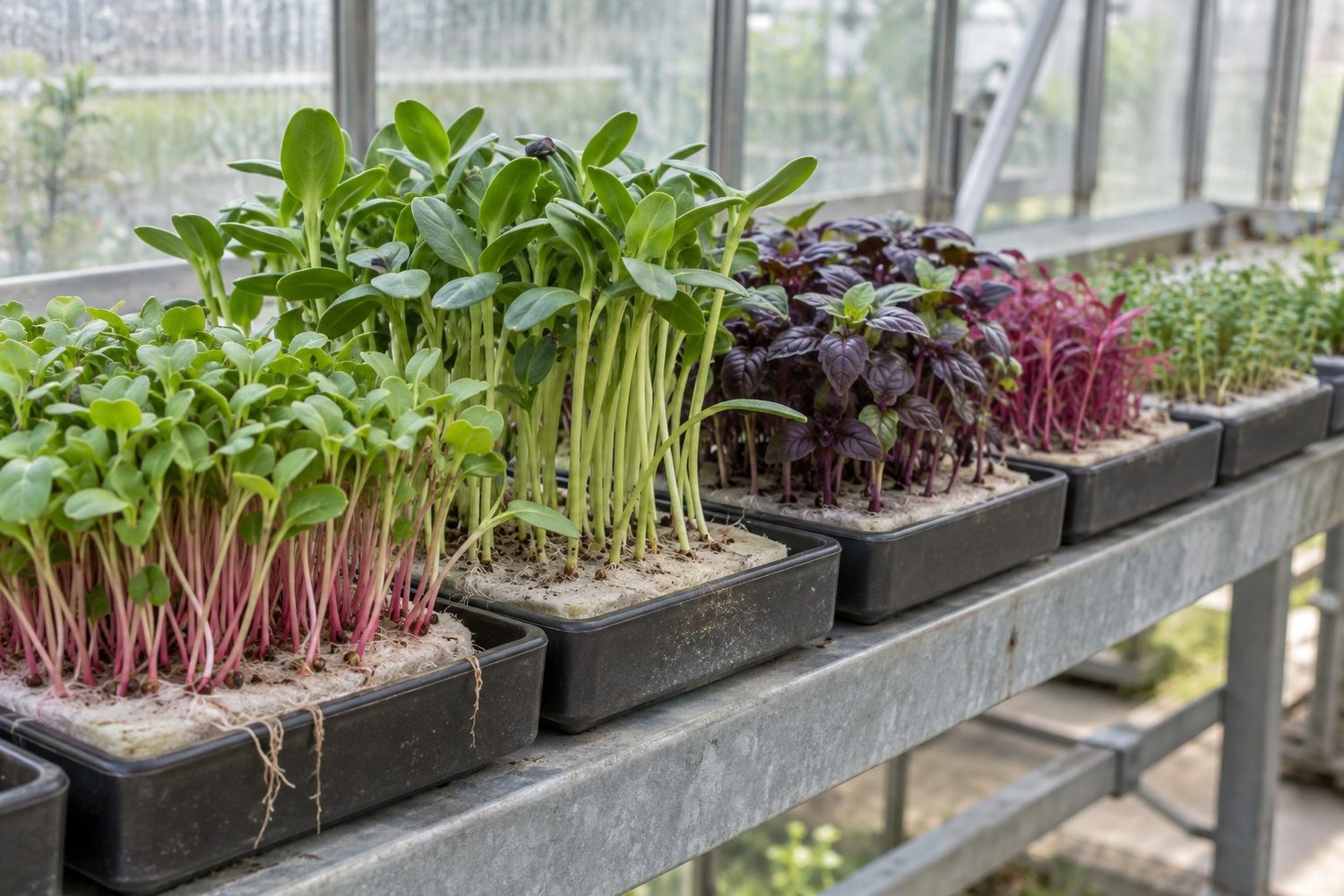
The cleanest per area comparison comes from Di Gioia and colleagues (2023), published in Frontiers in Plant Science. They grew 17 microgreen species in one trial period, in a greenhouse set at 20 and 28 C (averaging 25.4 C), on 25 by 25 cm BioStrate felt mats fed with a nutrient solution, and reported fresh weight per square meter. The average across all 17 was 1,175.7 grams per square meter. Because every crop went through the same system, the 5.5-fold span between the lowest and highest crop comes down to the crop itself.
Read these as reference points from one trial, not a ranking that will hold on your shelf. The cultivar, seed density and harvest stage the researchers used are built into each number, and your own trays may land higher or lower.
Hover or tap a row to highlight it.
| Crop | oz per sq ft | lb per sq ft | Nominal 1020 equivalent, oz |
|---|---|---|---|
| Radish | 7.40 | 0.46 | 10.3 |
| Borage | 5.79 | 0.36 | 8.0 |
| Sunflower | 5.43 | 0.34 | 7.5 |
| Broccoli | 4.79 | 0.30 | 6.7 |
| Kale | 4.73 | 0.30 | 6.6 |
| Arugula | 4.32 | 0.27 | 6.0 |
| Red cabbage | 4.10 | 0.26 | 5.7 |
| Mizuna | 3.97 | 0.25 | 5.5 |
| Mustard | 3.54 | 0.22 | 4.9 |
| Dark Opal basil | 3.36 | 0.21 | 4.7 |
| Britton shiso | 3.31 | 0.21 | 4.6 |
| Cress | 3.26 | 0.20 | 4.5 |
| Genovese basil | 3.05 | 0.19 | 4.2 |
| Amaranth | 2.94 | 0.18 | 4.1 |
| Beet | 2.29 | 0.14 | 3.2 |
| Scallion | 1.87 | 0.12 | 2.6 |
| Lemon balm | 1.34 | 0.08 | 1.9 |
Radish, borage and sunflower led, with broccoli and kale close behind at 4.79 and 4.73 ounces per square foot. Beet, scallion and lemon balm sat at the bottom. If you're choosing between crops for a small space and your conditions resemble a soilless mat system, this table shows how far apart crops can be when nothing else changes.
Per tray yields from growers and seed sellers, converted
Most crops have never been through a controlled per area trial, but many have a published per tray weight. The table below takes 39 crops with a numeric yield per 1020 and converts each to ounces per square foot. Ten of those figures trace to Johnny's 2017 trial of 29 varieties, grown in a greenhouse in germination mix, harvested at first true leaf, with poorly germinating flats left out: kale, kohlrabi, pak choi, mizuna, radish, Swiss chard, tatsoi, garden cress, shiso and sorrel. The rest come from other published sources, named on each crop's own page. Johnny's is the widest single set, and it reflects a seller's growing practice rather than a lab protocol.
Keep this table separate from the trial table above. The two come from different systems and sources, so a crop that appears in both, radish for one, carries different numbers in each, and neither set can be folded into the other.
Hover or tap a row to highlight it.
| Crop | oz per 1020 | oz per sq ft | Days to harvest (mean) | oz per sq ft per week |
|---|---|---|---|---|
| Sunflower | 18.77 | 13.51 | 10.5 | 9.01 |
| Komatsuna | 10.60 to 13.40 | 7.63 to 9.65 | 10.0 | 6.05 |
| Broccoli | 11.50 | 8.28 | 11.0 | 5.27 |
| Kale | 11.00 | 7.92 | 11.5 | 4.82 |
| Kohlrabi | 11.00 | 7.92 | 13.0 | 4.26 |
| Pak choi | 11.00 | 7.92 | 10.5 | 5.28 |
| Arugula | 10.00 | 7.20 | 12.5 | 4.03 |
| Mizuna | 10.00 | 7.20 | 11.5 | 4.38 |
| Radish | 8.00 to 11.50 | 5.76 to 8.28 | 8.0 | 6.14 |
| Mustard | 9.50 | 6.84 | 12.5 | 3.83 |
| Swiss chard | 9.50 | 6.84 | 17.5 | 2.74 |
| Red cabbage | 8.50 | 6.12 | 11.5 | 3.73 |
| Tatsoi | 8.50 | 6.12 | 11.5 | 3.73 |
| Borage | 8.05 | 5.80 | 15.5 | 2.62 |
| Garden cress | 8.00 | 5.76 | 11.5 | 3.51 |
| Pea shoots | 8.00 | 5.76 | 11.0 | 3.67 |
| Spinach | 7.20 to 8.80 | 5.18 to 6.34 | 16.0 | 2.52 |
| Bull's Blood beet | 7.50 | 5.40 | 19.5 | 1.94 |
| Lentil | 6.10 to 8.40 | 4.39 to 6.05 | 10.0 | 3.65 |
| Broccoli raab | 5.29 to 8.82 | 3.81 to 6.35 | 9.5 | 3.74 |
| Amaranth | 6.50 | 4.68 | 14.5 | 2.26 |
| Basil | 5.50 to 7.50 | 3.96 to 5.40 | 19.0 | 1.72 |
| Shiso | 6.50 | 4.68 | 23.0 | 1.42 |
| Sorrel | 6.50 | 4.68 | 23.5 | 1.39 |
| Parsley | 6.25 | 4.50 | 28.0 | 1.13 |
| Cilantro | 6.00 | 4.32 | 19.0 | 1.59 |
| Flax | 5.00 to 7.00 | 3.60 to 5.04 | 9.5 | 3.18 |
| Leek | 5.64 | 4.06 | 17.5 | 1.62 |
| Nasturtium | 5.64 | 4.06 | 16.5 | 1.72 |
| Chives | 3.80 to 5.60 | 2.74 to 4.03 | 22.0 | 1.08 |
| Fenugreek | 3.90 to 4.30 | 2.81 to 3.10 | 9.0 | 2.30 |
| Chervil | 3.00 to 5.00 | 2.16 to 3.60 | 15.0 | 1.34 |
| Clover | 3.00 to 5.00 | 2.16 to 3.60 | 11.0 | 1.83 |
| Dill | 3.00 to 5.00 | 2.16 to 3.60 | 18.5 | 1.09 |
| Celosia | 3.40 | 2.45 | 12.5 | 1.37 |
| Thyme | 3.30 | 2.38 | 27.5 | 0.60 |
| Carrot | 2.00 | 1.44 | 19.5 | 0.52 |
| Onion | 1.29 | 0.93 | 15.5 | 0.42 |
| Fennel | 1.00 | 0.72 | 20.5 | 0.25 |
The median crop in this set yields 7.05 ounces a tray, which is 5.08 ounces per square foot per harvest. Where a crop shows a range, the published figures disagree, and that spread is worth keeping in mind before you plan around the top of it. The pea shoot row is 8 oz from 150 g of seed; one New Hampshire farm's USDA SARE grant report recorded 17.28 oz a tray on a stated 10 by 20 inch tray from 6.8 oz (193 g) of soaked seed in winter 2020 to 21, a heavier sowing and one farm's result (SARE FNE20-966).
Per harvest and per week are different numbers
The per harvest column tells you what a square foot of tray gives you once. The per week column divides the average yield by the average days to harvest and multiplies by seven, so it tells you what that square foot produces for each week a tray is sitting on it. If you're growing for a single batch, the per harvest figure is the one you want. If you're filling a shelf for steady weekly sales, the per week figure is closer to your real question.
The two can tell very different stories. Amaranth and shiso both yield 4.68 ounces per square foot per harvest, but amaranth is ready in 14.5 days on average and shiso takes 23.0, so amaranth gives you 2.26 ounces per square foot per week against 1.42 for shiso. Parsley looks respectable at 4.50 ounces per harvest, then drops to 1.13 per week because it takes 28.0 days. Radish goes the other way: its per harvest range is middling, but at 8.0 days it reaches 6.14 ounces per square foot per week.
Measured per week, the crops that made the best use of tray space in this set were sunflower at 9.01, radish at 6.14, komatsuna at 6.05, pak choi at 5.28, broccoli at 5.27 and kale at 4.82. The slowest were chives at 1.08, thyme at 0.60, carrot at 0.52, onion at 0.42 and fennel at 0.25. The median crop comes to 2.52 ounces per square foot per week.
One limit on the per week figure: it only counts the days a tray is occupied. It ignores days a tray sits empty between crops, so if your trays turn over with gaps, your actual weekly output per square foot will be lower than the column shows.
A square foot of tray is not a square foot of rack or floor
Every figure so far is per square foot of tray. A square foot of tray is 0.72 of a 1020. A square foot of rack is a different area, because a rack stacks trays on several levels, and a square foot of floor is different again, because a room needs space to walk and reach.
University of Missouri Extension publishes the one budget that puts numbers on a rack. Its layout holds 16 tray positions, four 1020s on each of four levels, against 8 square feet, which is 2 tray positions per square foot of rack. That square foot of rack carries 2.78 times as much growing area as a square foot of tray. The budget doesn't say whether the 8 square feet is the rack's floor footprint or the area allocated to it. At the median of 0.50 ounces per tray per day across the 39 crops, those 16 positions in 8 square feet return about 7.0 ounces per square foot of rack per week.
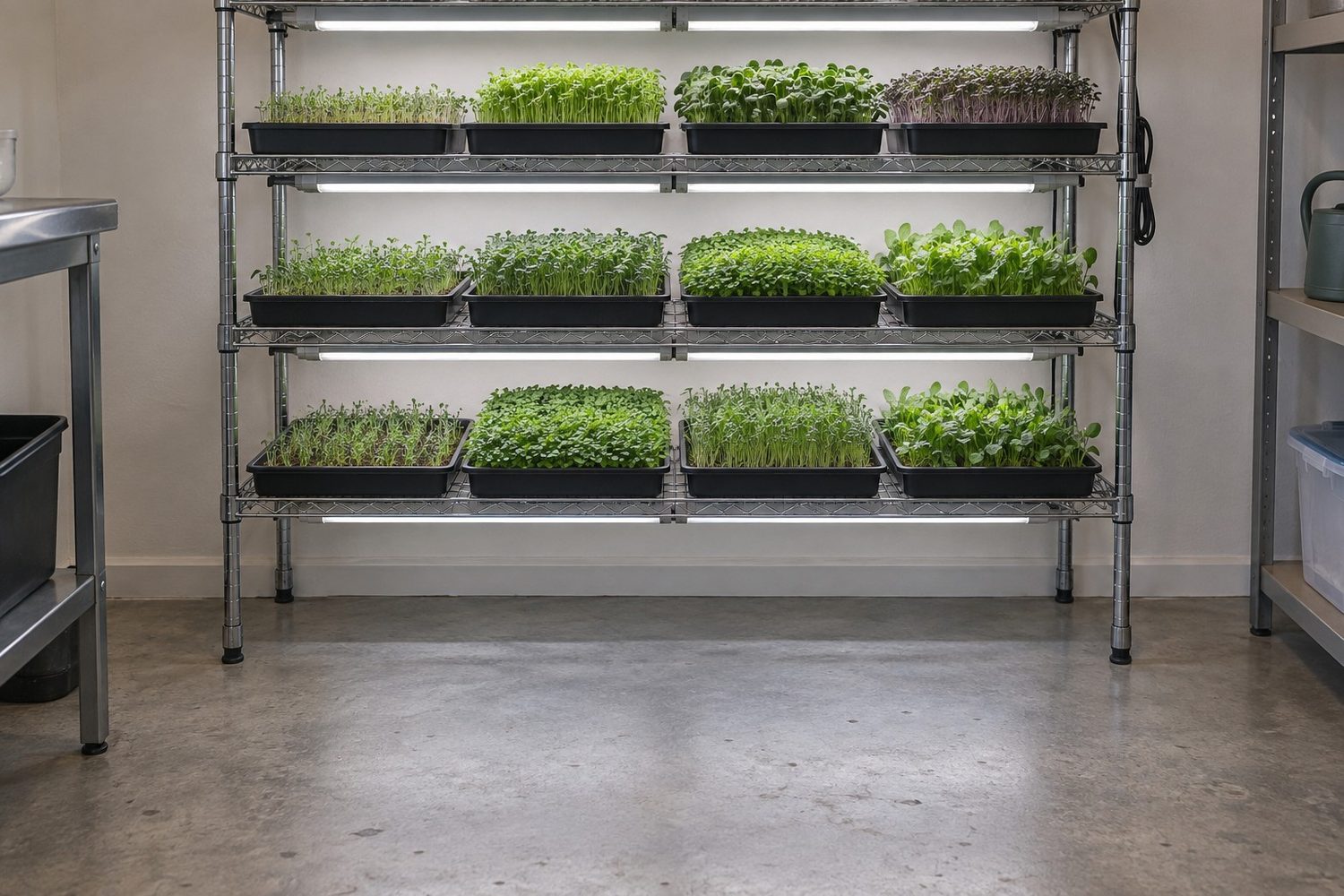
That's why a per tray number can't simply be multiplied by a room's total square footage. Aisle and access space differ from room to room, so work from tray positions instead: count how many trays your shelves hold, multiply by the per tray yield for your crop, and leave floor area out of the math.
Blackout time changes the count too. A peer-reviewed vertical farm model runs 7 days of germination stacked in the dark, then 7 days under lights, and only the lit stage needs a shelf position under a light. If you stack trays during germination, the number of lit positions you need can be smaller than the number of trays in progress. The rack density and succession page walks through output per shelf in more detail.
Why your own trays may come in higher or lower
Growing conditions move these numbers too. In a separate experiment, Poudel and colleagues (2023) grew pea and radish in six growing media, including compost and spent mushroom compost blends. Pea ranged from 3.24 to 14.32 ounces per square foot depending on the medium, a 4.4-fold spread. Radish ranged from 4.95 to 12.19 ounces per square foot, a 2.5-fold spread. That is a different experiment from the 17 crop trial, so its figures don't belong in the same ranking, but it shows how much the medium alone can shift yield per area.
Johnny's own discussion of its trial makes the same point from the grower's side: yields shift with procedure, growing system, conditions, harvest stage and seed lot, and one grower's numbers are unlikely to transfer to another's space. The page on what a tray actually yields goes further into why per tray weights vary so widely.
Weigh your own trays and work from your numbers
The figures above are good for a first estimate and for comparing crops. For real planning, your own trays are the better source. You need a kitchen scale and a tape measure.
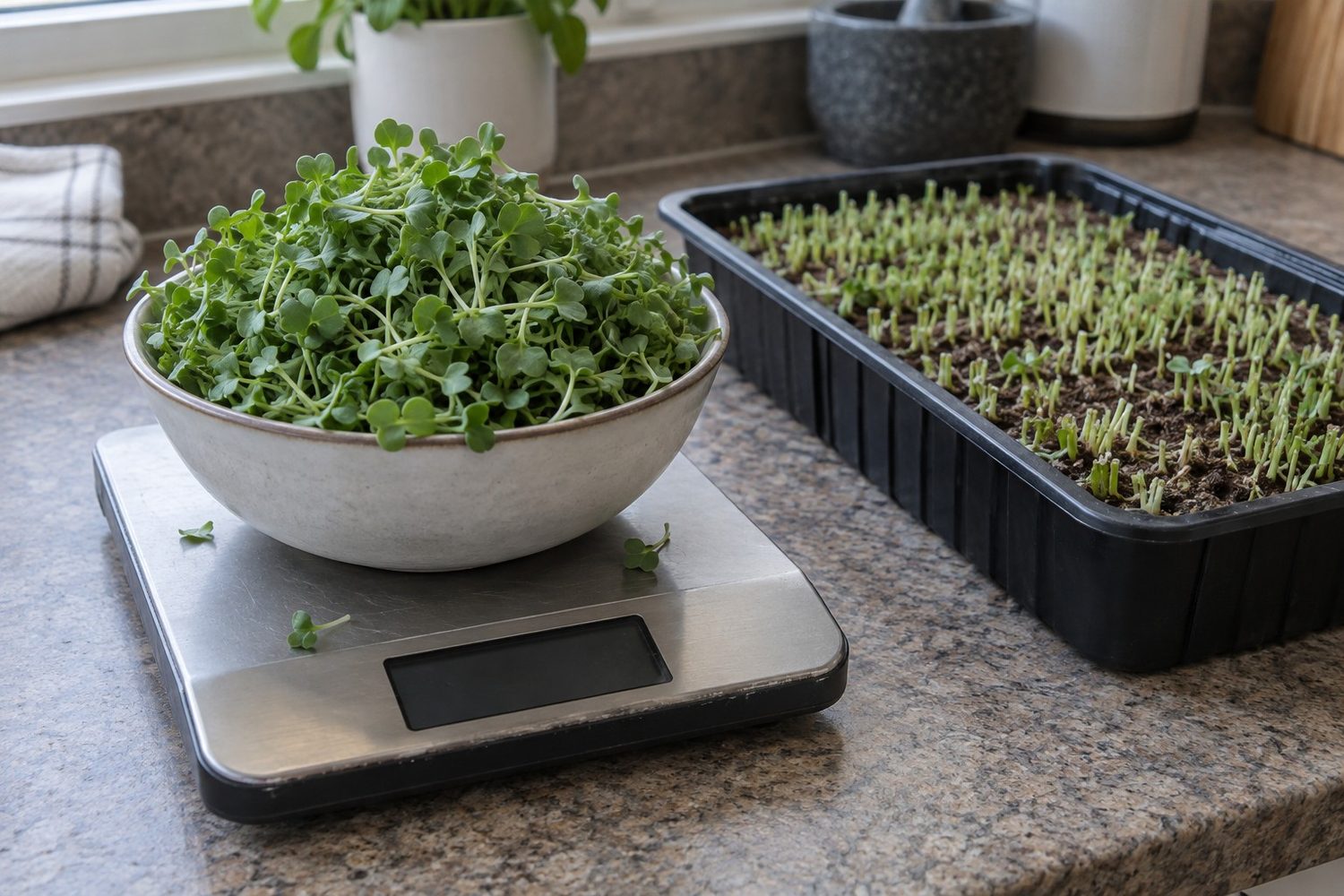
- Measure the inside floor of your tray and work out its area in square feet. The two trays mentioned earlier came to 1.30 and 1.34 square feet, not the nominal 1.39.
- Harvest and weigh several trays of the same crop, and write each weight down.
- Divide each weight by your tray's inside floor area. That gives you ounces per square foot of tray per harvest.
- Divide the average yield by the average days from sowing to harvest and multiply by seven. That gives you ounces per square foot of tray per week.
- For shelf planning, count your tray positions and multiply by your per tray yield. Don't scale from the room's floor area.
Keep the per harvest and per week figures in separate columns, and keep tray, rack and floor areas separate too. Mixing them up is an easy way to overestimate what a space will produce.
Frequently asked questions
These cover points that come up once you start running the numbers for your own space.
Is a pound of microgreens per square foot realistic?
Not from the published figures. None of the 39 converted grower and seller yields reaches a pound per square foot of tray, which would take 22.2 ounces from one 1020, and the top crop in the 17 crop trial, radish, came to 0.46 pounds per square foot.
Are these yields fresh weight or dry weight?
They are fresh weight, meaning the greens as cut. In the 17 crop trial, dry matter ran 3.9 to 9.4 percent of fresh weight, so nearly all of what goes on the scale is water.
What about crops with no yield listed, like buckwheat or wheatgrass?
Some crops, including buckwheat, wheatgrass, lettuce, alfalfa and turnip, have no per tray yield listed to convert. For those, weigh your own trays, divide by the inside floor area, and treat that as your starting figure.
Do these numbers show which crop earns the most?
No. They are weights only, with no price or profit attached, and a heavy crop is not automatically the best earner. For that side of the decision, see the page on the most profitable microgreens.
Planning a shelf with these numbers
Start with the crops you actually want to grow, look up their ounces per square foot of tray per harvest and per week, and use the controlled trial and the grower figures as two separate reference points rather than one answer. Then count the tray positions your shelf or rack really holds, grow a few trays, weigh them, divide by the inside floor area, and let your own numbers replace the published ones as soon as you have them.
Sources
Prices, stock and specifications are as the linked pages showed them on 2026-09-12.
Keep reading
The journal
What Does a Tray Actually Yield? The Range Is 18-Fold and the Reason Is Not the Crop
Published yields for 39 of 62 crops run from 1.00 oz to 18.77 a tray. A seed catalog's range is only 2.7-fold, because the commercial world has already selected out the low yielders.
Read What Does a Tray Actually Yield? The Range Is 18-Fold and the Reason Is Not the CropThe journal
Are Microgreens Sustainable? The Published Range Is 3.34 to 63.34 kg CO2e a Kilo, and Your Grid Decides Where You Land
One modeled crop spans a 19-fold carbon range. Indoor growing beats field lettuce on land by roughly 37 times and can lose on carbon, because the answer is a property of your electricity rather than of the crop.
Read Are Microgreens Sustainable? The Published Range Is 3.34 to 63.34 kg CO2e a Kilo, and Your Grid Decides Where You LandGrowing guides
Day 8 against day 14: what you are actually trading by waiting
The largest yield gain in the harvest-stage literature is 80.1 percent. Divide it by the five extra days it cost and it is worth 5.1 percent. Nutrient concentration does not peak; some compounds rise, some fall, and the studies report concentration rather than the total per tray.
Read Day 8 against day 14: what you are actually trading by waitingGrowing guides
Do microgreens need fertilizer? It is worth 8 to 47 percent of the yield and up to 227 times the nitrate
In one peat trial, taking the feed away cost cabbage 7.9 percent of its yield and arugula 47.4 percent, while cutting nitrate in the cut crop by 98 to 227 fold. Feeding is the largest lever anyone has measured on either number.
Read Do microgreens need fertilizer? It is worth 8 to 47 percent of the yield and up to 227 times the nitrate