Tray setup and drainage: the real usable area of a 1020, and how deep it needs to be
Cal HewittPublished Checked
- method
- equipment
- beginner
- water
Start with the unit, because everything else on this page is denominated in it.
A 1020 is a nominal 10 by 20 inch greenhouse flat. Illinois Extension calls the standard flat 200 square inches and Maryland calls the standard greenhouse flat 10 by 20. That is a planning convention, and it is not the tray you own.
Hover or tap a row to highlight it.
| Tray | Outside dimensions | Inside floor | Against the nominal 200 in² |
|---|---|---|---|
| Nominal 10 by 20 convention | Not specified | 200 in² | The figure the math uses |
| Bootstrap Farmer shallow | 21 x 10.75 x 1.25 in | 187.6 in² | Nominal is 6.6 percent larger |
| Active Grow heavy duty | 21.06 x 10.75 x 1.22 in | 192.6 in² | Nominal is 3.8 percent larger |
The two real trays differ from each other by 2.7 percent, and both are smaller than the number the rates are written against.
This is not a pedantic point. Seed rates are published in grams per 1020 and yields in ounces per 1020, right across the category. The median published tray is 7.055 oz and the median seeding rate is 23 g, both quoted in a unit that two manufacturers build 2.7 percent apart. Use 200 in² only for a rate that says it is nominal. For seed, medium or yield math, measure the inside of the tray in front of you.
What to actually do
- Measure your tray's inside floor once and write it on the tray. Every rate you will ever read is quoted per "1020," and the two on sale here differ by 2.7 percent. Growers do the same thing for depth: mark a fill line inside the tray with a marker once, and stop eyeballing it every sow. Shallow 1020 microgreen trays and standard 1020 trays are the two depths this page is talking about.
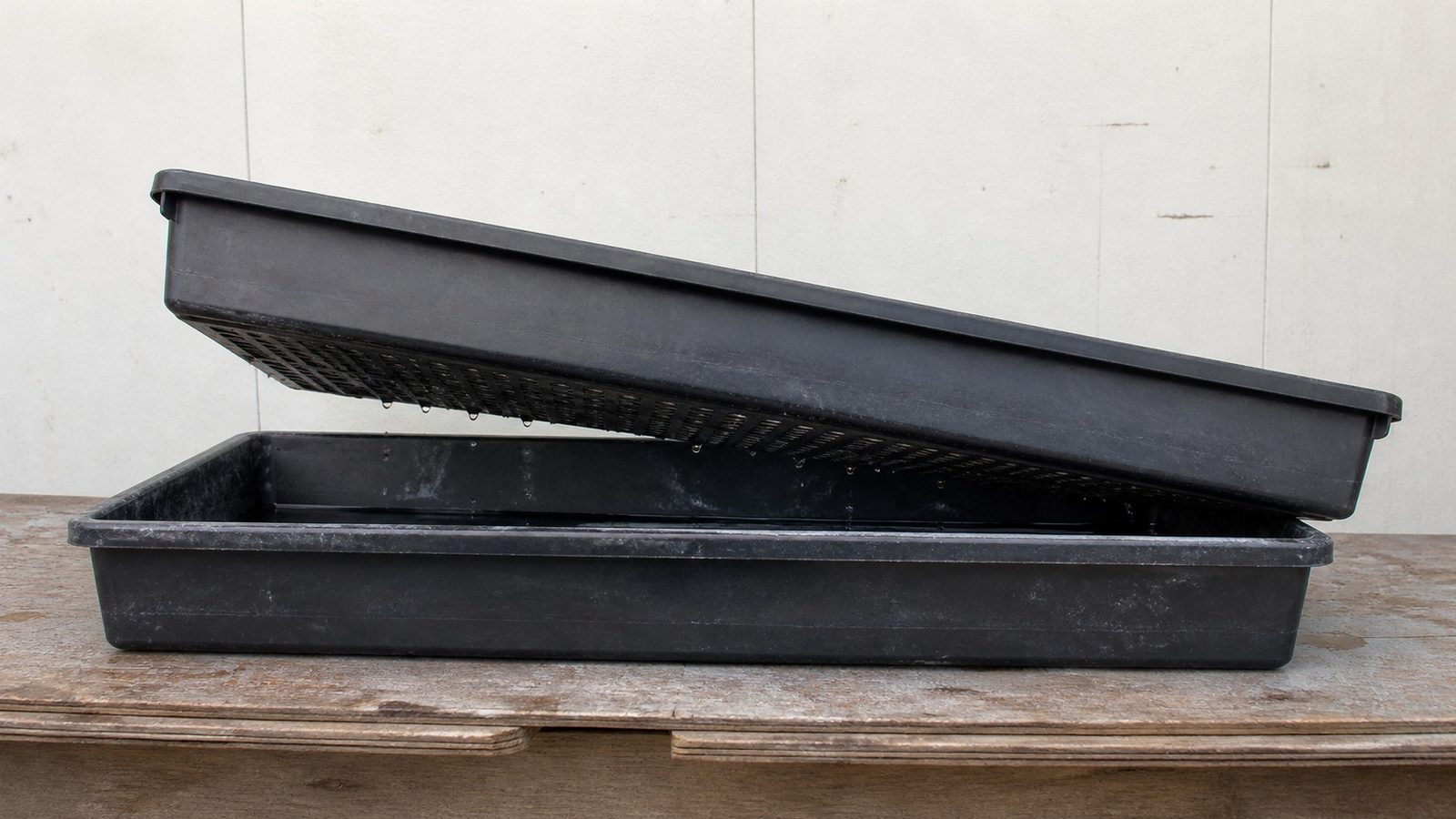
- Perforated tray on top, solid tray underneath, and a third tray on top only as a weight or a cover. One tray, one job at a time.
- Bottom water, then pour off what is left after 30 minutes. That single step is the difference between a reservoir and standing water.
- Start at 0.5 to 1 inch if you are following the published home advice, and know you are at the shallow end of the only depth range anybody has weighed.
- Before you cut depth to save money, run the side by side. Half an inch is about 51 cents a tray. Three trays each at two depths, same seed lot and same water, weighed at harvest, answers it for your crop in one cycle.
- Do not read a hole count as a specification. Thirty-two and thirty-six are both shipping, and no research supports either.
- Level the bench, level the medium, tamp lightly. Then leave it alone.
- If you use a solid tray or a paper towel, that is a different system, not a shortcut in this one. Water it accordingly and do not let it sit wet.
What each tray in the stack is actually for
The standard arrangement is two trays and three jobs, and the third job is the one people get wrong.
- The upper perforated tray is the planting tray. It holds the medium and the seed, takes water up through its holes, and lets the excess leave the same way.
- The lower solid tray is a reservoir and a catch tray. It briefly holds bottom-watering water and receives drain-off. It is not an instruction to keep roots submerged.
- A third tray, placed on top of the seeded medium, is a germination weight and later a dark cover. Utah State sets it directly on the medium with 2 to 5 lb on it during early dark germination, then inverts it as a cover that no longer touches the crop.
One tray cannot hold two of those positions at once. The common beginner error is leaving the solid tray on top as a cover and then expecting to bottom water into it. See the blackout period for what the weight and the cover are doing.
Utah State gives the only complete numeric procedure anybody publishes: 2 quarts of coir in a 1020 with drain holes, 2 cups of water in a 1020 without holes, nest the first in the second, and pour away whatever is left after 30 minutes. That last instruction is the one that matters most and gets dropped most.
And a note on the germination weight. Two to five pounds is an absolute figure applied to every crop. Across all 62 crops, the seed load underneath that weight runs from 1.1 g of celery to 450 g of wheatgrass, a 409-fold range. Two pounds is about twice the seed mass on a wheatgrass tray and roughly 330 times it on a celery tray. Nobody has tested whether one weight suits both, and the instruction does not say.
Holes: recommended everywhere, specified nowhere
For loose medium in an ordinary bottom-watered setup, use a tray with drainage holes. Utah State, NC State and Illinois all say so directly, and Virginia Tech and Maryland both document the nested perforated-in-solid arrangement.
What no university source gives is a number. There is no published minimum hole count, diameter, spacing or open-area percentage for microgreens in loose medium. The two commercial trays above disagree with each other: Active Grow specifies 32 drainage holes and Bootstrap Farmer specifies 36, and neither product page states the diameter. A mesh-bottom alternative uses 3.4 mm openings across the whole base instead.
So "all microgreens need exactly this hole pattern" is a claim the trays themselves contradict. Two manufacturers selling into the same market chose different answers, and no trial has compared them.
The failure claim is also softer than it is usually told. Saskatchewan links standing water and excess humidity to fungal disease, blackening and falling stems, and a 2023 peer reviewed media paper states that macropores let excess water drain and prevent waterlogging. That is a mechanism, and it is a good one. It is not the frequently repeated claim that a solid tray of loose medium causes root rot by itself, or costs a stated percentage of the crop. No replicated comparison of a perforated planting tray against an otherwise identical solid one has been published.
There are working systems with no holes at all, which is why the claim has to stay narrow. Maryland documents sealed hydroponic trays separated from a basin by fine mesh, Saskatchewan documents paper towel culture with no medium, and Florida calls drainage "a plus" rather than a requirement. Those are different root-zone designs rather than proof that holes do not matter in a tray of loose medium. If you use a solid tray with loose medium, you have given up the easy way to wet it from below and the easy way to get the excess out.
Depth: the published advice sits at the bottom of the only range anyone tested
The published depth figures conflict, and they conflict because they answer different questions.
Hover or tap a row to highlight it.
| Source | Figure | What it is measuring |
|---|---|---|
| NC State | 0.5 to 1 inch | Medium depth in a drainage tray. The only numeric fill depth in the six-page audit |
| Colorado State, Pueblo County | 0.5 to 1 inch | Practice guidance for a tray with holes |
| Illinois Extension | 0.5 inch rim gap | The space left below the lip, not a medium depth |
| Utah State | 2 quarts per 1020 | A volume. On a nominal 200 in² that computes to 0.58 inch before settling |
| Cornell, tested | 0.7, 1.3, 1.7 and 2.3 inches | Four depths measured against yield |
| UC Contra Costa | 1 to 2 inches | How deep the tray should be, not how deep to fill it |
| UF/IFAS | 2 to 3.5 inches | Container depth again, not fill |
The direct fill figures run from 0.5 inch to 2.3 inches. That is a 4.6-fold ratio for the single most basic setting on the tray.
Only one of those numbers came from measuring a harvest. Cornell tested arugula, mizuna and mustard at four depths in a peat based mix. Arugula fresh weight rose linearly all the way from 1.8 to 5.8 cm, mizuna also rose across that range on a quadratic fit, and all three performed well at the deepest setting, 5.8 cm or 2.3 inches.
Which puts the usual home advice at the shallow end of the only range anybody has weighed. Half an inch to an inch is a third to a half of the depth that produced the best yields in the one trial that looked.
Do not turn that into a universal 2.3 inch rule. It is three brassicas, in one peat based mix, under one set of greenhouse conditions. Water holding differs sharply by material, and the medium page covers why a result on peat does not transfer to coir or to a mat.
What the extra depth costs, and what it has to beat
The cost side is simple arithmetic and can be checked. Each additional inch in a nominal 200 in² flat is 200 in³, which is 2.98 dry quarts or 0.116 cubic feet of medium (bagged mix is sold in dry quarts; the same volume is 3.46 liquid quarts). A May 2026 retail list prices a 40 lb potting soil bag at $4.40 covering 3 square feet at 2 inches.
Hover or tap a row to highlight it.
| Filled depth | Medium volume | Cost per tray | Against a median tray grossing $15.87 to $23.52 |
|---|---|---|---|
| 0.5 inch | 1.49 dry qt | $0.51 | 2.2 to 3.2 percent |
| 1 inch | 2.98 dry qt | $1.02 | 4.3 to 6.4 percent |
| 1.5 inches | 4.46 dry qt | $1.53 | 6.5 to 9.6 percent |
| 2.3 inches | 6.85 dry qt | $2.34 | 9.9 to 14.7 percent |
Going from 1 inch to Cornell's best depth costs $1.32 more per tray. Against the $15.87 to $23.52 a median tray grosses at market, that is 5.6 to 8.3 percent of the gross.
So, the depth question has a threshold, and it is about eight percent. If the deeper tray yields more than roughly 8 percent extra, the medium pays for itself. Cornell measured a rising line and its abstract does not publish the size of the rise, so the one number that would settle the most common cost decision in microgreens has not been reported. Anyone telling you the deeper fill is wasted is asserting the thing nobody measured, in the face of the one trial that pointed the other way.
Two caveats on that table. It assumes the seller's coverage claim and a true 200 in² floor, so a 187.6 in² tray uses about 6 percent less than shown. And it prices only the medium, not the water, the labor or the yield.
Filling, leveling and the bench underneath
Fill loosely, level it, then tamp only enough to make a flat seedbed. Illinois says to level the mix, leave about a half inch below the rim and tamp lightly with a flat object. Florida says the medium should stay loose with the seed gently pressed into the surface. Those agree: you are making a flat surface, not a compacted layer. No optimal compaction level has been published.
Level the bench before you level the medium. A flat tray cannot correct a lopsided fill, and uneven medium produces uneven watering and a skewed stand. No study has quantified how much slope matters, so there is no safe tolerance to quote.
The documented failures are about water, not about hardware. Standing water and persistent excess moisture are the ones extension sources actually link to disease. Warping, cracking and seed washing into low spots are real complaints, but the only figures behind them are product durability claims: a 1.8 to 2.0 mm wall and a two-year crack warranty on one tray, a two-year breakage warranty and a 44 lb rating on the other. Nobody has published a rate at which trays warp, or what that does to a stand.
Tray color has never been tested either. Both manufacturers list a polypropylene body and one offers several colors, and no microgreen experiment compares black, white or colored trays for root-zone temperature, light at the roots, germination or yield.
What nobody has measured
- One tray against two, for yield, disease, labor or water use.
- Hole count, diameter or open area, against any crop outcome.
- A perforated planting tray against an identical solid one, with matched water in.
- Mesh against discrete holes, on drainage time, medium loss, dry spots or yield.
- How much extra yield the extra depth actually buys, which is the number the whole cost decision turns on.
- A depth above which medium is wasted. Cornell's yield was still climbing at the deepest setting it tested.
- A rule linking depth and material to a watering volume. The retention figures of 3.3 mL per gram for coir and peat, 8.9 for hemp and 10 for BioStrate cannot be converted into cups per tray without the dry mass of your own fill.
- An optimal tamping pressure, a bench slope tolerance, a tray warping rate, or any effect of tray color.
Terms on this page
Tap a term to see what it means.
1020 tray. A nominal 10 by 20 inch greenhouse flat. Outside and inside dimensions vary by manufacturer, and the inside floor is what your rates actually apply to.
Sources
Opened 2026-08-12. Tray dimensions and hole counts are manufacturer specifications read on that date and are labeled as such rather than treated as agronomic recommendations. The seed load range and the 409-fold figure were computed for this page from the published seeding rates across all 62 crops, 51 of which state one. The depth cost table is arithmetic on one dated retail price list and is shown in full so it can be checked; the percentages against a tray's gross use the market figure published elsewhere on the site. Two Penn State pages and three other sources returned errors when opened and are not used for anything here.
- Utah State Extension, grow your own microgreens - the two-tray procedure of 2 quarts coir in a holed 1020 and 2 cups water in a solid one, the instruction to discard water remaining after 30 minutes, and the separate 2 to 5 lb germination weight later inverted as a non-contact cover.
- University of Maryland Extension, growing microgreens and baby greens indoors - the explicit two-tray design with a channelled perforated tray inside an undrained reservoir, standard greenhouse flats at 10 by 20 inches, and sealed hydroponic trays separated from a basin by fine mesh.
- Illinois Extension, growing microgreens (PDF) - the 200 in² nominal flat, the upper holed container with a lower container receiving drain-off, the half inch rim gap, and leveling with light tamping.
- ASHS 2016 conference abstract, Cornell substrate depth trial - four substrate depths of 1.8, 3.3, 4.3 and 5.8 cm with arugula, mizuna and mustard, arugula fresh weight rising linearly across that range, mizuna rising on a quadratic fit, and all three performing well at 5.8 cm.
- NC State Extension Gardener, microgreens in the winter - a sterile tray with drainage holes and soilless medium at half an inch to an inch.
- Colorado State University, Pueblo County Extension, growing sprouts and microgreens at home - the same 0.5 to 1 inch fill guidance for a holed tray, and using a solid tray above for pressing and below for bottom watering.
- Virginia Cooperative Extension, introduction to microgreen production - the nested holed-in-solid 1020 arrangement with hemp mats, bottom irrigation as an option, and higher water-holding hemp needing a lower irrigation rate than burlap.
- UC Master Gardener Program of Contra Costa County, growing microgreens - trays of 1 to 2 inches deep with holes, set in a larger watertight container.
- UF/IFAS Gardening Solutions, microgreens - a 2 to 3.5 inch container, drainage described as a plus rather than a requirement, and loose medium with seed gently pressed into the surface.
- University of Saskatchewan, microgreens (PDF) - the instruction not to leave a tray standing in water, excess moisture and humidity as a cause of fungal disease including blackening and falling stems, and paper towel culture with no medium.
- University of Nevada Extension, DIY microgreens grow tray - an up-cycled shallow container with a lid and paper towels as a low-supply alternative.
- Horticulturae, agricultural and food wastes as microgreen media, 2023 (PDF) - that macropores allow excess water to drain and prevent waterlogging, which could promote root development.
- Oxford Academic, water retention table - the 3.3 mL per gram figure for peat with vermiculite and for coir, 8.9 for hemp and 10 for BioStrate. The table is visible and the full article is subscriber restricted.
- Bootstrap Farmer shallow microgreen tray - manufacturer specification read 2026-08-12: a 21 by 10.75 by 1.25 inch outer tray with a 19.75 by 9.5 inch inside bottom, 36 drainage holes, 1.8 to 2.0 mm thickness, polypropylene, and a two-year crack warranty.
- Bootstrap Farmer shallow mesh 1020 tray - manufacturer specification: 3.4 mm mesh openings and a quarter inch nesting gap above the bottom of a same-depth solid tray.
- Active Grow 1020 heavy duty microgreen tray - manufacturer specification read 2026-08-12: 21.06 by 10.75 by 1.22 inches outside with a 19.88 by 9.69 inch inside, 32 drainage holes, polypropylene, a 44 lb rating and a two-year breakage warranty.
- Johnny's Selected Seeds, domes, flats and trays comparison chart (PDF) - solid trays described as reservoirs, mesh trays as useful where drainage is beneficial, and shallow perforated trays as suitable for microgreens.
- Paperpot microgreens growing guide (PDF) - practice guidance that tamping makes a uniform pre-compacted surface easier to seed, and that uneven medium produces watering problems and skewed trays.
- Dale's Landscaping 2026 retail price list (PDF) - the 40 lb potting soil bag at $4.40 covering 3 square feet at 2 inches, which is the only input to the cost table above.
Keep reading
Growing guides
My microgreens are too short: telling a stunted tray from a naturally compact crop
Check the height against the crop before you treat it as a fault, because several crops simply finish short. If the tray is genuinely stunted, low light is the one cause it cannot be: too little light makes a tray taller.
Read My microgreens are too short: telling a stunted tray from a naturally compact cropGrowing guides
Watering a tray: how much, how often, and what overwatering actually means
Overwatering is blamed for more failed trays than anything else in this category and has no numerical definition anywhere. The published volumes disagree by four times, and the reason is the medium: hemp holds nearly three times as much water per gram as coir does.
Read Watering a tray: how much, how often, and what overwatering actually meansGrowing guides
What water to use on microgreens: the chlorine worry is 9x below the tested threshold, and the real risk is elsewhere
In the one dose-response study, broccoli tolerated 37 mg/L of residual chlorine before declining and vegetable seed germination was unaffected at 77. The federal drinking water ceiling is 4.0. Of eight ranking pages audited, none cited a source.
Read What water to use on microgreens: the chlorine worry is 9x below the tested threshold, and the real risk is elsewhereGrowing guides
Hydroponic and soil-free microgreens: the same swap costs a third of the pea crop and gains on radish
In one replicated trial, moving from peat-perlite to coir cost pea 32.7 percent of its yield and gained radish 4.5 percent. Two extension services cannot even agree whether a mat counts as hydroponic, and the word is doing two jobs at once.
Read Hydroponic and soil-free microgreens: the same swap costs a third of the pea crop and gains on radish