What water to use on microgreens: the chlorine worry is 9x below the tested threshold, and the real risk is elsewhere
Cal HewittPublished Checked
- water
- food safety
- method
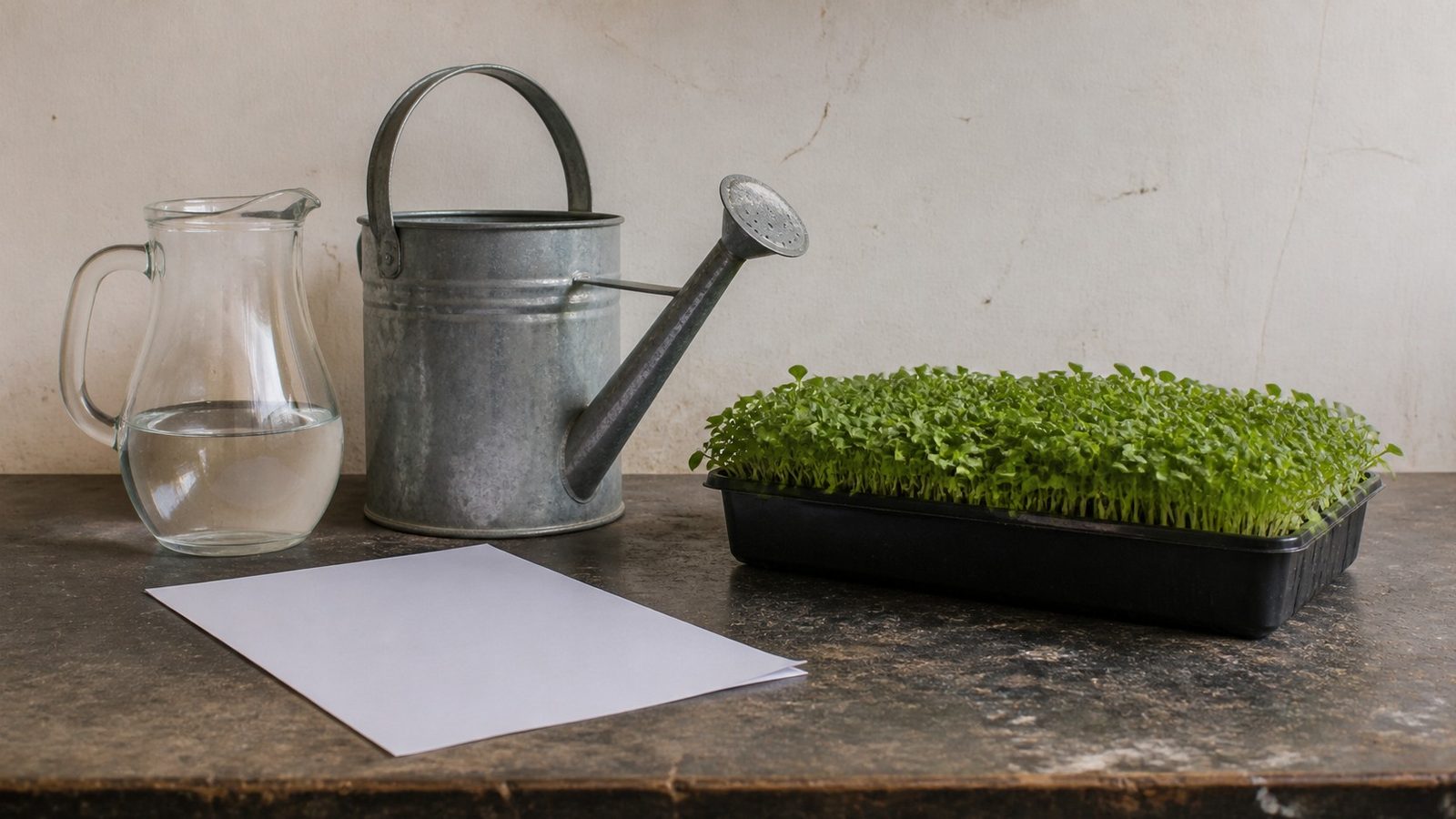
One claim dominates this subject: chlorinated tap water harms microgreens, so filter it or leave it out overnight.
Eight pages returned for that exact question were checked for a source on 2026-08-11. None of the eight had one. Not a study, not an extension publication, not a government figure behind the chlorine, filtered water or pH assertions. Two of the eight, both extension services, did say plainly that tap water can work.
There is relevant evidence. It just is not on those pages, and it points the other way.
What to actually do
- Read your consumer confidence report before changing anything. It is free, it is annual, and it tells you the one thing that decides the whole question: chlorine or chloramine.
- On a normal public supply, use the tap. No published microgreen evidence says you must filter or dechlorinate, and the one dose-response study puts the vegetable threshold nine times above the legal ceiling.
- Stop standing water overnight. It is the wrong duration for free chlorine and does nothing at all for chloramine.
- If you use a well, rainwater or any private source, test it at least yearly for germs and chemicals. That is the real decision point, and it is a different question from filtration.
- Never use graywater on a crop eaten raw. There is no validation of any kind.
- Filter to fix a measured problem, not a suspected one. Check what the device actually removes: many pitchers only improve taste and smell, and some also strip the disinfectant that was protecting the water.
- Treat the soak like food handling. It is the longest water contact in the process and the safety sheets name it alongside irrigation.
- Test water chemistry only when symptoms persist. The published irrigation panel is pH, alkalinity, carbonates and bicarbonates, EC, TDS, boron, chloride, calcium, magnesium, sodium, hardness and sodium adsorption ratio. That is the list for a diagnosis, not a routine.
- If a tray is failing, look at mold or root hair, watering and poor germination before blaming the water. No study links tap water chlorine, pH, hardness or filtration to mold or damping off in microgreens.
What the one dose-response study found
A 1987 peer reviewed experiment irrigated 11 foliage species, 8 flowering species and 4 vegetable seedlings at 0, 2, 8, 18, 37 or 77 mg/L of residual chlorine.
Hover or tap a row to highlight it.
| Plant | Growth declined at | Against the 4.0 mg/L federal ceiling |
|---|---|---|
| Geranium and begonia | 2 mg/L | Below the ceiling |
| Pepper and tomato | 8 mg/L | 2x the ceiling |
| Lettuce and others | 18 mg/L | 4.5x the ceiling |
| Broccoli | 37 mg/L | 9.25x the ceiling |
| Vegetable seed germination | Not affected at any level tested | Unaffected at 19.25x the ceiling |
The EPA maximum residual disinfectant level for chlorine and for chloramine is 4.0 mg/L, and that is a ceiling rather than a target. So the crop most like a microgreen in that trial, broccoli, needed more than nine times the maximum a utility is allowed to deliver before its growth declined, and germination in the vegetable seed was untouched all the way to 77 mg/L.
The study's own conclusion was that residual chlorine below 1 mg/L should not adversely affect most of the potted plants and vegetable seedlings it tested in soilless media.
Read the top row before relaxing entirely. Geranium and begonia declined at 2 mg/L, which is inside what a tap may legally deliver. Sensitivity to chlorine is real and it is wildly species-specific. The species that turned out sensitive are ornamentals nobody grows as a microgreen, and the ones at the tolerant end are the vegetables people do. That is a fortunate accident rather than a law.
And it is a 1987 study on seedlings in pots, not microgreens in a tray. No controlled trial has ever compared ordinary chlorinated tap water against dechlorinated water on a defined microgreen crop for germination, yield, appearance or safety. This page is not telling you chlorine cannot matter. It is telling you the worry is running about nine times ahead of the only measurement anybody has.
"Leave it out overnight" fails twice
The standard remedy is wrong in two separate ways, and which one applies depends on your utility.
- If your water carries free chlorine, it does dissipate. The CDC's figure for removing it by letting water sit is a few days, not a night.
- If your water carries chloramine, standing does nothing at all. The CDC says chloramine cannot be removed by letting water stand, and the EPA says monochloramine does not dissipate quickly. That is the entire point of chloramine: it is chosen as a longer lasting secondary disinfectant for the distribution pipes.
A 2009 EPA fact sheet put more than one in five Americans on water treated with monochloramine. That is the national figure that exists, not a current census, and the CDC notes some utilities switch between the two.
So, the most repeated fix in this category is useless for at least a fifth of American households and understates the time for the rest. Both count toward the same 4.0 mg/L ceiling, so the number on your water report does not tell you which one you have. The consumer confidence report does, and it is free.
And if you do want it out, standing is not the only option, it is just the one that does not work. Ascorbic acid, plain vitamin C, neutralizes both free chlorine and chloramine, which is why aquarium and hydroponic practice reaches for it rather than for a jug on the counter. Boiling breaks chloramine down too, at the cost of doing it. Carbon filtration and reverse osmosis both remove chlorine, and only some carbon filters touch chloramine, so the device has to be chosen for the one you actually have. None of that is a microgreen finding and none of it has been tested on this crop. It is the chemistry, offered because a page that retires the overnight jug should say what replaces it rather than leaving a hole.
The pH target, and where it actually comes from
Three published figures exist and they broadly agree. The University of Arizona calls pH 6.0 ideal for microgreens, Virginia Tech gives 5.5 to 6.0, and UC ANR says slightly acidic, around 6, while adding that tap or filtered water should work.
None of them is a trial. No located experiment isolates irrigation water pH across a normal harvest window while holding species, medium, nutrients and water chemistry constant.
And those recommendations are partly borrowed. A pH of 5.5 to 6.0 is a nutrient solution figure, and it matters because pH governs which nutrients stay available to roots. Most microgreen trays are not fertilized at all, so the mechanism the number exists to serve is largely absent. See fertilizer and nutrients for when a tray is being fed and the figure starts to apply.
Do not flip that into "pH never matters." Over repeated irrigation it is alkalinity rather than pH that drives the medium's pH, and high alkalinity water is a real greenhouse problem. It is simply a smaller one in a crop cut inside three weeks, and that last part is an inference rather than a measurement.
Hard water is the same shape of answer. Calcium and magnesium leave residues, scale equipment and clog emitters, which is well documented. No hardness threshold that reduces microgreen yield or quality has ever been published. Deposits on your hardware are not evidence about your harvest.
The thing that has actually been measured
Water is a genuine food safety route for this crop, and that is where the evidence is.
**A 2025 experiment inoculated municipal water and rainwater with Salmonella, E. coli O157:H7 or Listeria and transferred all of them to daikon, red cabbage, broccoli and mustard microgreens**, with persistence differing by pathogen and by day. A 2023 daikon study examined the same routes through seed and irrigation water.
Notice the reversal. The disinfectant that everyone tries to remove from their water is the one thing with no demonstrated microgreen downside, and contamination, which is what the disinfectant is there to prevent, is the one risk with direct experimental support.
The federal safety standard is not about chlorine or pH. Under 21 CFR 112.44(a), water that touches produce during or after harvest, water on food-contact surfaces and handwashing water during and after harvest must have **no detectable generic E. coli per 100 mL**; water used on the growing crop falls under an annual agricultural water assessment instead (21 CFR 112.43). North Carolina's microgreen fact sheet applies the zero figure more widely, to water used to humidify a grow room as well as to clean hands, tools, surfaces and containers, and Nevada Extension's microgreen sheet does the same for soaking, irrigation and washing water. Those are state and extension guidance that go further than the federal rule.
Which makes source category the decision, not filtration. A public supply meeting its report is a different thing from a private well, rainwater or graywater. The CDC advises well and rainwater users to test at least annually for harmful germs and chemicals, and a municipal report cannot substitute for either. Graywater is outside ordinary potable assumptions entirely and has no microgreen validation of any kind.
And no microgreen recall has ever been attributed to water. A 2018 broccoli microgreen recall followed a Listeria detection with the cause under investigation, and the notice does not name a route. Experimental transfer is established; outbreak attribution is not.
The soak is the water contact nobody discusses
Every published water quality discussion is about irrigation. The longest and most intimate contact between water and this crop is not irrigation.
Read the soak field across all 62 variety entries here: 18 crops get a soak, running from 4 hours up to 24 hours on buckwheat. Alfalfa and sunflower sit at 4 to 12 hours, barley grass, mung bean and popcorn shoots at 8 to 12.
A seed submerged in standing water for most of a day at room temperature is a different exposure from a tray watered from below, both for whatever is in the water and for whatever multiplies in it. The safety sheets above name soaking water explicitly alongside irrigation and washing water, at the same zero E. coli standard.
No study has compared water sources on soaking specifically, which is a real gap given that this is where the water sits longest against the food. See soaking microgreen seed for what a soak does and does not do, including that it is not a kill step.
Deliberate chlorine, which is a different subject at a different scale
Chlorine is genuinely used against produce pathogens, and the doses are nothing like a tap.
FDA guidance describes 50 to 200 ppm total chlorine at pH 6.0 to 7.5 for 1 to 2 minutes in post-harvest produce water. Canadian guidance gives 100 to 150 ppm total, or 2 to 7 ppm free residual after contact, at pH 6.0 to 7.0, ideally under five minutes.
That is 12.5 to 50 times the maximum residual a drinking water utility is allowed to deliver, applied for a minute or two after harvest rather than continuously to a living crop.
Do not read either direction into it. It is not evidence that a growing tray needs added chlorine, and it is not evidence that tap residual is meaningful sanitation. A 2012 study of two ready-to-eat vegetable plants found that 1 ppm of free chlorine in rinse water might be insufficient to prevent microbial build-up and cross-contamination, which is roughly where a tap sits.
What the rules require, if you sell
The Produce Safety Rule requires covered farms to use water that is safe and of adequate sanitary quality for its intended use. The 2024 final rule replaced fixed national pre-harvest testing numbers with an annual, systems-based agricultural water assessment covering the source, the distribution system, protection from contamination, the application method, the crop and the conditions, reassessed after any significant change.
Untreated surface water is prohibited for harvest and post-harvest uses, and a public water system's results or certificate can support an exemption where the water stays protected.
The compliance dates are April 7 2025 for large farms, April 6 2026 for small farms and April 5 2027 for very small farms. As of this page, the first two have passed. Whether any of it applies to you depends on coverage and exemptions, which is set out in microgreens under the FDA Produce Safety Rule.
Recirculating water has no microgreen protocol at all. The nearest evidence is a 2021 beansprout business that recycled about 60 percent of its spent irrigation water through 50 and 20 micron filtration plus chlorine dioxide, and found more than 90 percent of the cumulative particles sampled were smaller than the 20 micron filter. Filtration is not microbiological control. That is sprouts rather than microgreens, and no safe reuse interval has been published for either.
What nobody has measured
- Tap water against dechlorinated water on any microgreen crop, for germination, yield, appearance or safety.
- Filtered, distilled or RO water against a specified tap control. Not one replicated microgreen comparison exists.
- Irrigation water pH across a harvest window, holding everything else constant.
- Any hardness threshold that costs a microgreen crop yield or quality.
- Cold water shocking a tray. The room-temperature advice is practice with no trial behind it.
- Whether water quality changes mold or damping off. Mold is not a synonym for bacterial contamination, and the evidence for one is not evidence for the other.
- Water source compared on the soak, which is the longest contact of all.
- A safe recirculation protocol for microgreens, at any treatment or interval.
Terms on this page
Tap a term to see what it means.
Chlorine residual. Disinfectant still present in the water after treatment and distribution. Free chlorine is not the same thing as chloramine.
Sources
Opened 2026-08-11. The comparison of the 1987 thresholds against the federal ceiling is arithmetic on those two published figures and is shown in full so it can be checked. The eight-page citation audit is a dated, non-personalized snapshot of one result set for one search string, not a claim about the whole web. The soak figures were computed for this page from the soakHours field across all 62 variety entries here, 59 of which publish a numeric value.
- Frink and Bugbee, chlorinated water and plant growth, 1987 - 11 foliage, 8 flowering and 4 vegetable species irrigated at 0, 2, 8, 18, 37 and 77 mg/L residual chlorine, vegetable seed germination unaffected at every treatment, growth declining at 2 mg/L in geranium and begonia, 8 in pepper and tomato, 18 in lettuce and others and 37 in broccoli, and the conclusion that residual chlorine below 1 mg/L should not adversely affect most of the tested plants in soilless media.
- EPA, national primary drinking water regulations - the maximum residual disinfectant level of 4.0 mg/L as Cl₂ for both chlorine and chloramine, and the enforceable fluoride maximum of 4.0 mg/L.
- CDC, water disinfection with chlorine and chloramine, 2024 - up to 4 mg/L in drinking water, that free chlorine can be removed by letting water sit for a few days, that chloramine cannot be removed by standing water, and that some utilities switch between the two.
- EPA, basic information about chloramines - monochloramine formed by adding ammonia to chlorine and used as a longer-lasting secondary disinfectant in distribution pipes.
- EPA, monochloramine fact sheet, 2009 (PDF) - that more than one in five Americans used water treated with monochloramine, and that it does not dissipate quickly.
- EPA, drinking water regulations and contaminants - the secondary guidelines of pH 6.5 to 8.5, chloride 250 mg/L, sulfate 250 mg/L, total dissolved solids 500 mg/L and fluoride 2.0 mg/L, all aesthetic rather than crop targets.
- Rao, Pradhan and Patel, pathogen transfer through irrigation water to microgreens, 2025 - municipal water and rainwater inoculated with Salmonella, E. coli O157:H7 or Listeria transferring to daikon, red cabbage, broccoli and mustard microgreens, with persistence differing by pathogen and day.
- Daikon microgreen contamination route study, 2023 - seed against irrigation water as contamination routes.
- North Carolina Department of Agriculture, microgreen produce safety fact sheet - zero generic E. coli per 100 mL for water used to humidify a grow room or to clean hands, tools, surfaces and containers contacting microgreens; state guidance that goes further than 21 CFR 112.44(a), which applies the criterion to harvest and post-harvest uses.
- University of Nevada Reno Extension, microgreens and produce safety, 2020 (PDF) - that water for soaking, irrigation and washing should be tested with no detectable E. coli per 100 mL.
- CDC, choosing a home water filter - that filters have different functions, that carbon pitchers and fridge filters commonly improve taste and smell while reverse osmosis can remove germs and some chemicals, that a filter must be chosen for the contaminant actually present, and the advice to test private well and rainwater sources at least annually.
- Penn State, irrigation water testing for nurseries and greenhouses - the basic irrigation panel of pH, alkalinity, carbonates and bicarbonates, EC, TDS, boron, chloride, calcium, magnesium, sodium, hardness and sodium adsorption ratio.
- FDA, guidance to minimize microbial food safety hazards for fresh fruits and vegetables - chlorine commonly added to post-harvest produce water at 50 to 200 ppm total chlorine, pH 6.0 to 7.5, for 1 to 2 minutes.
- Canadian Food Inspection Agency, chlorinated wash water, 2018 - 100 to 150 ppm total chlorine or 2 to 7 ppm free residual after contact, pH 6.0 to 7.0, ideally no more than five minutes.
- D'Acunzo and colleagues, ready-to-eat vegetable processing water, 2012 - up to 1 ppm free chlorine in rinse water at two plants, with that level possibly insufficient to prevent microbial build-up and cross-contamination.
- FDA, final rule on pre-harvest agricultural water - the 2024 move from fixed national testing numbers to an annual systems-based agricultural water assessment, and the compliance dates of April 7 2025, April 6 2026 and April 5 2027.
- FDA, agricultural water requirements FAQ - the prohibition on untreated surface water for harvest and post-harvest uses, the role of public water system results, and the requirement to monitor treatment conditions where agricultural water is treated.
- FDA, Greenbelt Greenhouse microgreen recall notice - a 2018 broccoli microgreen recall after state sampling detected Listeria monocytogenes, with the cause under investigation and no route named.
- Spent irrigation water recycling case study, 2021 - a beansprout business recycling about 60 percent of its spent irrigation water through 50 and 20 micron filtration plus chlorine dioxide, with more than 90 percent of cumulative sampled particles smaller than the 20 micron filter.
- USGS, fluoride occurrence in United States groundwater, 2020 - 38,105 untreated domestic wells with 10.9 percent above 0.7 mg/L fluoride, 2.6 percent above 2 mg/L and 0.6 percent above 4 mg/L, and the highest fluoride class associated with higher pH, TDS, alkalinity and well depth.
- University of Arizona, microgreens (PDF) - pH 6.0 described as ideal for microgreens.
- Virginia Cooperative Extension, introduction to microgreen production - pH 5.5 to 6.0 alongside its EC and nutrient recommendations.
- UC ANR, growing microgreens - slightly acidic water around pH 6, that tap or filtered water should work, and germination at 65 to 75°F.
- University of Maryland Extension, growing microgreens and baby greens indoors - tap water guidance.
- Practice sample, audited 2026-08-11 for whether any external source was cited, and used only as a record of what is being recommended: On The Grow, which recommends carbon filtration or reverse osmosis and links a storefront; True Leaf Market, a seed supplier stating filtered water is ideal and that microgreens will do much better with balanced pH; Practical Growing; Wind River Greens, the source of the room-temperature water claim; and the Greenville Library guide (PDF), carrying the 24-hour standing-water practice.
Keep reading
Growing guides
My microgreens are too short: telling a stunted tray from a naturally compact crop
Check the height against the crop before you treat it as a fault, because several crops simply finish short. If the tray is genuinely stunted, low light is the one cause it cannot be: too little light makes a tray taller.
Read My microgreens are too short: telling a stunted tray from a naturally compact cropGrowing guides
Tray setup and drainage: the real usable area of a 1020, and how deep it needs to be
Two 1020 trays on sale today have inside floors of 187.6 and 192.6 square inches against the nominal 200, so every per-tray rate is quoted in a unit that varies. The one depth trial found yield still rising at 2.3 inches, which is above almost all published advice.
Read Tray setup and drainage: the real usable area of a 1020, and how deep it needs to beGrowing guides
Watering a tray: how much, how often, and what overwatering actually means
Overwatering is blamed for more failed trays than anything else in this category and has no numerical definition anywhere. The published volumes disagree by four times, and the reason is the medium: hemp holds nearly three times as much water per gram as coir does.
Read Watering a tray: how much, how often, and what overwatering actually meansGrowing guides
Cleaning trays between crops: the sequence, and how long the sanitizer actually needs
Published chlorine figures for food contact run 50 to 200 ppm depending on the job, and the required wet contact time is measured in seconds rather than minutes. The number that governs is the one on the bottle in your hand.
Read Cleaning trays between crops: the sequence, and how long the sanitizer actually needs