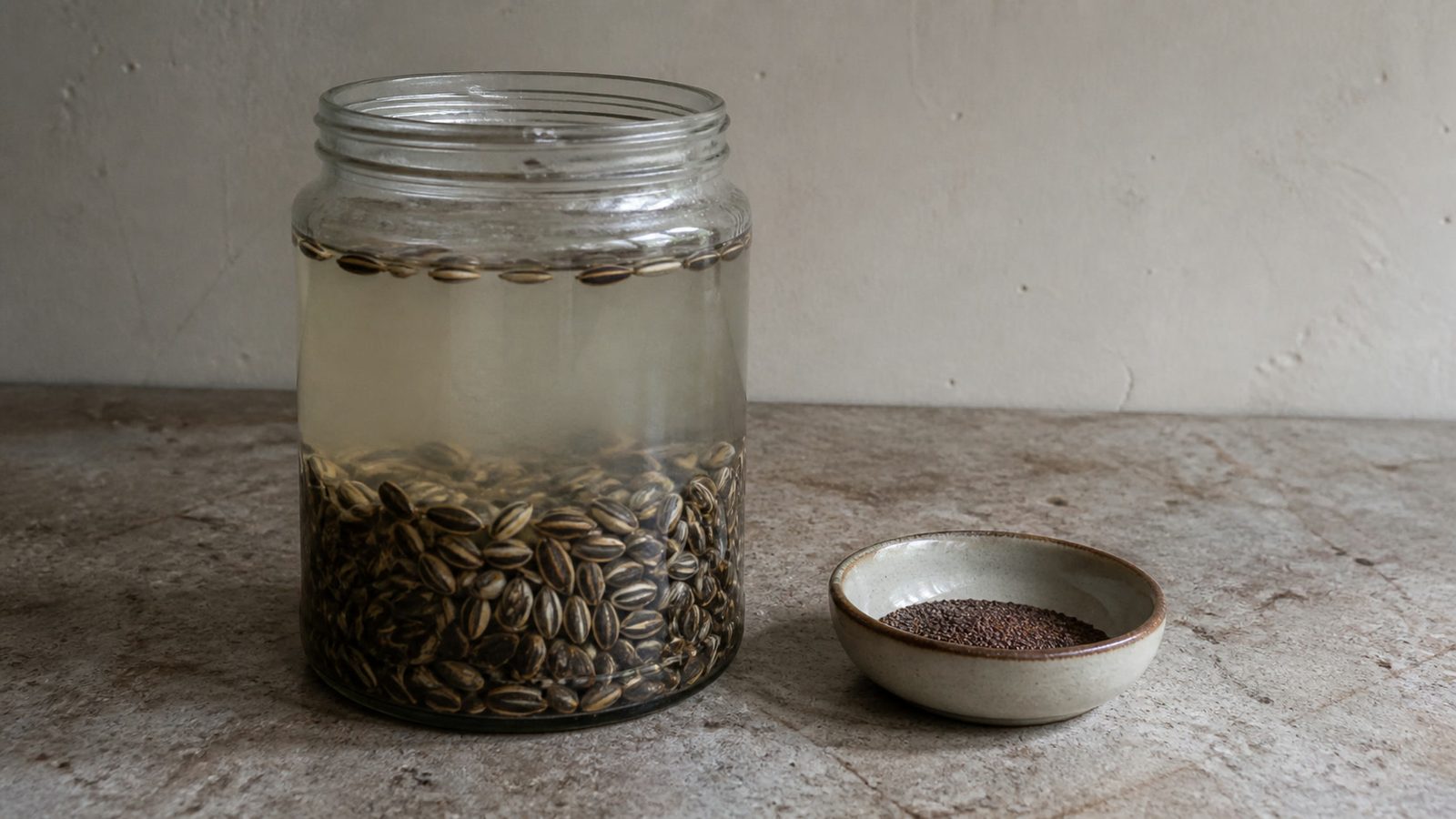
The standard instruction in this category is to soak seed overnight, somewhere between 6 and 12 hours, with 24 hours as a ceiling. It is given as though it applied to microgreen seed generally.
It does not. Counted crop by crop against each one's own published figure:
Soaking, across all 62 microgreen crops
Hover or tap a card to highlight it.
41 crops soak for zero hours
Two thirds of the directory. They are sown dry, and soaking them is either pointless or actively unhelpful.
12 crops have a soak that starts above zero
These are the ones the instruction is actually about. Alfalfa, barley grass, beet, buckwheat, chickpea, cilantro, lentil, mung bean, pea shoots, popcorn shoots, sunflower and wheatgrass.
6 more are optional
Fennel, fenugreek, nasturtium, sesame, shiso and spinach publish a range whose bottom is zero, so dry sowing is inside the recommendation.
3 are unestablished
Carrot, onion and thyme. Nobody publishes a figure either way.
So, the most repeated piece of advice about soaking is advice about 12 crops out of 62, and a reader who follows it across a mixed shelf will soak roughly four crops for every one that wanted it.
Two other things are worth knowing before you fill a jar. The evidence that soaking helps is thinner than the confidence around it, and the ceiling on how long is real and has been measured.
What to actually do
- Take the number from the crop, not from a general rule. Every entry here publishes its own soak figure with the source attached.
- If the crop says zero, sow it dry. That is 41 of the 62 here, and for the mucilaginous ones soaking actively makes the tray worse.
- If the crop has a range whose bottom is zero, dry sowing is inside the recommendation. That is another 6.
- Use potable water in a clean container, with headroom, because hydrated large seed expands a long way.
- Do not extend a soak because nothing has happened yet. Long immersion is the one thing measured to reduce germination on three separate crops.
- Drain thoroughly and sow promptly. Draining is in the published instructions. Drying the seed back out is not, and nobody has tested it.
- Do not treat any additive as a sanitizing step. The one tested protocol is 10 minutes with heat, not an overnight soak.
What soaking actually does
Soaking is imbibition: a dry seed takes up water, swells, and restarts the metabolism that had been suspended. Hydrated tissue begins respiring again, which is the part that matters for everything below, because a seed that has started respiring needs oxygen. That is why a step which begins as helpful hydration turns into suffocation if it runs long enough.
It is worth being precise about what soaking is not. Soaking is a limited pre-sowing hydration. Sprouting is continued germination over days, with repeated rinsing, and the seed, root and shoot are all eaten. They are different operations with different food-safety contexts, and not one of the six guides checked for this topic drew the distinction. That matters, because the detailed official guidance on soak water is written for sprout production, and importing a multi-day sprouting routine into a microgreen tray is not what it licenses.
What soaking buys, which is less than you would think
The most useful single study here put ten microgreen species through a 6 hour soak at about 20°C and compared them against dry sowing.
Hover or tap a row to highlight it.
| What was measured | Result |
|---|---|
| Emergence | Advanced by 12 to 24 hours |
| Species germinating within 36 to 48 hours regardless of soaking | Nine of the ten. Basil was the slow exception |
| Harvest date | Similar within a species. The head start did not reach the harvest |
| Dry shoot weight, in the January 2019 repeat | Down 10.3% |
Read the third row twice. The whole benefit being sold is speed, the speed is real, and it did not produce an earlier harvest. Where an effect on the crop did appear, fresh and dry shoot weight, height and several nutrient concentrations tended to go down rather than up.
One trial is not a verdict, and this one soaked every species for the same 6 hours regardless of what the species wanted, which is exactly the practice this page is arguing against. But it is the best multi-crop evidence that exists, and it does not support "soak and you will get more."
On a single crop the picture is sharper still. A 2025 arugula experiment ran 0, 6, 12, 18, 24 and 72 hours. Zero hours gave the highest germination, around 85 to 90 percent. Rates slipped at 6, 12 and 18, fell further past 24, and reached about 65 percent at 72 hours. Arugula's published figure is zero, so the recommendation and the study agree.
The 12 crops that do want it, and what they share
The 12 with a soak time starting above zero are all large, hard or hull-bearing seed: pea, sunflower, chickpea, lentil, mung bean, popcorn, buckwheat, barley and wheat grains, plus beet, cilantro and alfalfa.
Seed size is a working shortcut and not the actual mechanism. What determines whether a soak helps is whether water and oxygen can get through the coat at a sensible rate, and no microgreen study has tested seed dimensions, coat permeability and mucilage against soak response together to say which one predicts the benefit. Size is a good first guess that nobody has confirmed.
Buckwheat is the longest soak here at 12 to 24 hours, and it is also the crop with a documented over-soak failure, going mushy when the soak runs on. The crop with the widest window is the one where the far end of it is riskiest.
The general guidance and the crop figures mostly agree. Extension guidance puts sunflower at about 10 hours and grower instructions put pea and sunflower at 8 to 12, all inside sunflower's published 4 to 12. Pea shoots are tighter, at 6 to 8.
One widely used soak table is worth ignoring on one line. It gives "beet, chard and lentil, 8 hours" as a single entry, where the crop-specific figures are beet at 4 to 8, lentil at 6 to 12, and Swiss chard at zero. Beet and chard are close relatives with similar-looking seed, and bundling them into one row is the kind of shortcut that looks harmless and is not.
The crops you should not soak, and why
Some seed produces mucilage, a gel coating that forms the moment it gets wet. Soak it and it becomes a single sticky mass that cannot be spread evenly.
The crops named repeatedly in the practice guidance are arugula, basil, brown mustard, chia and curly cress. Every one of them has a published soak of zero, arrived at independently from each crop's own sources.
A second group is dry-sown for a plainer reason: the seed is small enough that wetting it makes it clump and hard to distribute. Amaranth, broccoli, cabbage, kale, mustard and radish are all named, and all six are zero here.
The cost in these cases is usually a bad stand rather than a dead tray. Nobody has measured what an uneven stand caused by wet seed actually costs in yield or in discarded trays, which is a gap worth knowing about, because "it makes sowing harder" is a labor complaint and "it costs you a tenth of the tray" would be a different argument.
How long is too long
There is a real ceiling and it has been measured on three crops, all in the same direction.
- Arugula: about 65 percent germination at 72 hours, against 85 to 90 at zero.
- Pea: across seven durations from half an hour to 72 and four temperatures, no soak treatment improved normal germination at all, and 72 hours at 20°C significantly reduced it. An older report found peas soaked 48 hours at 20°C producing abnormal seedlings.
- Fenugreek: 0 to 24 hours tied for the highest germination and 72 hours was the lowest, with root development restricted from 24 hours onward.
The mechanism is oxygen, and there is a striking measurement behind it. In kidney bean, unaerated water at 25°C for 72 to 74 hours suppressed germinative capacity, dissolved oxygen was nearly gone by 72 hours, and water deeper than 1.5 centimeters was enough to prevent germinative capacity in that experiment. A soaking seed is not sitting inert in water. It is breathing, and it can be drowned.
Note what this does to the common instruction to leave seed longer because it has not sprouted yet. That is the one response the evidence most clearly argues against.
Fermentation is a separate problem from suffocation, though the two arrive together. Suffocation is the seed running out of oxygen. Fermentation is microbes multiplying in warm standing water, and it is what produces the sour smell.
The water
Warm water holding food seed for twelve hours is a growth medium, and this is the part of soaking most likely to matter and least often discussed.
Seed microbiology is not hypothetical on this crop. A 2023 study bought 102 seed samples online across 14 species and measured bacteria, mold and yeast. Counts differed substantially between seed types.
Official guidance exists but it is written for sprouts, where the risk is far higher. It requires water used to rinse or soak seed to meet an agricultural water standard of no detectable generic E. coli in 100 mL, new water for each batch, and clean sanitized equipment. Those are sensible instructions to borrow. They are not a microgreen rule and they do not license a multi-day routine.
On additives, be careful what the one study actually shows. The same 2023 work tested 3 percent hydrogen peroxide and a peroxide and vinegar mixture for 10 minutes, with and without heat treatment, on amaranth, borage and carrot. Combined with 60°C for 20 hours, peroxide cut Enterobacteriaceae by 1.80, 1.46 and 2.83 log CFU per gram on those three crops, without significantly changing germination.
That is evidence for a 10 minute treatment on three crops, alongside a heat step. It is not evidence for an overnight peroxide soak, for other species, or for a home process. Bleach, vinegar alone and kelp have no microgreen soak evidence at all. Nothing here is a kill step, and calling it one is the error to avoid.
What nobody has measured
- Which seed trait predicts a soak benefit. Size, coat permeability and mucilage have never been tested against soak response in one multi-crop trial.
- What soaking a no-soak crop actually costs, in sowing time, stand evenness, yield or discarded trays.
- Whether changing the water mid-soak helps. No controlled comparison exists.
- A safe soak time and temperature for home use, as a food-safety threshold rather than a habit.
- Whether the bench warning signs work. Mushy coats, cloudy water and a fermented smell are widely used and nobody has tested them against later germination.
- A per-crop soak response for 59 of the 62 crops. Three have been studied at multiple durations. The rest are supplier recommendations.
Terms on this page
Tap a term to see what it means.
Imbibition. The first uptake of water by a dry seed. It restarts respiration and begins germination.
Sources
Opened 2026-08-12. The per-crop soak hours are sourced individually on each crop's own entry, and the counts across all 62 were recounted for this page on 2026-08-12.
- Li and colleagues, ten-species microgreen soaking trial, Horticulturae 2021 - the 6 hour soak at about 20°C across ten species, the 12 to 24 hour emergence advance, nine of ten germinating within 36 to 48 hours either way, the unchanged harvest date, and the 10.3 percent dry shoot weight reduction in the January 2019 repeat. The publisher page returned a reader error on request and the figures come from the indexed full text.
- Turhan and Dogan, arugula microgreens, 2025 - 0, 6, 12, 18, 24 and 72 hour treatments, with the highest germination at zero hours at about 85 to 90 percent and about 65 percent at 72 hours.
- Demici and colleagues, fenugreek microgreens, 2025 - 0 to 72 hour treatments, 0 to 24 hours tied highest, 72 hours lowest, root development restricted from 24 hours onward.
- Zaghdani and colleagues, pea seed soaking, 2000 - seven durations from 0.5 to 72 hours across four temperatures, no improvement in normal germination from any treatment, and a significant reduction at 72 hours and 20°C.
- Kobayashi, bean soaking and germination, 1957 - the oxygen mechanism, suppressed germinative capacity after 72 to 74 hours unaerated at 25°C, and the finding that water deeper than 1.5 centimeters prevented germinative capacity.
- Berrie, pea soaking note, Nature 1960 - 48 hours at 20°C producing abnormal seedlings. Abstract only; the full article is paywalled.
- Ocho Bernal and colleagues, microgreen seed microbiology, Frontiers in Sustainable Food Systems 2023 - 102 online-purchased seed samples across 14 species, and the 10 minute peroxide and peroxide-vinegar treatments with heat, giving the 1.80, 1.46 and 2.83 log CFU per gram reductions on amaranth, borage and carrot.
- FDA, guidance for sprout production (PDF), September 2023 - the no detectable generic E. coli in 100 mL water standard, new water per batch, clean and sanitized equipment, and the statement that some growers use a pre-germination soak.
- FDA, selecting and serving produce safely - why warm humid germination conditions let pathogens already on seed multiply.
- Food Quality and Safety review of edible seed soaking and sprouting, 2020 - water changing to remove metabolites and slow microbial growth, and the distinction between microbial fermentation and oxygen starvation.
- Extension, supplier and grower guides used as practice, and the source of the six-page audit: Penn State Extension's home microgreens guide, which says most microgreen seed needs no treatment and pictures sunflower at about 10 hours and which returned a 403 when reopened, Bootstrap Farmer for the mucilage and small-seed crop lists and the 6 to 8 hour general claim, Microgreen Shop for the named crop times including the beet, chard and lentil line, Copper Dog Farms for pea and sunflower at 8 to 12 hours and the rinse and drain step, RusticWise for the 8 to 12 hour general claim and 24 hour ceiling, and Greenery Insight for the mushy buckwheat warning.
Keep reading
Growing guides
Sowing a tray: how much seed, and why grams are not density
Published microgreen seed rates span 409-fold, from 1.1 g to 450 g a tray, so sow thick is not an instruction. Density has been tested at several rates in about five studies, the optima are six times apart, and it turns out to be a food-safety variable as well as a yield one.
Read Sowing a tray: how much seed, and why grams are not densityThe test bench
Scales for Microgreens: The $460 Balance Publishes No More Than the $19 One
Seed rates here run 1.1 to 450 grams a tray, a 409-fold range. One scale covers all of it for about $19, and neither it nor a $460 balance publishes the one specification that would let you trust either.
Read Scales for Microgreens: The $460 Balance Publishes No More Than the $19 OneGrowing guides
Growing a mix: one blend has a one-day harvest window and another keeps for three days
One commercial brassica blend's five components overlap on exactly one harvest day, and a three-crop spicy blend keeps only 2 to 3 days because of its cress, while another component lasts 14.
Read Growing a mix: one blend has a one-day harvest window and another keeps for three daysThe journal
Best Microgreen Seed Suppliers for Every Grower Scale
Find the best microgreen seed suppliers for your crops by weighing germination, organic certification, pathogen testing, pack sizes, and shipping costs.
Read Best Microgreen Seed Suppliers for Every Grower Scale