Scales for Microgreens: The $460 Balance Publishes No More Than the $19 One
Cal HewittPublished Checked
- equipment
- seed
- sowing
- buying
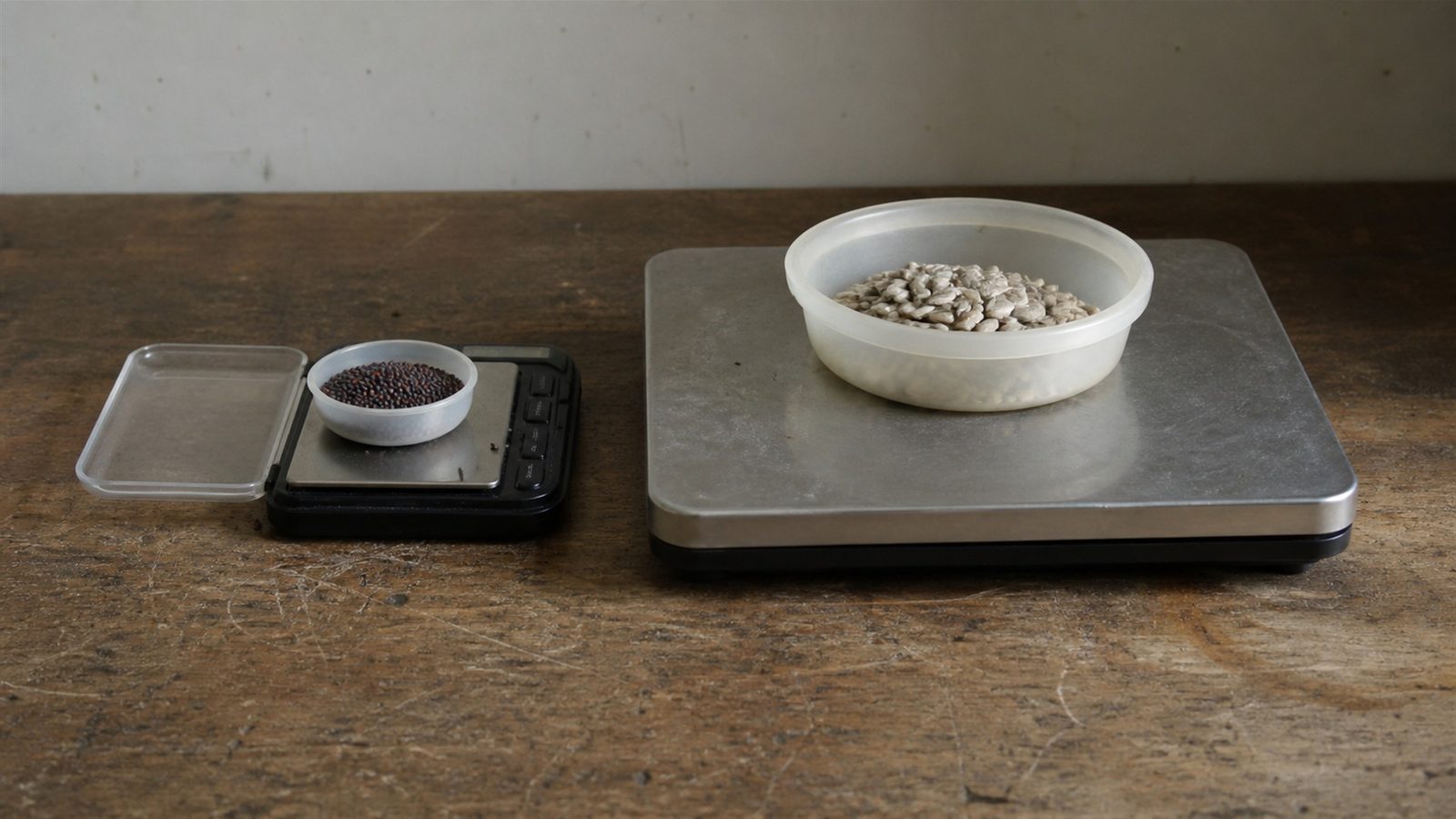
One 1,000 gram by 0.01 gram pocket scale weighs every published seed rate, and it was $18.88 on 2026-08-12. A $460 laboratory balance covers exactly the same ground and publishes no more about its accuracy than the cheap one does. Weighing each tray's dose is the instruction; that scale is the instrument.
Published seed rates run from 1.1 grams a tray for celery to 450 grams for wheatgrass, across the 51 crops that publish a rate. That is a 409-fold range, and it is why the instrument question is not as obvious as it looks. Nothing else in a kitchen is asked to span 409-fold.
What to actually do
- Buy one 1,000 gram by 0.01 gram pocket scale. That single specification covers all 51 published rates, from celery to wheatgrass, and it was $18.88 on 2026-08-12. If you already own a 1 gram kitchen scale, a small 0.01 gram pocket scale alongside it covers the same ground for less, because the two blind spots do not overlap.
- Check that a calibration weight is included, and buy one if not. These scales want a 100 gram mass. The cheap listings increasingly bundle it; the specialist ones sampled here did not.
- Check the scale before you trust it, at several loads and at several pan positions, and write down what you saw. This is the step that actually buys you accuracy, and it is free.
- Do not pay for a specification nobody publishes. A $460 balance and a $19 pocket scale publish the same two numbers. Until one of them publishes linearity or repeatability, the price difference is not buying a checkable claim.
- Weigh the bowl before you buy. Tare consumes capacity, so a 500 gram scale only clears the 450 gram crops if your container weighs under 50 grams.
- Keep the scale out of the humid room. Manufacturer guidance is a damp cloth and no liquid inside; seed dust on the pan is enough to stop a clean zero.
- Do not read a decimal place as an accuracy. The display step and the error are different things, and on cheap listings only the step is published.
What that range asks of an instrument
Two requirements, and they pull in opposite directions. The scale needs a capacity above 450 grams plus whatever the bowl weighs, and a display step small enough that 1.1 grams is still a real measurement rather than a rounding.
Take a usable step as one tenth of the target. That means the light end needs about 0.11 grams or better while the heavy end needs 450 grams or more of capacity. Those two demands together describe a span of roughly 4,000 to 1.
And the span is not the test, which is where the shopping goes wrong. A 5,000 gram by 1 gram kitchen scale has a capacity-to-division ratio of 5,000 to 1, comfortably past 4,000, and it still fails: the ratio is large but the division sits in the wrong place. Both requirements have to be met at once, and a ratio hides that.
Where each instrument actually breaks
Computed per crop against the 51 published rates. The resolution test uses the lightest figure in each crop's published range, because that is the smallest dose a grower would ever be asked to weigh.
Hover or tap a row to highlight it.
| Instrument | What it costs | How it fails | How many crops it fails on |
|---|---|---|---|
| 1 g kitchen scale | $21.50 | One division is more than 10% of the target | 11 of 51 |
| 1 g kitchen scale | as above | One division is more than half the target | 1 of 51 (celery) |
| 115 g pocket scale | CAD $22 | The dose exceeds capacity, before any bowl | 8 of 51 |
| 2,000 g by 0.2 g bench scale | $262 list | 0.2 g is still 18% of the celery target | Misses the light end |
| 1,000 g by 0.01 g balance | $460 | Nothing, on capacity and step | 0 of 51 |
| 1,000 g by 0.01 g pocket scale | $18.88 | Nothing, on capacity and step | 0 of 51 |
Celery is the extreme case and it is not close. At 1.1 grams a tray, one division of a 1 gram scale is 91% of the entire target. The scale cannot tell 1.1 grams from 2 grams, which on that crop is nearly double the dose.
Wheatgrass breaks the other instrument just as cleanly. At 450 grams it is 3.9 times the capacity of a 115 gram pocket scale, and seven more crops sit over that ceiling too: popcorn shoots, barley grass, mung bean shoots, sunflower, chickpea shoots, pea shoots and nasturtium.
The median crop needs none of this. On the same basis the sowing page uses, the median tray is about 23 grams, where one division of a cheap 1 gram scale is 4.3% of the target and perfectly adequate. The instrument question is entirely a question about the tails.
One cheap scale covers every crop
One instrument covers every crop with a published rate, and it is not the expensive one.
The pocket-scale category is where to find it: a 1,000 gram by 0.01 gram rechargeable pocket scale at $18.88, with a 100 gram calibration weight in the box. Capacity clears the 450 gram heaviest crop with 550 grams left for the bowl, and the 0.01 gram step clears the 1.1 gram lightest by a wide margin. It covers 51 of 51.
The specialist scale shops do not sell an equivalent under $460, so this is one purchase where the marketplace is the place to look rather than a scale supplier.
So, the $460 buys 24 times the price for the same coverage. The question is what else it buys, and the answer is nothing you can check. Neither product publishes a numerical linearity or repeatability figure. Both publish exactly two numbers, capacity and readability, which are the two numbers that do not tell you whether the reading is true.
That is the real state of this category. You are not choosing between a verified instrument and an unverified one at 24 times the price. You are choosing between two unverified instruments, so buy the cheap one and spend the difference on weights and ten minutes of checking.
The two-scale route still works if you already own a kitchen scale, because no crop is failed by both cheap instruments, zero of 51. Every crop a 1 gram scale cannot resolve sits far below a pocket scale's capacity, and every crop that overflows a small pocket scale is heavy enough that a 1 gram division is trivial against it. The blind spots do not overlap. That is complete coverage rather than a compromise, and it costs nothing extra if one of the two is already on the counter.
A 0.01 display is not a 0.01 accuracy
The thermometers review hits the same trap from the other direction.
NIST separates the displayed division, d, from the verification division, e, which is what establishes a tolerance and a class. A smaller d does not make a scale more accurate, and NIST says so directly. A 0.01 gram display only promises that the screen can show two values 0.01 grams apart. It is not a promise that the number is within 0.01 grams of the truth.
None of the four consumer and precision listings checked published a numerical linearity or repeatability figure. Capacity and readability are nearly always published; the specifications that would let you check the reading are not. So, you have to test it yourself.
NIST also warns that light loads can produce relatively large errors, which is precisely the region the light-seeded crops sit in.
Checking one, and what a check costs
A scale you have not checked is a display, not a measurement.
- The right reference is a known mass matched to the manual. A 0.01 gram pocket scale of the type reviewed here requires a 100 gram calibration mass, which its own manual specifies and its listing does not include. A 2,000 gram bench scale wants a 2 kilogram span mass and a 1 kilogram midpoint for linearity.
- None of the four listings checked stated that a calibration weight was included. The mass is the hidden cost of the cheap scale.
- A professional set is overkill. A traceable ASTM Class 6 set covering 100 grams down to 10 milligrams was $335, which is more than any scale on this page except the balance.
- A current US cent is specified at 2.50 grams by the US Mint, and it is a legitimate rough screen. It will reveal a dead zero, a stuck display or gross non-repeatability around 2.5 grams. It establishes nothing at 0.01 grams, because circulation wear, dirt and tolerance all move it. Use it as pass or fail, never as an adjustment reference.
- Test the pan, not just the center. Repeat the same mass at the center and at four positions. A position effect is the reason not to weigh in an oversized bowl or at the edge.
- Write the pass rule before the test. For a 1.1 gram target, a 1 gram scale fails on resolution no matter how good its 100 gram reading is. A good result at one load does not rescue the load you actually care about.
The tablespoon is a dispenser, not a mass
Measuring by volume is legitimate. It is only reliable inside one crop, one lot and one scoop.
University of Maryland Extension publishes the numbers that prove it. From its own seed counts, one tablespoon works out to about 10.7 grams of broccoli, 12.3 grams of mustard and 15.1 grams of beet. That is a 41% spread from the lightest to the heaviest across three ordinary crops.
The reason is seed size, and it is larger than most people expect. The same source gives 53 beet seeds per gram against 281 for broccoli and 530 for mustard. A supplier lists microgreen sunflower at 18 seeds per gram, and another guide lists sorrel at 1,150. A tablespoon calibrated on one crop, used on another, is simply the wrong dose.
So, use the scoop the honest way: weigh once, mark the scoop, then dispense by volume for that crop and that lot only. Reweigh ten fills whenever the lot, the crop, the moisture or the scoop changes, and treat soaked seed as a separate problem entirely.
A 1 gram kitchen scale will not do the light crops
One seeding calculator tells readers that a kitchen scale reading to 1 gram is precise enough even for the lightest varieties.
That is wrong on the crop it names. The lightest published rate is celery at 1.1 grams a tray, where a 1 gram scale offers one single division across the entire dose. Ten more crops sit in the band where a 1 gram step is over 10% of the target. It is a marketing statement rather than a published tolerance.
The guidance you will find mixes units, which is the other reason a figure will not carry across: of five calculator and guidance pages checked, three give a rate in grams and two give volumes, so a gram rate from one page and a scoop from another do not line up.
Who should skip this entirely
A grower who runs one crop, from one lot, with one marked scoop that was weighed once. That is a controlled volume method and it is fine. It stops being fine the moment the crop, the lot, the moisture or the scoop changes.
And anyone who will accept sowing by eye. Extension guidance explicitly permits weight, volume or estimation, and for a single tray of a forgiving crop the tray will still grow. The scale becomes hard to skip when you are following a published gram rate, trialing a low rate, changing lots, or trying to work out why a tray came in too dense.
What is still genuinely unknown
- Bulk density by crop and lot, in grams per level tablespoon, with a standard deviation. The three figures above are arithmetic from seed counts, not a measured density table.
- How much two growers differ filling the same scoop from the same lot. Nobody has measured it, so the real cost of the volume method is unquantified.
- Tablespoon mass for the large seeds, sunflower and pea, which are exactly the crops where a scoop is most tempting and the dose is largest.
- Whether these instruments survive a grow room. No durability study exists for humidity and seed dust, only a manufacturer instruction not to let liquid inside.
- Real battery life in use, as opposed to the manufacturer's bench figure of 1,500 hours with the backlight off.
- Any published recalibration interval for the consumer models checked. One manufacturer recommends a schedule set by use frequency and declines to name a number.
- Whether the $18.88 scale and the $460 balance actually perform differently. Both publish capacity and readability and neither publishes linearity or repeatability, so the question cannot be answered from either listing. It would take the same set of weights, the same loads and the same pan positions on both.
Terms on this page
Tap a term to see what it means.
Resolution, or displayed division. The smallest increment the screen can show. Written as the second number in a specification like 1,000 g by 0.01 g.
Sources
Opened 2026-08-12. Prices are snapshots on that date, not price promises, and this page is rechecked at least every two months. Prices come from different sellers in different currencies and are not a normalized comparison. The per-crop instrument arithmetic is computed from the seed-rate field on all 62 crop entries, of which 51 publish a rate. The $18.88 pocket scale's specifications and price were read from the seller's own listing on the same date.
- University of Maryland Extension, growing microgreens and baby greens indoors - the tablespoon figure of about 10 to 15 grams per flat, the seeds-per-gram counts of 53 for beet, 281 for broccoli and 530 for mustard used to derive the per-tablespoon masses, and the explicit permission to sow by weight, volume or eye.
- NIST, considerations for Class II scale applications and the NIST weighing and scales FAQ - the distinction between displayed division and verification division, the statement that a smaller displayed division does not make a scale more accurate, and the warning about relatively large errors at light loads.
- NIST on resolution - the definition of resolution used in the glossary.
- Jennings JZ 115 at Canadian Weigh - 115 g by 0.01 g at CAD $22, with auto-off and a tare feature but no published duration, linearity or repeatability, and its manual for the 100 gram calibration mass it requires and does not include.
- My Weigh iBalance M01 at Canadian Weigh - 1,000 g by 0.01 g at $460, covering both ends of the seed-rate range, published without a numerical linearity or repeatability figure.
- US-RA 5000 at Science Lab Supplies - 5,000 g by 1 g at $21.50, the low-cost capacity option.
- OXO 11 pound food scale at $64.99 with 1 gram increments and a zero function, and an independent multi-scale test that found it off by 1 to 2 grams against the tester's own weights, plus the Escali Primo review for a 5 kg by 1 g scale observed at $25 to $29.
- OHAUS Valor 1000 data sheet (PDF) and manual (PDF) - the 2,000 g by 0.2 g model used in the table, tare to capacity by subtraction, the selectable 1, 5 or 10 minute auto-off, the 1,500 hour battery figure with backlight off, the zero, midpoint and span linearity routine, and the cleaning and liquid warnings. List prices from the Rice Lake catalog (PDF).
- Troemner 100 g to 10 mg ASTM Class 6 weight set at Scales Plus - $335, the professionally specified reference and the reason most growers should buy individual weights instead.
- US Mint coin specifications - the current cent at a nominal 2.50 grams, used here only as a rough screen.
- USDA AMS on testing bulk weighing scale accuracy - the multi-load test principle behind checking at several masses rather than one.
- A&D weighing FAQ - that drafts, temperature and location affect results, and the recommendation to set a verification interval by use frequency rather than a fixed calendar date.
- Practice sample for the unit audit and the claim examined above, checked 2026-08-12: Aquager seeding calculator, which states a 1 gram kitchen scale is precise enough for the lightest varieties; Home Microgreens seed density calculator and its swivel measuring spoon set at $3.99; Farmer Grows calculator, a disclosed affiliate site; and the Seedmart growing guide (PDF) for its grams per tray and seeds per gram tables including sorrel at 1,150.
- West Coast Seeds microgreen sunflower - the 18 seeds per gram figure for a large seed.
- Easy Micro Greens mini scale - a microgreen-branded scale whose accessible page text published no capacity, resolution or price, and Rooted Robotics tabletop seeder at $10,000, a seeder rather than a scale, listed to show what the purpose-built end of this category actually is.
Keep reading
Growing guides
Soaking microgreen seed: only 12 of 62 crops need it
The standard advice is to soak overnight, 6 to 12 hours. Counted crop by crop, 41 of 62 crops soak for zero hours and only 12 have a soak time that starts above zero. And the one ten-species trial found soaking moved emergence forward without moving the harvest.
Read Soaking microgreen seed: only 12 of 62 crops need itGrowing guides
Sowing a tray: how much seed, and why grams are not density
Published microgreen seed rates span 409-fold, from 1.1 g to 450 g a tray, so sow thick is not an instruction. Density has been tested at several rates in about five studies, the optima are six times apart, and it turns out to be a food-safety variable as well as a yield one.
Read Sowing a tray: how much seed, and why grams are not densityThe test bench
Seed Storage for Microgreens: For 17 Crops the Container Costs More Than the Seed
A $0.92 container has to save three trays of turnip seed to pay for itself, or a tenth of a tray of barley grass. Nothing sold as airtight publishes a test, and a seal locks in whatever state the seed is already in.
Read Seed Storage for Microgreens: For 17 Crops the Container Costs More Than the SeedThe journal
Best Microgreen Seed Suppliers for Every Grower Scale
Find the best microgreen seed suppliers for your crops by weighing germination, organic certification, pathogen testing, pack sizes, and shipping costs.
Read Best Microgreen Seed Suppliers for Every Grower Scale