Sowing a tray: how much seed, and why grams are not density
Cal HewittPublished Checked
- seed
- sowing
- density
- method
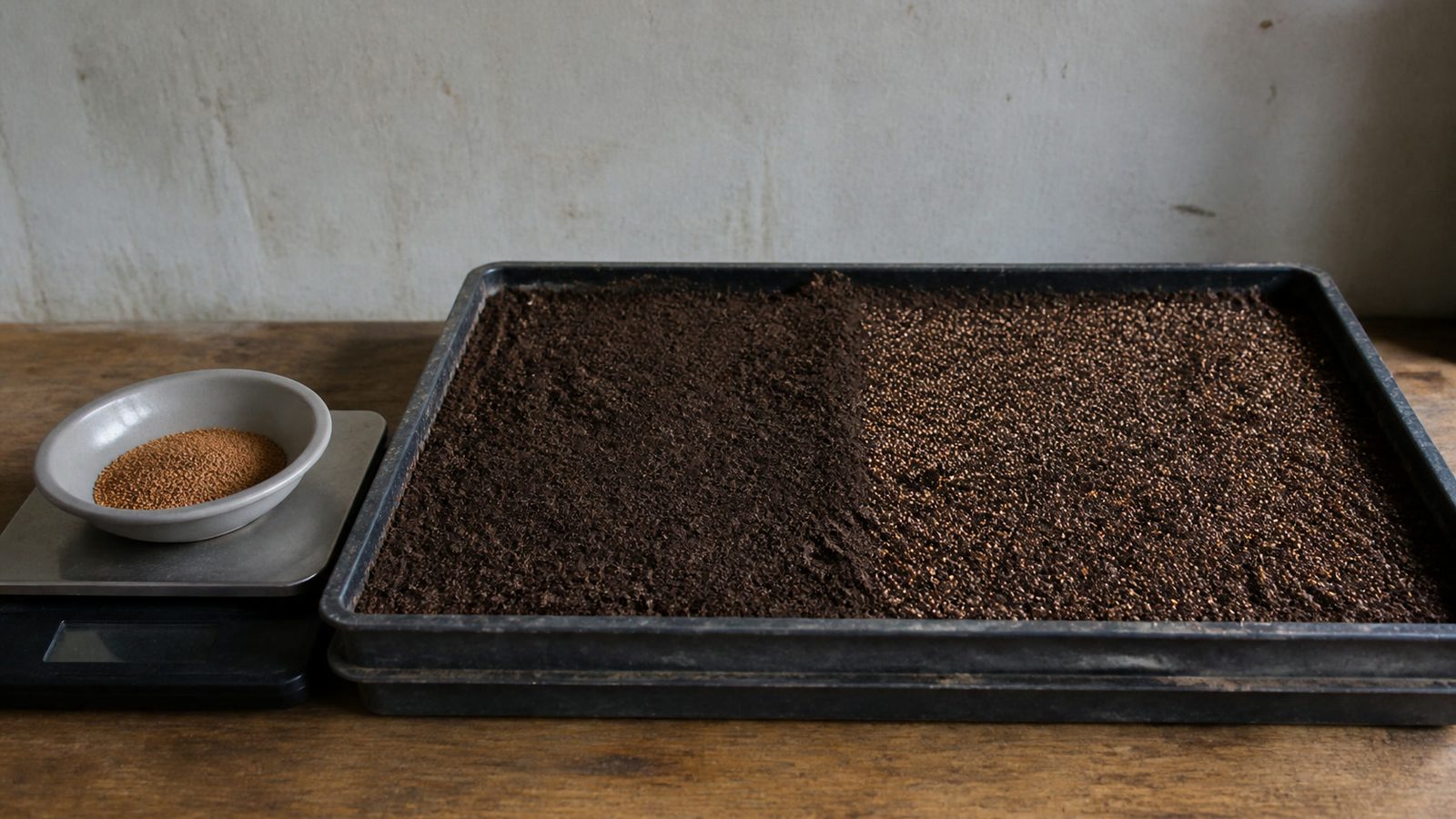
"Sow thick" is the default instruction in this category, and it is close to meaningless as written. Across the 51 crops with a published seed rate, the figures run from 1.1 grams a tray for celery to 450 grams for wheatgrass, a 409-fold range, checked 2026-08-12. There is no single thickness.
Three findings do most of the work here:
- Density has been tested at several rates in about five studies, and the optima are six times apart. Peak biomass sits at 12 seeds per square centimeter for cress and rocket and at 2 for pea, and a legume trial chose 3 for mungbean and lentil and 8 for Indian mustard.
- Density is a food-safety variable, not only a yield one. In the same study, total aerobic bacteria on cress rose from 7.04 to 7.94 log CFU per gram between 6 and 14 seeds per square centimeter, roughly an eightfold increase, while biomass peaked at 12. The best yield and the lowest microbial load are not the same setting.
- A gram figure is not a density until you know seeds per gram, and that conversion catches published rates that are ten times any measured optimum.
What to actually do
- Weigh the crop's own rate. Every entry here publishes one where a source exists, and the range across the directory is 1.1 to 450 grams a tray.
- Convert it before you trust it. Grams times seeds per gram, divided by 1,290 square centimeters. If the answer is far above about 12 seeds per square centimeter, something is wrong with the rate.
- Do not sow past the biomass peak. More seed stops buying yield at a crop-specific point and keeps adding microbial load past it.
- Decide whether you are selling weight or plants. Denser trays weigh more and produce smaller, thinner individuals.
- Sow onto level, moist medium, spread as evenly as you reasonably can, then press gently for contact.
- Use a shaker whose holes are close to the seed size, or sow through hardware cloth, rather than shaking from a wide opening.
- Change one thing at a time and write the rate down. Nothing here is a constant, and your own bench is the only place the question gets settled for your lot.
What has actually been measured
Most of what is written about seed rate is a recommendation. A small amount of it is a trial.
Hover or tap a row to highlight it.
| Study | Crops and range tested | Peak biomass at |
|---|---|---|
| 2026, three experiments, four replicates each | Cress 6 to 14 seeds/cm² | 12 seeds/cm² |
| Same | Rocket 8 to 16 seeds/cm² | 12 seeds/cm² |
| Same | Pea 1 to 4 seeds/cm² | 2 seeds/cm² |
| 2022, New Delhi, best marketable quality | Mungbean and lentil 2 to 4 seeds/cm² | 3 seeds/cm² |
| Same | Indian mustard 6 to 10 seeds/cm² | 8 seeds/cm² |
| 2020, Vietnam, greenhouse | Radish 6 to 12 seeds per cell | 8 seeds per cell |
Cress and rocket land on the same number and pea is six times sparser. That is the single most useful fact in the subject, and it kills any cross-crop rule of thumb on its own.
A separate 2025 chamber trial tested broccoli, black radish, red beet, pea, sunflower and bean at full surface coverage, then 50 and 100 percent above it. Its trays were 16 by 9 centimeters rather than 1020s, so its gram figures do not transfer, but its pattern does, and that pattern is the subject of a section below.
Three more trials fill in other crops. A 2022 study in New Delhi chose its optima on marketable quality, although yield kept rising at the densest rate. A 2020 radish trial in Vietnam peaked at 8 seeds per cell, a seed rate of 109.81 g per square meter, or about 14 g on a 1020. And a 2023 study grew radish, cabbage and rocket at 4, 8 and 12 seeds per cavity, with 12 giving the most yield, but it does not give the cavity size, so it cannot be turned into grams.
Everything else is a starting point. Extension services publish per-crop rates and say to test them in your own facility, and supplier calculators say the same in smaller print.
Density is a food-safety variable
This is the part almost nothing else in the category mentions, and it changes how the question should be framed.
The 2026 study measured microbial load alongside yield. Total aerobic bacteria, Enterobacteriaceae and fungi all rose with density. On cress, total aerobic bacteria went from 7.04 to 7.94 log CFU per gram between 6 and 14 seeds per square centimeter.
Two things about that finding deserve care.
It is a load measurement, not an illness rate. Nobody has shown that a denser tray makes anybody ill, and the microgreen recalls on record carry zero illnesses between them.
And it is not a mold experiment either. Higher counts of ordinary bacteria and fungi are not the same as diagnosed damping-off. No controlled trial has varied only sowing density and counted mold or damping-off incidence. The closest is the 2020 radish trial, which noted root rot in some trays at its highest density, 12 seeds per cell, as an observation rather than a count, and its substrates varied too.
What it does establish is that yield is the wrong sole criterion. If biomass peaks at 12 and microbial load keeps climbing past it, then the best commercial setting is somewhere at or below the biomass peak, not above it.
Grams are not density
A gram rate becomes a density only when you know how many seeds are in a gram, and seeds per gram varies enormously across crops. The arithmetic is:
seeds per cm² = (grams sown × seeds per gram) ÷ tray area in cm², where a 1020 is 200 square inches, or 1,290 square centimeters.
Run that check before you trust any rate, because it catches real errors. Mint has no usable seed rate for exactly this reason: the one published figure is 14 grams a tray, and at the supplier's own count of 10,999 seeds per gram that is 153,986 seeds, or about 119 seeds per square centimeter. That is roughly ten times the highest density anyone has measured as optimal, and thirty to sixty times a brassica tray.
The 409-fold spread across crops is the other half of the same point. Celery at 1.1 grams and wheatgrass at 450 are not describing different opinions about thickness. They are different seeds, and the median crop here sits at about 23 grams a tray.
So, when a page gives you a gram figure with no crop attached, it has told you nothing.
Where the published rates disagree
Two extension figures can be compared directly against the crop-specific ones, because both are stated per 1020 tray:
Hover or tap a row to highlight it.
| Crop | Utah State | Crop figure | Verdict |
|---|---|---|---|
| Pea shoots | 150 g | 150 g | exact match |
| Broccoli | 28 g | 13 g | 2.2 times apart |
Broccoli is the most commonly grown crop in the category and the two figures differ by more than double. Both are sourced. Neither is obviously wrong, and this is precisely the kind of disagreement that a gram-only convention hides: without seeds per gram for each lot, there is no way to tell whether these are two different densities or two different seed lots.
If you grow broccoli, that range is the honest one to work in, and it is worth weighing your own lot rather than inheriting either number.
Yield per tray and quality per plant pull apart
More seed usually does produce more weight per tray, up to a point, and it makes each individual plant smaller. The 2025 six-crop trial measured both:
- Broccoli yield rose from 0.64 to 1.20 g/cm² across its treatments, while individual plant mass fell from 0.081 g to 0.052 g.
- Red beet yield rose 0.17 to 0.30 g/cm². Sunflower rose 0.67 to 0.92.
- Black radish, sunflower and bean all showed lower individual weight at higher density.
- Stem diameter fell with density in every crop except red beet.
Height moved in different directions by crop, which is worth knowing before treating a taller stand as a fault: broccoli went from 6.81 to 7.81 cm while bean went from 24.16 down to 23.26.
Which of those you want is a selling decision, not a growing one. A dense tray of small plants and a sparse tray of larger, better separated ones are different products, and the trial cannot tell you which your customer wants.
And going sparser is not free either. A 2022 amaranth experiment yielded 13.6 g fresh at its low rate against 31.8 g at double the rate, and reported black mold at the lower density, not the higher one. That single result should not reverse the usual warning, but it should stop anyone treating sparse as automatically safer.
Getting it evenly into the tray
The documented methods are simple and none of them has been tested against another.
Weigh each tray's dose. Then sprinkle by hand, use a jar or shaker whose holes are only moderately larger than the seed, or sow through hardware cloth held over the medium. Powered, tabletop and vacuum seeders exist at scale.
The one mechanical reason given is useful: shaker holes much larger than the seed produce an unequal spread. Hardware cloth is offered as the more uniform option.
Nobody has measured what unevenness costs. No microgreen trial has compared an uneven stand with an even one at the same total seed count and reported yield, grade or disease. "Spread it evenly" is universal advice with no number behind it.
And the one experiment that did vary the pattern found the opposite of the intuition. A 1976 controlled garden-cress study held overall density constant and changed how clumped the seedlings were. Damping-off spread more slowly in the clumped stands than in the evenly spaced ones. That is an epidemic-spread result on one crop from fifty years ago and it is not a recommendation to sow badly. It is a reason to be careful about asserting that even is always healthier, because the only time anybody checked, it was not.
On seed size, extension guidance suggests roughly 10 to 12 seeds per square inch for small seed and 6 to 8 for large, and says a light cover of medium matters more for larger seed. No device has been shown to be better for dust-fine seed than for large.
On pre-soaked seed, wet seed clumps and is harder to spread, which is one of the reasons 41 of the 62 crops soak for zero hours. Whether soaking changes the stand at equal viable seed density has never been tested.
Pressing, contact and weight
Gentle contact between seed and moist medium is universal extension advice, with the stated reason being that the seed can take up water and the root can go down rather than lifting the seed up. Press the seed onto the surface, mist, then cover.
No crop has been identified as one that should not get gentle contact, and no trial has compared pressure levels by crop.
Contact and darkness are separate decisions, and the weight that gets stacked on top is the least evidenced number in the whole method. That belongs with the blackout period, which covers what the published weights are and why none of them has been tested.
What nobody has measured
- A density optimum for most of the 62 crops. About a dozen have been grown at more than one density.
- Mold or damping-off incidence against density, in a controlled trial that varies only the rate.
- What an uneven stand costs, in yield, grade or disease.
- Hand against shaker against hardware cloth, on distribution, time or outcome.
- Whether soaking changes the stand at equal viable seeds per unit area.
- Whether density changes days to harvest. The largest published dataset, a 29-variety industry trial, did not randomize densities within a variety.
- The relationship between density and moisture at the base of the canopy, which is asserted constantly and measured nowhere.
Terms on this page
Tap a term to see what it means.
Sowing density. Viable seeds per unit of growing area. Grams only become a density once seeds per gram is known.
Sources
Opened 2026-08-12. The per-crop seed rates are sourced individually on each crop's own entry, and the 409-fold spread and the mint conversion were recounted for this page on 2026-08-12.
- Dubey and colleagues, sowing density in cress, rocket and pea, 2026 - three independent experiments with four biological replicates each, testing cress at 6 to 14, rocket at 8 to 16 and pea at 1 to 4 seeds per square centimeter, with maximum fresh biomass at 12, 12 and 2 respectively, and total aerobic bacteria on cress rising from 7.04 to 7.94 log CFU per gram across the range.
- Balik and Yildiz-Dasgan, six-crop density trial, 2025 (PDF) - broccoli, black radish, red beet, pea, sunflower and bean at full surface coverage plus 50 and 100 percent above it in 16 by 9 cm containers, giving the yield against individual-plant-mass figures quoted above and the stem diameter result.
- Priti et al., 2022, mungbean, lentil and Indian mustard microgreens, PLoS One - mungbean and lentil at 2, 3 and 4 seeds per square centimeter and Indian mustard at 6, 8 and 10, with optima of 3, 3 and 8 chosen on marketable quality.
- Thuong and Minh, 2020, radish substrate and seed density, Research on Crops (PDF) - radish at 6, 8, 10 and 12 seeds per cell, the yield peak at 8 on all three substrates, and root rot observed in some trays at 12.
- Ntsoane et al., 2023, Brassica microgreen density, Horticulturae - radish, cabbage and rocket at 4, 8 and 12 seeds per cavity in three media.
- Virginia Cooperative Extension, introduction to microgreen production - the distinction between seeds within an area and a gram figure, the 13 g per 1020 example, the weighing, shaker and hardware-cloth methods, and the instruction to test the rate for your own species, facility and substrate.
- Utah State University Extension, grow your own microgreens - the per-crop grams per 1020 table including broccoli at 28 g and pea at 150 g, updated January 2026.
- UF/IFAS Gardening Solutions, microgreens - roughly 10 to 12 seeds per square inch for small seed and 6 to 8 for large, the press then mist then cover sequence, and the crop-by-crop cover guidance.
- Burdon and Chilvers, planting pattern and damping-off in garden cress, 1976 - overall density held constant while clumping varied, with disease multiplication generally slower in clumped than in evenly spaced stands.
- George Mason University student journal, amaranth density and cover contact, 2022 - 13.6 g fresh yield at 35.4 g per square meter against 31.8 g at 70.9, with black mold observed at the lower density, and the touching against non-touching cover comparison.
- Johnny's Selected Seeds, 2017 microgreen yield trial summary - seeding density, yield and days to maturity across 29 varieties, with the authors' own warning that density and harvest size both affect yield. Published industry data rather than a randomized density experiment.
- Deliseeds seed density calculator - a supplier tool, used as practice, which states that its grams per 1020 figures are starting points, that thousand-grain weight varies by lot, and that users should adjust by 10 to 20 percent.
Keep reading
Growing guides
Soaking microgreen seed: only 12 of 62 crops need it
The standard advice is to soak overnight, 6 to 12 hours. Counted crop by crop, 41 of 62 crops soak for zero hours and only 12 have a soak time that starts above zero. And the one ten-species trial found soaking moved emergence forward without moving the harvest.
Read Soaking microgreen seed: only 12 of 62 crops need itThe test bench
Scales for Microgreens: The $460 Balance Publishes No More Than the $19 One
Seed rates here run 1.1 to 450 grams a tray, a 409-fold range. One scale covers all of it for about $19, and neither it nor a $460 balance publishes the one specification that would let you trust either.
Read Scales for Microgreens: The $460 Balance Publishes No More Than the $19 OneGrowing guides
Growing a mix: one blend has a one-day harvest window and another keeps for three days
One commercial brassica blend's five components overlap on exactly one harvest day, and a three-crop spicy blend keeps only 2 to 3 days because of its cress, while another component lasts 14.
Read Growing a mix: one blend has a one-day harvest window and another keeps for three daysThe journal
Best Microgreen Seed Suppliers for Every Grower Scale
Find the best microgreen seed suppliers for your crops by weighing germination, organic certification, pathogen testing, pack sizes, and shipping costs.
Read Best Microgreen Seed Suppliers for Every Grower Scale