Take the number from your crop, not from a general rule. Across the 55 crops here that publish a figure the range runs from 0 to 14 days. 29 of them top out at 4 or 5 days, 15 top out at 3 or fewer, and 8 run to a week or longer. A blanket four-day cover is too long for a quarter of the bench and too short for the slow herbs.
Before you set a timer, work out which of two jobs you are doing, because they stop for different reasons.
- The germination cover. A lid over freshly sown seed that holds humidity, and if it touches the seed, keeps it pressed against the medium. Darkness is often incidental to this.
- A dark stage after germination. Deliberate light deprivation to make the seedlings stretch, so there is more stem to cut.
The first ends when the seed has germinated and rooted in. The second ends when you have the stem length you want, and staying in it too long costs you cotyledon size. A rule of thumb like "blackout for three days under five pounds" merges the two, and it cannot be traced to any study or extension trial: the days come from one source about one crop and the weight from another, and putting them together throws away the conditions that made each number mean something.
Two figures are worth having in front of you before you read further:
- Blackout days are a per-crop number, not a general one. Utah State's extension table publishes them for 9 crops; the 55 crops here that publish a figure run from 0 to 14 days. Where both cover a crop they agree on 7 of 8, and disagree on cilantro.
- The weight is the least evidenced number in the method. Published figures run from 2 pounds to 20, and no trial has compared a weighted tray against an unweighted one with everything else held constant.
What to actually do
- Say which operation you mean. A humidity cover during germination and a dark stage after it are different jobs with different stopping rules.
- Take the day count from the crop. Every entry here publishes one where a source exists, and the range across the directory is 0 to 14 days.
- Check whether your crop needs light to germinate before putting anything opaque over it. Lettuce is the standard counterexample; mint and sorrel are the two zeros here.
- Uncover on the tray, not the calendar. Majority anchored emergence. Write down your own definition of majority and keep it.
- If you weight it, keep it modest and remove it when roots enter the medium. The published range is 2 to 20 pounds and none of it has been tested.
- Vent the cover rather than shortening the dark stage, if moisture is collecting.
- Test it once on your own bench. Three trays each at 0, 2 and 4 post-emergence dark days, same seed lot and everything else, and take the shortest duration that hits your target without costing usable yield.
What darkness actually does, and what the cover does
Darkness causes etiolation. With no light signal, a seedling spends its stored reserve on extending the hypocotyl instead of on normal light-driven development. Longer stems, paler tissue. That is the effect growers are buying, because the hypocotyl is most of what you harvest.
A cover does something different. It reduces evaporation so the seed stays wet enough to keep taking up water. If the cover physically touches the seed it also supplies contact and resistance, which keeps seed against the medium and encourages roots to go down rather than lift the seed up.
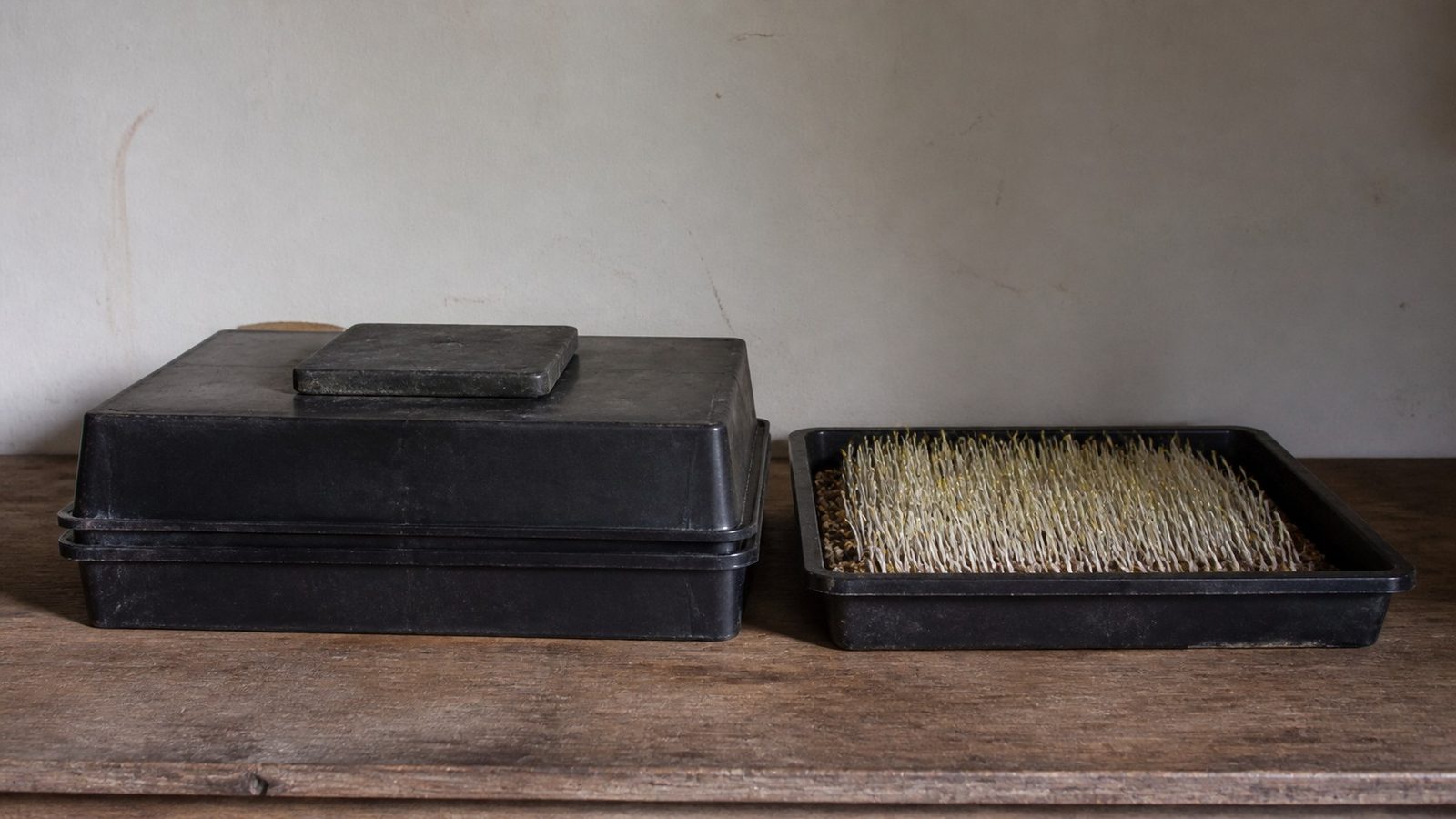
Utah State's method separates the two explicitly, and it is the clearest published protocol: a contacting tray with 2 to 5 pounds on it for the first half of the dark period to hold the seed down, then the same tray turned over so it no longer touches, for a second, non-contacting dark half that lets the seedlings stretch.
Nobody has tested those apart. No factorial trial has separated darkness from humidity from contact from pressure on a microgreen crop. Any page claiming one cover accomplishes all of it is reasoning, not reporting.
How long, per crop
Extension guidance gives a usable range and a short table. Virginia Tech says 2 to 5 days typically, until the majority germinates. Utah State publishes a per-crop table covering nine crops. The per-crop figures below cover 55.
Blackout days across the 55 crops here that publish a figure, 2026-08-12
Hover or tap a card to highlight it.
The range is 0 to 14 days
Mint and sorrel are zero. Celery runs 7 to 14, chives and popcorn shoots 6 to 14. Seven more crops publish no figure at all.
29 of 55 top out at 4 or 5 days
Which is where the general advice comes from, and it is right for about half the directory.
15 crops top out at 3 days or fewer
Including five at 2 days or less. A blanket four-day cover is too long for these.
8 crops run to a week or longer
These are the slow herbs and the shoots, and no general rule reaches them.
Where Utah State and this site both publish a figure, they mostly agree:
Hover or tap a row to highlight it.
| Crop | Utah State | This site | Verdict |
|---|---|---|---|
| Arugula | 1 to 2 days | 2 to 5 | overlap |
| Radish | 1 to 2 days | 2 to 4 | overlap |
| Turnip | 1 to 2 days | 2 to 4 | overlap |
| Broccoli | 2 to 4 days | 2 to 4 | overlap |
| Pea shoots | 3 days | 2 to 3 | overlap |
| Sunflower | 3 days | 2 to 4 | overlap |
| Basil | 4 to 7 days | 4 to 7 | exact match |
| Cilantro | 7 to 14 days | 6 days | disagree |
Cilantro is the one to look at. Utah State's range starts a day after this site's figure ends, and its top is more than double. Both are sourced. Neither is obviously wrong, and cilantro is a genuinely slow, awkward crop where a wide spread is plausible. If you grow cilantro, treat 6 to 14 as the honest range and watch the tray rather than the calendar.
Utah State also publishes kale at 1 to 2 days and this site has no kale figure at all, along with alfalfa, cucumber, mustard, oregano, Swiss chard and thyme. That is a real gap here and worth naming rather than papering over.
Blackout is an optimization, not a requirement
The single controlled experiment on this question tested five early dark days against continuous light from sowing, on sunflower and arugula. Both crops grew fine without any darkness at all, and the dark treatment moved yield in opposite directions: sunflower up 13 percent, arugula down 24. That result and what it means for lighting decisions is covered in full on the lighting page.
The part that belongs here is the consequence for the cover: darkness is a lever, not a prerequisite. A tray that never goes dark still produces a crop.
And some crops must not be blacked out. Lettuce seed, especially white-seeded types, needs light to germinate and should be pressed onto the surface under a clear cover rather than an opaque one. Basil is also listed as a small seed that can require light, which is why the per-crop figure outranks any general rule. Mint and sorrel are the two zeros here, and they are zero for different reasons: mint's seed is light-responsive, and sorrel simply does not appear as a blackout crop in any published protocol.
Seed size is not the rule either. It is a reasonable guess that larger seeds carry more reserve and so stretch further, and in the one controlled test the larger-seeded crop gained while the smaller lost. That is a hypothesis with a sample of two. "Small seed, no blackout" is not established, and neither is any weight-by-seed-size formula.
How much weight, and when to take it off
Start at two to five pounds on a contacting 1020 cover, and take it off once roots are clearly into the medium. That is Utah State's figure and it is a sensible place to begin.
Hover or tap a row to highlight it.
| Source | Weight | Status |
|---|---|---|
| Utah State Extension | 2 to 5 lb on a contacting 1020 cover | Extension guidance, no comparative evidence given |
| A grower guide | 5 to 20 lb recommended, 10 to 15 lb pavers common | Practice, and it says outright that it found no scientific study |
| Another practice guide | 2 to 3 lb small tray, 5 to 7 lb on a 1010, 10 to 13 lb on a 1020 | Practice |
Treat that as a starting point rather than a setting, and change it deliberately if the stand tells you to. Published recommendations run anywhere from 2 pounds to 20, and no trial has compared a weighted tray against an unweighted one with cover, medium, moisture, seed rate and light held constant, so there is no figure to defer to. The closest study used amaranth and compared a foam cover touching the seed against one held off it, finding 5.9 g more fresh yield and 1.85 cm more height for the touching cover. That says contact helps. It does not say what five pounds does, and nobody has published the pressure at which damage starts.
Amaranth and the small mustards are reported to take less pressure than most, which is worth knowing if you grow them. Whatever you settle on, the cover comes off on what the tray is doing rather than on a timer: once roots are pushing into the medium it has done its job.
When to take the cover off
Uncover when the majority of the tray has germinated, not when a day count expires. That is Virginia Tech's instruction, and it is the one rule here that holds across every crop, because it reads the tray rather than the calendar.
Nobody defines "majority." Not 50 percent, not 70, not 90. So, pick your own rule, write it down, and keep it the same across runs so your results are comparable. Something like "at least 8 of 10 evenly spaced one-inch squares show anchored emergence" is arbitrary but repeatable, which is the property that matters.
What "anchored" means: the seed has pushed a root into the medium and is held, rather than sitting loose on the surface.
Uncovering early risks leaving late seed dry or detached, and gives up the stretch you were covering for. Leaving it on too long produces exactly what the arugula treatment produced: longer stems that lodge, cotyledons about a quarter smaller, and a canopy that is taller on paper without being taller in the tray. Pale seedlings are normal under the cover and should green up once light arrives. Persistent poor form is a reason to shorten the next run.
On uneven trays, uncover the whole thing once the majority is anchored, then photograph the slow patch and check seed distribution, tray level, edge moisture and the seed lot before the next run. Do not hold a wet sealed tray dark waiting for stragglers.
Does blackout cause mold
Not by itself, and nothing has shown that it does. What is true is that blackout usually coincides with two conditions that do matter: enclosed high humidity, and no light. Damping-off pathogens are favored by cool wet conditions, and the symptoms are non-emergence, thin watery stems, wilt, and cobweb growth at high humidity.
So, the instruction is to vent the cover rather than to shorten the dark period, and to get air moving once it comes off. Temperature, humidity and airflow covers what that actually means and what has never been measured about it.
The trial that would settle it is a randomized blacked-out against lit comparison at matched humidity with known pathogen pressure. It has not been run.
Where the evidence stops, and what to do about it
Each of these is a gap that changes how much weight to put on a number above. Where something has not been measured, you are working from practice or from your own bench, and the practical answer in every case is the same: start conservative, change one thing at a time, and write down what happened.
- A duration and yield curve for any crop. The one controlled study tested a single five-day treatment against none.
- Weighted against unweighted, on anything, ever.
- A pressure at which damage begins, by crop or stage.
- Whether blackout raises disease risk independently of the humidity that comes with it.
- What "majority germination" means as a number.
- Which cover material performs best: plastic, board, cloth or an inverted tray.
- A blackout figure for 7 of the 62 crops here, including kale, which Utah State does publish.
Terms on this page
Tap a term to see what it means.
Blackout. An intentionally dark covered stage, either during germination or after it. Which one is meant varies by source, which is the central confusion on this subject.
Sources
Opened 2026-08-11 and 2026-08-12. Per-crop blackout days and the counts across the directory are this site's own, sourced on each crop's entry and recounted for this page on 2026-08-12.
- Utah State University Extension, grow your own microgreens (PDF) - the per-crop covered-day table quoted above, the two-part method with a contacting weighted cover then an inverted non-contacting one, the 2 to 5 pound figure, and the visual stop rule of removing the cover when roots push into the medium.
- Virginia Cooperative Extension, introduction to microgreen production - the 2 to 5 day typical range, the instruction to uncover at majority germination, and that darkness is needed or beneficial only for some species.
- University of Maryland Extension, growing microgreens and baby greens indoors - the cover as a warmth and humidity device, a few dark days after germination lengthening stems for easier harvest, and venting covers because trapped moisture encourages mold.
- Kong and Zheng, early-stage dark treatment on sunflower and arugula microgreens, 2021 - five early dark days against continuous light: hypocotyl length up 26 and 28 percent, yield up 13 percent on sunflower and down 24 on arugula, arugula cotyledons about 25 percent smaller with lodging, and no change in cotyledon color index.
- University of Illinois Extension on lettuce - that some lettuce, especially white-seeded types, requires light to germinate and should be surface pressed rather than covered.
- Utah State University Extension, starting vegetable seeds indoors - small-seeded crops that can require light, and why the lot's own propagation instruction outranks a general rule.
- University of Minnesota Extension, how to prevent seedling damping off - the pathogens involved, cool wet conditions as the risk, and the symptom list including cobweb growth at high humidity.
- George Mason University student study on amaranth cover contact - a touching foam cover against a non-touching one, reporting 5.9 g more fresh yield and 1.85 cm more height, without isolating pressure from contact.
- University of New Hampshire Extension, starting plants from seed - the light, moisture and oxygen requirements of germination.
- Practice sources, used as practice: Microgreen Manager on weighted germination, which recommends 5 to 20 pounds and states plainly that it found no scientific weighted against unweighted microgreen study, and Home Microgreens on the blackout period and on germinating with weight, which supply the smaller per-tray weights and the observation that amaranth and small mustards tolerate less pressure.
Keep reading
Growing guides
Lighting microgreens: how much, how long, and when it starts
Aim for about 230 to 250 PPFD at the canopy and sixteen hours. Brightness saturates, hours move yield more than spectrum does, and the same five-day blackout raised sunflower yield 13 percent while cutting arugula's by 24.
Read Lighting microgreens: how much, how long, and when it startsGrowing guides
Do you need a heat mat? The arithmetic says probably not, and it can overshoot
A heated home runs about 68F and a mat adds 9 to 20 above ambient, which lands at 77 to 88. Spinach stops germinating at 75. Nothing shows a mat produces an earlier harvest or more crop in a room already in range.
Read Do you need a heat mat? The arithmetic says probably not, and it can overshootThe test bench
Microgreens Humidity Domes: The Free Alternative Beats Most of Them
A second 1020 tray and a few pounds of weight gives darkness, moisture retention and the seed-to-medium contact a dome cannot. Even the sellers say to take the dome off.
Read Microgreens Humidity Domes: The Free Alternative Beats Most of ThemGrowing guides
Nothing came up: reading a failed tray instead of guessing at it
Old seed, dryness, wet, cold, heat, depth and poor contact can all empty a tray. Where the bare patch sits, and what a missed seed looks like when you lift it, rules most of them out in about two minutes.
Read Nothing came up: reading a failed tray instead of guessing at it