Do you need a heat mat? The arithmetic says probably not, and it can overshoot
Cal HewittPublished Checked
- temperature
- equipment
- germination
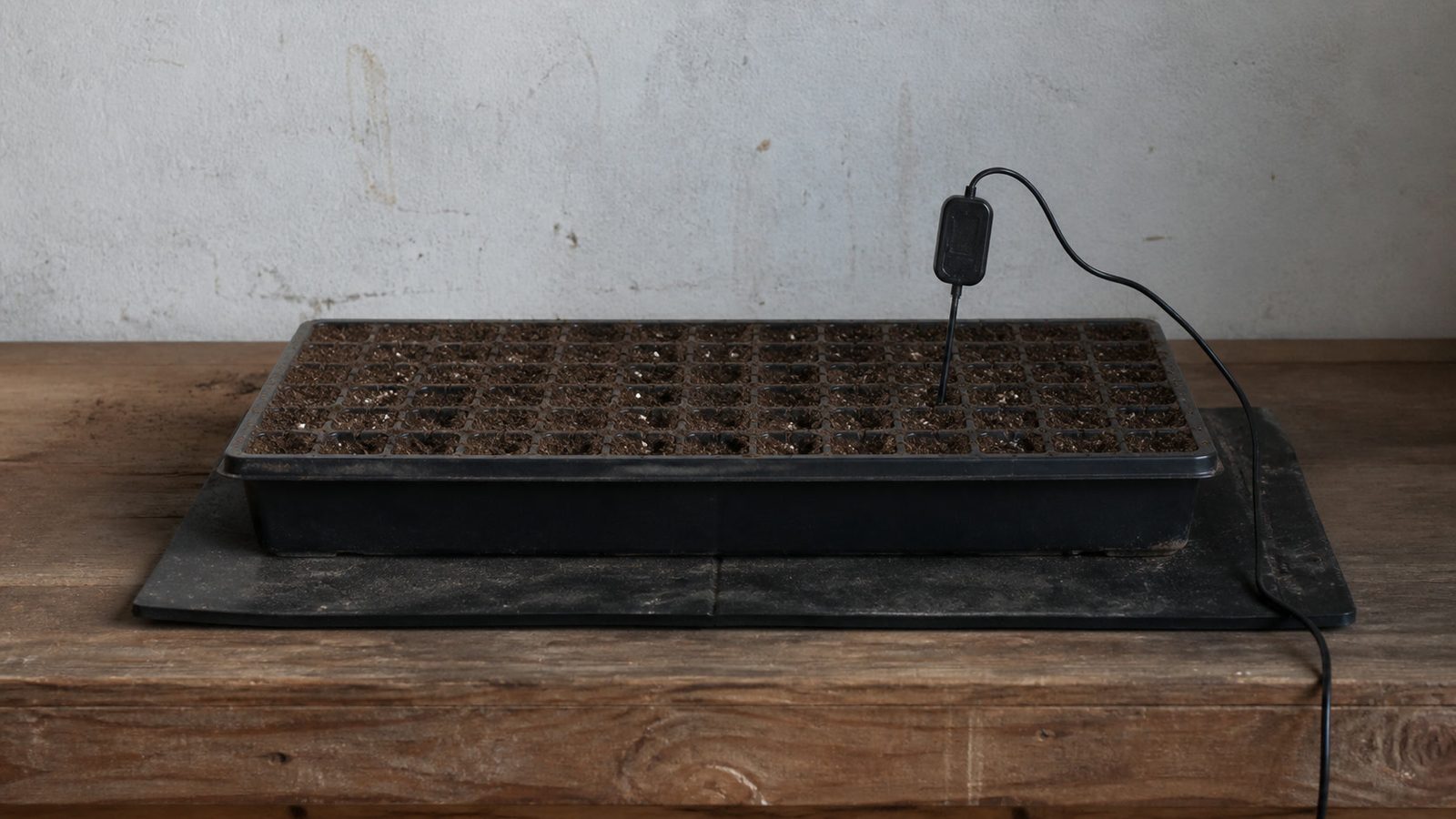
A heat mat is sold against a problem most indoor growers do not have, and the numbers to check that are all published. They have just never been put together.
Here they are.
Hover or tap a row to highlight it.
| The number | Source |
|---|---|
| A heated home in winter | 68°F, the US Department of Energy's recommended thermostat setting while awake |
| What a mat adds | 9 to 20°F above ambient, from a retailer's own product specification |
| So an unthermostatted mat in that room reaches | 77 to 88°F |
| Spinach stops germinating at | 75°F |
| Lettuce, peas and parsnips stop at | 85°F |
| Broccoli, cabbage and radish stop at | 95°F |
Read the bottom half against the third row. An uncontrolled mat in an ordinary heated room lands above spinach's published maximum at the bottom of its range, and at or past lettuce's and pea's at the top. For brassicas it is comfortable. For several other crops it is not.
And the benefit it is sold on has never been demonstrated on this crop. No controlled study compares a room already inside a crop's published germination range against the same tray on a controlled mat and reports emergence timing and harvest date. Nothing shows a mat produces an earlier harvest or more crop when the tray is already in range.
What to actually do
- Measure before you buy. Push a probe into a watered tray at seed depth and read it. That one measurement answers the entire question for your setup.
- If the medium is in the crop's range, you do not need a mat. Every crop entry here publishes a germination temperature where one exists.
- If you grow in a cold garage, basement or outbuilding, a mat is the right tool and the extension sources agree.
- If you buy one, buy the thermostat. An uncontrolled mat adding 9 to 20°F to a 68°F room lands at 77 to 88, which is past several published maximums.
- Check the center and an edge, because no mat has ever been mapped and center failure is the reported pattern.
- Watch the water. A mat dries the medium faster and that is the documented daily cost of using one.
- Be careful with spinach and peas. Both sit low in the sources that do cover them, and neither has a crop-specific germination figure published anywhere.
- Try the free version first. A warmer shelf is treated as equivalent by two extension sources.
What warmth actually does
It changes the speed and the completeness of germination, within limits, and each seed has three of them: a minimum, an optimum and a maximum.
The best evidence on this crop is a 2025 laboratory study on rocket and radish, testing eight temperatures from 5 to 35°C with four replicates of 50 seeds each. Germination got progressively faster as temperature rose from 5°C toward 25. Then at 35°C final germination fell and early root growth collapsed: radish radicle length was more than 90 percent shorter than its 25°C maximum.
That is the shape of the whole subject. Warmth helps a cold seed and hurts a hot one, and the fall on the far side is steep rather than gentle.
What it does not show is a harvest. The study stops at radicle emergence. A radicle 12 hours earlier is not a harvest 12 hours earlier, and nobody has run the study that would connect them.
Is your room already warm enough
For most crops in a heated home, yes.
Of the 44 crops with a published germination range, 39 of them include 70°F, as set out in running the room temperature and airflow. The Department of Energy's heated-home benchmark is 68°F, two degrees below that.
So, an ordinary heated room sits at or just below the range for most crops, and the case for adding heat there is weak. It is not a claim that 68°F is inside every one of those 44 ranges, which would need each range's endpoints and is not what the 39 count measured.
The case is completely different in a cold space. An unheated garage, a basement or an outdoor structure is a real seed-zone constraint, and that is where the extension sources put a mat.
And one extension source recommends bottom heat for a reason that is not speed at all. Minnesota says damping-off pathogens thrive in cool, wet conditions, lists cool soil among the conditions associated with more of it, and recommends bottom heat to hold indoor medium at 70 to 75°F. That is a disease argument, and it is the strongest argument for a mat on this page.
The mat heats the medium, not the room
Measure in the medium at seed depth, near the center and at an edge. Room air tells you about the room. The tray surface tells you about a boundary. Neither necessarily tells you what the seed is experiencing, and a probe thermometer is the documented way to find out.
Two things about what mats actually deliver.
The above-ambient figures are manufacturer claims, not independent tests. One retailer specifies 9 to 20°F above ambient. One manufacturer's manual claims a maximum working temperature of 77°F above ambient, capped at 122°F, which is a very large number for a tray of seed.
And nobody has mapped one. There is no published spatial temperature test of a heat mat under a standard microgreen tray, so the "even heating" claim is unverified. That matters because a failure concentrated in the center of a tray is the pattern growers attribute to mats, and it is the pattern an uneven mat would produce.
A mat also dries the medium faster. UConn is explicit about it: check daily, keep the mix moist but never wet. That is a real added cost in attention, and it interacts with everything on the watering page.
Do not put insulation over a mat. One manufacturer's own manual warns it may overheat. A blackout stack, a dome or a cover changes what reaches the seed and nobody has measured by how much, which is an awkward gap given that almost every microgreen tray is covered during exactly the phase a mat is used.
The crop most at risk is the one with no published number
Spinach has the lowest published germination maximum of any of these crops, at 75°F. An unthermostatted mat in a 68°F room clears that at the bottom of its claimed range.
And spinach is one of about eighteen crops with no published germination temperature of its own. So is pea shoots. That matters here, because the 70°F rule of thumb above was worked out across 44 crops that do not include either of them. On spinach and peas you have no number to lean on.
Two external sources put both crops low. Colorado State gives pea and spinach a maximum of 70°F; the chart used here gives spinach 75°F. They disagree by five degrees and agree on the direction. If you are growing spinach or peas, treat added heat as a live risk rather than a neutral upgrade.
Thermostats, cost and the alternative
A thermostat is not standard. Basic mats are sold on an above-ambient claim with no controller. Others include an adjustable digital one. An uncontrolled mat has no target, which is what turns the arithmetic at the top of this page from a caution into a real hazard.
Prices, as seen on 2026-08-12: basic mats from $22.50, and a 20 by 20.75 inch model with an integrated controller at $35.99. A general consumer guide from UF/IFAS mentions $10 to $20. Those are snapshots rather than a market survey.
Running cost is unmeasured. No source found reports kilowatt-hours per tray or per crop.
And the alternative is free. UConn says to put containers in a 70 to 75°F warm spot or on a heat mat, treating them as equivalent. UC Alameda says a mat is helpful but not critical if the seeds receive warmth another way. A warmer shelf, a different room, the top of a cupboard: all of these are the same intervention without the purchase or the overshoot risk.
Where the common advice holds, and where it does not
Six pages were examined. Four of six give a numeric target rather than just saying "warm", which is better than this category usually manages. Three of six are published by a seller or grow-supply business, which is disclosure rather than an accusation, because a seller page can describe a product accurately.
What they get right: a mat acts on the medium rather than the air; a cold garage is a genuine constraint; moisture needs closer watching; and the heat should not simply stay on through established seedling growth.
What is not supported: that a mat increases germination success or yield for ordinary indoor microgreens. Temperature improves speed, percentage and uniformity when temperature is limiting, and reduces them when it is too high. In a room already inside the range, no controlled study shows a final-yield gain.
What nobody has measured
- Whether a mat produces an earlier harvest, as opposed to an earlier radicle.
- Whether it produces more crop in a room already inside the range.
- The temperature map of any mat under a standard tray, so the even-heating claim is unverified.
- What a blackout stack or dome does to the temperature reaching the seed on a mat.
- The running cost, in kilowatt-hours per tray.
- A germination temperature for about eighteen of the sixty-two crops, including the two most at risk from added heat.
Terms on this page
Tap a term to see what it means.
Germination temperature. The medium temperature at which a seed lot germinates. It has a minimum, an optimum and a maximum, and it is not necessarily the best temperature for the crop afterward.
Sources
Opened 2026-08-12. The counts of crops with and without a published germination temperature were recounted across all 62 crops for this page on 2026-08-12.
- Agronomy, rocket and radish germination across eight temperatures, 2025 (PDF) - 5 to 35°C with four replicates of 50 seeds per combination, progressively faster germination toward 25°C, and the loss of final germination and more than 90 percent shorter radish radicle at 35°C.
- UC and Sacramento County soil temperature chart (PDF) - the germination minimums, optimums and maximums by vegetable, including spinach at 75°F, lettuce, peas and parsnips at 85°F and broccoli, cabbage and radish at 95°F, and the recommendation to test medium temperature with a probe thermometer.
- US Department of Energy, guide to home heating and cooling (PDF) - the 68°F recommended winter thermostat setting while awake, used here as the heated-home benchmark rather than as a measurement of any particular room.
- University of Minnesota Extension, how to prevent seedling damping off - damping-off pathogens thriving in cool wet conditions, cool soil among the conditions associated with more of it, and the recommendation of bottom heat to hold indoor medium at 70 to 75°F.
- UConn Home and Garden Education Center, seed starting - that a heat mat dries soil more quickly with a daily moisture check, and that a 70 to 75°F warm spot or a heat mat are alternatives.
- UC Master Gardener Program of Alameda County, starting seeds indoors - that a mat is helpful but not critical if the seeds receive warmth another way, and that lights and mat heat dry small containers rapidly.
- Tropical Agriculture, potato seedling response to high soil temperature, 1986 - significant wilting and weight loss above 30°C with predisposition to Rhizoctonia damping-off. A different crop and not a heat-mat experiment, used only for the direction of the high-temperature effect.
- UF/IFAS Gardening Solutions, tools and equipment - the general consumer price range for seedling heat mats.
- Product specifications and retail pages, used as practice and as the source of the above-ambient figures and prices: Lee Valley seedling heat mats, specifying 9 to 20°F above ambient and listing mats from $22.50, and the Vivosun adjustable mat manual, claiming a maximum working temperature of 77°F above ambient capped at 122°F, warning against placing insulating material over the mat, and listed at $35.99 with an integrated controller.
- Botanical Interests on heat mats and germination - seller guidance naming cold garages, basements and greenhouses as the use case, and warning of mold and damping-off risk from too much humidity and poor airflow.
Keep reading
The test bench
Microgreens Humidity Domes: The Free Alternative Beats Most of Them
A second 1020 tray and a few pounds of weight gives darkness, moisture retention and the seed-to-medium contact a dome cannot. Even the sellers say to take the dome off.
Read Microgreens Humidity Domes: The Free Alternative Beats Most of ThemThe test bench
Thermometers and Hygrometers for Microgreens: One for the Medium, One for the Room
Temperature has to be read in the medium at seed depth. Every instrument sold for the job reads air, and of ten product pages opened, exactly one publishes where its sensor actually sits.
Read Thermometers and Hygrometers for Microgreens: One for the Medium, One for the RoomGrowing guides
How long to blackout microgreens, crop by crop
Take the blackout days from your crop, not from a general rule. Across the 55 crops here that publish a figure the range runs 0 to 14 days, and 29 of them top out at 4 or 5.
Read How long to blackout microgreens, crop by cropGrowing guides
Nothing came up: reading a failed tray instead of guessing at it
Old seed, dryness, wet, cold, heat, depth and poor contact can all empty a tray. Where the bare patch sits, and what a missed seed looks like when you lift it, rules most of them out in about two minutes.
Read Nothing came up: reading a failed tray instead of guessing at it