Spinach microgreens
Cal HewittPublished Updated Checked
- chenopod
- difficult
- slow crop
- needs soaking
- mold prone
At a glance
Slow, unreliable emergence from a cool-loving seed makes an even saleable stand genuinely hard, and the published timelines disagree so widely, from 7 days to 25, that there is no calendar to fall back on when the tray refuses to come up evenly.
- Botanical name
- Spinacia oleracea
- Also sold as
- Winter Giant, Giant Winter, Bloomsdale, Matador, Palco F1
- Family
- chenopod
- Difficulty
- Difficult
- Days to harvest
- 7 to 25 days
- Harvest window
- No published figure
- Soak
- 0 to 12 hours
- Blackout
- 4 to 7 days
- Germination temperature
- No published figure
- Yield per 1020 tray
- 7.2 to 8.8 oz
- Mold risk
- High
- Hull shedding
- some
- Shelf life
- 7 days
- Eaten as
- raw
- Seed cost per tray
- $2.52
60 g at $19.09/lb, True Leaf Market Winter Giant spinach microgreen seed, listed 2026-08-08. The seed is unremarkable per pound; it is the 60 g rate that makes this one of the dearer trays to fill. Seed only, excludes medium, tray, labor, light and loss.
Any field name above ranks every variety by it. No published figure means we researched it and nobody has established one, which is different from not yet researched. Every figure here is sourced at the bottom of the page. Compare every variety side by side.
Spinach is a genuinely difficult crop, and the numbers behind it are the thinnest of any tray you could choose. It is absent from the one public per-variety yield trial in the category, so every seed rate and every yield figure you will read for it, the ones at the top of this page included, is a supplier's assertion or an area conversion rather than a measurement.
What that difficulty buys you is a slow, dear, sparse tray: about $2.52 of seed for 7 to 9 ounces over 16 to 20 days on the supplier's own timeline. That is roughly 2.9 ounces per dollar of seed, against broccoli's 14.5, and mold risk runs high because the blackout is twice a brassica's and the crop wants to be cool and wet while it sits there.
Grow it when somebody specifically wants the flavor, which is mild, sweet spinach in a tender form the mature leaf cannot give. If what you want is a dependable weekly turnaround, grow almost anything else.
What growers are saying right now
Sampled from public posts and videos, 9 July to 8 August 2026. Every line links what it is quoting. How often something is repeated is not evidence that it is true, so every line also says what the sources actually establish.
Spinach microgreens in five days
Circulating A timelapse at 9,716 views, and the fastest figure circulating for this crop
Five days is below everything published. The quickest guide opened for this page says 7 to 10 days to fully opened cotyledons; a supplier growing it cool says 16 to 20; the one controlled study needed 20 to 25 days to two true leaves. A speed claim that undercuts every documented figure is a reliable sign nobody timed it, and on this crop the gap is wide enough to wreck a planting schedule. Where each number comes from
Grow spinach microgreens in just 6 days
Circulating A guide with that headline, plus a step-by-step from the same family of content
Both are growing water spinach, which is Ipomoea aquatica, a morning-glory relative and not Spinacia oleracea at all. Nothing on this page applies to it and its six-day timeline belongs to that plant. The same caution goes for New Zealand spinach, another unrelated crop sold under the word. If a spinach timeline looks impossibly good, check which plant it is. What it is
Sow it with chard and beet
Circulating A how-to that handles spinach, swiss chard and beet root seed together
Botanically sound and the best practical advice in this sweep. All three are Amaranthaceae, not brassicas, and they share the traits that make brassica habits fail: larger irregular seed, slower and patchier emergence, and hulls that stay on. A grower who already runs bull's blood beet has far more transferable experience here than one coming from broccoli.
Paper towel or soil
Circulating The biggest microgreen video going, at 1,825,791 views, is not about a crop at all but about the medium
That choice matters more on spinach than on most crops. Its blackout runs 4 to 7 days against a brassica's 2 to 3, so it spends longer wet and dark than almost anything else you could grow, and mold risk is rated High for exactly that reason. Worth knowing that the one measured spinach result came from peat and vermiculite, so a paper-towel yield is not comparable to it.
Nobody in r/microgreens is asking about spinach
Circulating Not one thread in the sub is about it. The help traffic goes to sunflower at 28 comments, broccoli root hairs or mold, a monsoon setup lost to mold, a kale tips thread and a general setup question
On a crop that fails easily, silence is not reassurance. Read it the other way: this is difficult, dear and poor value by weight, so very few people are growing it, which means very little accumulated troubleshooting to fall back on when your tray misbehaves. Is it worth growing
What it is, and how to tell you grew it right
Spinach microgreens are seedlings of Spinacia oleracea, cut above the medium at the cotyledon or very early true-leaf stage. It is an Amaranthaceae crop, not a brassica, and that single fact explains most of what follows. Penn State describes the common brassica microgreens as 7 to 8 day crops; spinach runs two to three times that.
Two plants are sold under the word spinach and neither is this one. Water spinach is Ipomoea aquatica, a morning glory relative. New Zealand spinach is a different genus again. Both appear in microgreen content, both grow faster than real spinach, and neither is covered by anything on this page. Check the botanical name before you take a timeline from a guide.
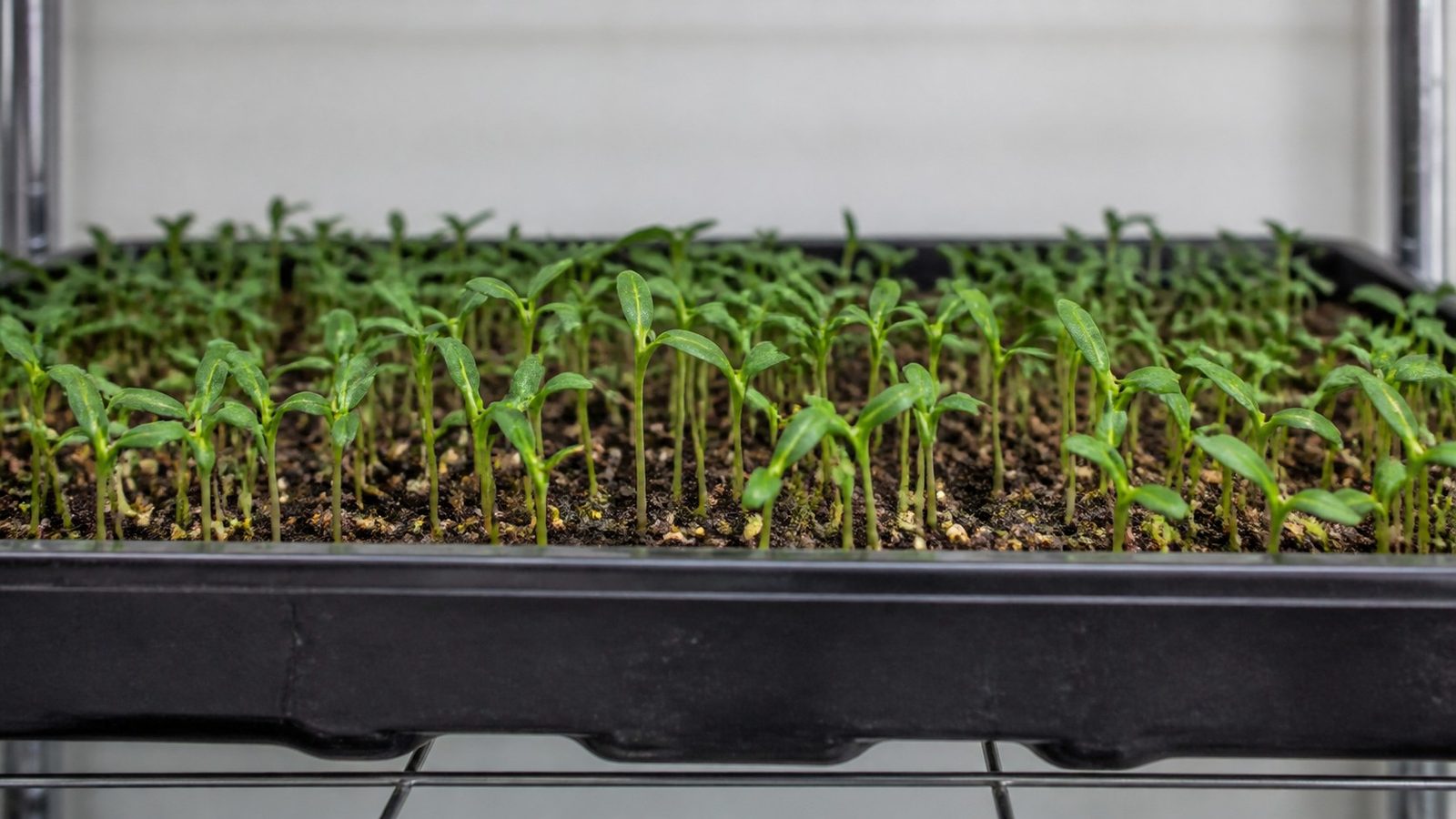
A correct tray is narrow, strap-shaped mid-green cotyledons on slender, leggy pale-to-mid-green stems, and it is a thin, visibly gappy stand with medium showing between the shoots. That is the part worth internalizing. On every other crop here, visible medium means you underseeded or lost seedlings. On spinach it is normal, and a grower judging a spinach tray by broccoli's density will conclude they have failed when they have not.
It is confused with baby spinach rather than with any other microgreen, and the difference is developmental rather than visual: a microgreen is a cut shoot at cotyledon or just-emerging-true-leaf stage, while baby spinach comes later off established plants.
What it tastes like, and what to do with it
Mild, sweet and unmistakably spinach, with less of the bitterness the mature leaf carries, on tender leaves and juicy stems. It tastes like what it is, in a gentler register.
Use it where a mild green needs soft texture and a little leafy volume: folded into eggs, through a salad or a sandwich, scattered over pasta, or dropped onto a warm lentil soup at service. It is the wrong choice when the dish wants a peppery bite, which is mustard or radish territory, when it wants crunch, which is pea shoots, or when it needs a dense high-volume garnish, because the stand is sparse and will not deliver one.
The people who will not like it are the people who do not like spinach. Its young stage makes it milder and sweeter, not neutral, and nobody has run a consumer study on it. What also has not been established is which way the flavor moves if you cut late: the guides say flavor changes once true leaves begin, and none of them says it gets better or worse, so this page does not claim a direction.
Growing it: only what differs from the standard method
Everything general about trays, medium, light and watering is on the standard tray method for growing microgreens. Spinach departs from it in four ways and all four come from one root cause: the seed comes up slowly, unevenly, and prefers to be cool.
Sixty grams per 1020, and be clear that nobody measured it. This is one supplier's stated rate and there is no trial behind it. The controlled study used 60,000 seeds per square meter, roughly 7,740 seeds on a 1020's growing area, but never reported seed mass, so converting that to grams would be inventing a number. Penn State's instruction is the honest fallback: set density from the species, the seed weight, the tray area and your lot's actual germination percentage. On a crop this variable that is not bureaucracy, it is the only way to get an even stand.
Soak it or do not, but if you do, 8 to 12 hours in cool water. One guide says spinach can be sown dry and that soaking may speed germination; a supplier specifies 8 to 12 hours in cool water then drained, describing it as a softening and speeding treatment rather than a requirement. No controlled comparison exists and no water temperature is stated. Do not extend past 12 hours on the theory that more helps, because nothing here establishes either a benefit or a safety margin beyond it.
Surface-sow on level, fine, thoroughly moistened medium, and press firmly. Do not bury it. Firm seed-to-medium contact is specific leverage on this crop, because slow emergence gives every poorly-contacted seed more time to sit and do nothing. The seed is large and irregular, so even placement matters more than it does with dust-fine brassica seed.
Expect 4 to 7 days of weighted blackout, roughly double a brassica's. One protocol gives 4 to 5 days minimum and permits a few more for root development; another gives 5 to 7 in cool conditions. Use a small weight, 5 lb or less, for contact and an anchored even stand. Take it off when the majority have germinated and start lifting the cover, not on a date: waiting past that gives you weak, over-elongated stems, and this crop is leggy enough already.
Keep it cool, and stop treating the calendar as the answer. A supplier's ideal growing range is 61 to 68°F, the controlled study ran 75/64°F day and night, and Virginia Tech's general microgreen guidance is 60 to 70°F. None of those is a germination-temperature experiment, so this page records the germination range as unpublished rather than picking one. What is clear is the direction: cool suits it, and heat during a long wet blackout is the worst combination available.
Then give it light and stop watering so much. At least 6 hours a day in one protocol, 12 hours at 300 µmol in the study. Bottom water and drain the excess, because on a crop that sits wet and dark for the better part of a week, excess moisture is the failure.
A spinach tray, day by day
- 1
Day 0, optional soak
8 to 12 hours in cool water, then drain. Optional, unproven, and not to be extended past 12 hours.
- 2
Day 0, sow and weight
60 g surface-sown on level, fine, thoroughly moist medium, pressed firmly for contact, not buried. Cover with a tray and a small weight, 5 lb or less.
- 3
Days 1 to 7, dark and cool
4 to 7 days depending on whose protocol you follow, roughly double a brassica's. Keep it cool. This long wet phase is where the crop is lost.
- 4
Uncover on the signal
When most seedlings have germinated and are lifting the cover. Waiting by the calendar past that point gives weak, over-elongated stems.
- 5
After uncovering
At least 6 hours of light a day, bottom water and drain the excess, keep the air moving. The stand will look thin. That is what a correct spinach tray looks like.
- 6
Days 7 to 25, cut
An unusually wide span, and the sources genuinely disagree. Cut at fully opened cotyledons through the first true leaves, judged on the crop.
What goes wrong with spinach specifically
Patchy, slow emergence, and it is the defining failure. Empty areas, or seed that has not even swollen while its neighbors are up. The causes are uneven moisture, poor seed-to-medium contact, or simply low-vigor seed. It is recoverable only if the lagging seed is clean and the tray is still early. The instinct to fix it with more water is exactly wrong and leads directly to the next failure.
Damping-off through the long wet blackout. Water-soaked or pinched stems, or seedlings that disappear before they emerge. Pythium often starts at the root tips and is favored by cool wet conditions, which is precisely the environment this crop asks for, and Rhizoctonia does the same job in warmer drier ones. A tray with active collapse is not a food crop: discard it, sanitize the trays, and fix drainage, spacing, temperature and irrigation before you sow again.
Stuck hulls and weak lift. Cotyledons trapped in the seed coat, or seedlings that cannot raise the cover. Spinach seed is large and irregular and it holds on, and a broadly helmeted tray is not commercially clean. Nobody has measured how often it happens, so budget cleanup time rather than expecting a rate. It is a real job here, unlike on a fine-seeded brassica such as mustard, where there is no hull work at all.
Pale, stretched, over-aged shoots. A tray held dark after it is already lifting the cover, followed by rapid true-leaf development once it finally gets light. Move it promptly and cut at the intended stage; once it has outgrown the tray it is baby leaf, not the crop you meant to sell.
Root hairs against mold, judged on behavior rather than color. Root hairs form a uniform close fringe along individual roots at the medium surface. They do not bridge across stems, hulls or bare medium. Suspect mold when the fuzz spreads between plants, climbs stems or cotyledons, comes with collapse or a sour smell, or stays as a mat after watering. And if stems are pinched or water-soaked, stop diagnosing fuzz: that is damping-off.
A bad lot looks exactly like bad technique on this crop, more than on any other here, because slow uneven emergence is what spinach does when everything is right. The tell is low, delayed, non-uniform emergence from seed you spread evenly on a properly prepared tray. The remedy is evidence rather than intuition: read the supplied germination information, or run your own germination test, and recalculate the seeding weight for the viable percentage you actually have.
Nutrition, and what is actually established
USDA FoodData Central has no Foundation, SR Legacy, FNDDS or Experimental Foods entry for spinach microgreens. The only thing the search returns is a branded juice product, which is not a composition record for this crop. Mature spinach values are a different food at a different stage and are not a substitute.
What does exist is one good controlled study, and it is unusually detailed. Petropoulos and colleagues (2021) grew Palco F1 in peat and vermiculite at 60,000 seeds per square meter, harvesting stems and leaves at two fully expanded true leaves, 20 or 25 days after sowing depending on the nutrient treatment, under 24/18°C day and night with 12 hours of light. At 20 days of quarter-strength nutrient solution it measured 1.59 kg fresh weight per square meter, 156.4 mg total ascorbic acid per 100 g, 82.8 mg total chlorophyll per 100 g, 54.2 µg lutein per g, 44.0 µg beta-carotene per g, and 1,698 mg nitrate per kg fresh weight.
That nitrate figure is worth pausing on, because it is the kind of number that only appears when somebody actually measures rather than markets. It is a real characteristic of a leafy crop grown on nutrient solution and it is not something any supplier page mentions.
The claim that spinach microgreens are simply more nutritious than mature spinach is not supported as a blanket statement. This study shows composition moving substantially with cultivar, harvest stage and nutrient regime, which is an argument against any fixed multiplier rather than for one. And every figure above belongs to one cultivar under one set of conditions, so they describe that experiment rather than your tray.
Which seed to buy
The honest summary is that nobody has compared spinach cultivars as microgreens, so buy on availability and lot quality rather than on a name.
Palco F1 is the only cultivar with peer-reviewed microgreen data, and even that study did not compare it against anything else for stem length, color, tenderness or per-tray yield. Winter Giant, also sold as Giant Winter, is sold expressly as microgreen seed, described as heirloom, open-pollinated and cold resistant, and its page publishes nothing about microgreen days, stem length or yield. Bloomsdale, Matador, Oceanside and Lavewa appear as spinach seed options with no microgreen trait comparison at all.
So, the meaningful specification is not the cultivar. Order untreated, uncoated seed sold for edible microgreen or sprout use, and insist on the lot number, germination percentage, test date, and seed count or weight. Penn State says suppliers should provide all of those, and on this crop you genuinely need them, because the seeding rate has to be calculated from real germinability rather than assumed. Refuse dyed, fungicide-treated or coated field seed: SDSU is explicit that treatment chemicals can end up in the young shoots, which are the entire product.
The cost of a bad lot here is higher than on any other crop in the directory, because a failed spinach tray occupies the bench for 16 to 25 days before you know. That is the real expense, not the seed.
Spinach microgreen seed on Amazon is the convenient route for a home grower. If you are selling, buy where the lot and its germination test are published, and test a retained sample before you commit a rack.
Is it worth growing?
For most growers, no, and the numbers say so plainly.
Spinach costs $2.52 of seed per tray, which is dear. It returns about 7 to 9 ounces, which is light. It takes 16 to 20 days on the supplier's own timeline, which is slow. And it is rated Difficult with High mold risk, because that long cool wet blackout is exactly what damping-off wants. Put those together and it returns roughly 2.9 ounces per dollar of seed, against broccoli's 14.5, in about half again the time. Only chives at 1.7 and fennel at 0.42 return less for the money.
It is worth growing when the flavor is specifically what somebody wants, and that is a real customer rather than a hypothetical one: mild sweet spinach in a tender form that mature spinach cannot give. If a chef asks for it, grow it and price it properly, which on these numbers means considerably above a brassica.
It is a poor first crop. A beginner expecting a reliable weekly turnaround will conclude they cannot grow microgreens, when what they actually chose was the hardest crop on the shelf. A market grower should trial a named lot with their own density and yield records before giving it rack space, because there is no benchmark to plan against. A home grower wanting dependable greens should grow almost anything else.
Its competition is any fast brassica, and the brassica wins on every axis except flavor. Do not treat them as equivalent because both are green cotyledon crops. Within its own family, bull's blood beet and swiss chard behave more like spinach than any brassica does, and a grower who wants that Amaranthaceae look with better odds should start there.
A note on the numbers above
Hover or tap a row to highlight it.
| Figure | Value | Source | What kind of number it is |
|---|---|---|---|
| Seed per 1020 | 60 g | Deliseeds | A SUPPLIER ASSERTION. No trial exists |
| Seed per m² | 60,000 seeds | Palco F1 study | Measured as a COUNT; seed mass never reported |
| Seed per 1020 | No trial figure | Johnny's | Spinach is absent from the trial entirely |
| Yield per 1020 | 7.2 oz | Palco F1 study, area-converted | 1.59 kg/m² × 0.129 m². A conversion, not a 1020 result |
| Yield per 1020 | 7.1 to 8.8 oz | Deliseeds, 200 to 250 g | A supplier assertion that happens to agree |
| Days to harvest | 7 to 10 | Epic Gardening | To fully opened cotyledons, temperature unstated |
| Days to harvest | 16 to 20 | Deliseeds | At 61 to 68°F, its stated ideal |
| Days to harvest | 20 to 25 | Palco F1 study | To TWO fully expanded true leaves, a later crop |
| Days to harvest | 5 | A timelapse video | Below every documented figure |
| Blackout | 4 to 5 days, plus | Epic Gardening | With a weight of 5 lb or less |
| Blackout | 5 to 7 days | Deliseeds | In cool conditions |
| Germination temperature | No published figure | Nobody | Growing ranges exist; a germination range does not |
| Shelf life | Up to 7 days | Epic Gardening | Sealed bag with a paper towel, refrigerated |
| Harvest window | No published figure | Nobody | Nothing measures how long a ready tray holds |
| Seed cost per 1020 | $2.52 | Calculated, True Leaf price | 60 g at $19.09/lb, listed 2026-08-08 |
Two of the numbers above are a publisher's house method rather than spinach results, so do not treat them as crop-specific. The 5 lb cover weight and the up-to-7-day shelf life come from a crop guide that publishes near-identical figures for endive: five pounds or less on both, 10 to 15 minutes of bottom watering on both, a foot or two of light height on both, up to a week refrigerated on both, no regrowth on both. What does change between the two guides is the day count, 7 to 10 here against 8 to 15 there, and the light hours. So, take the day counts as telling you something about spinach, and treat the weight and the shelf life as a sensible default you should test on your own trays.
Both yield figures on this page are inferences and neither is a measurement of a 1020. The lower one converts a peer-reviewed result reported per square meter onto a 1020's 0.129 m² growing area, which assumes the density transfers. The upper one is a supplier's claim. They agree at roughly 7 to 9 ounces, and that agreement is the only reason this field carries a number rather than a blank. Treat it as the best available estimate and weigh your own trays before pricing anything.
Days to harvest spans 7 to 25 because the sources are measuring different crops at different stages in different conditions. Seven to ten days is to fully opened cotyledons. Sixteen to twenty is a supplier growing deliberately cool. Twenty to twenty-five is a controlled study harvesting at two fully expanded true leaves, which is a materially larger plant. None of them is wrong, and averaging them would produce a number describing nothing.
Two numbers you will not find anywhere, and what to do instead. Nobody has measured how long a ready spinach tray holds its cut, so cut at fully opened cotyledons, note the date, and let a second tray tell you your own limit. And nobody has run a spinach germination-temperature experiment: a supplier's ideal growing range and a study's day-night regime are not germination ranges, so aim cool, around 60 to 68°F, and judge the tray rather than the thermometer.
Hover or tap a row to highlight it.
| Crop | Seed per 1020 | Yield | Days | Cost per tray | Oz per $1 | Oz per tray-day |
|---|---|---|---|---|---|---|
| Beet, Bull's Blood | 23 g | 7.5 oz | 16.5 | $0.99 | 7.6 | 0.45 |
| Amaranth | 7.5 g | 6.5 oz | 11 to 18 | $1.10 | 5.9 | 0.45 |
| Spinach, Winter Giant | 60 g | 7.2 oz | 18.0 | $2.52 | 2.9 | 0.40 |
| Celosia | 8 g | 3.4 oz, one tray | 13 | $1.06 | 3.2 | 0.26 |
| Beet, Red Leaf | 20 to 30 g | No published figure | 10 to 14 | $1.53 to $2.30 | cannot be calculated | cannot be calculated |
A blank means nobody has published that figure, so the cell is left empty rather than filled with an estimate. How the numbers work
All 62 crops, sortable, on the microgreen comparison.
Spinach sits at or near the bottom of both columns, and it is the only one of that group also rated Difficult. Its row pairs the supplier's own rate with the supplier's own 16 to 20 day timeline, at 18 days, so the arithmetic is internally consistent rather than mixing sources. Broccoli returns five times the crop per dollar of seed and clears the bench in two thirds of the time.
Prices move, so treat the dollar columns as dated and the rankings as the durable part.
Terms on this page
Tap a term to see what it means.
Cotyledon. The seed leaf. Spinach's are narrow and strap-shaped, nothing like a brassica's rounded pair.
Sources
- Petropoulos et al., 2021, spinach microgreens under differing nutrient regimes (PDF) - Palco F1 in peat and vermiculite at 60,000 seeds/m², harvested at two fully expanded true leaves 20 or 25 days after sowing, 24/18°C, 12 hours at 300 µmol, 65 to 75 percent RH, with 1.59 kg/m² fresh weight, 1,698 mg/kg nitrate, 156.4 mg/100 g total ascorbic acid, 82.8 mg/100 g chlorophyll, 54.2 µg/g lutein and 44.0 µg/g beta-carotene.
- True Leaf Market, Winter Giant spinach microgreens seeds - Spinacia oleracea sold expressly as microgreen seed, heirloom, open-pollinated and cold resistant, with no microgreen days, stem length or yield published, and the $19.09/lb price behind the cost calculation, listed 2026-08-08.
- Deliseeds, spinach microgreens seeds - the 60 g per 1020 rate, 16 to 20 days at an ideal 16 to 20°C, 7 to 10 days to sprout in cool conditions, an 8 to 12 hour cool-water soak, 5 to 7 blackout days, a 200 to 250 g yield claim, and the airflow instruction to prevent mold.
- Epic Gardening, spinach microgreens - 7 to 10 days to fully opened cotyledons, the cut window ending as true leaves grow, 4 to 5 blackout days with a weight of 5 lb or less, at least 6 hours of light, no regrowth after harvest, up to 7 days refrigerated in a sealed bag with a paper towel, retained seed casings, and the Bloomsdale, Matador, Oceanside and Lavewa options.
- Johnny's microgreens yield trial results (PDF) - 29 varieties, and no spinach row. The absence is why no measured seed rate or yield exists for this crop.
- Johnny's microgreens yield trial, method and discussion - 1020 flats, seed weighed by packet difference, first-true-leaf harvest, and the warning that one system's yields do not translate to another's.
- Penn State Extension, The ABCs of Microgreens (PDF) - the 7 to 8 day maximum for common brassicas that sets spinach's slowness in context, seeding density as a function of species, seed weight, tray area and lot germinability, and the lot number, germination percentage, test date and seed count a supplier should provide.
- Penn State Extension, a step-by-step guide for growing microgreens at home - the default method spinach departs from, bottom watering, and washing immediately before use because washing substantially reduces shelf life.
- Virginia Tech Extension SPES-756 (PDF) - the general 60 to 70°F production range, uncovering once most seedlings have germinated, and damping-off and mildews as the principal indoor disease concerns.
- SDSU Extension, growing microgreens at home - why dyed, fungicide-treated or coated seed is unacceptable on a crop eaten as young shoots.
- UC IPM, damping-off - Pythium favored by cool wet conditions and often starting at root tips, Rhizoctonia in warmer drier ones, and rot at or below the medium line.
- USDA FoodData Central, spinach microgreens search - searched 2026-08-08: no Foundation, SR Legacy, FNDDS or Experimental Foods record, only an unrelated branded juice product.
Keep reading
The variety directory
Fennel microgreens
The only umbellifer anybody measured, and the measurement is brutal: about 1 oz after 25 days, 0.04 oz per tray-day, on seed that costs more than most. Grown for aroma, not for weight.
Read Fennel microgreensThe variety directory
Carrot microgreens
Carrot is one of the cheapest trays of seed you can sow at 44 to 66 cents, and one of the poorest uses of a bench: about 2 oz after 20 days, a twelfth of radish's daily turnover.
Read Carrot microgreensThe variety directory
Celery microgreens
Three to four weeks of bench for a seasoning green, with an unusually complete measured nutrient panel behind it: 45.8 mg of vitamin C per 100 g, and four minerals that are higher in the mature leaf.
Read Celery microgreensThe variety directory
Quinoa microgreens
A delicate tray of thin burgundy stems and small open cotyledons, very mild, holding at its best for three to five days. No published seed rate or yield for a 1020, so plan a trial rather than an order.
Read Quinoa microgreens