At a glance
Nothing about the schedule is hard, but the seed is small and the early root zone is fragile, so the two habits that carry a brassica tray, a heavy press and generous water, are the two that lose this one.
- Botanical name
- Chenopodium quinoa
- Also sold as
- Quinoa, Red Quinoa, White quinoa, Black quinoa
- Family
- chenopod
- Difficulty
- Moderate
- Days to harvest
- 7 to 14 days
- Harvest window
- 3 to 5 days
- Seed per 1020 tray
- No published figure
- Soak
- None
- Blackout
- 2 to 3 days
- Germination temperature
- 68 to 72 °F
- Yield per 1020 tray
- No published figure
- Regrows after cutting
- No published figure
- Mold risk
- High
- Hull shedding
- No published figure
- Shelf life
- 5 to 7 days
- Eaten as
- raw
- Seed cost per tray
- No published figure
Any field name above ranks every variety by it. No published figure means we researched it and nobody has established one, which is different from not yet researched. Every figure here is sourced at the bottom of the page. Compare every variety side by side.
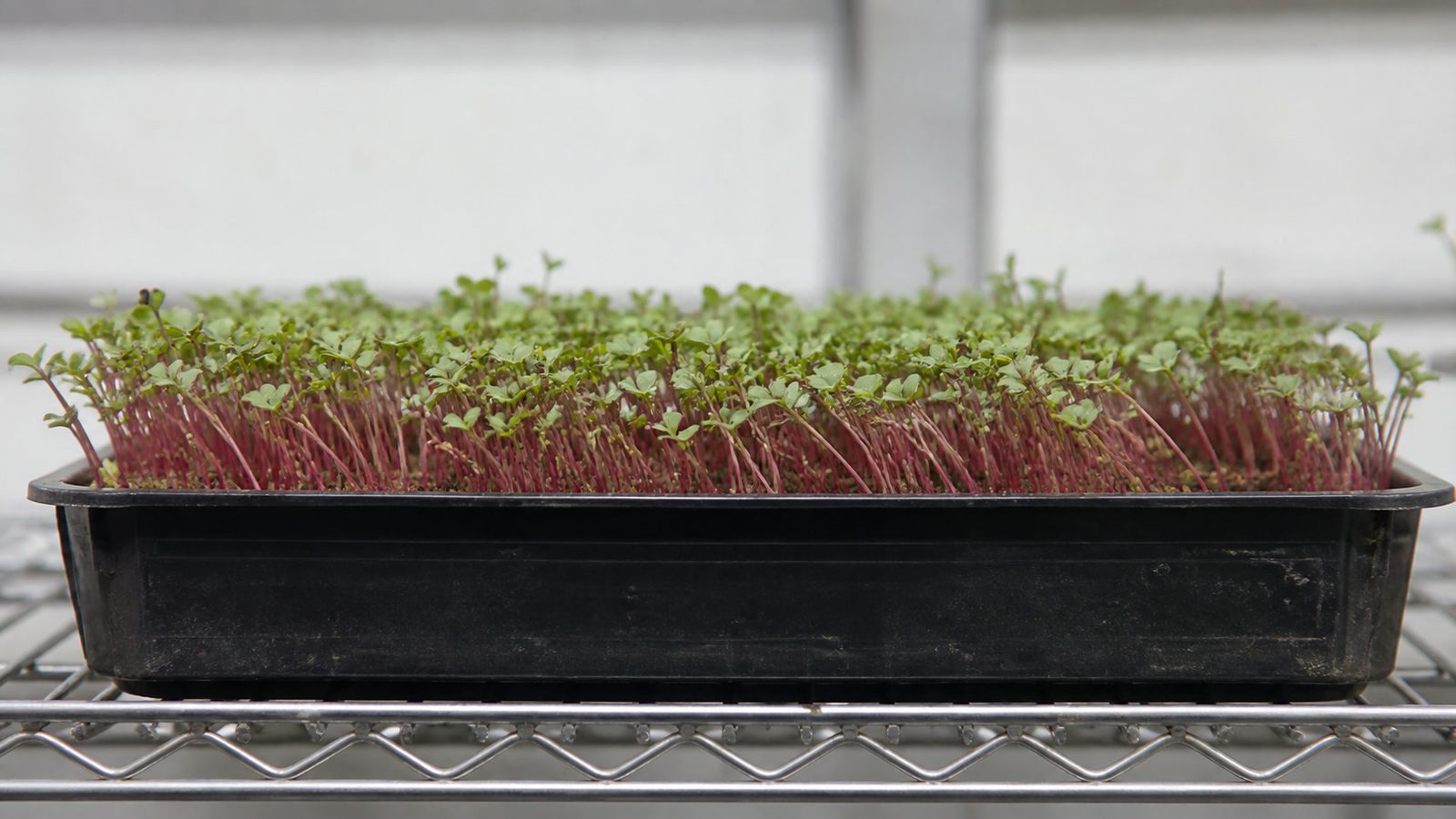
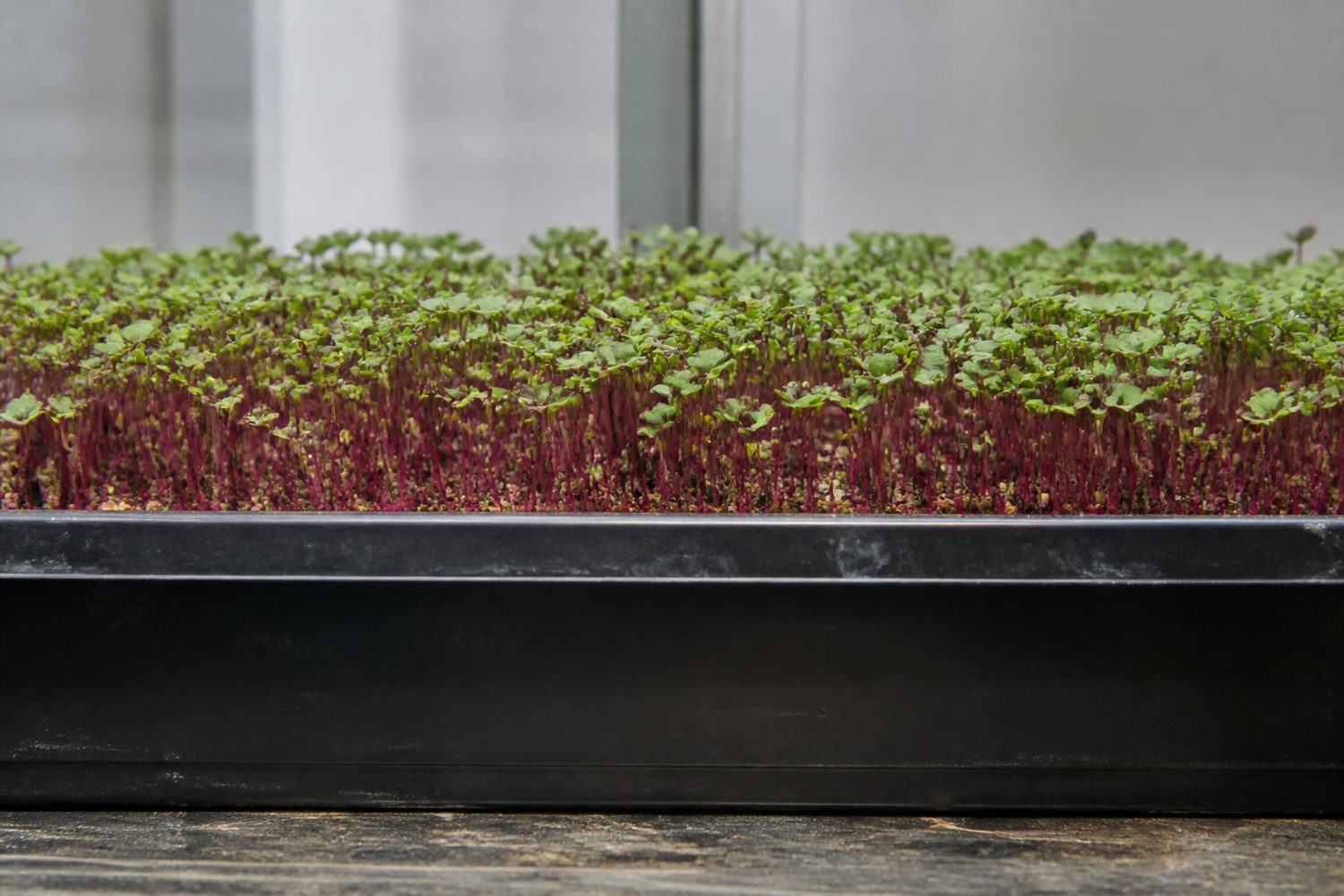
Quinoa gives you a fine, delicate tray of thin pink-to-burgundy stems carrying small open cotyledons, cut at 5 to 8 cm somewhere between a week and a fortnight. It is very mild. The one crop guide that has grown it rates its own intensity at 2.5 out of 10, so you are growing this for what it does to a plate visually, not for flavor and not for weight.
It holds at its best for three to five days, which is a more generous margin than most crops give you. That fits a pattern worth knowing when you plan a cutting schedule: crops sold on flavor, like radish, endive and fenugreek, hold about one to three days before the taste sharpens, while mild ones like lettuce hold four to seven because there is nothing to sharpen. On quinoa what eventually closes the window is a woody stem rather than a change in taste, so watch the stem.
Two things to settle before you give it bench space. Nobody has published a seed rate or a yield for a 1020 tray, so you cannot plan a market order around this crop, only a trial. And it must not be soaked, which here is a direct instruction rather than a missing number.
What growers are saying right now
Sampled from public posts and videos, 10 July to 9 August 2026. Every line links what it is quoting. How often something is repeated is not evidence that it is true, so every line also says what the sources actually establish.
I planted this on a whim because I got free seeds from my local library, but I think it's ready to harvest??
Circulating The largest quinoa item in the window at 844 views, posted 30 July
Even the biggest quinoa post going is not about the microgreen. This is a grain crop in a garden bed, grown to seed, and the poster is asking how to harvest it. That is the whole conversation: quinoa is a thing people grow for the seed head. Why the window is three to five days
Its seeds defend themselves with bitter chemicals
Circulating A history clip at 93 views
A food-history clip rather than growing advice, and the most useful thing anyone said about this crop. Those bitter chemicals are saponins, they coat the seed, and they are the reason the crop guide says to rinse surface saponins off before sowing and never to soak. How to grow it
What I like about the quinoa is that you can actually eat the leaves too
Circulating A raised-bed update at 810 views and 97 likes
True of the mature plant and a different food from this page's crop. Quinoa leaves are eaten like any chenopod green. A cotyledon-stage tray cut at 5 to 8 cm is neither that nor the grain, and none of the mature-plant nutrition transfers to it. What is actually measured
Nothing at all, from the place you would expect it
Circulating Not one thread in [r/microgreens](https://www.reddit.com/r/microgreens/) mentions quinoa. The traffic there is kale tips, a sunflower problem, monsoon mold, root hairs against mold
Which tells you what you are taking on. Nobody is growing this as a tray crop in any numbers, so there is no accumulated troubleshooting to fall back on and no consensus to check yourself against. Keep your own records from the first tray, because they will be the best evidence you have.
What it is, and how to tell you grew it right
Quinoa microgreens are seedlings of Chenopodium quinoa, cut at fully opened cotyledons. It is an Amaranthaceae, alongside amaranth, beet, bull's blood beet, celosia and spinach, and it belongs to the color-forward, light-yielding half of that family rather than the beet half.
White, red and black quinoa are seed color types of one species, not different crops. The crop guide says the taste difference between red and white is minimal; red is chosen for pink to burgundy stems, which intensify under stronger light. White gives a green-to-cream stand.
A correct tray is a fine, even, delicate carpet at 5 to 8 cm with small cotyledons fully open. The stems are thin. Do not expect the thick crunchy stand a brassica gives you: the guide's own description is a less substantial cut, and that is the crop working properly rather than failing.
You will not reliably tell it from red amaranth by looking. The two are close relatives and close visual neighbors, and no verified side-by-side photo set exists that supports a confident tray-level distinction. The tell is upstream: buy by botanical name and keep the packet.
What it tastes like, and what to do with it
Very mild. Soft, faintly grassy and nutty, closer to baby spinach than to any brassica, with little aroma. The crop guide rates its own intensity at 2.5 out of 10, which is unusually honest for a supplier page.
That makes it a finishing green rather than a flavor: on avocado toast, ricotta, egg dishes, grain bowls and cream soups, where red quinoa's stem color does the work and the taste stays out of the way.
It is the wrong crop when the dish needs pepper, mustard heat, or crunch. Anyone expecting a spicy or substantial microgreen will be disappointed by it, and no growing technique changes that.
Growing it: only what differs from the standard method
Five deltas against a standard tray, and four of the five are about restraint.
Do not soak. This is an instruction, not a gap in the research. The guide prohibits it: prolonged wet contact sours the small seed and sticks it into a lump. Rinse briefly to shed surface saponins if you want to, drain fully, sow dry.
Sow dry and very evenly. Uneven distribution of tiny dry seed is the single most common cause of a wavy, patchy stand that a grower then blames on the seed lot.
Press lightly. The cited pressure is 0.5 to 1 kg on a small tray, and the job is seed-to-medium contact, not forcing a stem. Heavy weight crushes quinoa seedlings.
Blackout is short: two to three days, and the weight comes off when most seedlings are pushing at the cover. Do not leave it on through elongation.
Then water less than you think. Once sprouted, bottom-water sparingly and ventilate. This is the crop's one real hazard and it is covered below.
Light after blackout is moderate, 16 to 18 hours. Too strong stiffens the leaves; too weak stretches the stems.
What goes wrong with quinoa specifically
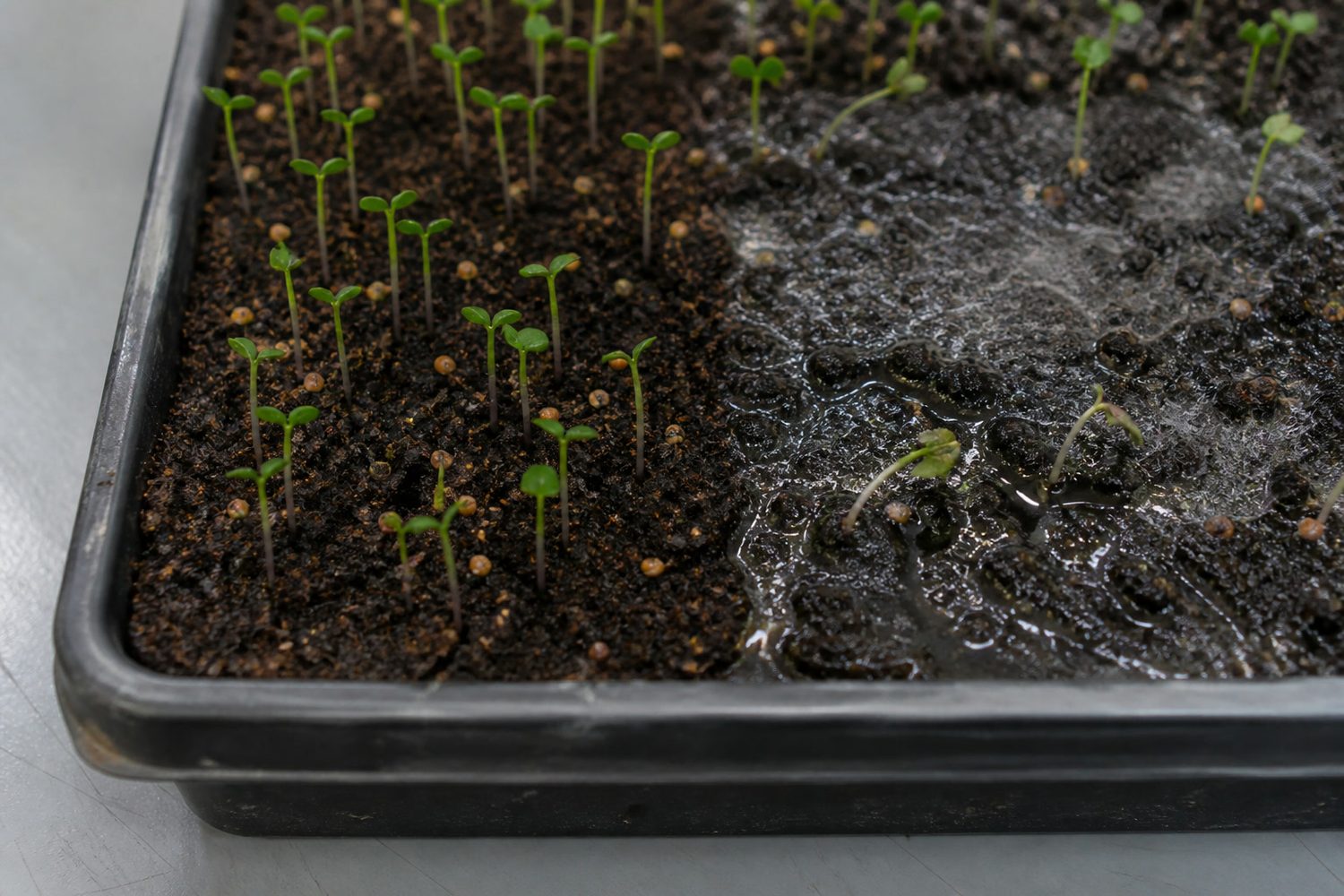
Overwatering during early germination is the failure that ends trays. The guide calls quinoa especially sensitive to excess moisture at the start. The early sign is wet, poorly aerated medium and fuzzy growth at the root zone; the end state is damping-off, lodging, and a tray you cannot save. The damping-off complex behind it, Pythium and Rhizoctonia among others, is well documented by UC IPM and is not quinoa-specific, but quinoa's water sensitivity is.
Root hairs are not mold, and on this crop the distinction is worth rehearsing because you will be watching the root zone closely. Root hairs sit on individual roots, look uniformly fine, and reappear after watering. Mold spreads as a web across the medium and stems and comes with wetness, odor, discoloration or collapse. On quinoa, fuzzy root-zone growth together with waterlogging and seedling collapse is disease.
Thin-stem lodging shows up at 79F and above, or under weak light: stretched, floppy stems. Fix the heat, light and airflow before harvest and a sound tray recovers.
Uneven emergence in waves is normal for this crop to a degree, which is exactly why a counted germination test is the only way to tell a bad lot from ordinary variability.
Nutrition, and the question nobody has answered
USDA FoodData Central has no quinoa microgreen record. A search on 8 August 2026 returned nothing, so there is no FDC ID and no nutrient panel to quote, and mature quinoa grain's panel is not a substitute for one.
Two real papers do exist and neither is a nutrition table. A 2024 Food Research International study examined soluble dietary fibers from quinoa microgreens, reporting fiber yields of 38.82 to 52.31 mg/g and characterizing their structure and in-vitro activity. A 2026 potassium-biofortification study measured yield alongside soluble sugars, protein, vitamin C, fats, cellulose, nitrate and free amino acids, under an experimental 8 mmol/L KCl treatment that is not a baseline for retail seed.
So, the honest position is narrow. The "complete protein" claim belongs to the grain and has not been shown for the microgreen, and neither has any specific vitamin or mineral amount. Claims that quinoa microgreens deliver all essential amino acids in serving-relevant quantities, or treat anemia, are unsupported as written.
Which seed to buy
There is no such thing as quinoa microgreen seed on the open marketplace, and the shopping trip proves it. A search for exactly that phrase returns 139 results; of the 60 tiles on page one, 42 are not quinoa at all (broccoli, arugula, cress, radish, pea) and the 18 that are quinoa are mostly food: microwaveable rice-and-quinoa pouches, 10 lb grocery bags, and garden packets of 30 to 500 seeds sold for growing the plant to grain.
Scoping the search to sprouting seed fixes it, and reveals the actual decision. On 9 August 2026, all organic, all the same species:
- A product actually named a quinoa sprouting seed, 1 lb: $23.01 a pound, with two reviews.
- Organic black quinoa sold as sproutable, 1 lb: $16.98 a pound.
- Organic tri-color sold as sproutable: $8.79 a pound at 4 lb, $6.06 a pound at 10 lb.
- Organic tri-color grocery grain: $6.73 to $6.81 a pound, hundreds of reviews.
That is a 3.8-fold spread, and the premium buys the word "sprouting." Nothing opened verifies that sprouting-grade quinoa germinates better than sproutable food grain, and the expensive listing describes itself, in its own title, as grain seed for flour, bread and food storage. The untested variable is polishing: commercial food quinoa is abraded to strip saponins, and no source opened says what that does to germination.
Quinoa sprouting seed on Amazon lands on the scoped search rather than on one product, deliberately. Buy the smallest organic bag you will actually use, run a counted germination test, and only then decide whether the premium bag is buying you anything. That test costs a paper towel and four days, and it is the only evidence anyone can currently get.
Specify seed sold for sprouting, microgreens or food use, untreated. Refuse dyed, fungicide-treated or insecticide-treated field seed: you are eating the shoot.
Is it worth growing?
Grow it if you want the pink-and-burgundy stem of red quinoa on a plate, or a genuinely neutral finishing green, and you are willing to water precisely.
Do not grow it for weight. No measured 1020 yield exists, quinoa is absent from the Johnny's trial, and a market grower who plans around an unmeasured crop is planning around a guess.
Its closest competitor here is amaranth for the same fine colorful look, and amaranth has the better-documented tray. Quinoa wins on delicacy and on being almost tasteless when that is what the dish wants. It loses whenever the answer needs to be a number.
A beginner can grow it. Start with one trial tray rather than a market order.
A note on the numbers above
Hover or tap a row to highlight it.
| Figure | Value | Source | What kind of number it is |
|---|---|---|---|
| Days to harvest | 7 to 10 | A crop grow guide | 2 to 3 dark plus 5 to 7 in light, cut at open cotyledons at 5 to 8 cm |
| Days to harvest | 10 to 14 | A named seed supplier, black quinoa | Stated flat, with no temperature and no harvest stage |
| Harvest window | 3 to 5 days | The same crop guide | Preferred 5 to 7 days, acceptable to 8 to 10, overripe at 11+. Grower assertion, not a holding study |
| Germination temperature | 68 to 72F | The same crop guide | The only crop-specific optimum found. Thin lodging stems reported at 79F and above |
| Seed rate | 4 g per 11x19 cm tray | The same crop guide | A recommendation for a 209 cm2 tray. Not a 1020 and not a measurement |
| Yield | 25 to 40 g per 11x19 cm tray | The same crop guide | Unlabeled as to method. Not a trial figure |
| Seed count | about 12,000 seeds per 125 g | A named seed supplier | 96 seeds per gram, which is what makes the density arithmetic below awkward |
| Blackout weight | 0.5 to 1 kg on the small tray | The same crop guide | No 1020 equivalent is published |
| Shelf life | 5 to 7 days at 39 to 43F | The same crop guide | Supplier guidance, loosely covered and unwashed. No storage trial |
| Fresh-weight nutrition | No FDC record | USDA FoodData Central, searched 8 August 2026 | An absence, confirmed rather than assumed |
| Soluble dietary fiber | 38.82 to 52.31 mg/g | Food Research International, 2024 | A real measurement of one nutrient class, not a panel |
| Johnny's 1020 yield | Does not exist | Johnny's 29-variety trial | Quinoa is not in the trial |
The harvest window is the most useful number on this page. Quinoa holds three to five days, against one to three for radish, endive and fenugreek, which are all sold on a flavor that sharpens if you overrun them, and four to seven for lettuce, which has no flavor to sharpen. Quinoa's own supplier rates it 2.5 out of 10 for intensity, so it behaves like the mild end. The wrinkle is that what closes quinoa's window is a woody stem first and a grassier taste second, so you are watching texture rather than tasting for the change.
There is no seed rate to give you, and it is worth knowing why rather than guessing. A 1020 tray is 1,290 square centimeters and the guide's tray is 209, so its 4 g scales by area to 24.7 g. At the supplier's own count of 96 seeds per gram that is about 2,370 seeds, or 1.8 seeds per square centimeter. For comparison, the one measured density study on garden cress found peak biomass at 12 seeds per square centimeter, and an ordinary brassica tray runs two to four. So, the arithmetic lands below a brassica tray. The guide's description of a delicate, less substantial stand fits a genuinely light sowing, and it warns explicitly against raising density to make up for poor germination. Start a trial tray somewhere near 25 g, weigh what comes off it, and let that be your number.
The same goes for yield and cost. Area-scaling the guide's 25 to 40 g gives 5.4 to 8.7 oz per 1020, but that is scaled from an assertion rather than from a measurement, so do not budget on it. At 24.7 g the seed costs 33 cents on the cheapest organic bag and $1.25 on the sprouting-labeled one, which is arithmetic on an unpublished rate across a 3.8-fold price spread. Weigh and price your own first tray.
Hover or tap a row to highlight it.
| Crop | Seed per 1020 | Yield | Days | Cost per tray | Oz per $1 | Oz per tray-day |
|---|---|---|---|---|---|---|
| Amaranth | 7.5 g | 6.5 oz | 11 to 18 | $1.10 | 5.9 | 0.45 |
| Spinach, Winter Giant | 60 g | 7.2 oz | 18.0 | $2.52 | 2.9 | 0.40 |
| Celosia | 8 g | 3.4 oz, one tray | 13 | $1.06 | 3.2 | 0.26 |
| Beet, Red Leaf | 20 to 30 g | No published figure | 10 to 14 | $1.53 to $2.30 | cannot be calculated | cannot be calculated |
| Quinoa | No published figure | No published figure | 7 to 14 | no rate to price | cannot be calculated | cannot be calculated |
A blank means nobody has published that figure, so the cell is left empty rather than filled with an estimate. How the numbers work
All 62 crops, sortable, on the microgreen comparison.
Quinoa is one of a handful of crops with neither a seed rate nor a yield published anywhere, alongside lettuce, mint, oregano, purslane, cucumber, cauliflower and collard. If you are planning a rotation on paper, those are the ones you cannot plan, only trial. Quinoa is the odd one out among them, because it does come with a harvest window: somebody worked out precisely when to cut it and nobody worked out how much to sow.
Terms on this page
Tap a term to see what it means.
*Chenopodium quinoa*. Quinoa, the crop here. White, red and black are seed color types of this one species, not separate crops.
Sources
- Quinoa microgreens crop guide, UAOrganic - the only crop-specific source for schedule, harvest window, rate, yield, pressure, temperature, storage and flavor. Supplier guidance throughout.
- Black quinoa microgreen seed, Incredible Seed - 10 to 14 days, approximately 12,000 seeds per 125 g, C$5.99 per 125 g packet, page opened 8 August 2026.
- Johnny's microgreen yield trial summary and the trial tech sheet - 29 varieties in 1020 flats harvested at first true leaf. Quinoa is not among them.
- USDA FoodData Central - searched 8 August 2026, no quinoa microgreen record.
- Soluble dietary fibers from quinoa microgreens, Food Research International 2024 - 38.82 to 52.31 mg/g fiber yields with structural and in-vitro characterization.
- Potassium biofortification of quinoa microgreens, 2026 - experimental KCl treatment, measured yield and several compositional variables.
- Damping-off, UC IPM - the Pythium and Rhizoctonia complex behind waterlogged seedling collapse.
- Growing microgreens at home, SDSU Extension - general tray method and the untreated-seed requirement.
- Microgreens production, Virginia Tech Extension - bottom irrigation as a valid 1020 method.
- Amazon listings for organic quinoa sold as sprouting or sproutable, prices and review counts read 9 August 2026.
Keep reading
The variety directory
Swiss chard microgreens
Swiss chard and Bull's Blood beet are the same species, and one trial measured both on the same day at the same stage. Chard takes 37 percent more seed and returns 27 percent more weight, and costs more than twice as much a tray.
Read Swiss chard microgreensThe variety directory
Amaranth microgreens
Red Garnet amaranth is the magenta garnish crop, and the trial numbers explain why it is a chef's crop rather than a grower's: 7.5 g of seed makes 6.5 oz in 17 days, against radish's 11 oz in nine.
Read Amaranth microgreensThe variety directory
Chia microgreens
A small bitter minty garnish in about a week. Chia seed is about 30 percent fat and the microgreen is not, so if you want the omega-3, eat the seed.
Read Chia microgreensThe variety directory
Chive microgreens
One of the few crops where somebody actually ran a density trial, and poor value per dollar of seed. It also competes with a perennial you buy once.
Read Chive microgreens