Bull's Blood beet microgreens
Cal HewittPublished Updated Checked
- garnish
- two tone
- measured yield
- amaranth
- moderate
- no soak
At a glance
Not hard to germinate, but the seed is a coarse multigerm fruit rather than a single seed: it needs even placement and real moisture to emerge, and it leaves hard hulls behind that have to come off by hand.
- Botanical name
- Beta vulgaris
- Also sold as
- Bull's Blood, Bulls Blood Beet, Beet, Bull's Blood
- Family
- amaranth
- Difficulty
- Moderate
- Days to harvest
- 16 to 23 days
- Harvest window
- No published figure
- Soak
- None
- Blackout
- 2 to 5 days
- Yield per 1020 tray
- 7.5 oz
- Regrows after cutting
- No published figure
- Mold risk
- Medium
- Hull shedding
- heavy
- Shelf life
- No published figure
- Eaten as
- raw
- Seed cost per tray
- $0.99
23 g at $19.60/lb, Urban Farmer Bull's Blood beet microgreen seed, listed 2026-08-08 and shown out of stock at the time. Seed only, excludes medium, tray, labor, light and loss.
Any field name above ranks every variety by it. No published figure means we researched it and nobody has established one, which is different from not yet researched. Every figure here is sourced at the bottom of the page. Compare every variety side by side.
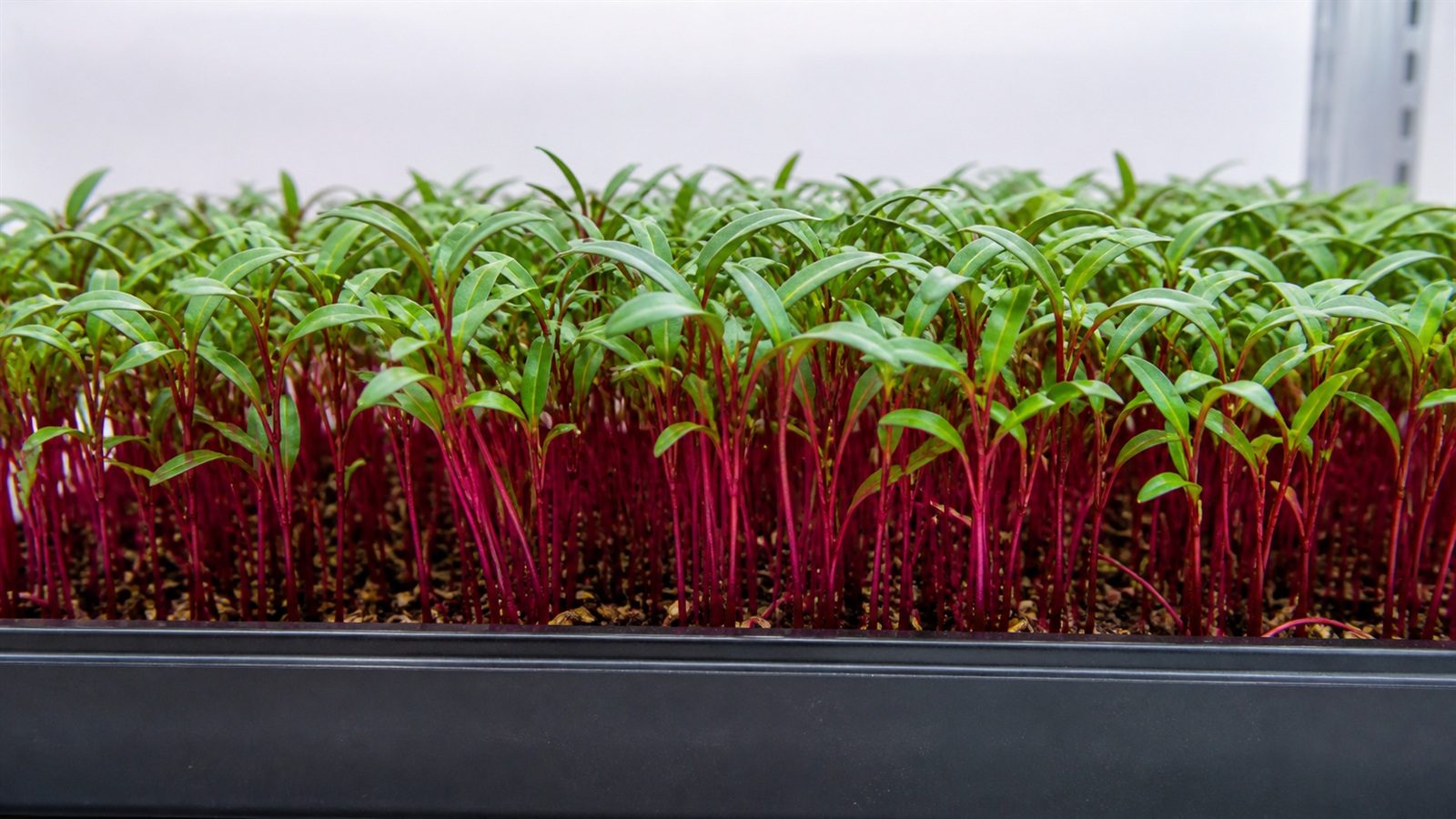
Bull's Blood is the two-tone crop: slender crimson stems carrying distinctly green cotyledons, a look nothing else gives you, and the reason chefs buy it. It is also the crop most often confused with red amaranth, and getting that wrong costs more than a mislabeled photograph, because the two are nothing alike to plan around. And underneath both of those sits one botanical fact that explains most of how the tray behaves: a beet seed is not a seed.
What growers are saying right now
Sampled from public posts and videos, 9 July to 8 August 2026. Every line links what it is quoting. How often something is repeated is not evidence that it is true, so every line also says what the sources actually establish.
Searching the cultivar name will not find you a grower
Circulating "Bull's blood" returns carnivore-diet videos, stock-market bulls and true crime, and nothing about the crop came back from the forums, YouTube or TikTok this month
Search beet microgreens instead, and then be careful, because that phrase has the opposite problem: it returns several beet cultivars that are not this one. Every figure below was measured on Bull's Blood specifically, and a generic red beet gives green leaves on red stems rather than the two-tone contrast you are paying for. Which seed to buy
What it is, and how to tell you grew it right
Bull's Blood is a named heirloom cultivar of Beta vulgaris, not a separate species and not a synonym for red beet. The family is Amaranthaceae, which it shares with amaranth, and that shared family is part of why the two get muddled.
One beet seed is a fruit cluster, and it can make several seedlings. That single fact explains the rest of the crop. It is why the rate is 23 grams a tray against a brassica's ten to thirteen, why the seed looks coarse and irregular, why you get clusters rather than an even scatter, and why hard brown hulls are still sitting on the medium at harvest.
A correct tray at the microgreen stage is an upright, even stand of slender vivid crimson stems carrying distinctly green cotyledons. The contrast is the product. Held longer to a full first-true-leaf finish, the red can extend into the foliage, and the color is strongest in cool conditions. Expect a few rough brown hulls on the medium and occasionally pinning a cotyledon.
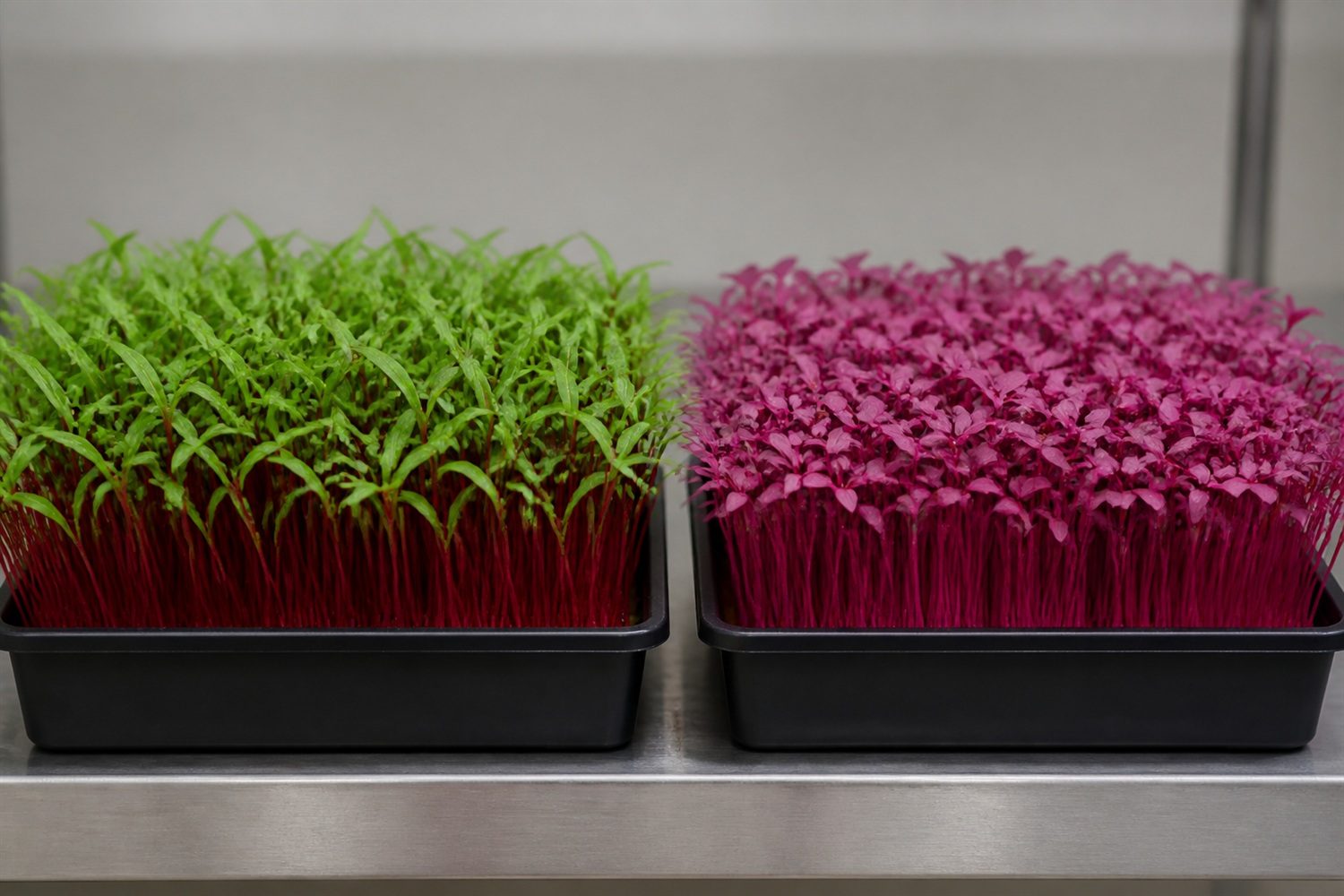
The confusion that matters is red amaranth, and there is one clean tell. Bull's Blood is crimson stems under green cotyledons, two-tone. Red amaranth is magenta and fuchsia through the leaves as well as the stems. If the leaves are red, it is not this crop.
That is not a cosmetic distinction. In the same trial, amaranth is 7.5 g of seed for 6.5 oz and Bull's Blood is 23 g for 7.5 oz. Swap the two and you have also swapped a threefold difference in seed rate, which is a real amount of money and a badly wrong tray.
What it tastes like, and what to do with it
Mild and earthy in exactly the way a beet is earthy, with a crisp, juicy bite. Sakata's description is crunchy and mildly earthy, and that soil-like beet note is the central sensory cue even though the crop is mild overall. It is not peppery and it is not neutral.
So, it belongs where a small amount of crunch, moisture, earthiness and color all earn their place at once: a composed salad, a grain bowl, an open sandwich, a canapé, an egg dish, or a dry final garnish on soup. Add it at the end so the upright stems stay standing and visible, and keep it away from anything wet enough to bleed, because it will color the plate red.
It is the wrong choice as the bulk of a salad, and the wrong choice in a delicate dish that wants a neutral green: both the flavor and the pigment compete rather than blend. The people who will not like it are the people who do not like beetroot, which is a larger group than most crop pages admit.
Growing it: only what differs from the standard method
The general method is on the standard tray method. Bull's Blood departs from it in one direction, and everything follows from the seed.
23 grams per 1020, and this number is unusually well supported. It is Johnny's trial rate, and a Colorado State University experiment independently used the same 23 g per 1020 on coir for the same cultivar. Two independent sources landing on one figure is rare for any microgreen, so this is a number you can plan against. Go lower only if you are deliberately holding the tray past first true leaf, because a longer finish needs fewer plants for airflow and slower depletion.
Do not compensate for a thin-looking sowing by adding more. The seed is multigerm, so what looks like a sparse scatter of seed is not a sparse scatter of plants. Adding seed to fix a stand you have not seen yet is how you end up with clumps.
Spread it evenly and press it in. These are large irregular fruits, so a level, evenly moistened medium matters more than with fine seed: dry pockets and clusters both show up plainly in the finished stand. Cover only lightly if at all, for contact and humidity.
Do not soak it. No cultivar-specific soak trial exists, and soaking makes the irregular fruits clump, which is the last thing this seed needs. Sow it dry.
Two to five days covered, uncovered when most of it is up. The criterion is the stand, not a date. A light weight is optional and it is for seed-to-medium contact rather than for stretch; no tested poundage exists for this crop, so use enough for firm contact and treat any specific figure you are given as somebody's preference. Keeping dense wet beet seed dark longer is what raises the damping-off risk.
Then bottom-water. Splashing medium up onto crimson stems is a presentation problem as well as a disease one, on a crop bought for how it looks.
A tray of Bull's Blood, day by day
- 1
Day 0, sow dry
23 g of the coarse multigerm fruits spread evenly on leveled, pre-moistened medium and pressed for contact. No soak. Remember one fruit can make several seedlings.
- 2
Days 1 to 5, covered
Dark and humid at around 75°F at the medium, light weight optional and only for contact. Off when most of the tray has emerged.
- 3
Then, light and cooler
Around 60°F. The stems color up and the cotyledons stay green, and Sakata notes the color is strongest in cool conditions.
- 4
Watch for the hulls
Hard brown fruits pinning cotyledons or riding on shoot tips. They come off by hand, and a wash will not do it.
- 5
Days 16 to 23, cut
At first true leaf if you want the 7.5 oz figure to mean anything. Past it, the two-tone look goes and so does the comparison.
What goes wrong with beet specifically
Four failures, and two of them are the seed.
Uneven or failed emergence in the first three days. Some fruits sit dry and unmoved while neighboring clusters come up. Causes are uneven contact, dry pockets, or a weak lot. If nothing has started to decay, fix the moisture and contact immediately. A widely sparse tray will not become a uniform commercial one.
Damping-off from germination into early light. A wet medium plus slow seedlings, with Pythium and Rhizoctonia as the usual organisms. The tell is collapse, or a brown constriction at or just below the medium line. Isolated plants can be pulled and the watering and airflow corrected; a spreading patch, a smell or slime means the tray goes.
Retained hulls, which is this crop's signature nuisance. The coarse beet fruit does not always shed, so you get hard brown hulls pinning cotyledons or perched on shoot tips. They come off by hand at harvest or packing, carefully enough not to tear the shoots. Do not promise yourself a wash will fix it, because it will not, and the customer finds the one you missed.
Going past the stage. True leaves fully expand, the stems get less tender, the stand loses its compact two-tone look, and the crop stops being the thing the numbers describe. Johnny's figures are first-true-leaf figures; applying them to an older tray is not a small stretch, it is invalid.
Root hairs or mold: the standard test. Fine white root hairs sit at the root and seed zone, look straight and uniform, and usually collapse after one light mist. Mold is grayish or dull, web-like and patchy, may carry dark specks, spreads across medium, seed and stems, and survives the mist. A smell or slime is a discard signal on its own.
Nutrition, and what is actually established
There is no USDA FoodData Central record for Bull's Blood beet microgreens that could be verified for this entry, and mature beet or generic beet greens values are not a substitute: different stage, different product.
What does exist is unusually rigorous. A Colorado State University study grew this exact cultivar from Johnny's seed, at 23 g per 1020 on coir under LED, and harvested five uniform replicate trays 20 days after sowing. Untargeted mass spectrometry detected 3,321 metabolites across six microgreens and their mature counterparts, and elemental analysis covered 26 elements. For red beet microgreens it reported potassium at 293.6 µg/g dry weight, phosphorus 39.8, calcium 19.0 and magnesium 9.7.
Those are dry-weight results under one set of conditions, not a serving label. They do not support a per-100 g figure for calories, iron, folate or any vitamin, a claim that the microgreen is some multiple of the mature beet, or any therapeutic claim, so treat all three as unsourced wherever you meet them.
Which seed to buy
Ask for Bull's Blood by name. On most microgreens the cultivar is a preference. On this one it is the product. Sakata lists it at 16 to 19 days with dark purple-red foliage and an upright habit. Johnny's separately lists Early Wonder Tall Top and Red Beet as bright green leaves with red stems: those are real beet microgreens and they are a different presentation, so a generic red beet bag will not give you what this page describes. No controlled side-by-side comparison of yield or tenderness across beet cultivars exists, so nobody should claim a winner beyond the look.
Specify seed sold expressly for microgreens or edible production, untreated, with lot and germination information where you can get it. Refuse dyed or chemically treated field seed, because extension guidance is explicit that treatments can be present in the young shoots. Organic is a preference and not a substitute for a germination trial.
A bad lot is visible before it is quantifiable, and multigerm seed makes the usual test misleading: a germination percentage does not tell you how evenly clusters will fill a tray. Look for many hard ungerminated fruits, weak seedlings, and gaps sitting next to multi-stem clumps under otherwise uniform moisture. The cost is unusable tray area, extra hull-sorting labor, and a tray that cannot be sold as uniform. Run a small test at 23 g before committing to a production run.
Bull's Blood beet microgreen seed on Amazon is the convenient route for a home tray, and it is worth reading the bag rather than the search result: that page mixes named Bull's Blood listings with generic beet microgreen seed.
Is it worth growing?
Yes, if you are selling a look. Bull's Blood gives a crimson-and-green contrast no other microgreen produces, with a documented 7.5 oz per 1020 at first true leaf and a roughly 16 to 23 day cycle. That suits a market grower selling visual distinction rather than fastest turnover, and it suits a home grower who genuinely likes earthy beet flavor and will use a whole tray near readiness.
No, if you want speed, forgiveness or heat. A radish or a fast brassica turns over in eight to twelve days with fine seed and almost no hull work, and if you are selling purely by ounces and labor efficiency, the hull-sorting on this crop is a real cost that nobody puts in a spreadsheet.
Its tray-slot competition sorts by exactly what you want on the plate. Red amaranth wins when the whole thing should be magenta. A generic red beet or Early Wonder wins when green leaves on red stems is acceptable and the cultivar name is not worth paying for. Radish and the brassicas win on speed and simplicity. Bull's Blood wins on one thing and wins it outright: crimson stems under green cotyledons, with a mild earthy crunch underneath.
Terms on this page
Tap a term to see what it means.
Multigerm. A beet "seed" is a dried fruit cluster that can produce several seedlings. It is why the rate is 23 g rather than ten, why clusters appear, and why counting seeds tells you nothing useful.
Sources
- Sakata, Bull's Blood for indoor greens - the cultivar, 16 to 19 days indoors, dark purple-red foliage, upright habit, strongest color in cool conditions, and the crunchy mildly earthy description.
- Johnny's microgreens yield trial results (PDF) - 23 g per 1020, 7.5 oz, 17 days at first true leaf, and the amaranth figures it is compared against here.
- Johnny's trial method and discussion - the harvest standard, fewer plants for a larger finish, and the transferability caveat.
- Johnny's slow-growing microgreens comparison chart (PDF) - Bull's Blood against Garnet Red amaranth, Early Wonder Tall Top and Red Beet, and the 5 to 10 day storage figure.
- Colorado State University study of microgreens and mature counterparts - Bull's Blood at 23 g per 1020 on coir, harvested at 20 days, 3,321 metabolites, 26 elements, and the potassium, phosphorus, calcium and magnesium figures.
- Virginia Tech Extension SPES-756 (PDF) - 12 to 23 days for beet microgreens, uncovering at majority germination, bottom irrigation, and that cut microgreens leave their roots behind.
- Urban Farmer, Bull's Blood beet microgreen seed - open-pollinated Bull's Blood, 75°F to germinate then 60°F, the above-75°F warning, and the price checked 2026-08-08.
- West Coast Seeds, Bull's Blood - the garden-beet soil temperature band and germination minimum, included here to mark what is NOT a microgreen figure.
- UC IPM, damping-off - Pythium and Rhizoctonia, and the conditions that favor them.
- Island Microgreens, root hair or mold - the practical diagnostic used here.
- SDSU Extension, growing microgreens at home - why treated seed is unacceptable on a crop eaten as shoots.
- USDA FoodData Central - no verified record for this microgreen.
Keep reading
The variety directory
Amaranth microgreens
Red Garnet amaranth is the magenta garnish crop, and the trial numbers explain why it is a chef's crop rather than a grower's: 7.5 g of seed makes 6.5 oz in 17 days, against radish's 11 oz in nine.
Read Amaranth microgreensThe variety directory
Beet microgreens
Generic red beet, the cheaper and less uniform sibling of Bull's Blood. Its seed is a multi-seed cluster, several shoots from one point are normal, and it has no measured yield of its own.
Read Beet microgreensThe variety directory
Celosia microgreens
A color crop whose entire measured record is a single YouTube video: 8 g of seed, 3.4 oz, 13 days. Bought for pink and orange stems, never for weight.
Read Celosia microgreensThe variety directory
Kohlrabi microgreens
Measured in the same trial as kale and broccoli, kohlrabi matches kale's 11 oz and takes 2.5 days longer to do it. You are not buying yield with those days, you are buying purple stems.
Read Kohlrabi microgreens