At a glance
Fast, vigorous, near-uniform emergence puts the crop on the plate in about a week, so mistakes declare themselves early rather than tying up a rack, but the seed is large and a tray sown too dense holds water at the canopy base.
- Botanical name
- Raphanus sativus
- Also sold as
- Hong Vit, Red Arrow, Daikon, Rambo, Sango
- Family
- brassica
- Difficulty
- Beginner
- Days to harvest
- 6 to 10 days
- Harvest window
- 1 to 3 days
- Seed per 1020 tray
- 22.5 to 28.5 g
- Soak
- None
- Blackout
- 2 to 4 days
- Germination temperature
- 65 to 75 °F
- Yield per 1020 tray
- 8 to 11.5 oz
- Mold risk
- Medium
- Hull shedding
- some
- Shelf life
- 14 to 21 days
- Eaten as
- raw
- Seed cost per tray
- $2.01
28.5 g at $31.95/lb, Johnny's Hong Vit radish microgreen seed, listed 2026-08-08. Seed only, excludes medium, tray, labor, light and loss.
Any field name above ranks every variety by it. No published figure means we researched it and nobody has established one, which is different from not yet researched. Every figure here is sourced at the bottom of the page. Compare every variety side by side.
Radish is the crop people start with when they want a result this week, and the speed is real: eight to ten days from sowing to a full tray. It is also a comparatively dear tray of seed at about $2.01, roughly two and a half times what broccoli costs, because radish seed is large and a 1020 takes about twice the weight.
Those two facts sit together and almost nobody publishes them together: fast to grow, dear to sow. It is not the dearest tray you can fill, barley grass runs to $9.69, but it is well above the mild brassicas it competes with. The third thing nobody tells you is that the cultivar named on the bag moves both numbers further than the color photographs suggest. Hong Vit takes 28.5 g and returns 11.5 oz. Daikon takes 22.5 g and returns 8 oz. That is a 44 percent difference in yield between two bags both labeled radish, so read the cultivar before you read the picture.
What growers are saying right now
Sampled from public posts and videos, 9 July to 8 August 2026. Every line links what it is quoting. How often something is repeated is not evidence that it is true, so every line also says what the sources actually establish.
Radish is the fastest growing microgreen of all microgreens, five to six days
Circulating Said in the opening line of Jag Singh's radish walkthrough at Daisy Creek Farms, 72,197 views, and it is the claim the whole crop travels on
True at an early cotyledon cut, and not in conflict with the trial. Johnny's measured 8 to 9.5 days across its three radish entries, but that is to FIRST TRUE LEAF, which is a later and heavier crop. Five days and nine days are two different products, and the published yields belong to the later one. Where each number comes from
Twenty-five grams of Rambo per flat, and it barely needs weight
Circulating Weighed out on camera in On The Grow's grow-mat comparison, 77,705 views, which says the crop "doesn't need a whole lot of weights really can grow with 15"
That one checks out against the measurements. Johnny's trial rate runs 22.5 to 28.5 g depending on cultivar, so 25 g sits squarely inside it, and you can weigh 25 g with confidence on any of the named cultivars. Seeding it
Rambo, Sango, Triton, Daikon, Hong Vit, Red Arrow, all named, none explained
Circulating Cultivar names carry the marketing everywhere from a seven-variety grow-out to a farmers-market blend post pairing Triton with Sago, and the descriptions are almost always color
The name changes more than color. In the one trial that measured them side by side, Hong Vit needed 28.5 g and returned 11.5 oz while Daikon needed 22.5 g and returned 8 oz. That is a 44 percent yield gap between two bags both labeled radish. Which seed to buy
Nobody is asking for help with radish
Circulating In a month of r/microgreens, the rescue threads were sunflower at 28 comments, broccoli root hairs or mold, monsoon mold across a whole setup, and a lettuce mix. Not one radish tray
It supports the beginner rating rather than proving it. Radish emerges fast and evenly, so it fails early and visibly if it fails at all. The one thing that does catch people is overseeding, and an overseeded tray does not look wrong until the canopy is already wet. What goes wrong
Radish microgreens as the thing on top
Circulating The widest-reach radish post of the month by a distance was not a grower at all: a natto and cod breakfast bowl finished with radish microgreens at 30,823 views and 4,256 likes, roughly forty times the combined reach of every grower radish post in the window
That is the crop's actual job, and the suppliers agree: every product description places it as a garnish, a slaw or sandwich component and a spicy accent. Its heat is why it works on top of a dish and why it fails underneath one. What to do with it
What it is, and how to tell you grew it right
Radish microgreens are seedlings of Raphanus sativus, the same species as the root in the ground, cut above the medium at the cotyledon or first-true-leaf stage. One species, several named selections, and the trade sells at least Hong Vit, Red Arrow, Daikon, Rambo and Sango under that one word.
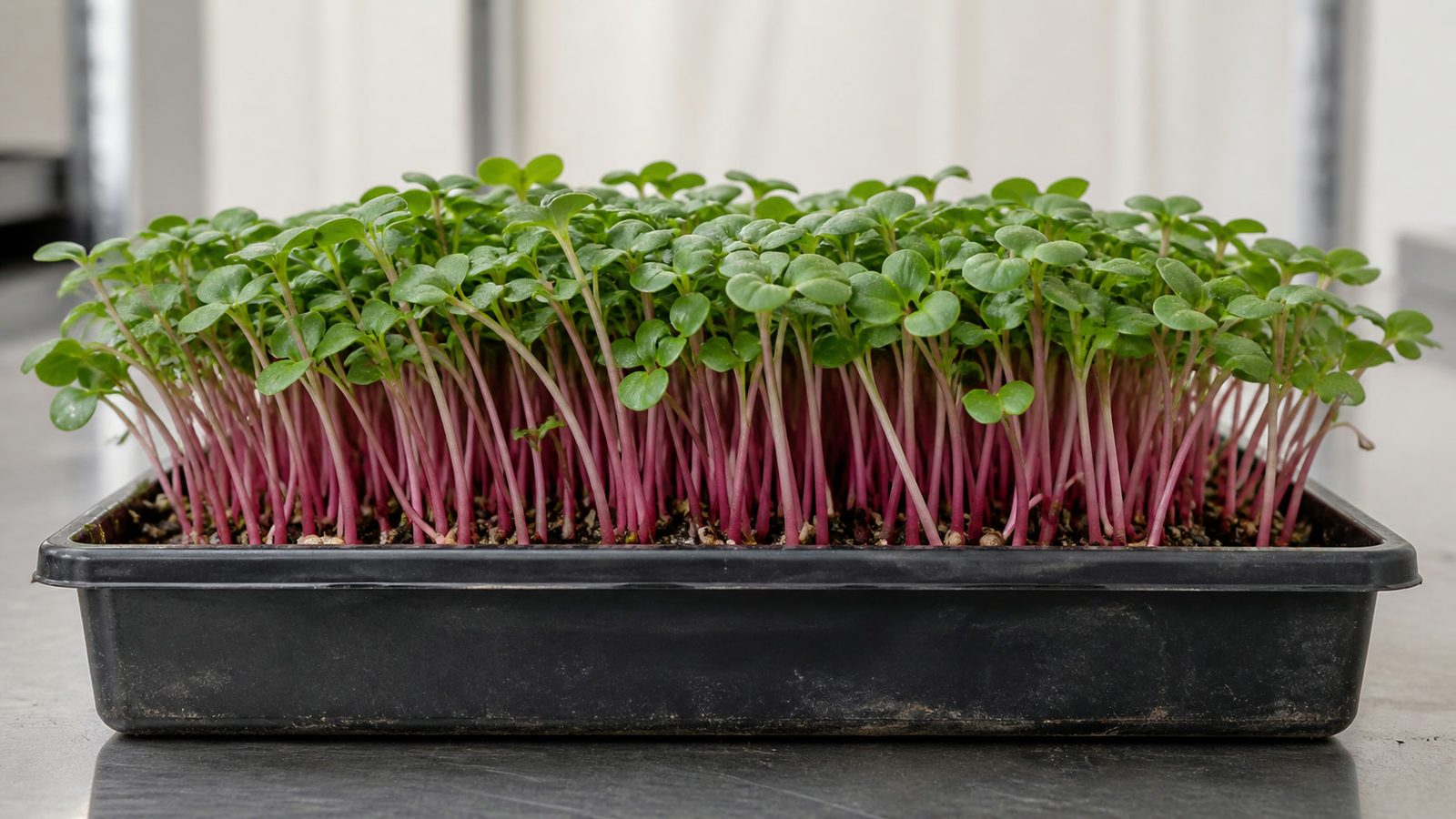
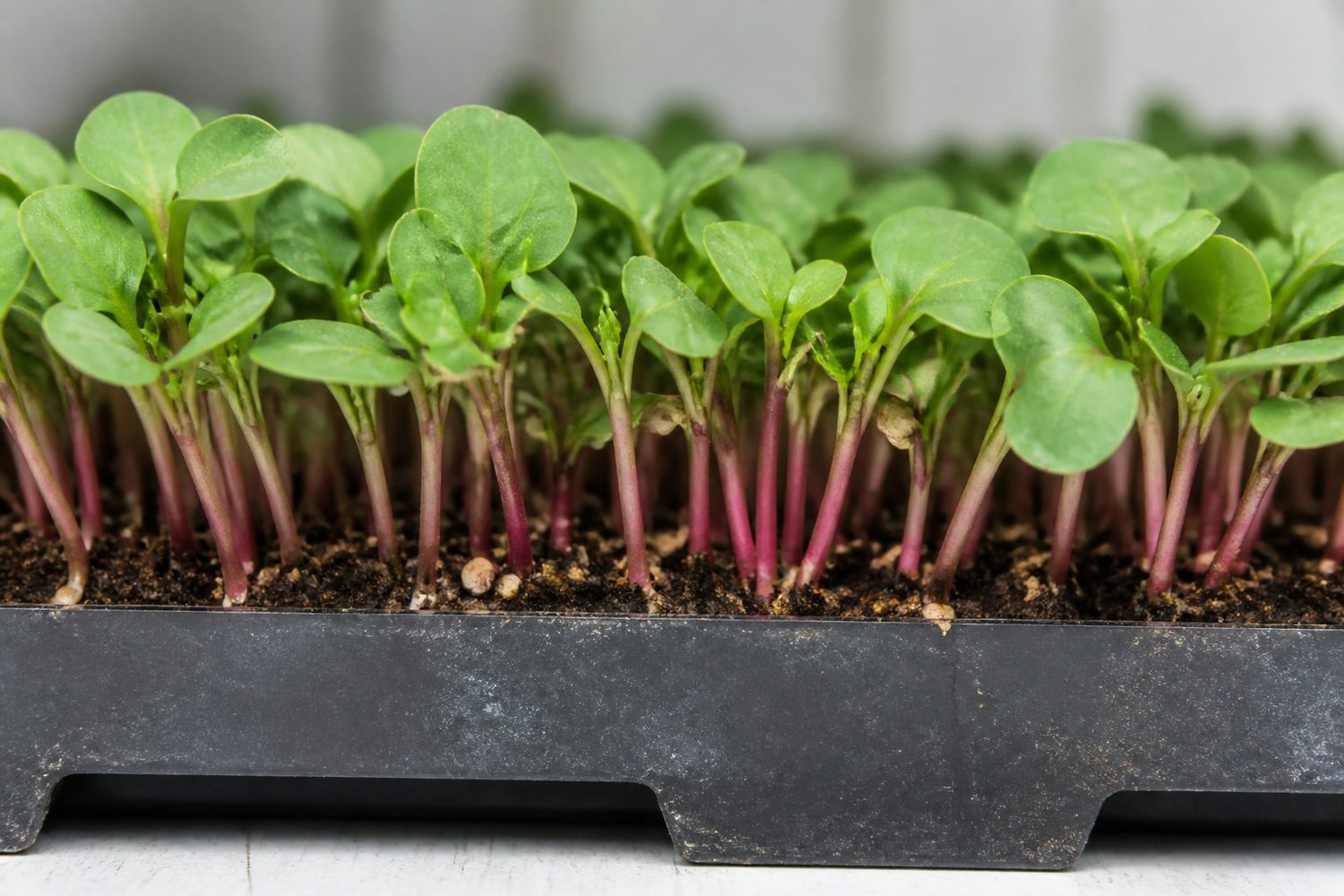
A correct tray reads as a dense, upright carpet roughly half an inch to two inches tall, with thick pink to magenta stems carrying broad, rounded mid-green cotyledons. Rambo and Sango selections push the cotyledons themselves toward purple. Hong Vit specifically has erect purple stems under green, lobed, essentially hairless leaves. At the medium line you want anchored roots and a few loosened hulls sitting in the canopy, not a white web. The whole stand should look substantial and crunchy rather than fine and feathery, and that heft is the honest way to judge it.
It is confused with broccoli microgreens more than anything else, particularly in a mixed brassica tray, and the reliable tell is the stem rather than the leaf. Radish runs a thick pink-to-magenta hypocotyl under broad cotyledons; broccoli is much finer and pale to white. Daikon can come up greener and paler than the red-stemmed types, so use stem thickness together with radish's chunky seed and hulls rather than color on its own.
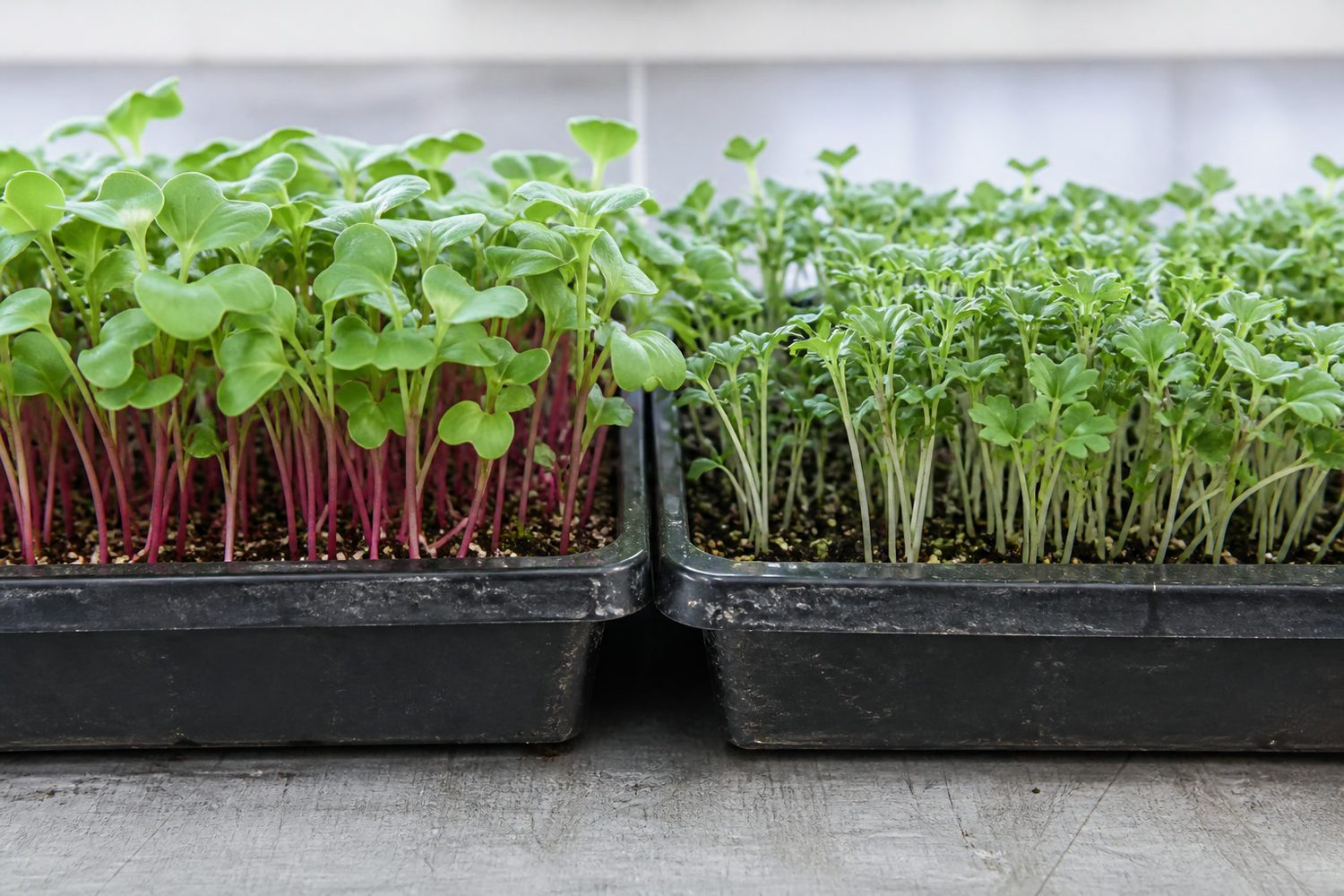
One thing worth settling before you buy seed: radish is sold as sprouting seed as often as microgreen seed, and daikon sprouts are a product in their own right. A sprout is germinated seed grown in water and eaten whole, seed and root included. A microgreen is grown in a medium, cut above the soil line, and the seed is not eaten. That line decides which food-safety rules apply, because sprouts fall under Subpart M of the FDA Produce Safety Rule and cut microgreens do not, so anyone growing to sell should read how the FDA separates sprouts from microgreens before ordering. The seed can be the same bag. The regulation is not the same.
What it tastes like, and what to do with it
A crisp, juicy radish bite, peppery enough to season a sandwich rather than merely taste green. Johnny's calls Hong Vit spicy, True Leaf calls Rambo floral and spicy, and Sango gets the most useful description of the set: it tastes exactly like radish. There is no translation problem here. If you know what a radish tastes like, you know what this is, minus the woodiness and with a crunch that comes from the stem instead of the root.
The heat is not fixed, and this is the part worth planning around. As the true leaves advance, the flavor sharpens. Cut at full cotyledons or as the first true leaves begin to show and you get the mild version that a customer eats a handful of. Cut four days later and you get something that a fair number of people will find too hot on its own.
That makes it an accent crop, and it is very good at the job. Pile it into tacos, a bánh mì or a turkey sandwich, lay it over avocado toast or eggs, fold it through a slaw. Hong Vit is expressly sold for visual appeal and bulk in mixed packs, which is the other thing it does well: purple stems carry a mix visually without adding another crop to the rack.
It is the wrong choice as a salad base. A large bowl of nothing but radish microgreens is a lot of pepper, and it will overpower a mild fish or anything creamy rather than season it. It is also wrong for the buyer who wanted a gentle green for children, and telling them so is more useful than promising it will mellow, because it will not. That buyer wants a mild brassica or pea shoots. Radish's heat is the product, not a defect to be grown out of it.
Using it in the kitchen, with amounts and a timing rule
The section above says what radish is for. This one says how much, and when it goes in, because those are the two things recipe pages leave out.
Hover or tap a row to highlight it.
| Amount | Dish | When it goes in | Source type |
|---|---|---|---|
| 1 oz, about one loose cup | Mexican coleslaw with cabbage, jalapeno, lime and cumin, 5 servings | Stirred in immediately before serving | Named recipe developer |
| One small handful | Fish tacos, per taco | Last, after the fish is plated | Grower recipe page |
| 19 to 20 g, half a tray | Grated carrot salad with sauerkraut | Raw, stems chopped fine, cotyledons left whole | Grower's own log |
| The other 19 to 20 g | Fried rice | Folded in after the pan came off the heat | Same grower, same tray |
| 1 cup | Pork tenderloin, beef tacos, avocado toast, pesto pasta, cucumber salad | After cooking, at plating | See the warning below |
| 2 cups | Tofu stir-fry, cooked 2 minutes until wilted | In the pan | See the warning below |
Those last two rows are one source, not six. All six of those recipes come from a single supplier's recipe index, which labels its own pages as AI-generated. Six recipes all landing on "1 cup" is a generator repeating itself, not six cooks independently arriving at the same amount. They are listed because they exist, and they should not be counted as corroboration for anything, including the two-minute stir-fry that is the only published instruction anywhere to cook this crop deliberately.
The trustworthy amount is the ounce. One ounce, about one loose cup, dressing five people. That is a real recipe by a named developer with the rest of the ingredients weighed, and it is the number to start from.
What a tray of it actually gives you
A 1020 tray of radish runs 8 to 11.5 oz, from Johnny's 2017 trial across three cultivars, at $2.01 of seed. Working from that:
- 8 to 11.5 batches of the coleslaw, which is 40 to 58 servings of a dressed side.
- About 91 to 130 servings at the 2.5 g garnish weight, for roughly one and a half to two and a bit cents of seed each.
One published figure disagrees with that badly, and it is worth knowing why. The grower's log above weighed a whole tray at 36 to 40 g, about 1.4 oz, which is six to nine times less than the trial. The likely explanation is tray size rather than error: the trial figure is a standard 1020, and the grower never says theirs is. A weight with no tray size attached is not a yield, and the same trap catches people on fenugreek, where a published figure turns out to be a units problem. Check for a tray size before you scale anybody's number, including your own.
The timing rule, and the two things that ruin it
Every reliable source on this crop says the same thing: raw, and last. After the heat, after the plating, at the table.
- Heat wilts it in seconds. There is no measured time-to-wilt for radish specifically, so nobody can give you a number, but the observation is consistent across growers and one notes the purple color fades with heat as well.
- Acid softens it, and this one catches people out. The coleslaw recipe is explicit that the microgreens go in at the end rather than with the dressing, because vinegar left in contact with them takes the crispness out. If you are making anything dressed, the crop is the last thing in the bowl.
The claim to be skeptical of runs the other way, and it is everywhere: that radish microgreens must never meet heat because cooking destroys all their nutrients. That is stronger than the evidence supports. The only real measurements are from hot-air drying, not cooking, where several compounds held up better than expected and vitamin C did not. There is more in what cooking actually does to microgreens. The honest reason to add radish raw and last is texture, color and the pepper, all three of which you lose in the pan. That is a good enough reason without inventing a nutritional one.
Two handling details worth copying
Chop the stems, keep the cotyledons whole. A grower working through half a tray chopped the stems finely and left the seed leaves intact, which keeps the leaf shape visible on the plate while making the stems easy to eat. It is a small thing and it is the only crop-specific knife instruction found for radish.
Cut above the medium and serve no roots. The food-safety literature defines the edible part as the cotyledon plus the stem, cut about a centimeter above the root and the growing medium. Roots bring grit and they bring the substrate with them.
Buying it, storing it, washing it
Retail on 2026-08-11 ran about $1.67 an ounce at one organic grower's listing, against $2.01 of seed for 8 to 11.5 ounces grown yourself. Radish microgreen seed on Amazon is the convenient route, and this page's seed section matters more than usual here because the cultivar moves the yield by 44 percent.
Buy crisp and dry. Condensation in the package is the beginning of slime. After about ten days a sour or musty smell means compost rather than a rescue.
Store it unwashed and wash only what you are about to eat, which is the standing rule for every microgreen and is stated by Purdue and by growers alike. One grower warns that a pre-washed pack may last only about two days.
There is a controlled storage study on this crop, and it is not a household number. A daikon radish study found 1°C optimal with no chilling injury and packaged product still acceptable at day 28, which is far beyond anything a fridge and a clamshell will give you. It used controlled packaging and a chlorine wash whose effect had faded by day seven. Do not plan around day 28 unless you have that packaging and that temperature. For an ordinary fridge, household guidance runs 5 to 7 days from Purdue and 7 to 10 from a grower holding it at 1 to 4°C.
Growing it: only what differs from the standard method
Everything general about trays, medium, light and watering is on the standard tray method for growing microgreens. Radish's departures are few and they are mostly about weight, both the seed's and the tray's.
Twenty-two and a half to twenty-eight and a half grams per 1020, which is roughly twice a fine-seeded brassica. This is the number to fix in your head, because it runs the opposite way to the correction on most crops. Johnny's 2017 trial seeded Daikon OG at 22.5 g, Red Arrow at 24.5 g and Hong Vit at 28.5 g, against 10 to 13 g for the fine-seeded brassicas in the same trial. Those are the rates Johnny's sowed, one per cultivar, rather than a tested best rate. The one radish trial that compared densities, a 2020 greenhouse study in Vietnam, got its highest yield at 8 seeds per cell, which works out to about 14 to 18 g on a 1020, from one seed lot. Radish seed is simply bigger, so a given tray takes fewer seeds and more grams. A commercial protocol runs 25 g with a push to 30 g when airflow is genuinely good. Go lower for a larger later cut or a humid room, and go higher only with the airflow to back it.
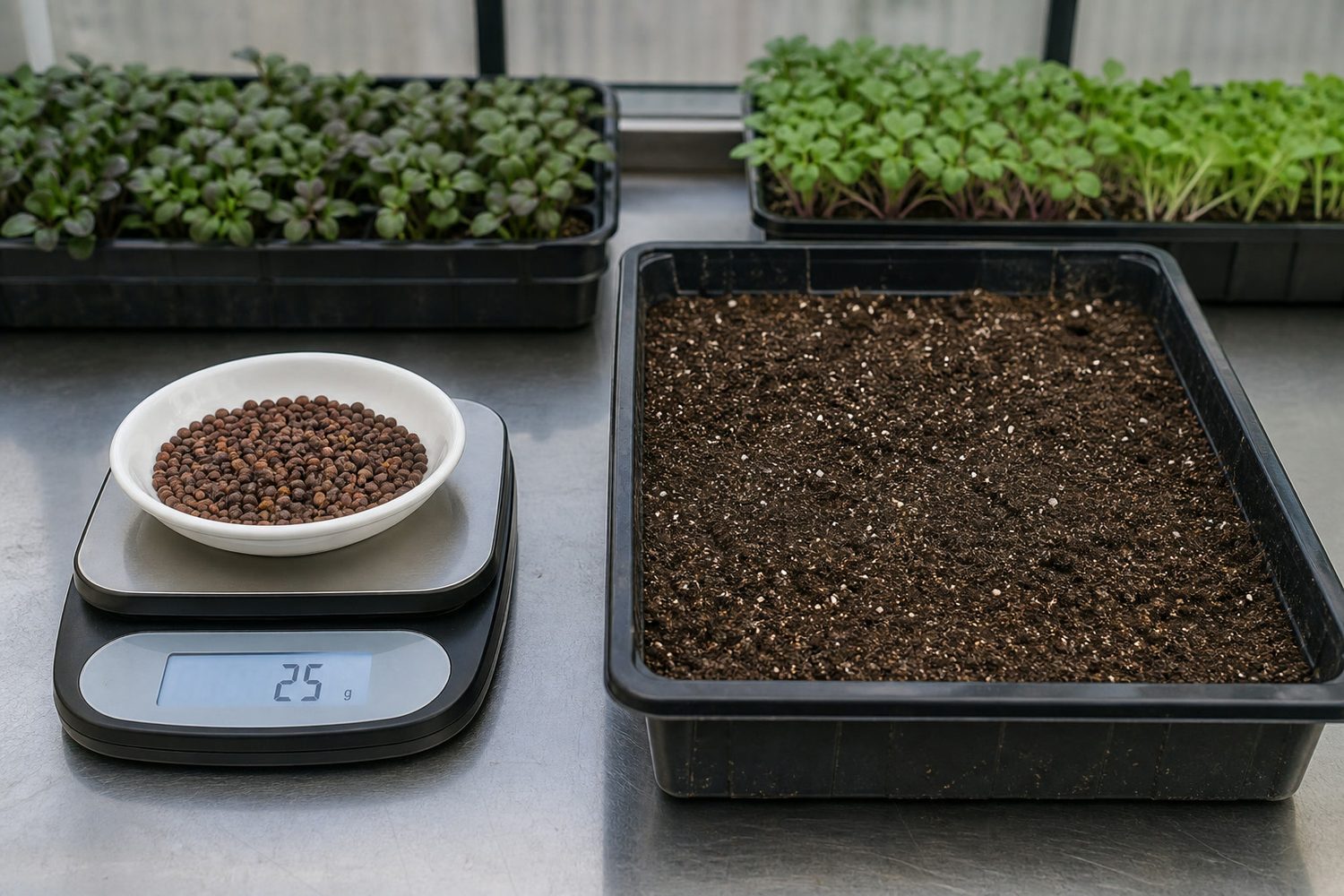
No soak, and nobody has established that a soak helps. No US supplier guide opened for this page specifies a radish soak duration or water temperature for tray production. The one soak on record is a research method, not a recommendation: a Korean substrate-free experiment soaked 10 g lots in tap water for 24 hours before a ten-day crop. Sow it dry. Radish emerges quickly anyway, and skipping the soak avoids handling swollen seed that clumps.
Broadcast on the surface at about an eighth to a quarter inch apart, press firmly for contact, and do not bury it. Level the medium carefully first. Radish's large seed makes a high spot or a low spot show up later as a visibly jagged canopy, and you will blame the seed.
Short blackout, light weight, and take it off early. A documented 10 by 20 routine uses 5 to 7 lb under a second tray, checks at day two, changes to an unweighted dome around day four and moves to light around day five. The weight is there for seed-to-medium contact and a flat canopy, not to force tall stems. Leave it on too long and you bend and bruise the thick hypocotyls, which is the one part of this crop you are selling.
Warm to germinate, then cool. Johnny's program is 75°F at the medium until germination and 60°F after it, with 65 to 75°F ambient generally favorable. Above 75°F it warns that disease pressure rises and germination can be inhibited. Radish needs no more light than a default brassica tray, and no source opened here supports a radish-specific increase.
Bottom water once it is in light, and watch it daily. The documented routine runs about a cup once or twice a day, rising as the crop demands more. A radish stand is heavier and thirstier than a fine-seeded brassica tray of the same size, and it also holds water in a denser canopy, which is exactly the combination that turns a watering habit into a problem.
A radish tray, day by day
- 1
Day 0, sow dry
22.5 to 28.5 g broadcast on leveled, pre-moistened medium, pressed for contact, not buried. Medium at about 75°F until it germinates. No soak.
- 2
Days 1 to 2, weighted
5 to 7 lb under a second tray for seed-to-medium contact and a flat canopy. Check at day two. Large seed cracks fast, and this is not a phase to extend.
- 3
Days 3 to 4, dome only
Weight off, unweighted dome on, once most seed has cracked and shoots start pushing the cover. Leaving the weight past this point bruises the thick stems.
- 4
Day 5, light
Cover off, medium down toward 60°F, bottom water about a cup once or twice daily so the canopy stays dry. Stems color up from here.
- 5
Days 6 to 10, cut
Watch the true leaves, not the calendar. Full cotyledons with true leaves just showing is the mild premium cut, and you have roughly one to three days before the flavor sharpens.
What goes wrong with radish specifically
Radish fails early or not at all, which is most of the reason it is a beginner crop. The failures arrive in a rough order and knowing which stage you are in tells you whether the tray is worth saving.
Days one to four: patchy emergence and trapped hulls. Usually uneven seed-to-medium contact or uneven moisture. Early signs are dry spots, seed that has not cracked, and shoots carrying their hulls up with them. You can re-cover briefly if the medium is genuinely moist and the seedlings are not being bent. A badly uneven stand is not commercially recoverable, and adding seed to a running tray fixes nothing.
Days two to six: the overdense wet canopy, and this is the one that catches people. Overseeding is the most common consequential mistake on this crop. Push past 30 g per 1020 without the airflow, light and watering discipline to support it and the stand mats, the surface stays wet, and rot appears at the stem base. Early signs are a surface that never dries, collapsed seedlings, a sour smell, or cottony growth sitting on the hulls. Cut the water, improve airflow, and remove affected material only if it is genuinely localized. A tray with damping-off spreading through it is not food.
Overseeded, or just dense? The check before you water again
Hover or tap a card to highlight it.
Look at the surface between waterings
A correct radish tray dries at the surface between waterings. One that is still glossy several hours later is holding water it cannot get rid of, and that is the overseeding signal, not thirst.
Put a finger into the canopy
You should be able to part the stand and see medium. If the stems form a mat you cannot part, the tray is too dense for its airflow whatever the scale said.
Check what your scale actually weighed
Radish seed size varies by cultivar. Measured across five, 1,000 seeds ranged from 10.22 g to 17.23 g, so the same 28 g can be two very different seed counts. Recalibrate grams per cultivar; do not assume radish is one density.
Smell it
Nothing much is correct. Sour is not, and smell is the tell people ignore longest.
Decide before you water
If the surface is wet and the canopy is matted, the fix is air and less water, never more water. Watering a tray in this state is what turns a dense tray into a lost one.
Emergence onward: damping-off. Pythium and Rhizoctonia rot stems at or below the medium line. Early signs are pinched, water-soaked stem bases and seedlings that simply go missing, and UC IPM notes that Pythium often begins at the root tips. None of this is radish-specific: it is the general seedling disease complex, which is why clean seed, clean water, clean medium and airflow matter more here than any crop-specific pest list. No radish-exclusive indoor pest or pathogen turned up in any source opened for this page.
Day eight onward under fast conditions: the crop goes sharp. This is the failure mode unique to radish, and it is not a disease. Held too late, it turns sharper and more fibrous, the true leaves overtake the cotyledon canopy, and the tender crunch that the customer is buying goes. You can see it before you cut. It is still edible if it is sound, but it is no longer the product you priced.
Root hairs or mold, the radish version. Radish shows a visible white fuzz at the medium line on a perfectly healthy tray, same as every other crop in the directory, and the test is the same one: root hairs stay at the root and medium line, are fine and regular and tapering, and collapse when you mist them, reappearing as the area dries. Mold is disorganized, crosses between hulls and medium, and climbs the stems. This is a grower's diagnostic, not an identification. Only a lab names an organism, and a sour smell or a spreading web means discard rather than rinse and hope.
Hulls. Radish has large seed coats, so hulls can sit perched in the canopy when emergence is uneven, and it is a real handling job rather than a trivial one. It is still nothing like sunflower. The signal is loose or lifted shells by the time the cover comes off, and the fix is taking the cover off once the majority has germinated instead of trapping a wet canopy while you wait for the stragglers. Nobody publishes a retention percentage for radish, so budget for a little cleanup and do not expect a number.
Nutrition, and what is actually established
There is no dedicated radish microgreen record in USDA FoodData Central, searched 2026-08-08. The entry for mature raw radishes is not a substitute, because it is a different food at a different harvest stage, and neither is a radish sprout record.
What does exist is one good cultivar study. Tilahun and colleagues (2023) grew five radish cultivars in water-only sprouting trays under artificial light and harvested at ten days, measuring fresh weight, dry matter, chlorophyll, minerals, amino acids, phenolics, flavonoids, anthocyanins, vitamin C, glucosinolates and antioxidant activity. Six glucosinolates were identified, glucoraphasatin exceeded 80 percent of the total in three of the five cultivars, and potassium was the most abundant mineral measured. Those values are on a dry-weight basis, from a Korean water-only system, on cultivars that are not the ones on a US seed rack. It is a real result about radish microgreens. It is not a nutrition label for your tray.
Two claims to leave alone. The widely repeated line that radish microgreens carry four to six times the magnesium, and the claims that they specifically improve sleep or mental wellness, are not supported by any primary source opened for this page for a defined cultivar, serving size and comparator. And there is no honest single multiplier against mature radish, because the study above found the numbers moving between five cultivars grown side by side in one system. A multiplier that survives cultivar, harvest stage, light and production method does not exist.
Which seed to buy
On most crops the cultivar changes the photograph. On radish it changes the economics, so this is the decision to take seriously.
Only one source publishes comparable numbers for named radish cultivars, and the spread is large. In Johnny's 2017 trial, Hong Vit took 28.5 g and returned 11.5 oz at 9.5 days, Red Arrow took 24.5 g and returned 10 oz at 8 days, and Daikon OG took 22.5 g and returned 8 oz at 8 days. Hong Vit therefore costs 27 percent more seed and returns 44 percent more crop than Daikon. Whether that trade is worth it depends on what you pay for seed and what you sell by, and it is a decision no supplier photograph will make for you. Hong Vit is described as spicy, with erect purple stems and green lobed leaves, and is sold for visual appeal and bulk in mixes.
Rambo and Sango come from a different kind of source. True Leaf gives Rambo rosy stems, dark cotyledons and a floral, spicy flavor, and Sango spectacular purple color and a substantial, crunchy texture, both at 6 to 10 days with no temperature or harvest stage stated. Those are supplier adjectives, not yield data, and they should be treated as leads rather than specifications. On the strength of evidence available, the two color-forward cultivars everyone names online are the two nobody has measured.
Specify untreated seed sold for edible microgreen or sprouting use, name the cultivar, and ask for the lot and its germination information if the supplier publishes it. Refuse treated field seed outright. SDSU Extension is explicit that dyes, fungicides or insecticides applied to seed may be present in the young shoots and should not be eaten, and this is a crop whose whole tissue is eaten eight days after the seed touched the medium. Organic certification is useful sourcing information and a separate question from that; untreated food-use is the actual requirement.
A bad lot shows up as low or uneven germination, uneven vigor and height, too much empty tray, unusual hull retention, or a stand that never develops the color the cultivar is sold for. It costs the seed, the medium, the labor, a light or unsaleable tray and possibly a missed delivery. Johnny's names seed lot as a yield variable and removed obvious poor-germination flats from its trial averages, which is worth reading twice: a published yield has already had the bad lots taken out of it.
Radish microgreen seed on Amazon is the convenient route for a home grower. If you are selling what you grow, buy from a supplier who will name the cultivar and the lot, because on this crop the cultivar is a number and not a color.
Is it worth growing?
Yes, for three quite different people. The beginner gets a fast, visually obvious success in about a week, with a stand that looks deliberately grown rather than accidentally survived. The market grower gets a colorful, spicy, eight-to-eleven-ounce crop that turns in 8 to 10 days and stands out in a case full of green. The one-tray home grower gets something they will actually use, provided they like pepper.
It is the wrong crop for anyone who wants mild bulk, anyone who cannot check a tray daily across a 7 to 10 day cycle, and anyone hoping for a second cut. Radish is one cut. Cutting above the medium removes the cotyledons and early true leaves that power the plant, and no production trial opened for this page verifies a marketable second flush.
In a rotation it competes with broccoli, kale and green cabbage when the buyer wants a fast brassica, and with mustard and arugula when the buyer wants heat. Radish wins on pink and purple stems, on crunch and volume, on the 8 to 10 day turn, and on a clean radish flavor people recognize without being told. A mild brassica wins for a gentler all-purpose base, and mustard or arugula win when the leaf shape or that particular mustard bite is the point rather than crunchy peppery volume.
One caution before you build a price around any of this. Johnny's own discussion of its yield trial says plainly that yields shift with procedure, technique, system, conditions, harvest stage and seed lot, and that one grower's numbers are unlikely to transfer to another's. Weigh your own trays.
The crop people ask about feeding to animals, and the answer nobody likes
Radish is the microgreen people ask about feeding to animals more than any other, by a distance. It comes up as "can bearded dragons eat radish microgreens", "can hamsters eat radish", "can cats eat radish greens", "can chickens eat radish microgreens" and "can horses eat radish greens", across five unrelated species.
The answer is that nobody has established anything about feeding radish microgreens to any animal. Not a safety verdict, not a quantity, not a composition at this stage. UC Davis describes mature radishes as low in nutrition and an occasional treat for bearded dragons rather than as a hazard, which is the nearest real evidence in any direction, and it is about the root of an adult plant.
That is not a warning. It means the confident lists you will find were assembled from the mature vegetable. The reasoning is worked through on the feeding microgreens to chickens and feeding microgreens to bearded dragons guides, both of which say the same thing about this crop and show their sources for saying it.
A note on the numbers above
Hover or tap a row to highlight it.
| Figure | Value | Source | What kind of number it is |
|---|---|---|---|
| Seed per 1020, Hong Vit | 28.5 g | Johnny's 2017 trial | Measured, at first true leaf |
| Seed per 1020, Red Arrow | 24.5 g | Johnny's 2017 trial | Measured, at first true leaf |
| Seed per 1020, Daikon OG | 22.5 g | Johnny's 2017 trial | Measured, at first true leaf |
| Seed per 1020 | 25 to 30 g | On The Grow protocol | One commercial system's practice |
| Yield per 1020, Hong Vit | 11.5 oz | Johnny's 2017 trial | Measured, at first true leaf |
| Yield per 1020, Red Arrow | 10 oz | Johnny's 2017 trial | Measured, at first true leaf |
| Yield per 1020, Daikon OG | 8 oz | Johnny's 2017 trial | Measured, at first true leaf |
| Yield per 1020 | 13.9 oz from 1.5 oz seed | ZipGrow enclosed cart | Different system, not comparable |
| Days to harvest | 8 to 9.5 | Johnny's 2017 trial | Measured, to first true leaf |
| Days to harvest | 6 to 10 | True Leaf product pages | Published range, no stage stated |
| Germination temperature | 75°F then 60°F | Johnny's growing information | Crop guidance, not a trial |
| Harvest window | About 1 to 3 days | On The Grow | Grower observation, not a trial |
| Shelf life | 21 days at 4°C, 14 at 10°C | Berba and Uchanski 2012, in a 2020 review | Visual quality in storage |
| Seed cost per 1020 | $2.01 | Calculated, Johnny's Hong Vit | 28.5 g at $31.95/lb, listed 2026-08-08 |
The seed rate is high on purpose, and it is the one place a brassica instinct will mislead you. Radish genuinely takes about twice the weight of a fine-seeded brassica, 22.5 to 28.5 g against broccoli's 13, because the seed is about twice the size. The advice that circulates for fine-seeded crops, that most people sow far too heavy, does not transfer here. Weigh radish to its own number and you will not underseed it.
The yield figures are three separate cultivar measurements, not one range. Johnny's numbers come from at least three seedings per variety in its 2017 greenhouse trial, at the stated seed rate, harvested at first true leaf, rounded to the nearest half unit. Reading 8 to 11.5 oz as a tolerance band on one crop is the wrong reading. It is three crops. Which one you get is decided at the point you choose a bag.
Do not compare the ZipGrow figure against the trial. 13.9 oz from 1.5 oz of seed in an enclosed seedling-cart and flood-tray system, against 4.7 oz from the same seed in an open office tray, shows how much the system matters and gives you nothing to set beside Johnny's. Different system, different harvest stage, no shared basis.
Days to harvest spans 6 to 10 because the sources measure different targets. Johnny's trial entries came in at 8, 8 and 9.5 days to first true leaf. True Leaf's product pages say 6 to 10 days without naming a temperature or a harvest stage. That is the same gap as on broccoli: an earlier cotyledon cut against a later true-leaf cut, reported as though they were the same crop.
Radish keeps well when it is kept cold. A storage study reported in a 2020 review of microgreen postharvest research found radish microgreens averaged 21 days of shelf life at 4°C (39°F), judged on visual quality, and 14 days at 10°C (50°F). Johnny's gives 5 to 10 days for microgreens generally, without a temperature or package. Keep it dry, unwashed, cold and barely handled, wash immediately before serving as Johnny's directs, and note how yours actually holds over two or three cuts. That record will be worth more to you than the class-level number.
Terms on this page
Tap a term to see what it means.
Cotyledon. The seed leaf, the first thing up and most of what you eat. Radish's are broad and rounded, and on Rambo or Sango they carry purple.
Sources
- Johnny's Selected Seeds, microgreens yield trial results (PDF) - Hong Vit 28.5 g and 11.5 oz at 9.5 days, Red Arrow 24.5 g and 10 oz at 8 days, Daikon OG 22.5 g and 8 oz at 8 days, all at first true leaf, plus the rounding and variation caveats.
- Johnny's microgreens yield trial, method and discussion - trial method, the harvest standard, seed lot as a yield variable, and the warning that one system's yields do not transfer.
- Johnny's radish Hong Vit microgreen seed - Raphanus sativus, purple stems and lobed green leaves, spicy flavor, 75°F then 60°F with 65 to 75°F ambient, the above-75°F warning, 5 to 10 days storage for microgreens generally, wash before use, and the $31.95/lb price behind the seed-cost calculation, listed 2026-08-08.
- True Leaf Market, Rambo radish - rosy stems, dark cotyledons, floral and spicy, 6 to 10 days with no stage stated.
- True Leaf Market, Sango purple radish - purple color, substantial and crunchy, tastes exactly like radish, salad and sandwich and garnish uses.
- True Leaf Market, Daikon radish sprouting seed - the same seed sold for sprouting, substantial and crunchy as a microgreen, radish accent.
- On The Grow, how to grow radish microgreens - the commercial protocol: 25 g with a push to 30 g, 5 to 7 lb for two days then a dome at day four and light at day five, bottom watering about a cup once or twice daily, the 6 to 10 day routine, the sharpening flavor, and the roughly one to three day premium cut window.
- Virginia Tech Extension SPES-756 (PDF) - general production environment and the 2 to 5 day generic blackout to majority germination, plus hull behavior on large-seeded crops.
- UC IPM, damping-off - Pythium and Rhizoctonia, symptoms at or below the medium line, and Pythium often beginning at the root tips.
- Tilahun et al., 2023, five radish cultivars grown as microgreens - the ten-day water-only cultivar comparison, six glucosinolates with glucoraphasatin above 80 percent in three cultivars, potassium as the most abundant mineral, and the 10.22 to 17.23 g thousand-seed weight range.
- SDSU Extension, growing microgreens at home - treated seed, and why dyes, fungicides and insecticides on seed should not be consumed in the shoots.
- ZipGrow, microgreens quick guide (PDF) - 13.9 oz from 1.5 oz of seed in an enclosed cart system against 4.7 oz in an open office tray, and why system beats variety for yield comparisons.
- USDA FoodData Central - searched 2026-08-08, no dedicated radish microgreen record.
Keep reading
The variety directory
Arugula microgreens
Arugula is a seasoning green rather than a salad base: 10 g of seed makes 10 oz in 14 days, it is genuinely peppery, and its 10-day shelf life comes from a controlled storage study rather than an estimate.
Read Arugula microgreensThe variety directory
Broccoli microgreens
Broccoli takes 13 g of seed per 1020 tray and gives 11.5 oz at first true leaf, both from Johnny's trial. No soak, fast even germination, and the root-hair-or-mold test you will need in the first week.
Read Broccoli microgreensThe variety directory
Cabbage, red microgreens
Red cabbage is measured at 10.5 g per 1020 tray returning 8.5 oz, the lowest of the four mild brassicas measured in one trial. What it sells on is the purple veining, which no broccoli tray can give you.
Read Cabbage, red microgreensThe variety directory
Collard microgreens
The crop where more light did not buy more weight: collard was the documented exception in a controlled DLI study. Its mold risk is left blank because nobody has measured it.
Read Collard microgreens